
Judge, 1915-01-02 · page 7 of 24
Judge — January 2, 1915 — page 7: what you’re looking at
What you’re looking at
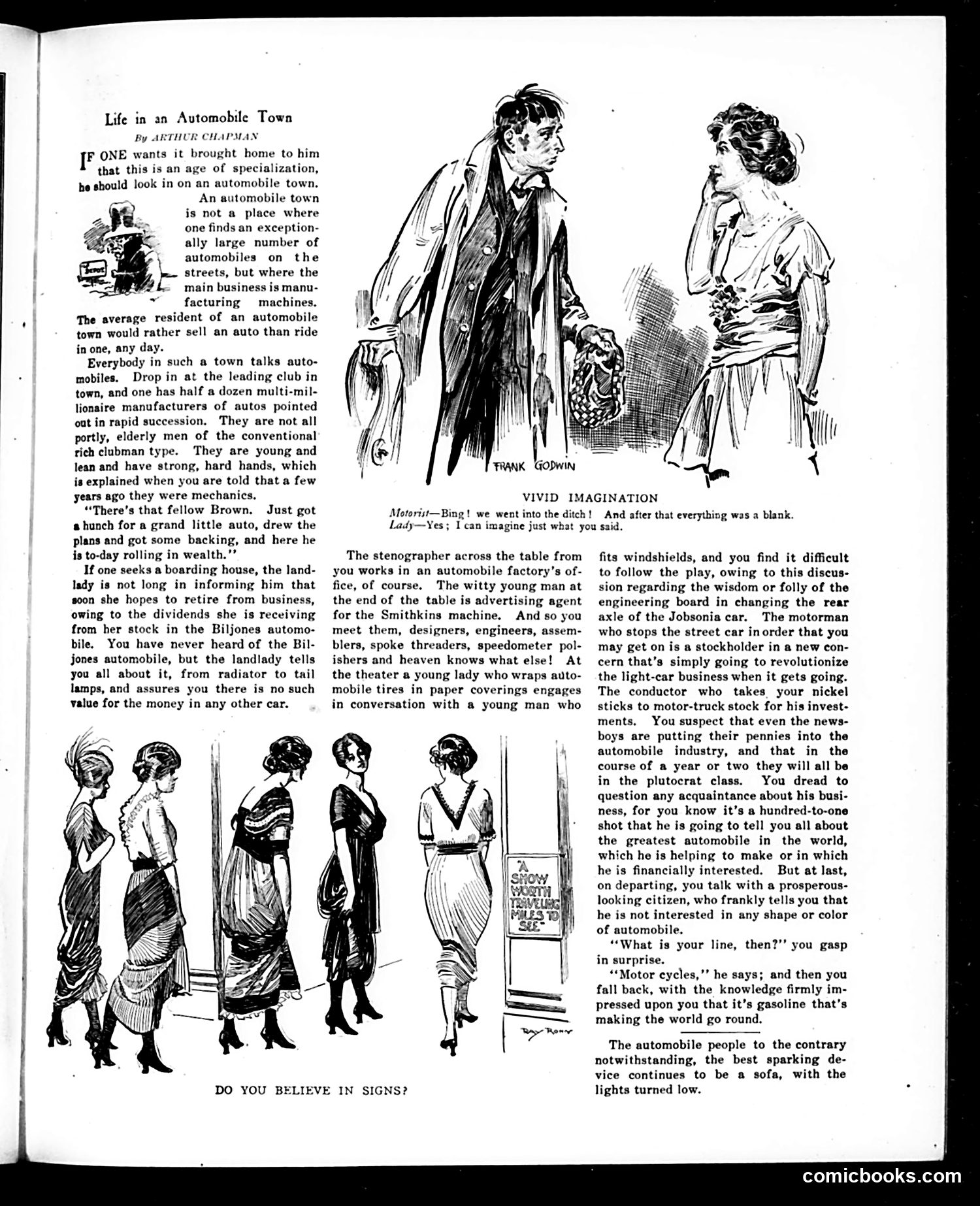
This article satirizes early 20th-century American automobile manufacturing towns—industrial centers where car production dominated the economy and culture. Chapman mocks how automobile manufacturing had created a new class of wealthy industrialists and how the industry permeated every aspect of social life. The satire highlights: **Social mobility**: Former mechanics rapidly became millionaires through auto manufacturing, disrupting traditional class structures. **Obsessive specialization**: Every townsperson—stenographers, theater-goers, motormen, newsboys—was somehow invested in or employed by the auto industry, making conversation inescapable. **The punchline** subverts expectations: After describing universal automobile obsession, Chapman reveals one prosperous citizen uninterested in cars—he's invested in *motorcycles* instead. The final joke about sofas with "lights turned low" deflates the industrial enthusiasm with old-fashioned romance. The cartoons illustrate social pretension and fashion influenced by automobile culture, reinforcing how thoroughly the industry had reshaped American life.
📄 Transcribed text from this page (OCR, searchable)
Machine-transcribed from the original scan — historical spelling and the odd misread are preserved.
Life in an Automobile Town By ARTHUR CHAPMAN IF ONE wants it brought home to him that this is an age of specialization, he should look in on an automobile town, An automobile town is not a place where one finds an exception- ally large number of automobiles on the streets, but where the main business is manu- - facturing machines. The average resident of an automobile town would rather sell an auto than ride in one, any day. Everybody in such a town talks auto- mobiles. Drop in at the leading club in town, and one has half a dozen multi-mil- lionaire manufacturers of autos pointed out in rapid succession. They are not all portly, elderly men of the conventional rich clubman type. They are young and lean and have strong, hard hands, which is explained when you are told that a few years ago they were mechanics, “There's that fellow Brown. Just got shunch for a grand little auto, drew the plans and got some backing, and here he is to-day rolling in wealth.’” If one seeks a boarding house, the land- lady is not long in informing him that soon she hopes to retire from business, owing to the dividends she is receiving from her stock in the Biljones automo- bile. You have never heard of the Bil- jones automobile, but the landlady tells you all about it, from radiator to tail lamps, and assures you there is no such value for the money in any other car. VIVID IMAGINATION Motorist—Bing ! we went into the ditch ! And after that everything was a blank. Lady—Yes; I'can imagine just what you said. The stenographer across the table from you works in an automobile factory’s of- fice, of course. The witty young man at the end of the table is advertising agent for the Smithkins machine. And so you meet them, designers, engineers, assem- blers, spoke threaders, speedometer pol- ishers and heaven knows what else! At the theater a young lady who wraps auto- mobile tires in paper coverings engages in conversation with a young man who DO YOU BELIEVE IN SIGNS? fits windshields, and you find it difficult to follow the play, owing to this discus- sion regarding the wisdom or folly of the engineering board in changing the rear axle of the Jobsonia car. The motorman who stops the street car inorder that you may get on is a stockholder in a new con- cern that’s simply going to revolutionize the light-car business when it gets going. The conductor who takes your nickel sticks to motor-truck stock for his invest- ments, You suspect that even the news- boys are putting their pennies into the automobile industry, and that in the course of a year or two they will all be in the plutocrat class. You dread to question any acquaintance about his busi- ness, for you know it’s a hundred-to-one shot that he is going to tell you all about the greatest automobile in the world, which he is helping to make or in which he is financially interested. But at last, on departing, you talk with a prosperous- looking citizen, who frankly tells you that he is not interested in any shape or color of automobile. “What is your line, then?’’ you gasp in surprise. “Motor cycles,’’ he says; and then you fall back, with the knowledge firmly im- pressed upon you that it’s gasoline that’s making the world go round, The automobile people to the contrary notwithstanding, the best sparking de- vice continues to be a sofa, with the lights turned low. comicbooks.com