
Judge, 1915-01-02 · page 15 of 24
Judge — January 2, 1915 — page 15: what you’re looking at
What you’re looking at
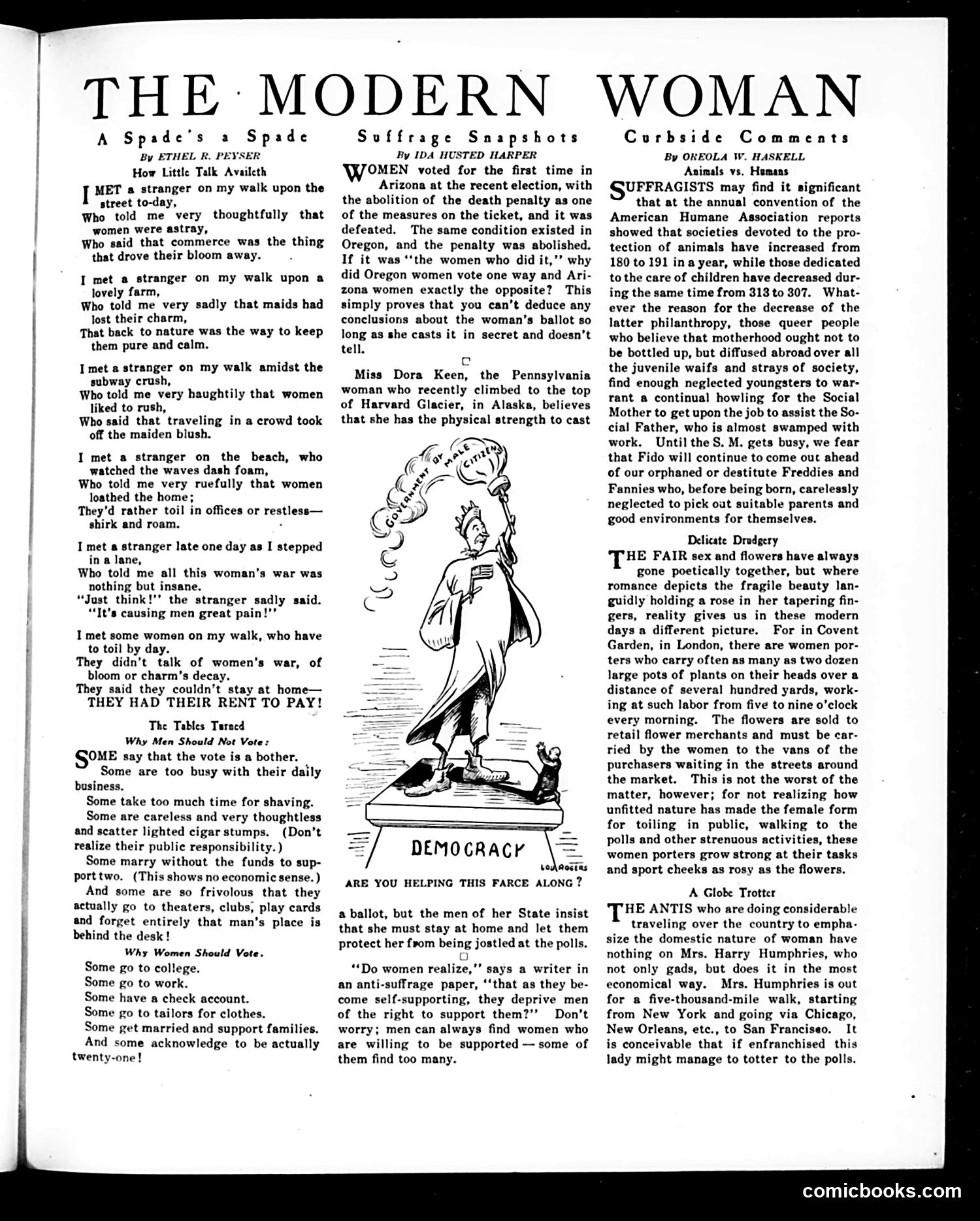
This page satirizes anti-suffrage and anti-feminist arguments through sharp irony. **The main cartoon** depicts a woman labeled "Democracy" balanced precariously on a pedestal, suggesting the instability of female political participation—a common anti-suffrage trope. **"A Spade's a Spade"** (left column) mocks men who blame women's "decline" on commerce, cities, and work. The poem's punchline reveals the real issue: working women have "THEIR RENT TO PAY"—dismissing romantic complaints as privileged nonsense. **"The Tables Turned"** flips the script, listing absurd reasons men shouldn't vote (frivolousness, poor finances) that mirror actual anti-suffrage arguments against women, exposing their hypocrisy. **"Suffrage Snapshots"** (right) challenges specific anti-suffrage claims: women voting differently in Arizona vs. Oregon proves they're independent thinkers; Miss Dora Keen's glacier-climbing proves physical capability; and the sarcastic response about "depriving men of support" mocks protectionist arguments. The page argues suffragists are rational while opponents traffic in emotion and contradiction.
📄 Transcribed text from this page (OCR, searchable)
Machine-transcribed from the original scan — historical spelling and the odd misread are preserved.
THE MODERN WOMAN A Spade’s a Spade By ETHEL R. PEYSER How Little Talk Availeth I MET a stranger on my walk upon the street to-day, Who told me very thoughtfully that women were astray, Who said that commerce was the thing that drove their bloom away. I met a stranger on my walk upon a lovely farm, Who told me very sadly that maids had lost their charm, That back to nature was the way to keep them pure and calm. I met a stranger on my walk amidst the subway crush, Who told me very haughtily that women liked to rush, Who said that traveling in a crowd took off the maiden blush. I met a stranger on the beach, who watched the waves dash foam, Who told me very ruefully that women loathed the home; They’d rather toil in offices or restless— shirk and roam. : I met a stranger late one day as I stepped in a lane, Who told me all this woman’s war was nothing but insane. “Just think!’’ the stranger sadly said. “It's causing men great pain!’’ I met some women on my walk, who have to toil by day. They didn’t talk of women’s war, of bloom or charm’s decay. They said they couldn't stay at home— THEY HAD THEIR RENT TO PAY! The Tables Turned Why Men Should Not Vote: SOME say that the vote is a bother. Some are too busy with their daily business. Some take too much time for shaving. Some are careless and very thoughtless and scatter lighted cigar stumps. (Don’t realize their public responsibility. ) Some marry without the funds to sup- Porttwo. (This shows no economic sense. ) And some are so frivolous that they actually go to theaters, clubs, play cards and forget entirely that man’s place is behind the desk! Why Women Should Vote. Some go to college. Some go to work. Some have a check account. Some go to tailors for clothes. Some get married and support families. And some acknowledge to be actually twenty-one! Suffrage Snapshots By IDA HUSTED HARPER ‘OMEN voted for the first time in Arizona at the recent election, with the abolition of the death penalty as one of the measures on the ticket, and it was defeated. The same condition existed in Oregon, and the penalty was abolished. If it was ‘tthe women who did it,”” why did Oregon women vote one way and Ari- zona women exactly the opposite? This simply proves that you can’t deduce any conclusions about the woman’s ballot so long as she casts it in secret and doesn’t tell. e Miss Dora Keen, the Pennsylvania woman who recently climbed to the top of Harvard Glacier, in Alaska, believes that she has the physical strength to cast DEMOCRACY voaosias ARE YOU HELPING THIS FARCE ALONG? a ballot, but the men of her State insist that she must stay at home and let them protect her from being jostled at the polls, a **Do women realize,’’ says a writer in an anti-suffrage paper, ‘‘that as they be- come self-supporting, they deprive men of the right to support them?’’ Don’t worry; men can always find women who are willing to be supported — some of them find too many. Curbside Comments By OREOLA W. HASKELL Animals vs. Homans SUFFRAGISTS may find it significant that at the annual convention of the American Humane Association reports showed that societies devoted to the pro- tection of animals have increased from 180 to 191 in a year, while those dedicated to the care of children have decreased dur- ing the same time from 313 to 307. What- ever the reason for the decrease of the latter philanthropy, those queer people who believe that motherhood ought not to be bottled up, but diffused abroad over all the juvenile waifs and strays of society, find enough neglected youngsters to war- rant a continual howling for the Social Mother to get upon the job to assist the So- cial Father, who is almost swamped with work, Until the S. M. gets busy, we fear that Fido will continue to come out ahead of our orphaned or destitute Freddies and Fannies who, before being born, carelessly neglected to pick out suitable parents and good environments for themselves. Delicate Drudgery THE FAIR sex and flowers have always gone poetically together, but where romance depicts the fragile beauty lan- guidly holding a rose in her tapering fin- gers, reality gives us in these modern days a different picture. For in Covent Garden, in London, there are women por- ters who carry often as many as two dozen large pots of plants on their heads over a distance of several hundred yards, work- ing at such labor from five to nine o’clock every morning. The flowers are sold to retail flower merchants and must be car- ried by the women to the vans of the purchasers waiting in the streets around the market. This is not the worst of the matter, however; for not realizing how unfitted nature has made the female form for toiling in public, walking to the polls and other strenuous activities, these women porters grow strong at their tasks and sport cheeks as rosy as the flowers. A Globe Trotter HE ANTIS who are doing considerable traveling over the country to empha- size the domestic nature of woman have nothing on Mrs. Harry Humphries, who not only gads, but does it in the most economical way. Mrs. Humphries is out for a five-thousand-mile walk, starting from New York and going via Chicago, New Orleans, etc., to San Franciseo. It is conceivable that if enfranchised this lady might manage to totter to the polls. comicbooks.com