
Judge, 1915-01-02 · page 9 of 24
Judge — January 2, 1915 — page 9: what you’re looking at
What you’re looking at
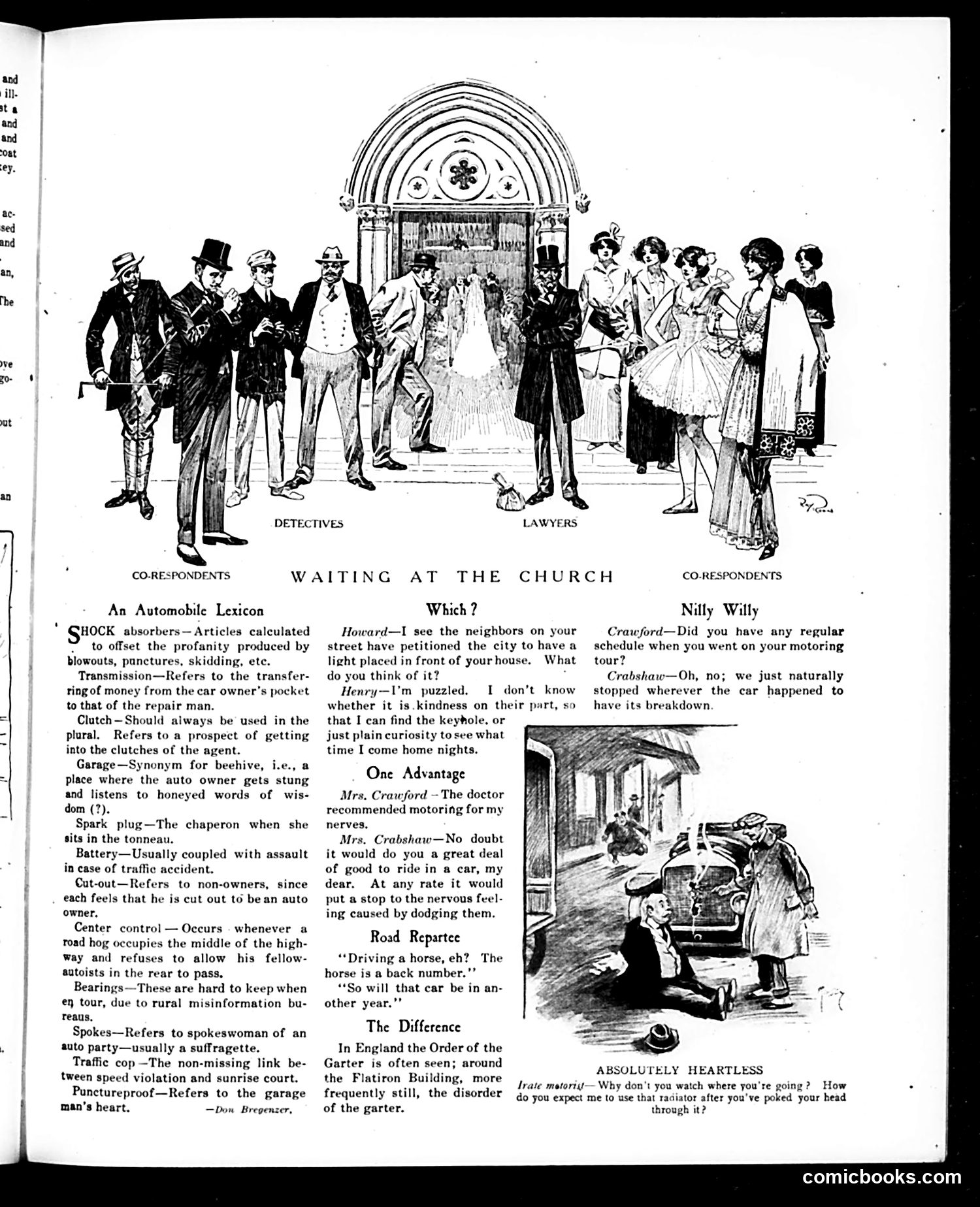
This page satirizes early automobile culture and social anxieties of the era. The central illustration shows detectives, lawyers, and "co-respondents" (likely divorce case participants) gathered at a church—suggesting automobiles enabled illicit affairs by providing private transportation. The "Automobile Lexicon" column mocks car ownership pretensions through automotive puns: "garage" equals getting "stung," "transmission" means money leaving owners' pockets, "spokes" references suffragettes (women advocating for driving rights). The humor targets both automotive unreliability and emerging social changes. Other jokes ridicule dangerous driving habits, nervous drivers, and the automobile's disruptive social impact. The "Order of the Garter" reference jokes about women losing undergarments due to bumpy rides—mixing automotive danger with sexual innuendo typical of the era's satirical magazines. Overall, the page reflects period anxieties: automobiles as morally corruptive, mechanically unreliable, and dangerous to traditional social order—particularly regarding women's newfound mobility and independence.
📄 Transcribed text from this page (OCR, searchable)
Machine-transcribed from the original scan — historical spelling and the odd misread are preserved.
ut DETECTIVES CO-RESPONDENTS An Automobile Lexicon HOCK absorbers— Articles calculated to offset the profanity produced by blowouts, punctures, skidding, ete. Transmission—Refers to the transfer- ring of money from the car owner's pocket to that of the repair man. Clutch—Should always be used in the plural. Refers to a prospect of getting into the clutches of the agent. Garage—Synonym for beehive, i.e., a place where the auto owner gets stung and listens to honeyed words of wis- dom (?). Spark plug—The chaperon when she sits in the tonneau. Battery—Usually coupled with assault in case of traffic accident. Cut-out—Refers to non-owners, since each feels that he is cut out to bean auto owner, Center control — Occurs whenever a toad hog occupies the middle of the high- way and refuses to allow his fellow- autoists in the rear to pass. Bearings—These are hard to keep when en tour, due to rural misinformation bu- reaus, Spokes—Refers to spokeswoman of an auto party—usually a suffragette. Traffic cop —The non-missing link be- tween speed violation and sunrise court. Punctureproof—Refers to the garage man’s heart. —Don Bregenzer, LAWYERS WAITING AT THE CHURCH Which ? Howard—I see the neighbors on your street have petitioned the city to have a light placed in front of yourhouse. What do you think of it? Henry—I'm puzzled. 1 don’t know whether it is.kindness on their part, so that I can find the keyhole, or just plain curiosity to see what time I come home nights. One Advantage Mrs. Crawford ~The doctor recommended motoring for my nerves. Mrs. Crabshaw—No doubt it would do you a great deal of good to ride in a car, my dear. At any rate it would put a stop to the nervous feel- ing caused by dodging them. Road Repartee “Driving a horse, eh? The horse is a back number.”’ “*So will that car be in an- other year.”’ The Difference In England the Order of the Garter is often seen; around the Flatiron Building, more frequently still, the disorder of the garter. Irate metorigt— Why don't you watch where you're going ? do you expect me to use that radiator after you've poked your head CO-RESPONDENTS Nilly Willy Crawford—Did you have any regular schedule when you went on your motoring tour? Crabshaw—Oh, no; we just naturally stopped wherever the car happened to have its breakdown ABSOLUTELY HEARTLESS How through it? comicbooks.com