
Judge, 1915-01-02 · page 13 of 24
Judge — January 2, 1915 — page 13: what you’re looking at
What you’re looking at
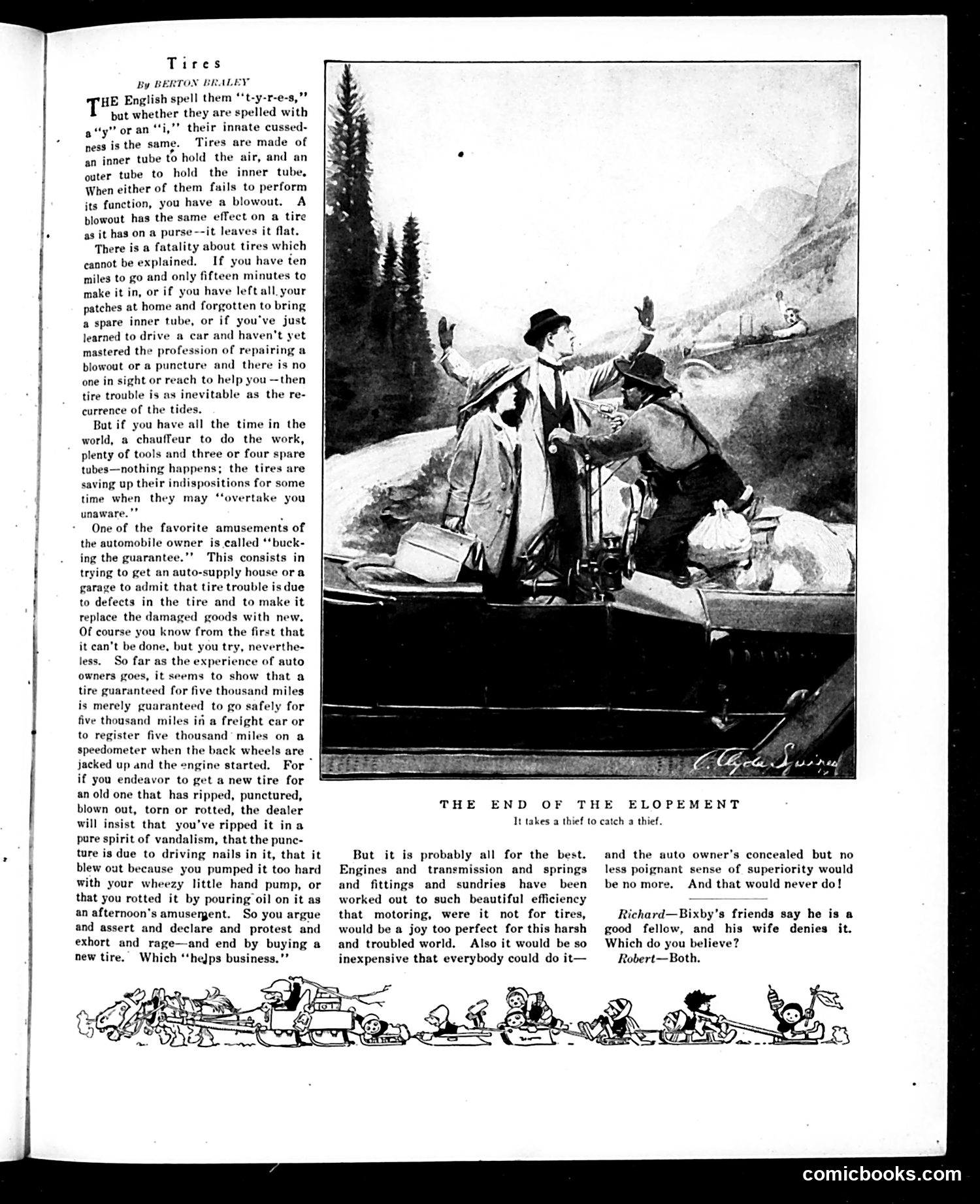
This satirical article mocks the inevitable frustrations of early automobile ownership, specifically tire problems. The piece uses bitter humor to describe how tire failures follow a cruel Murphy's Law: they occur precisely when you're unprepared or in a hurry, but never when you have time and tools to fix them. The satire targets two groups: incompetent tire manufacturers who issue worthless guarantees (tires guaranteed for 5,000 miles only work reliably when sitting in a freight car), and consumers who futilely attempt to claim warranty replacements despite knowing they'll lose. The final joke suggests tire troubles actually benefit society—without them, motoring would be so perfectly reliable and cheap that everyone could afford cars, eliminating the wealthy automobile owner's sense of superiority. The accompanying cartoon "The End of the Elopement" appears unrelated, showing a roadside automotive mishap.
📄 Transcribed text from this page (OCR, searchable)
Machine-transcribed from the original scan — historical spelling and the odd misread are preserved.
cence TH English spell them ‘‘t-y-r-e-s,”” but whether they are spelled h ’ their innate cussed- ness is the same. Tires are made of an inner tube to hold the air, and an outer tube to hold the inner tube, When either of them fails to perform its function, you have a blowout. A blowout has the same effect on a tire as it has on a purs t leaves it flat. There is a fatality about tires which cannot be explained. If you have ten miles to go and only fifteen minutes to make it in, or if you have left all. your patches at home and forgotten to bring a spare inner tube, or if you've just learned to drive a car and haven't yet mastered the profession of repairing a blowout or a puncture and there is no one in sight or reach to help you —then tire trouble is as inevitable as the re- currence of the tides. But if you have all the time in the world, a chauffeur to do the work, plenty of tools and three or four spare tubes—nothing happens; the tires are saving up their indispositions for some time when they may ‘‘overtake you unaware.’* . One of the favorite amusements of the automobile owner is called ‘*buck- ing the guarantee.’’ This consists in trying to get an auto-supply house ora garage to admit that tire trouble is due to defects in the tire and to make it replace the damaged goods with new. Of course you know from the first that. it can’t be done, but you try, neverthe- less. So far as the experience of auto owners goes, it seems to show that a tire guaranteed for five thousand miles is merely guaranteed to go safely for five thousand miles in a freight car or to register five thousand’ miles on a speedometer when the back wheels are jacked up and the engine started. For” if you endeavor to get a new tire for an old one that has ripped, punctured, blown out, torn or rotted, the dealer will insist that you've ripped it ina pure spirit of vandalism, that the pune- ture is due to driving nails in it, that it blew out because you pumped it too hard with your wheezy little hand pump, or that you rotted it by pouring oil on it as an afternoon's amusergent. So you argue and assert and declare and protest and exhort and rage—and end by buying a new tire. Which ‘‘heJps business.’ THE END OF THE ELOPEMENT It takes a thief to catch a thief. But it is probably all for the best. Engines and transmission and springs and fittings and sundries have been worked out to such beautiful efficiency that motoring, were it not for tires, would be a joy too perfect for this harsh and troubled world. Also it would be so inexpensive that everybody could do it— and the auto owner’s concealed but no less poignant sense of superiority would be no more. And that would never do! Richard—Bixby’s friends say he is a good fellow, and his wife denies it. Which do you believe? Robert—Both. comicbooks.com