
Judge, 1915-01-02 · page 3 of 24
Judge — January 2, 1915 — page 3: what you’re looking at
What you’re looking at
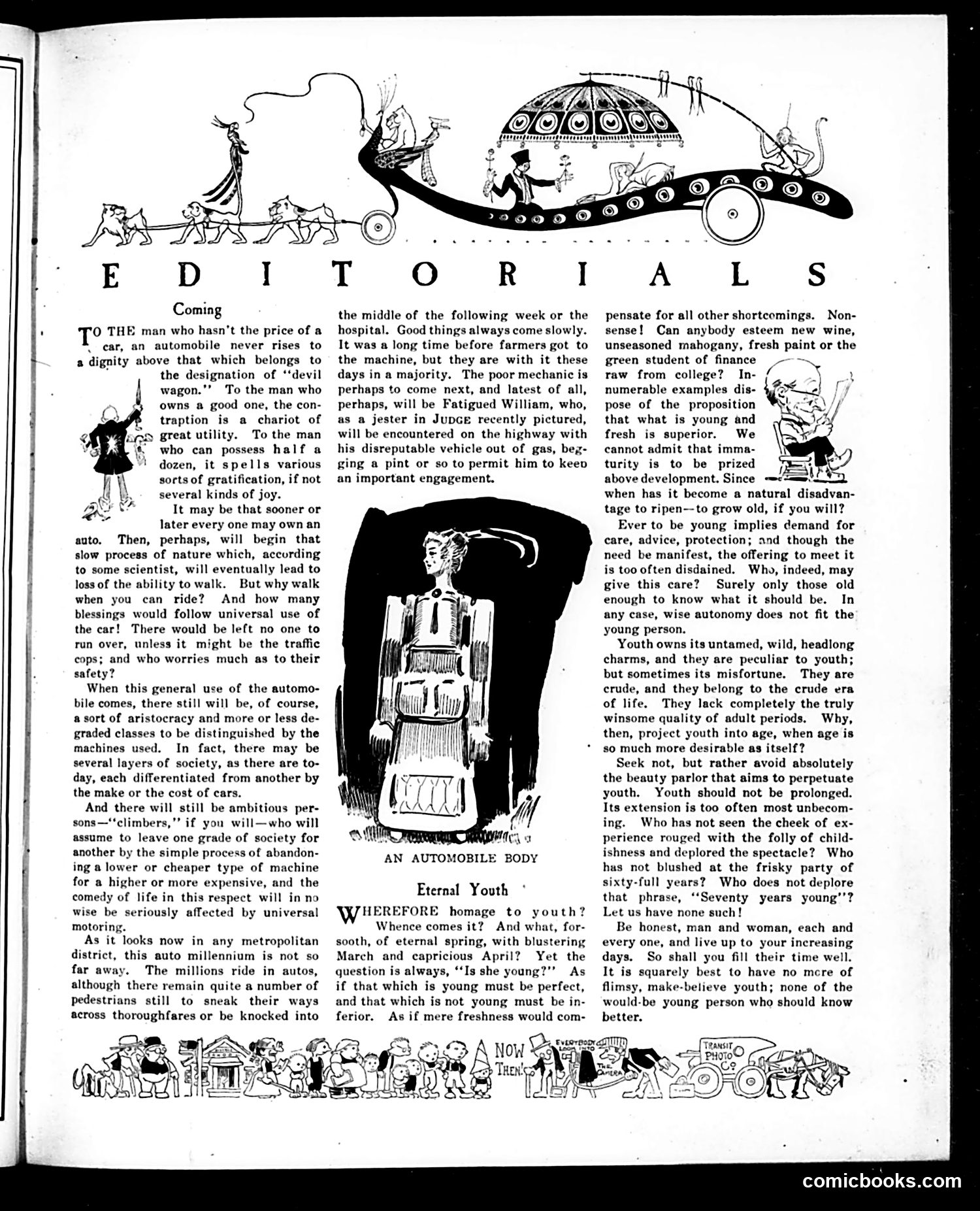
This page features two distinct sections: **Header Illustration ("Editorials")**: An elaborate decorative header depicting an ornate chariot or vehicle laden with mechanical/automobile imagery, suggesting early 20th-century fascination with motorized transportation as a symbol of progress and modern society. **Main Editorial ("Eternal Youth")**: The text discusses automobiles as status symbols and their role in creating social stratification. It critiques society's obsession with youth and newness, warning against prolonging childhood or refusing to mature. The central illustration shows an "automobile body"—likely a visual pun comparing a car's exterior to human physicality. **Social Commentary**: The piece satirizes both the automobile industry's expansion and contemporary anxieties about modernization, class hierarchy, and generational values during what appears to be the early automotive era in America.
📄 Transcribed text from this page (OCR, searchable)
Machine-transcribed from the original scan — historical spelling and the odd misread are preserved.
Coming © THE man who hasn't the price of a car, an automobile never rises to a dignity above that which belongs to : the designation of ‘devil wagon."’ To the man who owns a good one, the con- traption is a chariot of great utility. To the man who can possess half a dozen, it spells various sorts of gratification, if not several kinds of joy. It may be that sooner or later every one may own an perhaps, will begin that auto. Then, slow process of nature which, according to some scientist, will eventually lead to loss of the ability to walk. But why walk when you can ride? And how many blessings would follow universal use of the car! There would be left no one to run over, unless it might be the traffic cops; and who worries much as to their safety? When this general use of the automo- bile comes, there still will be, of course, asort of aristocracy and more or less de- graded classes to be distinguished by the machines used. In fact, there may be several layers of society, as there are to- day, each differentiated from another by the make or the cost of cars. And there will still be ambitious per- sons—‘‘climbers,"’ if you will—who will assume to leave one grade of society for another by the simple process of abandon- ing a lower or cheaper type of machine for a higher or more expensive, and the comedy of life in this respect will in no wise be seriously affected by universal motoring. As it looks now in any metropolitan district, this auto millennium is not so far away. The millions ride in autos, although there remain quite a number of pedestrians still to sneak their ways across thoroughfares or be knocked into the middle of the following week or the hospital. Good things always come slowly. It was a long time before farmers got to the machine, but they are with it these days in a majority. The poor mechanic is perhaps to come next, and latest of all, perhaps, will be Fatigued William, who, as a jester in Jupce recently pictured, will be encountered on the highway with his disreputable vehicle out of gas, beg- ging a pint or so to permit him to keeo an important engagement. CY rp enmel alias se Eternal Youth WHEREFORE homage to youth? Whence comes it? And what, for- sooth, of eternal spring, with blustering March and capricious April? Yet the question is always, ‘‘Is she young?"’ As if that which is young must be perfect, and that which is not young must be in- ferior. As if mere freshness would com- pensate for all other shortcomings. Non- sense! Can anybody esteem new wine, unseasoned mahogany, fresh paint or the green student of finance |-———_ In- raw from college? numerable examples pose of the proposition that what is young and fresh is superior. We cannot admit that imma- turity is to be prized above development. Since when has it become a natural disadvan- tage to ripen—to grow old, if you will? Ever to be young implies demand for care, advice, protection; and though the need be manifest, the offering to meet it is too often disdained. Who, indeed, may give this care? Surely only those old enough to know what it should be. In any case, wise autonomy does not fit the young person. Youth owns its untamed, wild, headlong charms, and they are peculiar to youth; but sometimes its misfortune. They are crude, and they belong to the crude era of life. They lack completely the truly winsome quality of adult periods. Why, then, project youth into age, when age is so much more desirable as itself? Seek not, but rather avoid absolutely the beauty parlor that aims to perpetuate youth. Youth should not be prolonged. Its extension is too often most unbecom- ing. Who has not seen the cheek of ex- perience rouged with the folly of child- ishness and deplored the spectacle? Who has not blushed at the frisky party of sixty-full years? Who does not deplore that phrase, ‘Seventy years young’’? Let us have none such! Be honest, man and woman, each and every one, and live up to your increasing days. So shall you fill their time well. It is squarely best to have no mcre of flimsy, make-believe youth; none of the would-be young person who should know better. TRANSIT, <5} puoi yO) Ke) comicbooks.com