
Judge, 1915-01-02 · page 10 of 24
Judge — January 2, 1915 — page 10: what you’re looking at
What you’re looking at
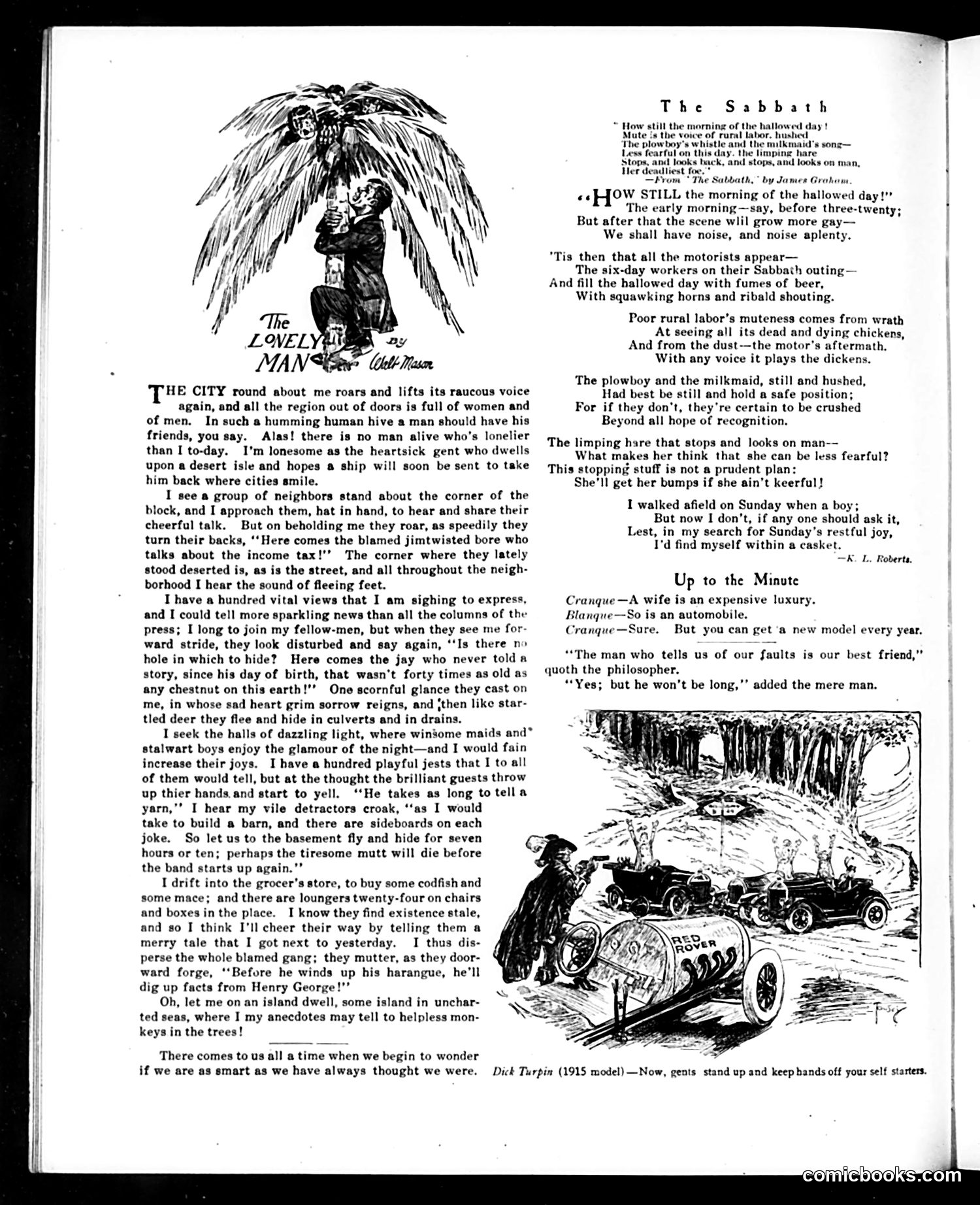
**"The Lovely Man"** (left) satirizes a social bore—a man whose tedious stories and tiresome conversation cause neighbors, party guests, and shopkeepers to literally flee whenever he approaches. The joke is that despite living in a crowded city, he's utterly alone because nobody will tolerate his company. The humor targets the archetype of the relentless raconteur who won't stop talking (particularly about income tax and worn-out jokes). **"The Sabbath"** (right) mocks the violation of the Christian Sabbath by motorists. The poem contrasts the peaceful early morning with the afternoon invasion of six-day workers taking "Sabbath outings" in automobiles—creating noise, pollution, and dead animals. The satire criticizes how automobiles and working-class leisure activities desecrate what was traditionally a quiet, religious day of rest. The rural workers are angered by the dust and dead livestock left in the motors' wake. Both pieces critique early 20th-century urban social behavior and modernization's disruptions.
📄 Transcribed text from this page (OCR, searchable)
Machine-transcribed from the original scan — historical spelling and the odd misread are preserved.
THE CITY round about me roars and lifts its raucous voice again, and all the region out of doors is full of women and of men. In such a humming human hive a man should have his friends, you say. Alas! there is no man alive who's lonelier than I to-day. I'm lonesome as the heartsick gent who dwells upon a desert isle and hopes a ship will soon be sent to take him back where cities smile. I see a group of neighbors stand about the corner of the block, and I approach them, hat in hand, to hear and share their cheerful talk. But on beholding me they roar, as speedily they turn their backs, ‘‘Here comes the blamed jimtwisted bore who talks about the income tax!’’ The corner where they lately stood deserted is, as is the street, and all throughout the neigh- borhood I hear the sound of fleeing feet. I have a hundred vital views that I am sighing to express, and I could tell more sparkling news than all the columns of the press; I long to join my fellow-men, but when they see me for- ward stride, they look disturbed and say again, ‘‘Is there no hole in which to hide? Here comes the jay who never told a story, since his day of birth, that wasn't forty times as old as any chestnut on this earth!’’ One scornful glance they cast on me, in whose sad heart grim sorrow reigns, and jthen like star- tled deer they flee and hide in culverts and in drains. I seek the halls of dazzling light, where winsome maids and” stalwart boys enjoy the glamour of the night—and I would fain increase their joys. I have a hundred playful jests that I to all of them would tell, but at the thought the brilliant guests throw up thier hands.and start to yell. ‘‘He takes as long to tella yarn,’’ I hear my vile detractors croak, ‘‘as I would take to build a barn, and there are sideboards on each joke. So let us to the basement fly and hide for seven hours or ten; perhaps the tiresome mutt will die before the band starts up again.’’ I drift into the grocer’s store, to buy some codfish and some mace; and there are loungers twenty-four on chairs and boxes in the place. I know they find existence stale, and so I think I'll cheer their way by telling them a merry tale that I got next to yesterday. I thus dis- perse the whole blamed gang; they mutter, as they door- ward forge, ‘‘Before he winds up his harangue, he'll dig up facts from Henry George!"’ Oh, let me on an island dwell, some island in unchar- ted seas, where I my anecdotes may tell to helpless mon- keys in the trees! There comes to us all a time when we begin to wonder if we are as smart as we have always thought we were. Dick Turpin (1915 model) —Now, gents stand up and keep hands off your self starters. The Sabbath ~ How still the morning of the hallowed day ! Mute !s the voice of rural labor. od The plowboy’s whistle and the milkmaid's sonz— day. the limping hare ck, and stops, and looks on man, rhe Sabbath,” by James Grohew « «OW STILL the morning of the hallowed day!” The early morning—say, before three-twenty; But after that the scene wlil grow more gay— We shall have noise, and noise aplenty. ‘Tis then that all the motorists appear— The six-day workers on their Sabbath outing— And fill the hallowed day with fumes of beer, With squawking horns and ribald shouting. Poor rural labor’s muteness comes from wrath At seeing all its dead and dying chickens, And from the dust—the motor’s aftermath, With any voice it plays the dickens. The plowboy and the milkmaid, still and hushed, Had best be still and hold a safe position; For if they don't, they're certain to be crushed Beyond all hope of recognition, The limping hare that stops and looks on man-- What makes her think that she can be less fearful? This stopping stuff is not a prudent plan: She'll get her bumps if she ain't keerful! I walked afield on Sunday when a boy; But now I don’t, if any one should ask it, Lest, in my search for Sunday's restful joy, I'd find myself within a casket. —K. L. Roberts. Up to the Minute Cranque—A wife is an expensive luxury. Blanque—So is an automobile. Cranque—Sure. But you can get ‘a new model every year, “The man who tells us of our faults is our best friend,” quoth the philosopher. “Yes; but he won't be long,’’ added the mere man.