
Judge, 1915-01-02 · page 8 of 24
Judge — January 2, 1915 — page 8: what you’re looking at
What you’re looking at
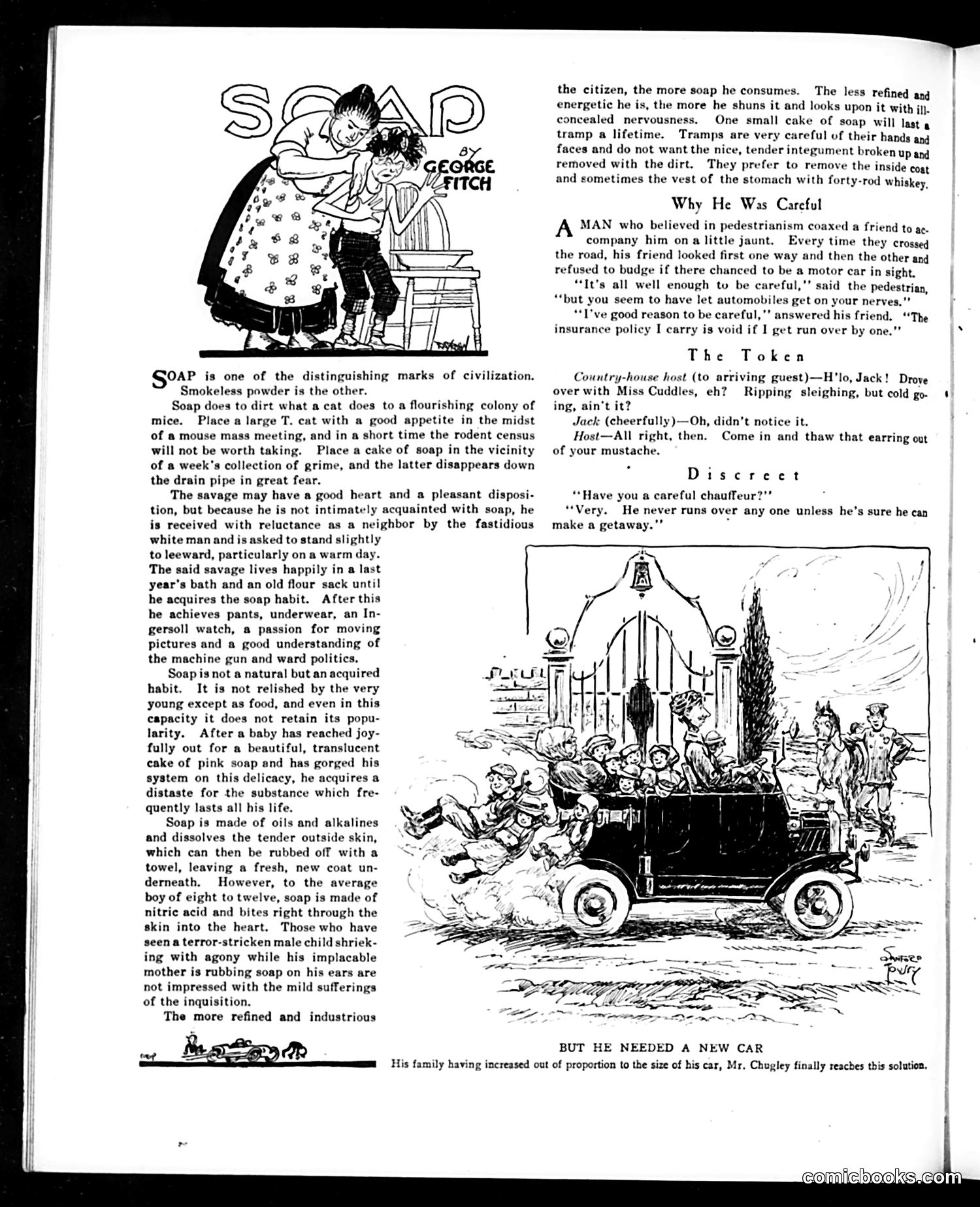
This page contains three distinct humor pieces: **"Soap" (by George Fitch):** A satirical essay using soap as a metaphor for civilization. It argues soap distinguishes "refined" citizens from "savages" and working-class people (notably tramps), reflecting period attitudes that linked personal hygiene to social status and morality. The piece is ethnically condescending, suggesting indigenous peoples lack civilization until acquiring soap habits along with watches and interest in "ward politics." **"Why He Was Careful":** A joke about a cautious driver whose insurance policy voids coverage if hit by a motor car—an absurd clause played for humor about the perceived dangers of early automobiles. **"The Token" and "Discreet":** Brief jokes about winter socializing and, humorously, a chauffeur's willingness to hit pedestrians if he can escape—dark humor about automobile safety. **"But He Needed a New Car":** An illustration showing a man whose family has outgrown his vehicle, depicting early-1900s concerns about automobile practicality and family growth. The page reflects early-20th-century attitudes about class, hygiene, and technology.
📄 Transcribed text from this page (OCR, searchable)
Machine-transcribed from the original scan — historical spelling and the odd misread are preserved.
OAP is one of the distinguishing marks of civilization. Smokeless powder is the other. Soap does to dirt what a cat does to a flourishing colony of mice. Place a large T. cat with a good appetite in the mid: of a mouse mass meeting, and in a short time the rodent census will not be worth taking. Place a cake of soap in the vicinity of a week's collection of grime, and the latter disappears down the drain pipe in great fear. The savage may have a good heart and a pleasant disposi- tion, but because he is not intimately acquainted with soap, he is received with reluctance as a neighbor by the fastidious white man and is asked to stand slightly to leeward, particularly on a warm day. The said savage lives happily in a last year's bath and an old flour sack until he acquires the soap habit. After this he achieves pants, underwear, an In- gersoll watch, a passion for moving pictures and a good understanding of the machine gun and ward politics. Soap is not a natural but an acquired habit. It is not relished by the very young except as food, and even in this capacity it does not retain its popu- larity. After a baby has reached joy- fully out for a beautiful, translucent cake of pink soap and has gorged his system on this delicacy, he acquires a distaste for the substance which fre- quently lasts all his life. % Sg Soap is made of oils and alkaline: and dissolves the tender outside skin, which can then be rubbed off with a a towel, leaving a fresh, new coat un- derneath. However, to the average boy of eight to twelve, soap is made of nitric acid and bites right through the skin into the heart. Those who have seen a terror-stricken male child shriek- ing with agony while his implacable mother is rubbing soap on his ears are not impressed with the mild sufferings of the inquisition. The more refined and industrious the citizen, the more soap he consumes. The less Tefined and energetic he is, the more he shuns it and looks upon it with il}. concealed nervousness. One small cake of soap will last a tramp a lifetime. Tramps are very careful of their hands and faces and do not want the nice, tender integument broken up and removed with the dirt. They prefer to remove the inside coat and sometimes the vest of the stomach with forty-rod whiskey, Why He Was Careful MAN who believed in pedestrianism coaxed a friend to ace company him ona little jaunt. Every time they crossed the road, his friend looked first one way and then the other and refused to budge if there chanced to be a motor car in sight. “It’s all well enough tu be careful,’’ said the pedestrian, “but you seem to have let automobiles get on your nerves, “I've good reason to be careful,"’ answered his friend, insurance policy I carry is void if 1 get run over by one.” The Token Country-house host (to arriving guest)—H’lo, Jack! Drove over with Miss Cuddles, eh? Ripping sleighing, but cold go- ing, ain’t it? Jack (cheerfully )—Oh, didn’t notice it. Host—All right, then. Come in and thaw that earring out of your mustache. Discreet “Have you a careful chauffeur?”” “Very. He never runs over any one unless he’s sure he can make a getaway."” UT HE NEEDED A NEW CAR ee > : His family having increased out of proportion to the size of his car, Mr, Chugley finally reaches this solution.