
A complete issue · 26 pages · 1913
Judge — November 8, 1913
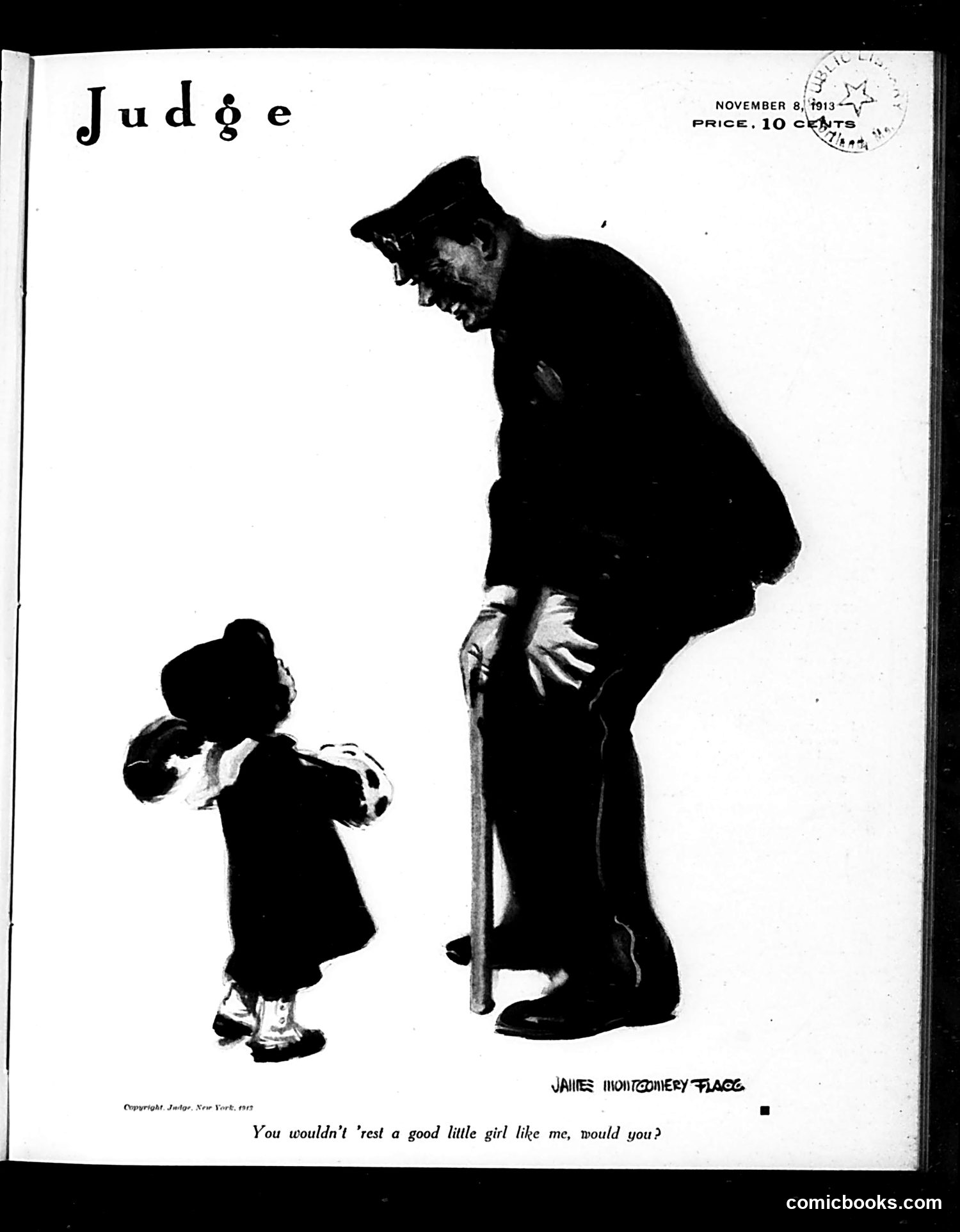
This cover illustration by James Montgomery Flagg depicts an adult man bending toward a small child with the caption: "You wouldn't rest a good little girl like me, would you?" The cartoon appears to be a satirical commentary on child protection or exploitation concerns of the Progressive Era (early 1900s). The child's innocent question to the looming adult figure likely critiques either inadequate child labor laws, exploitation of children, or failures in child welfare enforcement—major social reform issues of that period. The silhouette style and dramatic composition emphasize the vulnerability and power imbalance between adult and child, making the satire's moral point through visual contrast rather than explicit political reference.
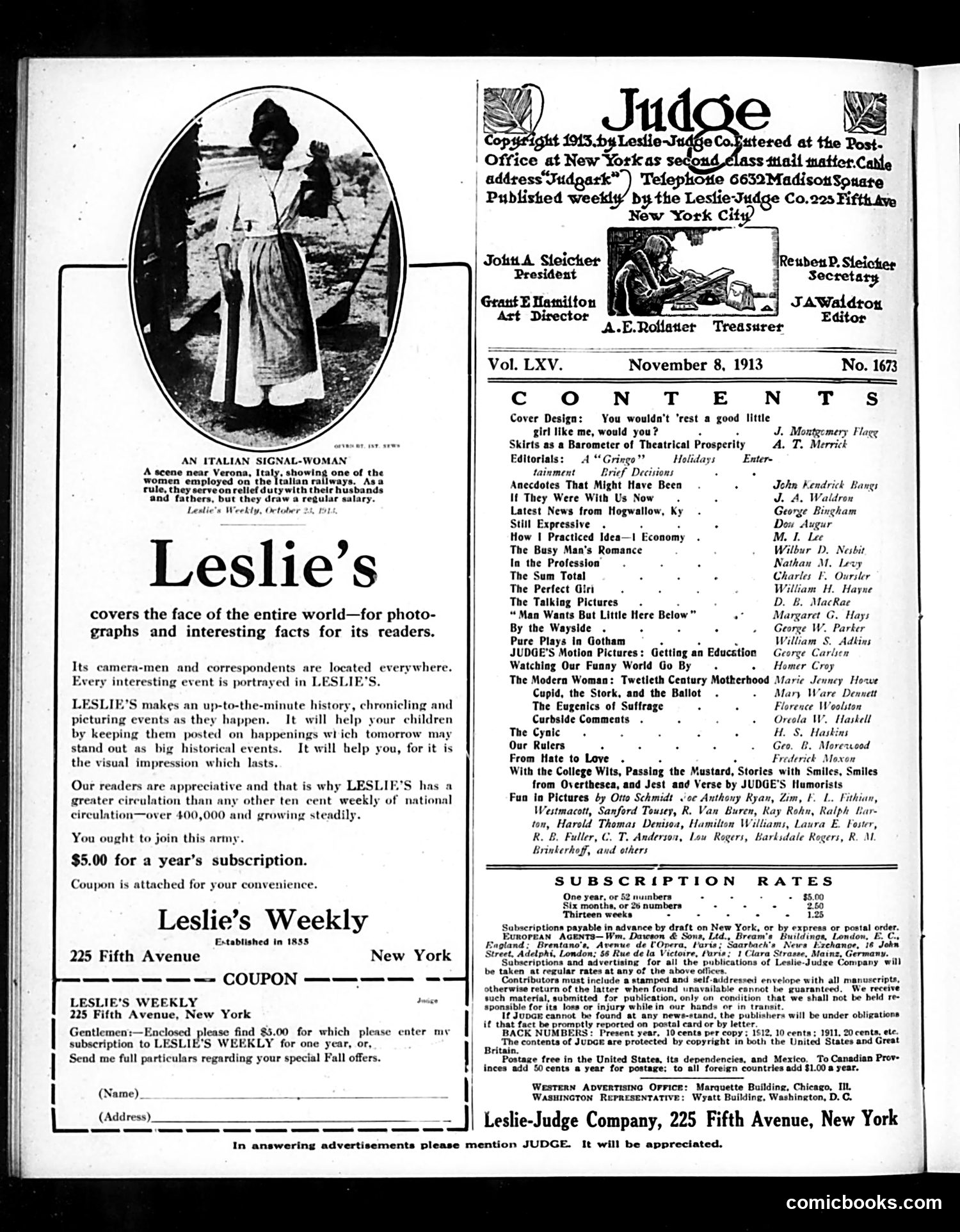
The page features an image labeled "An Italian Signal-Woman" showing a woman in traditional Italian dress employed by Italian railways. According to the caption, Italian railroad rules required these women to perform signaling duties alongside their household tasks. The image appears designed to illustrate a humorous or satirical point about gender roles and labor practices in early 20th-century Italy—specifically the unusual combination of domestic expectations and industrial work. The satire likely targets either Italian labor practices or broader contemporary attitudes about women's roles in the workplace. The rest of the page is primarily advertising for Leslie's Weekly subscription ($3.00/year) rather than additional editorial content or cartoons.
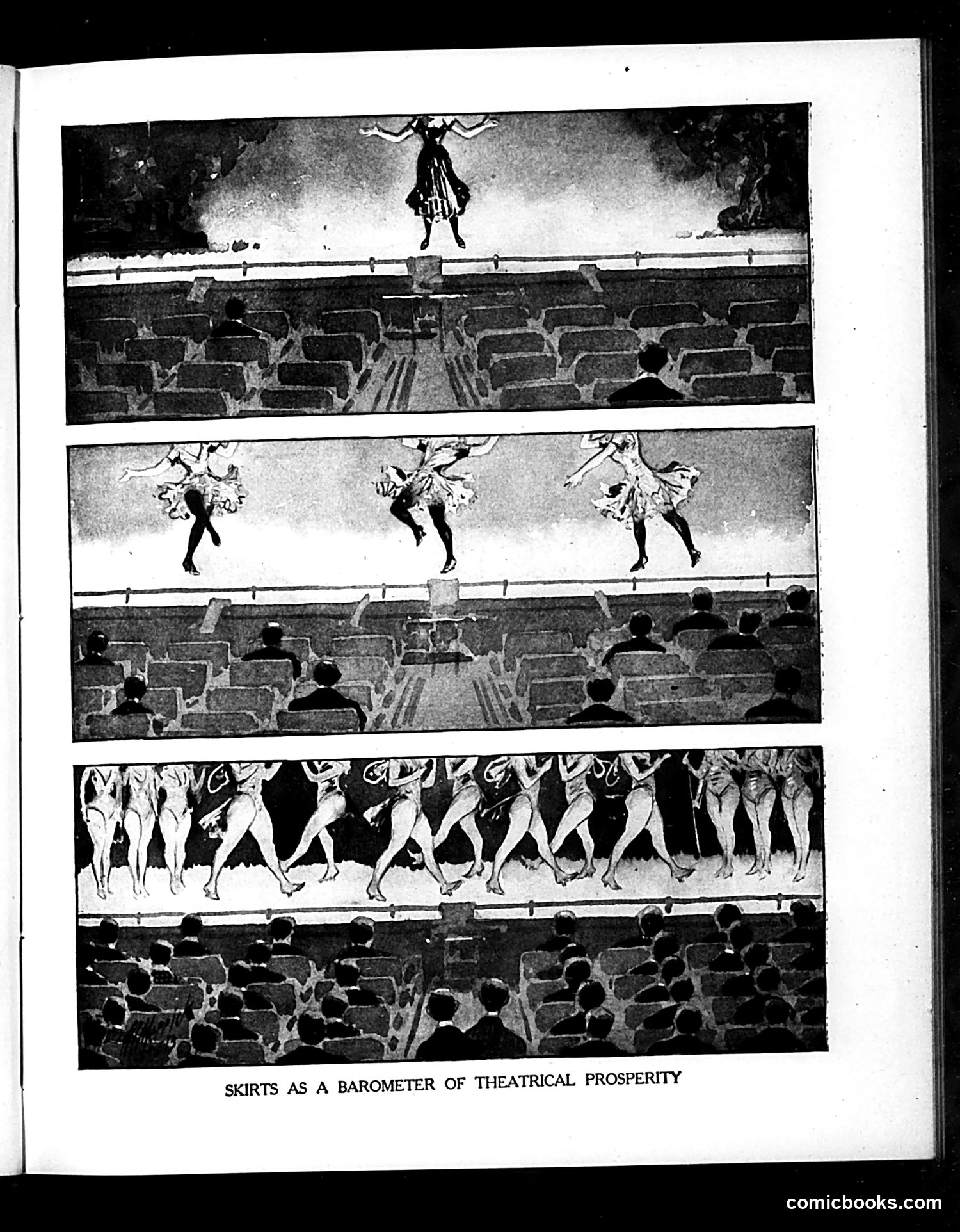
This Judge magazine cartoon satirizes the relationship between theatrical fashion and economic prosperity. The caption "Skirts as a Barometer of Theatrical Prosperity" presents a visual argument: as you move down the three theatrical scenes, the dancers' skirts become progressively shorter and more revealing. The joke appears to be that shorter skirts correlate with theatrical success—the fuller, more populated audiences in lower panels suggest that revealing costumes drive attendance and profits. This reflects early 20th-century attitudes about theatrical entertainment, where more provocative costuming was associated with popularity and financial gain. The satire mocks both theater producers' willingness to rely on sexuality for profits and audiences' predictable appetite for such spectacle, presenting this as an actual economic indicator of the industry's health.
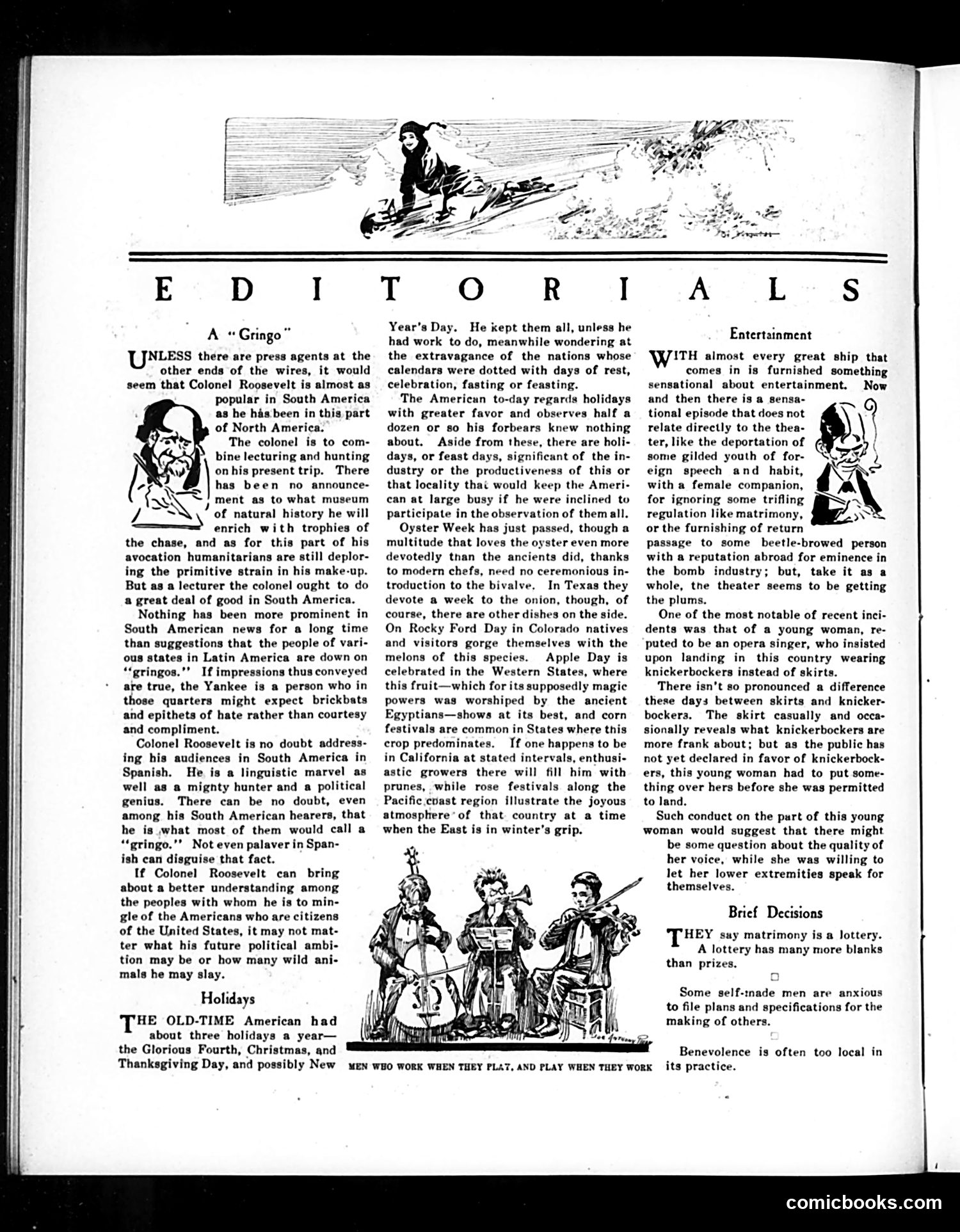
This page contains editorials and satirical commentary rather than political cartoons. The main content discusses Colonel Roosevelt's activities in South America, praising his efforts to improve understanding between the U.S. and Latin American nations. The text suggests Roosevelt's popularity and diplomatic skill could help Americans better comprehend their southern neighbors. The "Holidays" section discusses traditional American celebrations (Fourth of July, Christmas, Thanksgiving) and regional American customs like Oyster Week and Apple Day, contrasting old-time American practices with contemporary observations. The decorative illustrations show period musicians and appear merely ornamental rather than satirical commentary. The "Brief Decisions" section offers cynical aphorisms about matrimony and human nature typical of Judge's humor style.
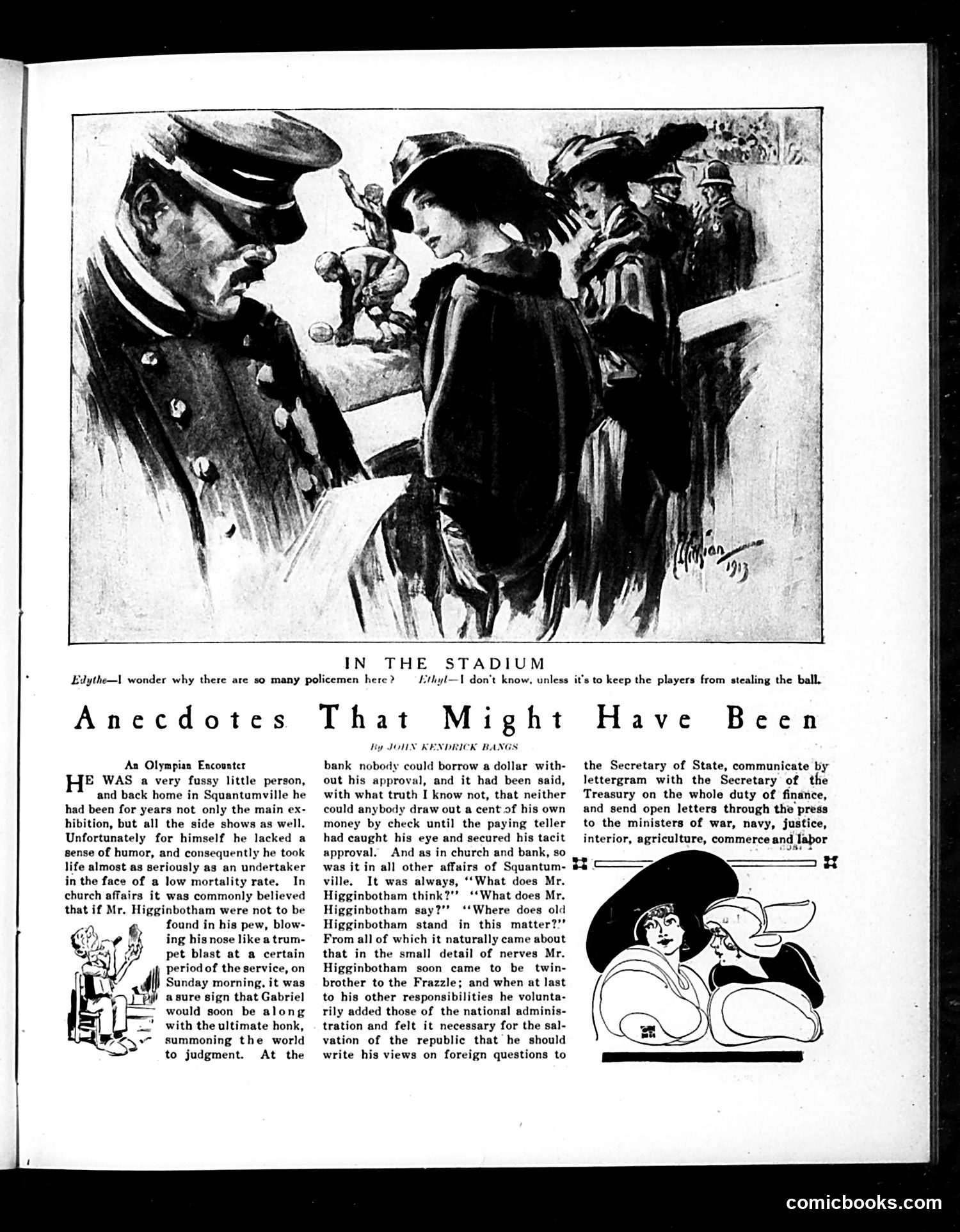
This Judge magazine page satirizes an unnamed politician (labeled "As Olympias Escuttet"), depicted as an overly serious public figure obsessed with minutiae. The cartoon jokes that he's so preoccupied with trivial details—like preventing ball theft at stadiums—that he neglects serious governance. The dialogue reveals the satire's target: a man so concerned with micromanaging every affair that he constantly asks "What does Mr. Higginbotham think?" about everything, eventually assuming responsibility for national administration and foreign policy. The joke critiques a particular political figure's anxiety-driven, detail-obsessed management style and his apparent uncertainty about decisiveness. The "stadium" setting provides an ironic backdrop for discussing weighty matters of state finance and international relations.
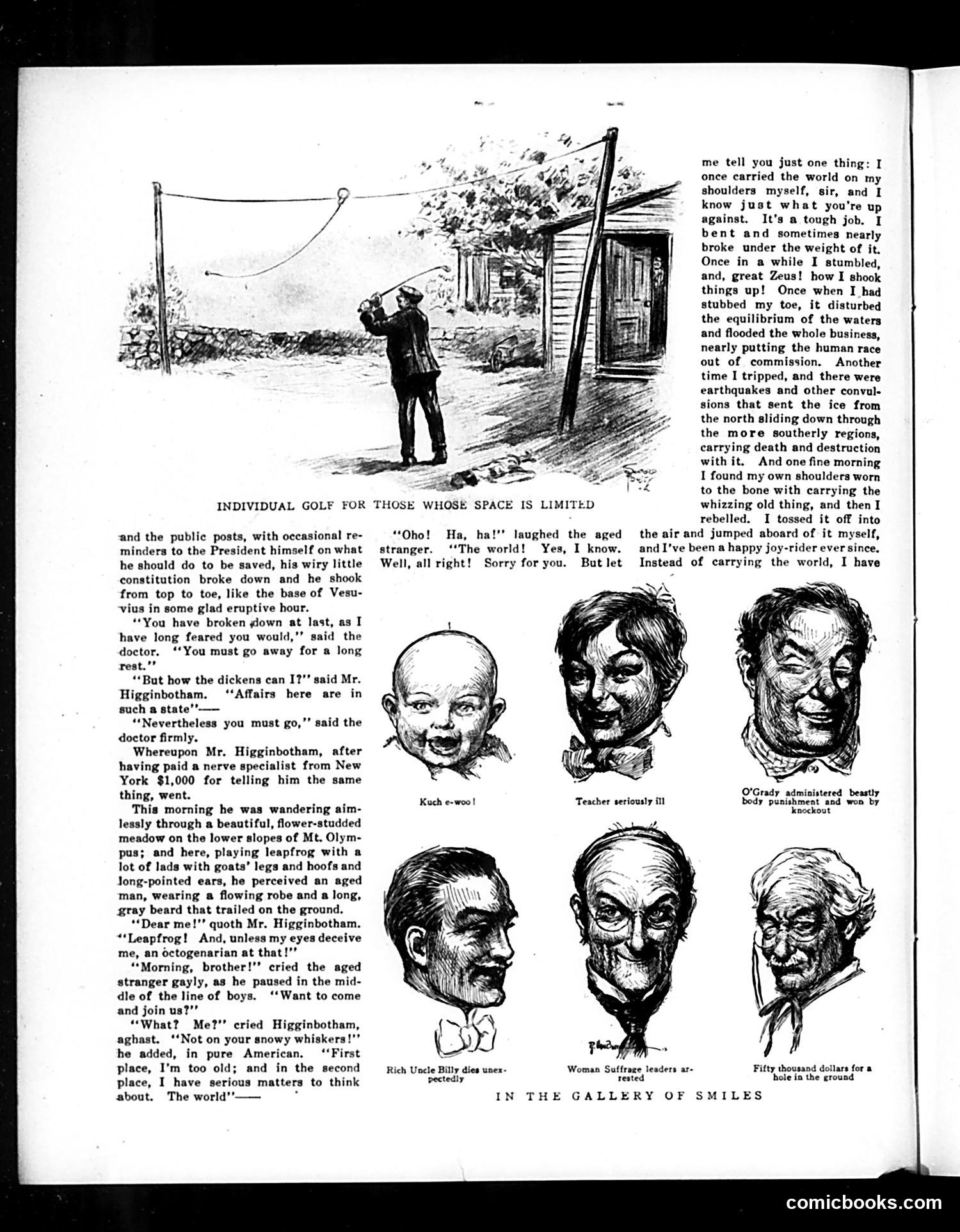
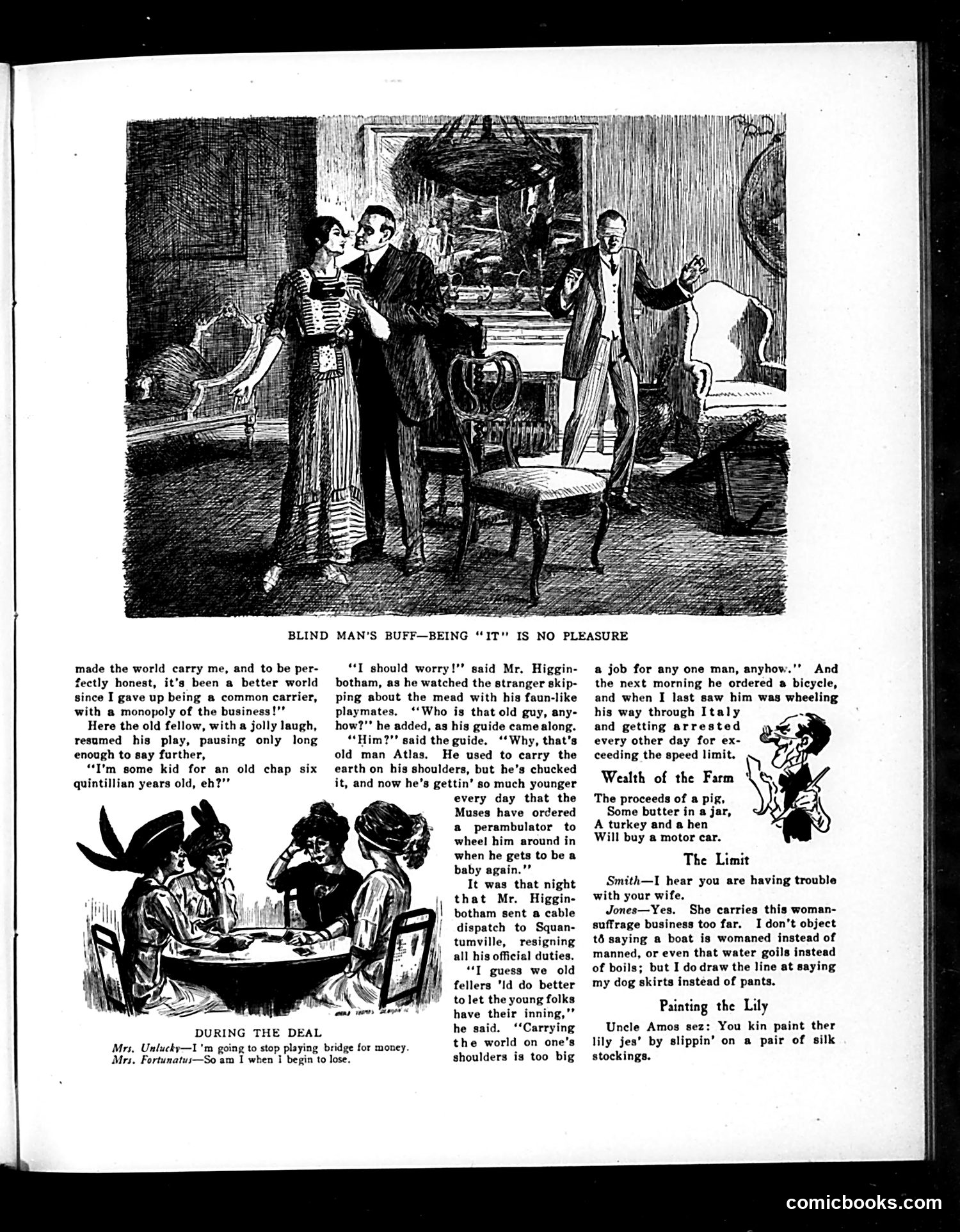
This page contains multiple satirical pieces targeting early 20th-century social attitudes: **"Blind Man's Buff"** presents a fantasy where Atlas—the mythological figure condemned to carry Earth—has abandoned his burden and is growing younger. The satire critiques wealthy industrialists who, like Atlas, claim their monopolistic control benefits society. Mr. Higgenbotham, apparently a railroad magnate, recognizes the absurdity and resigns to pursue leisure (buying a bicycle), suggesting even titans should relinquish power. **"During the Deal"** mocks wealthy women's inconsistency: Mrs. Untucky claims principle (quitting bridge gambling), while Mrs. Fortunatus admits she'll only stop losing—exposing hollow morality among the affluent. Smaller pieces satirize women's suffrage rhetoric ("water girls" instead of "boils"), farm-to-wealth mobility, and rural philosophy. The overall tone ridicules both industrial excess and the pretensions of the wealthy classes, while containing period-typical gender stereotypes and class condescension.
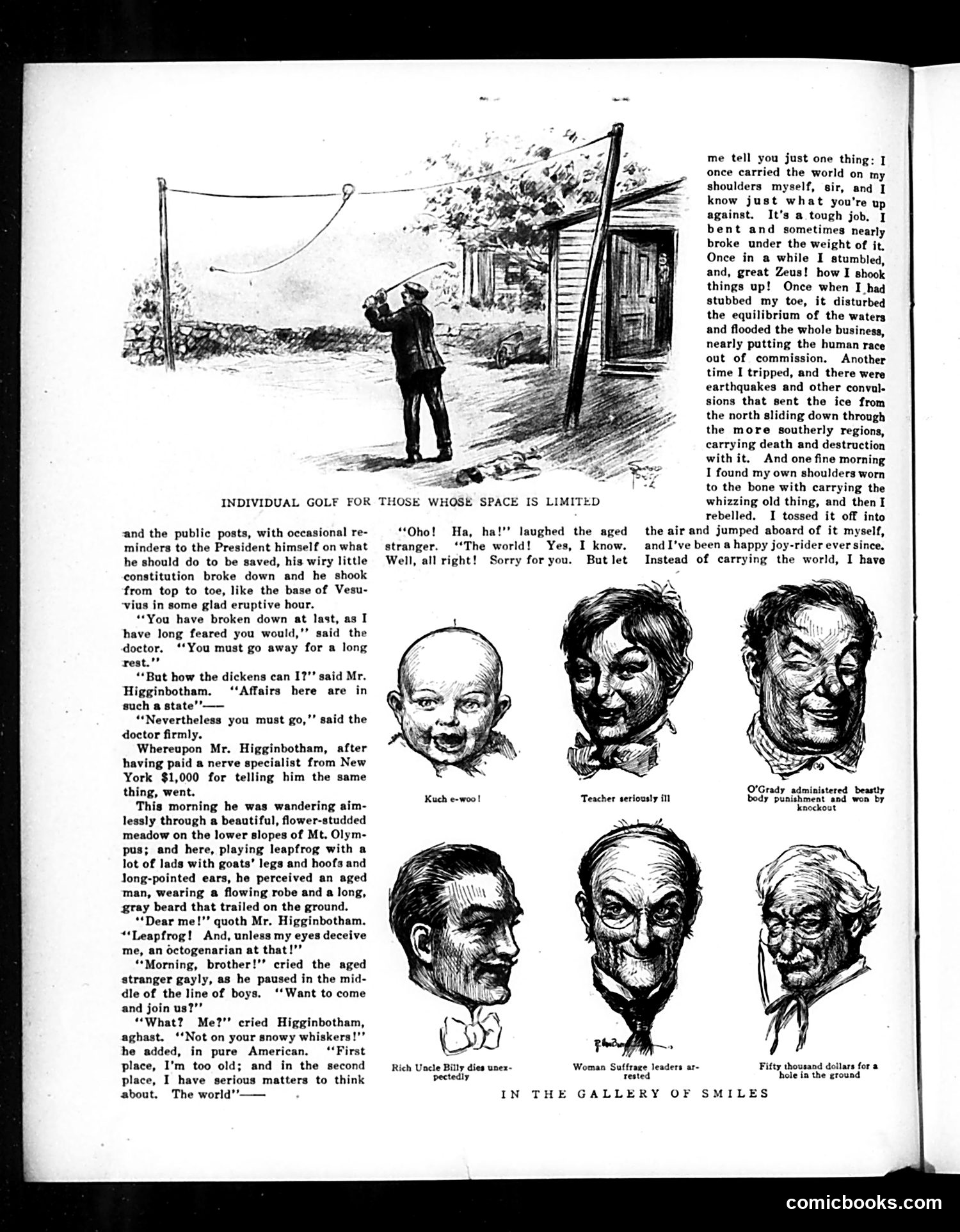
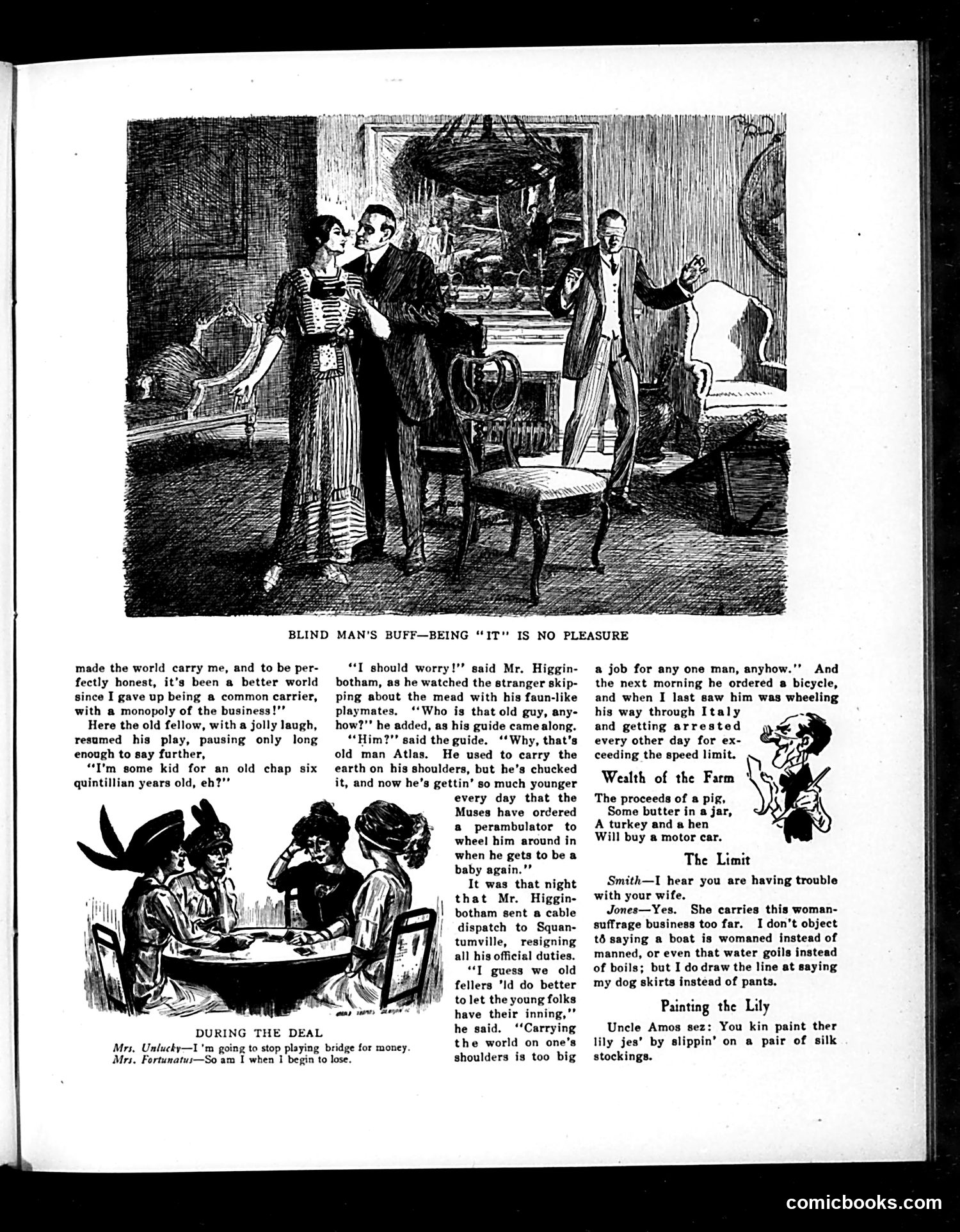
This page contains several unrelated satirical pieces typical of Judge magazine's format. The main cartoon, "Blind Man's Buff—Being 'It' Is No Pleasure," presents a fantastical scenario: an aging Mr. Higgingbotham encounters the mythological Atlas, who has abandoned his burden of carrying the earth and is now growing younger. The satire targets wealthy businessmen and politicians who cling to power and responsibility. Inspired by Atlas's liberation, Higgingbotham resigns his official duties to bicycle through Italy—suggesting that letting go of burdensome positions paradoxically brings rejuvenation and freedom. The smaller pieces mock everyday absurdities: a woman's flawed logic about stopping bridge gambling ("when I begin to lose"), farmers' newfound wealth purchasing automobiles, and a husband's exasperation with his wife's suffrage activism (she's taken gender-neutral language too far, even calling his dog's "pants" its "skirts"). The overall theme celebrates liberation from societal expectations and burdensome roles.
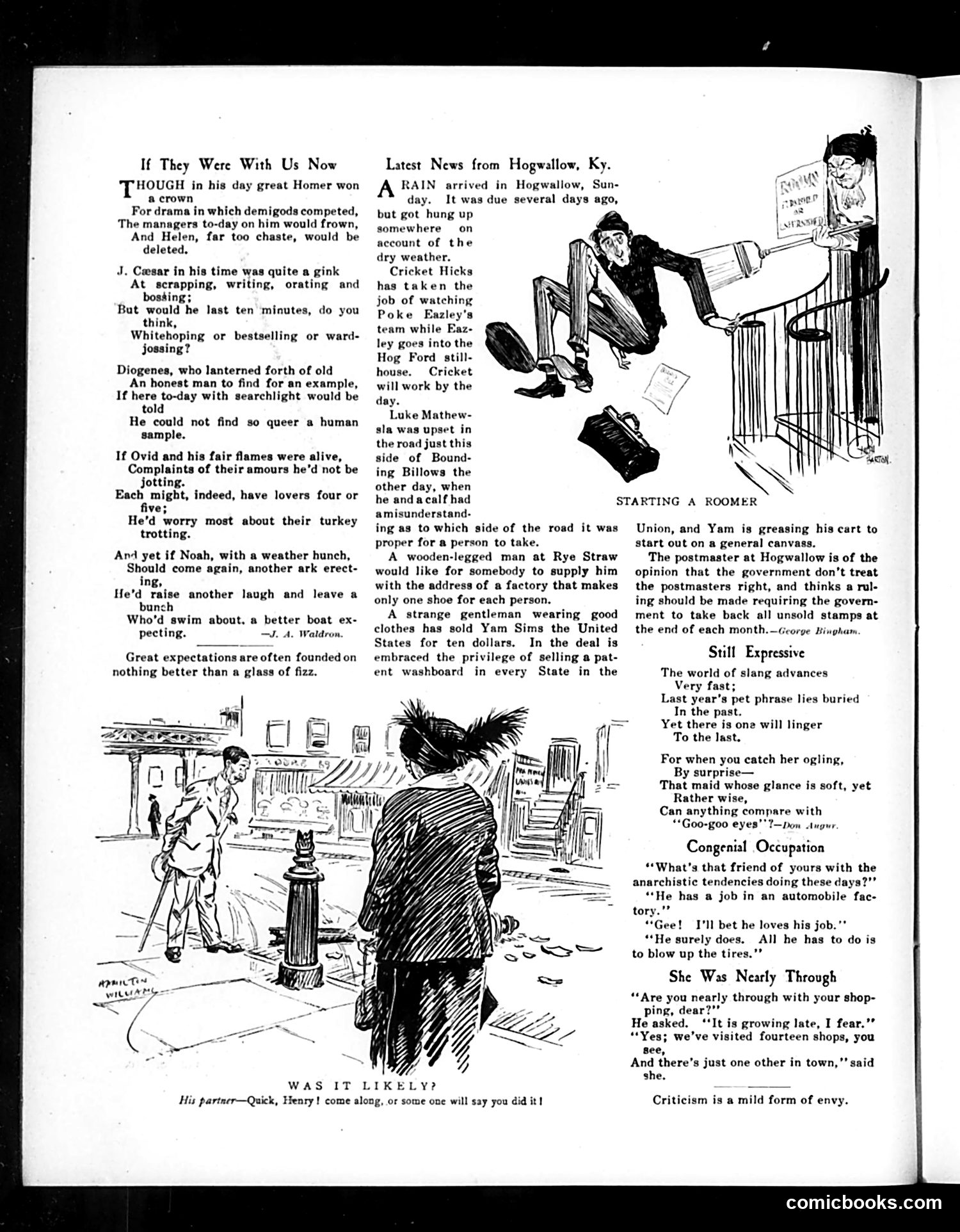
This page contains three distinct pieces of satirical content: **"If They Were With Us Now"** — A poem mocking how modern society would reject historical figures. Homer's *Helen of Troy* is "too chaste" for contemporary theater; Julius Caesar couldn't survive modern competitive business ("whitehoping" and "bestselling"); Diogenes searching for an honest man would find modern humans too strange. The joke: historical greatness means nothing in contemporary commercial culture obsessed with scandal, sales, and novelty. **"Latest News from Hogwallow, Ky."** — Humorous rural dispatches satirizing small-town absurdities: a man seeking a one-shoe factory, someone selling "the United States" for ten dollars as a patent washboard scheme, and a postmaster demanding the government buy back unsold stamps. This mocks rural gullibility and bureaucratic absurdity. **Two cartoon vignettes** illustrate urban life: one shows a man loitering near a fire hydrant while his partner urges him along (implying loitering could invite suspicion); another depicts a wife insisting on shopping at yet another store despite the hour. Both mock modern social anxieties and marital dynamics.
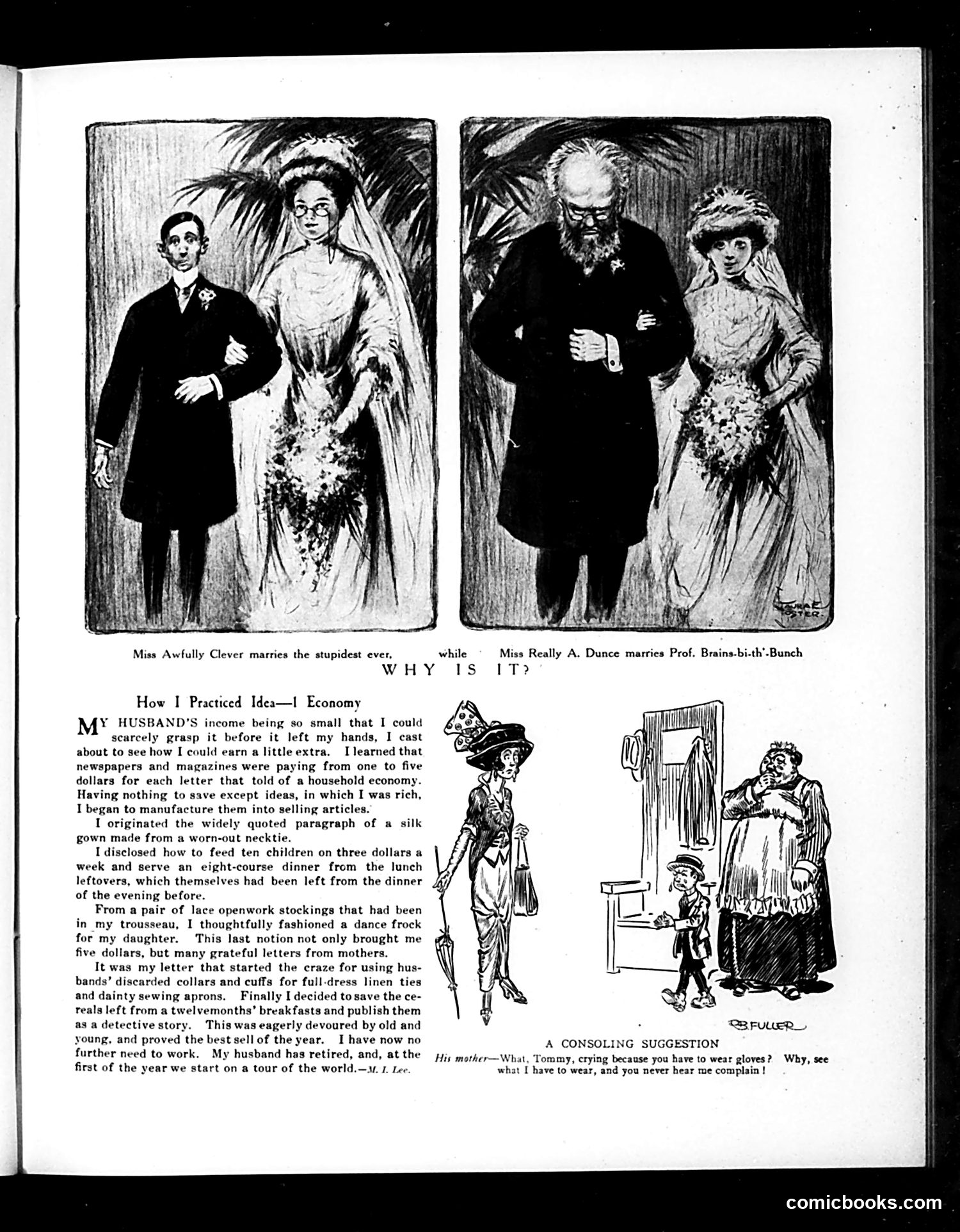
The page contains two distinct satirical pieces from *Judge* magazine: **Top Section ("Why Is It?"):** Two contrasting wedding scenes mock class disparities. "Miss Awfully Clever" marries "the stupidest ever" (left panel), while "Miss Really A. Dunce" marries "Prof. Brains-bi-th'-Bunch" (right panel). The satire questions why intelligent women marry foolish men and vice versa—critiquing marriage practices where intellect seemingly plays no role in partner selection. **Main Article ("How I Practiced Idea—! Economy"):** A first-person account by a housewife who monetizes domestic advice by writing articles about extreme frugality—feeding ten children on three dollars weekly, making dresses from worn stockings and old stockings. The satire mocks both the proliferation of housekeeping advice columns in newspapers/magazines and women's resourcefulness being commodified. Her success allows her husband to retire, suggesting ironic commentary on economic roles and gender. **Bottom Cartoon ("A Consoling Suggestion"):** A mother dismisses her son's complaint about wearing gloves by pointing to her own restrictive clothing, suggesting Victorian-era women endured greater discomfort without complaint—gentle satire of stoicism and gender expectations.
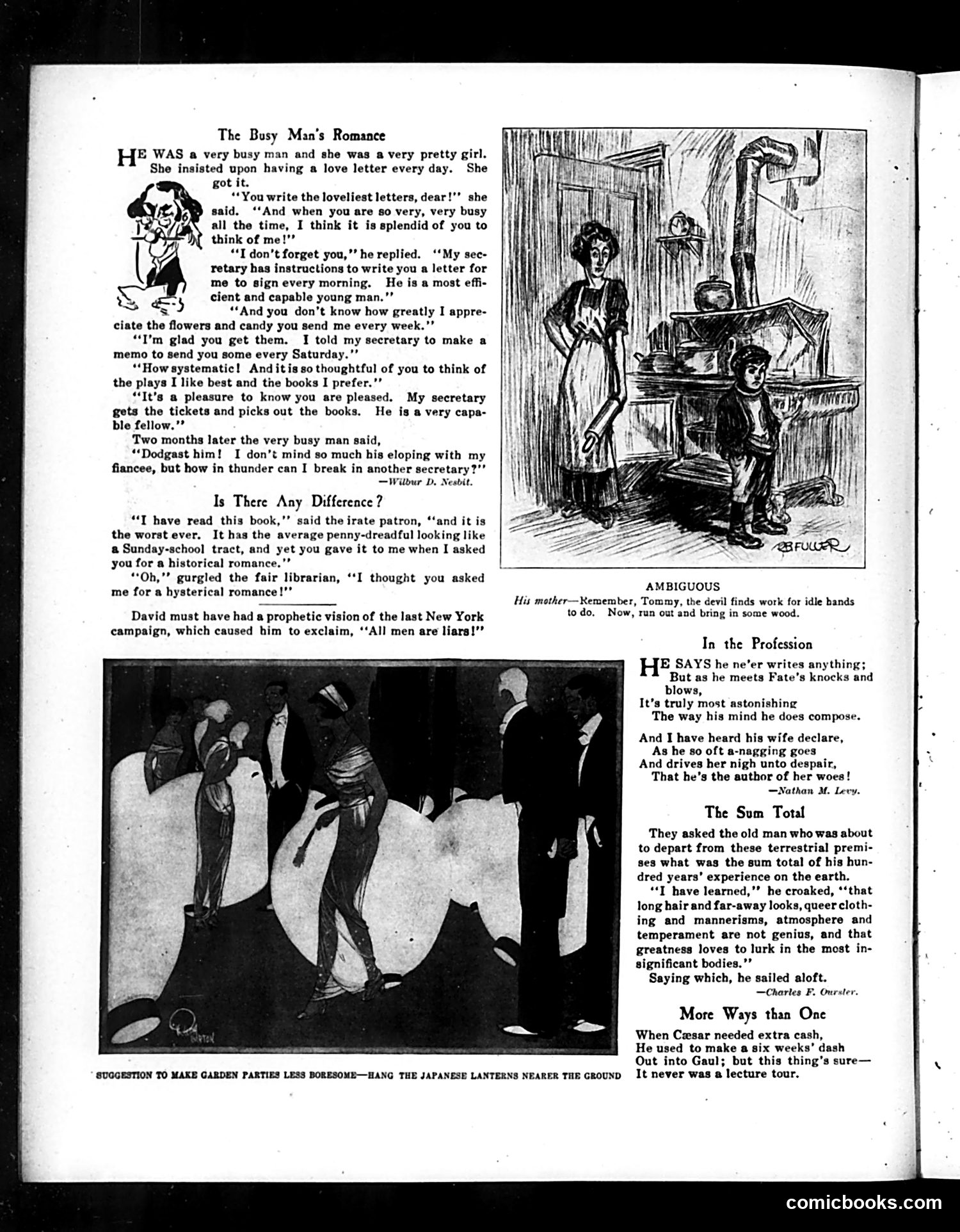
This page satirizes early-20th-century business culture and outsourcing of personal relationships. The main story mocks a wealthy businessman so preoccupied with work that he delegates *all* romantic gestures—love letters, flowers, theater tickets, books—to his secretary. The joke's punchline: the secretary elopes with his fiancée, and the busy man's only concern is losing an efficient employee, not his bride. The satire targets affluent men who substitute money and delegation for genuine attention, suggesting their relationships are hollow transactions. The businessman's shocked reaction reveals he valued the secretary's *competence* more than actual romance with his fiancée. Other brief humor pieces on the page include library patrons misremembering book titles, and quips about writing and aging—typical Judge magazine fare offering mild social commentary on manners and human folly.
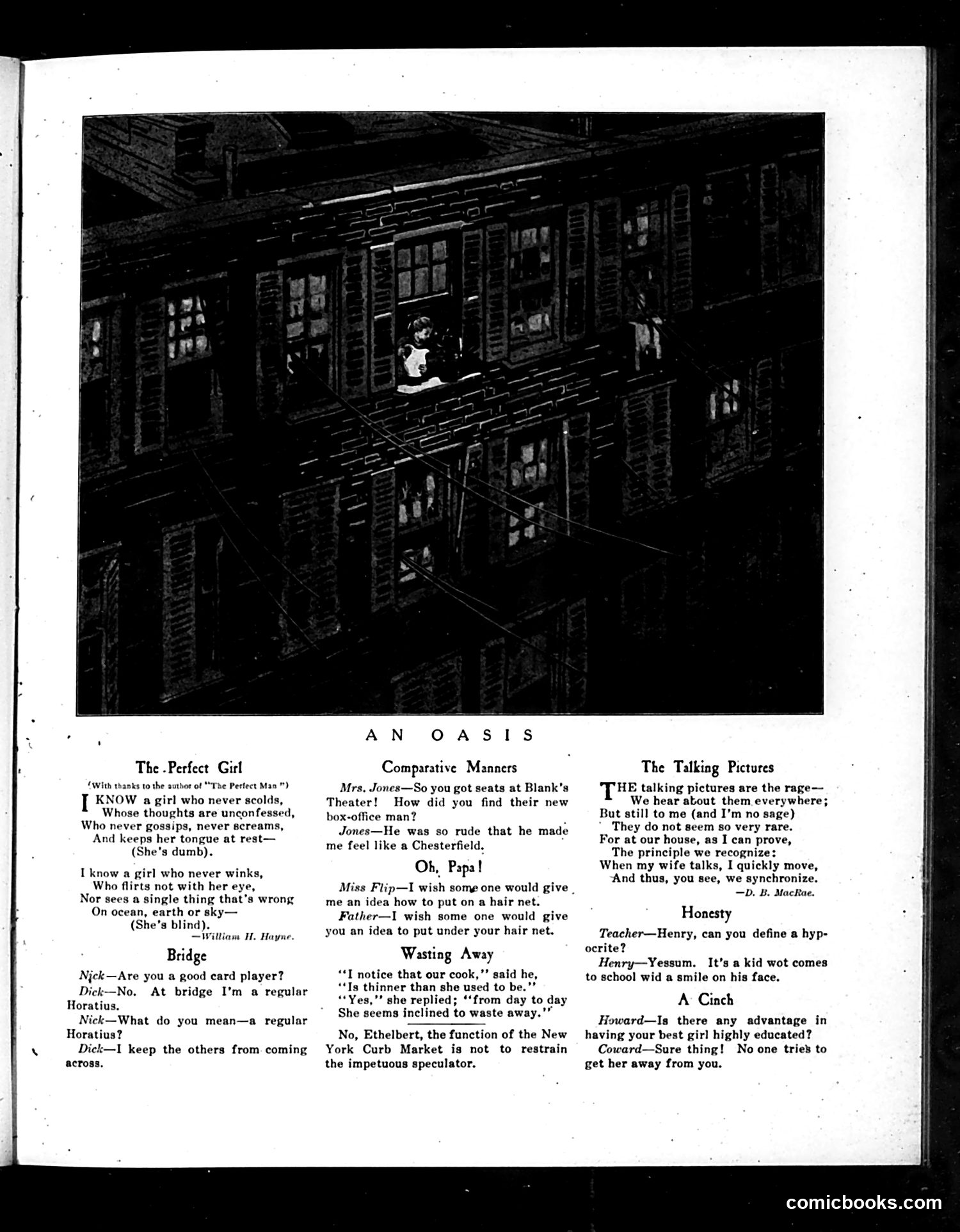
This page contains multiple short humorous pieces typical of early 20th-century satirical magazines. **The image** shows a nighttime urban tenement building with figures visible in windows—likely illustrating one of the comedic pieces below. **The jokes target social conventions and gender dynamics:** - "The Perfect Girl" satirizes idealized femininity by suggesting the "perfect" woman is actually intellectually disabled (dumb and blind). - "Bridge" plays on the word "Horatius" (referencing the classical defender who "kept the bridge"), with the punchline being social disruption at card games. - "Comparative Manners" mocks rudeness and includes a cigarette brand reference ("Chesterfield") as a simile for irritation. - "The Talking Pictures" jokes about synchronized sound films (then new technology) by comparing them to a nagging wife. - "Honesty" uses a child's blunt definition of hypocrisy (fake cheerfulness at school). - "A Cinch" suggests educated women are unattractive to potential suitors. The humor reflects period attitudes about women, class, and emerging technologies, with largely cynical takes on relationships and social behavior.
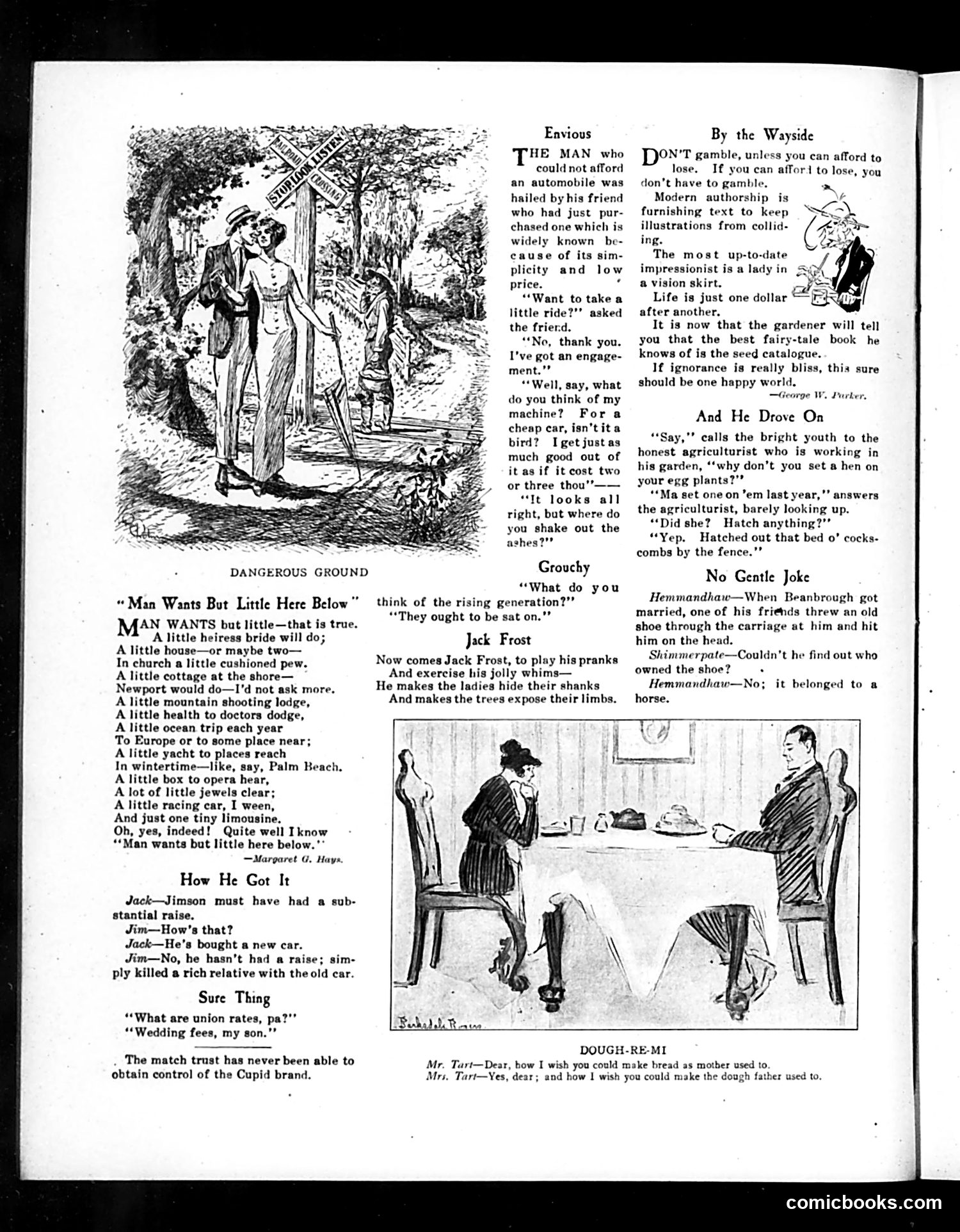
This page contains several satirical pieces mocking early 20th-century materialism and social pretension: **"Man Wants But Little Here Below"** sarcastically catalogues the supposed modest desires of wealthy men—starting with "a little heiress bride" and escalating through multiple estates, yachts, and jewelry. The joke: claims of wanting "little" mask unlimited greed. **Automobile humor** appears in multiple pieces, reflecting the era's fascination with cars as status symbols. One joke suggests a man killed a wealthy relative with his old car to afford a new one—dark satire on inheritance and class mobility. **"Jack Frost"** is a straightforward seasonal poem about winter's effects on fashion and nature. **"Dough-Re-Mi"** is a domestic joke: the wife laments her husband can't make bread like his mother; he counters that she can't make dough like her father—a pun on "dough" (money vs. batter). The cartoons and brief jokes collectively target nouveau-riche pretension, marital discord, and materialism—typical Judge targets of the era.
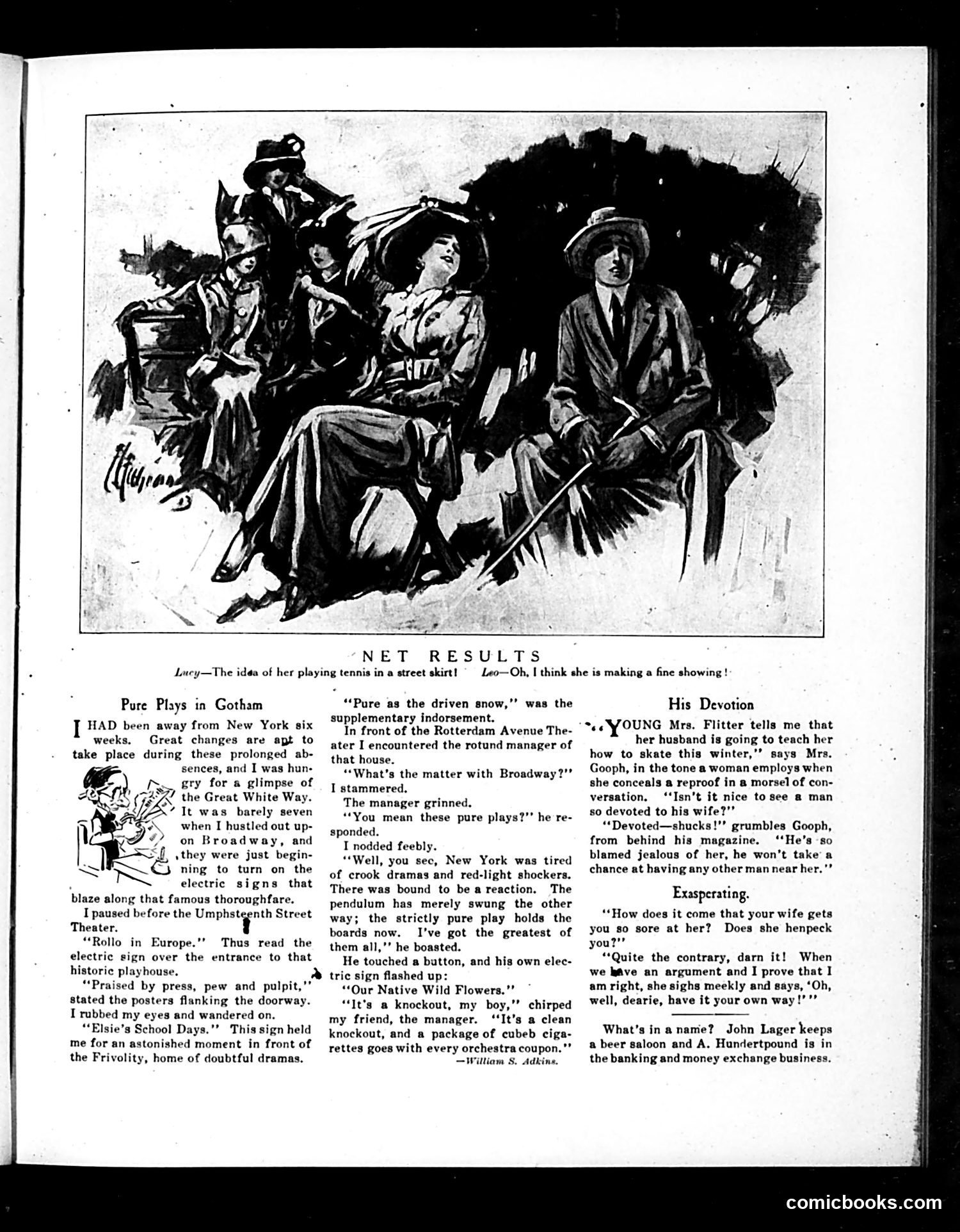
This page satirizes Broadway's theatrical trends around the early 1900s. The top cartoon mocks the theater industry's sudden shift toward "pure" plays—wholesome productions advertised with moral endorsements ("Praised by press, pew and pulpit," "Pure as the driven snow"). The satire suggests these plays are artificially marketed as morally superior to replace previous "crook dramas and red-light shockers," revealing the cynicism behind theatrical reform. The manager's boast that his "pure play" comes with free cigaret coupons undercuts the sincerity of this morality crusade. The bottom section contains unrelated comic vignettes about marital dynamics, including a joke about a husband teaching his wife to skate (motivated by jealousy, not devotion) and a pun about names like "Lager" and "Hundertpound." The top illustration shows fashionably dressed theater-goers, though the caption references a woman playing tennis improperly dressed.
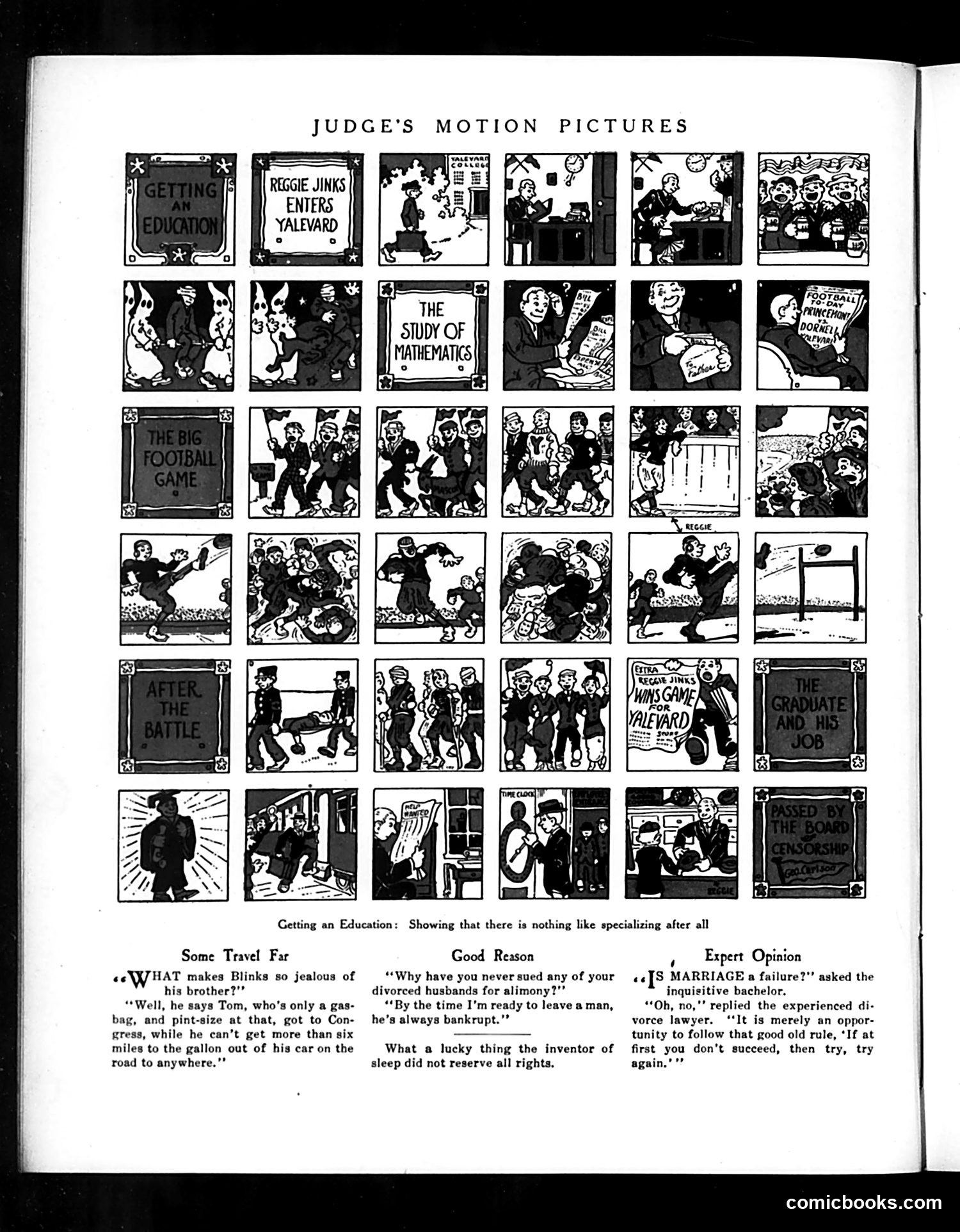
This page presents a grid of silent film-style motion picture stills (appearing to feature a character named Reggie Jinks) accompanying three separate joke strips at the bottom. The jokes satirize contemporary social issues: 1. **"Some Travel Far"**: Mocks a man jealous his brother reached Congress despite being small and ineffectual, while he can't even improve his car's fuel efficiency—suggesting political incompetence compared to personal failure. 2. **"Good Reason"**: A cynical joke about a woman who's divorced multiple times, implying her ex-husbands become financially ruined, leaving nothing to sue for in alimony claims. 3. **"Expert Opinion"**: A divorce lawyer equates marriage to a "try, try again" experiment—dark humor about serial marriage failures and the legal profession profiting from divorce. The overall theme ("showing there is nothing like specializing after all") suggests these vignettes humorously demonstrate people becoming "specialized" in particular failures: political ineptness, extracting wealth through marriage, and legal manipulation.
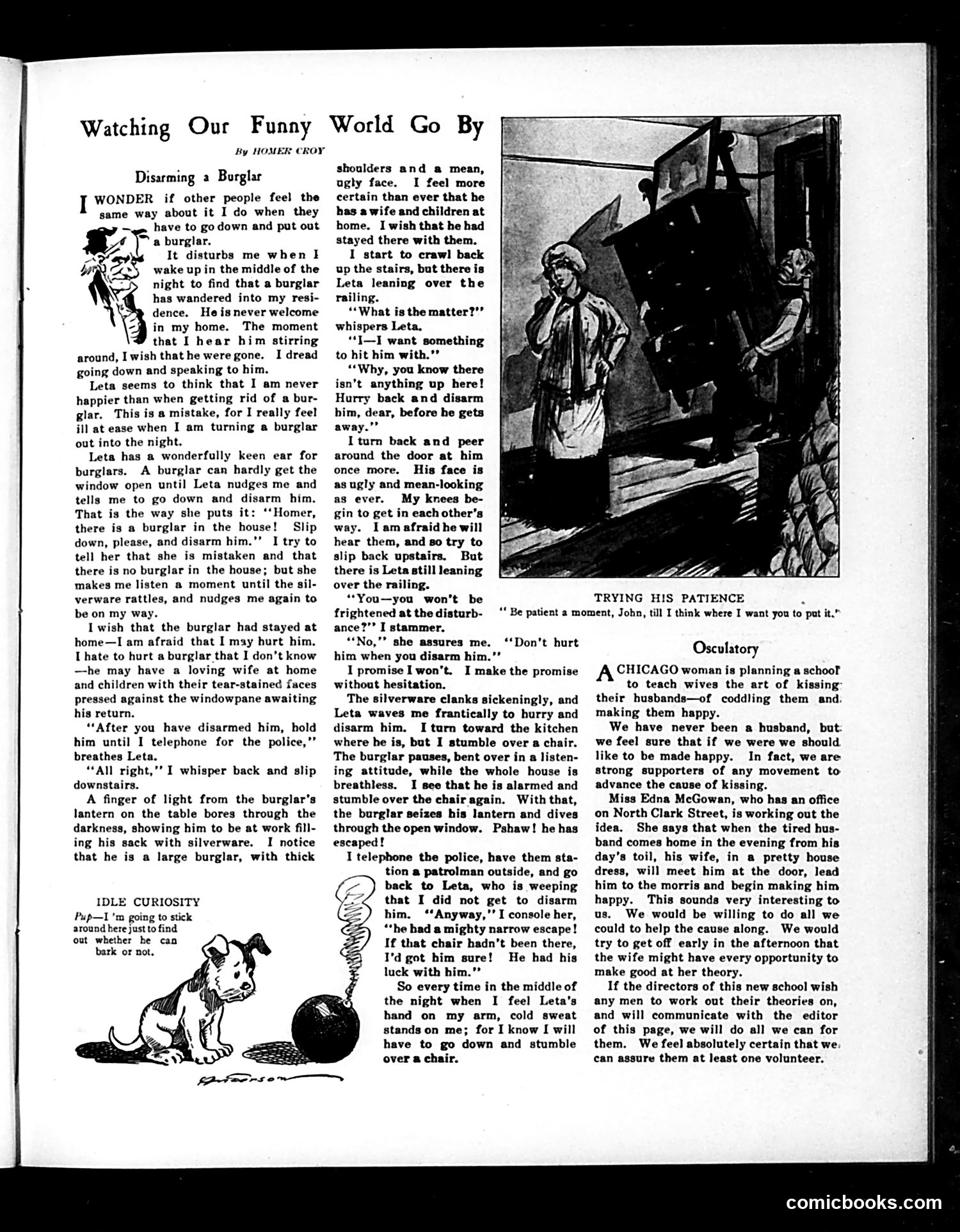
This humorous essay by Homer Croy satirizes marital dynamics through a domestic intrusion scenario. The narrator's wife "Leta" discovers a burglar and repeatedly urges her anxious, reluctant husband to "disarm" (confront and disable) the intruder. The satire targets the husband's ineffectual masculinity: he's more concerned about potentially injuring the burglar (whom he imagines has a grieving family) than protecting his own home. Leta, by contrast, is competent and decisive—she hears the burglar first and pressures her hesitant husband into action. The ironic climax reveals the husband's clumsy stumbling actually frightens the burglar away, though the narrator credits luck rather than courage. The piece gently mocks early 20th-century assumptions about gender roles: the "weaker" wife shows more backbone than the ostensible male protector, whose overthinking and squeamishness render him comically useless in a crisis. The accompanying illustration and sidebar piece about marital "kissing instruction" reinforce Judge's running commentary on marriage and domestic life.
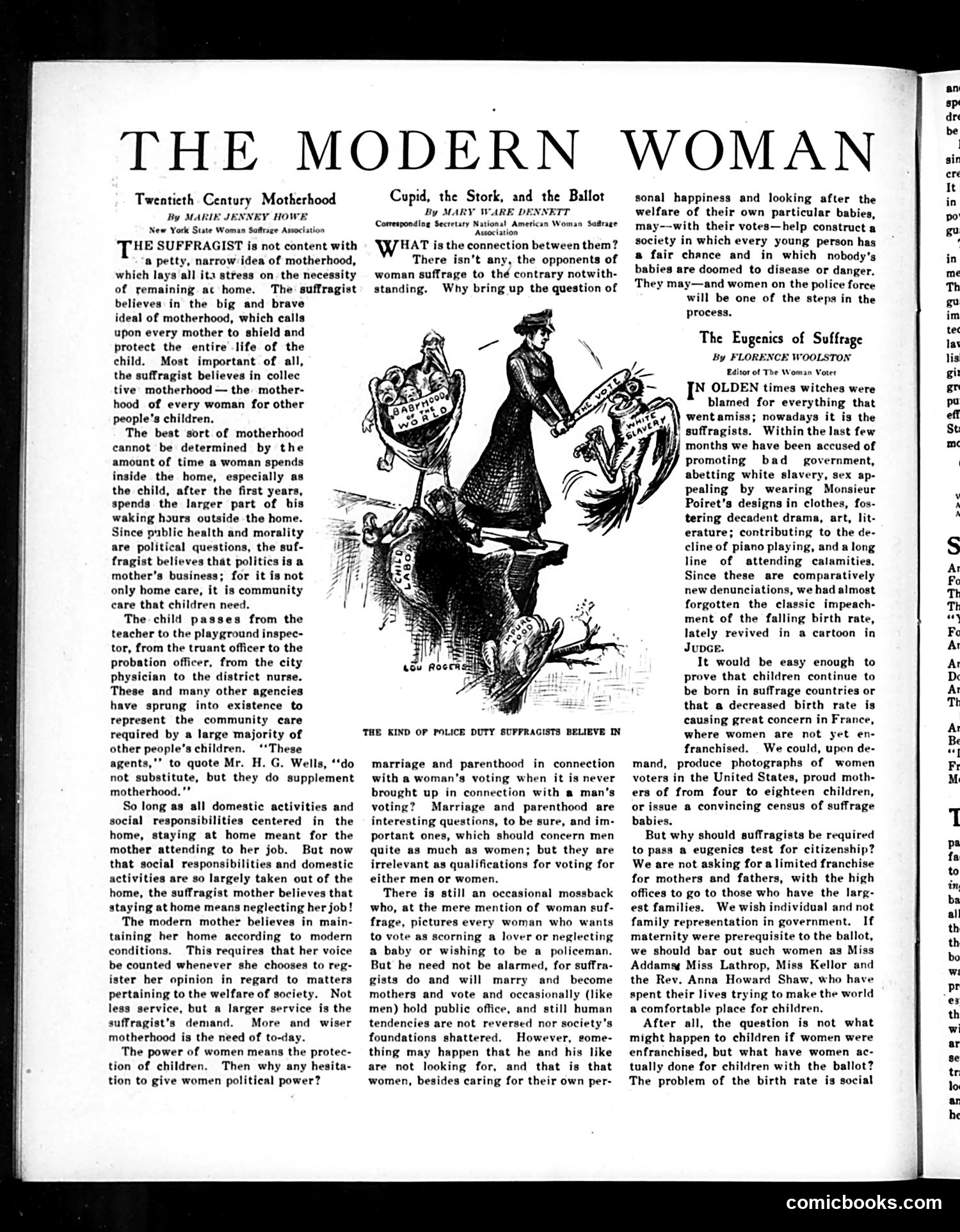
This page presents pro-suffrage arguments from the National American Woman Suffrage Association, framed as satire against anti-suffrage opponents. The central cartoon depicts a suffragist woman juggling domestic duties (represented by a baby carriage) while being pulled in multiple directions—illustrating the suffragists' argument that women's responsibilities *already* extend beyond the home into public life (schools, health inspectors, probation officers, etc.). The text sarcastically rebuts anti-suffrage claims that voting conflicts with motherhood. Marie Jenney Howe argues that modern motherhood *requires* political participation, since child welfare depends on public policy. The cartoon titled "The Kind of Police Duty Suffragists Believe In" likely mocks opponents' absurd fears that women voters would abandon families. The second article dismisses the irrelevant connection between "Cupid, the Stork, and the Ballot"—arguing that men's voting qualifications aren't questioned based on marriage/parenthood, so why should women's be? This is advocacy disguised as satirical humor.
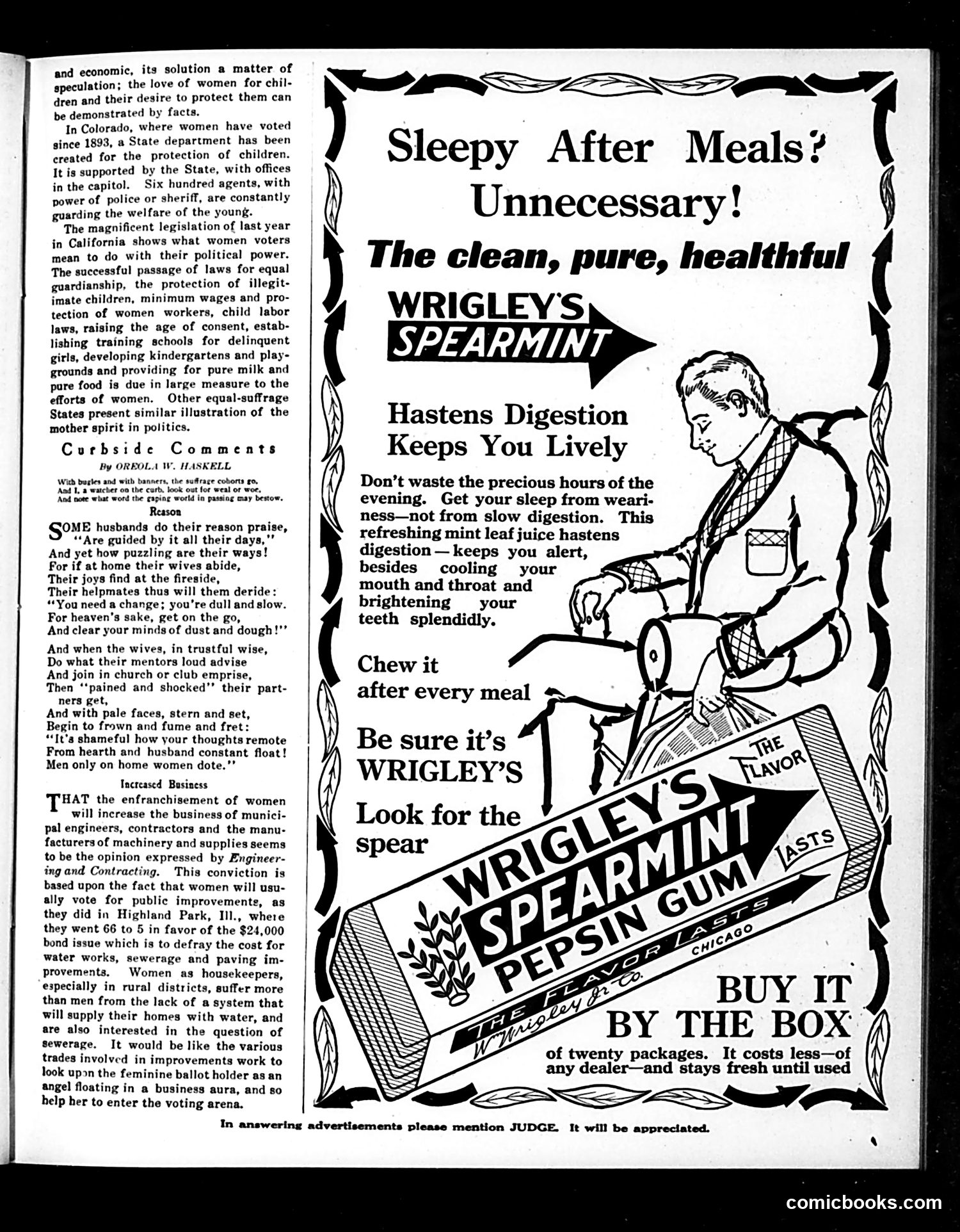
This page combines political commentary on women's suffrage with advertising. The left side features three opinion pieces arguing that women voters improve civic life: Colorado and California examples show women using voting power for child protection and labor reform. A poem mocks husbands who contradict themselves—demanding wives stay home, then complaining when they do. An editorial predicts women voters will support public infrastructure improvements, benefiting construction industries. The right side is a Wrigley's Spearmint gum advertisement claiming the product hastens digestion and prevents post-meal drowsiness, keeping one "lively." A illustrated man chews gum contentedly. The juxtaposition is striking: progressive arguments for female political participation share the page with a frivolous consumer product ad, reflecting the era's tension between suffragists' serious reform agenda and prevailing trivialization of women's concerns.
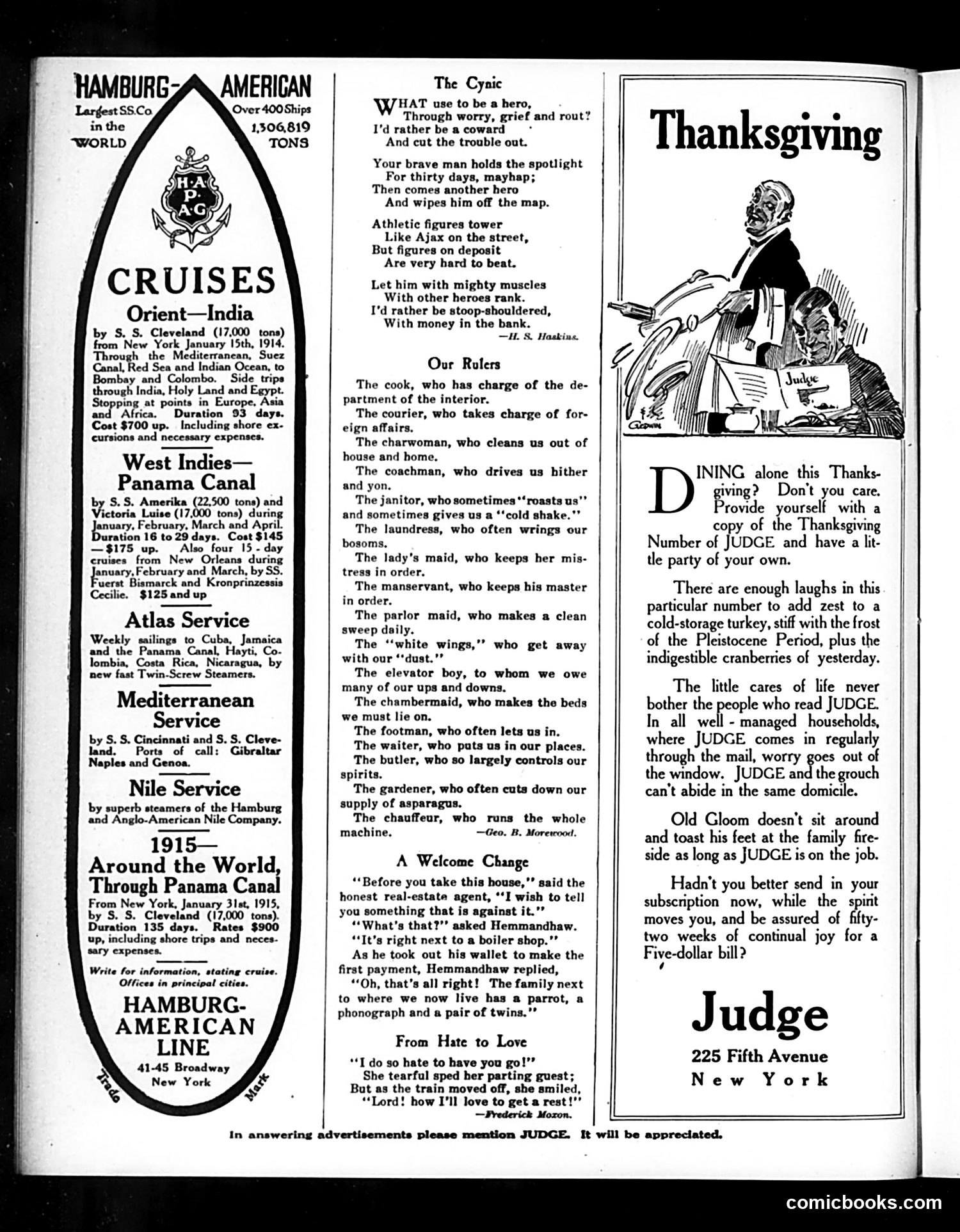
This page is primarily **advertising and filler content** from Judge magazine (circa 1914-1915). The main cartoon labeled "Thanksgiving" shows a man carving a turkey labeled "Judge" — a self-promotional visual joke encouraging readers to purchase the Thanksgiving issue as entertaining dinner company. The left side contains cruise advertisements from the Hamburg-American Line (a German shipping company), highlighting luxury ocean travel options. The middle section includes light satirical poetry and prose pieces: "The Cynic" mocks society's obsession with wealth over heroism; "Our Rulers" humorously lists household servants who actually control their employers' lives; other pieces offer gentle domestic humor about real-estate agents, noisy neighbors, and reluctant goodbyes. **No specific political figures or events** are caricatured here. This is typical Judge content: upper-class oriented, satirizing manners and social pretense rather than politics. The ads reflect pre-WWI transatlantic travel culture, before America entered the war in 1917.
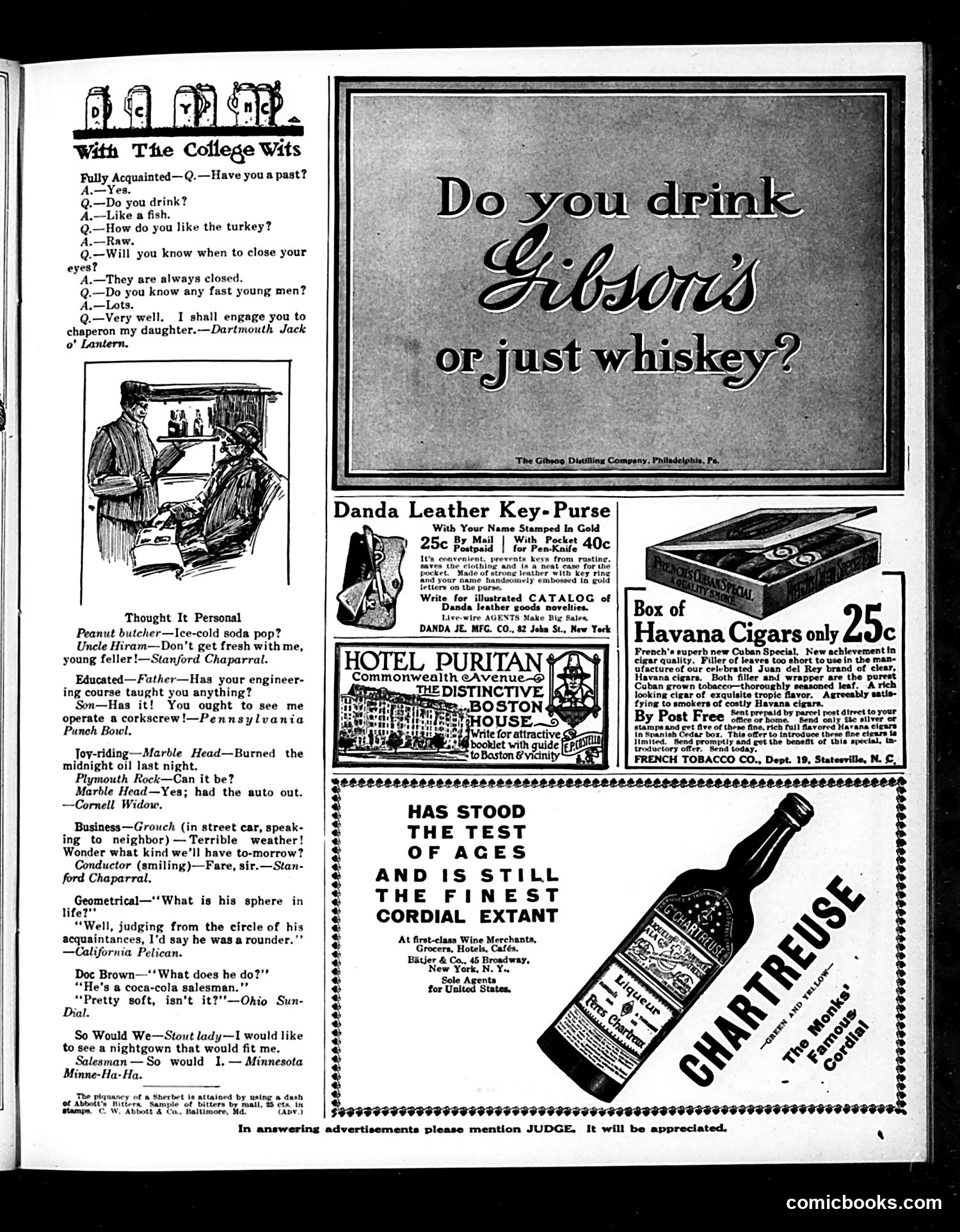
This page contains **humor columns and period advertisements**, not political cartoons. ## Content: The left side features "With The College Wits"—a Q&A humor section mocking college life. A series of jokes present a father interviewing a young woman as a potential chaperone for his daughter. The humor relies on her admitting to drinking heavily, eating messily ("Raw" turkey), and knowing "fast young men"—making her seemingly unsuitable, yet the father hires her anyway. This satirizes either parental obliviousness or the era's dating culture among the wealthy. Below are miscellaneous one-liners about daily life (peanut vendors, engineers, joy-riding, business encounters) targeting upper-class or educated audiences. ## Advertisements: The right side showcases period products: leather goods, Havana cigars (25¢), Gibson's whiskey, the Hotel Puritan in Boston, and Chartreuse liqueur—all targeting affluent readers during Prohibition's eve or early years. No identified political figures or serious social commentary appears on this page.
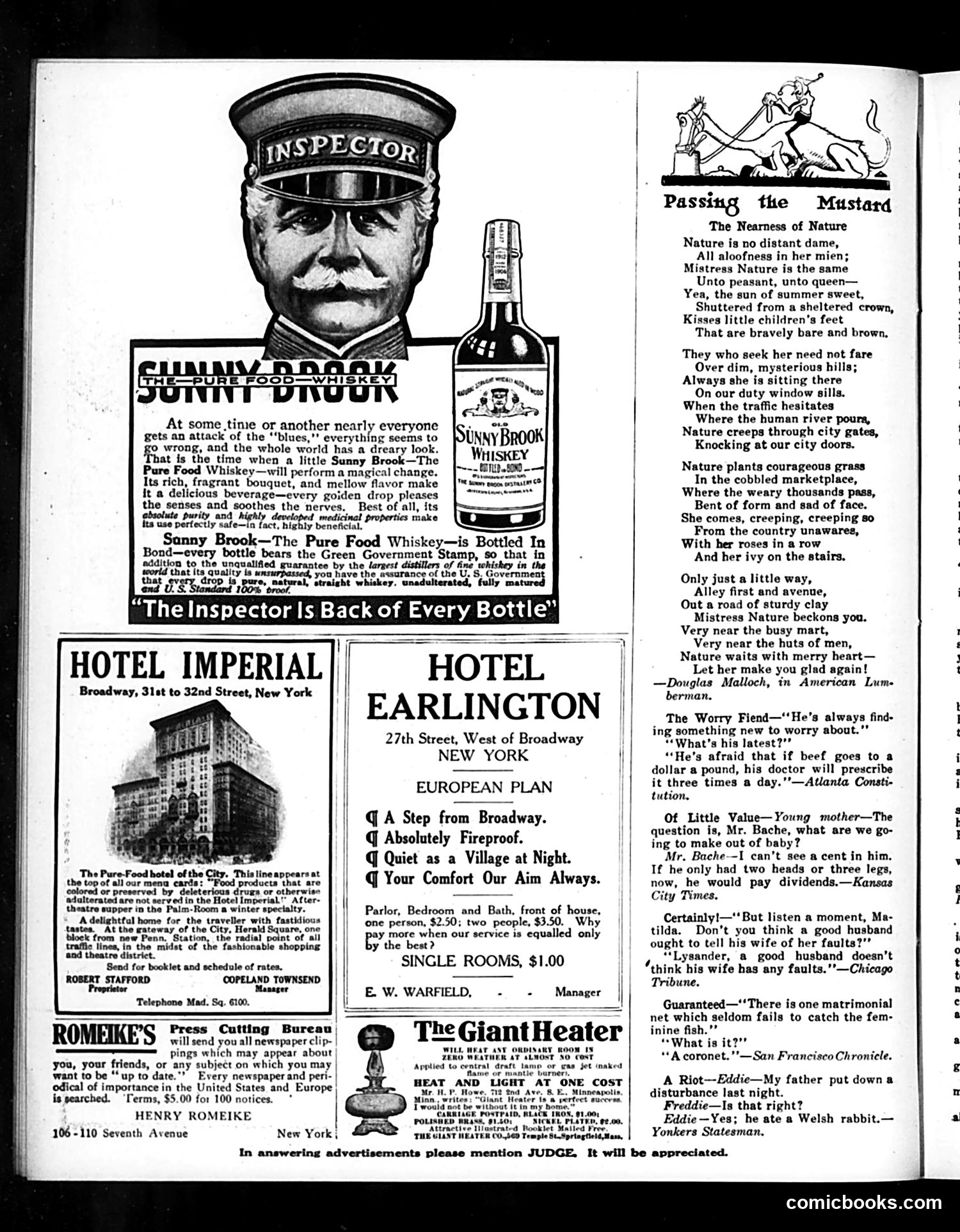
This page is primarily **advertising** rather than political satire. The dominant content features commercial advertisements for whiskey, hotels, and services typical of early 20th-century publications. The main visual element is a **Sunny Brook Whiskey ad** featuring an "Inspector" character endorsing the product as "Pure Food Whiskey" — referencing the Pure Food and Drug Act (1906), which required truthful labeling. The ad's emphasis on government inspection and bonding reflects consumer concerns about product safety and authenticity during this era. The page also includes hotel advertisements (Hotel Imperial, Hotel Earlington) and services like Romeike's Press Cutting Bureau. A poem titled "Passing the Mustard" appears on the right side. Minor humor appears in the "Worry Fiend" and other brief comic anecdotes at bottom—typical filler content for Judge magazine—but this page lacks significant political or social satire. It functions primarily as a revenue-generating advertising page rather than editorial content.
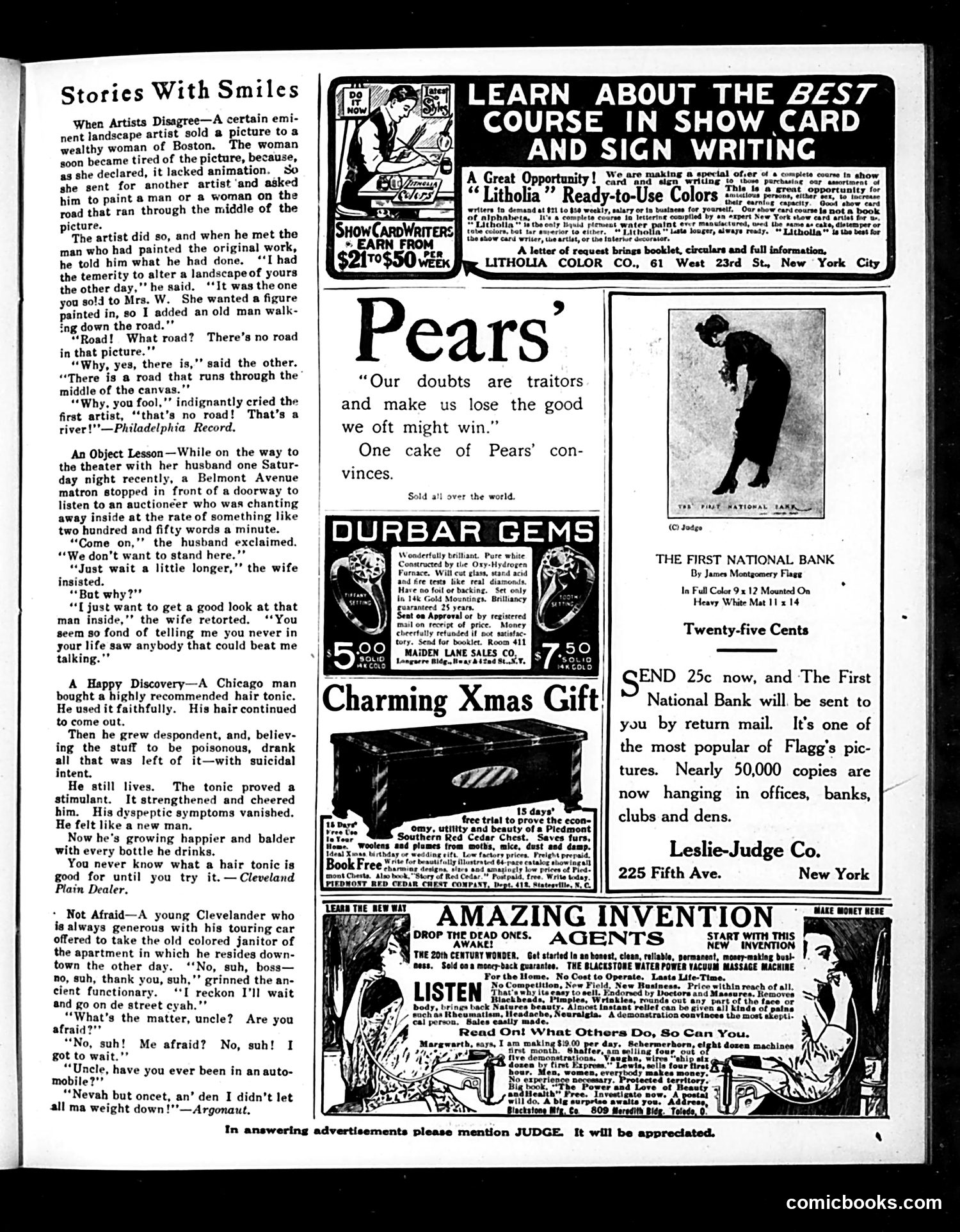
This page from *Judge* magazine consists primarily of **humorous anecdotes** ("Stories With Smiles") rather than political cartoons. The jokes satirize everyday social situations: 1. **"Artists Disagree"**: Two painters argue over whether a landscape element is a "road" or "river"—satirizing artistic pretension and miscommunication. 2. **"An Object Lesson"**: A wife stops to watch an auctioneer, claiming she wants to hear someone talk faster than she does—poking fun at talkative spouses. 3. **"A Happy Discovery"**: A man's hair tonic fails at its intended purpose but accidentally cures his indigestion—mocking patent medicine claims and unintended consequences. 4. **"Not Afraid"**: A Black janitor declines a car ride, preferring the streetcar—the humor relies on period racial stereotypes and dialect. The remainder is **advertising** for art supplies, banking services, and various products. There is no significant political satire on this particular page.
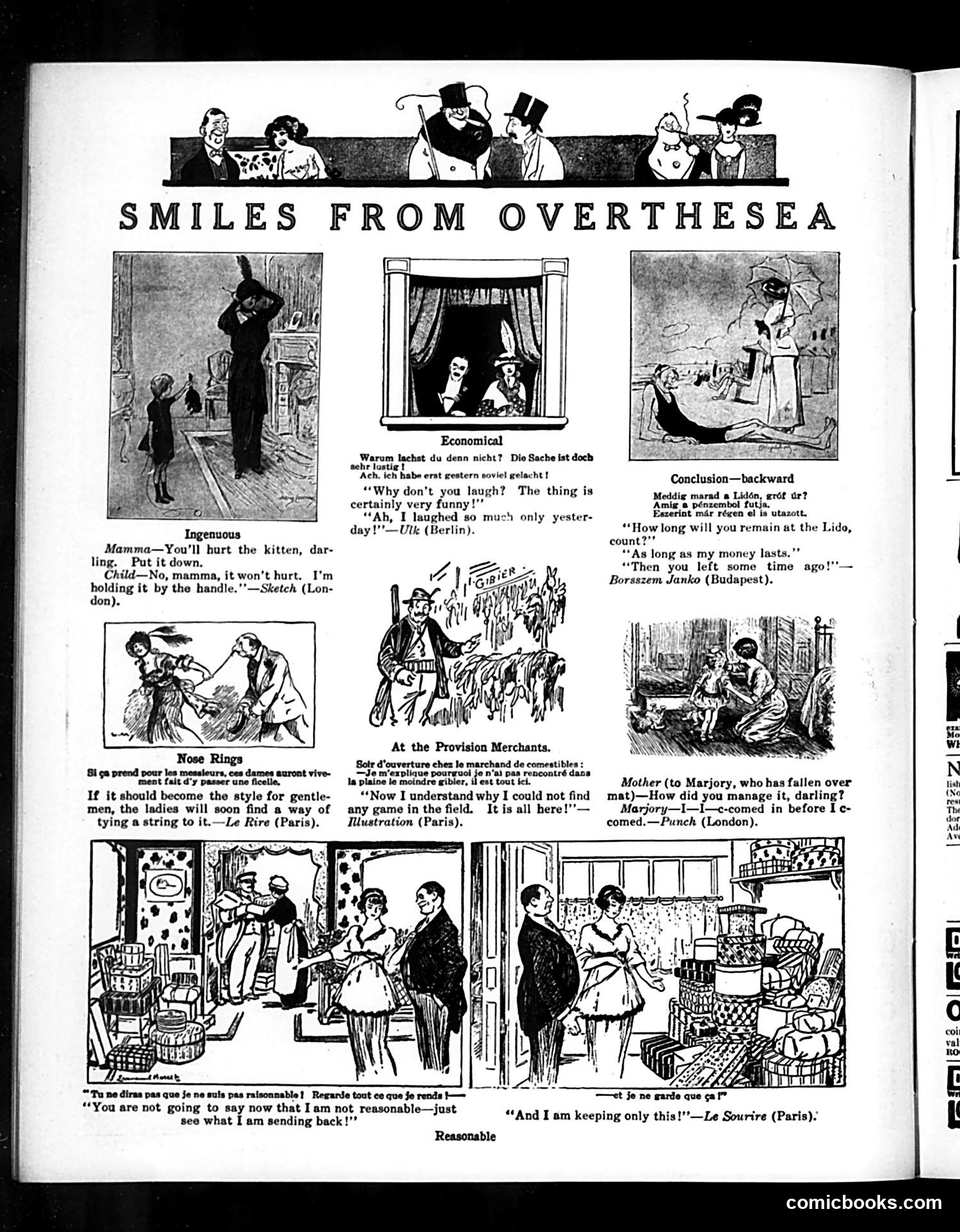
This page collates humorous cartoons and jokes from European publications (Punch, Le Rire, Ulk, Illustration, Borsszem Janko, Le Sourire). Each depicts everyday domestic or social situations treated as comedy: - A child holding a kitten "by the handle" misunderstands how to hold animals - A woman struggling with a kitten inspires jokes about fashionable accessories - A hunter realizes game is unavailable because it's all been purchased at market - A woman claims unreasonable generosity while returning most of a purchase - A nobleman's money lasting determines his vacation length - A child's confused speech about "coming in before coming" The satire is gentle, focusing on human absurdity rather than political targets. The international sources suggest this was a lighthearted "world humor" compilation, meant to entertain American readers with amusing observations of European life and character—implying a shared cultural understanding across nations despite recent WWI tensions.
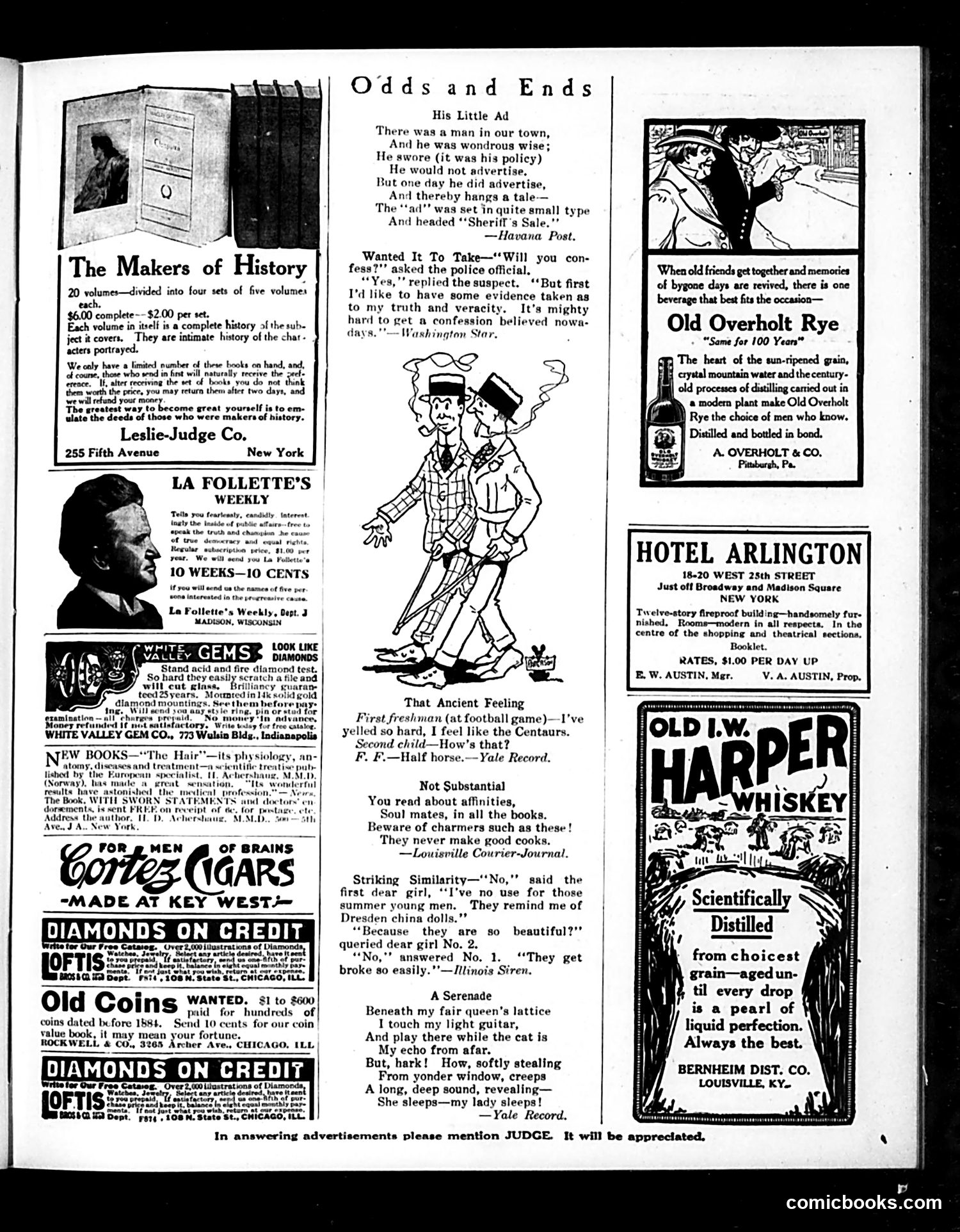
This page is primarily a collection of **advertisements and light humor pieces** rather than political satire. The content includes: **Central Cartoon**: A humorous illustration labeled "That Ancient Feeling" depicts a football game exchange where a freshman, exhausted from yelling, says he "feels like the Centaurs" (being half-horse). This is straightforward wordplay without political significance. **Surrounding Humor Pieces**: Short jokes on topics like reluctant advertisers, police confessions, "soul mates," and romantic serenades—all genteel, domestic humor typical of early 20th-century magazine filler. **Advertisements**: Various ads for books, coins, diamonds, whiskey (Old Overholt Rye), a hotel, and cigars occupy most of the page. **Notable Element**: La Follette's Weekly appears here—Robert La Follette's progressive magazine, indicating Judge's audience included politically-engaged readers, though this particular page lacks political content. The page represents typical Judge content: advertising-heavy with light, non-controversial jokes aimed at middle-class readers.
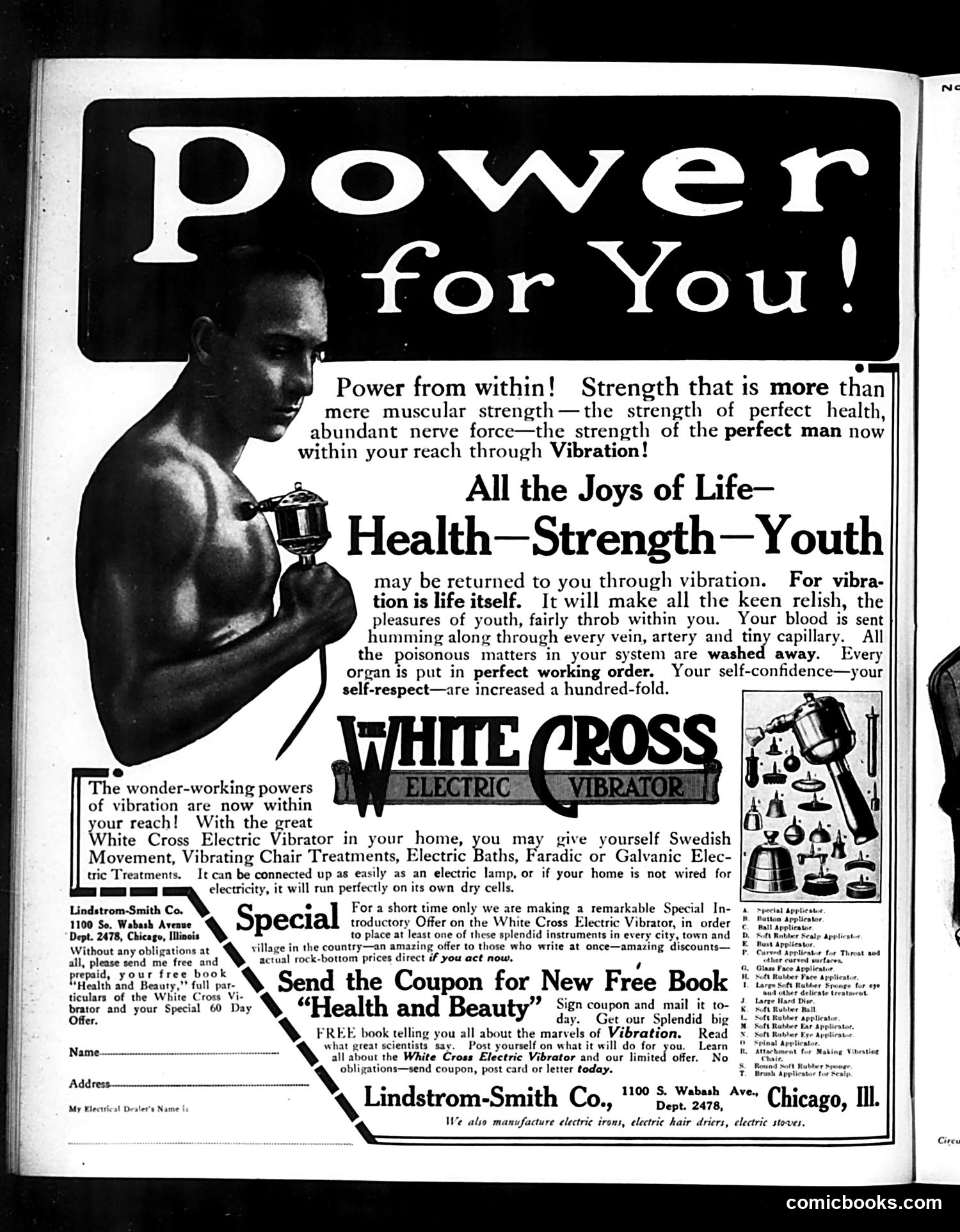
This page is **primarily a product advertisement**, not satire or political commentary. It promotes the White Cross Electric Vibrator, a mail-order medical device from Lindstrom-Smith Co. (Chicago). **The "Product" and Its Claims:** The vibrator promises extraordinary health benefits—strength, youth, perfect organs, improved blood circulation, and removal of "poisonous matters." It claims to deliver "Swedish Movement" treatments and "galvanic" therapy at home, as easily as an electric lamp. **Historical Context (for modern readers):** This represents early 20th-century pseudoscientific medicine. Electric vibrators were genuinely marketed as cure-alls during this era, before FDA regulation. The muscular male figure and promises of restored "self-respect" reflect period anxieties about masculine vitality. **Why it appears in *Judge*:** As a satirical magazine, *Judge* likely ran such advertisements satirically—the absurdly grandiose claims ("strength of the perfect man") and vague pseudo-scientific language were targets of contemporary humor. The gap between promise and reality would have been apparent to readers. This is a period artifact illustrating both consumer gullibility and early advertising manipulation.