
Judge, 1913-11-08 · page 4 of 26
Judge — November 8, 1913 — page 4: what you’re looking at
What you’re looking at
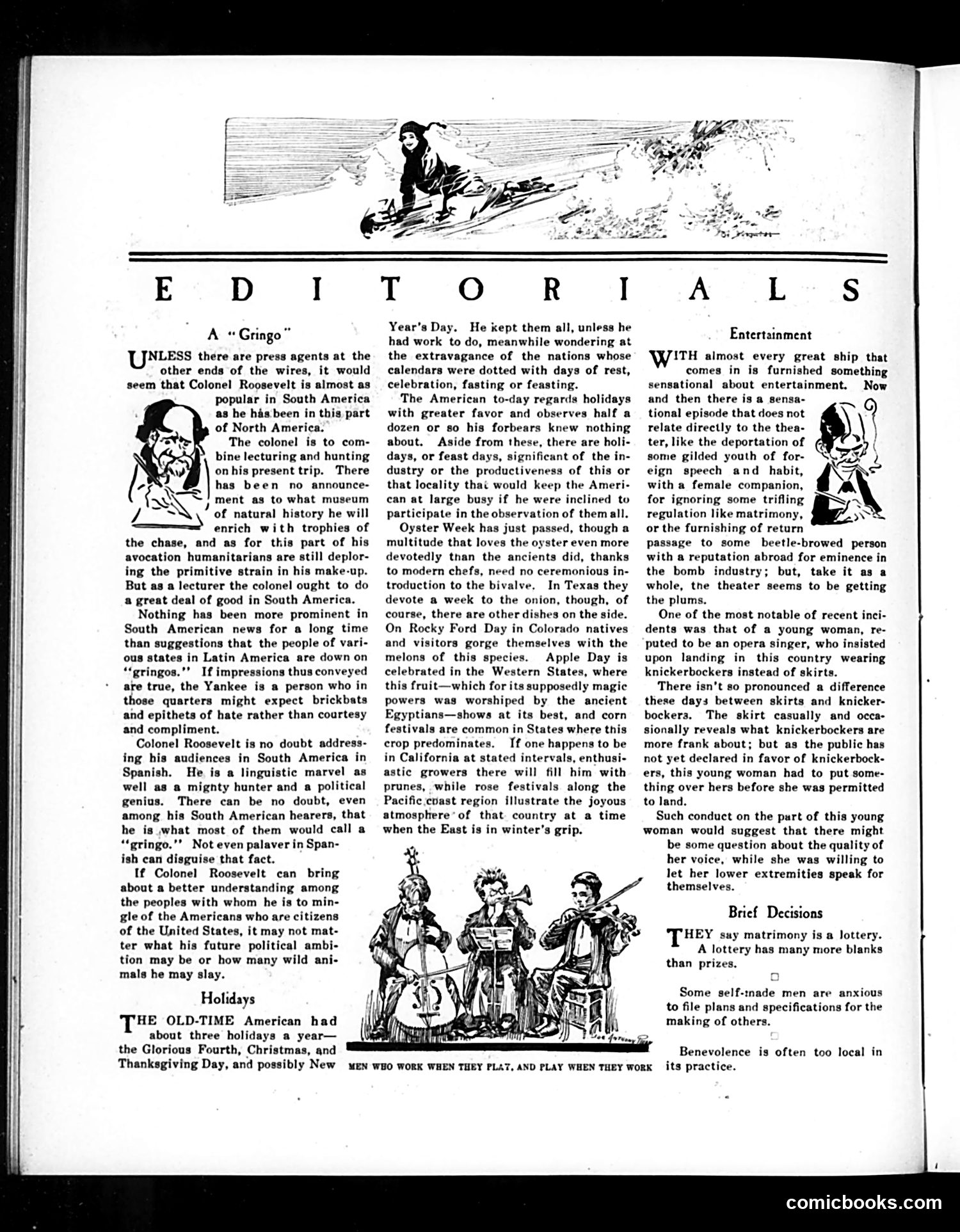
This page contains editorials and satirical commentary rather than political cartoons. The main content discusses Colonel Roosevelt's activities in South America, praising his efforts to improve understanding between the U.S. and Latin American nations. The text suggests Roosevelt's popularity and diplomatic skill could help Americans better comprehend their southern neighbors. The "Holidays" section discusses traditional American celebrations (Fourth of July, Christmas, Thanksgiving) and regional American customs like Oyster Week and Apple Day, contrasting old-time American practices with contemporary observations. The decorative illustrations show period musicians and appear merely ornamental rather than satirical commentary. The "Brief Decisions" section offers cynical aphorisms about matrimony and human nature typical of Judge's humor style.
📄 Transcribed text from this page (OCR, searchable)
Machine-transcribed from the original scan — historical spelling and the odd misread are preserved.
E D I A “Gringo” USLEss there are press agents at the other ends of the wires, it would seem that Colonel Roosevelt is almost as popular in South America as he has been in this part of North America. The colonel is to com- bine lecturing and hunting on his present trip. There has been no announce- ment as to what museum of natural history he will enrich with trophies of the chase, and as for this part of his avocation humanitarians are still deplor- ing the primitive strain in his make-up. But as a lecturer the colonel ought to do a great deal of good in South America. Nothing has been more prominent in South American news for a long time than suggestions that the people of vari- ous states in Latin America are down on “‘gringos.’’ If impressions thus conveyed are true, the Yankee is a person who in those quarters might expect brickbats and epithets of hate rather than courtesy and compliment. Colonel Roosevelt is no doubt address- ing his audiences in South America in Spanish. He is a linguistic marvel as well as a mignty hunter and a political genius. There can be no doubt, even among his South American hearers, that he is what most of them would call a “‘gringo.’’ Not even palaver in Span- ish can disguise that fact. If Colonel Roosevelt can bring about a better understanding among the peoples with whom he is to min- gle of the Americans who are citizens of the United States, it may not mat- ter what his future political ambi- tion may be or how many wild ani- mals he may slay. Holidays THE OLD-TIME American had about three holidays a year— the Glorious Fourth, Christmas, and T O R J Year's Day. He kept them all, unless he had work to do, meanwhile wondering at the extravagance of the nations whose calendars were dotted with days of rest, celebration, fasting or feasting. The American to-day regards holidays with greater favor and observes half a dozen or so his forbears knew nothing about. Aside from these, there are holi- days, or feast days, significant of the in- dustry or the productiveness of this or that locality thai would keep the Ameri- can at large busy if he were inclined to participate in the observation of them all. Oyster Week has just passed, though a multitude that loves the oyster even more devotedly than the ancients did, thanks to modern chefs, need no ceremonious in- troduction to the bivalve, In Texas they devote a week to the onion, though, of course, there are other dishes on the side. On Rocky Ford Day in Colorado natives and visitors gorge themselves with the melons of this species. Apple Day is celebrated in the Western States, where this fruit—which for its supposedly magic powers was worshiped by the ancient Egyptians—shows at its best, and corn festivals are common in States where this crop predominates. If one happens to be in California at stated intervals, enthusi- astic growers there will fill him with prunes, while rose festivals along the Pacific coast region illustrate the joyous atmosphere’ of that country at a time when the East is in winter's grip. A L_S§& Entertainment WITH almost every great ship that comes in is furnished something sensational about entertainment. Now and then there is a sensa- tional episode that does not Ve 9 relate directly to the thea- | ter, like the deportation of | some gilded youth of for- eign speech and _ habit, with a female companion, » for ignoring some trifling A regulation like matrimony, we or the furnishing of return passage to some beetle-browed person with a reputation abroad for eminence in the bomb industry; but, take it as a whole, the theater seems to be getting the plums. One of the most notable of recent inci- dents was that of a young woman, re- puted to be an opera singer, who insisted upon landing in this country wearing knickerbockers instead of skirts. There isn’t so pronounced a difference these days between skirts and knicker- bockers. The skirt casually and occa- sionally reveals what knickerbockers are more frank about; but as the public has not yet declared in favor of knickerbock- ers, this young woman had to put some- thing over hers before she was permitted to land. Such conduct on the part of this young woman would suggest that there might be some question about the quality of her voice, while she was willing to let her lower extremities speak for themselves. Brief Decisions THEY suy matrimony is a lottery. A lottery has many more blanks than prizes. Some self-:nade men are anxious to file plans and specifications for the making of others. Benevolence is often too local in Thanksgiving Day, and possibly New en wao WoRK WHEN THEY PLAT, AND PLAY WHEN THEY Work its practice. comicbooks.com