
Judge, 1913-11-08 · page 14 of 26
Judge — November 8, 1913 — page 14: what you’re looking at
What you’re looking at
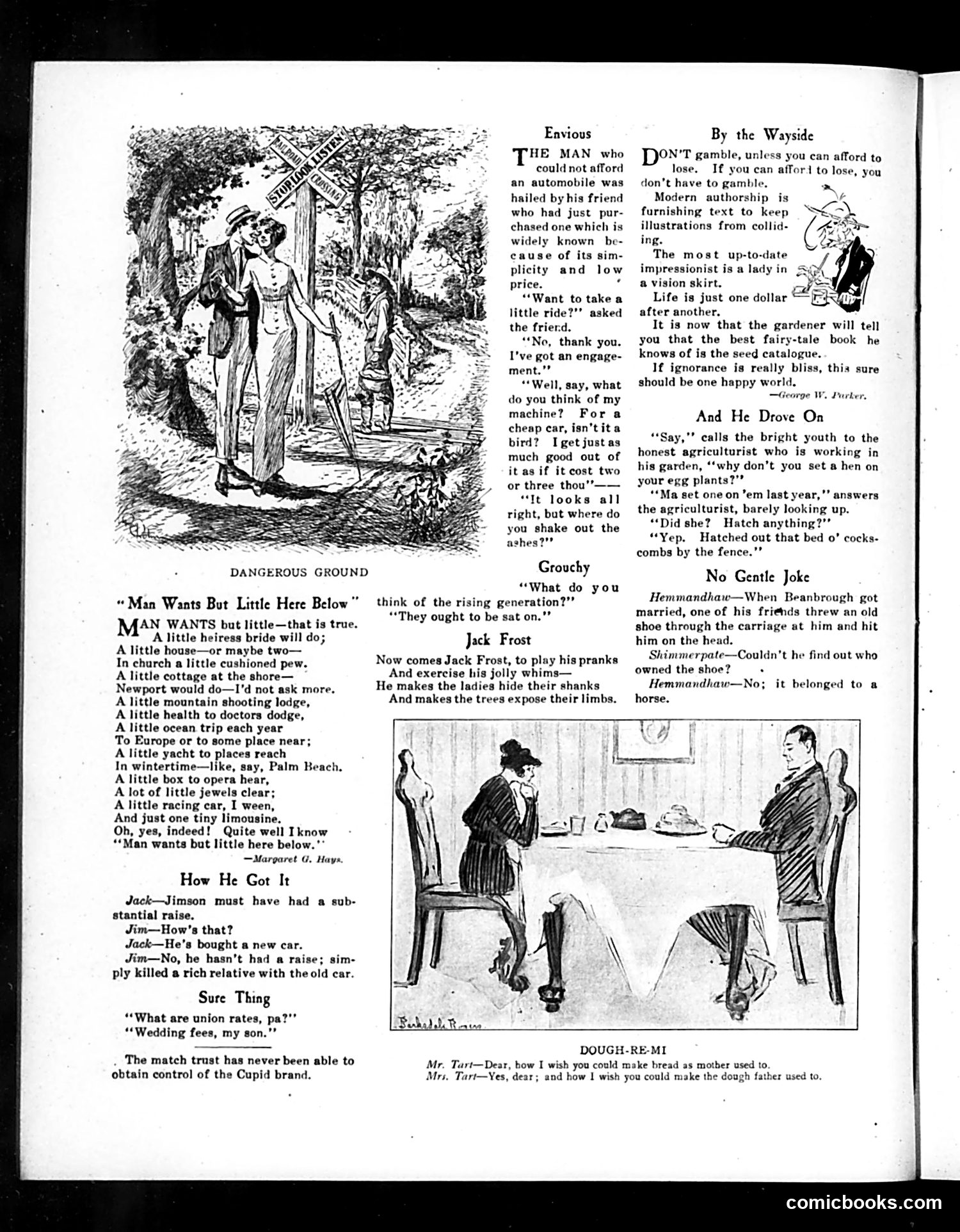
This page contains several satirical pieces mocking early 20th-century materialism and social pretension: **"Man Wants But Little Here Below"** sarcastically catalogues the supposed modest desires of wealthy men—starting with "a little heiress bride" and escalating through multiple estates, yachts, and jewelry. The joke: claims of wanting "little" mask unlimited greed. **Automobile humor** appears in multiple pieces, reflecting the era's fascination with cars as status symbols. One joke suggests a man killed a wealthy relative with his old car to afford a new one—dark satire on inheritance and class mobility. **"Jack Frost"** is a straightforward seasonal poem about winter's effects on fashion and nature. **"Dough-Re-Mi"** is a domestic joke: the wife laments her husband can't make bread like his mother; he counters that she can't make dough like her father—a pun on "dough" (money vs. batter). The cartoons and brief jokes collectively target nouveau-riche pretension, marital discord, and materialism—typical Judge targets of the era.
📄 Transcribed text from this page (OCR, searchable)
Machine-transcribed from the original scan — historical spelling and the odd misread are preserved.
i Ses Ts Pp DANGEROUS GROUND «Man Wants But Little Here Below” AN WANTS but little—that is true. A little heiress bride will do; A little house—or maybe two— In church a little cushioned pew. A little cottage at the shore Newport would do—I'd not ask more. A little mountain shooting lodge, A little health to doctors dodge, A little ocean trip each year To Europe or to some place near; A little yacht to places reach In wintertime—like, say, Palm Beach. A little box to opera hear, A lot of little jewels clear; A little racing car, I ween, And just one tiny limousine. Oh, yes, indeed! Quite well Iknow “Man wants but little here below.’* Margaret G. Hays. How He Got It Jack—Jimson must have had a sub- stantial raise. Jim—How's that? Jack—He's bought a new car. Jim—No, he hasn’t had a raise; sim- ply killed a rich relative with the old car. Sure Thing “What are union rates, pa?’ “‘Wedding fees, my son.’” . The match trust has never been able to obtain control of the Cupid brand. Envious THE MAN who could not afford an automobile was hailed by his friend who had just pur- chased one which is widely known be- cause of its sim- plicity and low price. , “Want to takea little ride?’’ asked the friend. “No, thank you. I've got an engage- ment."” “Well, say, what do you think of my machine? For a cheap car, isn’tita bird? Igetjustas much good out of itas if it cost two or three thou’’—— “It looks all right, but where do you shake out the ashes?"" Grouchy “What do you think of the rising generation?” “They ought to be sat on.’” Jack Frost Now comes Jack Frost, to play his pranks And exercise his jolly whims— He makes the ladies hide their shanks And makes the trees expose their limbs. By the Wayside ON'T gamble, unless you can afford to lose. If you can afford to lose, you don’t have to gamble. Modern authorship is furnishing text to keep illustrations from collid- ing. The most up-to-date impressionist is a lady in a vision skirt. = i el Life is just one dollar j= after another, It is now that the gardener will tell you that the best fairy-tale book he knows of is the seed catalogue. If ignorance is really bliss, this sure should be one happy world. George W. Purker. And He Drove On “Say,’’ calls the bright youth to the honest agriculturist who is working in his garden, ‘‘why don’t you set a hen on your egg plants?”” **Ma set one on ’em last year,’’ answers the agriculturist, barely looking up. “Did she? Hatch anything?” “Yep. Hatched out that bed 0’ cocks- combs by the fence.’’ No Gentle Joke Hemmandhaw—When Beanbrough got married, one of his friends threw an old shoe through the carriage at him and hit him on the head. Shimmerpate—Couldn’t he find out who owned the shoe? . Hemmandhaw—No; horse. it belonged to a [Bekah DOUGH-RE-MI Mr. Tart—Dear, bow I wish you could make bread as mother used to. Mrs. Tart—Yes, dear; and how | wish you could make the dough father used to. comicbooks.com