
Judge, 1913-11-08 · page 12 of 26
Judge — November 8, 1913 — page 12: what you’re looking at
What you’re looking at
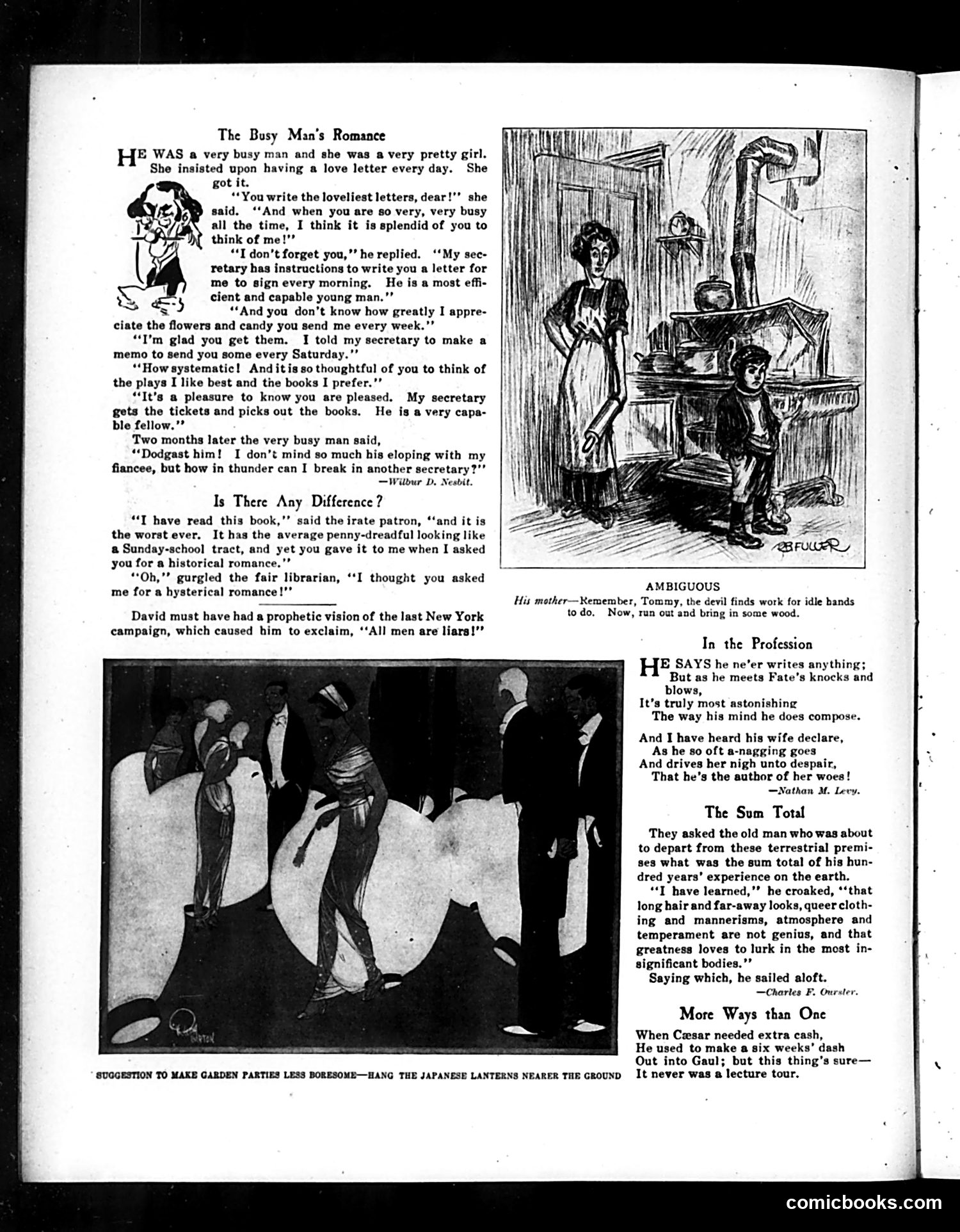
This page satirizes early-20th-century business culture and outsourcing of personal relationships. The main story mocks a wealthy businessman so preoccupied with work that he delegates *all* romantic gestures—love letters, flowers, theater tickets, books—to his secretary. The joke's punchline: the secretary elopes with his fiancée, and the busy man's only concern is losing an efficient employee, not his bride. The satire targets affluent men who substitute money and delegation for genuine attention, suggesting their relationships are hollow transactions. The businessman's shocked reaction reveals he valued the secretary's *competence* more than actual romance with his fiancée. Other brief humor pieces on the page include library patrons misremembering book titles, and quips about writing and aging—typical Judge magazine fare offering mild social commentary on manners and human folly.
📄 Transcribed text from this page (OCR, searchable)
Machine-transcribed from the original scan — historical spelling and the odd misread are preserved.
The Busy Man's Romance HE WAS a very busy man and she was a very pretty girl. She insisted upon having a love letter every day. She got it. “You write the loveliest letters, dear!’’ she said. ‘‘And when you are 80 very, very busy all the time, I think it is splendid of you to think of me!"’ “I don’t forget you,’’ he replied. ‘‘My sec- retary has instructions to write you a letter for me to sign every morning. He is a most effi- cient and capable young man.’’ “And you don’t know how greatly I appre- ciate the flowers and candy you send me every week.”’ “I'm glad you get them. I told my secretary to make a memo to send you some every Saturday.’’ “How systematic! And itis so thoughtful of you to think of the plays I like best and the books I prefer.”” “It’s a pleasure to know you are pleased. My secretary gets the tickets and picks out the books. He is a very capa- ble fellow.’” Two months later the very busy man said, “‘Dodgast him! I don’t mind so much his eloping with my fiancee, but how in thunder can I break in another secretary?” —Wilbur D. Nesbit. Is There Any Difference ? “T have read this book,’’ said the irate patron, ‘‘and it is the worst ever. It has the average penny-dreadful looking like a Sunday-school tract, and yet you gave it to me when I asked you for a historical romance.”” “Oh,’’ gurgled the fair librarian, ‘‘I thought you asked me for a hysterical romance !"’ David must have had a prophetic vision of the last New York campaign, which caused him to exclaim, ‘‘All men are liars!’’ SUGGESTION TO MAKE GARDEN PARTIES LESS BORESOME—HANG THE JAPANESE LANTERNS NEARER THE GROUND AMBIGUOUS His mother—Remember, Tommy, the devil finds work for idle bands to do, Now, run out and bring in some wood. In the Profession HE SAYS he ne'er writes anything; But as he meets Fate's knocks and blows, It’s truly most astonishing The way his mind he does compose. And I have heard his wife declare, As he so oft a-nagging goes . And drives her nigh unto despair, > That he’s the author of her woes! Nathan M. Levy. The Sum Total They asked the old man who was about to depart from these terrestrial premi- ses what was the sum total of his hun- dred years’ experience on the earth. “IT have learned,”’ he croaked, *‘that long hair and far-away looks, queer cloth- ing and mannerisms, atmosphere and temperament are not genius, and that greatness loves to lurk in the most in- \ significant bodies.’’ Saying which, he sailed aloft. —Charles F. Ourster. More Ways than One When Cesar needed extra cash, He used to make a six weeks’ dash Out into Gaul; but this thing’s sure— ‘ It never was a lecture tour. comicbooks.com