
Judge, 1913-11-08 · page 10 of 26
Judge — November 8, 1913 — page 10: what you’re looking at
What you’re looking at
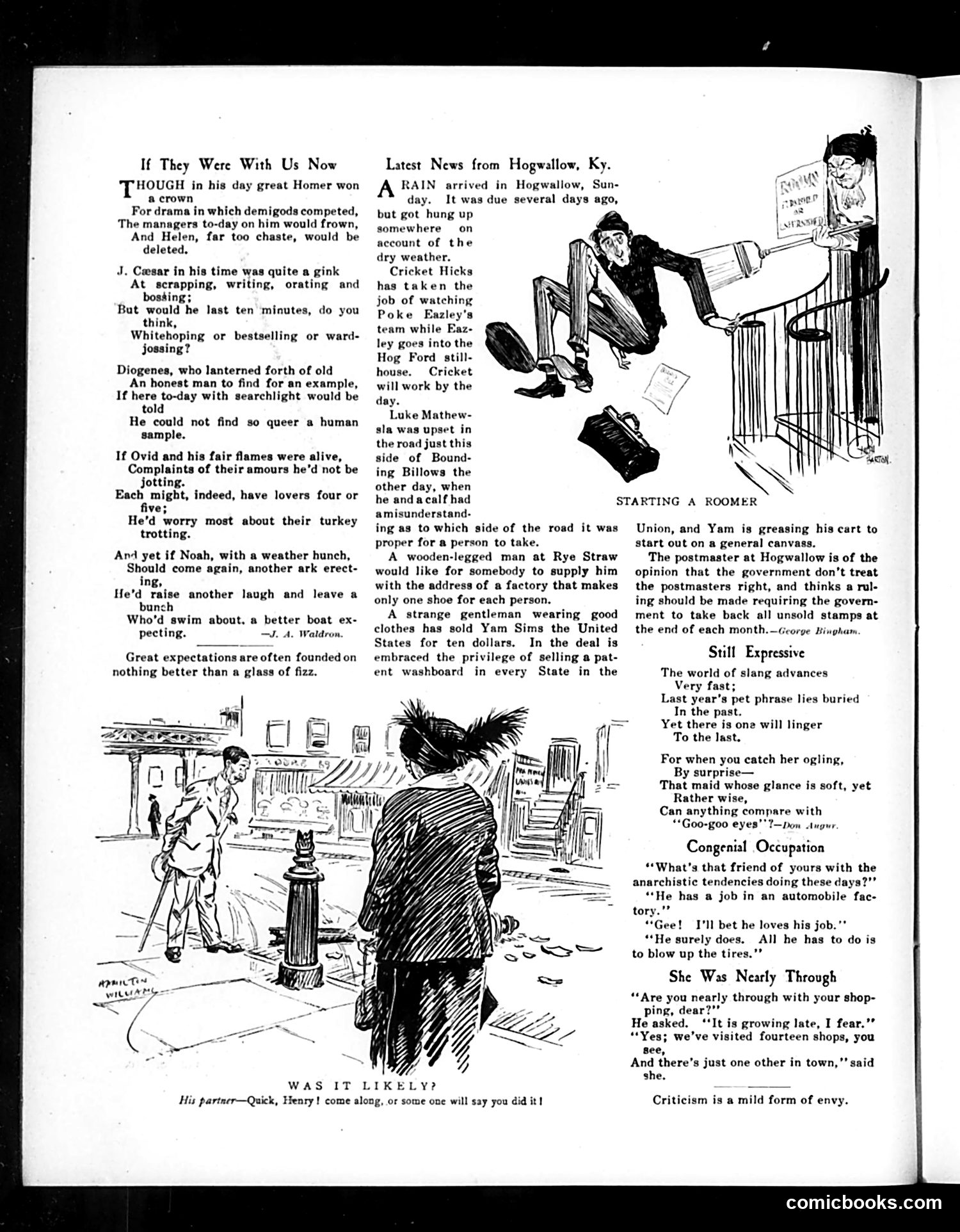
This page contains three distinct pieces of satirical content: **"If They Were With Us Now"** — A poem mocking how modern society would reject historical figures. Homer's *Helen of Troy* is "too chaste" for contemporary theater; Julius Caesar couldn't survive modern competitive business ("whitehoping" and "bestselling"); Diogenes searching for an honest man would find modern humans too strange. The joke: historical greatness means nothing in contemporary commercial culture obsessed with scandal, sales, and novelty. **"Latest News from Hogwallow, Ky."** — Humorous rural dispatches satirizing small-town absurdities: a man seeking a one-shoe factory, someone selling "the United States" for ten dollars as a patent washboard scheme, and a postmaster demanding the government buy back unsold stamps. This mocks rural gullibility and bureaucratic absurdity. **Two cartoon vignettes** illustrate urban life: one shows a man loitering near a fire hydrant while his partner urges him along (implying loitering could invite suspicion); another depicts a wife insisting on shopping at yet another store despite the hour. Both mock modern social anxieties and marital dynamics.
📄 Transcribed text from this page (OCR, searchable)
Machine-transcribed from the original scan — historical spelling and the odd misread are preserved.
If They Were With Us Now ‘THoucu in his day great Homer won a crown For drama in which demigods competed, The managers to-day on him would frown, And Helen, far too chaste, would be deleted, J. Cesar in his time was quite a gink At scrapping, writing, orating and bossing; But would he last ten minutes, do you think, Whitehoping or bestselling or ward- jossing? Diogenes, who lanterned forth of old An honest man to find for an example, If here to-day with searchlight would be told He could not find so queer a human sample. If Ovid and his fair flames were alive, Complaints of their amours he'd not be jotting. Fach might, indeed, have lovers four or ve; He'd worry most about their turkey trotting. And yet if Noah, with a weather hunch, Should come again, another ark erect- ing, He'd raise another laugh and leave a bunch Who'd swim about, a better boat ex- pecting. —J. A. Waldron. Great expectations are often founded on nothing better than a glass of fizz. WAS IT Latest News from Hogwallow, Ky. A RAIN arrived in Hogwallow, Sun- day. It was due several days ago, but got hung up eo somewhere on account of the dry weather. Cricket Hicks has taken the job of watching Poke Eazley's team while Eaz- ley goes into the Hog Ford still- house. Cricket will work by the day. Luke Mathew- sla was upset in the road just this side of Bound- ing Billows the other day, when he andacalf had amisunderstand- ing as to which side of the road it was proper for a person to take. A wooden-legged man at Rye Straw would like for somebody to supply him with the address of a factory that makes only one shoe for each person. A strange gentleman wearing good clothes has sold Yam Sims the United States for ten dollars. In the deal is embraced the privilege of selling a pat- ent washboard in every State in the LIKELY? His partner—Quick, Henry! come along, or some one will say you did it! STARTING A ROOMER Union, and Yam is greasing his cart to start out on a general canvass. The postmaster at Hogwallow is of the opinion that the government don’t treat the postmasters right, and thinks a rul- ing should be made requiring the govern- ment to take back all unsold stamps at the end of each month.—George Bingham Still Expressive The world of slang advances Very fast; Last year’s pet phrase lies buried In the past. Yet there is one will linger To the last. For when you catch her ogling, By surprise— That maid whose glance is soft, yet Rather wise, Can anything compare with “*Goo-goo eyes’’?—Don Augur Congenial Occupation **What’s that friend of yours with the anarchistic tendencies doing these days?” “He has a job in an automobile fac- tory.”” “Gee! I'll bet he loves his job."* “He surely does. All he has to do is to blow up the tires.”” She Was Nearly Through “Are you nearly through with your shop- ping, dear?” He asked. ‘‘It is growing late, I fear.’” “Yes; we've visited fourteen shops, you see, And there’s just one other in town,’ said she. Criticism is a mild form of envy. comicbooks.com