
Judge, 1913-11-08 · page 18 of 26
Judge — November 8, 1913 — page 18: what you’re looking at
What you’re looking at
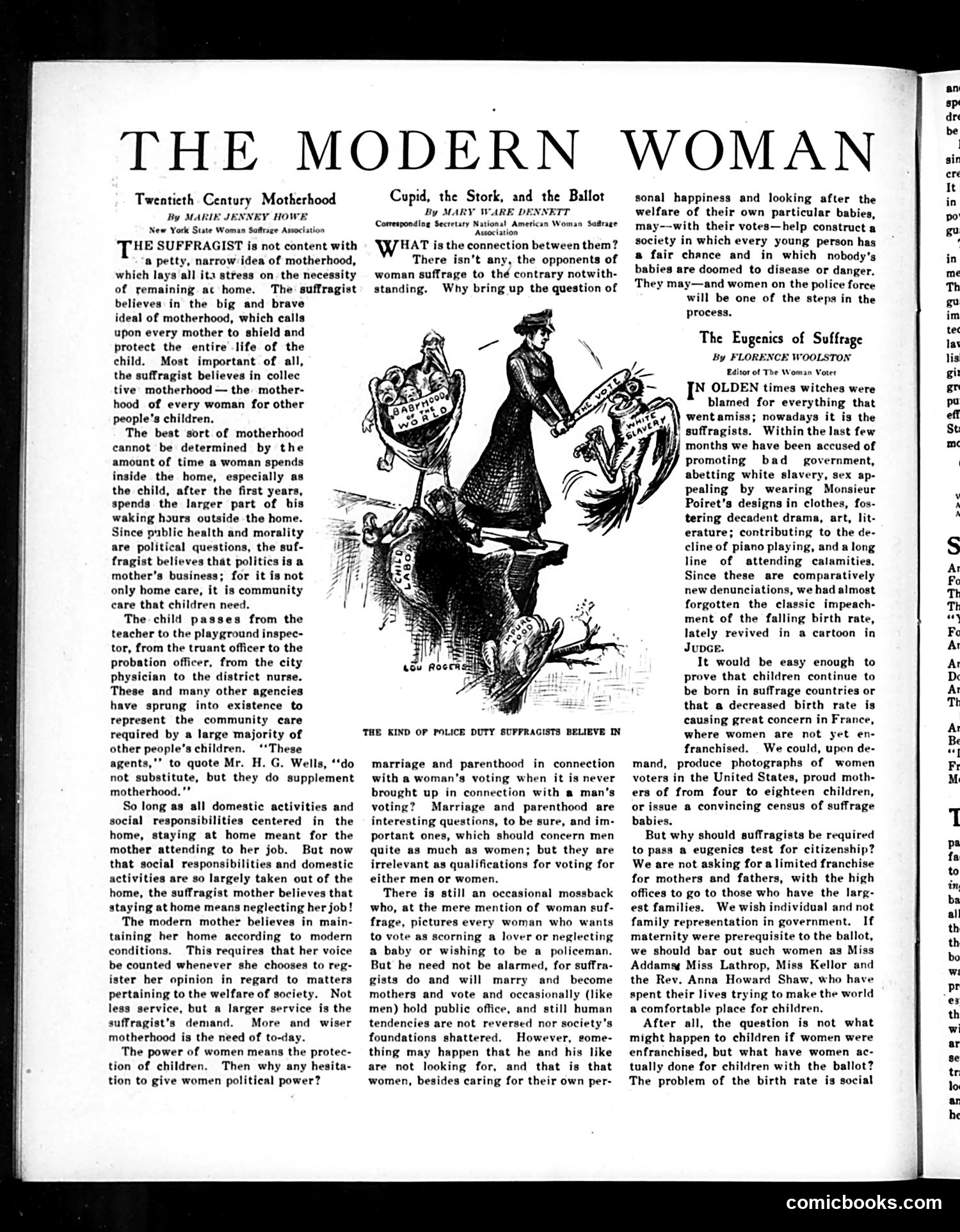
This page presents pro-suffrage arguments from the National American Woman Suffrage Association, framed as satire against anti-suffrage opponents. The central cartoon depicts a suffragist woman juggling domestic duties (represented by a baby carriage) while being pulled in multiple directions—illustrating the suffragists' argument that women's responsibilities *already* extend beyond the home into public life (schools, health inspectors, probation officers, etc.). The text sarcastically rebuts anti-suffrage claims that voting conflicts with motherhood. Marie Jenney Howe argues that modern motherhood *requires* political participation, since child welfare depends on public policy. The cartoon titled "The Kind of Police Duty Suffragists Believe In" likely mocks opponents' absurd fears that women voters would abandon families. The second article dismisses the irrelevant connection between "Cupid, the Stork, and the Ballot"—arguing that men's voting qualifications aren't questioned based on marriage/parenthood, so why should women's be? This is advocacy disguised as satirical humor.
📄 Transcribed text from this page (OCR, searchable)
Machine-transcribed from the original scan — historical spelling and the odd misread are preserved.
THE MODERN WOMAN Twentieth Century Motherhood By MARIE J) Y HOWE New York State Woman Saffrage Association HE SUFFRAGIST is not content with @ petty, narrow idea of motherhood, which la: 11 ita stress on the necessity of rema i ac home. The suffragist believes in the big and brave ideal of motherhood, which calls upon every mother to shield and protect the entire life of the child. Most important of all, the suffragist believes in collec tive motherhood — the mother- hood of every woman for other people's children. The best sort of motherhood cannot be determined by the amount of time a woman spends inside the home, especially as the child, after the first years, spends the larger part of bis waking hours outside the home. Since public health and morality are political questions, the suf- fragist believes that politics is a mother’s business; for it is not only home care, it is community care that children need. The child passes from the teacher to the playground inspec- tor, from the truant officer to the probation officer, from the city physician to the district nurse. These and many other agencies have sprung into existence to represent the community care required by a large majority of other people's children. ‘*These agents,’’ to quote Mr. H. G. Wells, ‘‘do not substitute, but they do supplement motherhood."’ So long as all domestic activities and social responsibilities centered in the home, staying at home meant for the mother attending to her job. But now that social responsibilities and domestic activities are so largely taken out of the home, the suffragist mother believes that staying at home means neglecting her job! The modern mother believes in main- taining her home according to modern conditions. This requires that her voice be counted whenever she chooses to reg- ister her opinion in regard to matters pertaining to the welfare of society. Not less service, but a larger service is the suffragist’s demand. More and wiser motherhood is the need of to-day. The power of women means the protec- tion of children. Then why any hesita- tion to give women political power? Cupid, the Stork, and the Ballot By MARY WARE D 1T Corresponding Secretary National American Woman Saftrage ‘Association wrt is the connection between them? There isn’t any, the opponents of woman suffrage to thé contrary notwith- standing. Why bring up the question of THE KIND OP POLICE DUTY SUPPRAGISTS BELIEVE IN marriage and parenthood in connection with a woman's voting when it is never brought up in connection with a man’s voting? Marriage and parenthood are interesting questions, to be sure, and im- portant ones, which should concern men quite as much as women; but they are irrelevant as qualifications for voting for either men or women. There is still an occasional mossback who, at the mere mention of woman suf- frage, pictures every woman who wants to vote as scorning a lover or neglecting a baby or wishing to be a policeman. But he need not be alarmed, for suffra- gists do and will marry and become mothers and vote and occasionally (like men) hold public office, and still human tendencies are not reversed nor society’s foundations shattered. However, some- thing may happen that he and his like are not looking for, and that is that women, besides caring for their own per- sonal happiness and looking after the welfare of their own particular babies, may—with their votes—help construct a society in which every young person has a fair chance and in which nobody's babies are doomed to disease or danger. They may—and women on the police force will be one of the steps in the process. The Eugenics of Suffrage By FLORENCE WOOLSTON Editor of The Woman Voter IN OLDEN times witches were blamed for everything that wentamiss; nowadays it is the suffragists. Within the last few months we have been accused of promoting bad government, abetting white slavery, sex ap- pealing by wearing Monsieur Poiret’s designs in clothes, fos- tering decadent drama, art, lit- erature; contributing to the de- cline of piano playing, and a long line of attending calamities. Since these are comparatively new denunciations, we had almost forgotten the classic impeach- ment of the falling birth rate, lately revived in a cartoon in Jupce. It would be easy enough to prove that children continue to be born in suffrage countries or that a decreased birth rate is causing great concern in France, where women are not yet en- franchised. We could, upon de- mand, produce photographs of women voters in the United States, proud moth- ers of from four to eighteen children, or issue a convincing census of suffrage babies. But why should suffragists be required to pass a eugenics test for citizenship? We are not asking fora limited franchise for mothers and fathers, with the high offices to go to those who have the larg- est families. We wish individual and not family representation in government. If maternity were prerequisite to the ballot, we should bar out such women as Miss Addams Miss Lathrop, Miss Kellor and the Rev. Anna Howard Shaw, who have spent their lives trying to make the world a comfortable place for children. After all, the question is not what might happen to children if women were enfranchised, but what have women ac- tually done for children with the ballot? The problem of the birth rate is social comicbooks.com