
A complete issue · 24 pages · 1913
Judge — October 11, 1913
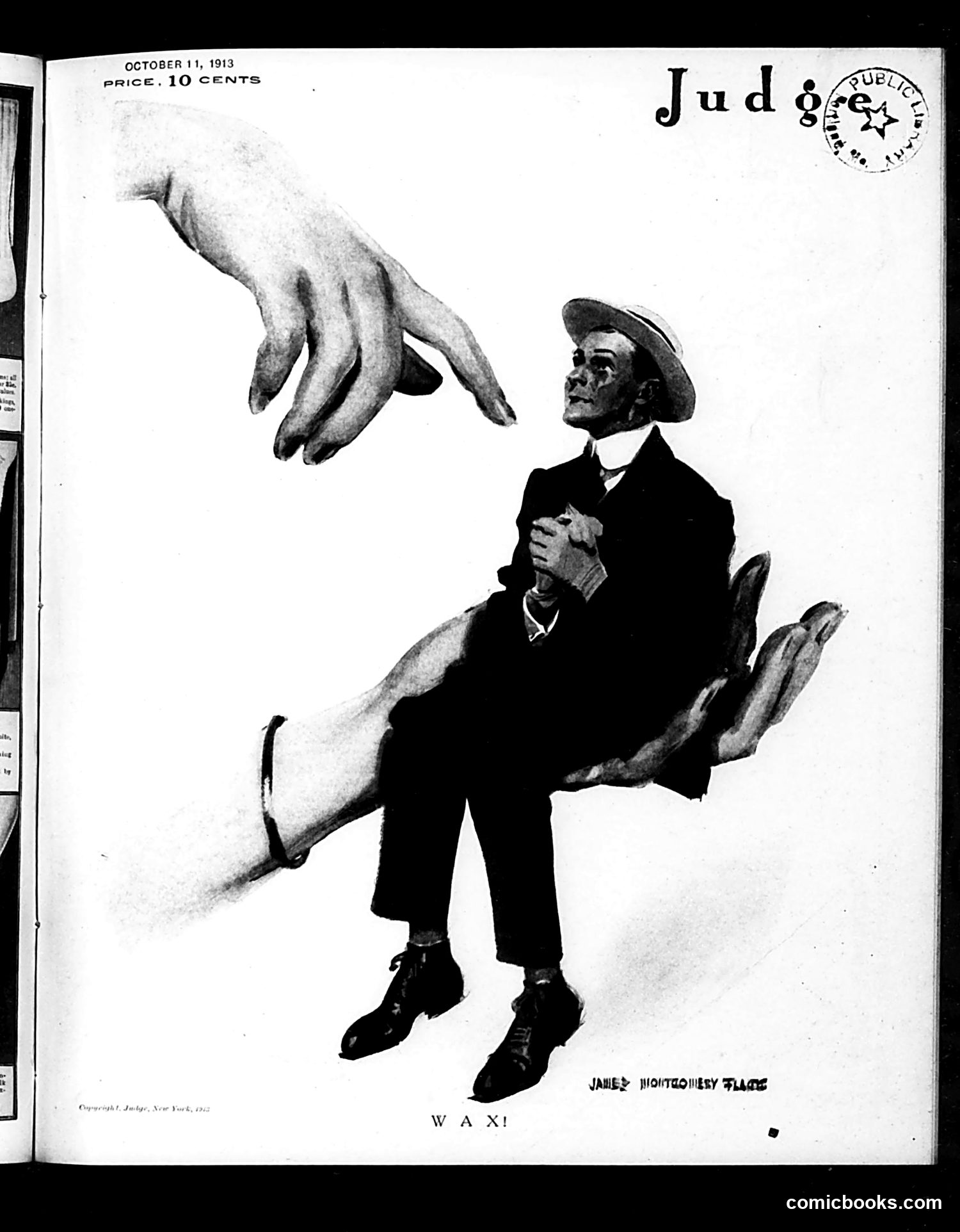
This political cartoon titled "WAX!" depicts a well-dressed man being manipulated like a puppet by two large disembodied hands. The man appears distressed, looking upward while the hands control him from above and below. The satire likely comments on political manipulation or loss of autonomy—suggesting someone in power is being controlled by unseen forces or special interests. The title "WAX" may reference the man's malleable nature (as in "wax in their hands," a common phrase meaning easily manipulated). Without additional context or identifying marks visible in the cartoon, the specific political figure or situation remains unclear, though the commentary on puppet-like control by hidden powers is evident. The artist's signature appears to be James Montgomery Flagg.
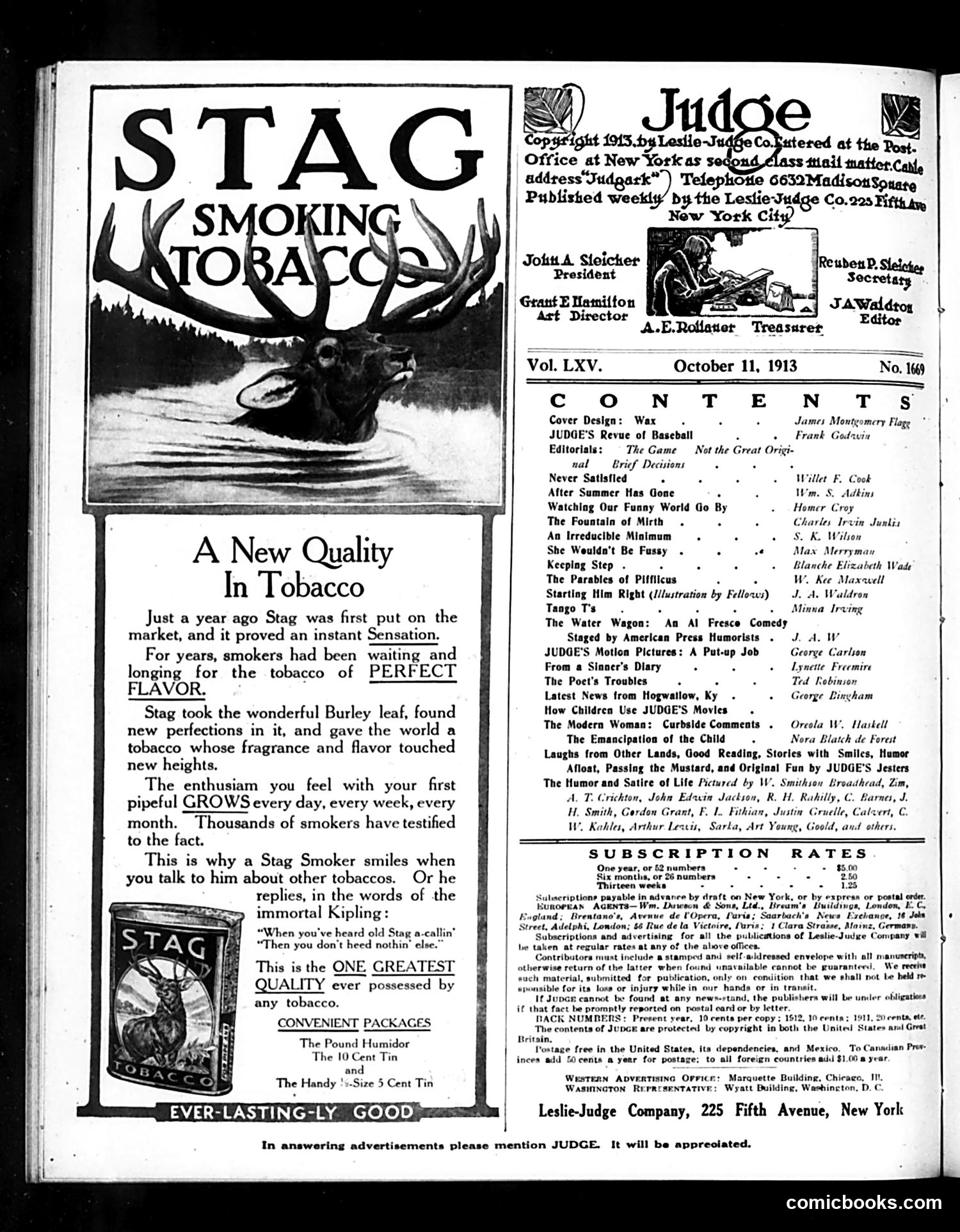
This page is primarily a **tobacco advertisement**, not political satire. The left side features a full-page ad for "Stag Smoking Tobacco," emphasizing its new "perfect flavor" derived from Burley leaf. The ad claims smokers have been "waiting and longing" for such a product and includes testimonials about its quality. The right side contains the magazine's contents page for the October 11, 1913 issue of *Judge*. While various articles are listed (covering baseball, movies, and humor), **no specific political figures or satirical cartoons are visible on this page**. The stag imagery—a large buck with prominent antlers—serves as the brand's logo, suggesting masculinity and strength to appeal to male smokers.
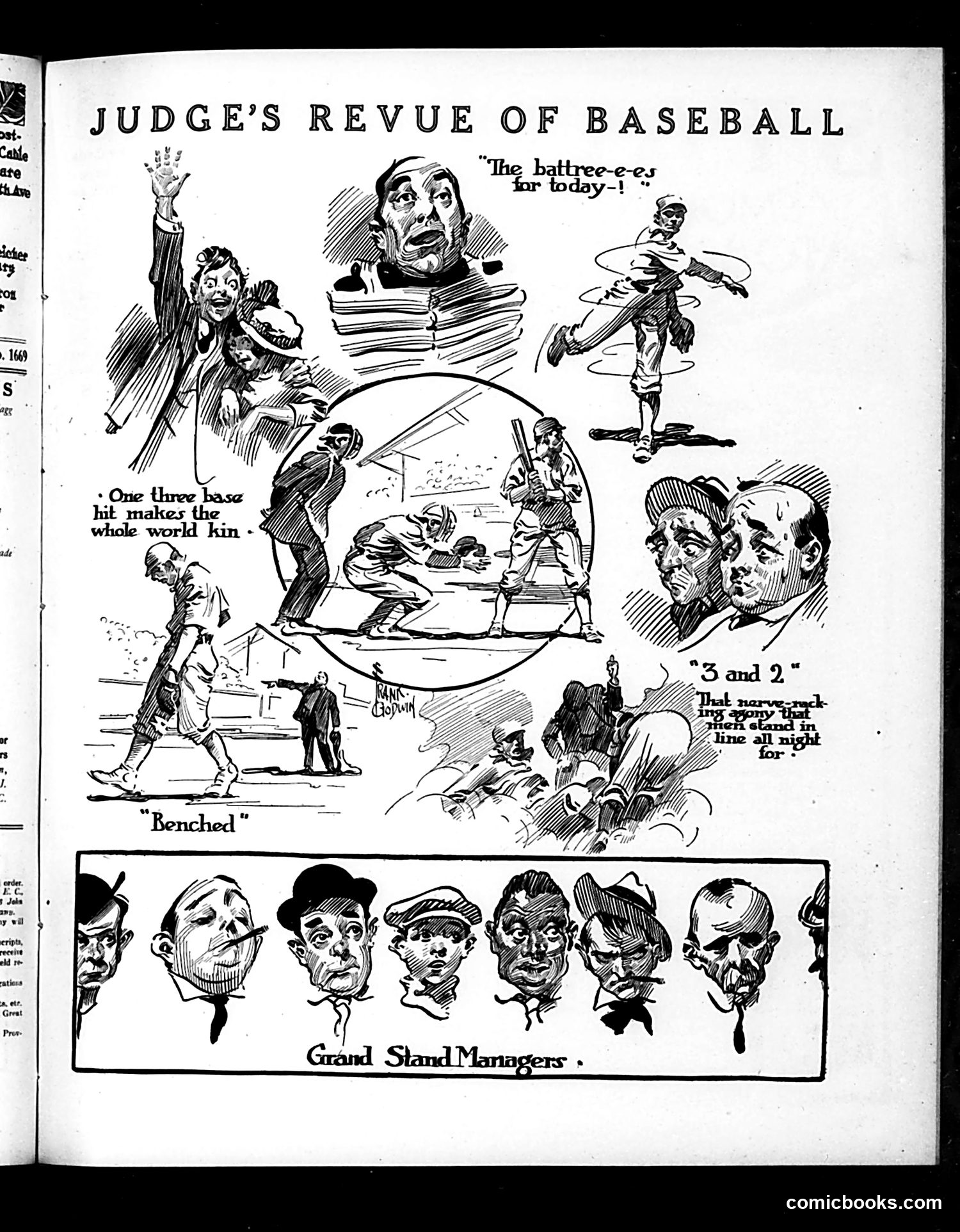
This satirical baseball page uses caricatures to mock baseball personalities and situations circa early 1900s. The central comic strips humorously depict typical game scenarios: "One three base hit makes the whole world kin" shows excited fans; "The battree-e-es for today" presents managers announcing lineups; "Benched" illustrates a player's dismissal; and "3 and 2" references a tense count situation. The bottom panel, "Grand Stand Managers," features caricatured heads of what appear to be famous managers or owners of the era—likely mocking their distinctive appearances and reputations. The overall satire targets baseball's colorful personalities, fan enthusiasm, and the sport's social prominence in American culture, using exaggerated facial features typical of period sports journalism humor.
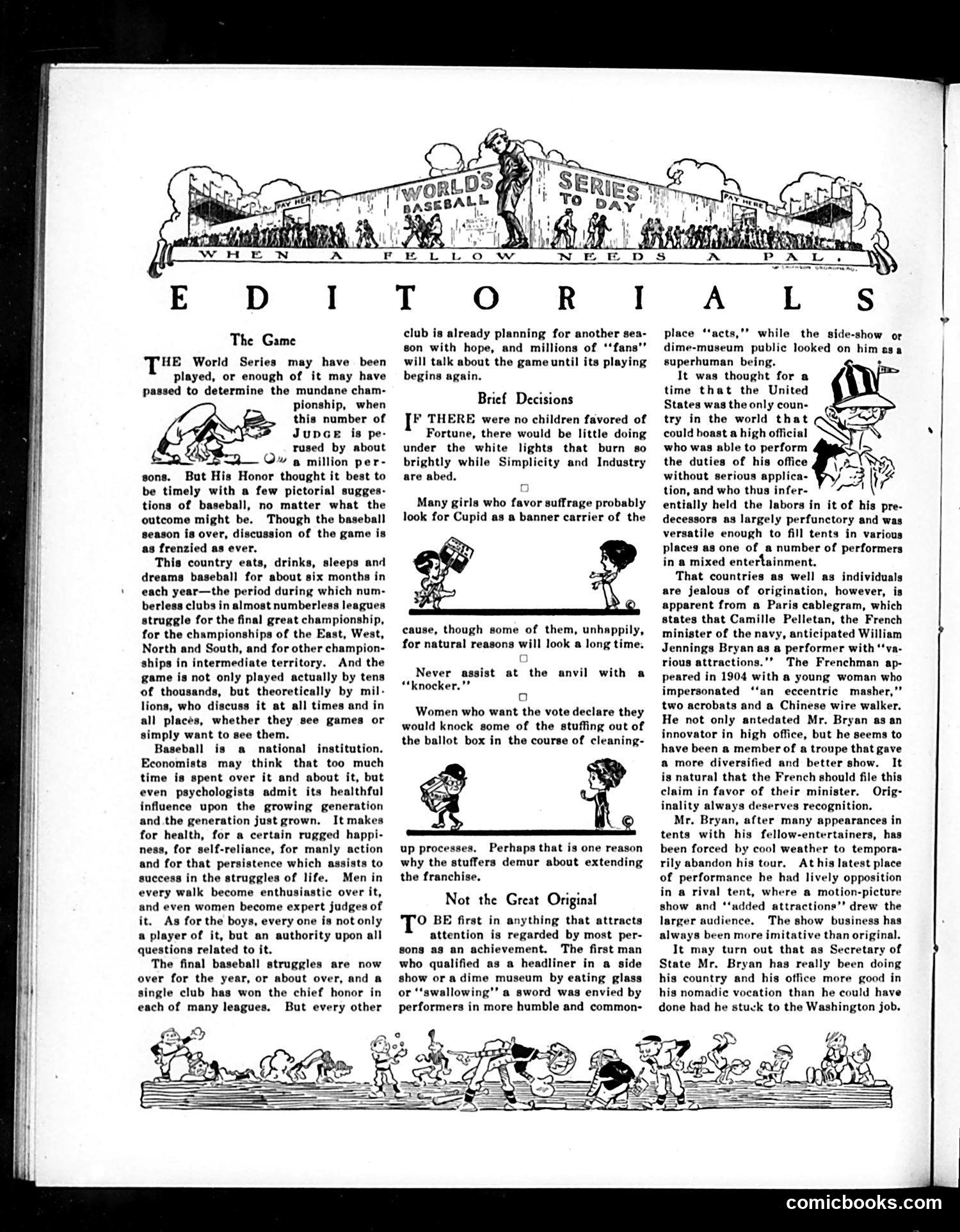
This appears to be a **World Series editorial** from Judge magazine, discussing baseball's cultural significance. The page critiques how baseball dominates American life—people "eat, drink, sleeps and dreams baseball" for six months yearly. The editorial satirizes **suffragists and women's rights advocates**, suggesting they distract from "serious" matters. It mocks women seeking voting rights, implying they should focus on domestic concerns instead. There's also commentary on **William Jennings Bryan**, a politician/performer, suggesting his various "attractions" and showmanship undermine his credibility. The cartoons depict domestic scenes with women and children, likely illustrating the editorial's argument about gender roles and societal priorities during this pre-suffrage era. The satire fundamentally opposes women's political participation while celebrating baseball as a unifying national pastime.
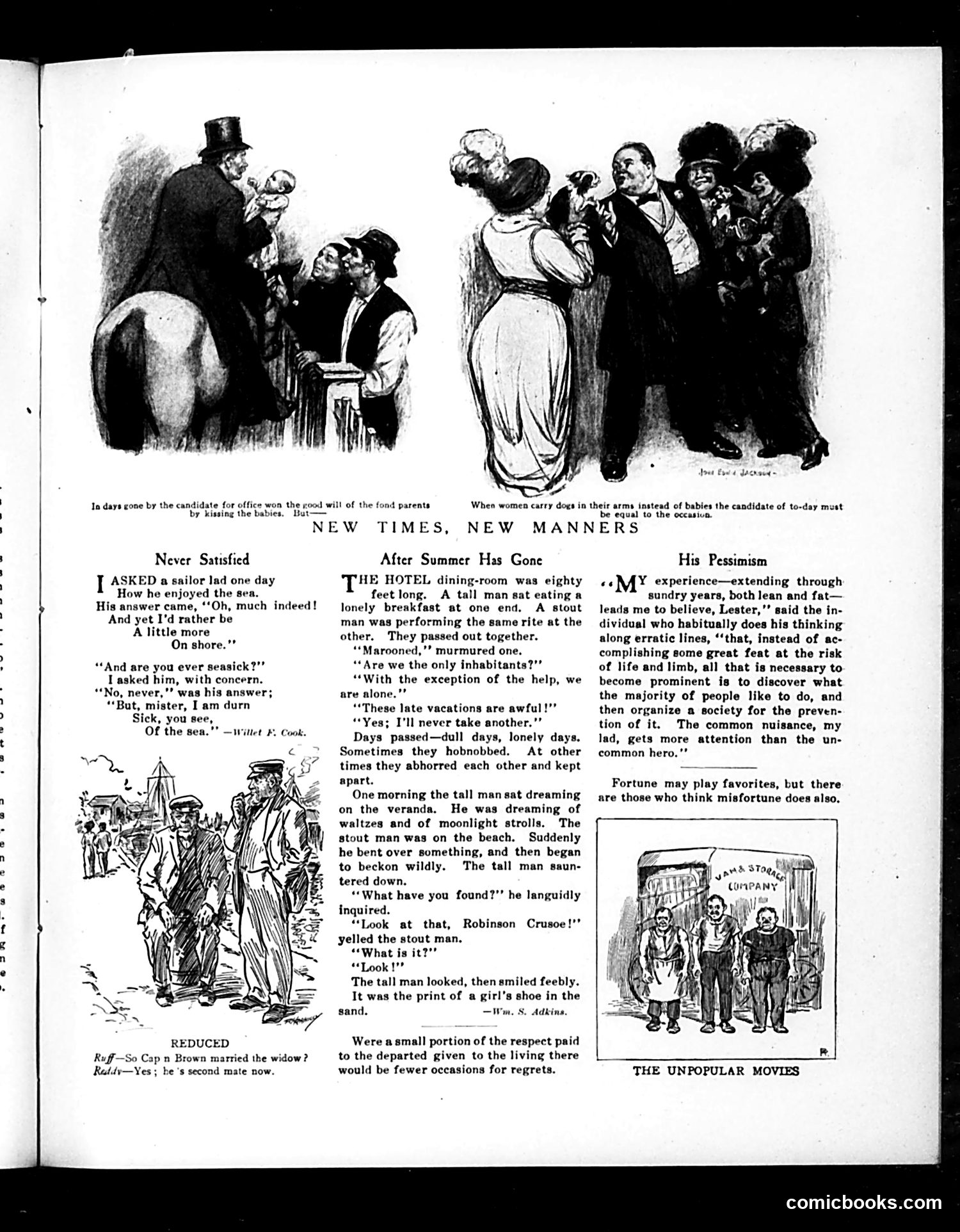
This page presents satirical commentary on changing social customs titled "NEW TIMES, NEW MANNERS." The three cartoons mock evolving behavior: **Top panels**: Contrast old versus new etiquette—the left shows traditional courtship (men kissing babies to gain parental favor), while the right shows modern women carrying dogs instead of infants, suggesting superficiality in contemporary society. **"Never Satisfied"**: A poem mocking someone perpetually dissatisfied with leisure activities. **"After Summer Has Gone"**: A humorous anecdote about a tall man's awkward dining experience, attributed to W.S. Atkins. **"His Pessimism"**: Commentary on someone devoted to preventing social nuisances through organized societies. The page satirizes modern American social pretension and changing values among the middle and upper classes, typical of Judge's satirical approach to contemporary manners and morality.
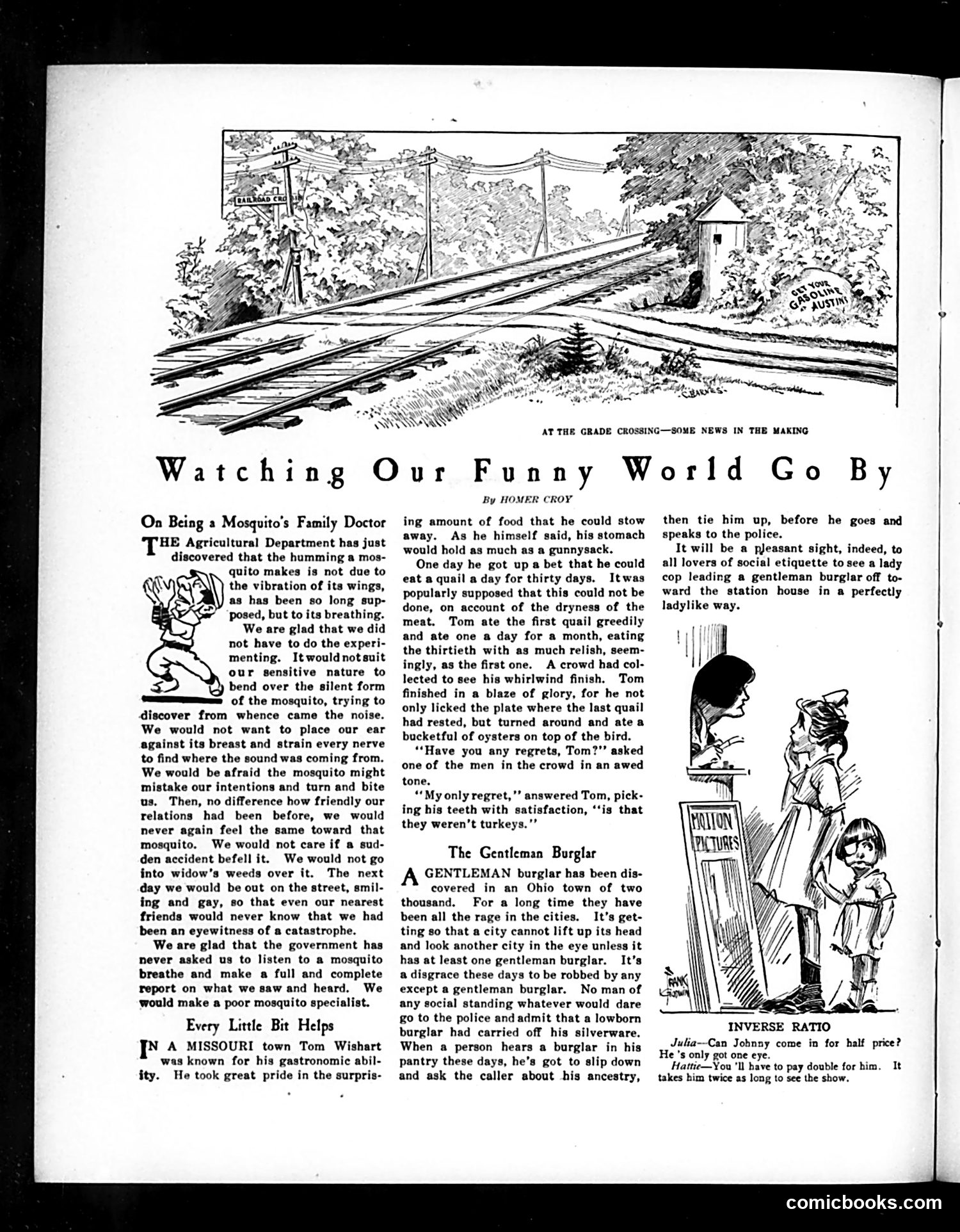
This page from Judge magazine contains three humorous essays satirizing American life: **"Mosquito's Family Doctor"** mocks the Agricultural Department's discovery that mosquitoes hum from breathing, not wing vibration. The author humorously objects to imagining having to listen to a mosquito's chest to verify this—fearing the mosquito might misinterpret the gesture and bite, destroying their "relationship." **"Every Little Bit Helps"** describes Tom Wishart of Missouri, famous for eating prodigiously. He wins a bet eating one quail daily for thirty days, then tops it off with oysters. When asked if he regrets anything, Tom replies his only regret is they weren't turkeys—satirizing American excess and appetite. **"The Gentleman Burglar"** satirizes urban snobbery. It jokes that cities now consider it shameful to be robbed by ordinary burglars—only "gentleman burglars" maintain social respectability. The satire targets class consciousness and the absurdity of prioritizing propriety over actual crime. The cartoons' simple line drawings illustrate these everyday American absurdities with gentle, affectionate humor typical of Judge's satirical approach.
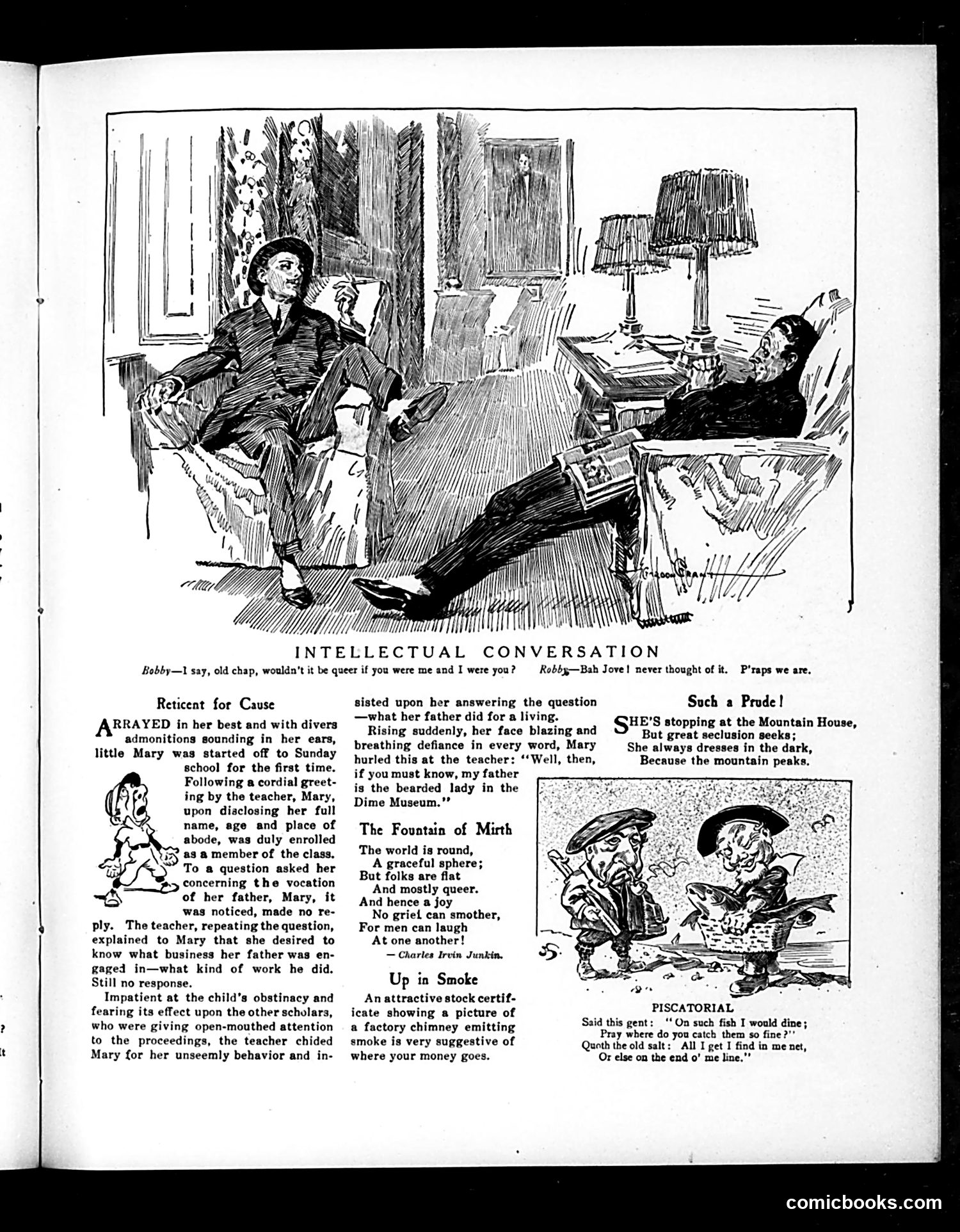
This page from *Judge* magazine contains several brief humorous pieces typical of early 20th-century satirical magazines: **"Intellectual Conversation"** (top cartoon): Two men debate whether it would be "queer" to swap identities—a light philosophical joke playing on the absurdity of such a premise. **"Reticent for Cause"**: A child refuses to disclose her father's profession at Sunday school. When forced to answer, she reveals he's a "bearded lady in the Dime Museum"—meaning he works as a circus freak exhibit. The humor lies in the child's shame and the teacher's shock at this disreputable occupation. **"The Fountain of Mirth"**: A short poem observing that while the world is "round" (orderly), people are "flat" (dull/peculiar), making human folly amusing. **"Up in Smoke" and "Piscatorial"**: Brief jokes about stock certificates and fishing, using visual puns and wordplay common to the era. The overall tone is genteel mockery of middle-class propriety and social embarrassment—typical *Judge* fare targeting educated audiences amused by others' discomfort.
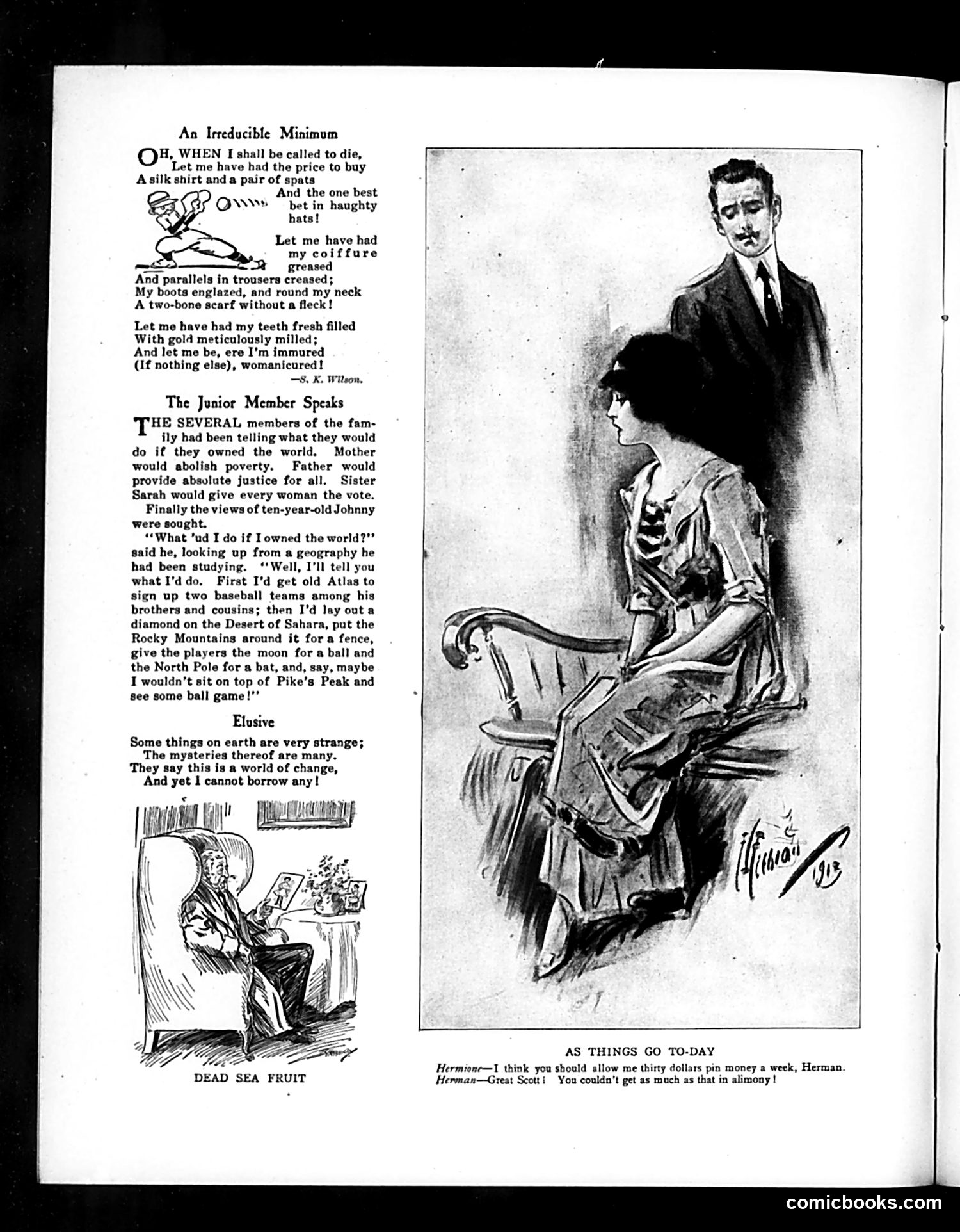
This page contains three separate satirical pieces mocking early 20th-century vanity and social values: **"An Irreducible Minimum"** (poem by S.X. Wilson): Satirizes male materialism and superficiality. The speaker's deathbed "minimum" wish list—silk shirts, spats, greased hair, creased trousers, gold-filled teeth, manicures—mocks men who prioritize grooming and fashion over meaningful accomplishments. The title suggests these trivial concerns represent the bare essentials of a shallow life. **"The Junior Member Speaks"**: Contrasts family members' noble ideals (abolishing poverty, ensuring justice, women's suffrage) with a ten-year-old boy's purely imaginative, self-centered fantasy of baseball using cosmic-scale props. The satire critiques childish materialism versus adult progressivism. **"As Things Go To-Day"**: A brief domestic joke where a wife requests $30 weekly "pin money" and the husband sarcastically compares it to alimony payments—implying marriage costs approach divorce settlements. This satirizes marital financial tension and changing women's economic demands.
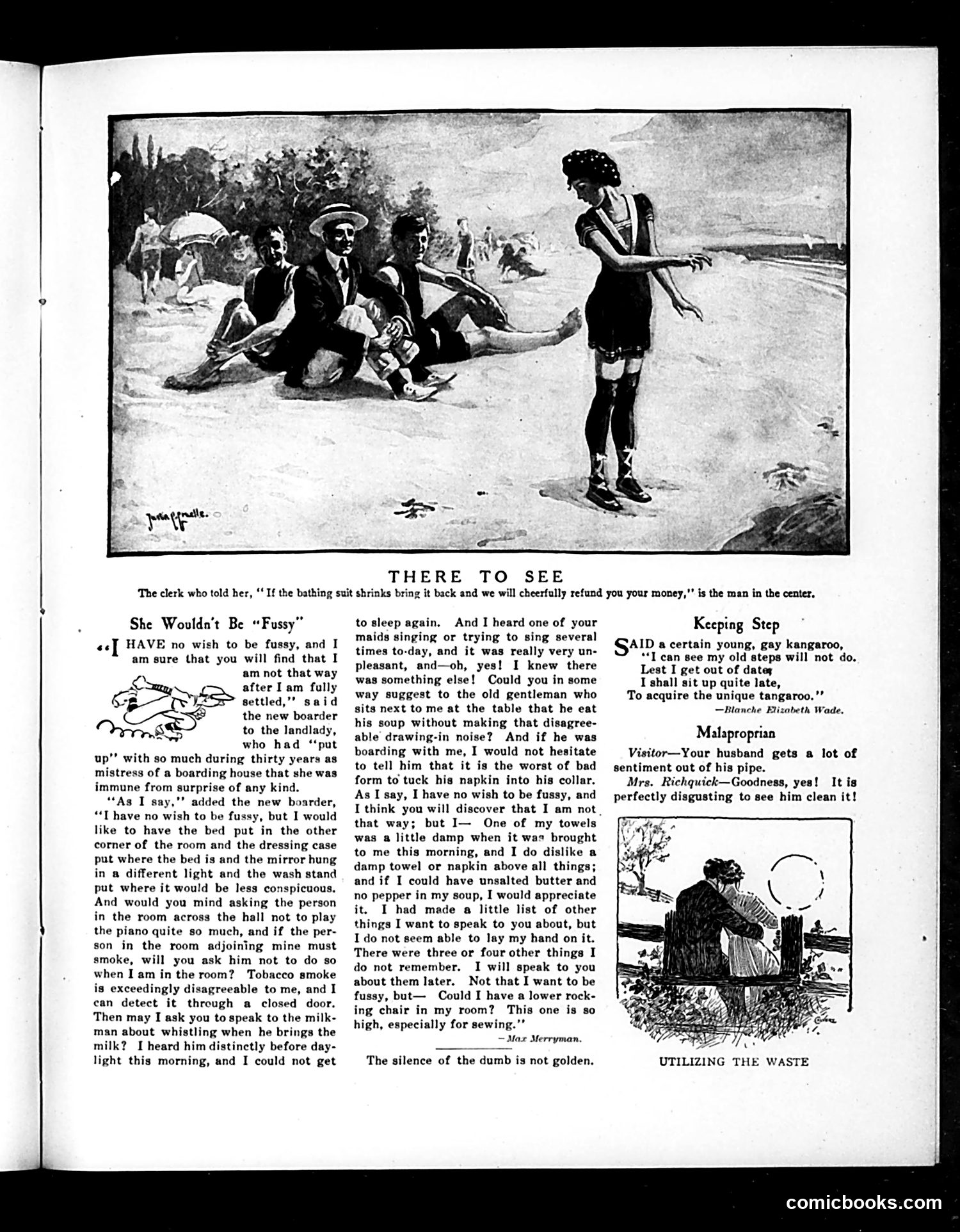
**Top Illustration ("There to See"):** A beach scene depicting the punchline to a retail transaction. A young woman in a bathing suit confronts a clerk (center, in dark suit) about a shrinking swimsuit. The joke plays on the clerk's promise to refund money if the suit shrinks—he's now in the water with her, presumably to verify the claim personally, turning a customer-service guarantee into awkward social comedy. **"She Wouldn't Be Fussy":** Satire of a new boarding-house tenant who claims not to be "fussy" while listing dozens of petty complaints: room rearrangement, noise from neighbors' piano and singing, the milkman's whistling, soup-slurping sounds, damp towels, unsalted butter, and chair height. The humor relies on the classic contradiction between stated humility and obsessive demands—a portrait of tedious, neurotic complaint-making. **"Keeping Step" and "Malaproprian":** Brief humorous verse and quips about fashion conformity and domestic sentiment, minor filler pieces typical of satirical magazines of this era.
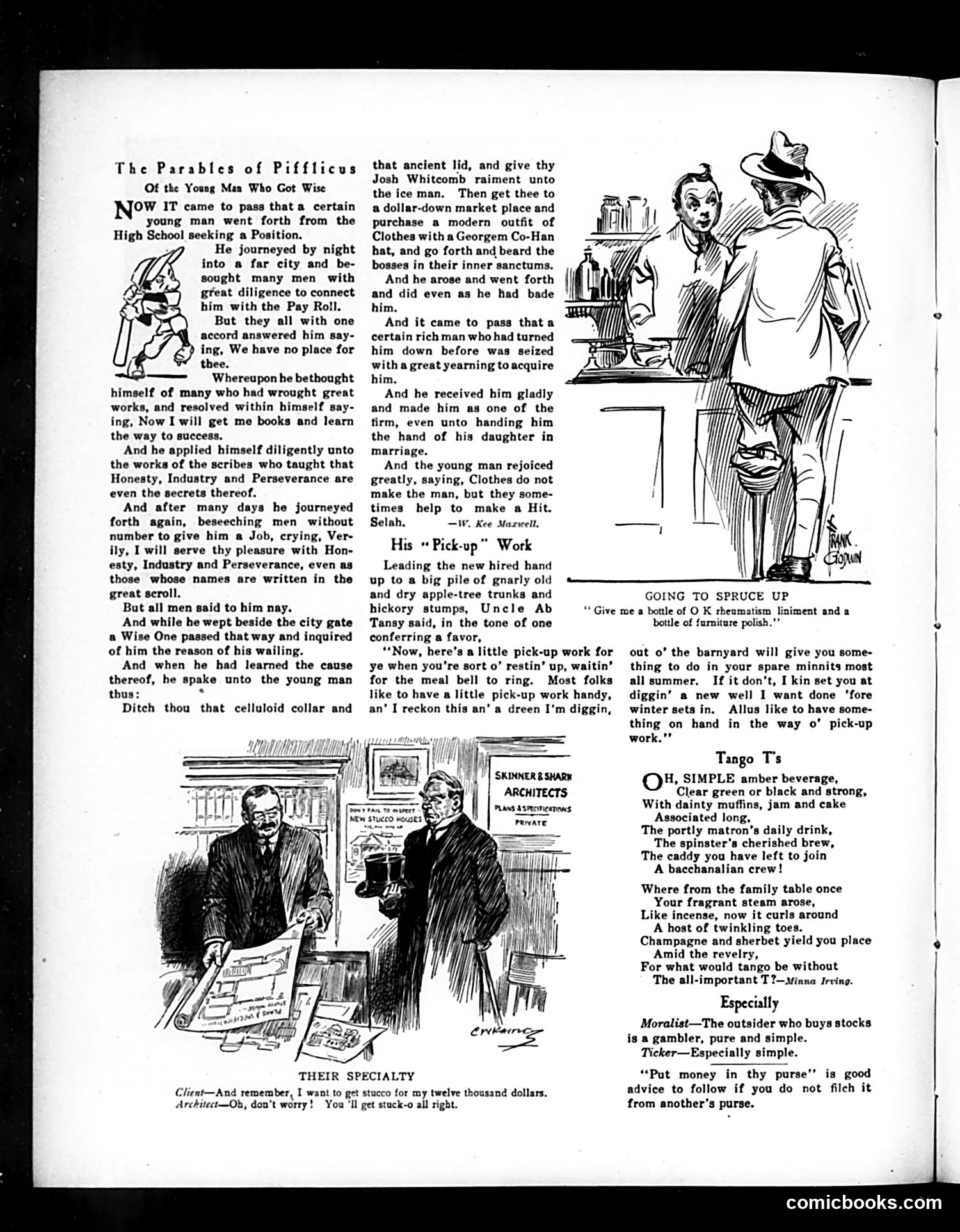
This page satirizes early 20th-century self-help culture and employment struggles. The main narrative mocks the young man who repeatedly fails to find work despite claims of "Honesty, Industry and Perseverance"—values promoted by popular success literature. The twist: a "Wise One" advises him to abandon ethics for *appearance*—ditching his shabby clothes and buying fashionable Georgem Co-Han brand clothing. Suddenly, he succeeds and wins a boss's daughter. The satire cuts both ways: it ridicules both superficial job-seekers and employers who judge applicants by fashion rather than merit. The biblical parody format amplifies the absurdity. Secondary content includes satirical jokes about architects who "stick" clients for money, and a poem mocking how tea (once respectable) became associated with risqué tango dancing.
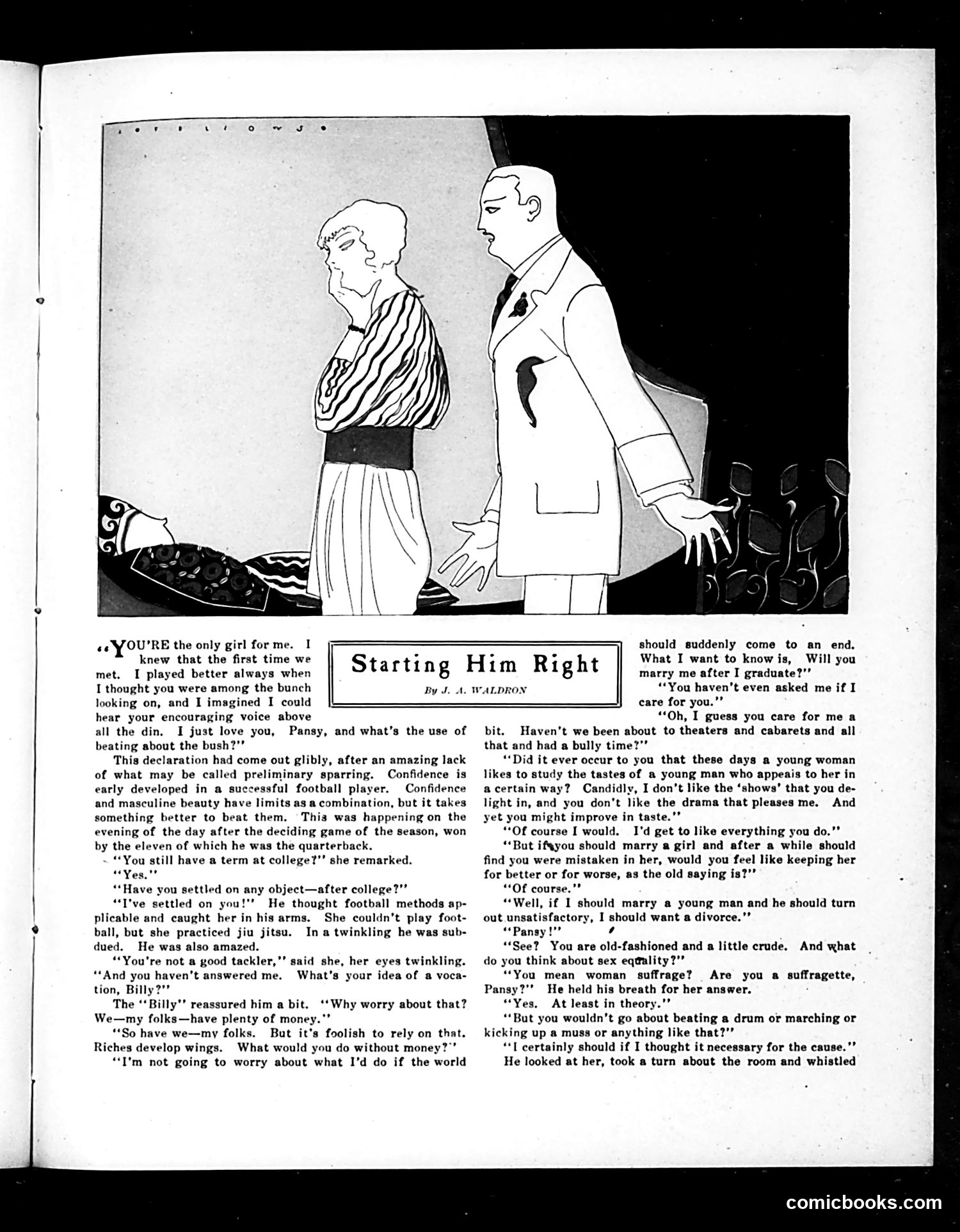
This story satirizes the clash between traditional masculinity and emerging feminist ideals in early 20th-century America. A confident, wealthy college football quarterback ("Billy") proposes to Pansy assuming her affection is guaranteed because they've attended shows together. She rejects his assumptions, insisting women have intellectual tastes independent of men's preferences and deserve equal consideration in relationships. The satire targets his old-fashioned entitlement: he expects marriage without understanding her as an individual, assumes financial security makes ambition unnecessary, and is shocked when she advocates women's suffrage and divorce rights. Pansy represents the "New Woman"—educated, opinionated, and unwilling to be passively "won" through male confidence alone. The title's irony is key: she's "starting him right" by demanding he modernize his views on gender equality, marriage partnership, and women's autonomy—the very issues suffragettes were actively fighting for during this era.
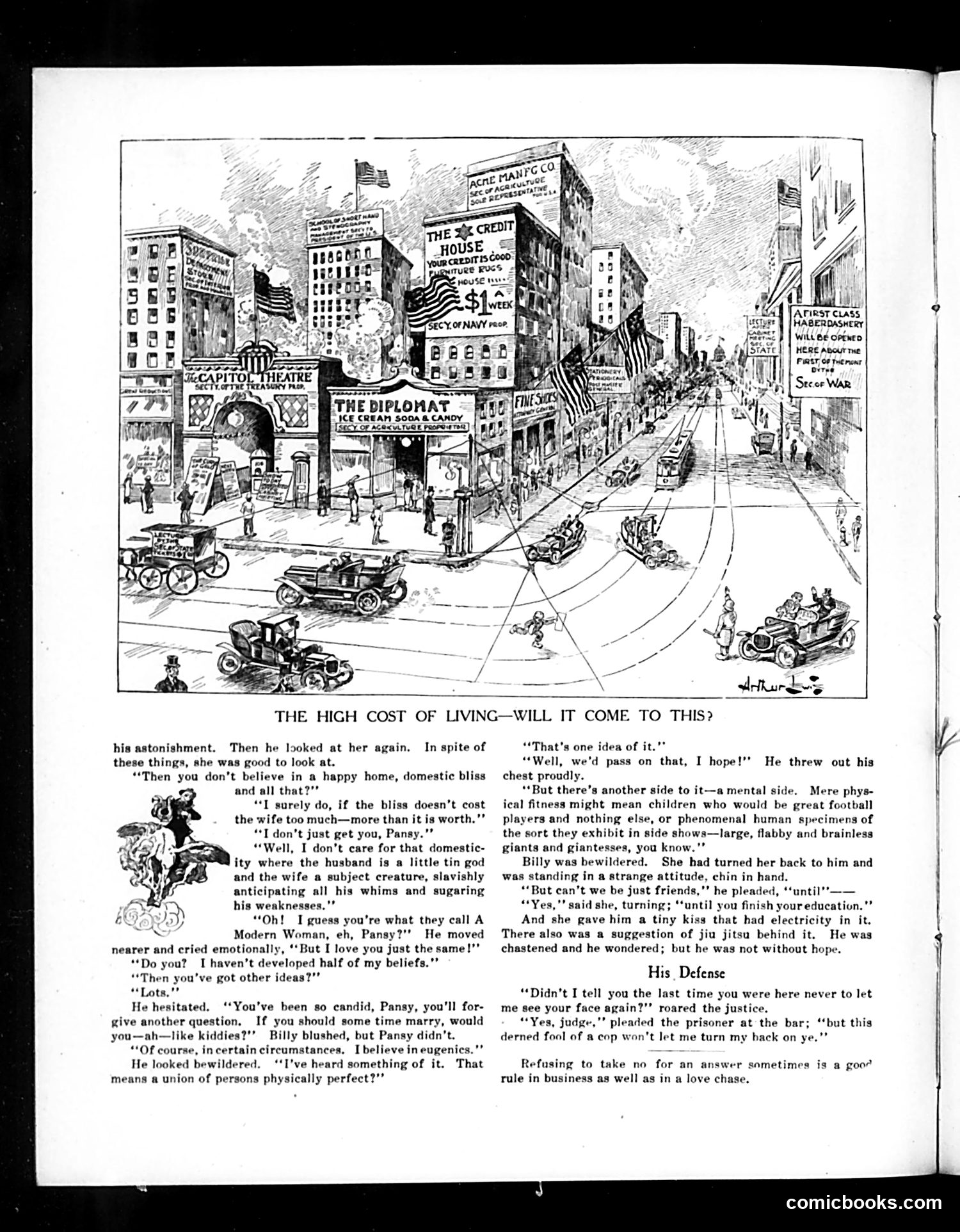
**The Cartoon:** The top illustration depicts a bustling early 20th-century downtown street scene titled "THE HIGH COST OF LIVING—WILL IT COME TO THIS?" It shows towering buildings, theaters, automobiles, and crowds—satirizing urban economic anxiety. The caption suggests fears that rising costs might force families into chaotic, automobile-dependent lifestyles rather than stable domestic life. **The Story:** A dialogue between "Billy" and "Pansy" satirizes the "Modern Woman" of the era—a female character who rejects traditional domestic subservience. She advocates for eugenics (selective breeding for "physical perfection"), demands educational equality, and refuses to be a submissive wife. Billy represents conventional masculine bewilderment at these progressive ideas. **The Satire:** The piece mocks both the modern woman's emerging independence and Billy's outdated expectations. The brief legal joke at bottom continues the theme: a prisoner's refusal to obey mirrors the broader social resistance to authority and convention. **Context:** This reflects 1910s-era anxieties about women's suffrage, changing gender roles, and eugenic pseudoscience presented as progressive thinking.
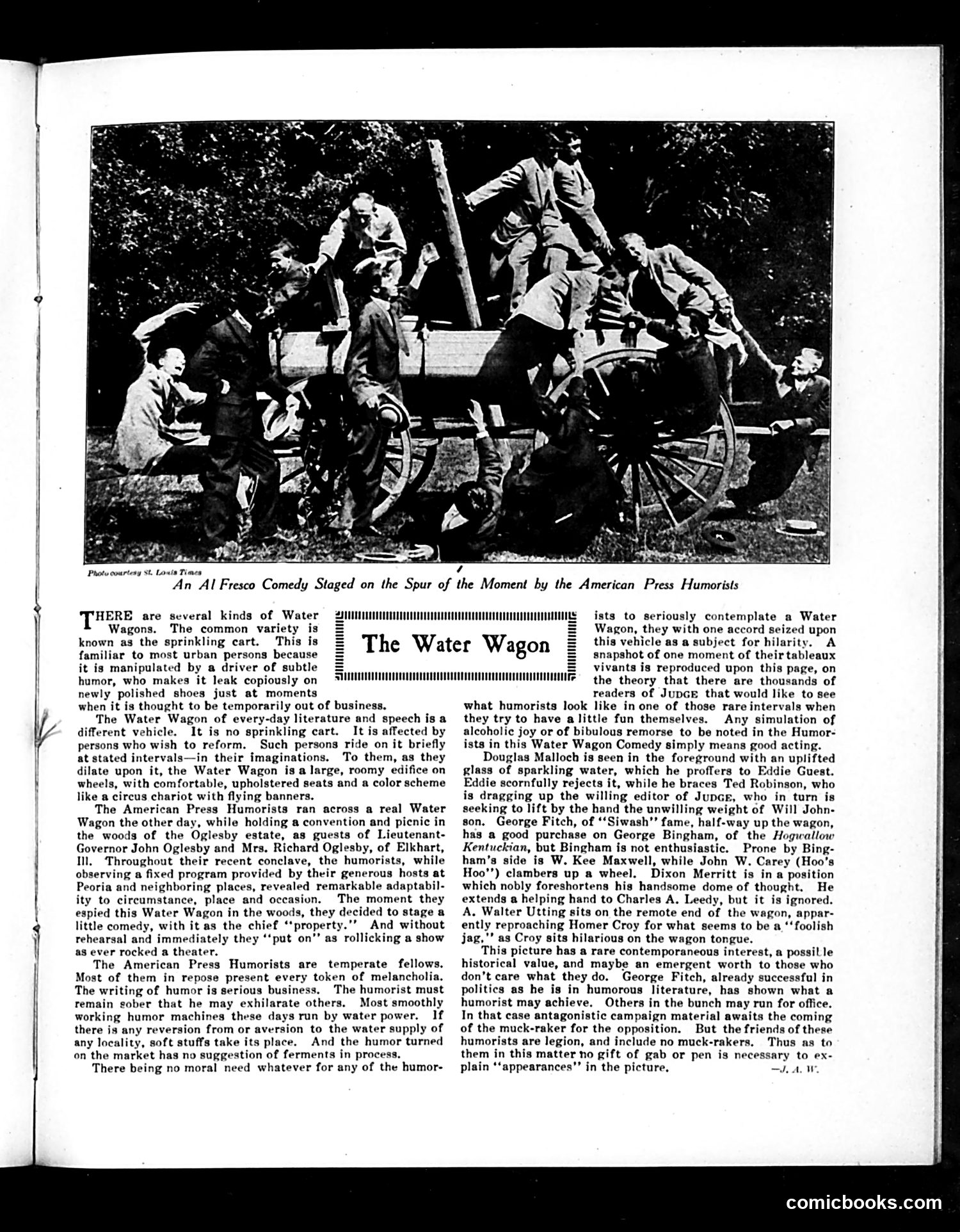
This page documents a humorous photo-stunt by members of the American Press Humorists association at a 1912 gathering near Peoria, Illinois. The satirical point is subtle: the text explains that "Water Wagon" has two meanings—a literal water cart, and the figurative phrase for temperance/sobriety that people claim to embrace but rarely sustain. The joke: these professional humorists, who must remain sober to write humor, spontaneously staged an exaggerated "temperance" scene around an actual water wagon, with named participants (Douglas Malloch, Eddie Guest, Ted Robinson, and others—all identifiable contemporary humorists and editors) theatrically "dragging" each other toward the water wagon in mock-serious fashion. The satire targets the common hypocrisy of public temperance claims—people boarding the "water wagon" temporarily in their "imaginations," as the text says. By staging this absurdist pantomime, the humorists mock both the cliché and themselves.
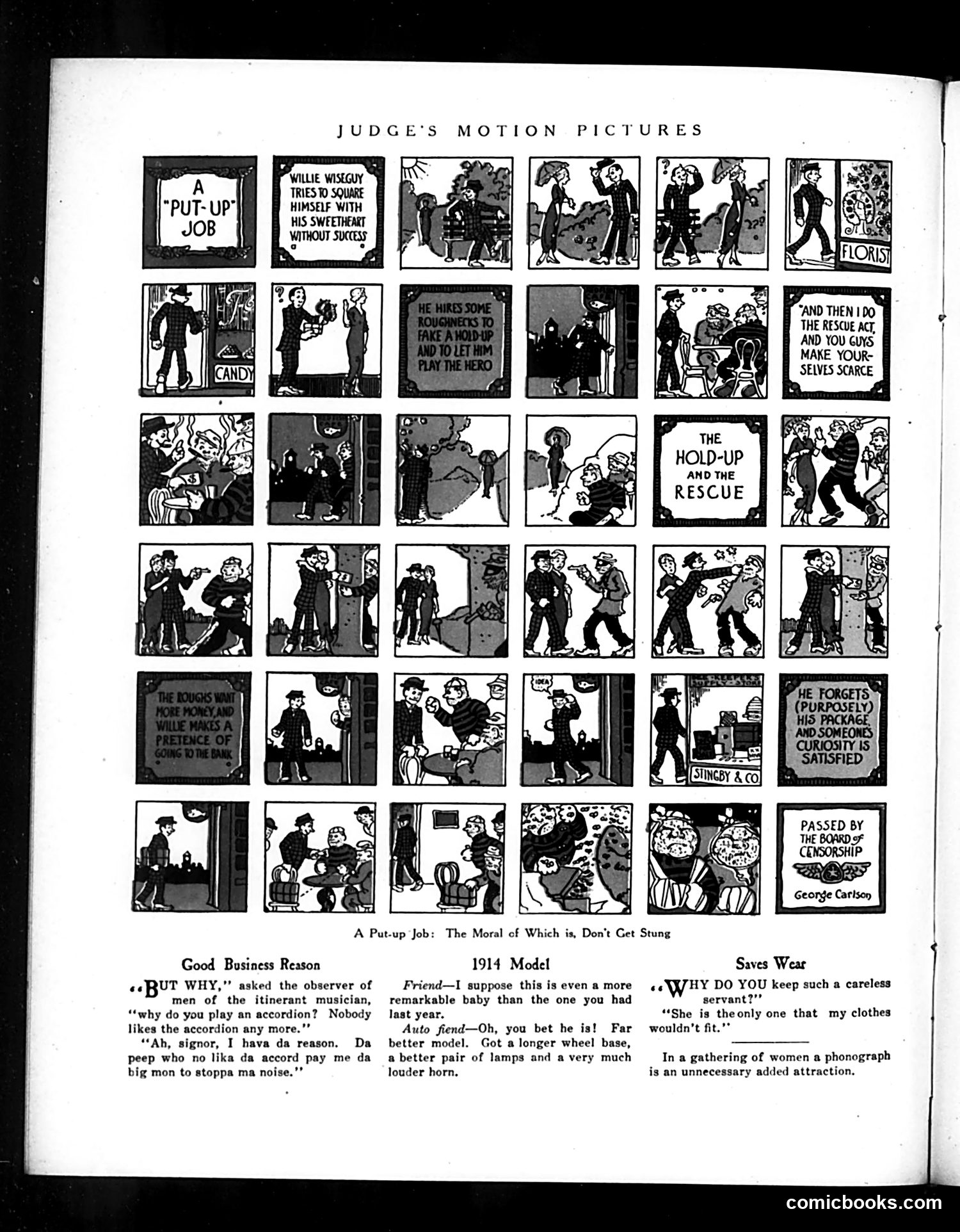
This page contains a six-panel comic strip titled "A Put-up Job: The Moral of Which is, Don't Get Stung," depicting what appears to be a robbery or hold-up scenario with a rescue and comedic denouement. The strip's narrative involves criminals, a victim, and an intervention—the "rescue act" mentioned—that goes awry. Below are three unrelated brief joke items typical of Judge's satirical humor circa 1914: 1. **"Good Business Reason"**: An immigrant accordion player admits he's paid *not* to play—mocking both street musicians and public annoyance with noise. 2. **"1914 Model"**: A father describes his newborn baby using automobile specifications (wheel base, lamps, horn), satirizing the era's obsession with automobiles and mechanization. 3. **"Saves Wear"**: A servant-keeping joke playing on class dynamics and clothing fit—implying the employer and servant are drastically different sizes. The humor relies on immigrant dialect, anti-modern sentiment, and servant-class stereotypes typical of early 20th-century American satire.
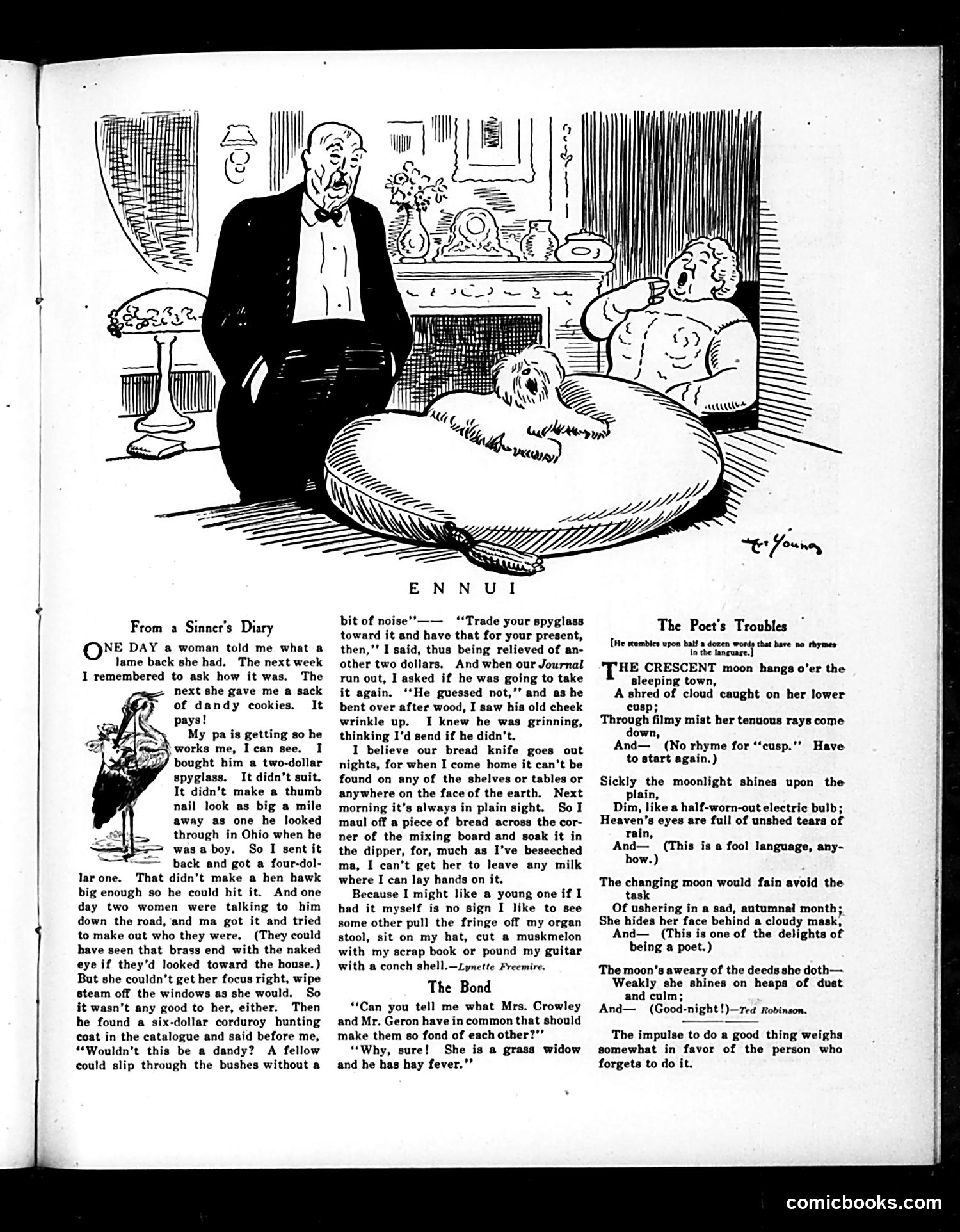
This page from the satirical magazine *Judge* contains humor pieces mocking everyday frustrations and literary pretension. The main cartoon ("Ennui") depicts a wealthy man in formal dress observing an obese woman lounging on a large cushion—likely satirizing idle leisure class excess and the affectation of boredom as a status symbol. The text pieces include: - "From a Sinner's Diary": A humorous account of petty domestic manipulation (trading unwanted gifts, hiding kitchen items) - "The Bond": A brief joke about a widow and a man with hay fever finding common ground - "The Poet's Troubles": A mock-serious poem by "Ted Robinson" where the author struggles repeatedly to find rhymes for "cusp" and other words, satirizing overwrought Romantic poetry and the pretension of serious verse-writing The overall theme mocks social artifice, domestic irritations, and the self-importance of aspiring poets—typical targets of *Judge's* satire.
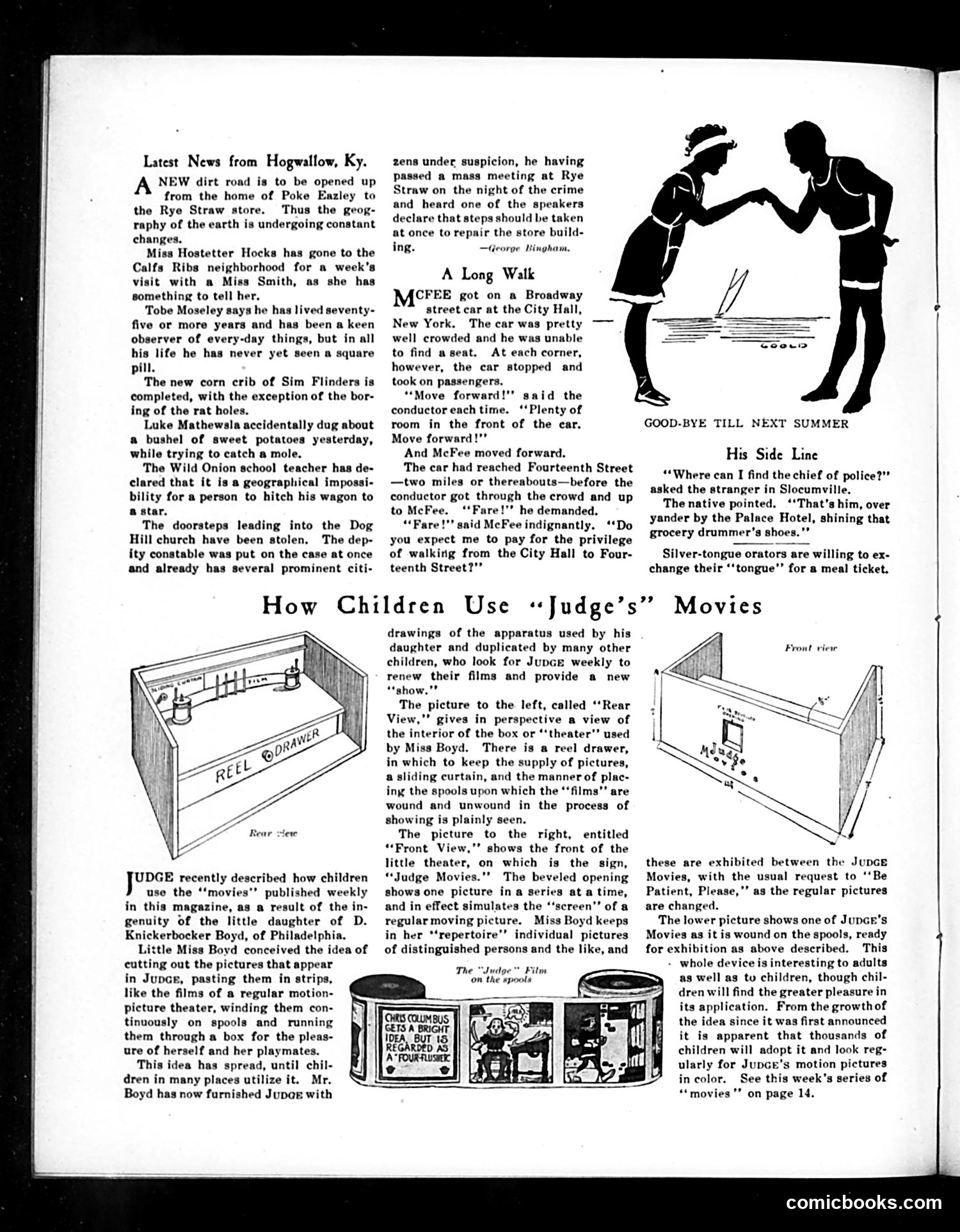
This page contains three separate pieces: 1. **"Latest News from Hogwallow, Ky."** — Rural humor satirizing small-town life through absurd anecdotes (a person never seeing a square pill, accidentally digging potatoes while mole-hunting). The satire mocks rural simplicity and provincial concerns. 2. **"A Long Walk"** — A commuter humor piece where a passenger boards a crowded streetcar at City Hall and is repeatedly told to move forward as passengers board at each stop. He walks two miles before the conductor finally demands his fare, and he protests paying for what amounts to a forced walk. This satirizes NYC transit overcrowding and conductor rudeness. 3. **"How Children Use 'Judge's' Movies"** — Not satire but rather a feature describing an invention by a reader's daughter: a homemade movie projector using Judge magazine pictures. Children cut out picture strips, wind them on spools, and project them through a cardboard box theater—an early DIY animation device that became popular among children.
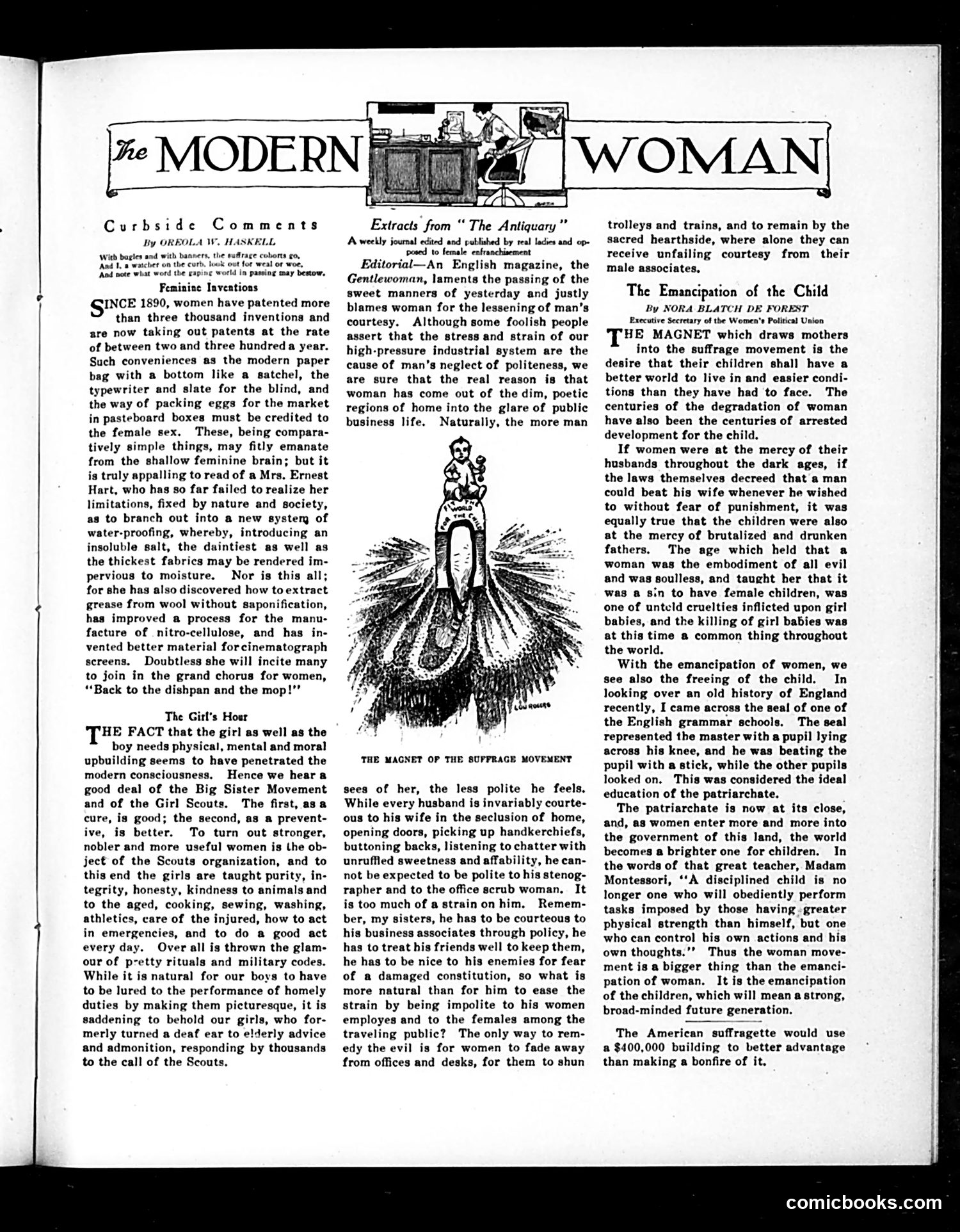
This page satirizes the women's suffrage movement and female advancement through multiple pieces: **"Feminine Inventions"** mocks Mrs. Ernest Hart's substantial technological achievements (waterproofing fabrics, extracting grease from wool, improving cinematograph screens) by sarcastically suggesting women should return to "the dishpan and the mop"—implying women's intellectual capabilities are naturally limited to domestic work. **"The Girl's Hose"** questions why girls need the Girl Scouts' character training when boys do, suggesting it's unfortunate that young women respond to appeals for self-improvement. **"Extracts from 'The Antiquary'"** contains the harshest satire: it presents an anti-suffrage argument claiming men's declining courtesy stems from women entering public life. The logic is absurdly circular—men are courteous to wives at home but rude to female stenographers and office workers because treating women decently in public "strains" them. The cartoon "The Magnet of the Suffrage Movement" (center) visually supports this mockery, likely depicting women attracted to suffrage as foolish or manipulated. Overall, Judge satirizes anti-suffrage arguments by exposing their contradictions and absurdity.
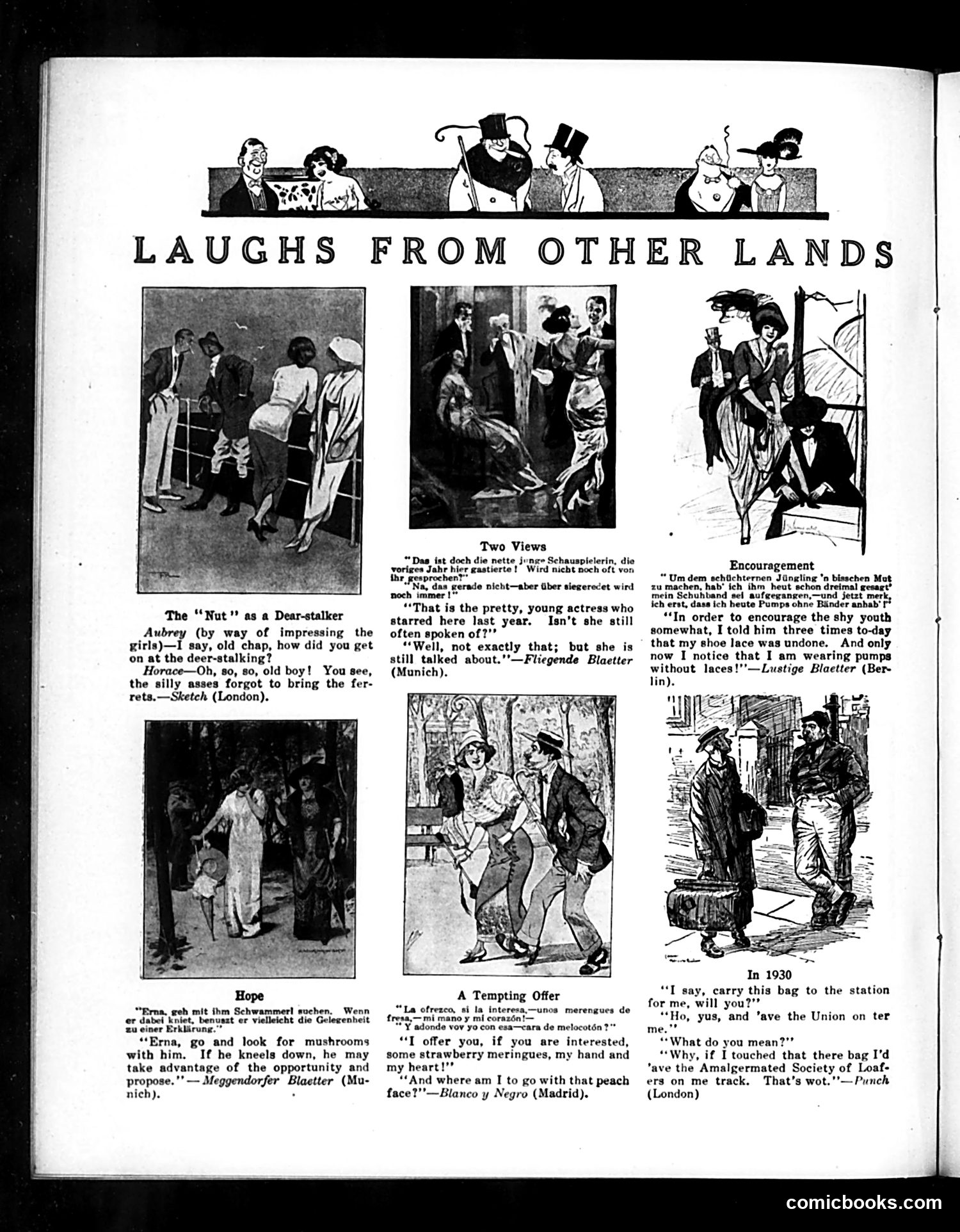
This page collects satirical humor translated from European magazines, showcasing early 20th-century social attitudes. **Key jokes:** - **"The Nut as a Dear-stalker"**: A young man embarrassingly admits he failed at hunting because ferrets were forgotten—mocking pretentious posturing. - **Mushroom gathering**: German humor about a woman sending her companion to pick mushrooms, hoping he'll kneel and propose—satirizing awkward courtship rituals. - **The actress**: Mocking a former stage performer whose reputation has faded; she's no longer discussed but remains a scandal topic. - **"Tempting Offer"**: Spanish satire where a suitor offers strawberries, his hand, and heart, but the woman rejects his "peach face"—insulting his appearance. - **Encouragement**: A woman repeatedly pretends her shoelace is loose to give a shy man confidence, only to realize she's wearing laceless pumps—self-defeating vanity. - **The bag**: British class humor where a working man refuses to carry luggage because union rules prohibit it, satirizing labor rigidity. The page reflects period anxieties about courtship, class, labor, and vanity across cultures.
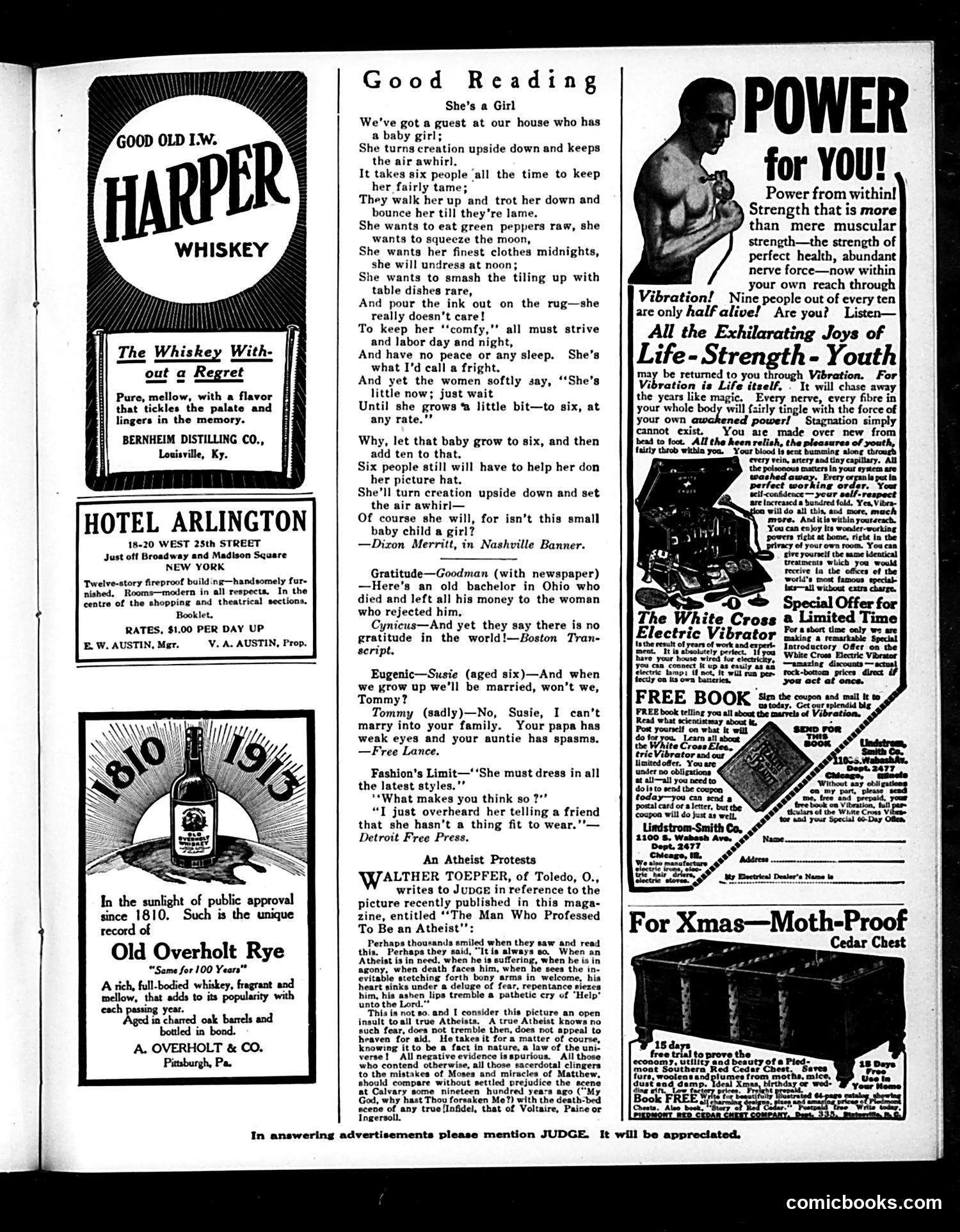
This is primarily an **advertising page** from Judge magazine, featuring whiskey and hotel ads alongside light humor pieces—typical early 20th-century magazine content. The notable editorial item is a letter from **Walther Toepfer of Toledo, Ohio**, protesting a recent Judge cartoon titled "The Man Who Professed To Be an Atheist." Toepfer argues that the cartoon perpetuated a stereotype: that atheists lose their faith when facing death. He insists true atheists accept death rationally, without fear or religious appeals, and cites famous freethinkers like Voltaire, Paine, and Ingersoll as examples. This reflects a real historical debate: early 1900s American anxiety about atheism and religious authority. The complaint reveals how Judge used religious stereotypes for satire, and how that provoked pushback from atheist readers. The humor pieces ("She's a Girl," "Fashion's Limit") are gentle domestic comedy typical of the era.
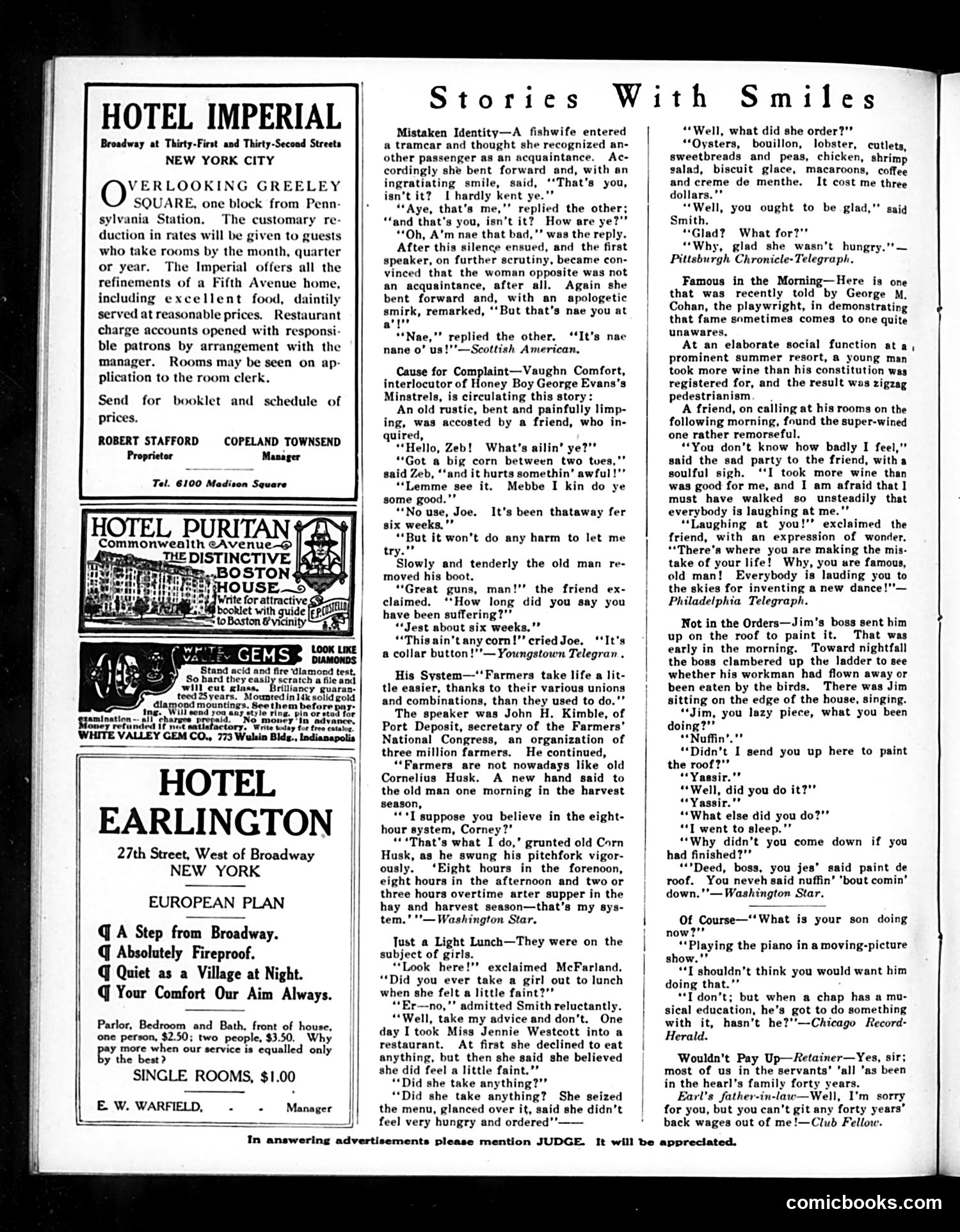
This page is primarily **advertising and humor content**, not political satire. The top two-thirds consists of hotel advertisements (Hotel Imperial, Hotel Duritan, Hotel Earlington) and a diamond company ad. The bottom section, titled "Stories With Smiles," contains **humorous anecdotes** rather than political cartoons: 1. **"Mistaken Identity"**: A Scottish fishwife mistakes a stranger on a tramcar for an acquaintance, then realizes her error—humor derives from the Scottish dialect and awkward social moment. 2. **"Cause for Complaint"**: A rustic man complains of a painful "corn" between his toes for six weeks; his friend discovers it's actually a **collar button**—slapstick/absurdist humor. 3. **"His System"**: Farmers' union leader quotes an old farmer's interpretation of "eight-hour system"—working eight hours morning, afternoon, plus overtime—satirizing farmer labor conditions. 4. **"Just a Light Lunch"**: Incomplete anecdote about taking girls to lunch (text cuts off). These are **gentle, domestic jokes** typical of early-20th-century American humor magazines, not political commentary.
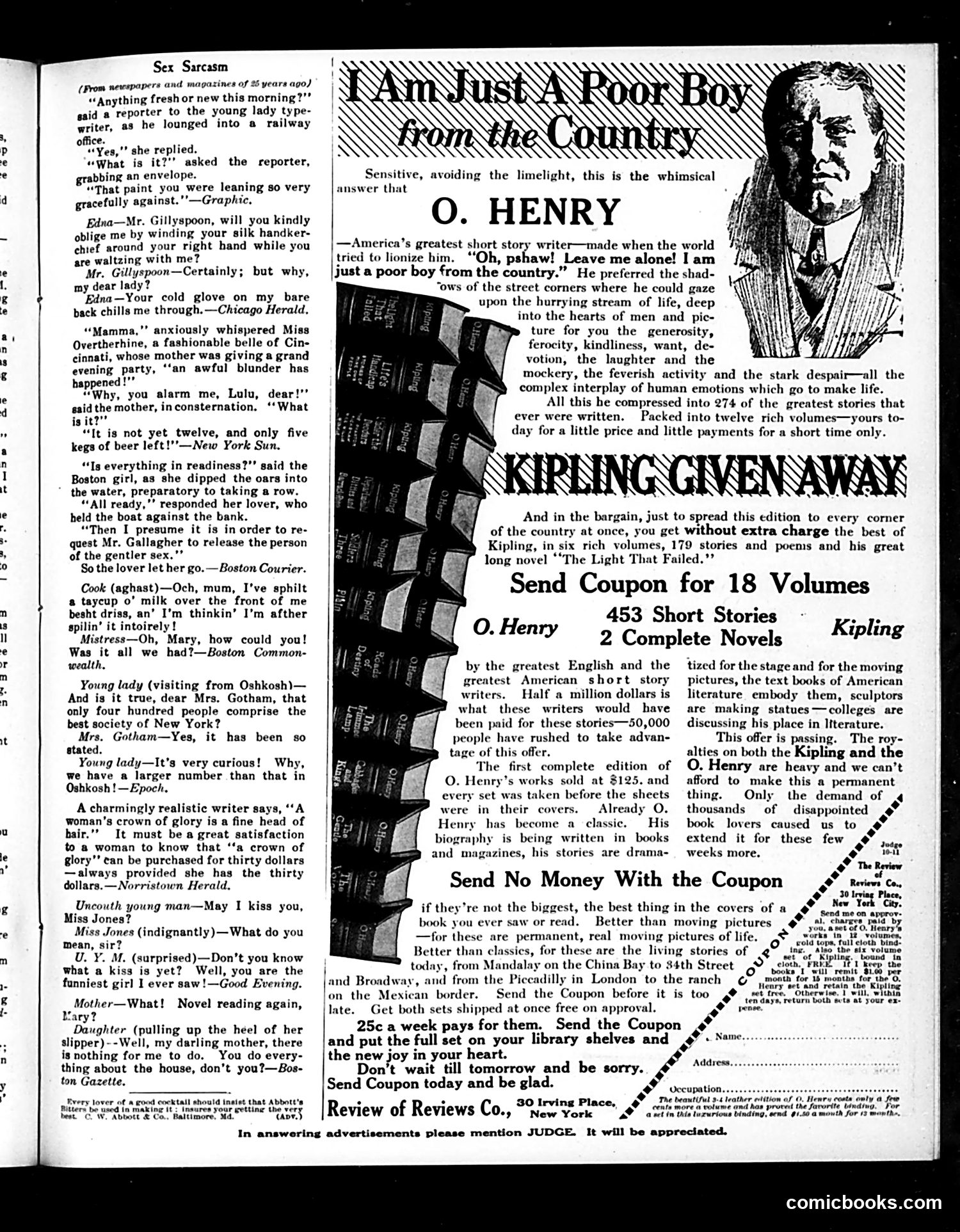
This page combines two distinct elements: a "Sex Sarcasm" column reprinting witty exchanges from newspapers circa 25 years prior, and a major advertisement for collected works of O. Henry and Rudyard Kipling. The sarcasm section features brief comedic dialogues playing on gender dynamics and courtship conventions of the era—a typewriter girl's quip about paint, a woman's complaint about cold gloves during waltzing, a debutante's concern about insufficient beer at her party. These jokes rely on period-specific social anxieties: women in offices, formal dancing customs, and upper-class entertaining. The advertisement promotes O. Henry as "America's greatest short story writer," emphasizing his humble persona ("just a poor boy from the country") and his literary output of 274 stories compressed into twelve volumes, paired with Kipling works. The pitch targets readers seeking affordable, complete literary collections through a coupon system, highlighting both authors' cultural prestige and commercial success.
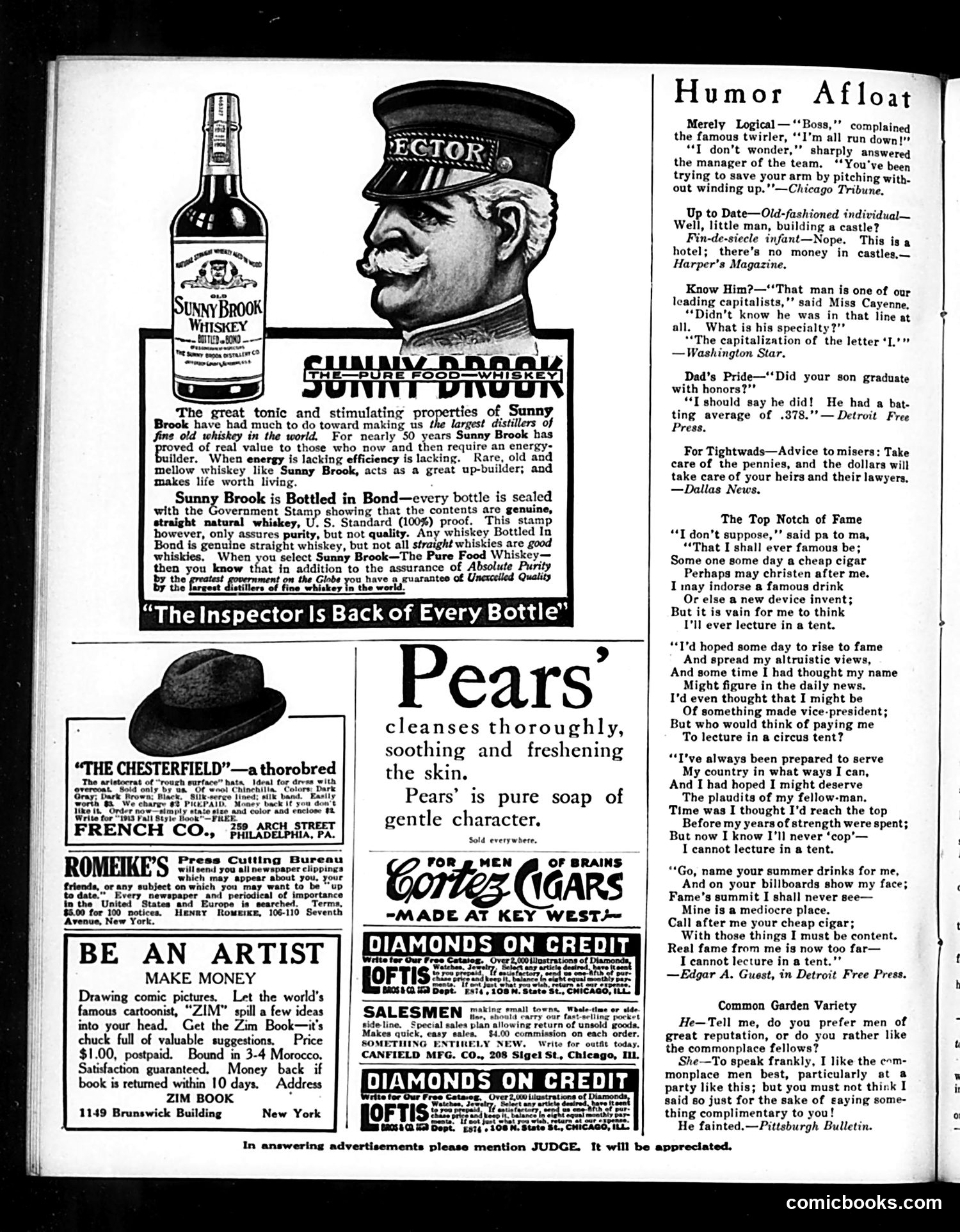
This page is primarily **advertising and humor snippets** rather than a unified political cartoon. The main content includes: **Central Advertisement:** A "Sunny Brook Whiskey" ad featuring an inspector character, promoting the product as a pure, government-stamped whiskey that provides "energy" and acts as a "great up-builder." **Humor Section ("Humor Afloat"):** A collection of short jokes from various sources (Chicago Tribune, Harper's Magazine, Washington Star, Detroit Free Press, Dallas News) on topical subjects: - Baseball (pitcher, batting averages) - Modern society (child building a hotel instead of castle—commentary on capitalist values) - Capitalism and money - Social ambition **Supporting Advertisements:** Pears' soap, Coffez cigars, diamonds on credit, and other period products. The "Top Notch of Fame" poem is satirical commentary on modest American aspirations—the narrator resigned to never achieving fame, unable even to "lecture in a tent." The overall page reflects early 20th-century American consumer culture and gentle social satire about commercialism, sports, and social climbing.
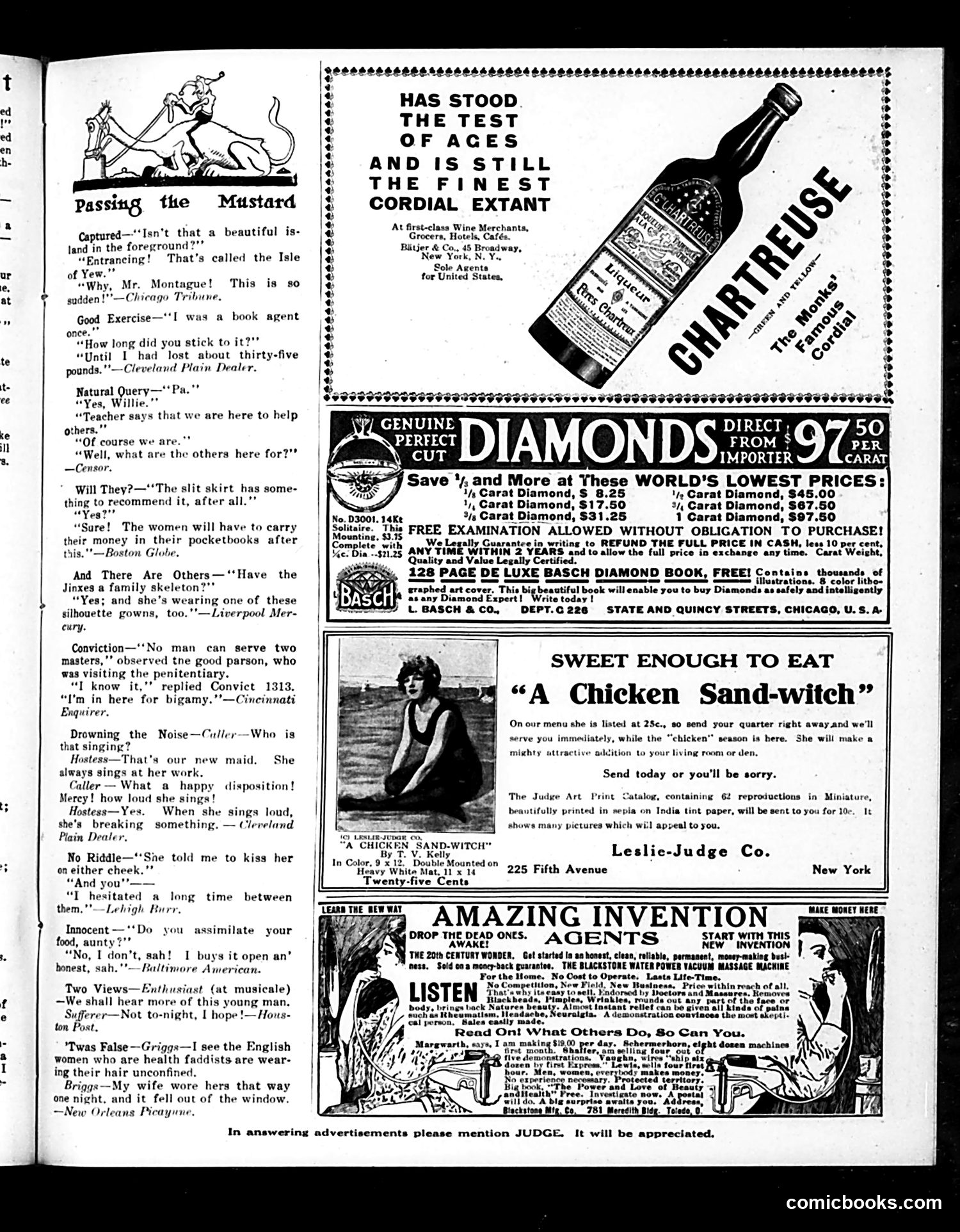
This page consists primarily of **humorous short jokes and advertisements** rather than political cartoons. The content reflects early 20th-century American humor and social commentary. The jokes target contemporary social anxieties: women's fashion (slit skirts requiring purses), new servant-keeping practices, and changing gender roles. One piece mocks a man who hesitates between kissing a woman's cheeks—playing on period courting awkwardness. Another jokes about a woman's hair literally falling out when worn loose, suggesting skepticism toward health fads. The advertisements reveal the era's commercial interests: diamond sales at "world's lowest prices," a "chicken sandwich" art print (apparently depicting a woman), and a mysterious "20th Century Wonder" invention promising easy money—likely a scam targeting desperate workers. The overall tone is genteel, middle-class satire aimed at readers of *Judge*, a humor magazine. Nothing here references specific political figures or events—instead, it captures period preoccupations with propriety, gender relations, consumerism, and get-rich-quick schemes.
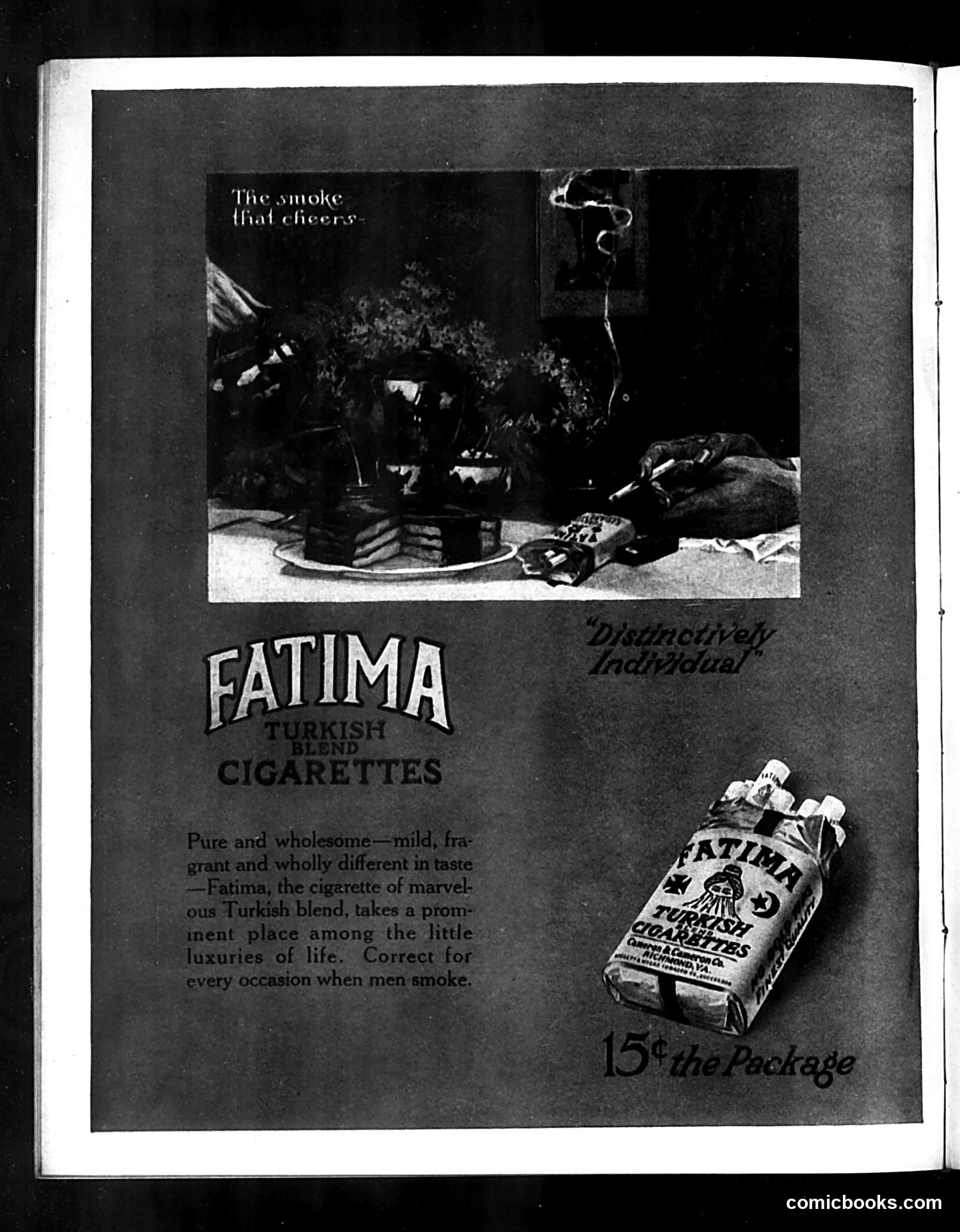
This is a cigarette advertisement rather than political satire. It promotes "Fatima Turkish Blend Cigarettes" at 15¢ per package, emphasizing the product as "Pure and wholesome—mild, fragrant and wholly different in taste." The top image shows smoke forming a face or figure with the caption "The smoke that cheers," a marketing claim about the cigarette's appeal. The advertisement describes Fatima as "Correct for every occasion when men smoke" and "a prominent place among the little luxuries of life." The page illustrates early 20th-century cigarette marketing, when such products were openly advertised without health warnings. The "Distinguished Individual" tagline suggests the brand positioned itself as sophisticated and upscale.