
Judge, 1913-10-11 · page 17 of 24
Judge — October 11, 1913 — page 17: what you’re looking at
What you’re looking at
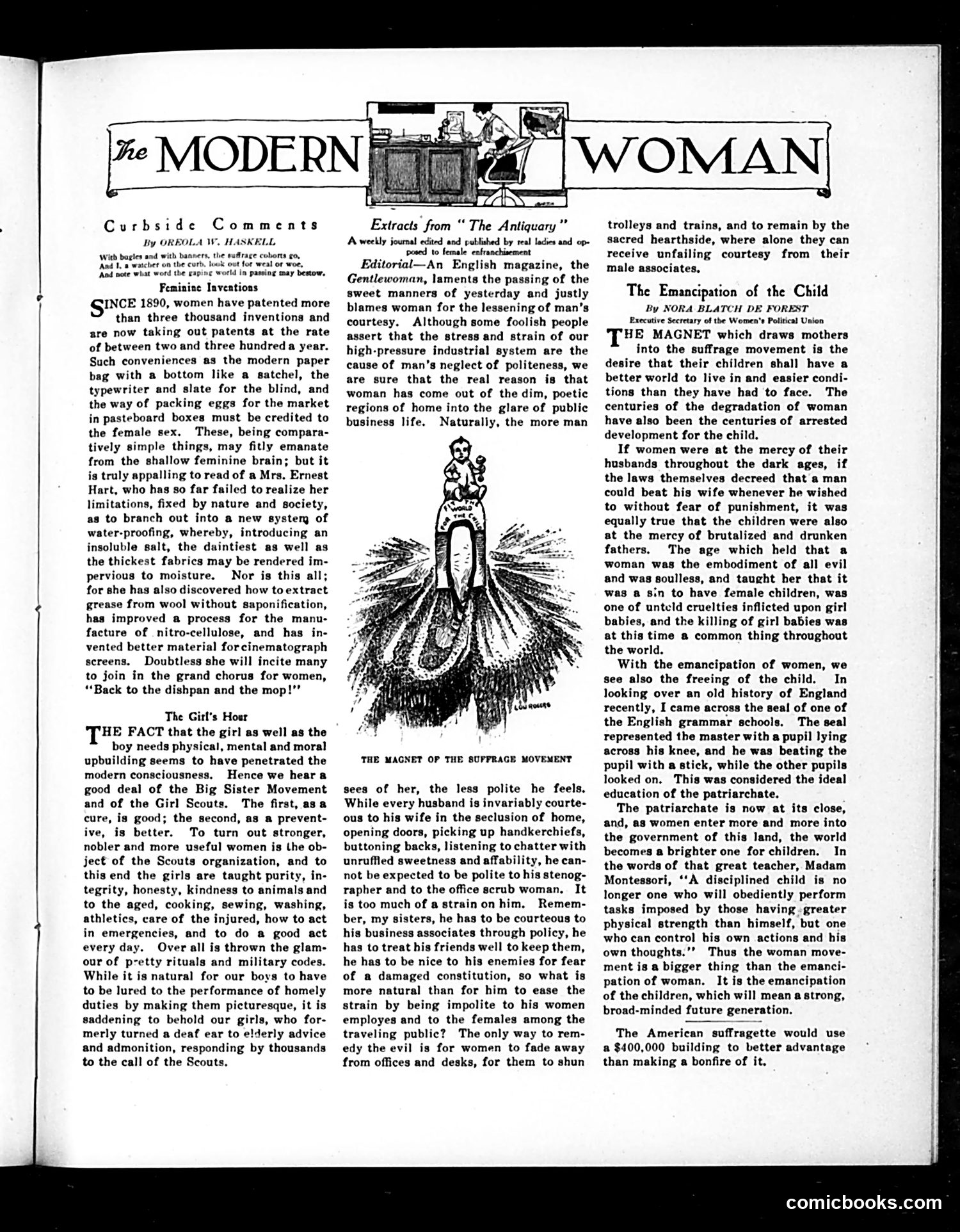
This page satirizes the women's suffrage movement and female advancement through multiple pieces: **"Feminine Inventions"** mocks Mrs. Ernest Hart's substantial technological achievements (waterproofing fabrics, extracting grease from wool, improving cinematograph screens) by sarcastically suggesting women should return to "the dishpan and the mop"—implying women's intellectual capabilities are naturally limited to domestic work. **"The Girl's Hose"** questions why girls need the Girl Scouts' character training when boys do, suggesting it's unfortunate that young women respond to appeals for self-improvement. **"Extracts from 'The Antiquary'"** contains the harshest satire: it presents an anti-suffrage argument claiming men's declining courtesy stems from women entering public life. The logic is absurdly circular—men are courteous to wives at home but rude to female stenographers and office workers because treating women decently in public "strains" them. The cartoon "The Magnet of the Suffrage Movement" (center) visually supports this mockery, likely depicting women attracted to suffrage as foolish or manipulated. Overall, Judge satirizes anti-suffrage arguments by exposing their contradictions and absurdity.
📄 Transcribed text from this page (OCR, searchable)
Machine-transcribed from the original scan — historical spelling and the odd misread are preserved.
Curbside Comments By OREOLA W. HASKELL ith banners, the saffrage cobors £0, out for weal or woe, id in passing may bestow. Feminine Inventions SINCE 1890, women have patented more than three thousand inventions and are now taking out patents at the rate of between two and three hundred a year. Such conveniences as the modern paper bag with a bottom like a satchel, the typewriter and slate for the blind, and the way of packing eggs for the market in pasteboard boxes must be credited to the female sex. These, being compara- tively simple things, may fitly emanate from the shallow feminine brain; but it is truly appalling to read of a Mrs. Ernest Hart, who has so far failed to realize her limitations, fixed by nature and society, as to branch out into a new systerg of water-proofing, whereby, introducing an insoluble salt, the daintiest as well as the thickest fabrics may be rendered im- pervious to moisture. Nor is this all; for she has also discovered how to extract grease from wool without saponification, has improved a process for the manu- facture of nitro-cellulose, and has in- vented better material forcinematograph screens. Doubtless she will incite many to join in the grand chorus for women, “Back to the dishpan and the mop!”’ The Girl's Hosr HE FACT that the girl as well as the boy needs physical, mental and moral upbuilding seems to have penetrated the modern consciousness, Hence we hear a good deal of the Big Sister Movement and of the Girl Scouts. The first, asa cure, is good; the second, as a prevent- ive, is better. To turn out stronger, nobler and more useful women is Lhe ob- ject of the Scouts organization, and to this end the girls are taught purity, in- tegrity, honesty, kindness to animals and to the aged, cooking, sewing, washing, athletics, care of the injured, how to act in emergencies, and to do a good act every day. Over all is thrown the glam- our of pretty rituals and military codes. While it is natural for our boys to have to be lured to the performance of homely duties by making them picturesque, it is saddening to behold our girls, who for- merly turned a deaf ear to elderly advice and admonition, responding by thousands to the call of the Scouts. Extracts from “ The Antiquary” Aweekly journal edited and published by real ladies and op- posed to female enfranchisement Editorial—An English ma; Gentlewoman, laments the pas: sweet manners of yesterday and justly blames woman for the lessening of man’s courtesy. Although some foolish people assert that the stress and strain of our high-pressure industrial system are the cause of man’s neglect of politeness, we are sure that the real reason is that woman has come out of the dim, poetic regions of home into the glare of public business life. Naturally, the more man THE MAGNET OP THE SUPPRAGE MOVEMENT sees of her, the less polite he feels. While every husband is invariably courte- ous to his wife in the seclusion of home, opening doors, picking up handkerchiefs, buttoning backs, listening to chatter with unruffled sweetness and affability, he can- not be expected to be polite to his stenog- rapher and to the office scrub woman. It is too much of a strainon him. Remem- ber, my sisters, he has to be courteous to his business associates through policy, he has to treat his friends well to keep them, he has to be nice to his enemies for fear of a damaged constitution, so what is more natural than for him to ease the strain by being impolite to his women employes and to the females among the traveling public? The only way to rem- edy the evil is for women to fade away from offices and desks, for them to shun trolleys and trains, and to remain by the sacred hearthside, where alone they can receive unfailing courtesy from their male associates. The Emancipation of the Child By NORA BLATCH DE FOREST Executive Secretary of the Women's Political Union HE MAGNET which draws mothers into the suffrage movement is the desire that their children shall have a better world to live in and easier condi- tions than they have had to face. The centuries of the degradation of woman have also been the centuries of arrested development for the child. If women were at the mercy of their husbands throughout the dark ages, if the laws themselves decreed that a man could beat his wife whenever he wished to without fear of punishment, it was equally true that the children were also at the mercy of brutalized and drunken fathers. The age which held that a woman was the embodiment of all evil and was soulless, and taught her that it was a sin to have female children, was one of untceld cruelties inflicted upon girl babies, and the killing of girl babies was at this time a common thing throughout the world. With the emancipation of women, we see also the freeing of the child. In looking over an old history of England recently, I came across the seal of one of the English grammar schools. The seal represented the master with a pupil lying across his knee, and he was beating the pupil with a stick, while the other pupils looked on. This was considered the ideal education of the patriarchate. The patriarchate is now at its close, and, as women enter more and more into the government of this land, the world becomes a brighter one for children. In the words of that great teacher, Madam Montessori, ‘‘A disciplined child is no longer one who will obediently perform tasks imposed by those having greater physical strength than himself, but one who can control his own actions and his own thoughts.’’ Thus the woman move- ment is a bigger thing than the emanci- pation of woman. It is the emancipation of the children, which will mean a strong, broad-minded future generation. The American suffragette would use a $400,000 building to better advantage than making a bonfire of it, comicbooks.com