
Judge, 1913-10-11 · page 4 of 24
Judge — October 11, 1913 — page 4: what you’re looking at
What you’re looking at
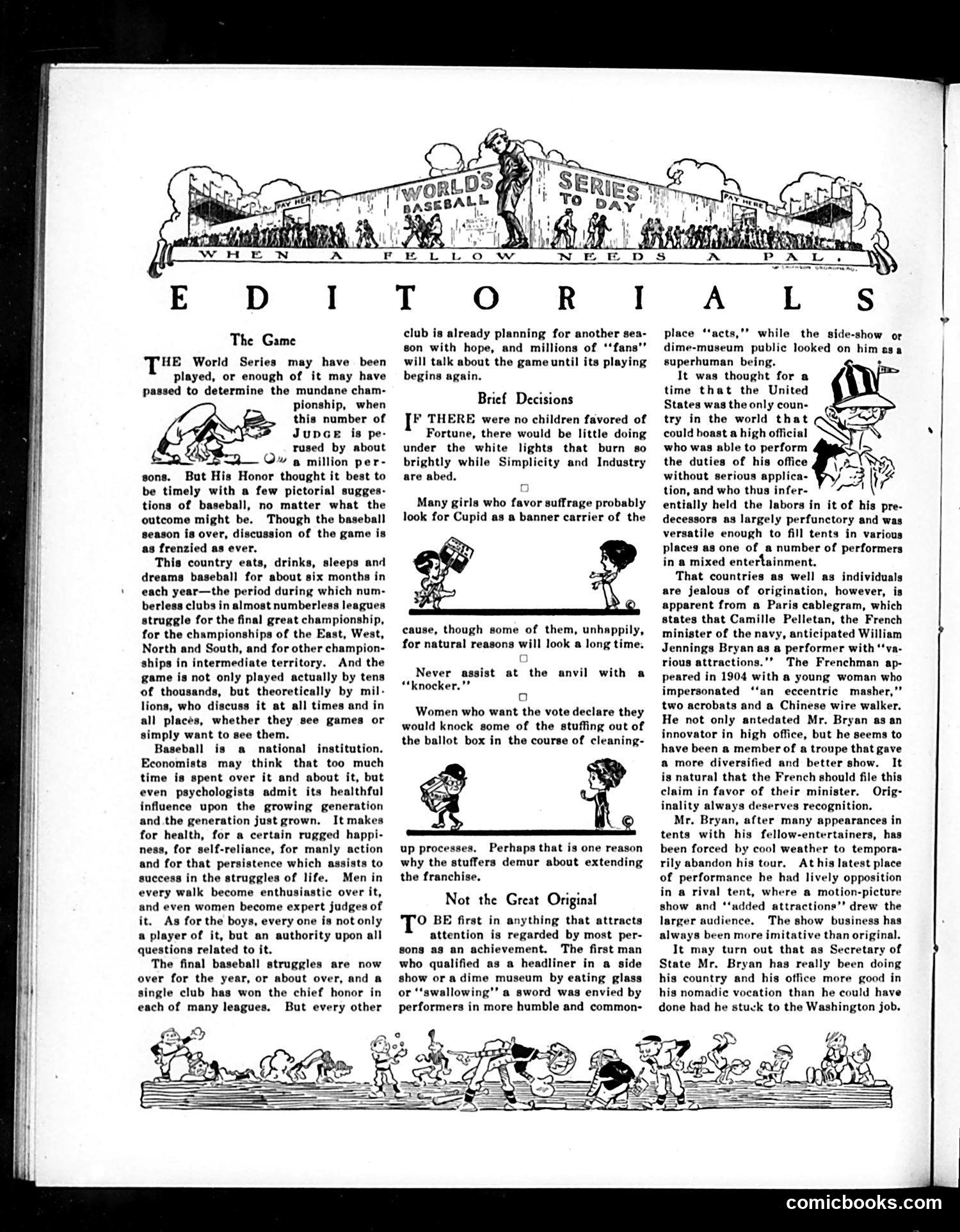
This appears to be a **World Series editorial** from Judge magazine, discussing baseball's cultural significance. The page critiques how baseball dominates American life—people "eat, drink, sleeps and dreams baseball" for six months yearly. The editorial satirizes **suffragists and women's rights advocates**, suggesting they distract from "serious" matters. It mocks women seeking voting rights, implying they should focus on domestic concerns instead. There's also commentary on **William Jennings Bryan**, a politician/performer, suggesting his various "attractions" and showmanship undermine his credibility. The cartoons depict domestic scenes with women and children, likely illustrating the editorial's argument about gender roles and societal priorities during this pre-suffrage era. The satire fundamentally opposes women's political participation while celebrating baseball as a unifying national pastime.
📄 Transcribed text from this page (OCR, searchable)
Machine-transcribed from the original scan — historical spelling and the odd misread are preserved.
The Game HE World Series may have been played, or enough of it may have passed to determine the mundane cham- pionship, when this number of JupGE is pe- rused by about ” @ million per- sons. But His Honor thought it best to be timely with a few pictorial sugges- tions of baseball, no matter what the outcome might be. Though the baseball season is over, discussion of the game is as frenzied as ever. This country eats, drinks, sleeps and dreams baseball for about six months in each year—the period during which num- berless clubs in almost numberless leagues struggle for the final great championship, for the championships of the East, West, North and South, and for other champion- ships in intermediate territory. And the game is not only played actually by tens of thousands, but theoretically by mil- lions, who discuss it at all times and in all places, whether they see games or simply want to see them. Baseball is a national institution. Economists may think that too much time is spent over it and about it, but even psychologists admit its healthful influence upon the growing generation and. the generation just grown. It makes for health, for a certain rugged happi- ness, for self-reliance, for manly action and for that persistence which assists to success in the struggles of life. Menin every walk become enthusiastic over it, and even women become expert judges of it. As for the boys, every one is not only a player of it, but an authority upon all questions related to it. The final baseball struggles are now over for the year, or about over, and a single club has won the chief honor in each of many leagues. But every other club is already planning for another sea- son with hope, and millions of ‘*fans’’ will talk about the game until its playing begins again. Brief Decisions Ir THERE were no children favored of Fortune, there would be little doing under the white lights that burn so brightly while Simplicity and Industry are abed. Many girls who favor suffrage probably look for Cupid as a banner carrier of the cause, though some of them, unhappily, for natural reasons will look a long time. Never assist at the anvil with a “*knocker.’” fa) Women who want the vote declare they would knock some of the stuffing out of the ballot box in the course of cleaning- up processes, Perhaps that is one reason why the stuffers demur about extending the franchise. Not the Great Original 'O BE first in anything that attracts attention is regarded by most per- sons as an achievement. The first man who qualified as a headliner in a side show or a dime museum by eating glass or ‘‘swallowing’’ a sword was envied by performers in more humble and common- place ‘‘acts,’? while the side-show or dime-museum public looked on him asa superhuman being. It was thought for a time that the United States was the only coun- try in the world that could boast a high official who was able to perform the duties of his office without serious applica- tion, and who thus infer- entially held the labors in it of his pre- decessors as largely perfunctory and was versatile enough to fill tents in various places as one of a number of performers in a mixed entertainment. That countries as well as individuals are jealous of origination, however, is apparent from a Paris cablegram, which states that Camille Pelletan, the French minister of the navy, anticipated William Jennings Bryan as a performer with ‘‘va- rious attractions.’’ The Frenchman ap- peared in 1904 with a young woman who impersonated ‘‘an eccentric masher,” two acrobats and a Chinese wire walker. He not only antedated Mr. Bryan as an innovator in high office, but he seems to have been a member of a troupe that gave a more diversified and better show. It is natural that the French should file this claim in favor of their minister. Orig- inality always deserves recognition. Mr. Bryan, after many appearances in tents with his fellow-entertainers, has been forced by cool weather to tempora- rily abandon his tour, At his latest place of performance he had lively opposition in a rival tent, where a motion-picture show and ‘‘added attractions’’ drew the larger audience. The show business has always been more i ive than original. It may turn out that as Secretary of State Mr. Bryan has really been doing his country and his office more good in his nomadic vocation than he could have done had he stuck to the Washington job. comicbooks.com