
Judge, 1913-10-11 · page 5 of 24
Judge — October 11, 1913 — page 5: what you’re looking at
What you’re looking at
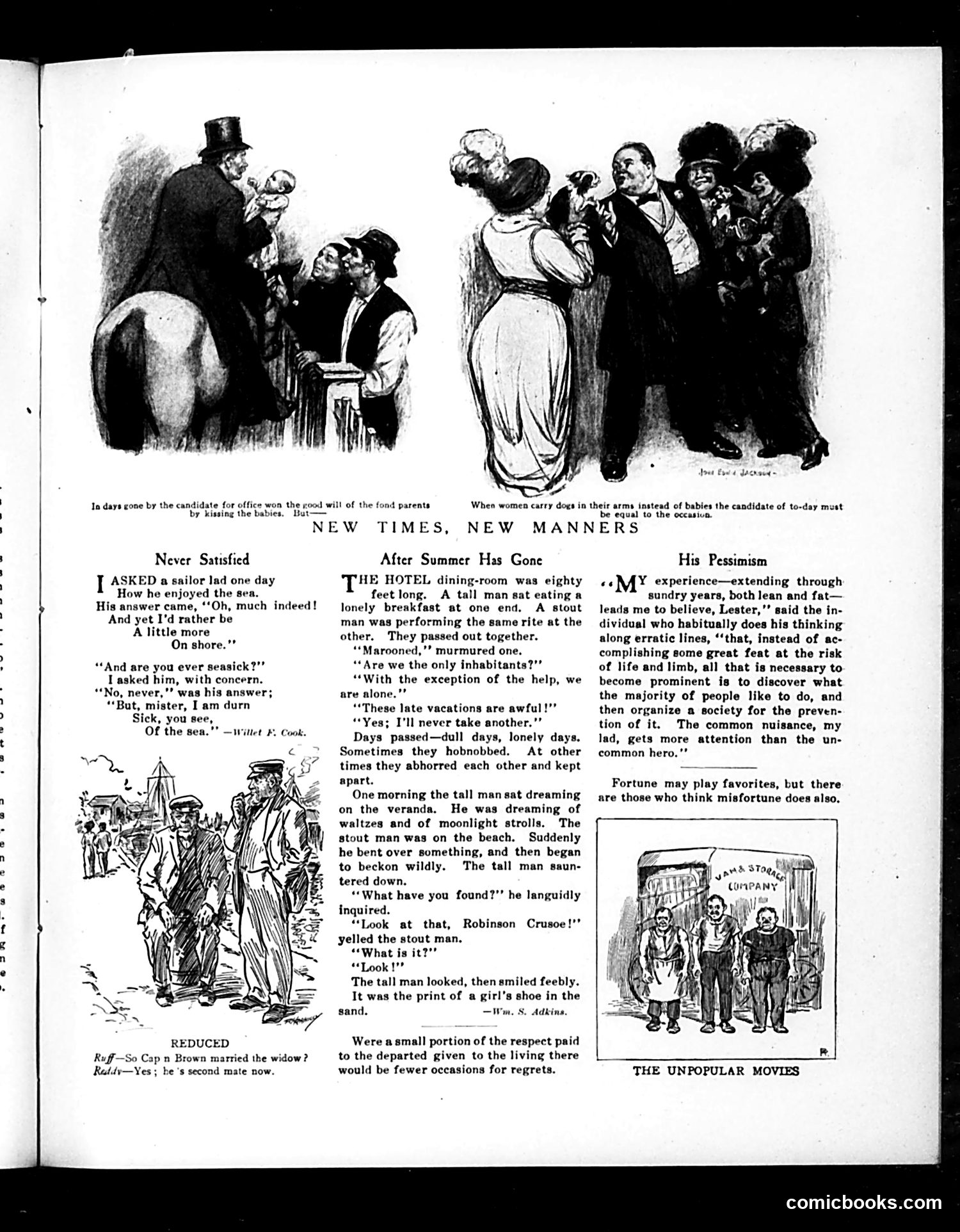
This page presents satirical commentary on changing social customs titled "NEW TIMES, NEW MANNERS." The three cartoons mock evolving behavior: **Top panels**: Contrast old versus new etiquette—the left shows traditional courtship (men kissing babies to gain parental favor), while the right shows modern women carrying dogs instead of infants, suggesting superficiality in contemporary society. **"Never Satisfied"**: A poem mocking someone perpetually dissatisfied with leisure activities. **"After Summer Has Gone"**: A humorous anecdote about a tall man's awkward dining experience, attributed to W.S. Atkins. **"His Pessimism"**: Commentary on someone devoted to preventing social nuisances through organized societies. The page satirizes modern American social pretension and changing values among the middle and upper classes, typical of Judge's satirical approach to contemporary manners and morality.
📄 Transcribed text from this page (OCR, searchable)
Machine-transcribed from the original scan — historical spelling and the odd misread are preserved.
Ia days cone by the candidate for office won the rood will of the fond parents st NEW TIMES, by kissing the babies, Never Satisfied I ASKED a sailor lad one day How he enjoyed the sea. His answer came, ‘‘Oh, much indeed! And yet I'd rather be A little more On shore.’* ‘‘And are you ever seasick?"’ LT asked him, with concern. **No, never,’’ was his answer; “But, mister, I am durn Sick, you see, Of the sea.’” —witiet #. Cook. REDUCED Ruff—So Cap n Brown married the widow ? Raddv—Yes ; he's second mate now. NEW After Summer Has Gone THE HOTEL dining-room was eighty feet long. A tall man sat eating a lonely breakfast at one end. A stout man was performing the same rite at the other. They passed out together. ‘*Marooned,’? murmured one. “Are we the only inhabitants?’’ “With the exception of the help, we are alone.’’ ‘These late vacations are awful !’’ “Yes; I'll never take another.”” Days passed—dull days, lonely days, Sometimes they hobnobbed. At other times they abhorred each other and kept apart. One morning the tall man sat dreaming on the veranda. He was dreaming of waltzes and of moonlight strolls. The stout man was on the beach. Suddenly he bent over something, and then began to beckon wildly. The tall man saun- tered down. “What have you found?” he languidly inquired. “Look at that, yelled the stout man. “‘What is it?"’ “Look !"” The tall man looked, then smiled feebly. It was the print of a girl's shoe in the sand. —Wm. S. Adkins. Robinson Crusoe!'’ Were asmall portion of the respect paid to the departed given to the living there would be fewer occasions for regrets. When women carry dogs in their arms instead of babies the candidate of to-day must be equal to the occasiva. MANNERS His Pessimism oe Y experience—extending through sundry years, both lean and fat— leads me to believe, Lester,’’ said the in- dividual who habitually does his thinking along erratic lines, ‘‘that, instead of ac- complishing some great feat at the risk of life and limb, all that is necessary to become prominent is to discover what the majority of people like to do, and then organize a society for the preven- tion of it. The common nuisance, my lad, gets more attention than the un- common hero.’"" Fortune may play favorites, but there. are those who think misfortune does also, THE UNPOPULAR MOVIES comicbooks.com