
Judge, 1913-10-11 · page 15 of 24
Judge — October 11, 1913 — page 15: what you’re looking at
What you’re looking at
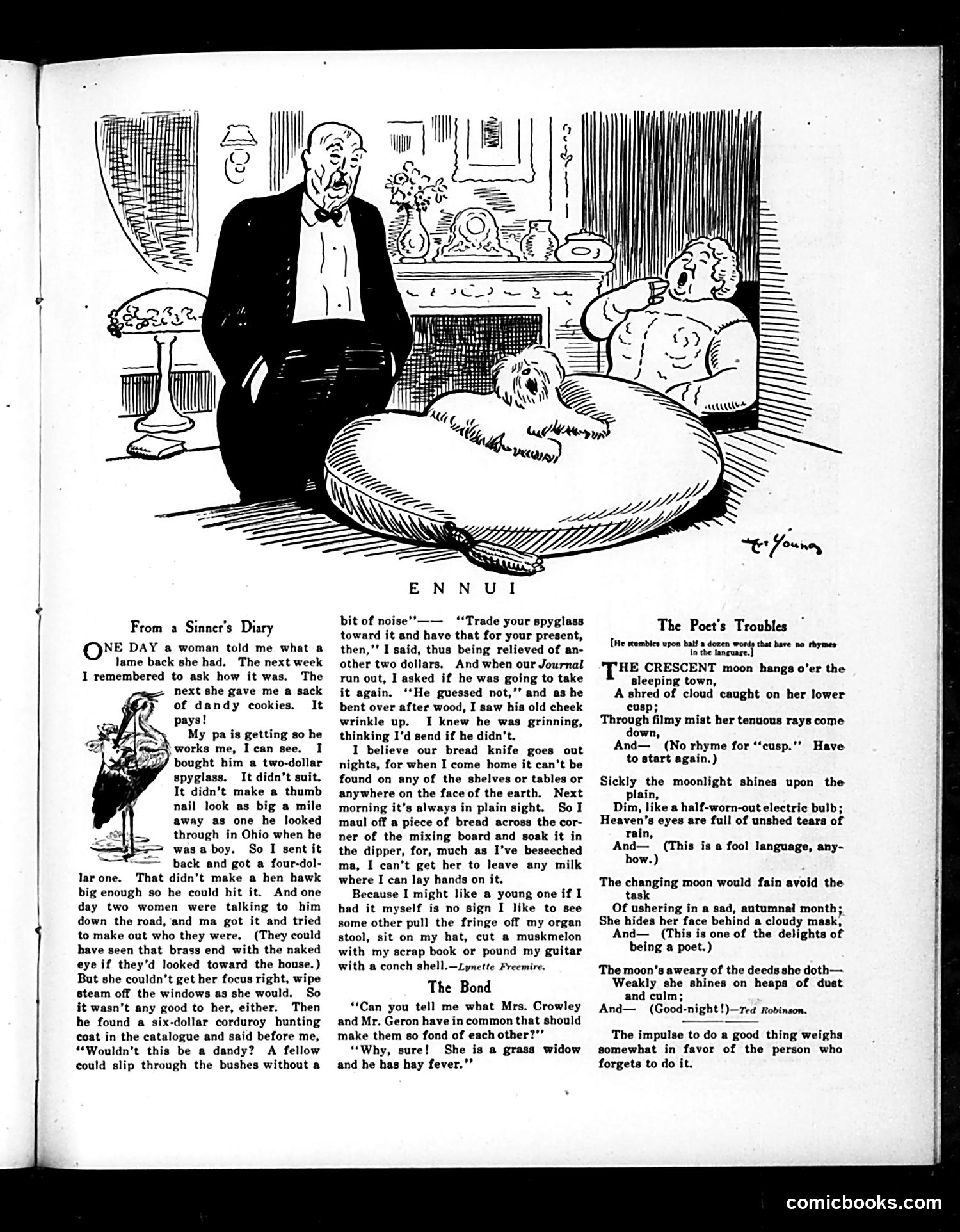
This page from the satirical magazine *Judge* contains humor pieces mocking everyday frustrations and literary pretension. The main cartoon ("Ennui") depicts a wealthy man in formal dress observing an obese woman lounging on a large cushion—likely satirizing idle leisure class excess and the affectation of boredom as a status symbol. The text pieces include: - "From a Sinner's Diary": A humorous account of petty domestic manipulation (trading unwanted gifts, hiding kitchen items) - "The Bond": A brief joke about a widow and a man with hay fever finding common ground - "The Poet's Troubles": A mock-serious poem by "Ted Robinson" where the author struggles repeatedly to find rhymes for "cusp" and other words, satirizing overwrought Romantic poetry and the pretension of serious verse-writing The overall theme mocks social artifice, domestic irritations, and the self-importance of aspiring poets—typical targets of *Judge's* satire.
📄 Transcribed text from this page (OCR, searchable)
Machine-transcribed from the original scan — historical spelling and the odd misread are preserved.
—~. z |i C) S From a Sinner’s Diary ONE DAY a woman told me what a lame back she had. The next week 1 remembered to ask how it was. The next she gave me a sack of dandy cookies. It pays! . My pa is getting so he ‘works me, I can see. I bought him a two-dollar spyglass. It didn’t suit. It didn’t make a thumb nail look as big a mile away as one he looked through in Ohio when he wasaboy. So I sent it back and got a four-dol- larone. That didn’t make a hen hawk big enough so he could hit it. And one day two women were talking to him down the road, and ma got it and tried to make out who they were. (They could have seen that brass end with the naked eye if they’d looked toward the house.) But she couldn’t get her focus right, wipe steam off the windows as she would. So it wasn’t any good to her, either. Then he found a six-dollar corduroy hunting coat in the catalogue and said before me, “‘Wouldn’t this be a dandy? A fellow could slip through the bushes without a wl | : ° eens d0> —— re TS (( cA bit of noise’’-—— ‘‘Trade your spyglass toward it and have that for your present, then,"’ I said, thus being relieved of an- other two dollars, And when our Journal run out, I asked if he was going to take it again. ‘‘He guessed not,’’ and as he bent over after wood, I saw his old cheek wrinkle up. I knew he was grinning, thinking I'd send if he didn't. I believe our bread knife goes out nights, for when I come home it can’t be found on any of the shelves or tables or anywhere on the face of the earth. Next morning it’s always in plain sight. So I maul off a piece of bread across the cor- ner of the mixing board and soak it in the dipper, for, much as I’ve beseeched ma, I can’t get her to leave any milk where I can lay hands on it. Because I might like a young one if I had it myself is no sign I like to see some other pull the fringe off my organ stool, sit on my hat, cut a muskmelon with my scrap book or pound my guitar with a conch shell.—Lynette Freemire. The Bond “Can you tell me what Mrs. Crowley and Mr. Geron have in common that should make them 80 fond of each other?”’ “Why, sure! She is a grass widow and he has hay fever."” The Poet’s Troubles [He scambics upon half a dozen words that bare no rhymes in the language.) THE CRESCENT moon hangs o’er the sleeping town, A shred of cloud caught on her lower cusp; Through filmy mist her tenuous rays come down, And— (No rhyme for ‘‘cusp.”' to start again.) Have Sickly the moonlight shines upon the plain, Dim, like a half-worn-out electric bulb; Heaven's eyes are full of unshed tears of rain, And— how.) (This is a fool language, any- The changing moon would fain avoid the task Of ushering in a sad, autumnal month; She hides her face behind a cloudy mask, And— (This is one of the delights of being a poet.) The moon’s aweary of the deeds she doth— Weakly she shines on heaps of dust and culm; And— (Good-night!)—rTed Robinson. The impulse to do a good thing weighs somewhat in favor of the person who forgets to do it. comicbooks.com