
Judge, 1913-10-11 · page 13 of 24
Judge — October 11, 1913 — page 13: what you’re looking at
What you’re looking at
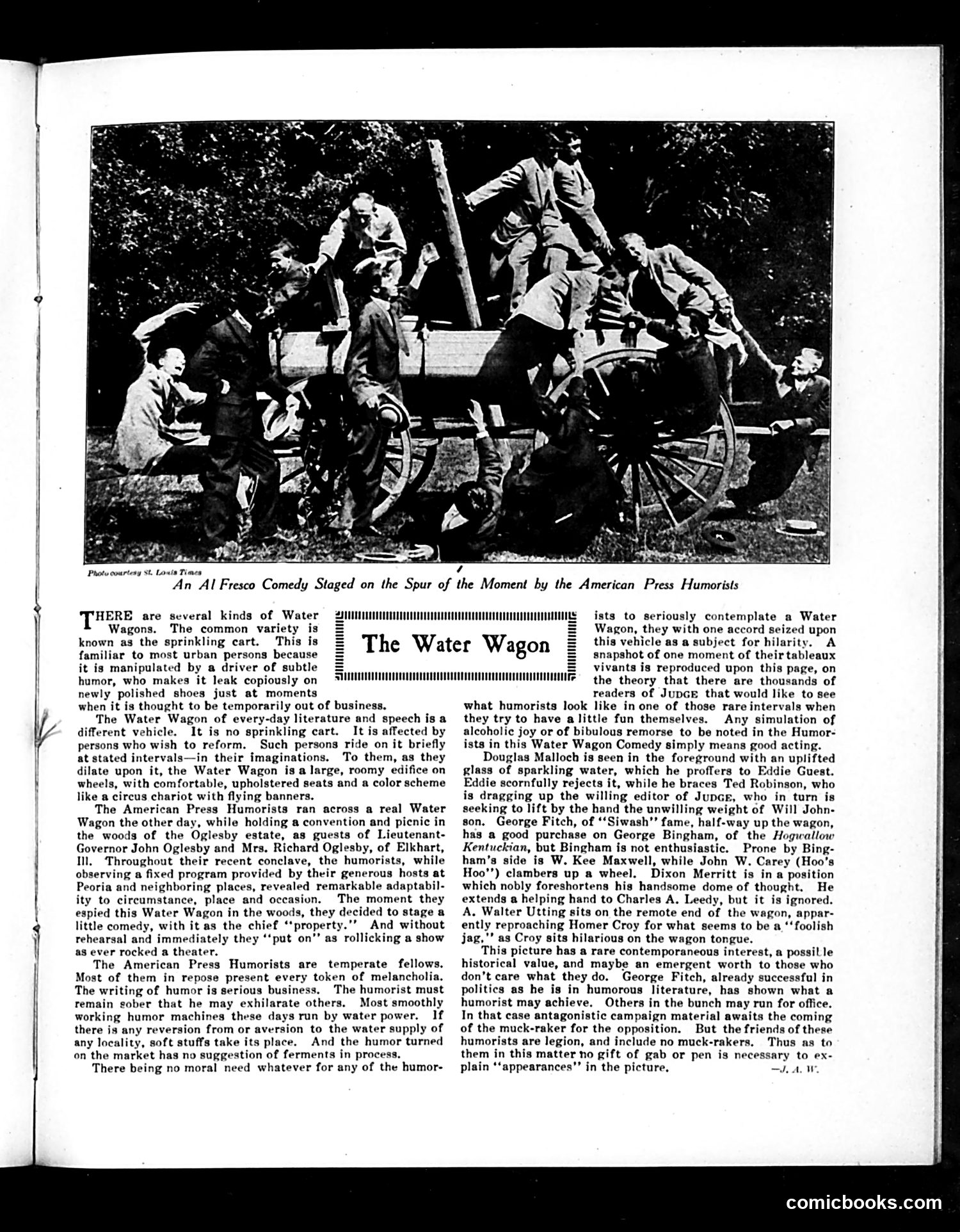
This page documents a humorous photo-stunt by members of the American Press Humorists association at a 1912 gathering near Peoria, Illinois. The satirical point is subtle: the text explains that "Water Wagon" has two meanings—a literal water cart, and the figurative phrase for temperance/sobriety that people claim to embrace but rarely sustain. The joke: these professional humorists, who must remain sober to write humor, spontaneously staged an exaggerated "temperance" scene around an actual water wagon, with named participants (Douglas Malloch, Eddie Guest, Ted Robinson, and others—all identifiable contemporary humorists and editors) theatrically "dragging" each other toward the water wagon in mock-serious fashion. The satire targets the common hypocrisy of public temperance claims—people boarding the "water wagon" temporarily in their "imaginations," as the text says. By staging this absurdist pantomime, the humorists mock both the cliché and themselves.
📄 Transcribed text from this page (OCR, searchable)
Machine-transcribed from the original scan — historical spelling and the odd misread are preserved.
ih eee Photu courtesy St. Louis Times HERE are several kinds of Water Wagons. The common variety is = known as the sprinkling cart. This is familiar to most urban persons because it is manipulated by a driver of subtle humor, who makes it leak copiously on newly polished shoes just at moments when it is thought to be temporarily out of business. The Water Wagon of every-day literature and speech is a different vehicle. It is no sprinkling cart. It is affected by persons who wish to reform. Such persons ride on it briefly at stated intervals—in their imaginations. To them, as they dilate upon it, the Water Wagon isa large, roomy edifice on wheels, with comfortable, upholstered seats and a color scheme like a circus chariot with flying banners. The American Press Humorists ran across a real Water Wagon the other day, while holding a convention and picnic in the woods of the Oglesby estate, as guests of Lieutenant- Governor John Oglesby and Mrs. Richard Oglesby, of Elkhart, Ill. Throughout their recent conclave, the humorists, while observing a fixed program provided by their generous hosts at Peoria and neighboring places, revealed remarkable adaptabil- ity to circumstance, place and occasion. The moment they espied this Water Wagon in the woods, they decided to stage a little comedy, with it as the chief ‘‘property.’’ And without rehearsal and immediately they ‘‘put on’’ as rollicking a show as ever rocked a theater. The American Press Humorists are temperate fellows. Most of them in repose present every token of melancholia. The writing of humor is serious business. The humorist must remain sober that he may exhilarate others, Most smoothly working humor machines these days run by water power. If there is any reversion from or aversion to the water supply of any locality, soft stuffs take its place. And the humor turned on the market has no suggestion of ferments in process, There being no moral need whatever for any of the humor- An Al Fresco Comedy Staged on the Spur of the Moment by the American Press Humorists ‘SAUUeU naan naeaeeueaeaceeaceceneaeaeaeaeaea cates The Water Wagon ETM re criti Ait tint nina Sis? | SITS 7 ists to seriously contemplate a Water = Wagon, they with one accord seized upon = this vehicle as a subject for hilarity. A = snapshot of one moment of their tableaux = -vivants is reproduced upon this page, on le the theory that there are thousands of readers of JupGe that would like to see what humorists look like in one of those rare intervals when they try to have a little fun themselves. Any simulation of alcoholic joy or of bibulous remorse to be noted in the Humor- ists in this Water Wagon Comedy simply means good acting. Douglas Malloch is seen in the foreground with an uplifted glass of sparkling water, which he proffers to Eddie Guest. Eddie scornfully rejects it, while he braces Ted Robinson, who is dragging up the willing editor of Jupce, who in turn is seeking to lift by the hand the unwilling weight of Will John- son. George Fitch, of ‘‘Siwash’’ fame, half-way up the wagon, has a good purchase on George Bingham, of the Hogiwallow Kentuckian, but Bingham is not enthusiastic. Prone by Bing- ham’s side is W. Kee Maxwell, while John W. Carey (Hoo’s Hoo'’) clambers up a wheel. Dixon Merritt is in a position which nobly foreshortens his handsome dome of thought. He extends a helping hand to Charles A. Leedy, but it is ignored. A. Walter Utting sits on the remote end of the wagon, appar- ently reproaching Homer Croy for what seems to be a ‘‘foolish jag,’’ as Croy sits hilarious on the wagon tongue. This picture has a rare contemporaneous interest, a possille historical value, and maybe an emergent worth to those who don’t care what they do. George Fitch, already successful in politics as he is in humorous literature, has shown what a humorist may achieve. Others in the bunch may run for office. In that case antagonistic campaign material awaits the coming of the muck-raker for the opposition. But the friends of these humorists are legion, and include no muck-rakers. Thus as to them in this matter no gift of gab or pen is necessary to ex- plain ‘‘appearances’’ in the picture, JAW, comicbooks.com