
A complete issue · 24 pages · 1913
Judge — October 4, 1913
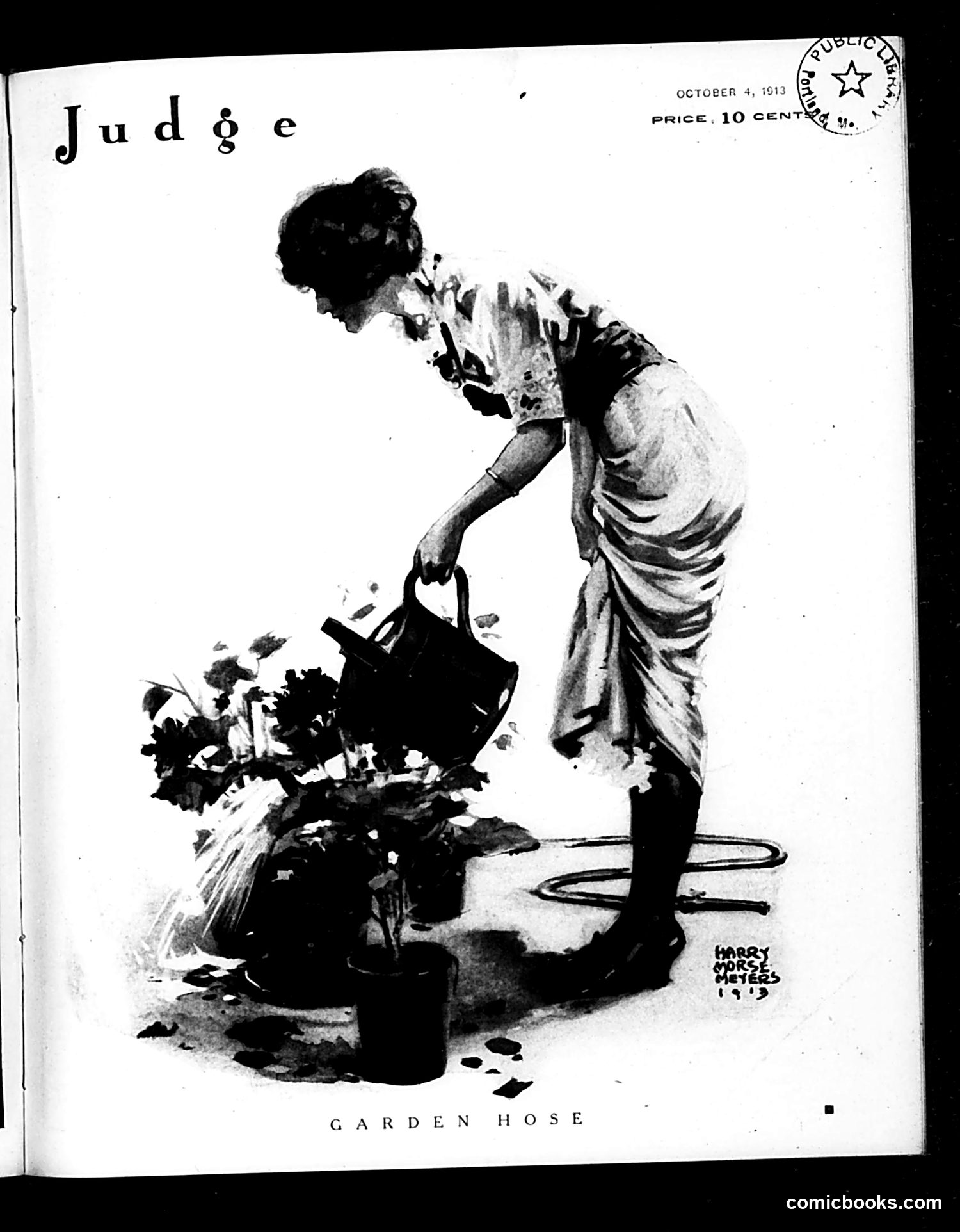
This illustration shows a woman watering wilted flowers with a garden hose—a straightforward domestic scene with no apparent political satire or caricature visible in the image itself. The page appears to be primarily illustrative/humorous rather than political commentary. The title "Garden Hose" and the simple domestic scenario suggest this is either a standalone cartoon joke (possibly about gardening mishaps or household management) or an advertisement for garden equipment. Without additional context from the magazine's editorial content that day, the specific satirical point remains unclear. The careful rendering and professional composition suggest this was featured content, but the meaning would have been apparent primarily to 1913 readers familiar with any contemporary references or advertising campaigns.
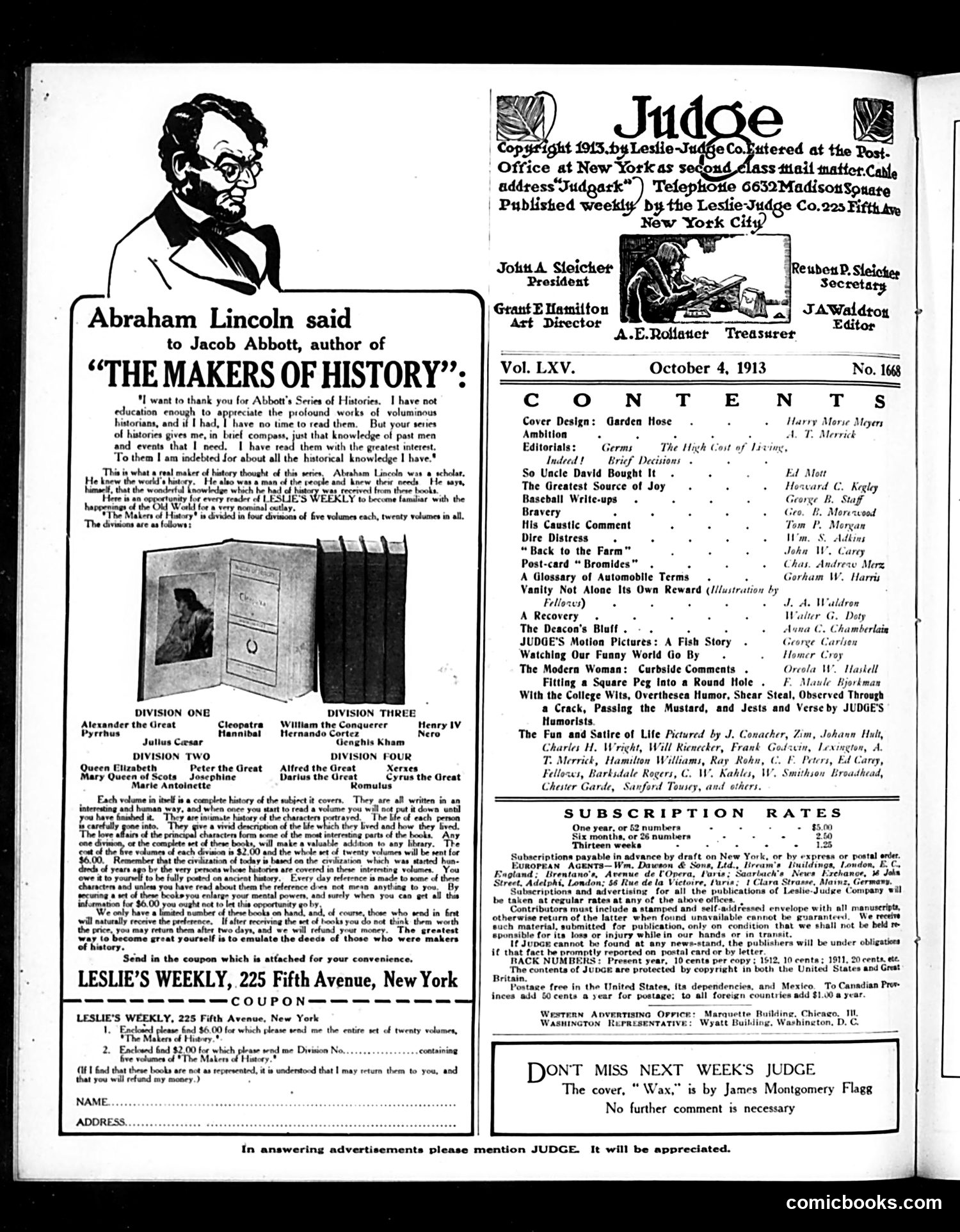
The left page features a prominent quote attributed to Abraham Lincoln praising Jacob Abbott's historical series "The Makers of History." This appears to be an advertisement for Leslie's Weekly book series, using Lincoln's authority to endorse the educational value of Abbott's work. The image shows the book set's multiple volumes. The right page is the magazine's contents listing for Vol. LXV, No. 168. It includes typical Judge magazine fare: political commentary, satirical articles with titles like "Dire Distress" and "The Beacon's Bluff," sports coverage, and humorous pieces about contemporary life (automobile terminology, family situations). The bottom advertisement promotes next week's cover illustration about "Wax" by James Montgomery Flagg, suggesting the magazine's ongoing satirical focus on current events and social commentary typical of early-20th-century American humor publications.
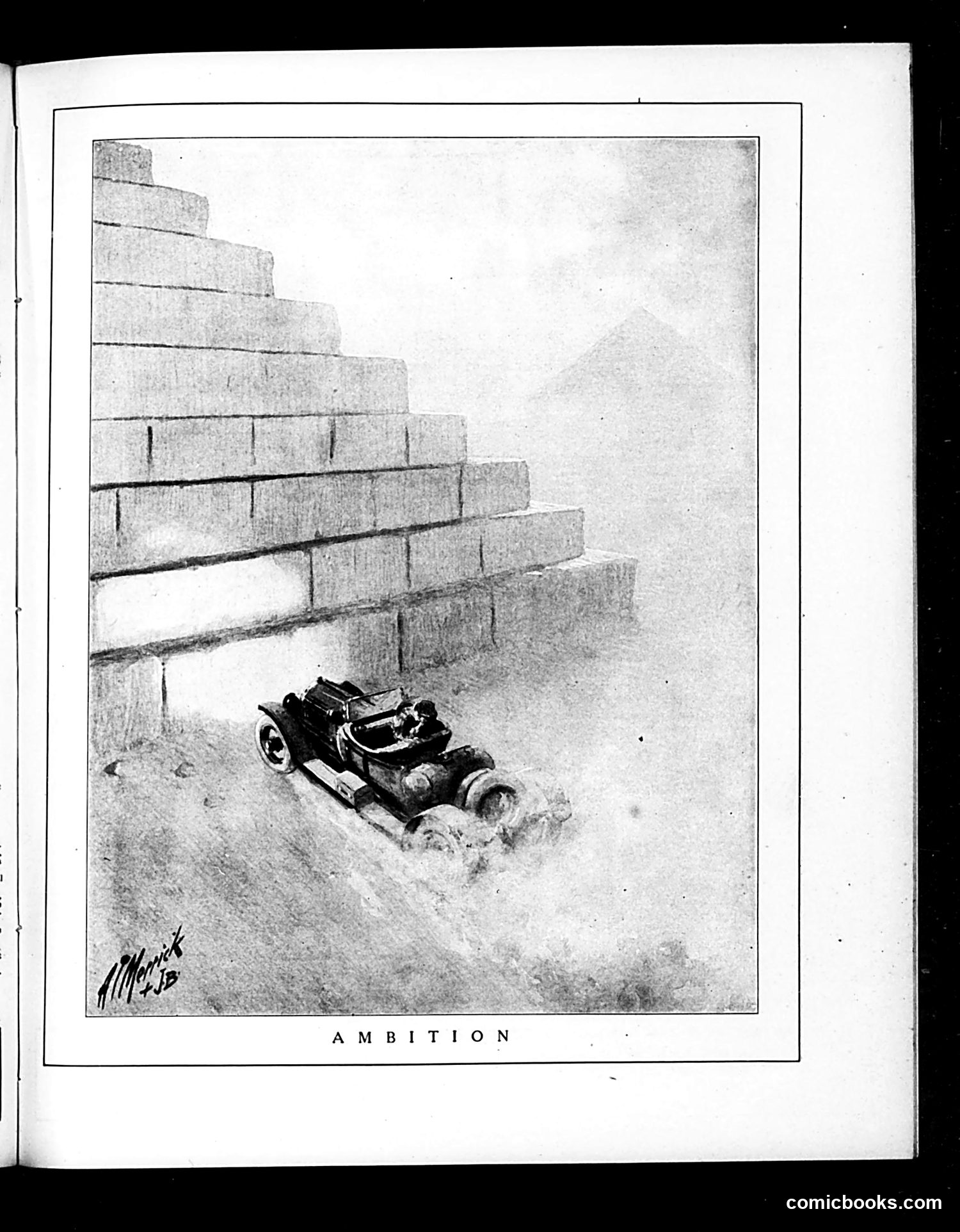
This political cartoon depicts a small automobile struggling to climb an enormous stepped pyramid or wall structure. The car appears insignificant against the massive obstacle, with the driver barely visible within the vehicle. The title "Ambition" suggests the satire comments on the difficulty of achieving one's goals—the steep, imposing architecture represents barriers to success that appear nearly insurmountable relative to one's resources or power. The tiny car symbolizes an individual or perhaps a common person attempting to overcome systemic obstacles. The cartoon likely critiques either the impracticality of certain aspirations or the structural inequalities that make advancement difficult for ordinary people. Without additional context about Judge's publication date, the specific target remains unclear, though the image effectively conveys futility through scale disproportion.
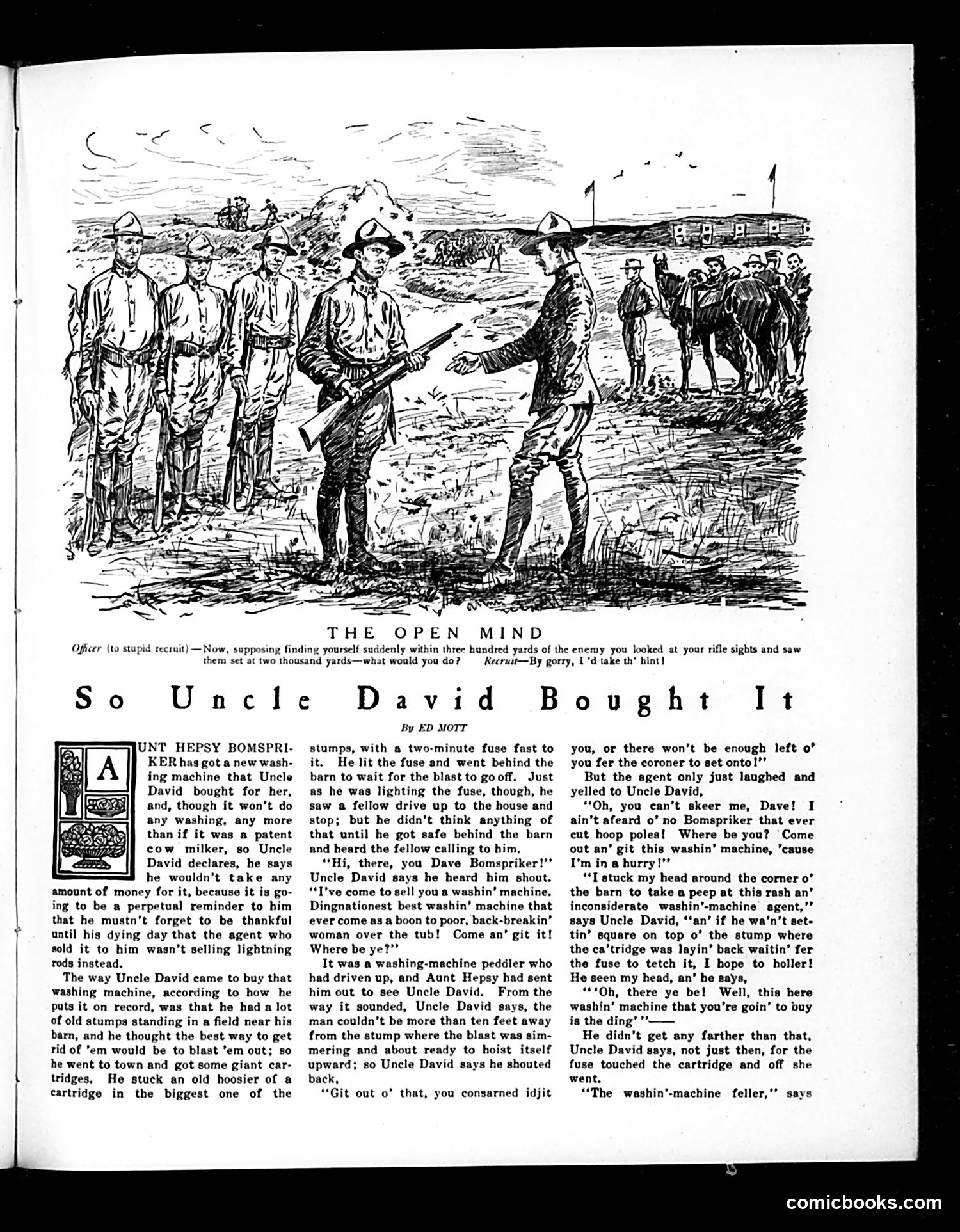
This page contains a satirical cartoon and accompanying story by Ed Mott. The top illustration shows military officers (identifiable by their uniforms and hats) in a field setting, apparently debating military tactics with one holding a rifle. The story below concerns "Uncle David," who purchases a washing machine from a traveling salesman after being convinced it's a practical investment. The humor derives from Uncle David's naive credulity and the salesman's manipulative sales pitch emphasizing the machine's supposed necessity and the limited time offer. The satire targets gullible consumers and high-pressure sales tactics common in early 20th-century America. The "open mind" refers ironically to Uncle David's susceptibility to persuasion, suggesting that being too open-minded leaves one vulnerable to commercial exploitation.
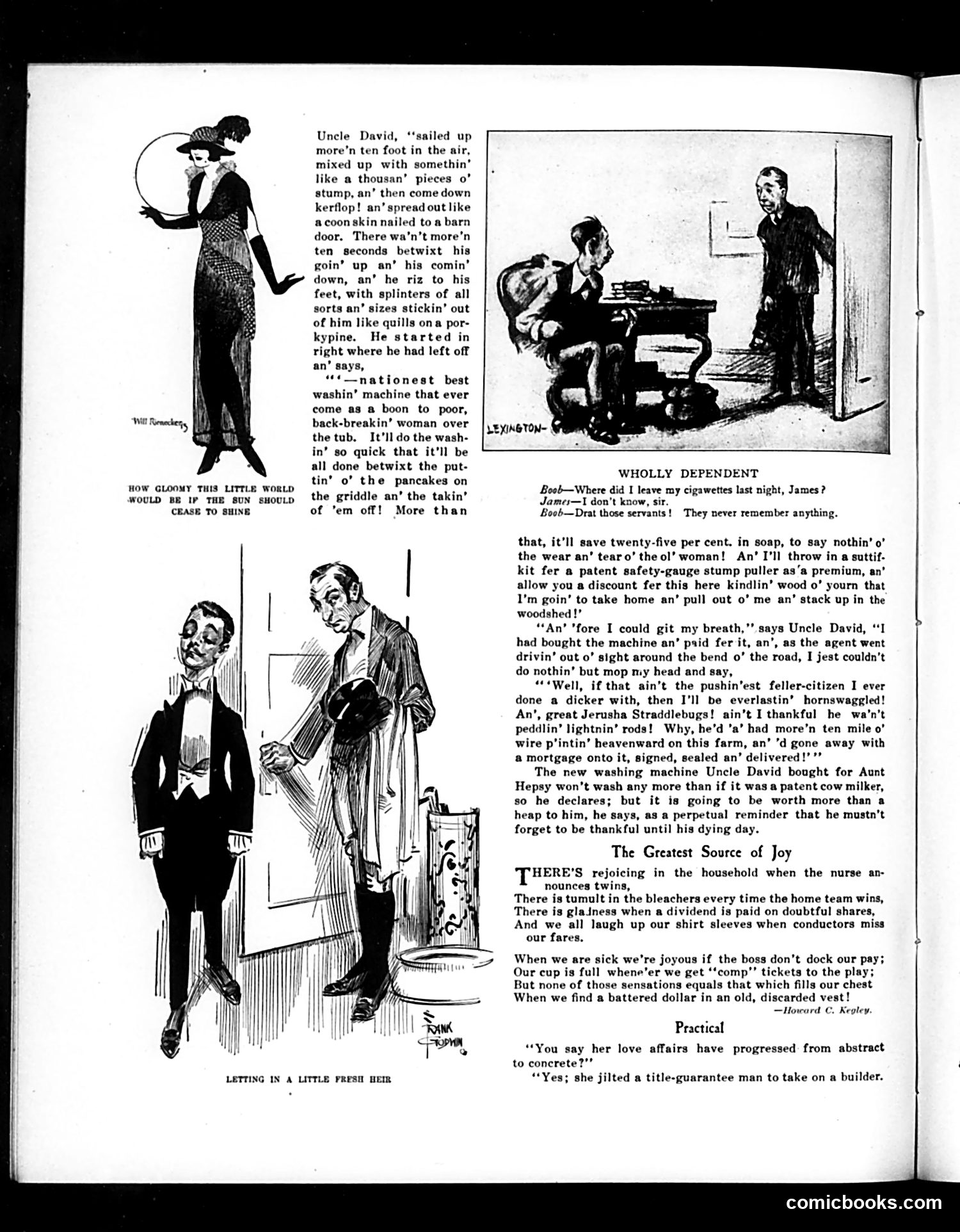
This page contains humor pieces satirizing early 20th-century American life: **The main narrative** (Uncle David story) mocks aggressive door-to-door salesmen and rural gullibility. Uncle David is literally knocked down by a faulty washing machine demonstration but remains so impressed by the salesman's pitch that he buys it anyway—and even gets swindled into purchasing a worthless stump-puller. The satire targets both the con-artist sales tactics of the era and the victim's inability to recognize he's been fleeced. **"Wholly Dependent"** cartoon jokes about servants' forgetfulness regarding their employer's cigarettes. **"Letting in a Little Fresh Heir"** appears to show social climbing through marriage or inheritance. **"The Greatest Source of Joy"** poem humorously catalogs life's small pleasures, culminating in finding money in old clothing—suggesting working-class consciousness. **"Practical"** makes a cynical joke about women's romantic choices, implying a woman left an educated man (title-guarantee agent) for a tradesman (builder), reducing romance to practical economics. The overall tone reflects Judge's satirical stance on consumer culture, class, and American foibles.
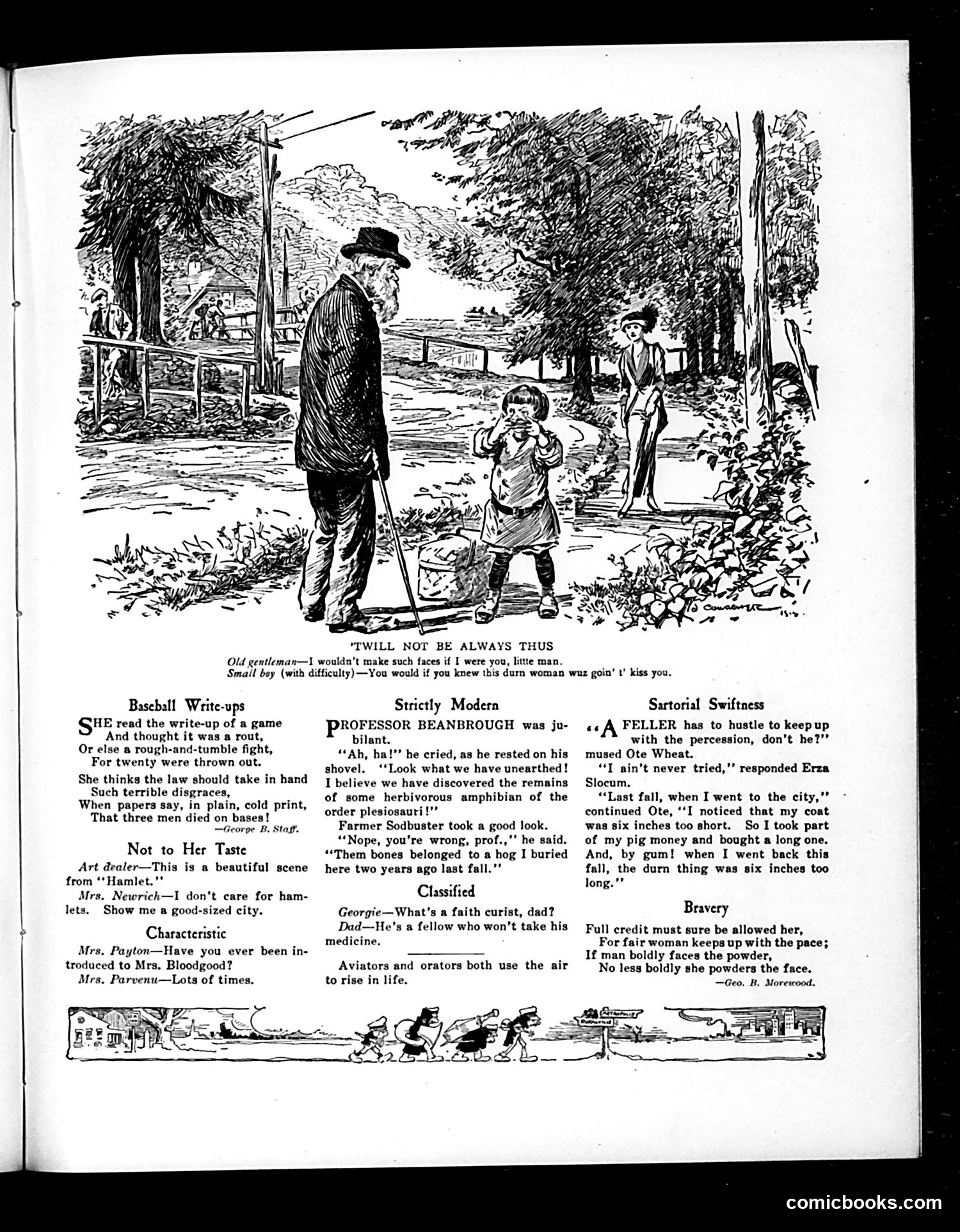
This page from Judge magazine contains various short humorous pieces typical of early 20th-century American satire: **Main Cartoon:** Shows an old gentleman and small boy—the child dreads being kissed by "this durn woman," while the man suggests the boy shouldn't make faces. It's gentle humor about childhood's reluctant social obligations. **Other Content:** Several brief comedic sketches satirize contemporary society: - A woman misreads baseball terminology, thinking "three men died on bases" reflects actual deaths - A nouveau-riche woman dismisses a "Hamlet" painting because she prefers city scenes to hamlets - A professor mistakes a buried pig for a prehistoric amphibian - Rural characters discuss clothing fashion cycles **Themes:** The humor targets feminine ignorance, class pretension, and rural simplicity—common Judge targets. The "faith curist" joke mocks alternative medicine practitioners. The final poem celebrates women's devotion to cosmetics. The overall tone reflects genteel, era-appropriate satire aimed at educated middle-class readers.
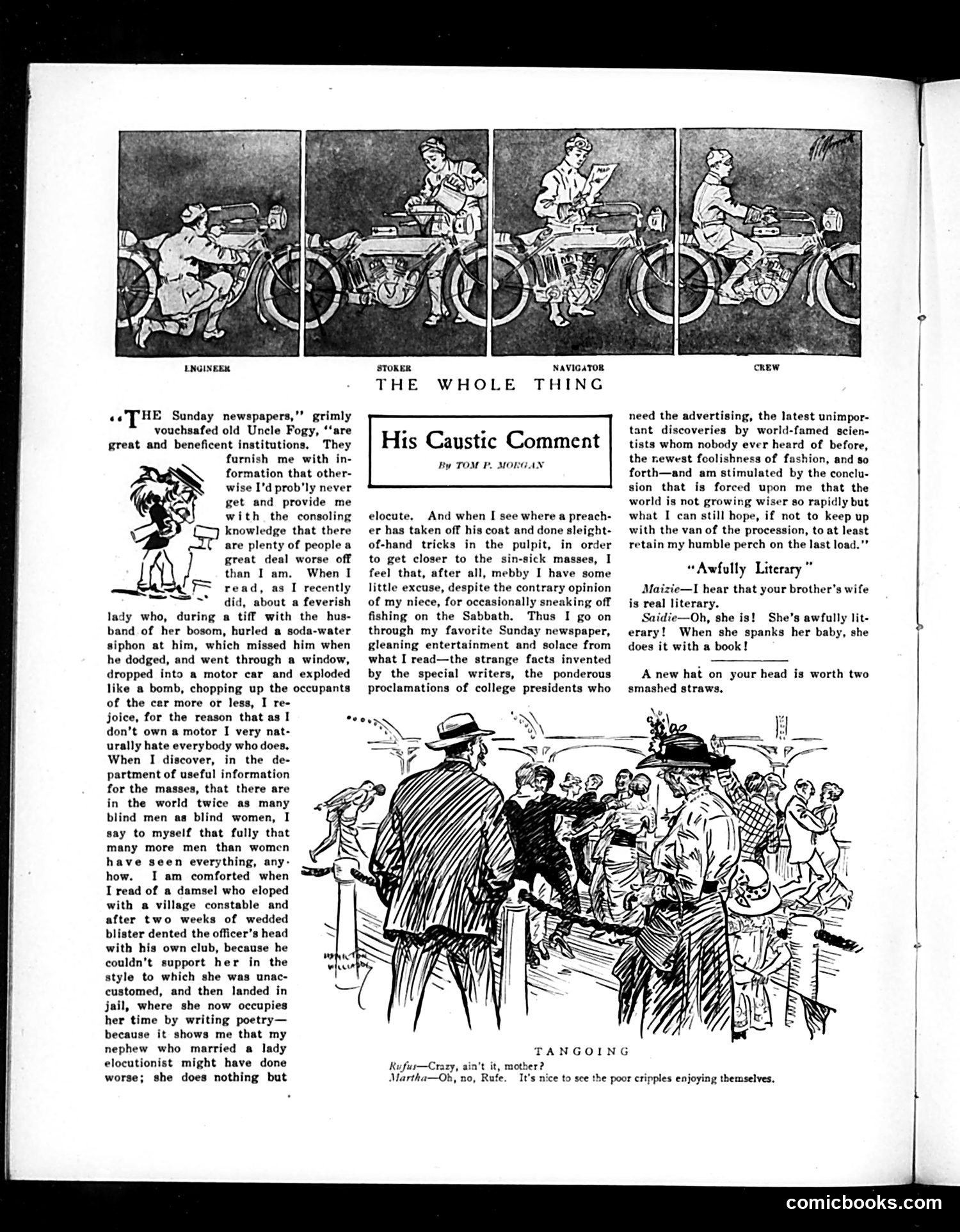
This Judge magazine page contains satirical commentary on early 20th-century American life. **Top Comic Strip ("The Whole Thing"):** Four panels show a motorcycle journey with labeled crew members (Engineer, Stoker, Navigator, Crew), likely mocking the novelty and complexity of early motorcycles—treating them as requiring multiple operators like a ship. **Main Column ("His Caustic Comment" by Tom P. Morgan):** "Uncle Fogy" (an old curmudgeon character) sarcastically praises Sunday newspapers for entertaining him with absurd human-interest stories. He lists ridiculous incidents—a woman attacking her husband with a soda siphon, crime statistics, failed marriages—and uses them to comfort himself that he's not worse off. The satire targets both sensationalist newspaper journalism and smug complacency. **Bottom Section:** Two brief jokes: one about a literary woman spanking her baby "with a book," and another labeled "Tangoing" mocking people with disabilities dancing (the tango was a contemporary dance craze). The latter reflects period attitudes—presenting disabled people as objects of amusement rather than dignity.
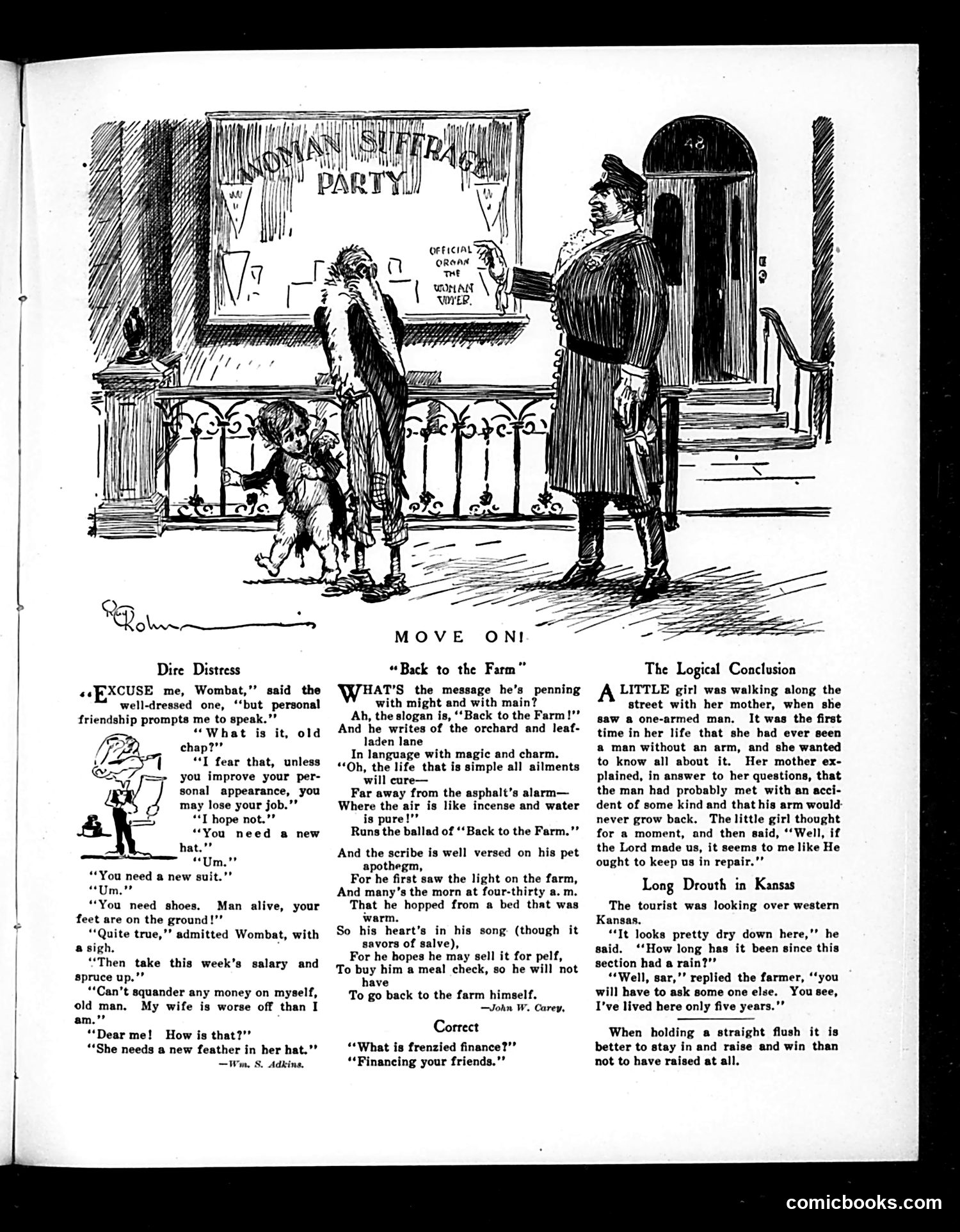
This page contains four separate humorous pieces typical of early 20th-century American satirical magazines: 1. **"Dire Distress"**: A well-dressed man advises his shabby friend "Wombat" to improve his appearance or lose his job. The joke: Wombat can't afford new clothes because his wife needs a feather for her hat—suggesting working-class wives prioritize frivolous fashion over practical needs. 2. **"Back to the Farm"**: Satirizes popular romantic literature promoting rural life. The irony: the writer who sentimentalizes farm living actually *hated* farm work (waking at 4:30 a.m.) and now wants only to *sell* the idea to others, never returning himself. 3. **"The Logical Conclusion"**: A child's innocent theological question about why God doesn't repair disabled people like broken machines. 4. **"Long Drouth in Kansas"**: A farmer admits he can't answer how long the drought has lasted—he's only lived there five years—implying the drought is so severe, even the recently-arrived don't remember rain. The page showcases Judge's mix of domestic humor, social commentary, and regional American wit.
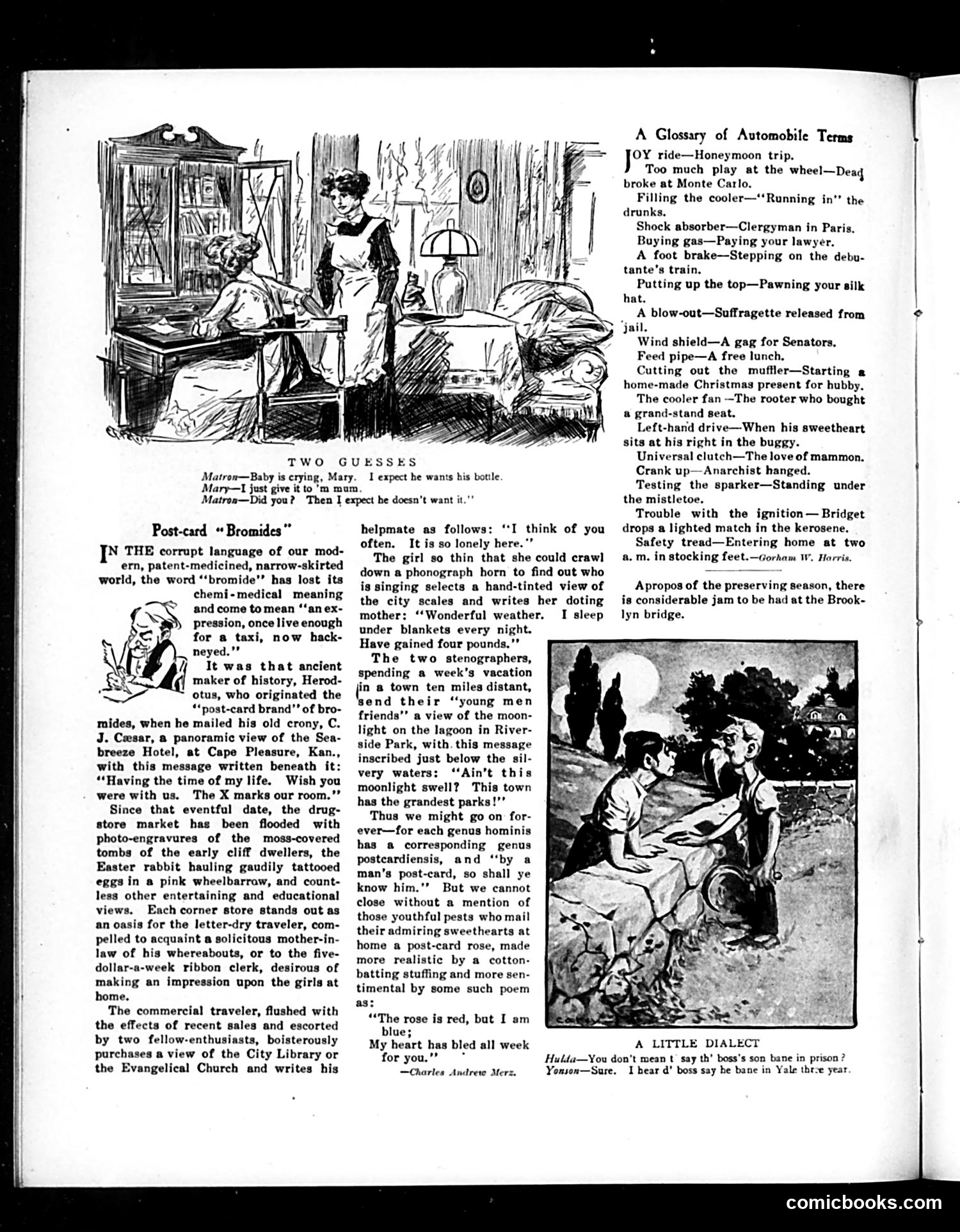
This page contains early 20th-century satirical humor from *Judge* magazine. The main content includes: **"Two Guesses"**: A brief domestic joke about a crying baby and a nursemaid's logic. **"Post-card Bromides"**: The lengthy satirical essay mocks the tedious clichés people write on picture postcards. "Bromide" means a hackneyed phrase. The piece humorously catalogs stereotypical postcard messages from travelers, salesmen, stenographers, and young lovers—all claiming to think of home while experiencing "wonderful weather" or gaining weight. The satire targets the artificiality and formulaic nature of tourist correspondence. **"Glossary of Automobile Terms"**: A humorous list of slang definitions mixing car parts with social commentary. Examples: "Buying gas = Paying your lawyer" (car accidents cost money); "Blow-out = Suffragette released from jail" (topical reference to women's suffrage activism); "Crank up = Anarchist hanged" (reflecting period anxieties). This mocks both automobiles as status symbols and contemporary social issues. The humor assumes readers familiar with early motoring culture, postal customs, and Progressive Era social movements.
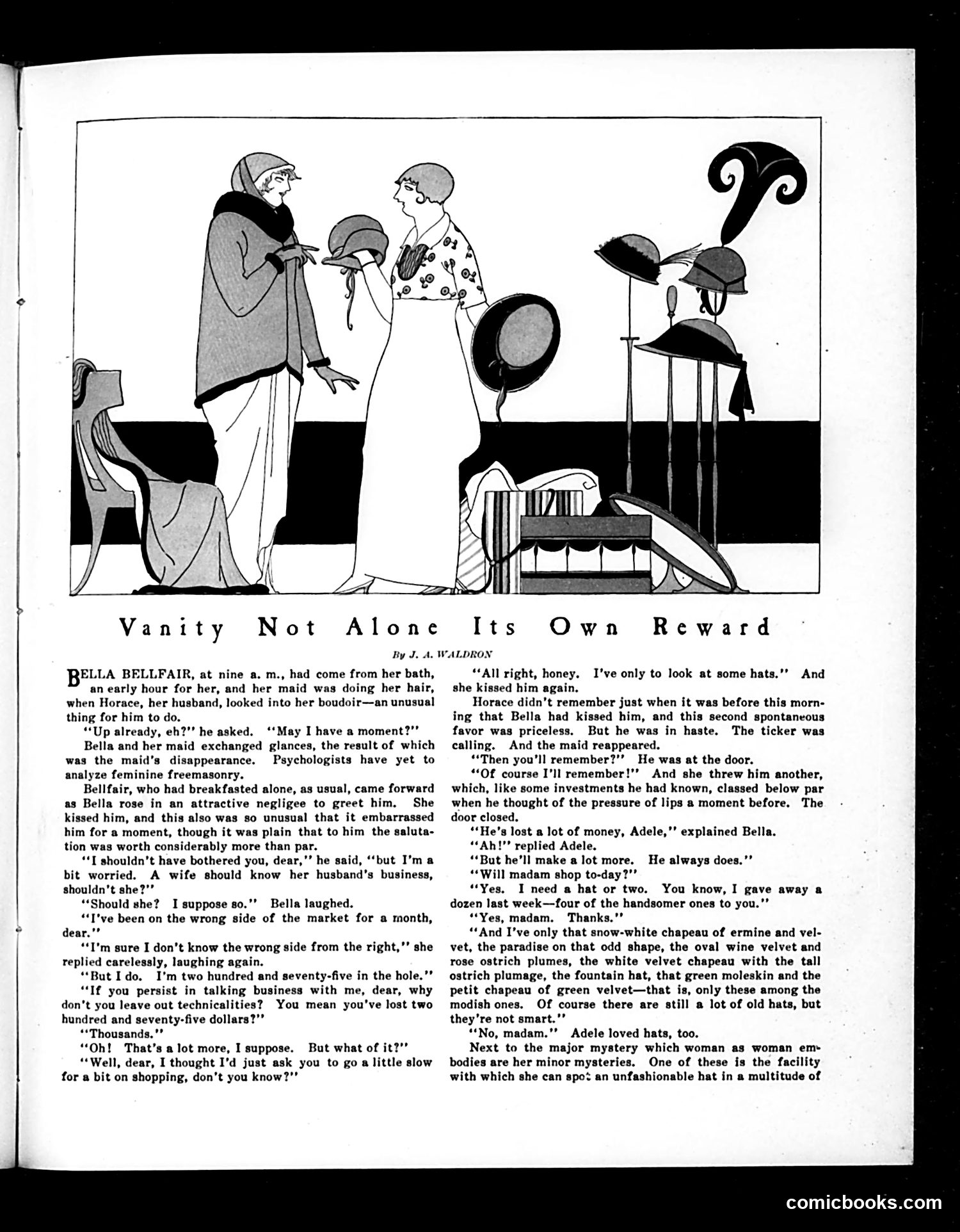
This story by J.A. Waldron satirizes the perceived disconnect between wives and financial reality. Horace, facing stock market losses of "thousands," asks his wife Bella to curtail shopping. She agrees sweetly—then immediately asks her maid about purchasing new hats. The satire targets: (1) wives' indifference to or ignorance of household finances, (2) women's compulsive spending on fashion, particularly hats—a recurring target of period humor, and (3) the gap between women's promises and actions. The title's irony is key: Bella's vanity (acquiring fashionable hats) becomes its own "reward"—she gets what she wants despite financial hardship. The illustration shows her with a display of hats, emphasizing the absurdity of her "collection" despite claiming she needs more. The story mocks both feminine materialism and husbands' powerlessness to control it.
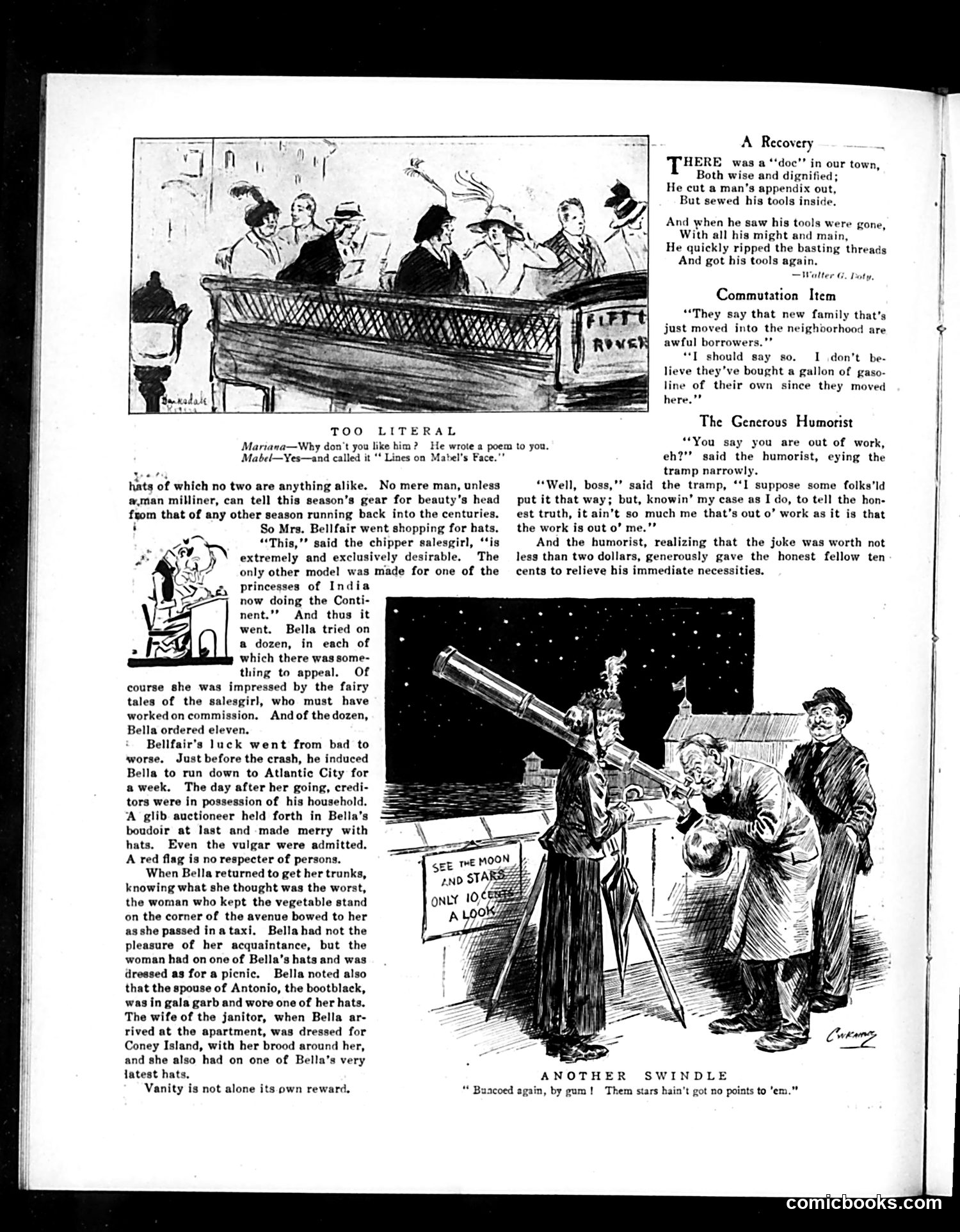
The main story satirizes wealthy Mrs. Bellfair's vanity and poor financial judgment. A salesman convinces her to buy eleven identical hats by falsely claiming each is an exclusive model—one supposedly made for Indian royalty. When her husband's finances collapse before a "crash" (likely the 1929 stock market crash), creditors auction their possessions. The hats end up on working-class women—the vegetable vendor, the bootblack's wife, the janitor's wife—who wear them to outings. The joke: Bellfair's expensive vanity purchase becomes common property, her status symbol humiliated. The page also includes brief humorous items: a poem about a surgeon who accidentally sews his tools inside a patient; a "commutation item" mocking nouveau-riche neighbors as borrowers; and anecdotes about a generous but cheapskate humorist and a con artist selling fake telescopes. The satire targets upper-class pretension, gullibility, and the redistribution of wealth during financial crisis.
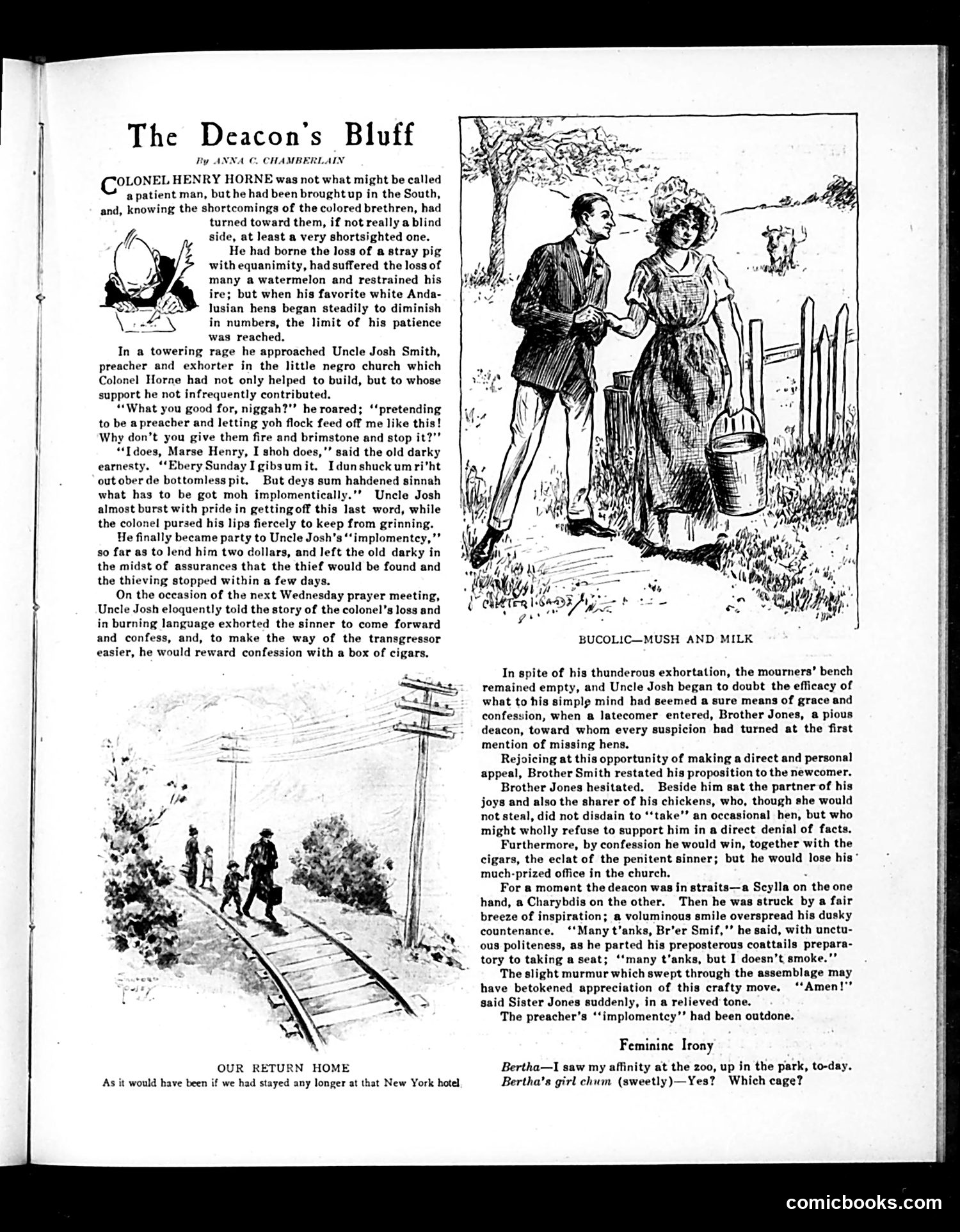
This story satirizes African American religious life in the post-Reconstruction South through dialect humor and stereotypes typical of the era. Colonel Horne, a white Southern landowner, loses chickens and confronts Uncle Josh Smith, the Black preacher of a church Horne supports, demanding he use religion to stop the theft. Uncle Josh offers cigars as reward for confession at Wednesday prayer meeting. When deacon Brother Jones—the suspected thief—is approached, he faces a dilemma: confess and gain cigars plus moral standing, but lose his church office; or refuse and preserve his status. Jones escapes by accepting the reward while declining the cigars ("I doesn't smoke"), thus avoiding explicit confession. The satire mocks both the preacher's naive faith in bribery and the deacon's clever evasion. The humor relies heavily on racist dialect and caricature conventions standard to Judge magazine's era.
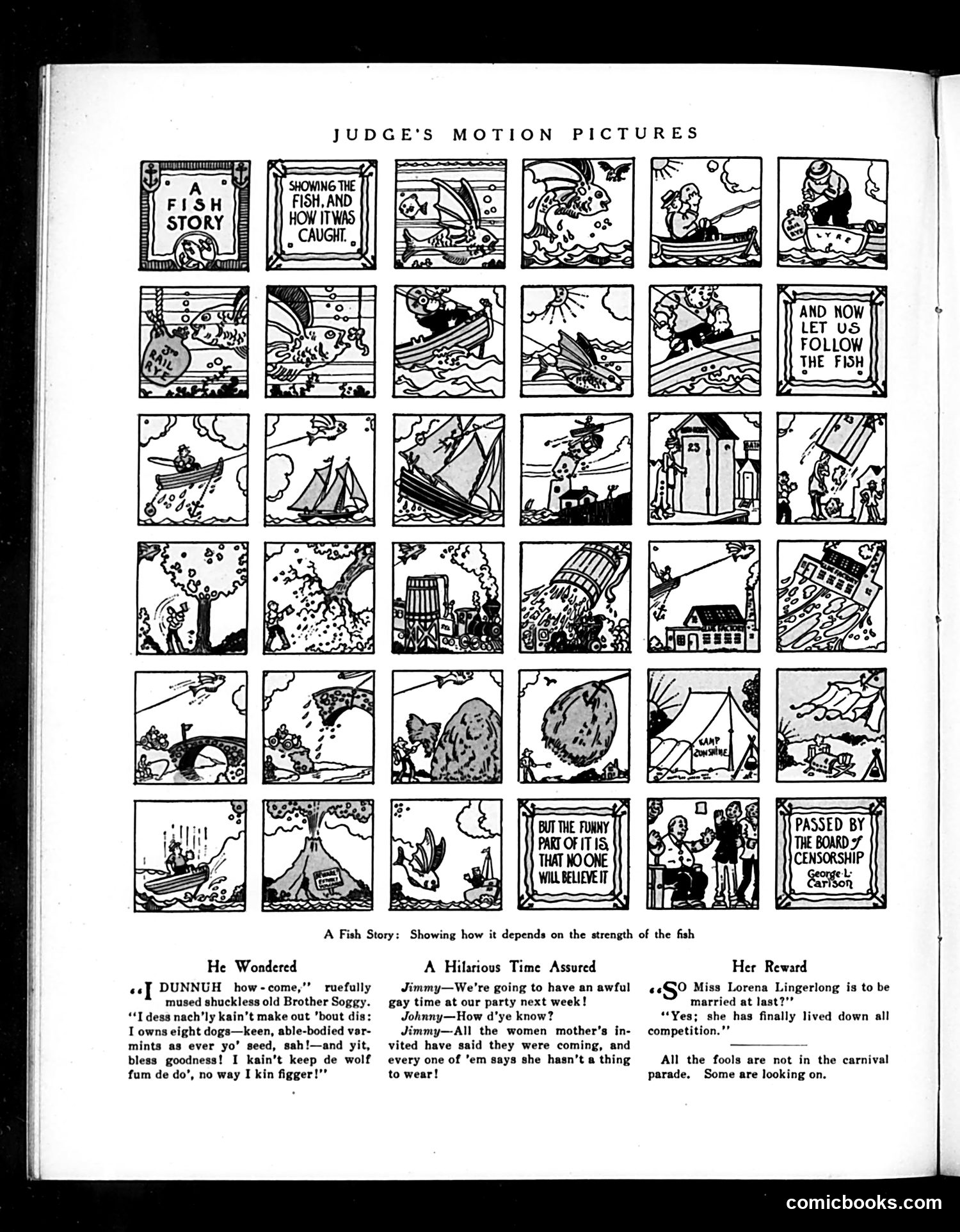
This page presents a six-row comic strip titled "A Fish Story: Showing how it depends on the strength of the fish"—a visual pun where the narrative outcomes depend literally on which fish is stronger in various scenarios. Below are three separate comic vignettes with dialogue: **"He Wondered"**: A rural African American character (drawn in period-stereotypical dialect) expresses bewilderment that despite owning eight strong dogs, he cannot keep "the wolf from the door"—meaning he remains poor. **"A Hilarious Time Assured"**: A joke about a party where all invited women claim to have nothing to wear. **"Her Reward"**: A woman finally marries after living down social competition. The page reflects early 20th-century Judge magazine humor: crude ethnic caricature, domestic comedy, and wordplay. The racial stereotype in the first section would be considered offensive today, though it was standard in contemporary satirical publications.
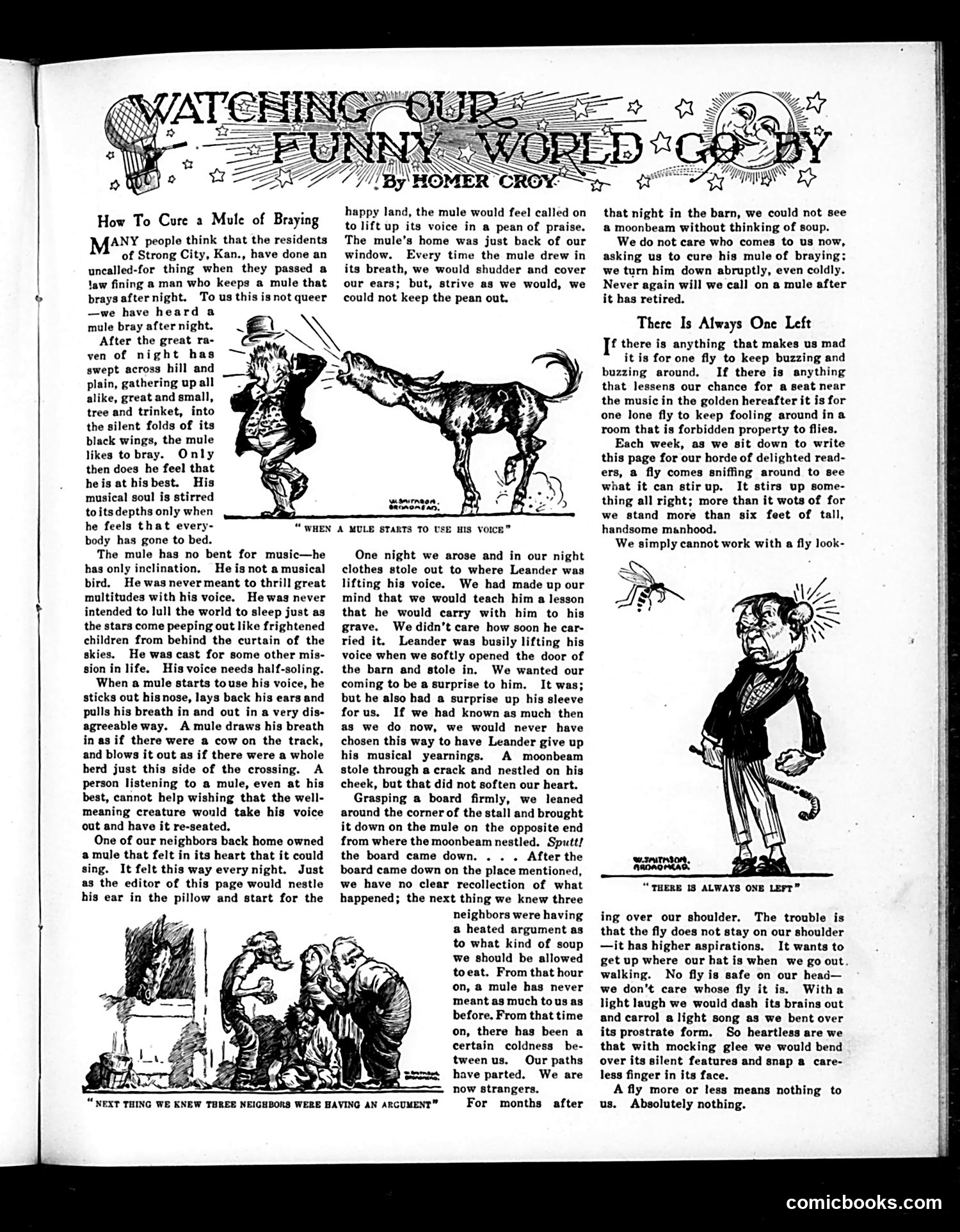
This is a humorous essay by Homer Croy about a Kansas law fining owners of braying mules at night. The satire targets small-town ordinances and their unintended consequences. **The Setup:** The author defends Strong City, Kansas's anti-braying law, describing mules as inherently unmusical creatures whose nighttime noise is genuinely unbearable. The piece humorously characterizes mules as having no artistic merit—they "draw breath in as if there were a cow on the track." **The Joke:** The narrator recounts attempting to silence his neighbor's mule "Leander" by sneaking into the barn at night with a board. However, in the darkness, he hits the mule's rear end, causing it to buck and send him flying. Neighbors subsequently debate what kind of soup the injured narrator should eat—implying serious injury. **The Point:** The story illustrates how well-intentioned attempts to enforce social order (like anti-braying laws) can backfire comically. The narrator becomes so traumatized that he refuses to help anyone with their mule problems afterward, and moonbeams now remind him of soup. The accompanying illustrations show the mule braying and the neighbors arguing over the narrator's injury.
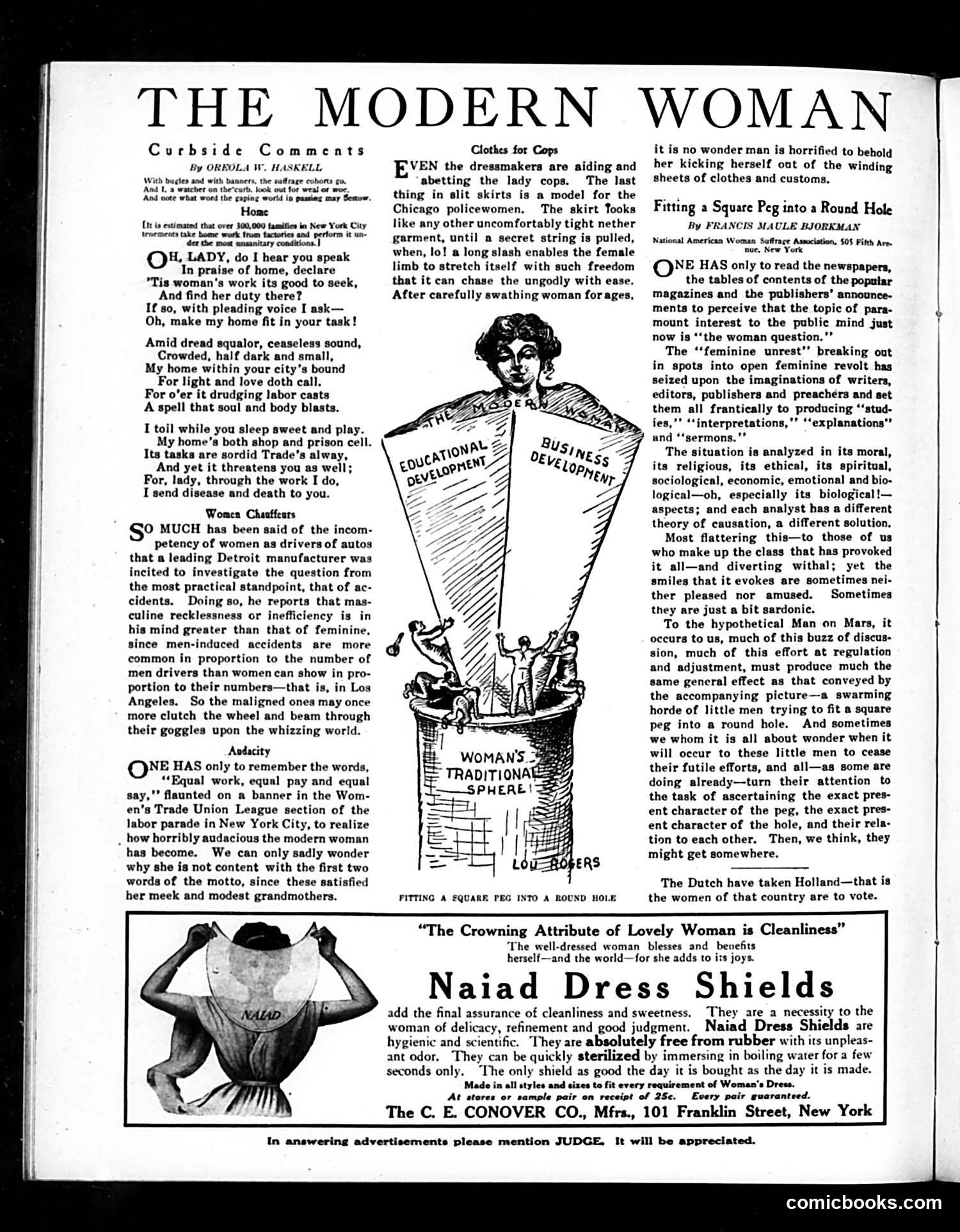
This page satirizes early 20th-century anxieties about women's changing roles. The central cartoon depicts a woman as a "square peg" bursting from a cone labeled "Woman's Traditional Sphere," with smaller figures (men) below trying futilely to contain her. Her expanding form represents women entering "Educational Development," "Business Development," and other spheres previously denied them. The accompanying essays mock male hand-wringing over female advancement: women demanding "equal pay and equal say" alongside equal work is deemed absurdly "audacious." Yet the page also critiques genuine injustices—tenement workers laboring in unsanitary conditions, and defends women drivers and police officers against male skepticism. The satire cuts both ways: Judge ridicules both stubborn male resistance to women's progress and the overheated public panic about "the woman question." The tone suggests exasperation that such basic equality remains controversial.
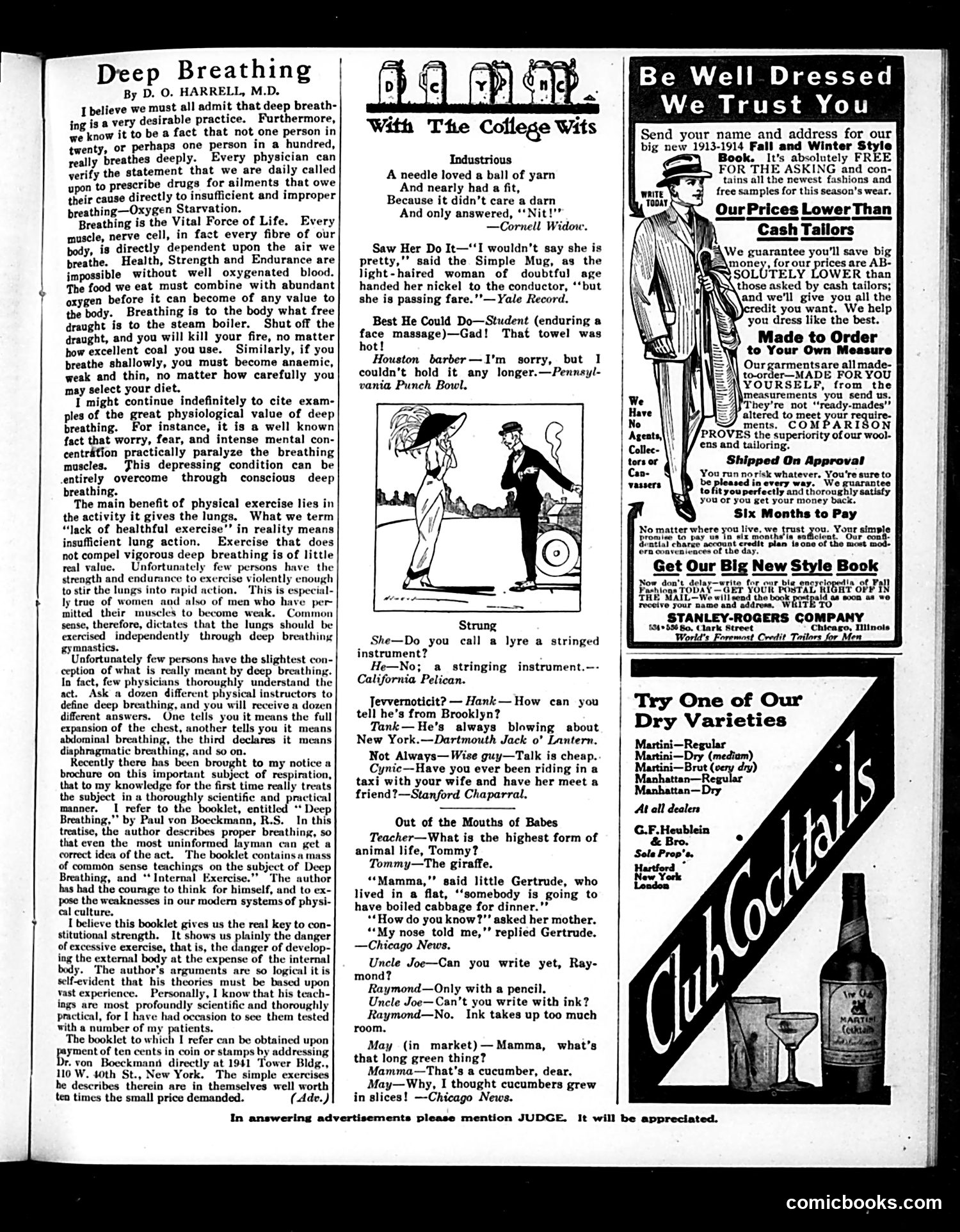
This page combines a serious health article with period advertisements and humor. **Main Content:** Dr. D.O. Harrell's article on "Deep Breathing" argues that shallow breathing causes widespread health problems and advocates for conscious deep-breathing exercises. He endorses a booklet by Paul von Boeckmann titled "Deep Breathing," claiming it's the first scientifically rigorous treatment of proper respiration technique. **The Cartoon:** A small illustration shows a woman in a hat speaking with a man, depicting one of the humorous "College Wits" anecdotes below—likely illustrating a dating or courtship scenario typical of Judge's satirical humor. **Advertisements:** The right side features clothing and spirits ads, including Stanley-Rogers Company (mail-order suits) and Cocktails. **Context for Modern Readers:** This reflects early-20th-century health anxiety about "oxygen starvation" from modern sedentary life—a concern that drove the physical culture movement. The endorsement of a specific breathing method booklet is characteristic of period wellness marketing.
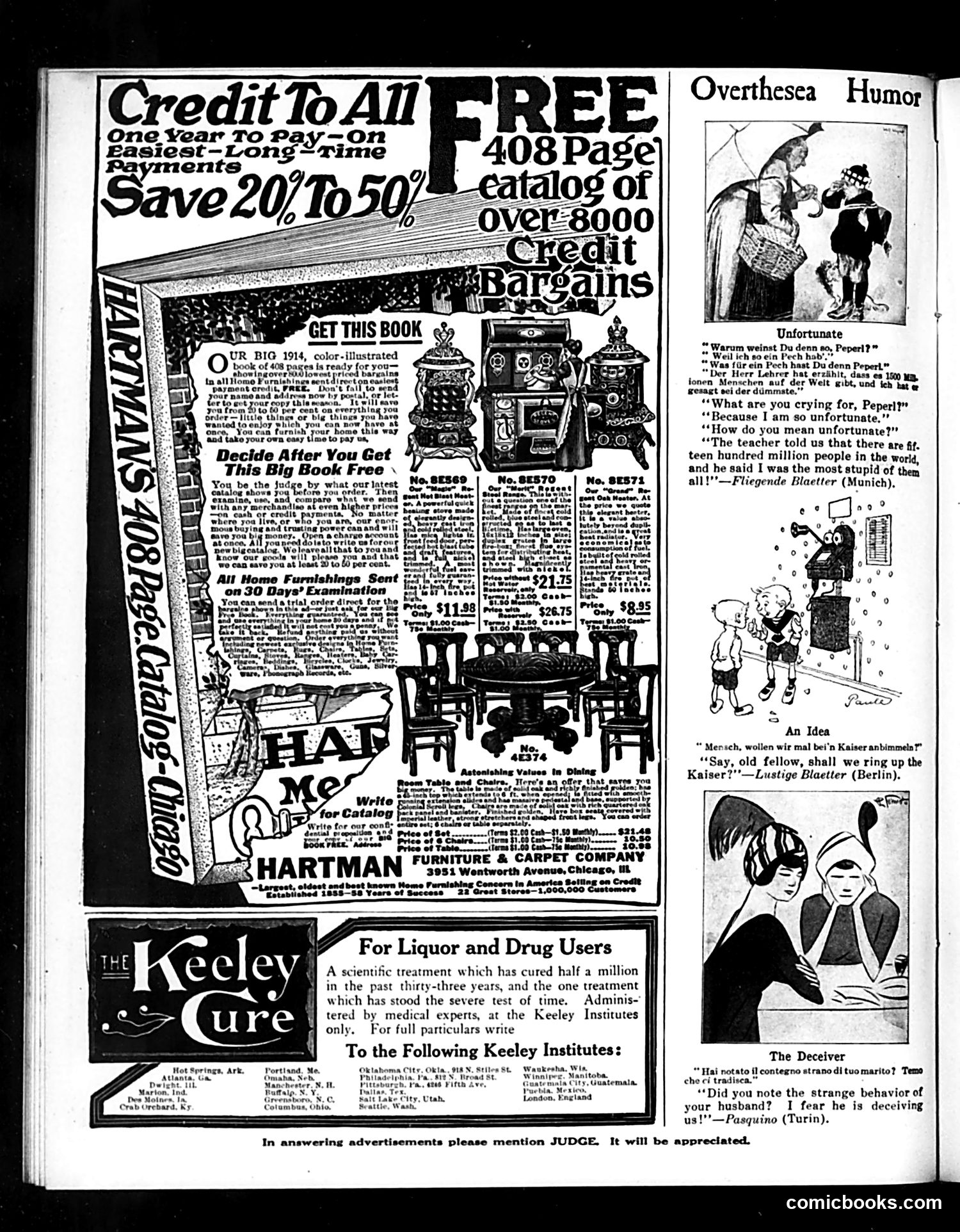
This page is primarily **advertising**, not political satire. The dominant content features a large Hartman Furniture & Carpet Company catalog advertisement promising 20-50% savings and easy payment plans—typical early 20th-century consumer marketing. The **"Overthesea Humor"** section on the right contains reprinted foreign comic captions (from German and Italian publications like *Fliegende Blaetter* and *Lustige Blaetter*). These are gentle, domestic humor pieces: a child crying over being called stupid, children joking about calling the Kaiser, and a wife suspecting infidelity. They're cultural curiosities presented as "overseas" humor for American readers—illustrating how Judge recycled international content for amusement. A secondary advertisement for the **Keeley Cure** treatment (for alcohol and drug addiction) appears below, reflecting early 20th-century attitudes toward substance abuse as a medical condition requiring specialized institutional treatment. The page is essentially a commercial digest, not political commentary.
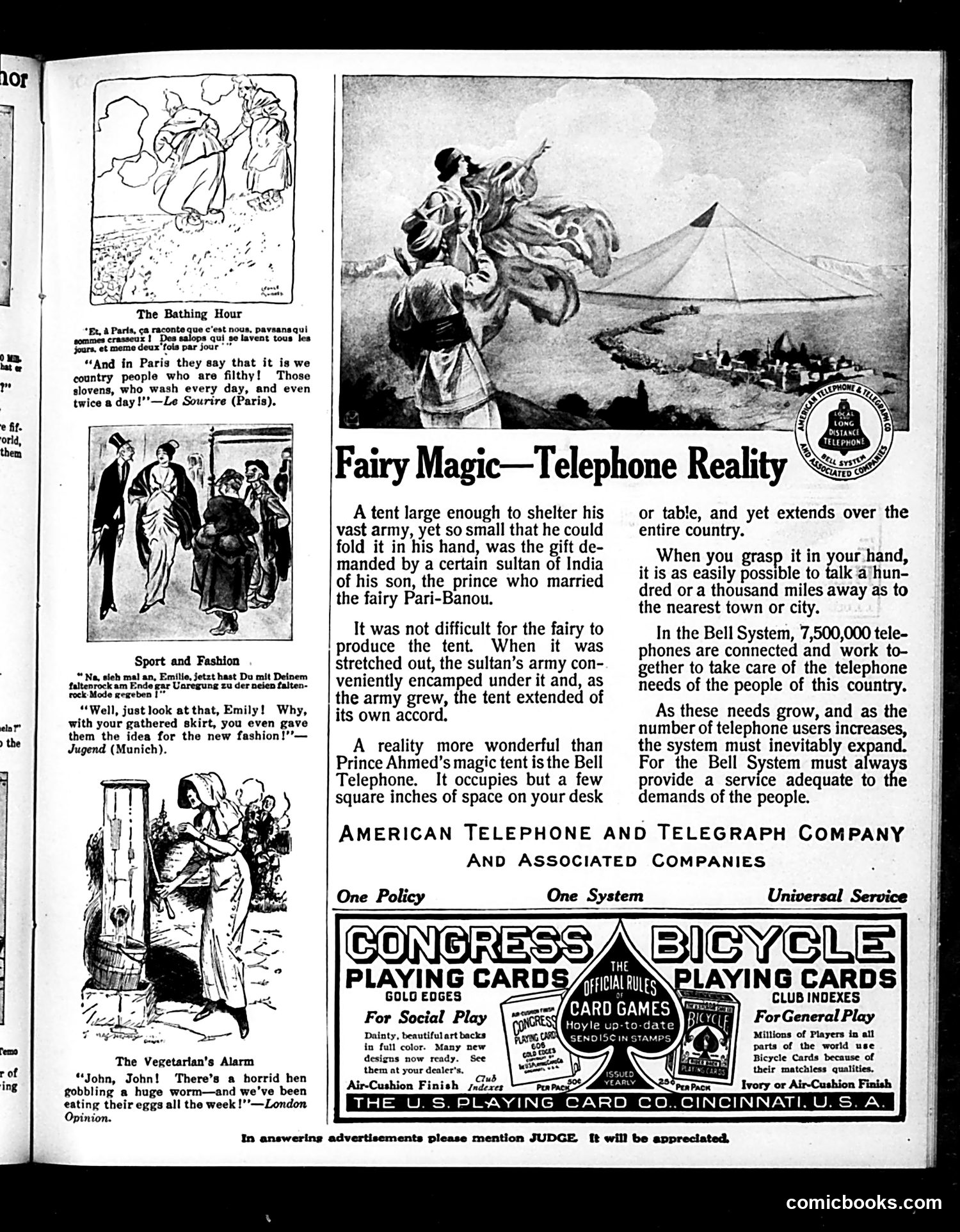
This page contains multiple unrelated items typical of early 20th-century satirical magazines: **Left side cartoons:** Three brief humorous sketches—"The Bathing Hour" (French rural people defending their cleanliness against Paris stereotypes), "Sport and Fashion" (a woman's outfit choice), and "The Vegetarian's Alarm" (ironic guilt about eating eggs while opposing harm to animals). These are light social humor with minimal political content. **Main content:** A lengthy advertisement disguised as editorial comparing the Bell Telephone System to a magical tent from Arabian Nights folklore. The "Fairy Magic—Telephone Reality" piece uses the fairy tale's miraculous expanding tent as a metaphor for the telephone network's vast yet compact utility. It's corporate advertising emphasizing how the Bell System serves the nation's growing communication needs. **Bottom:** Playing card advertisements. The page is primarily **advertising-driven content**, with satirical cartoons as filler. The telephone piece represents early corporate image-building through cultural analogies rather than direct sales pitches.
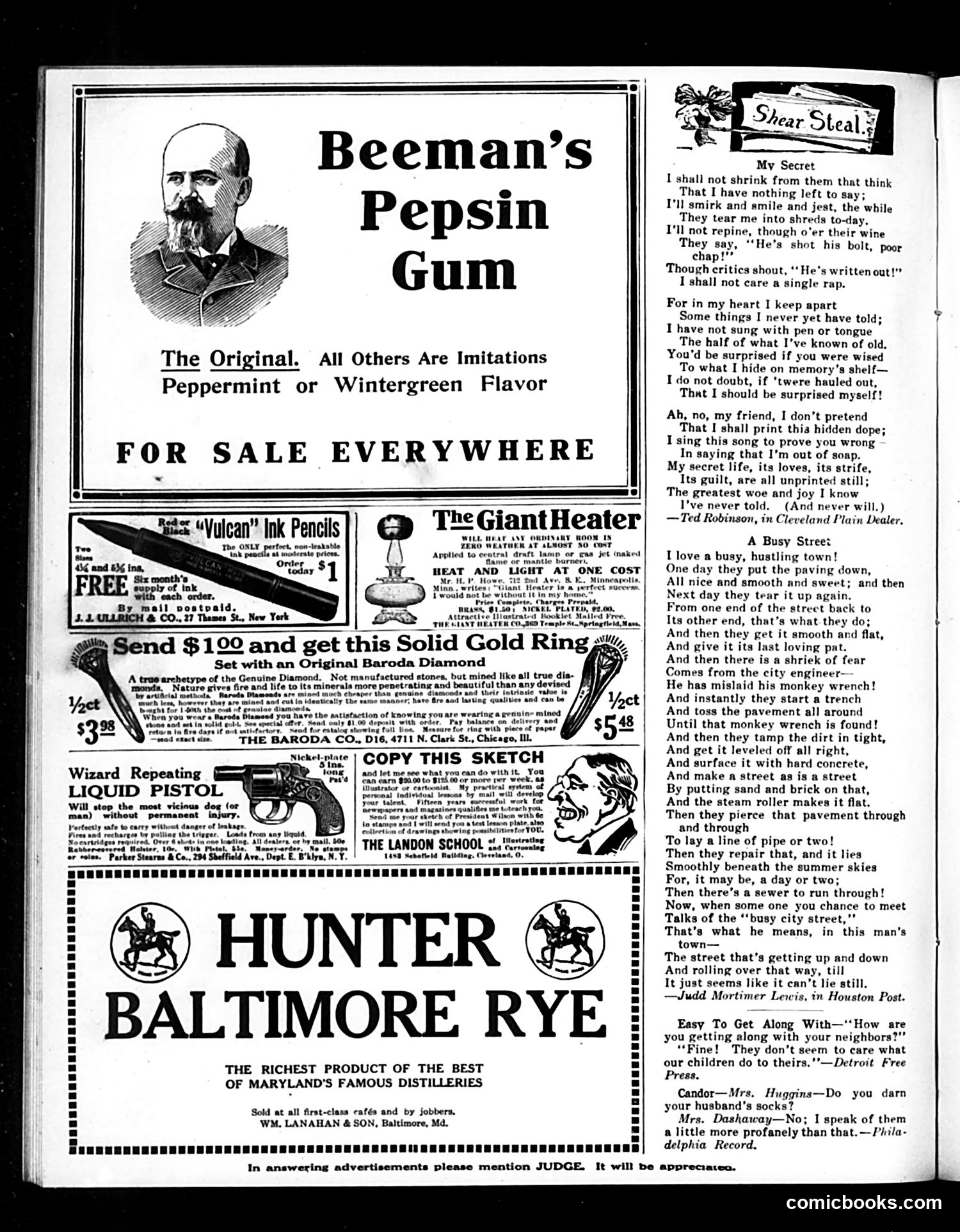
This page is primarily **advertisements and filler content**, not political satire. The main elements are: **Advertisements** dominate: Beeman's Pepsin Gum, "Vulcan" ink pencils, The Giant Heater, gold rings with diamonds, a correspondence art school, a "Wizard Repeating Liquid Pistol" (dog repellent), and Hunter Baltimore Rye whiskey. **Poetry section** ("Shear Steals"): Contains poems by Ted Robinson and Judd Mortimer Lewis—light verse about an artist's hidden creative reserves and the endless street repairs in a busy city. These are humorous observations rather than satire. **No identified political figures or cartoons** appear on this page. The content reflects early 1900s consumer culture and popular humor writing typical of Judge magazine's lighter pages, which balanced satirical content with entertainment and commercial advertisements.
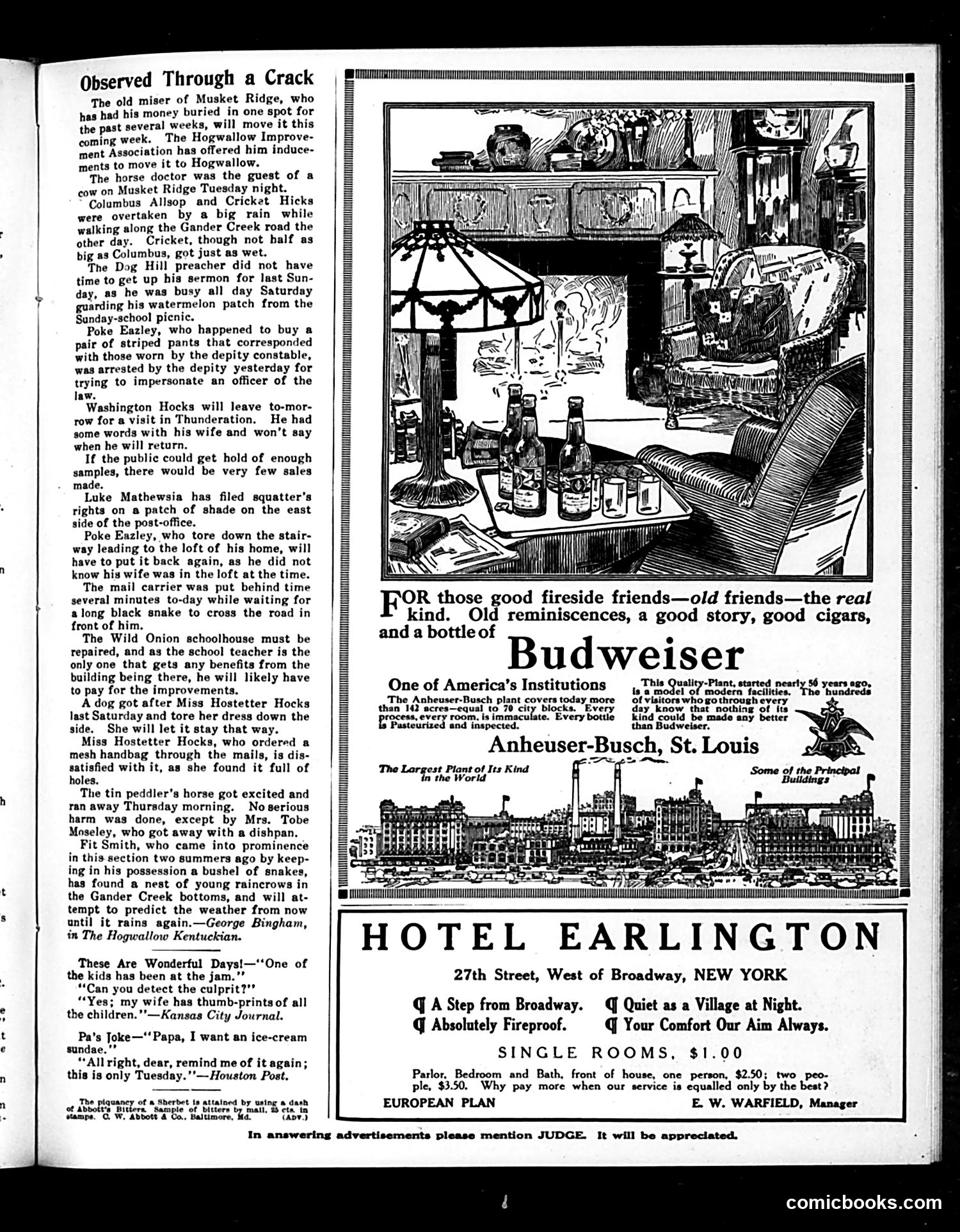
This page contains two distinct elements: a humorous rural column and advertisements. **"Observed Through a Crack"** is a satirical column mocking small-town rural life, likely in the American South or Midwest (references "Hogwallow," "Dog Hill," "Gander Creek"). The humor relies on depicting rural characters as foolish or peculiar: a miser hiding money, a preacher guarding watermelons, a man arrested for wearing striped pants resembling a constable's uniform, someone demolishing stairs unaware his wife occupied the loft above. The satire targets rural incompetence and absurdity—the implicit joke being that country folk lack sophistication or common sense. This reflects early 20th-century urban attitudes mocking rural Americans. The advertisements—for Budweiser beer and Hotel Earlington—occupy the lower half, typical of Judge magazine's revenue model. The Budweiser ad emphasizes the brewery's scale and modern facilities, appealing to readers' respect for industrial achievement.
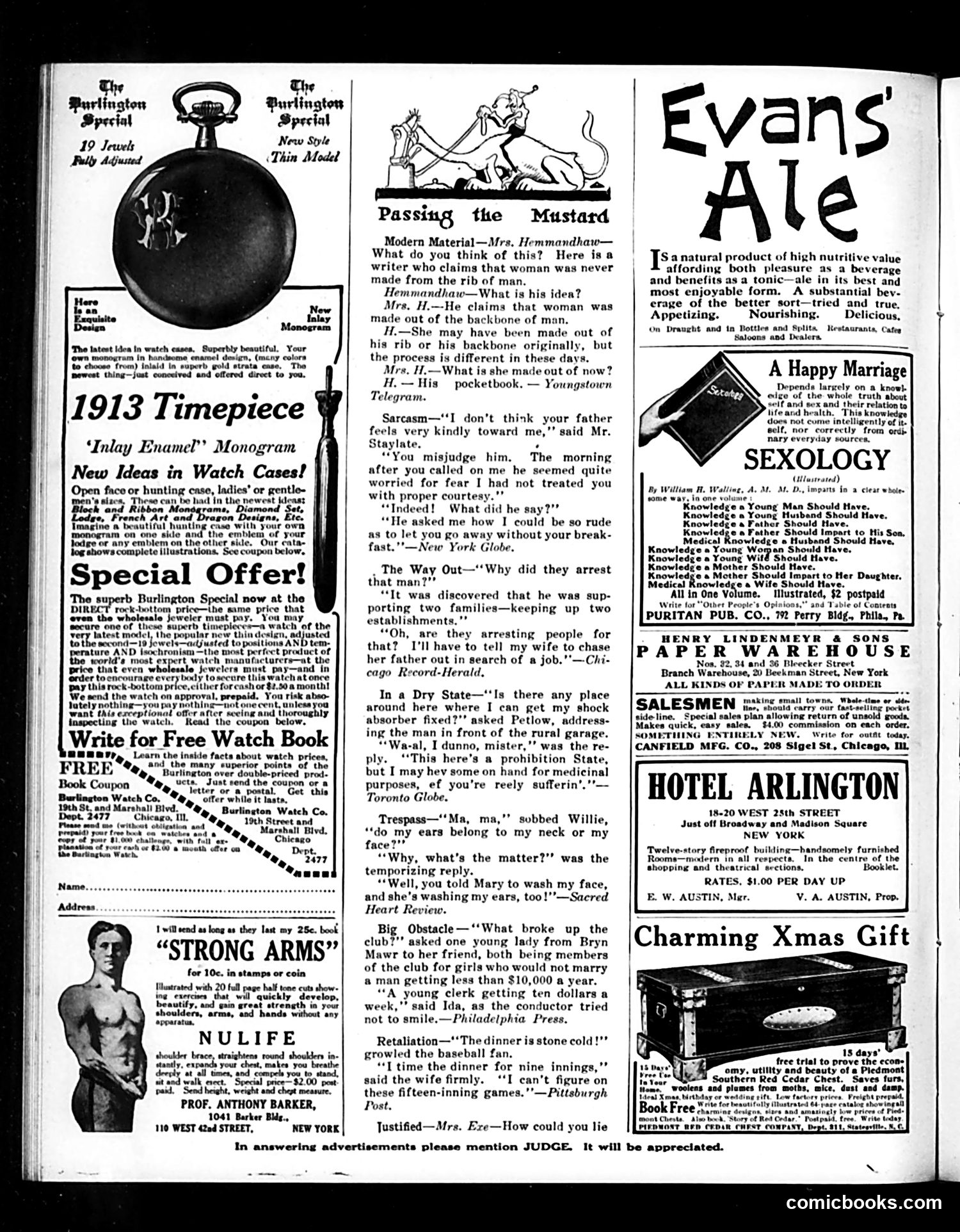
This page is primarily **advertising**, typical of early 20th-century magazines. The main content includes watch advertisements (Burlington timepieces with personalized monograms), Evans' Ale, a sexology book, and hotel/warehouse services. The humor appears in small sections labeled "Passing the Mustard" and other brief jokes. These are gentle domestic satire: one jokes that wives drain husbands' pocketbooks; another describes a man supporting two families who faces arrest. A third contains light sarcasm about a father-in-law's approval. The cartoon labeled "Passing the Mustard" appears to be a simple domestic scene illustrating marital banter—likely showing a husband and wife discussing gender origins and modern economic realities. The page reflects early 1910s consumer culture and conventional gender roles (wives spending money, husbands earning it), presented as humorous observation rather than sharp social critique.
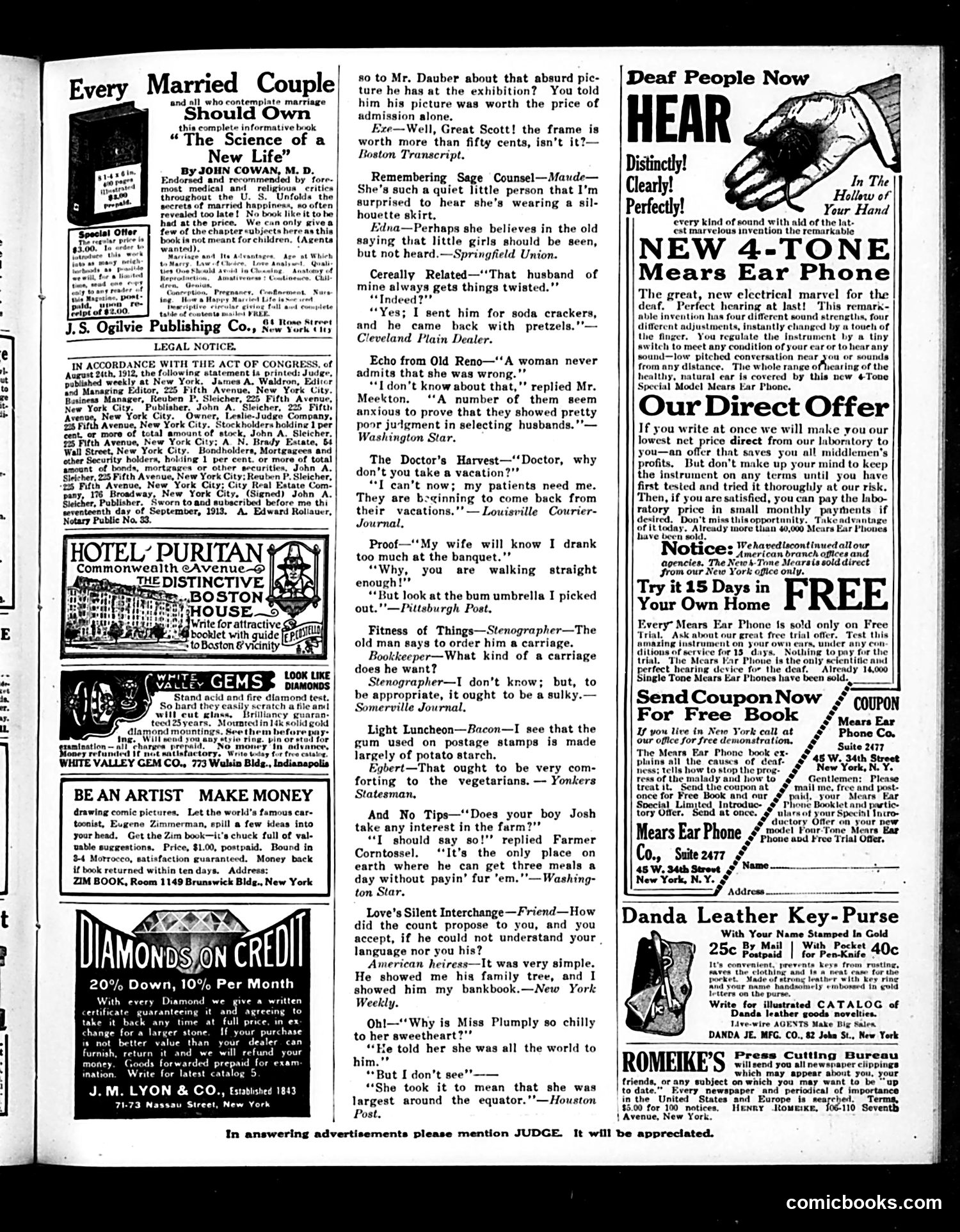
This page is primarily **advertising and legal notices**, not political cartoons. The dominant content includes: **Legal/Administrative**: Publisher information for Judge magazine (filed per 1912 Congressional requirements), listing ownership at Leslie-Judge Company. **Advertisements**: Multiple product ads including: - "Science of a New Life" marriage manual - Hotel Puritan in Boston - White Valley Gem diamonds (synthetic) - Eugene Zimmerman's cartooning instruction book - J.M. Lyon diamonds on credit **Humor Column**: Small captioned jokes about marriage, relationships, and social situations—typical period humor about domestic life, infidelity, and gender dynamics. **Notable Feature**: "Deaf People Now Hear Distinctly, Perfectly!" advertising a "New 4-Tone Acoustophone"—an early hearing aid device. The page reflects early 1910s consumer culture and marriage-focused social commentary typical of Judge magazine's satirical approach, though this particular page emphasizes commerce over political satire.
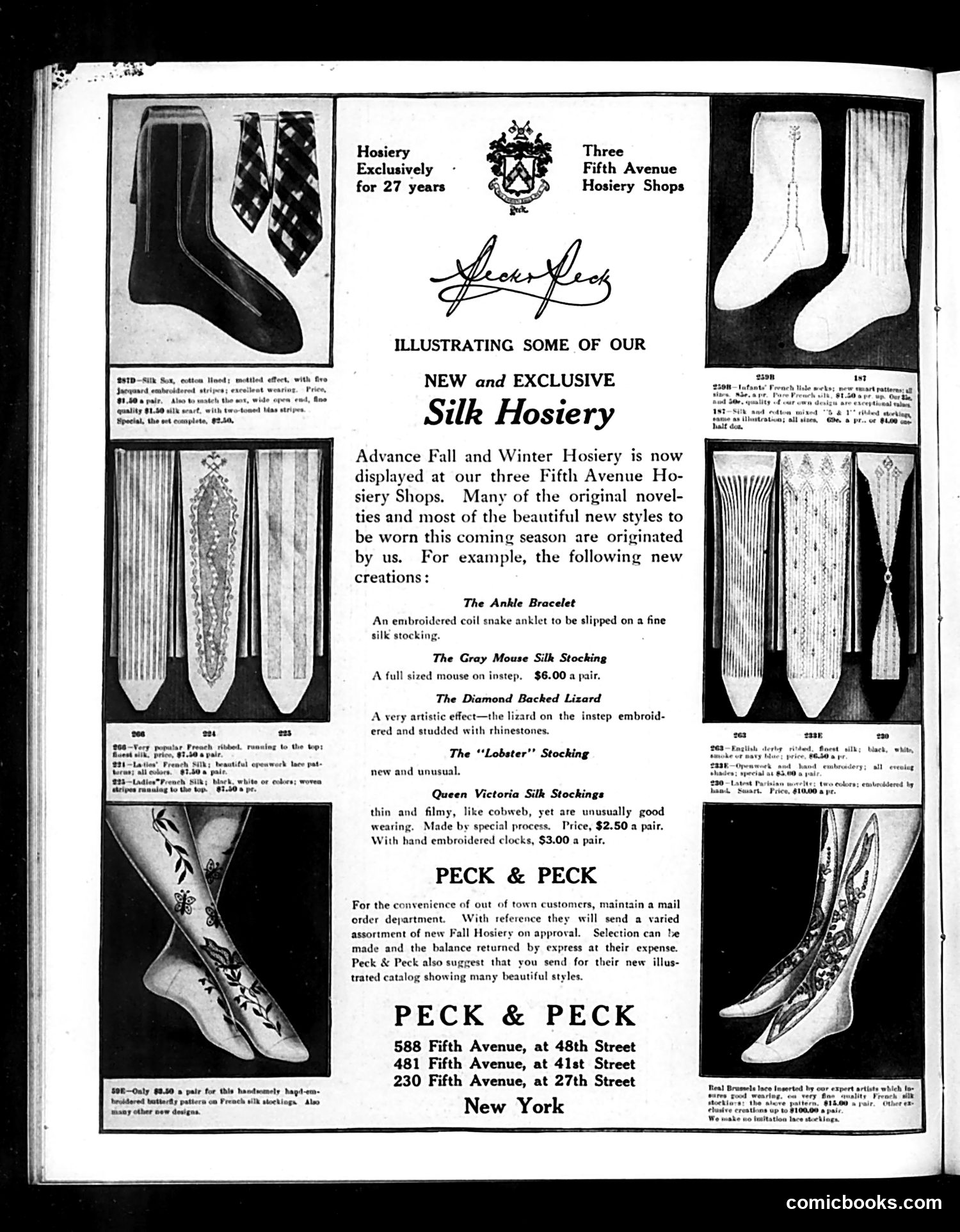
This is not a cartoon or satirical content—it's a **full-page advertisement** for Peck & Peck, a high-end hosiery retailer operating three locations on Fifth Avenue in New York. The page showcases luxury silk stockings for fall and winter, featuring novelty designs with embroidered details: animals (mice, lizards, lobsters, snakes) and ornamental patterns studded with rhinestones. "Queen Victoria Silk Stockings" are advertised as delicate yet durable. The company emphasizes exclusivity ("27 years"), originality of design, and premium pricing ($2.50–$9.40 per pair—substantial sums in the early 20th century). They offer mail-order service for out-of-town customers and an illustrated catalog. This reflects the era's luxury market and women's fashion focus on decorative hosiery as status symbols. The absurdist animal motifs might seem humorous to modern readers, but they represent authentic high-fashion novelties of the period marketed to affluent women.