
Judge, 1913-10-04 · page 13 of 24
Judge — October 4, 1913 — page 13: what you’re looking at
What you’re looking at
This story satirizes African American religious life in the post-Reconstruction South through dialect humor and stereotypes typical of the era. Colonel Horne, a white Southern landowner, loses chickens and confronts Uncle Josh Smith, the Black preacher of a church Horne supports, demanding he use religion to stop the theft. Uncle Josh offers cigars as reward for confession at Wednesday prayer meeting. When deacon Brother Jones—the suspected thief—is approached, he faces a dilemma: confess and gain cigars plus moral standing, but lose his church office; or refuse and preserve his status. Jones escapes by accepting the reward while declining the cigars ("I doesn't smoke"), thus avoiding explicit confession. The satire mocks both the preacher's naive faith in bribery and the deacon's clever evasion. The humor relies heavily on racist dialect and caricature conventions standard to Judge magazine's era.
📄 Transcribed text from this page (OCR, searchable)
Machine-transcribed from the original scan — historical spelling and the odd misread are preserved.
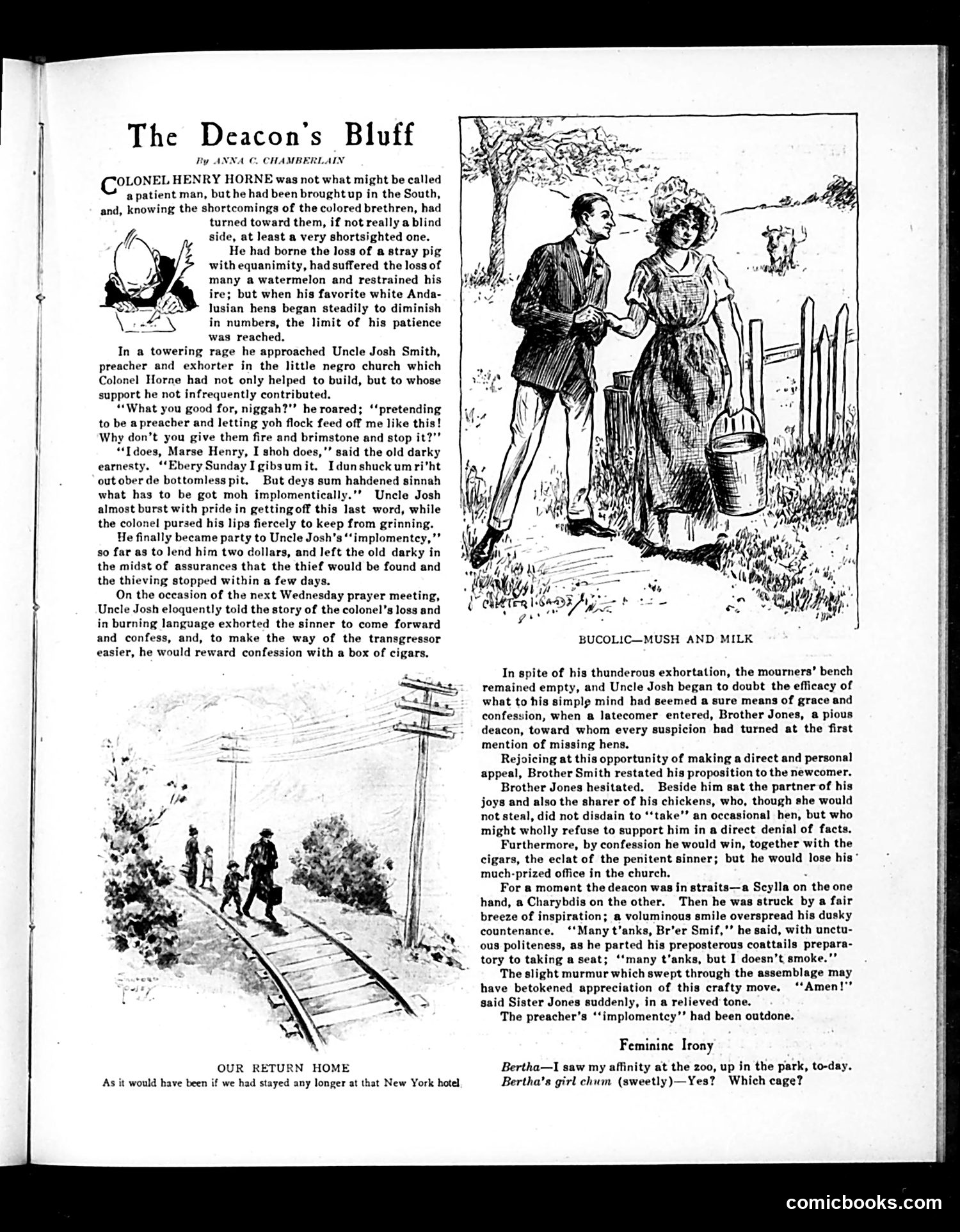
The Deacon's Bluff Ry ANNA ©. CHAMBERLAIN COLONEL HENRY HORNE was not what might be called a patient man, but he had been brought up in the South, and, knowing the shortcomings of the colored brethren, had turned toward them, if not really a blind side, at least a very shortsighted one. He had borne the loss of a stray pig with equanimity, had suffered the loss of many a watermelon and restrained his ire; but when his favorite white Anda- lusian hens began steadily to diminish in numbers, the limit of his patience was reached, In a towering rage he approached Uncle Josh Smith, preacher and exhorter in the little negro church which Colonel Horne had not only helped to build, but to whose support he not infrequently contributed. “‘What you good for, niggah?”’ he roared; ‘‘pretending to be a preacher and letting yoh flock feed off me like this! Why don’t you give them fire and brimstone and stop it?” “I does, Marse Henry, I shoh does,’’ said the old darky earnesty. ‘‘Ebery Sunday I gibsumit. Idunshuck um ri’ht out ober de bottomless pit. But deys sum hahdened sinnah what has to be got moh implomentically.’’ Uncle Josh almost burst with pride in getting off this last word, while the colonel pursed his lips fiercely to keep from grinning. He finally became party to Uncle Josh’s ‘‘implomentcy,’’ so far as to lend him two dollars, and left the old darky in the midst of assurances that the thief would be found and the thieving stopped within a few days. On the occasion of the next Wednesday prayer meeting, Uncle Josh eloquently told the story of the colonel’s loss and in burning language exhorted the sinner to come forward and confess, and, to make the way of the transgressor easier, he would reward confession with a box of cigars. OUR RETURN HOME As it would have been if we had stayed any longer at that New York hotel. BUCOLIC—MUSH AND MILK In spite of his thunderous exhortation, the mourners’ bench remained empty, and Uncle Josh began to doubt the efficacy of what to his simplg mind had seemed a sure means of grace and confession, when a Jatecomer entered, Brother Jones, a pious deacon, toward whom every suspicion had turned at the first mention of missing hens, Rejoicing at this opportunity of making a direct and personal appeal, Brother Smith restated his proposition to the newcomer. Brother Jones hesitated. Beside him sat the partner of his joys and also the sharer of his chickens, who, though she would not steal, did not disdain to ‘‘take’’ an occasional hen, but who might wholly refuse to support him in a direct denial of facts. Furthermore, by confession he would win, together with the cigars, the eclat of the penitent sinner; but he would lose his* much-prized office in the church. - For a moment the deacon was in straits—a Scylla on the one hand, a Charybdis on the other. Then he was struck by a fair breeze of inspiration; a voluminous smile overspread his dusky countenance. ‘*Many t’anks, Br’er Smif,’’ he said, with unctu- ous politeness, as he parted his preposterous coattails prepara- tory to taking a seat; ‘‘many t’anks, but I doesn’t smoke.’” The slight murmur which swept through the assemblage may have betokened appreciation of this crafty move. ‘‘Amen!"’ said Sister Jones suddenly, in a relieved tone. The preacher’s ‘‘implomentcy’’ had been outdone. Feminine Irony Bertha—I saw my affinity at the zoo, up in the park, to-day. Bertha’s girl chum (sweetly)—Yes? Which cage? comicbooks.com