
Judge, 1913-10-04 · page 15 of 24
Judge — October 4, 1913 — page 15: what you’re looking at
What you’re looking at
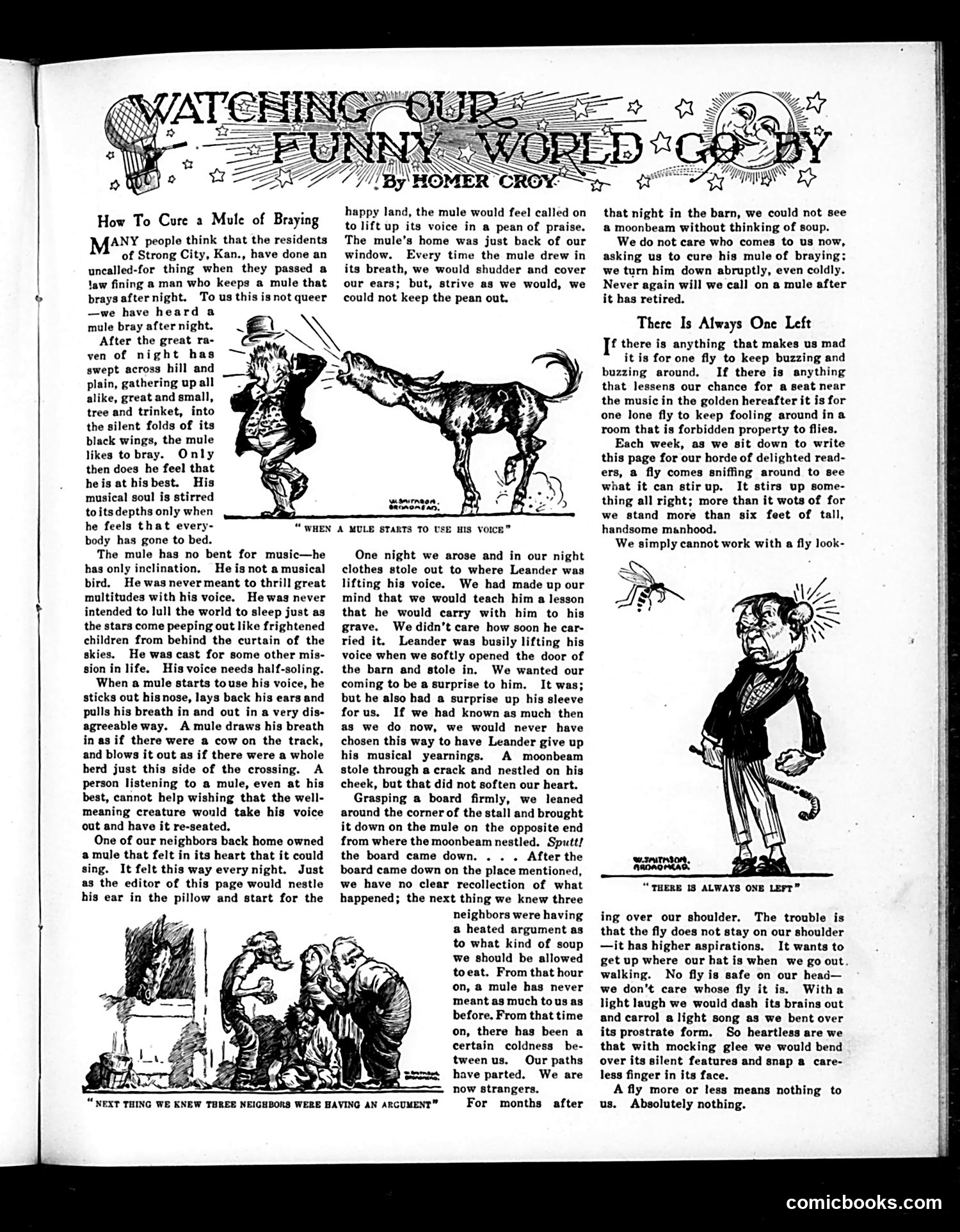
This is a humorous essay by Homer Croy about a Kansas law fining owners of braying mules at night. The satire targets small-town ordinances and their unintended consequences. **The Setup:** The author defends Strong City, Kansas's anti-braying law, describing mules as inherently unmusical creatures whose nighttime noise is genuinely unbearable. The piece humorously characterizes mules as having no artistic merit—they "draw breath in as if there were a cow on the track." **The Joke:** The narrator recounts attempting to silence his neighbor's mule "Leander" by sneaking into the barn at night with a board. However, in the darkness, he hits the mule's rear end, causing it to buck and send him flying. Neighbors subsequently debate what kind of soup the injured narrator should eat—implying serious injury. **The Point:** The story illustrates how well-intentioned attempts to enforce social order (like anti-braying laws) can backfire comically. The narrator becomes so traumatized that he refuses to help anyone with their mule problems afterward, and moonbeams now remind him of soup. The accompanying illustrations show the mule braying and the neighbors arguing over the narrator's injury.
📄 Transcribed text from this page (OCR, searchable)
Machine-transcribed from the original scan — historical spelling and the odd misread are preserved.
How To Cure a Mule of Braying MAYY people think that the residents of Strong City, Kan., have done an uncalled-for thing when they passed a law fining a man who keeps a mule that braysafternight. To us this isnot queer —we have heard a mule bray after night. After the great ra- ven of night has swept across hill and plain, gathering up all alike, great and small, tree and trinket, into the silent folds of its black wings, the mule likes to bray. Only then does he feel that heis at hisbest. His musical soul is stirred toitsdepths only when he feels that every- body has gone to bed. The mule has no bent for music—he has only inclination. He is not a musical bird. He was never meant to thrill great multitudes with his voice. He wag never intended to lull the world to sleep just as the stars come peeping out like frightened children from behind the curtain of the skies. He was cast for some other mis- sion in life. His voice needs half-soling. When a mule starts touse his voice, he sticks out his nose, lays back his ears and pulls his breath in and out in a very dis- agreeable way. A mule draws his breath in as if there were a cow on the track, and blows it out as if there were a whole herd just this side of the crossing. A person listening to a mule, even at his best, cannot help wishing that the well- meaning creature would take his voice out and have it re-seated. One of our neighbors back home owned a mule that felt in its heart that it could sing. It felt this way everynight. Just as the editor of this page would nestle his ear in the pillow and start for the “NEXT THING WE KNEW THREE NEIGHBORS WERE BAVING AN ARGUMENT” WOR happy land, the mule would feel called on to lift up its voice in a pean of praise. The mule’s home was just back of our window. Every time the mule drew in its breath, we would shudder and cover our ears; but, strive as we would, we could not keep the pean out. mawenson. Seenonean: “WHEN A MULE STARTS TO USE HIS VOICE” One night we arose and in our night clothes stole out to where Leander was lifting his voice. We had made up our mind that we would teach him a lesson that he would carry with him to his grave. We didn’t care how soon he car- ried it. Leander was busily lifting his voice when we softly opened the door of the barn and stole in. We wanted our coming to be a surprise to him. It was; but he also had a surprise up his sleeve for us. If we had known as much then as we do now, we would never have chosen this way to have Leander give up his musical yearnings. A moonbeam stole through a crack and nestled on his cheek, but that did not soften our heart. Grasping a board firmly, we leaned around the corner of the stall and brought it down on the mule on the opposite end from where the moonbeam nestled. Sputt! the board came down. . . . After the board came down on the place mentioned, we have no clear recollection of what happened; the next thing we knew three neighbors were having a heated argument as to what kind of soup we should be allowed toeat. From that hour on, a mule has never meant as much tous as before. From that time on, there has been a certain coldness be- tween us. Our paths have parted. We are now strangers. For months after ETT w that night in the barn, we could not see & moonbeam without thinking of soup. We do not care who comes to us now, asking us to cure his mule of braying; we turn him down abruptly, even coldly. Never again will we call on a mule after it has retired. There Is Always One Left If there is anything that makes us mad it is for one fly to keep buzzing and buzzing around. If there is anything that lessens our chance for a seat near the music in the golden hereafter it is for one lone fly to keep fooling around ina room that is forbidden property to flies. Each week, as we sit down to write this page for our horde of delighted read- ers, a fly comes sniffing around to see what it can stirup. It stirs up some- thing all right; more than it wots of for we stand more than six feet of tall, handsome manhood. We simply cannot work with a fly look- “THERE IS ALWAYS ONE LEFT” ing over our shoulder. The trouble is that the fly does not stay on our shoulder —it has higher aspirations, It wants to get up where our hat is when we go out. walking. No fly is safe on our head— we don’t care whose fly it is. Witha light laugh we would dash its brains out and carrol a light song as we bent over its prostrate form. So heartless are we that with mocking glee we would bend over its silent features and snap a care- less finger in its face. A fly more or less means nothing to us. Absolutely nothing. comicbooks.com