
A complete issue · 24 pages · 1913
Judge — September 27, 1913
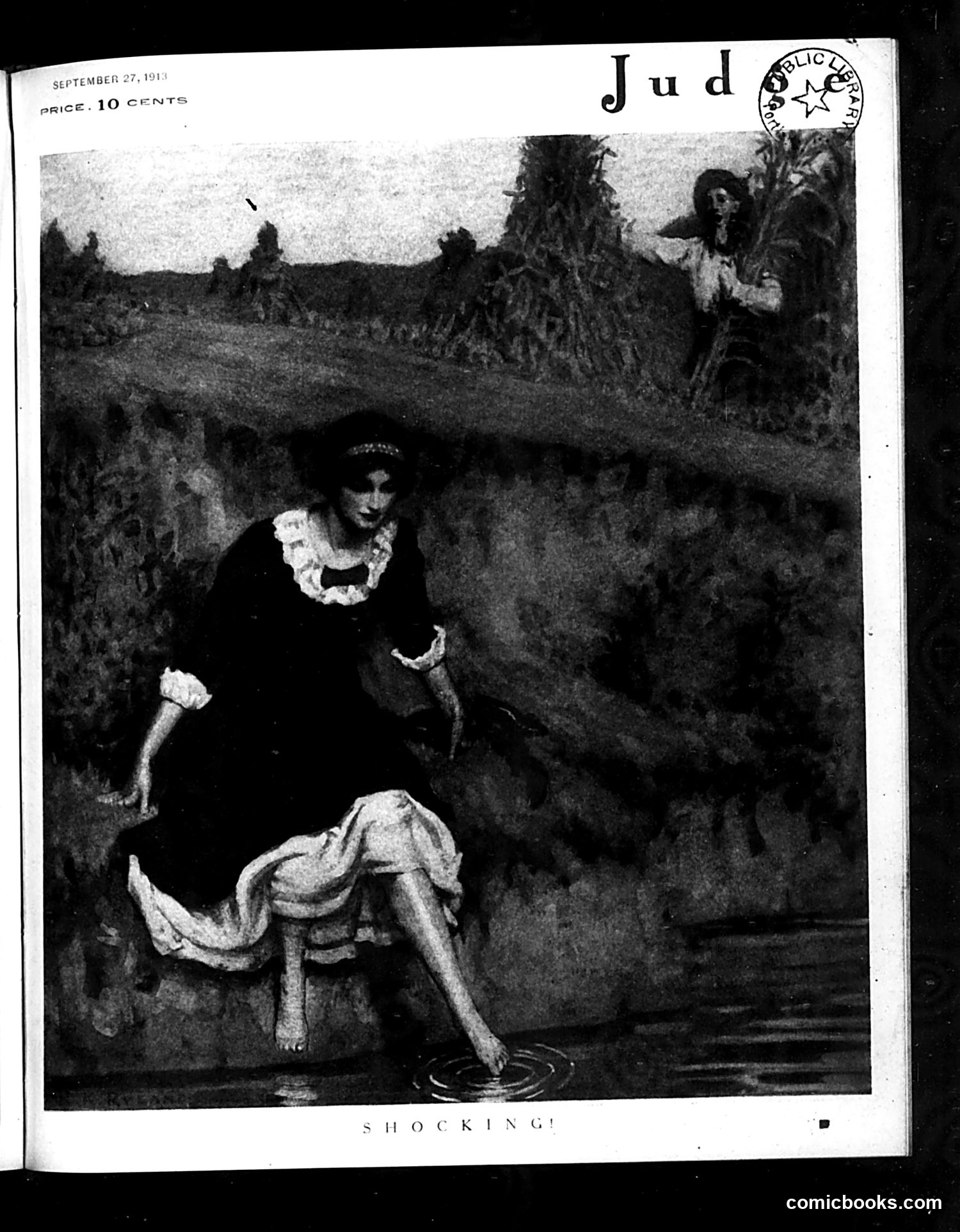
This cartoon satirizes a woman's scandalous behavior. The caption "SHOCKING!" and the woman's facial expression suggest moral outrage at her action—dipping her bare foot into water, likely a pond or stream, with her skirt lifted. In 1913, exposing one's bare legs in public was considered highly improper and sexually suggestive. The illustration plays on Victorian-era anxieties about women's changing social roles and increasingly relaxed dress codes. The figure's fashionable hat and dark clothing suggest she's a modern woman defying traditional propriety. The joke targets contemporary pearl-clutching about women's liberation: what older generations found "shocking" represented the emerging sexual freedom and casualness of early 20th-century youth culture.
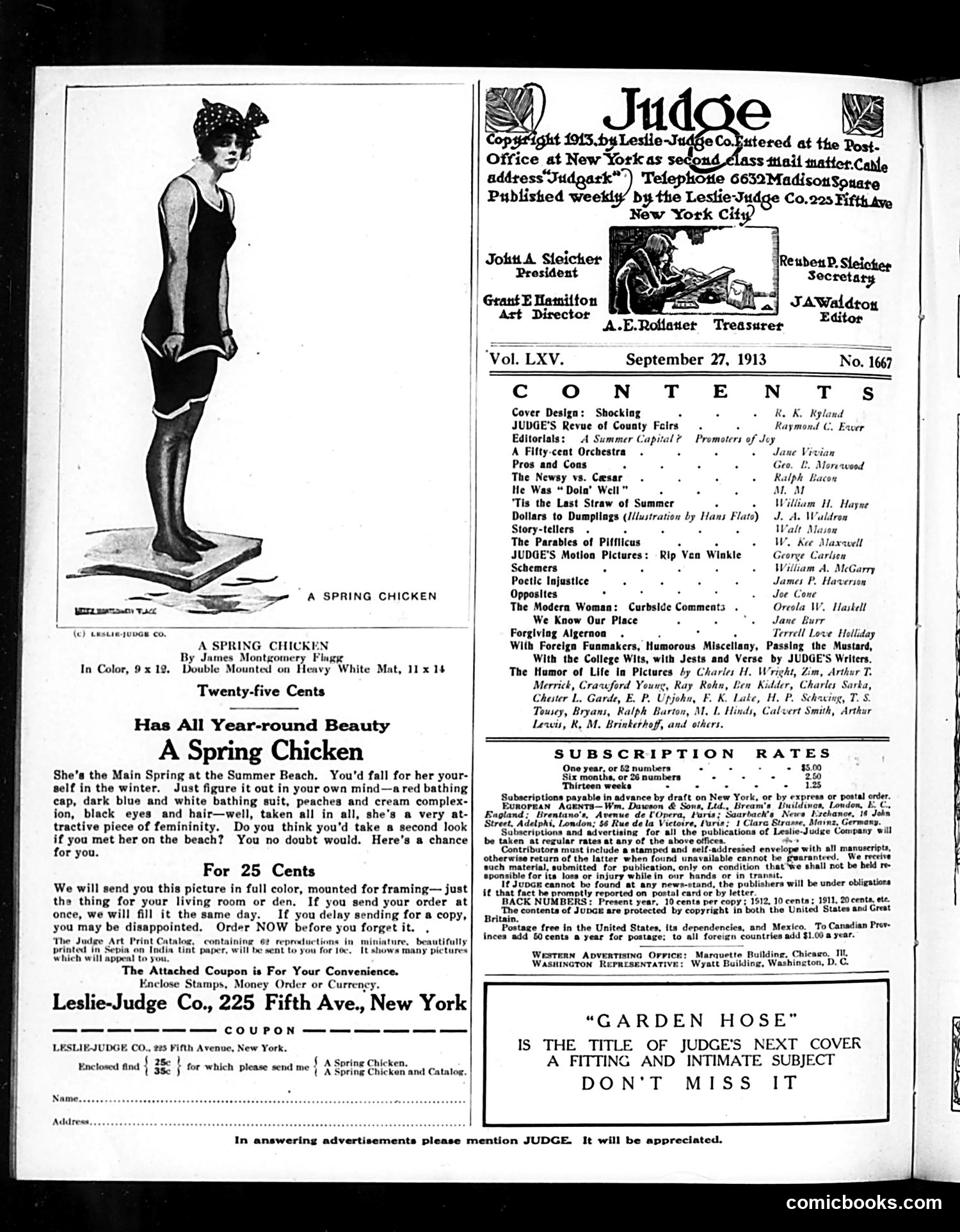
This page is primarily an **advertisement for a picture print** titled "A Spring Chicken," depicting a young woman in a bathing suit posed on a platform. The accompanying text uses the term "spring chicken"—a phrase meaning an attractive young woman or, ironically, someone pretending to be younger than they are. The ad's humor likely plays on vanity and self-deception: it offers the picture for home display, suggesting women should admire their own youthful image. The phrase "Has All Year-round Beauty" reinforces the joke about maintaining or claiming perpetual youth—a timeless satirical target in early 20th-century magazines. The rest of the page contains magazine contents and subscription information. No significant political satire is present.
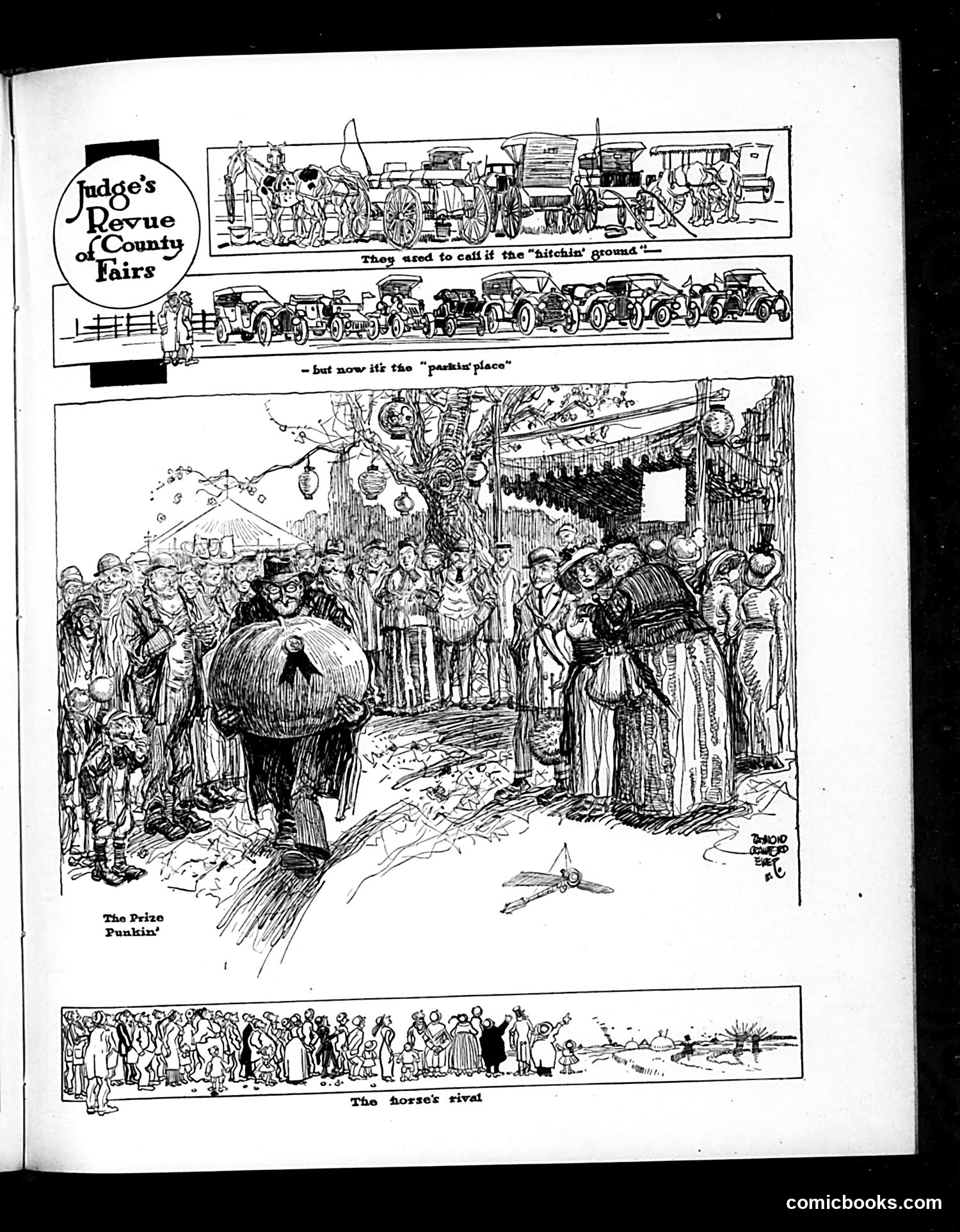
This page satirizes the evolution of county fairs. The top panel shows traditional horse-drawn wagons and livestock at "the 'hitchin' ground," contrasting with the middle panel depicting rows of automobiles at "the 'parkin' place"—mocking how rapidly cars replaced horses in rural America. The large central illustration, captioned "The Prize Punkin'," depicts a massive pumpkin as the fair's centerpiece, surrounded by crowds. The bottom panel, "The Horse's rival," shows spectators viewing an airplane, suggesting aviation now competes with agricultural exhibits for fairgoers' attention. The overall satire critiques how modernization—automobiles and aviation—is displacing traditional agricultural culture at rural county fairs, reflecting early 20th-century anxieties about technological change in American countryside communities.
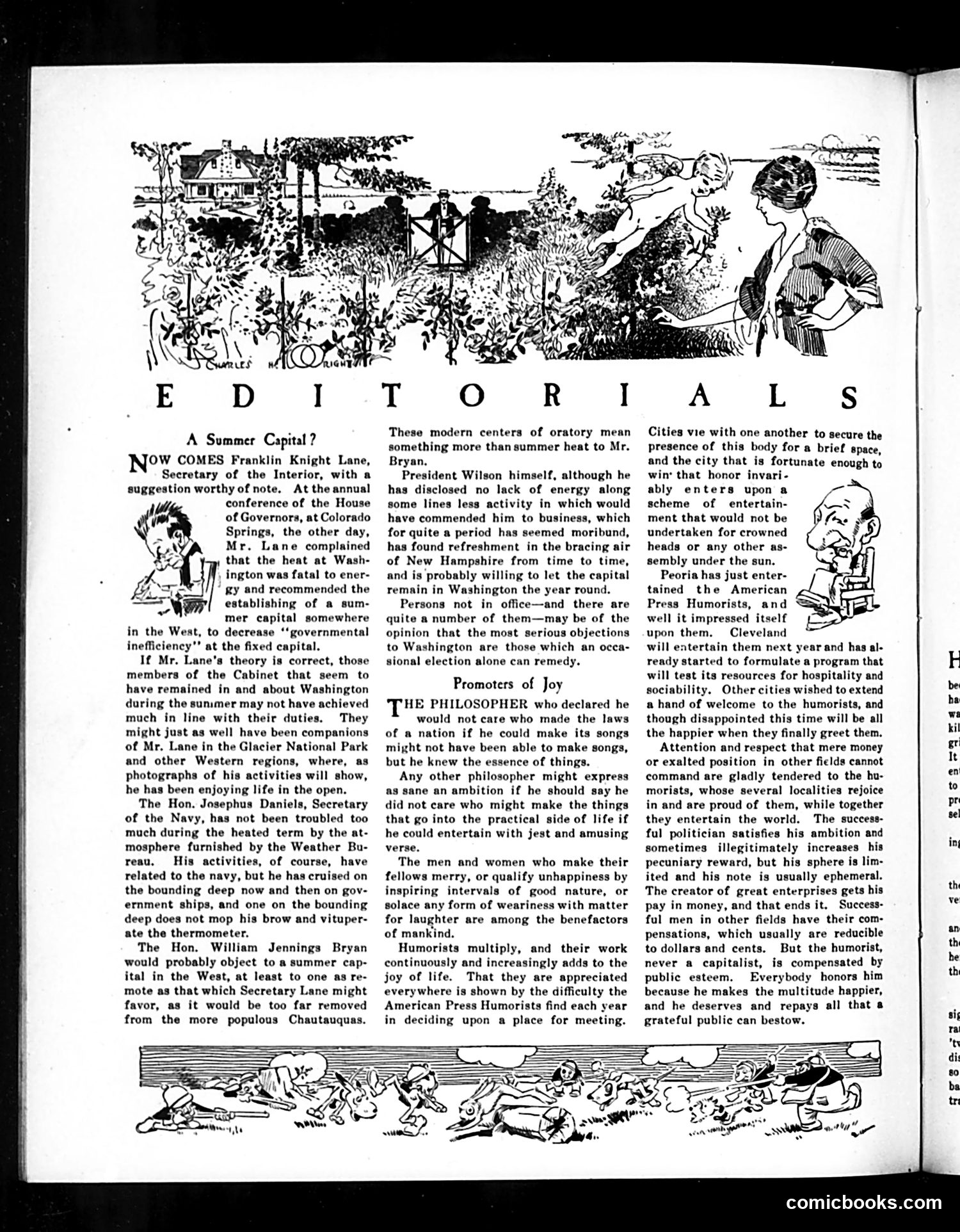
This page discusses a proposal by Franklin Knight Lane (Secretary of the Interior) to establish a summer capital in Colorado Springs rather than keeping the U.S. government in hot, humid Washington, D.C. year-round. The satire mocks this idea, suggesting it's impractical and that even Cabinet members stuck in Washington during summer may not have achieved much anyway. The cartoon suggests relocating would be excessive. The second editorial, "Promoters of Joy," praises American Press Humorists—cartoonists and joke-makers whose work provides social benefit by lifting public spirits. It argues humor's value transcends mere entertainment, offering genuine public service. The bottom illustration shows people relaxing outdoors, likely complementing the humor discussion above it.
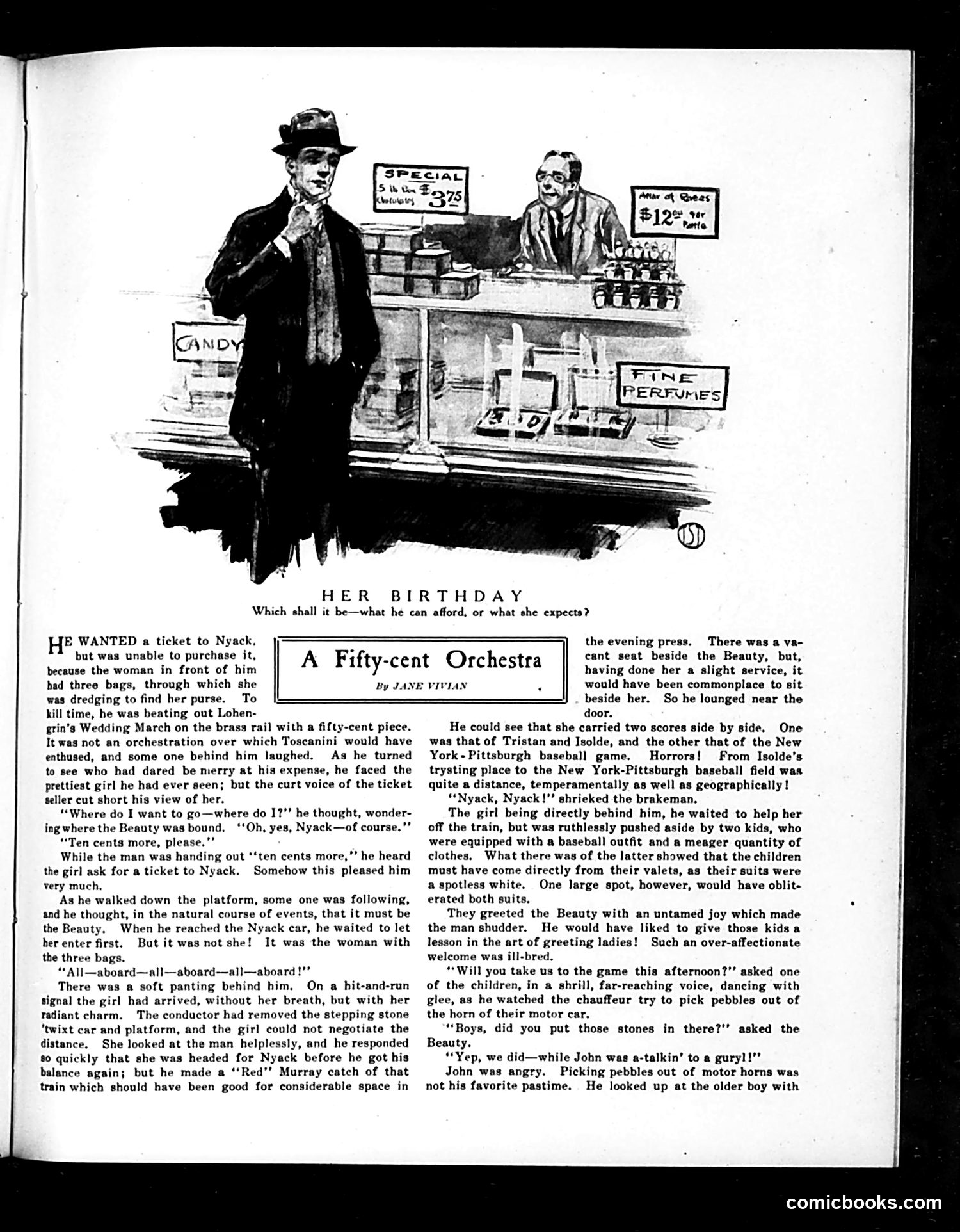
This page contains an illustration and short story titled "A Fifty-cent Orchestra" by Jane Vivian. The cartoon depicts a store counter scene where a man contemplates purchasing a birthday gift for a woman. The story satirizes working-class romantic gestures and financial constraints. The man struggles with limited funds (fifty cents) while wanting to impress his companion. The narrative follows his journey to purchase a ticket, involving a train encounter and children with baseball equipment—apparently stolen goods from wealthy travelers' luggage. The satire targets class differences and the gap between romantic aspirations and modest means. The "fifty-cent orchestra" likely refers to cheap entertainment or inadequate resources for courtship. The humor derives from the protagonist's earnest but economically constrained attempt at romance during the early 1900s era when such sums held real significance.
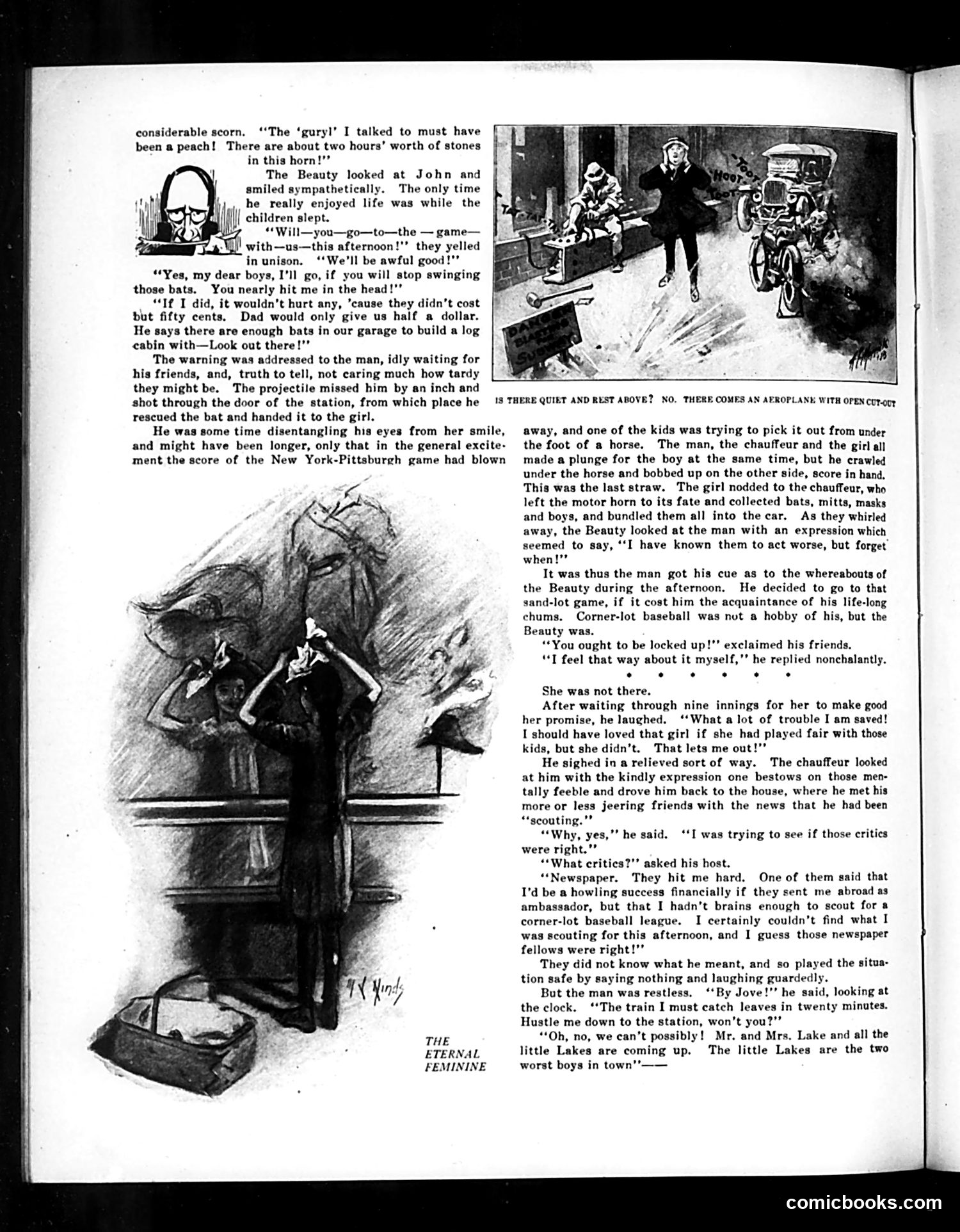
This story satirizes romantic infatuation and male poor judgment. A wealthy man ("the Beauty") becomes smitten with a woman after she manages rowdy children at a baseball game. Ignoring his longtime friends, he abandons them to attend a sand-lot game hoping to see her again. The satire's point: his romantic fantasy crumbles when she fails to appear, yet he's relieved—realizing she'd be incompatible with his lifestyle. His friends mockingly call him "scouting" (searching), and newspaper critics have questioned his intelligence. The irony is sharp: he romanticizes a practical woman managing chaos, then rejects her for the very same competence. The title "The Eternal Feminine" suggests timeless female mystery, while the story implies men are foolishly irrational about romance. The concluding revelation that the "worst boys in town" are the very children from earlier reinforces the cyclical nature of domestic chaos he's unconsciously avoiding.
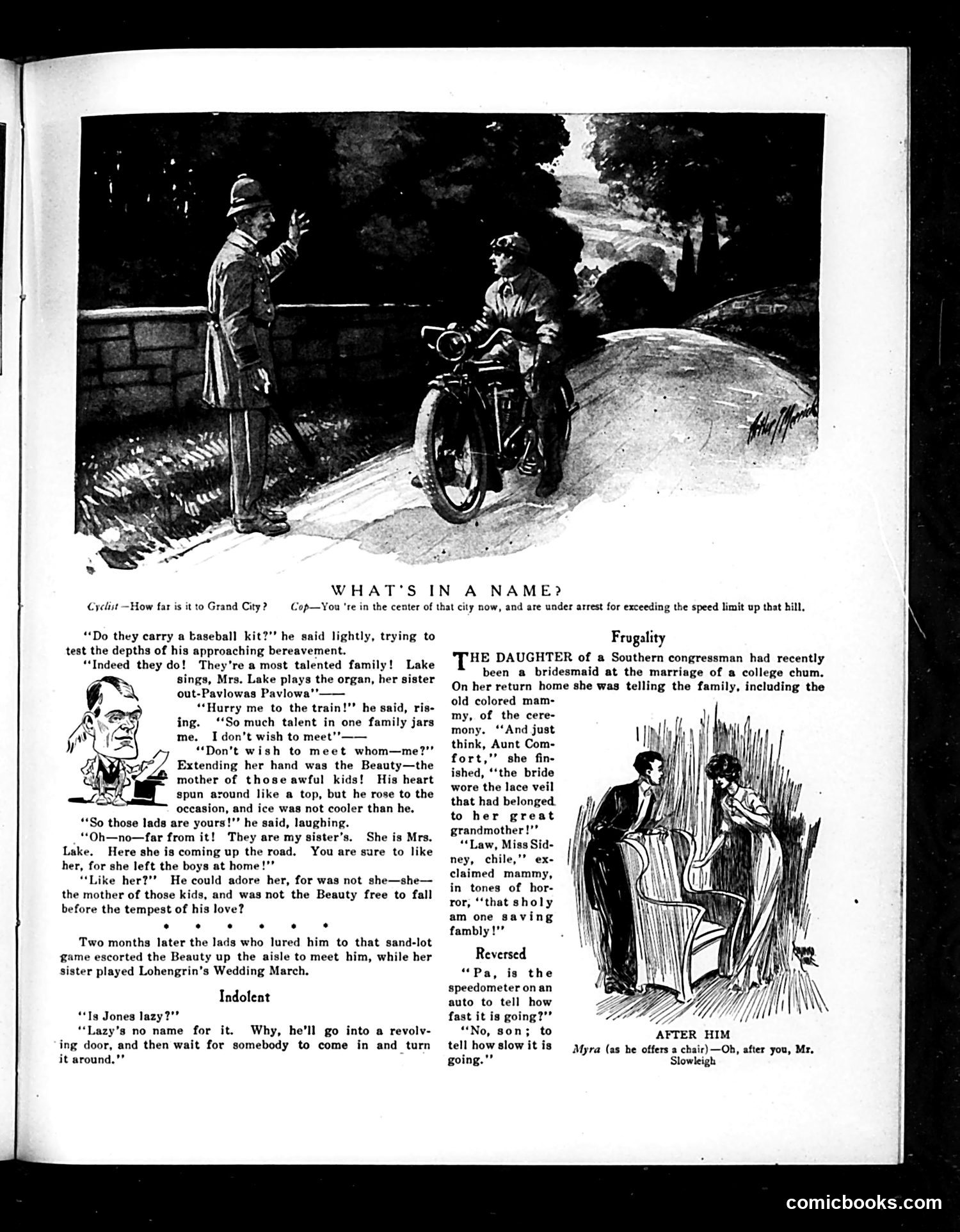
This page contains four separate humorous anecdotes typical of early 20th-century Judge magazine satire. **"What's In a Name?"** (top): A cyclist romantically pursues a beautiful woman, only to learn she's the mother of talentless but "talented" children who sing and dance poorly. He's horrified—until discovering the Beauty herself is the *sister*, not the mother. Two months later, the kids trick him into marrying their sister anyway. The joke: he was duped by family deception despite his initial discernment. **"Indolent"**: A one-liner mocking extreme laziness—a man so idle he enters a revolving door and waits for someone else to push it. **"Frugality"**: A Southern congressman's daughter brags about a bride reusing a great-grandmother's lace veil. The old mammy responds with horror at such penny-pinching, treating it as shockingly miserly. The joke satirizes Southern gentility and attitudes toward family heirlooms. **"Reversed"**: A father jokes that car speedometers actually measure slowness, not speed—contemporary satire on slow driving or traffic.
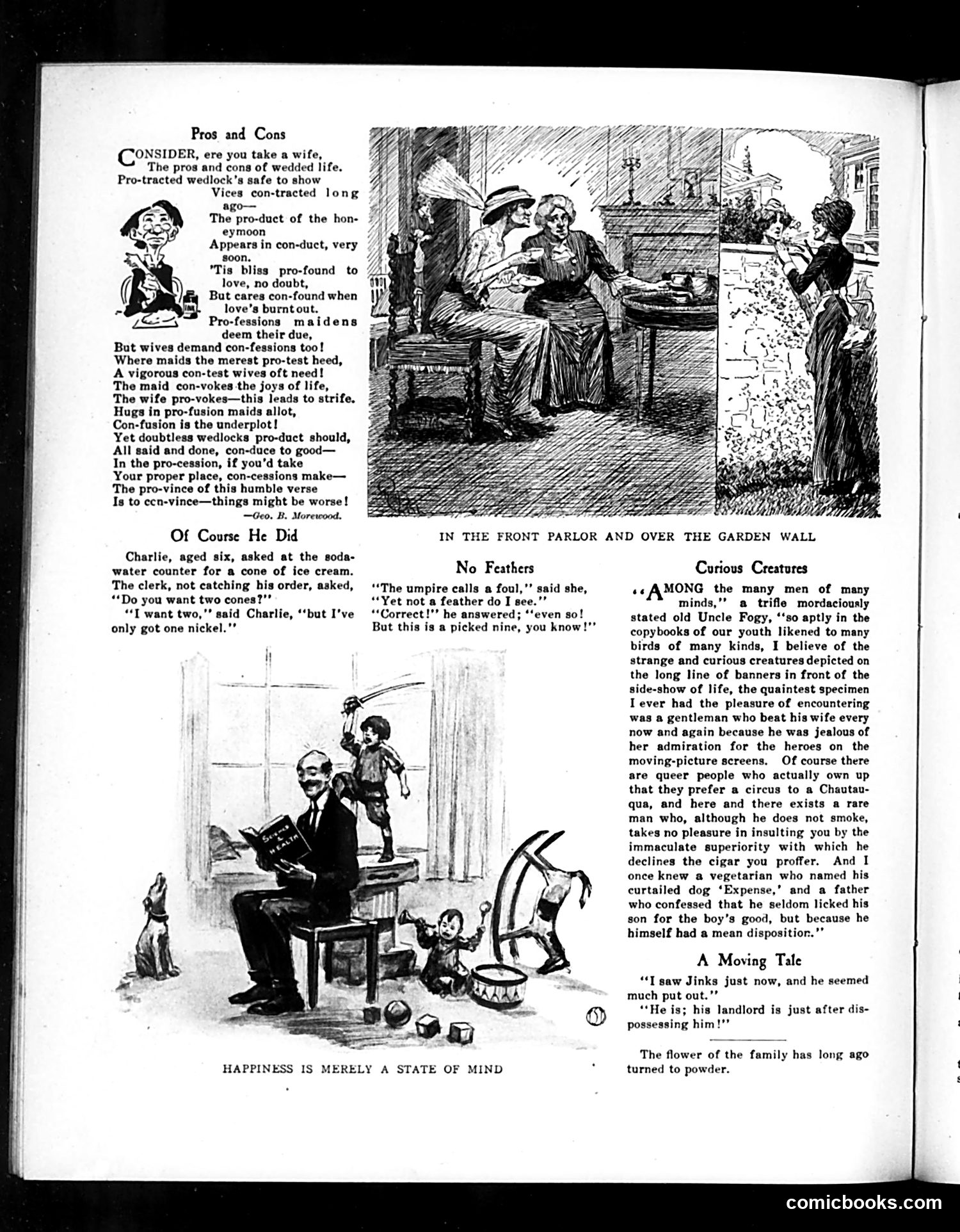
This page contains three humorous pieces satirizing marriage and social behavior circa early 20th century. **"Pros and Cons"** is a punning poem about marriage's contradictions—courtship's "pro-found" love becomes married life's "con-fusion" and "strife." It mocks how wives demand confessions while husbands must make concessions. The wordplay (pro/con prefixes) suggests married life's fundamental contradictions. **"Of Course He Did"** is a children's joke: a boy asks for ice cream at a soda counter but only has one nickel for two cones—the punchline implies he'll get two anyway (or eat them anyway). **"Curious Creatures"** features Uncle Fogy describing society's oddities: a man who beats his wife from jealousy over movie stars, people who prefer circuses to intellectual Chautauquas, and a non-smoking man who smugly refuses cigars. The satire targets social hypocrisy and peculiar human contradictions. The illustrations depict domestic scenes emphasizing the marriage and social commentary themes.
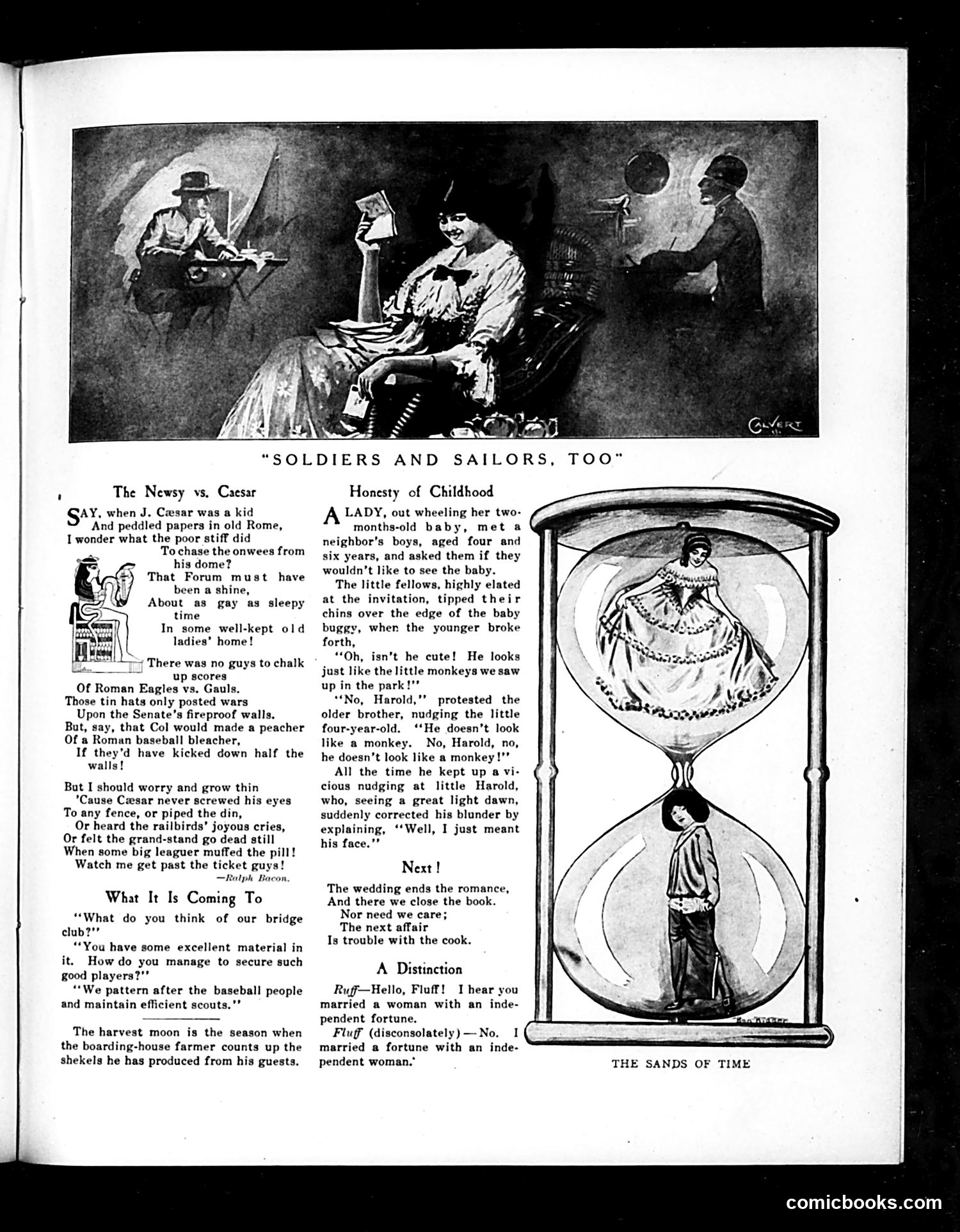
This page contains multiple satirical pieces typical of early 20th-century American humor: **"The Newsy vs. Caesar"**: Compares Julius Caesar's youth unfavorably to modern American newsboys, lamenting that Caesar missed baseball games and the excitement of urban street life. The satire mocks both classical Rome as boring and celebrates contemporary American popular culture as superior. **"Honesty of Childhood"**: A brief anecdote where a young boy's candid comparison of a baby to monkeys is corrected by his older brother—until the boy "clarifies" by saying he meant only the baby's *face*. The joke relies on the brother's well-intentioned social correction accidentally making the insult worse. **"What It Is Coming To"** and **"A Distinction"**: Short quips about bridge clubs adopting baseball recruitment methods, and wordplay about marrying women versus fortunes. **"The Sands of Time"** illustration (right): Shows figures inside an hourglass, likely representing time's passage or mortality. The overall tone reflects Judge's genteel, middle-class sensibility and preference for observational humor over political commentary.
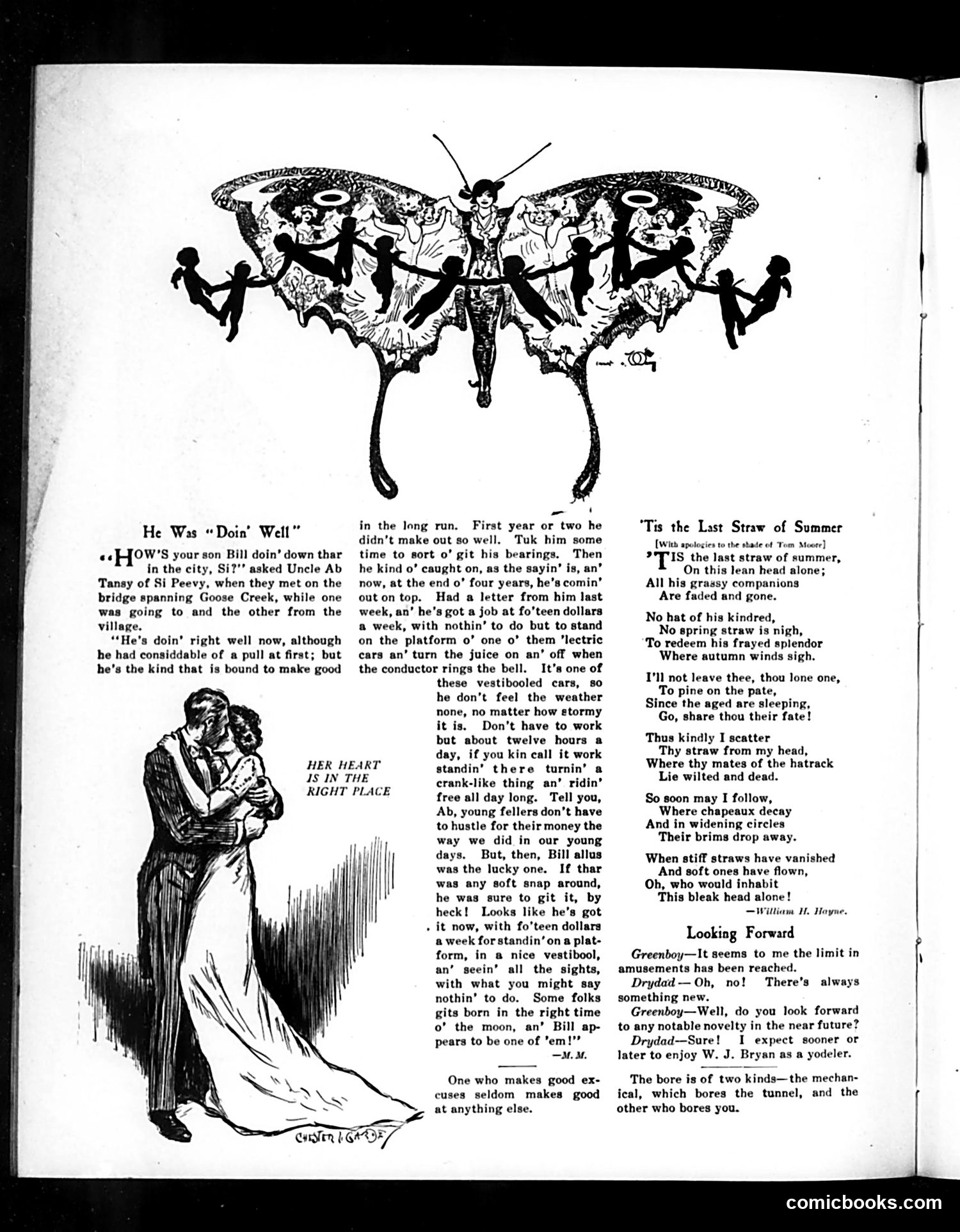
This page contains three satirical pieces from *Judge* magazine: **"He Was 'Doin' Well'"** (left): A rural dialect story mocking class aspirations. Si Peevy brags that his son Bill, working as a streetcar operator in the city, is "doing well" earning $14/week for minimal labor in a heated car. The satire targets both working-class delusion about "easy money" jobs and the sentimentality about rural virtue versus city work. The illustration shows a working-class couple, suggesting the humor lies in their pride over what was actually low-wage, unskilled labor. **"'Tis the Last Straw of Summer"** (right): A sentimental parody of romantic poetry, treating a worn straw hat as a dying companion. It mocks overwrought Romantic-era verse (referencing Tom Moore, an Irish Romantic poet). **"Looking Forward"** (bottom): A brief dialogue joke where Drydad predicts future entertainment will include "W. J. Bryan as a yodeler"—likely satirizing William Jennings Bryan, the three-time presidential candidate, as an unlikely performer, suggesting he was considered ridiculous or exhausting.
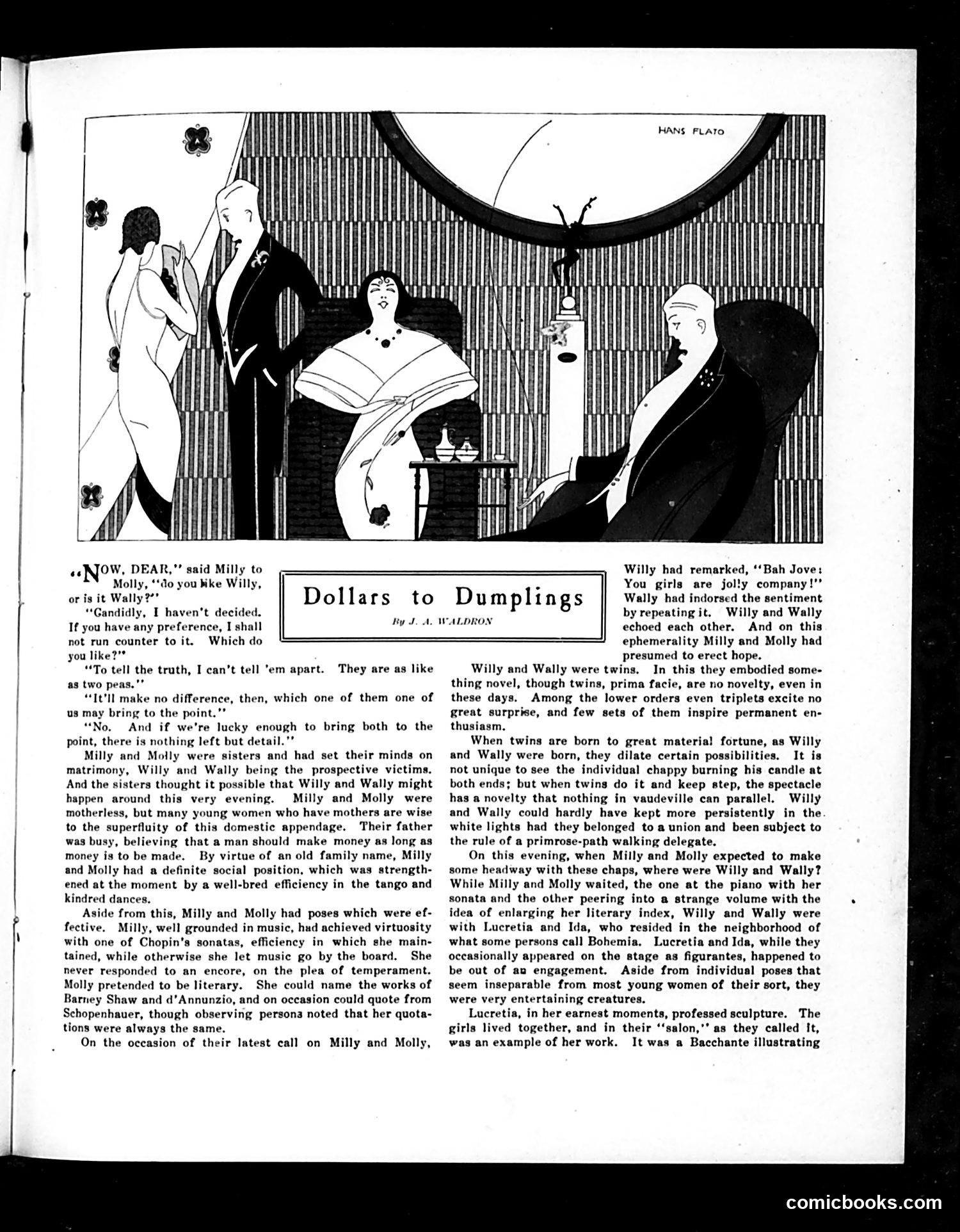
This story satirizes wealthy but shallow young women and the interchangeable men they pursue. Sisters Milly and Molly, from an affluent family, affect cultural sophistication—one poses as musical (Chopin), the other as literary (quoting Shaw and Schopenhauer)—yet they admit they cannot tell apart their identical twin suitors, Willy and Wally, and consider either equally suitable for marriage. The joke centers on their mercenary superficiality: despite their "well-bred efficiency" and refined pretenses, they're simply hunting husbands. Meanwhile, the indistinguishable twins abandon them for Lucretia and Ida—bohemian actresses from the artistic neighborhood, who are more genuinely entertaining despite (or because of) lacking pretense. The title suggests the wealthy sisters' "dollars" cannot secure the twins' devotion, resulting instead in emotional "dumplings"—a deflating comeuppance. The satire mocks both the girls' performative culture and the era's marriage-market dynamics among the upper classes.
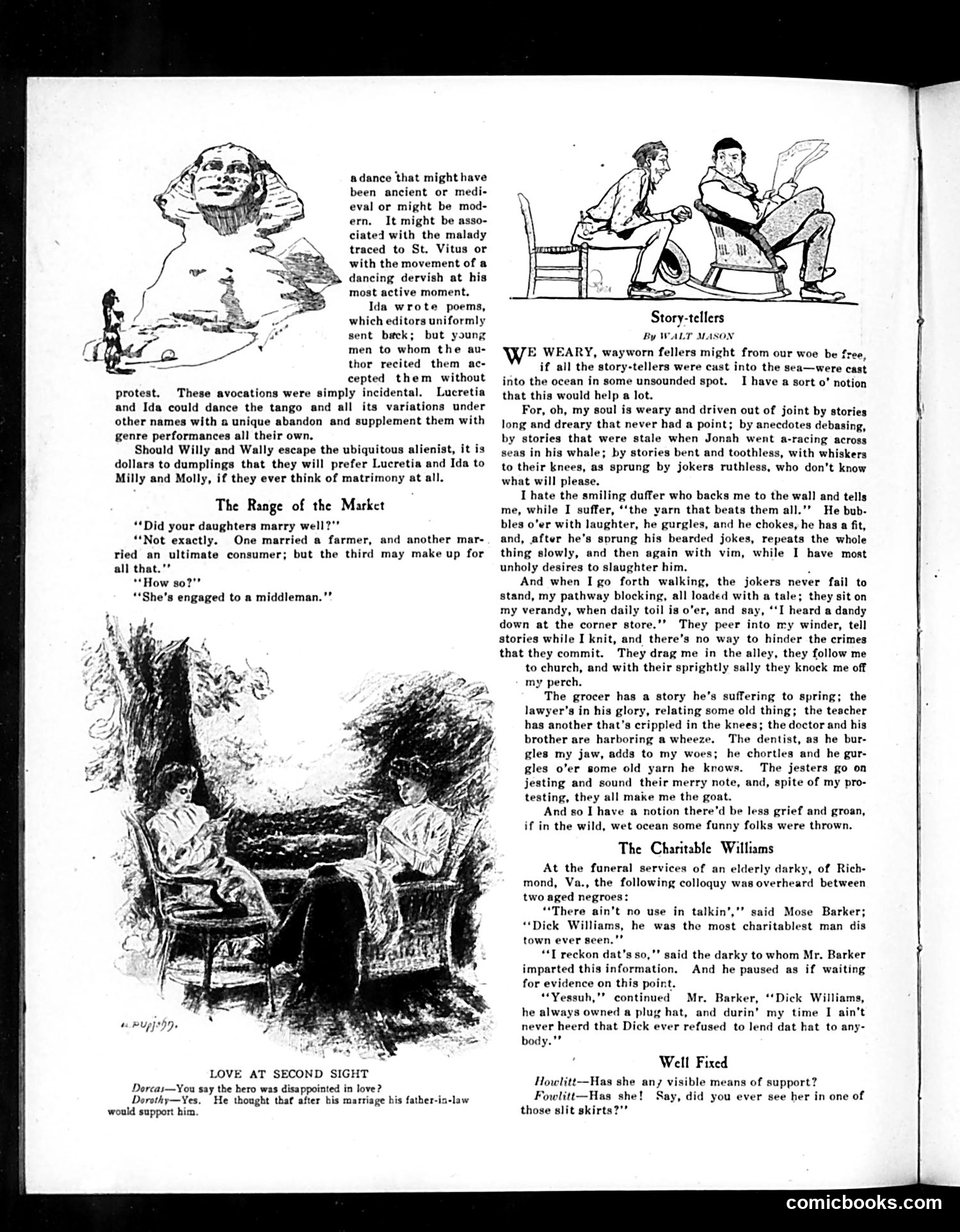
This page contains three distinct satirical pieces: **"The Range of the Market"** mocks class aspiration through a dialogue about daughters' marriages. The joke hinges on a middleman (a commercial intermediary) being positioned as a desirable match—satirizing how mercenary concerns and economic status determine marriage eligibility among the socially ambitious. **"Story-tellers"** by Walt Mason is a humorous poem lamenting chronic storytellers who inflict tedious, pointless anecdotes on captive audiences everywhere—at work, church, and home. It's social satire about the universal annoyance of people who won't stop talking. **"The Charitable Williams"** presents a racial dialogue (using period dialect) where two Black men discuss a deceased man's charity. The humor appears to rest on the contradiction between claims of generosity and the modest evidence (owning a plug hat)—though the incomplete text makes the punchline unclear. The illustrations complement these pieces with genre scenes of domestic life and social interaction typical of Judge's satirical style.
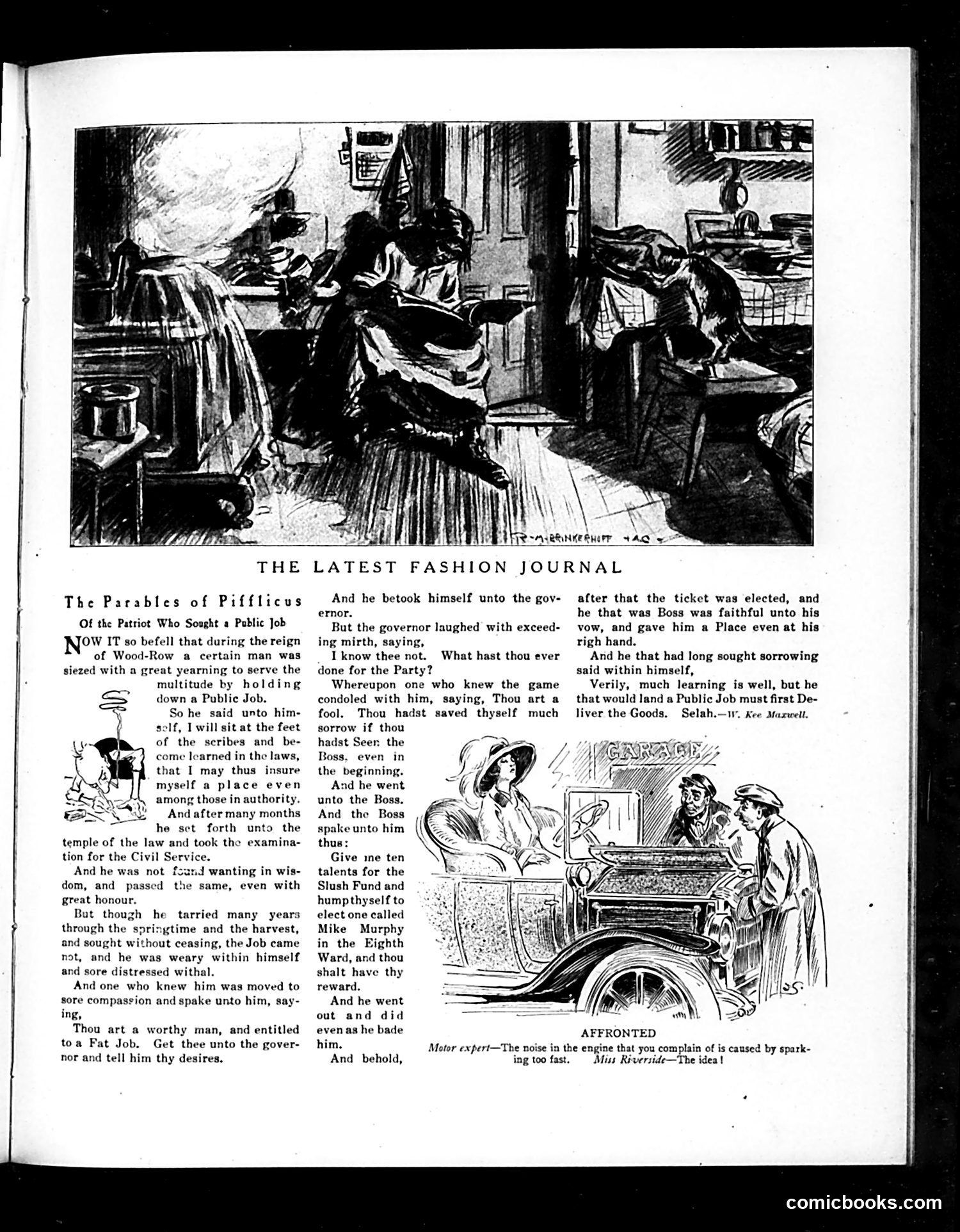
This is a political parable mocking early 20th-century American political corruption, specifically targeting the Wood-Row (Woodrow Wilson) administration. The narrative ridicules the gap between merit-based civil service and actual patronage politics. A worthy man studies law, passes civil service exams with honors, but cannot secure a job through legitimate channels. When he appeals to the governor based on qualifications, he's dismissed—the governor doesn't care about merit. Only when he consults the "Boss" (the political machine operator) does he succeed, but only by: 1. Contributing ten talents to the "Slush Fund" (campaign bribery) 2. Doing partisan work (electing Mike Murphy in the Eighth Ward) The moral: public jobs require political corruption, not competence. The piece satirizes how American civil service reform remained theoretical while machine politics and patronage actually controlled hiring. The bottom panel appears unrelated advertising humor about a motor car.
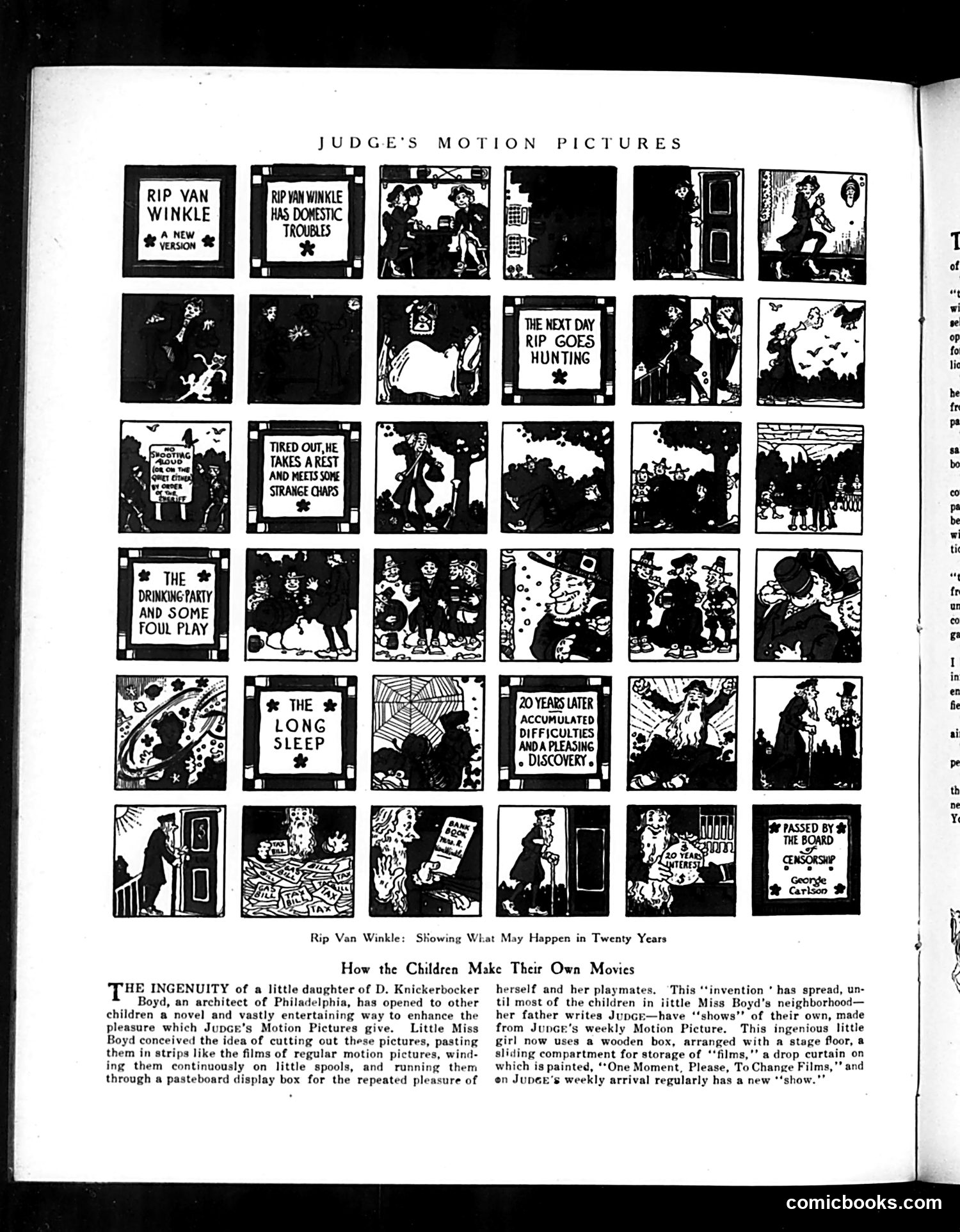
This page documents a creative trend among early 20th-century children: repurposing Judge magazine's cartoon strips as homemade motion pictures. A Philadelphia architect's daughter, D. Knickerbocker Boyd, invented a DIY projector by cutting out Judge's sequential cartoon panels, pasting them into filmstrips, and winding them on spools to view through a pasteboard box—creating the illusion of moving pictures. The page showcases one such strip: "Rip Van Winkle," the Washington Irving classic reimagined through Judge's satirical lens, showing the character's misadventures over twenty years. The article celebrates how this "invention" spread among neighborhood children, who created elaborate homemade theaters with wooden boxes, stage floors, and drop curtains. It's essentially an early example of children's hands-on media engagement—repurposing commercial content to create their own entertainment, predating modern fan culture and DIY media by decades.
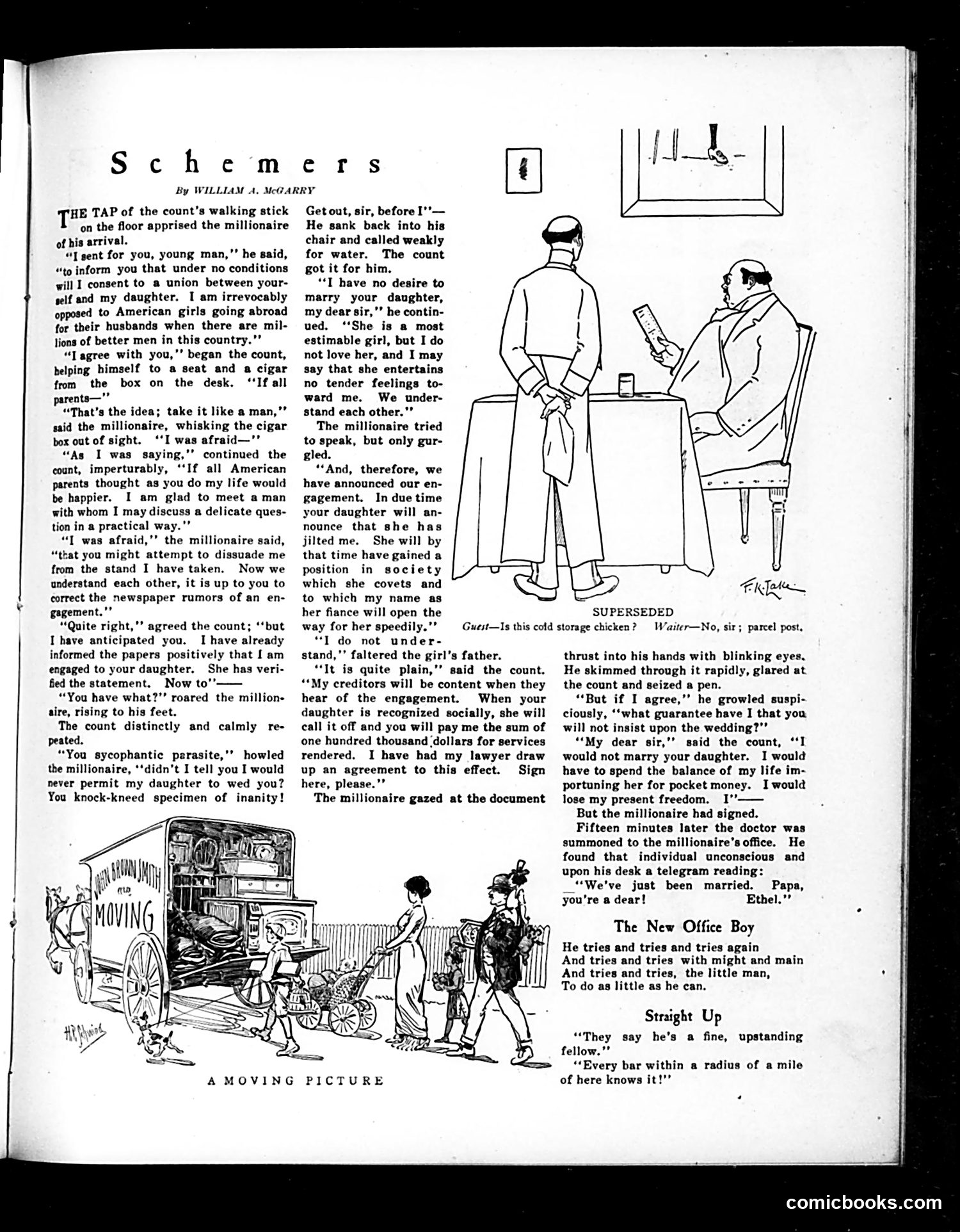
This story satirizes the transactional nature of turn-of-the-century courtship among the wealthy. A European count schemes to marry an American millionaire's daughter not for love, but to gain social credibility with his creditors. He proposes a cynical arrangement: announce the engagement (impressing creditors), allow the daughter to gain social position, then have her jilt him—for which the father pays $100,000. The satire targets both the opportunistic European fortune-hunter (a stock figure of the era) and the American millionaire's materialistic worldview, where even romance becomes a financial transaction. The joke's twist: the daughter elopes anyway, leaving the father apoplectic. The cartoon mocks how wealth-obsessed elites treat marriage as business rather than love—and how their schemes backfire when genuine human emotion intervenes.
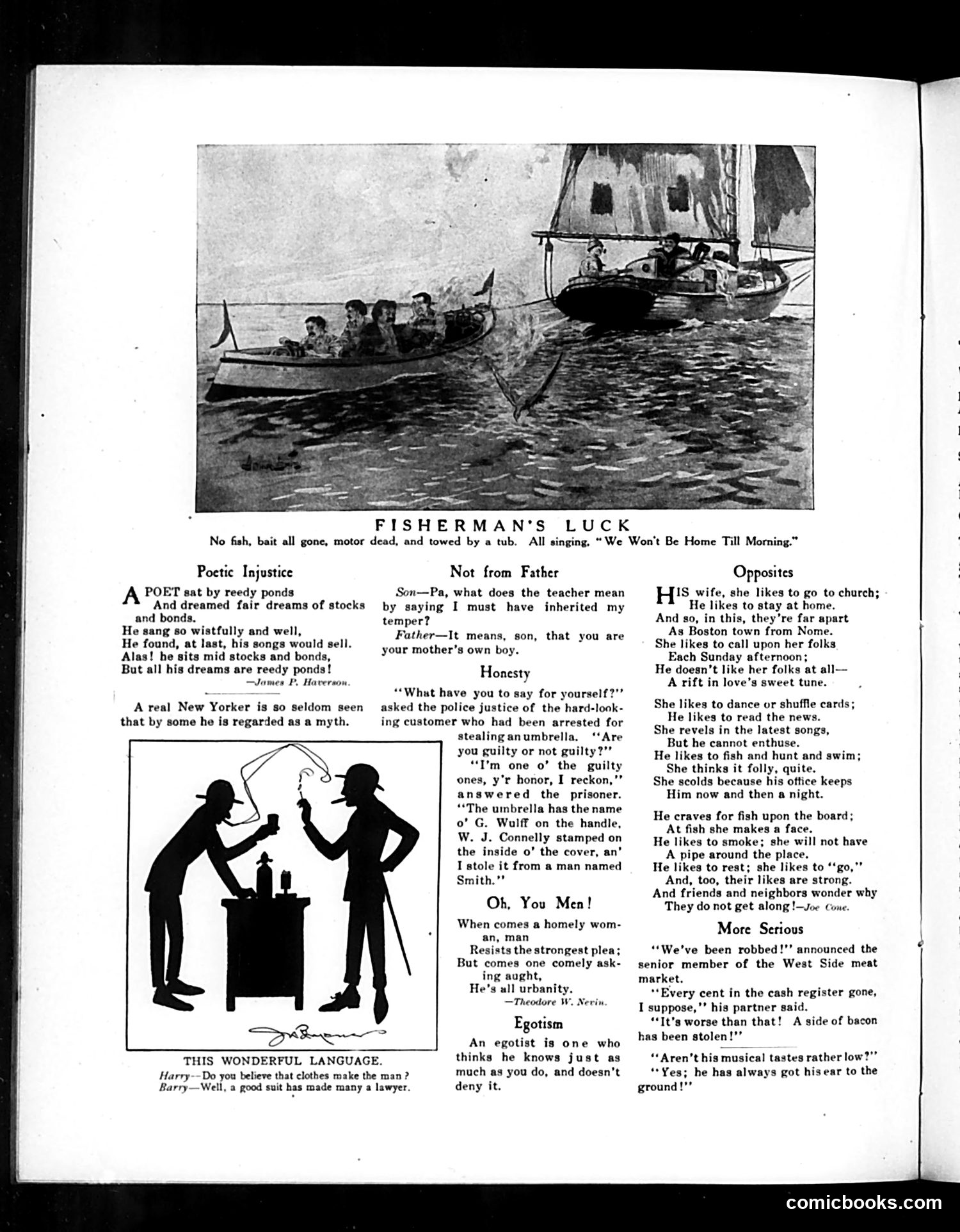
This page contains several short humorous pieces typical of early 20th-century American satire: **"Poetic Injustice"** satirizes the romantic poet who dreams of artistic freedom but, upon achieving commercial success selling verses, finds himself trapped in the mundane world of stocks and bonds—his dreams literally replaced by the financial reality he once disdained. **"This Wonderful Language"** is a brief joke about how a "good suit" (implying appearance or deception) has helped many become lawyers, suggesting the profession's dependence on presentation over substance. **"Not from Father"** jokes that a boy's inherited temper comes from his mother, a mild jab at marital dynamics. **"Honesty"** describes an umbrella thief's refreshing candor in admitting guilt while listing the conflicting names on the stolen item—humor derived from his straightforward dishonesty. Other short pieces cover egotism, marital opposites, and workplace comedy. The page is primarily satirical humor targeting universal human behavior, professions, and relationships rather than specific political events.
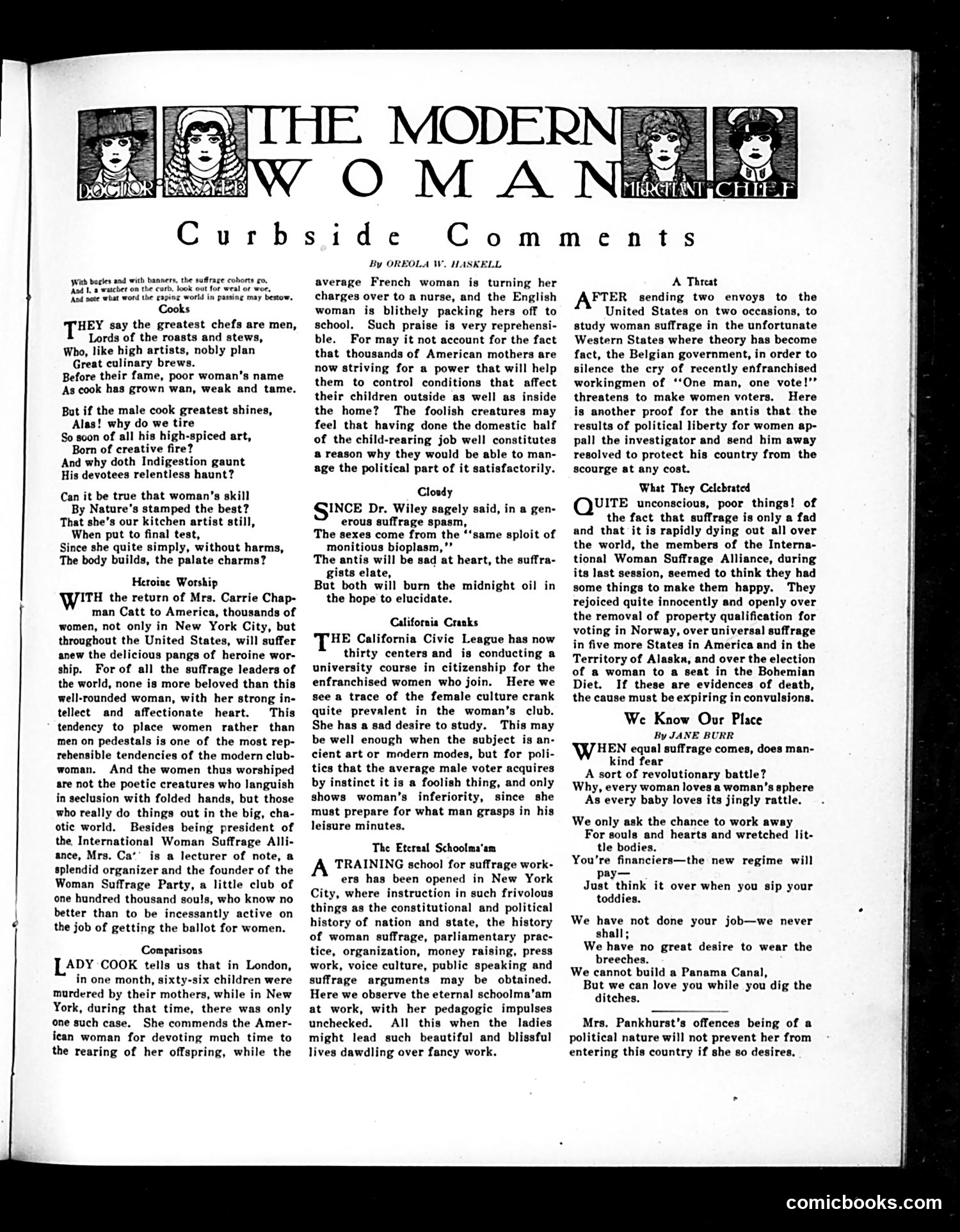
This page from *Judge* magazine presents satirical commentary on women's suffrage and changing female roles in early 20th-century America. The author, Oreola W. Haskell, adopts a mock-serious tone criticizing both suffragists and anti-suffragists. Key targets include: **Carrie Chapman Catt**: The suffrage leader whose return to America is mocked as inspiring "heroine worship" among women—portrayed as an unhealthy tendency toward idolizing active women rather than domestic ones. **Suffragists generally**: Criticized for neglecting domestic duties while pursuing political power, and for their "inferiority" in requiring formal training in citizenship (unlike men who acquire it "by instinct"). **The satire's irony**: The piece actually undermines anti-suffrage arguments by highlighting women's demonstrated competence in organizing, founding institutions, and managing large organizations—while pretending these prove women's unsuitability for politics. The humor relies on readers recognizing the absurdity of claims that women are simultaneously capable organizers yet intellectually inferior to men.
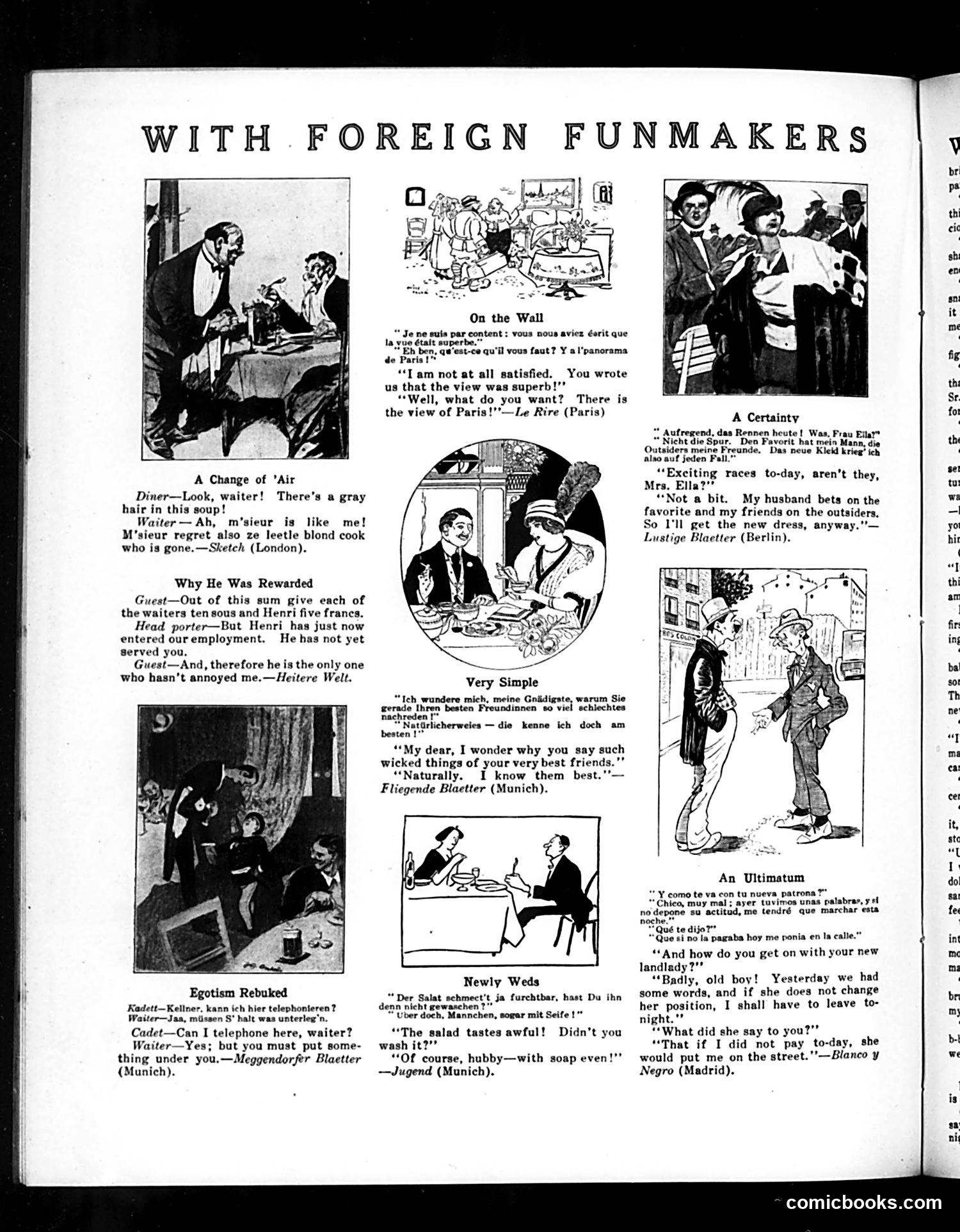
This page collects translated comic jokes from European satirical publications (British, French, German, Spanish sources). The cartoons mock middle-class social situations through simple domestic scenarios: **Key jokes include:** - A waiter's deadpan response to a diner complaining about a hair in soup, implying the cook (blonde woman) has also disappeared - A guest rewarding only the head porter who *hasn't* served him, as he's the only one who hasn't annoyed him - A newlywed wife washing salad with soap; a gambler's wife betting against her husband to guarantee money for a dress - A tenant threatening eviction if he doesn't pay rent The satire targets petty grievances, class dynamics between service workers and patrons, marital tensions, and financial anxieties. The page demonstrates Judge's practice of curating "sophisticated" European humor for American readers, presenting Continental wit as urbane and cosmopolitan. The humor relies on exaggeration and ironic reversals of social expectations.
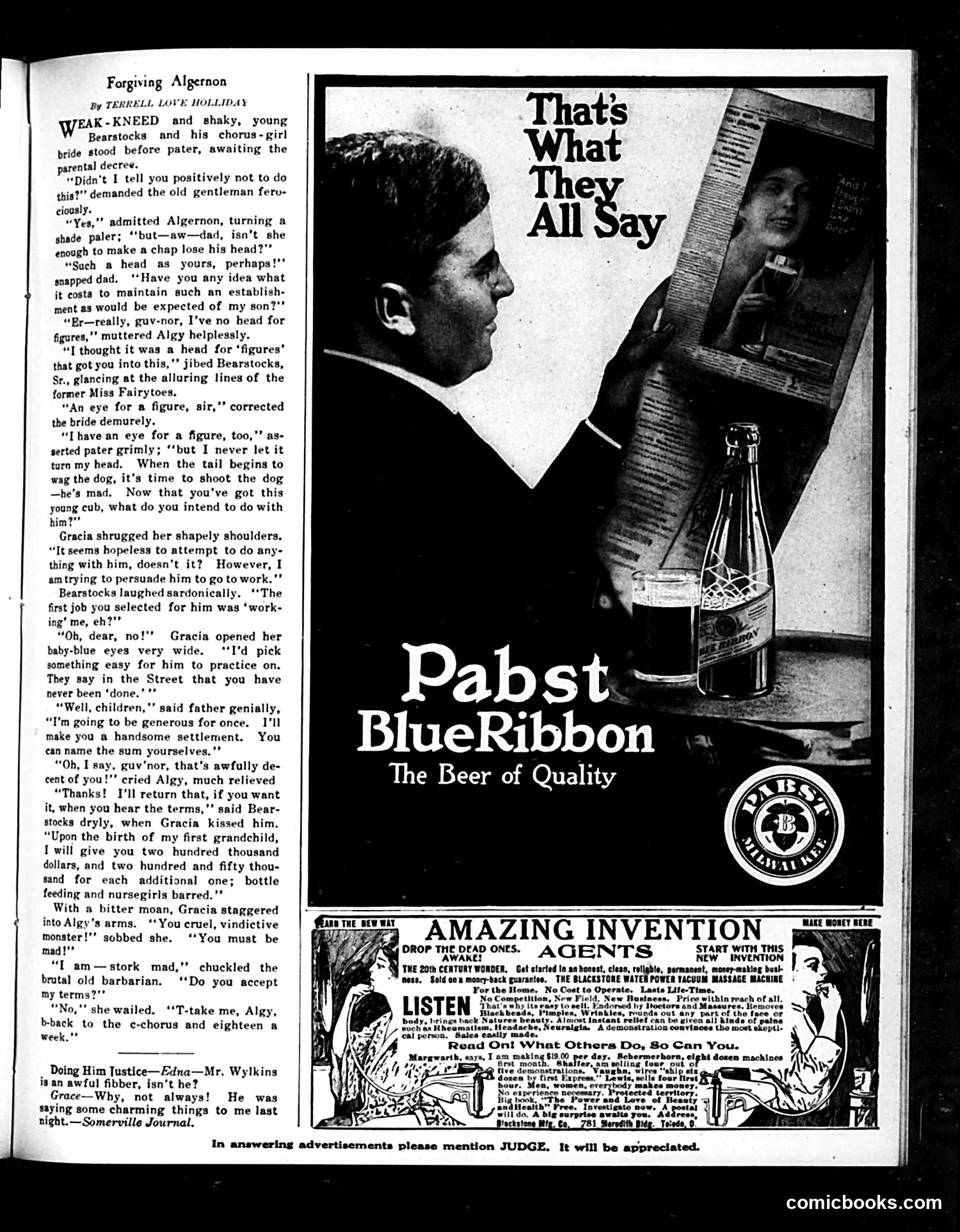
This page contains two unrelated pieces: a short satirical story and period advertising. **"Forgiving Algernon"** is a comedy about class and marriage. A wealthy father confronts his son for marrying a chorus girl (a performer of low social status). The father's servant/friend Bearstocks mocks the bride, Gracia, who cunningly charms the father into offering a generous settlement—but with a cruel twist: he'll pay handsomely for grandchildren *only* if she stops working and avoids nursemaids, essentially trapping her in domesticity. The joke is on the groom's bride: her gold-digging scheme backfires into a life sentence of motherhood. **The advertisement** promotes Pabst Blue Ribbon beer as "The Beer of Quality," a standard early-20th-century marketing claim. The page reflects period anxieties about social mobility, working women, and marriage mercenary motives—all filtered through humor that modern readers would find dated and somewhat misogynistic.
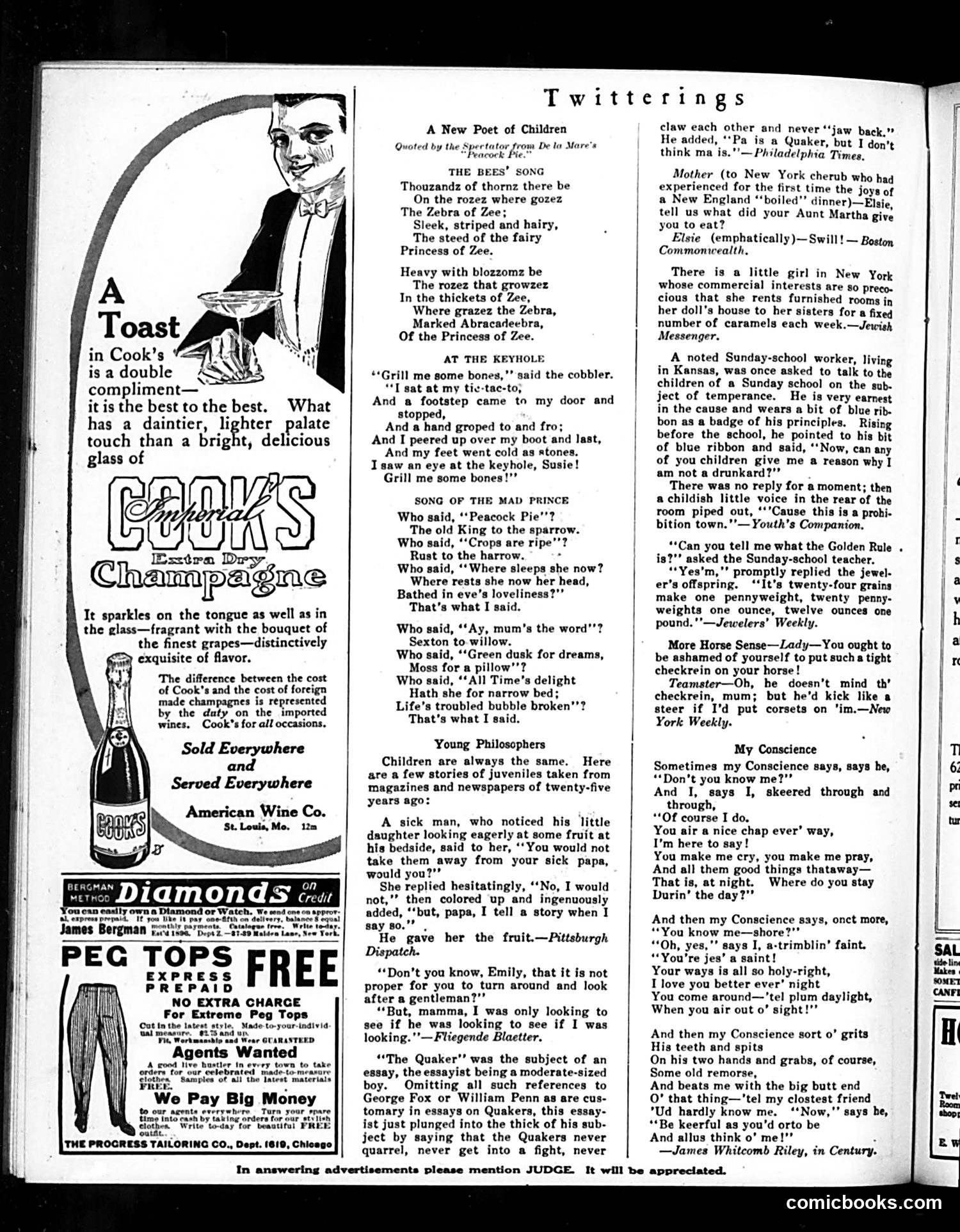
This page is primarily **literary content, not political satire**. The main feature, "Twitterings: A New Poet of Children," presents whimsical children's poetry attributed to or quoted from De la Mare's work—pieces like "The Bees' Song" and "Song of the Mad Prince" with their playful, deliberately affected spellings ("rozez," "gozez," "blozzomz"). Below this are anecdotes labeled "Young Philosophers"—humorous stories about children's innocent logic and honesty, drawn from magazines and newspapers. These illustrate how children observe the world literally and unselfconsciously. The surrounding advertisements (Cook's Champagne, "Peg Tops" tailoring, Progress Tailoring Co.) are standard period commercial content. **The satirical element is subtle**: the page gently mocks both affected literary pretension in children's verse and adults' sentimental fascination with children's "wisdom"—a common theme in early 20th-century magazines.
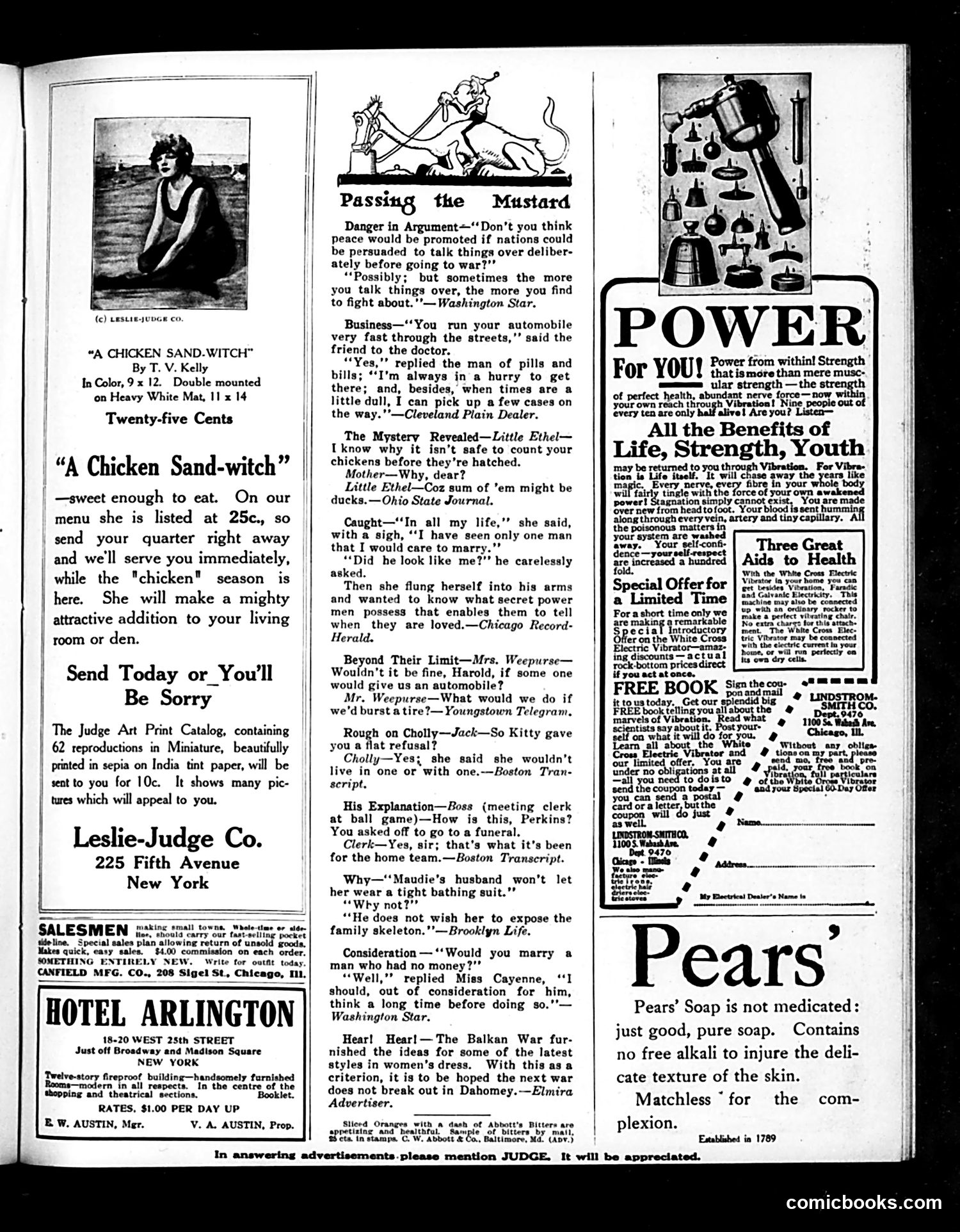
This page is primarily **advertisements and humorous anecdotes** rather than political cartoons. The main illustrated item is "A Chicken Sand-Witch" by T.V. Kelly—a playful art print (25¢) depicting an attractive woman as a "sandwich," advertised for purchase. The title is a visual pun combining "chicken" with the woman's image. The "Passing the Mustard" section contains brief jokes on various topics: a sardonic quip about nations talking before war (from the Washington Star), a doctor making money from traffic accidents, a child's logic about chickens and ducks, romantic misunderstandings, and references to automobiles and bathing suits. The final anecdote about the Balkan War influencing women's fashion satirizes how fashion borrows from current events—humorously hoping future wars won't occur in "Dahomey," implying that region's fashion would be undesirable. **Context**: This reflects early-20th-century American humor sensibilities—light social commentary, gender dynamics, and contemporary references (automobiles, the Balkan War).
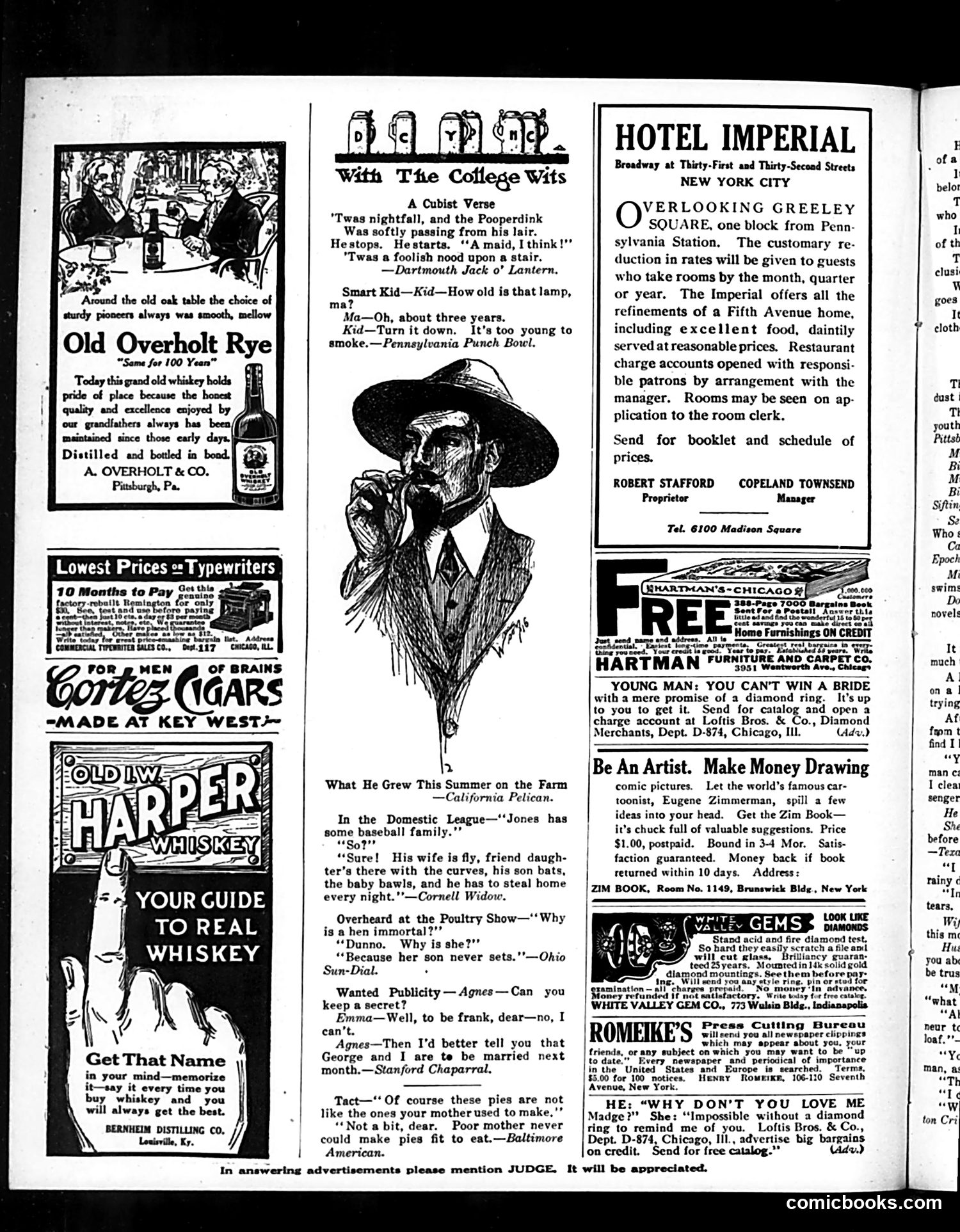
This is primarily an **advertising page** from Judge magazine, with minimal satirical content. The page features multiple product advertisements (whiskey, typewriters, cigars, hotel, diamonds, furniture) interspersed with brief humorous college jokes and quips. The only visual cartoon shows a **rural farmer** (likely from a California agricultural college publication, based on the caption "California Pelican"). The joke appears to reference what he grew that summer—though the specific point is unclear from the text provided. The "college wits" humor section includes light wordplay: a cubist verse parody, jokes about a young child misunderstanding a lamp's age, baseball family puns, and a play on "hen" and "son/sun" (immortality pun). The page reflects **early 20th-century consumer culture**, with heavy emphasis on luxury goods (whiskey marketed as traditional quality, diamonds for courtship, upscale hotel accommodations). Most content serves commercial rather than satirical purposes.
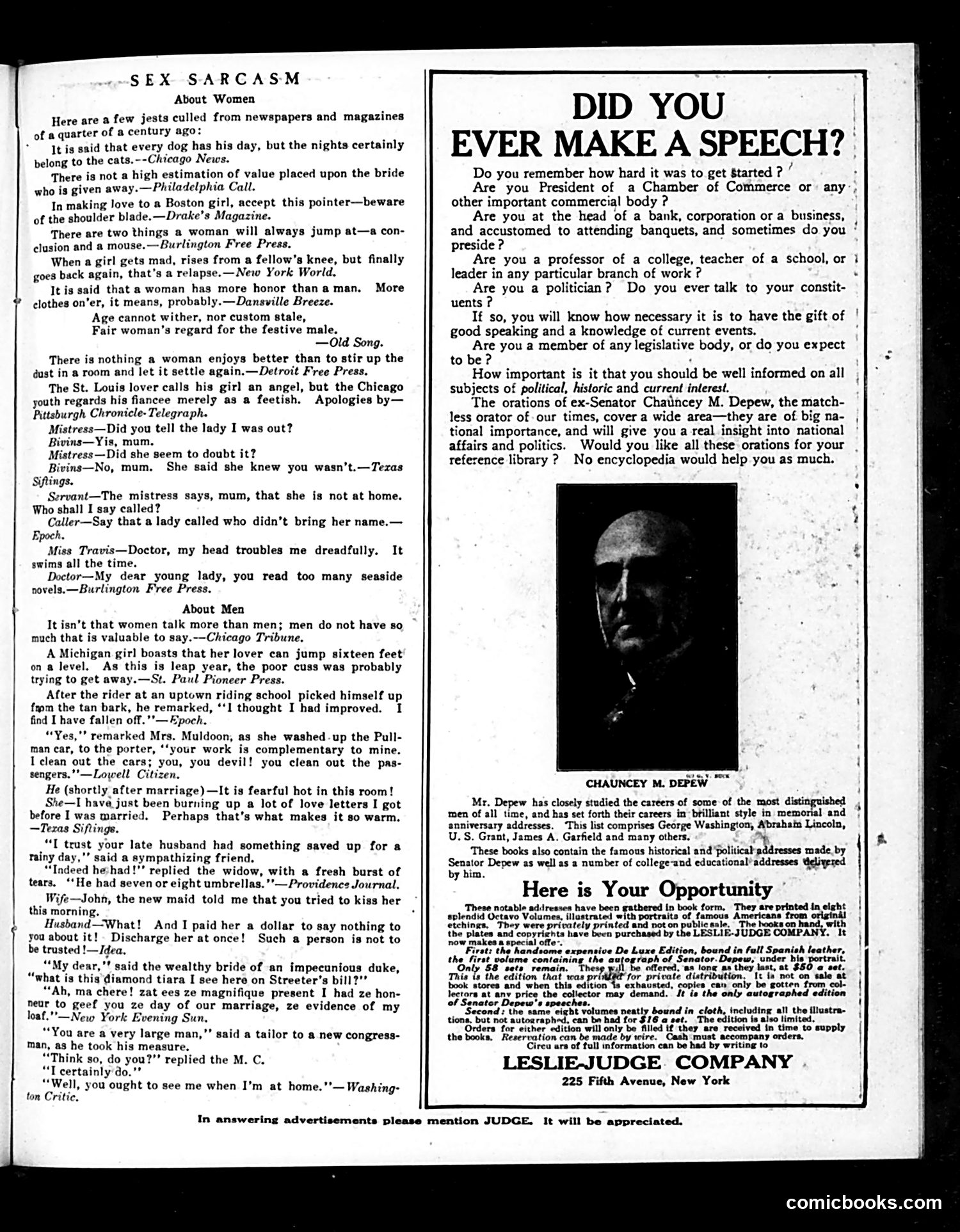
This page from *Judge* magazine contains vintage sex-based humor and satire, primarily through short jokes collected from early 20th-century newspapers. The content reflects period attitudes toward gender relations through crude stereotypes. The "Sex Sarcasm" section presents jests mocking women as chatty, vain, domestic-focused, and romantically manipulative, while jokes about men ridicule them as either hen-pecked husbands or commitment-averse. Examples include quips about women enjoying housecleaning and gossip, and men trying to escape romantic situations. The right side advertises Senator Chauncey M. Depew's oratorical works—a reference collection for public speakers. The advertisement suggests these historical political addresses provide insight into national affairs, appealing to businessmen and politicians who might need public speaking guidance. The humor is entirely dependent on gender stereotypes now considered offensive. The page exemplifies how mainstream publications once normalized such stereotyping as entertainment.
This is a Velvet tobacco advertisement rather than political satire. The page shows a darkly lit photograph of a man smoking a pipe, with marketing copy comparing a smoker's attachment to his pipe with a musician's cherished instrument. The ad emphasizes the tobacco's smoothness and quality. The pitch appeals to masculine sentiment and product loyalty—suggesting Velvet tobacco creates such a pleasurable, consistent experience that users develop deep emotional bonds with it. The pricing information at bottom advertises 10¢ tins in handy 5¢ bags or one-pound glass humidor jars. This appears to be early 20th-century advertising, when such tobacco marketing was common in magazines like Judge without health warnings.