
Judge, 1913-09-27 · page 16 of 24
Judge — September 27, 1913 — page 16: what you’re looking at
What you’re looking at
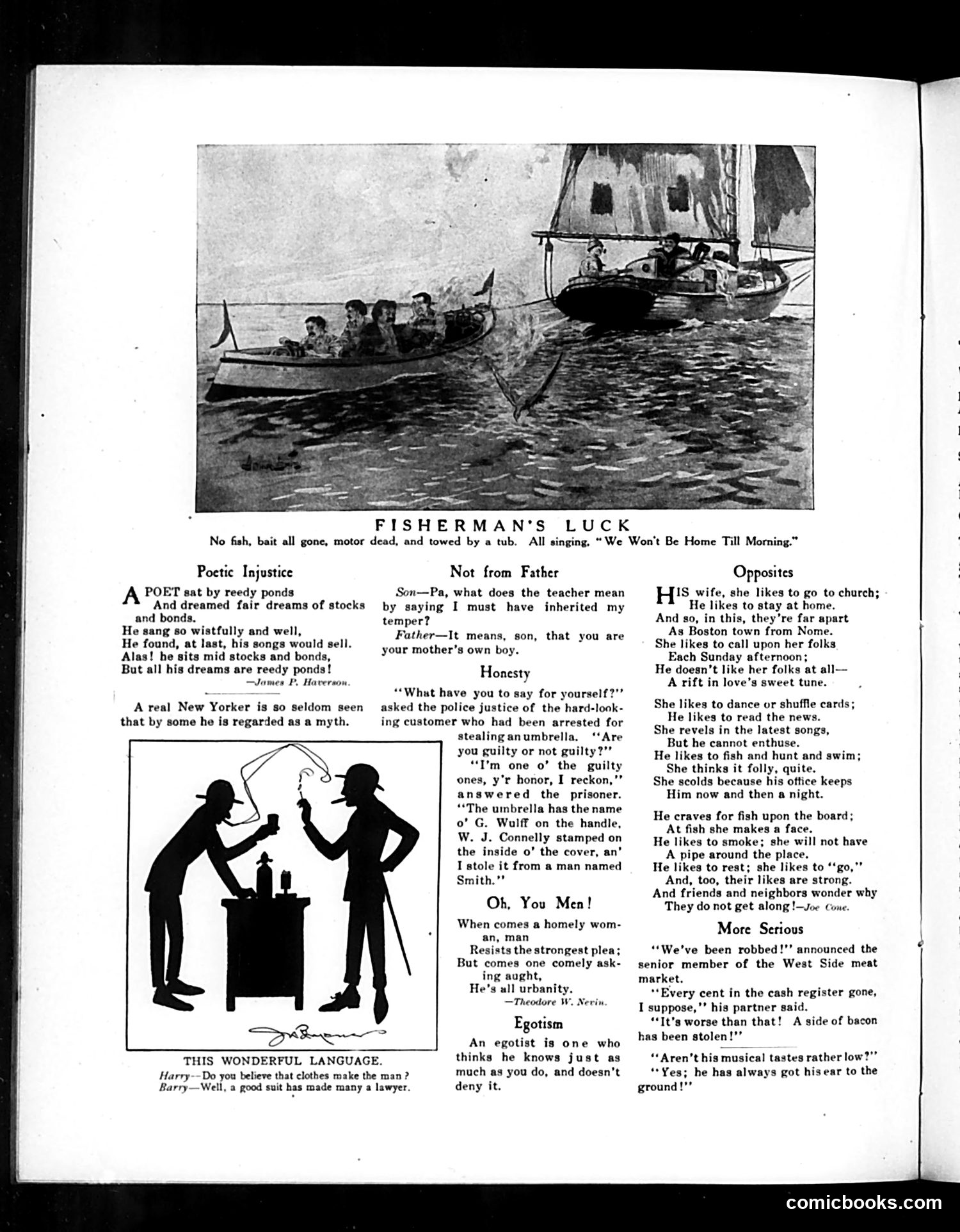
This page contains several short humorous pieces typical of early 20th-century American satire: **"Poetic Injustice"** satirizes the romantic poet who dreams of artistic freedom but, upon achieving commercial success selling verses, finds himself trapped in the mundane world of stocks and bonds—his dreams literally replaced by the financial reality he once disdained. **"This Wonderful Language"** is a brief joke about how a "good suit" (implying appearance or deception) has helped many become lawyers, suggesting the profession's dependence on presentation over substance. **"Not from Father"** jokes that a boy's inherited temper comes from his mother, a mild jab at marital dynamics. **"Honesty"** describes an umbrella thief's refreshing candor in admitting guilt while listing the conflicting names on the stolen item—humor derived from his straightforward dishonesty. Other short pieces cover egotism, marital opposites, and workplace comedy. The page is primarily satirical humor targeting universal human behavior, professions, and relationships rather than specific political events.
📄 Transcribed text from this page (OCR, searchable)
Machine-transcribed from the original scan — historical spelling and the odd misread are preserved.
Poetic Injustice A POET sat by reedy ponds And dreamed fair dreams of stocks and bonds. He sang 80 wistfully and well, He found, at last, his songs would sell. Alas! he sits mid stocks and bonds, But all his dreams are reedy ponds! James P. Haverson A real New Yorker is so seldom seen that by some he is regarded as a myth. THIS WONDERFUL LANGUAGE. Harry-—Do you believe that clothes make the man ? Barry—Well, a good suit has made many a lawyer. No fish, bait all gone, motor dead, and towed by a tub. All singing, “We Won't Be Home Till Morning.” Not from Father Son—Pa, what does the teacher mean by saying I must have inherited my temper? Father—It means, son, that you are your mother’s own boy. Honesty “What have you to say for yourself?”” asked the police justice of the hard-look- ing customer who had been arrested for stealinganumbrella. ‘‘Are you guilty or not guilty?” “I'm one o’ the guilty ones, y’r honor, I reckon, answered the prisoner. “The umbrella has the name o’ G. Wulff on the handle, W. J. Connelly stamped on the inside o’ the cover, an’ I stole it from a man named Smith.” Oh, You Men! When comes a homely wom- an, man Resists the strongest ple: But comes one comely ask- ing aught, He's ull urbanity. —Theodore W.} Egotism An egotist is one who thinks he knows just as much as you do, and doesn’t deny it. Opposites IS wife, she likes to go to church; He likes to stay at home. And so, in this, they're far apart As Boston town from Nome. She likes to call upon her folks Each Sunday afternoon; He doesn’t like her folks at all— A rift in love’s sweet tune. She likes to dance or shuffle cards; He likes to read the news. She revels in the latest songs, But he cannot enthuse. He likes to fish and hunt and swim; She thinks it folly, quite. She scolds because his oftice keeps Him now and then a night. He craves for fish upon the board; At fish she makes a face. He likes to smoke; she will not have A pipe around the place. He likes to rest; she likes to ‘‘go,"’ And, too, their likes are strong. And friends and neighbors wonder why They do not get along !—Joe Cone. More Serious **We’ve been robbed!’’ announced the senior member of the West Side meat market. “Every cent in the cash register gone, I suppose,’ his partner said. “It’s worse than that! A side of bacon has been stolen!’" “Aren’t his musical tastes rather low?"” “Yes; he has always got hisear to the ground!’’ comicbooks.com