
Judge, 1913-09-27 · page 11 of 24
Judge — September 27, 1913 — page 11: what you’re looking at
What you’re looking at
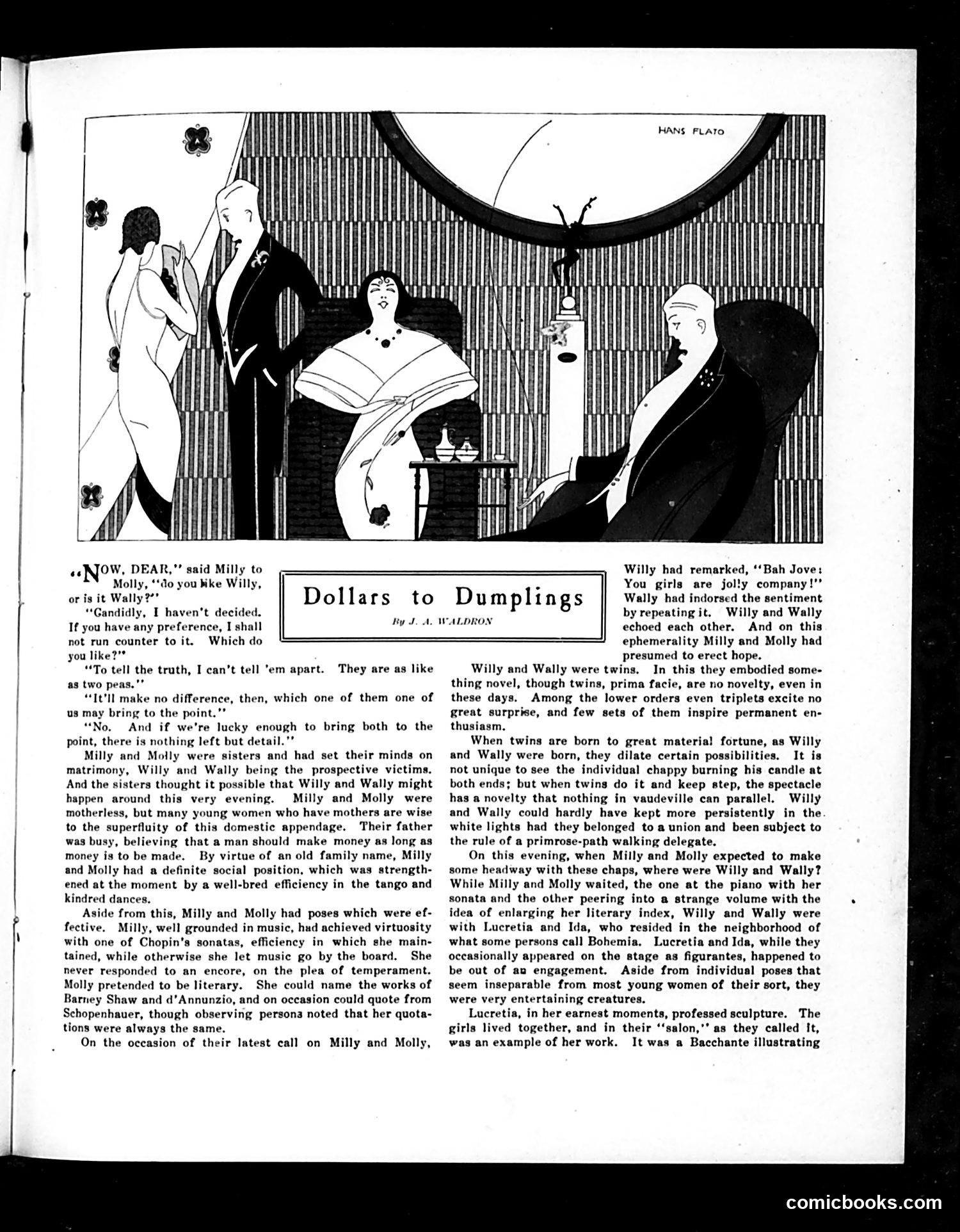
This story satirizes wealthy but shallow young women and the interchangeable men they pursue. Sisters Milly and Molly, from an affluent family, affect cultural sophistication—one poses as musical (Chopin), the other as literary (quoting Shaw and Schopenhauer)—yet they admit they cannot tell apart their identical twin suitors, Willy and Wally, and consider either equally suitable for marriage. The joke centers on their mercenary superficiality: despite their "well-bred efficiency" and refined pretenses, they're simply hunting husbands. Meanwhile, the indistinguishable twins abandon them for Lucretia and Ida—bohemian actresses from the artistic neighborhood, who are more genuinely entertaining despite (or because of) lacking pretense. The title suggests the wealthy sisters' "dollars" cannot secure the twins' devotion, resulting instead in emotional "dumplings"—a deflating comeuppance. The satire mocks both the girls' performative culture and the era's marriage-market dynamics among the upper classes.
📄 Transcribed text from this page (OCR, searchable)
Machine-transcribed from the original scan — historical spelling and the odd misread are preserved.
«es NJOW, DEAR,” said Milly to Molly, ‘do you bike Willy, or is it Wally”? “Gandidly, I haven't decided. If you have any preference, I shall not run counter to it. Which do you like?”* “To tell the truth, I can’t tell ’em apart. as two peas." “It'll make no difference, then, which one of them one of us may bring to the point.”” “No. And if we're lucky enough to bring both to the point, there is nothing left but detail.’" Milly and Moily were sisters and had set their minds on matrimony, Willy and Wally being the prospective victims. And the sisters thought it possible that Willy and Wally might happen around this very evening. Milly and Molly were motherless, but many young women who have mothers are wise to the superfluity of this domestic appendage. Their father was busy, believing that a man should make money as long as money is to be made. By virtue of an old family name, Milly and Molly had a definite social position, which was strength- ened at the moment by a well-bred efficiency in the tango and kindred dances. Aside from this, Milly and Molly had poses which were ef- fective. Milly, well grounded in music, hud achieved virtuosity with one of Chopin's sonatas, efficiency in which she main- tained, while otherwise she let music go by the board, She never responded to an encore, on the plea of temperament. Molly pretended to be literary. She could name the works of Barney Shaw and d’Annunzio, and on occasion could quote from Schopenhauer, though observing persona noted that her quota- tions were always the same. On the occasion of their latest call on Milly and Molly, Dollars to They are as like Ry J. A. WALDRON HANS FLATO Willy had remarked, ‘‘Bah Jove: You girls are jol!y company!"’ Wally had indorsed the sentiment by repeating it. Willy and Wally echoed each other. And on this ephemerality Milly and Molly had presumed to erect hope. Willy and Wally were twins. In this they embodied some- thing novel, though twins, prima facie, are no novelty, even in these days. Among the lower orders even triplets excite no great surprise, and few sets of them inspire permanent en- thusiasm. When twins are born to great materia! fortune, as Willy and Wally were born, they dilate certain possibilities. It is not unique to see the individual chappy burning his candle at both ends; but when twins do it and keep step, the spectacle has a novelty that nothing in vaudeville can parallel. Willy and Wally could hardly have kept more persistently in the white lights had they belonged to a union and been subject to the rule of a primrose-path walking delegate. On this evening, when Milly and Molly expected to make some headway with these chaps, where were Willy and Wally? While Milly and Molly waited, the one at the piano with her sonata and the other peering into a strange volume with the idea of enlarging her literary index, Willy and Wally were with Lucretia and Ida, who resided in the neighborhood of what some persons call Bohemia. Lucretia and Ida, while they occasionally appeared on the stage as figurantes, happened to be out of an engagement. Aside from individual poses that seem inseparable from most young women of their sort, they were very entertaining creatures. Lucretia, in her earnest moments, professed sculpture. The girls lived together, and in their ‘‘salon,’’ as they called It, was an example of her work. It was a Bacchante illustrating Dumplings comicbooks.com