
Judge, 1913-09-27 · page 20 of 24
Judge — September 27, 1913 — page 20: what you’re looking at
What you’re looking at
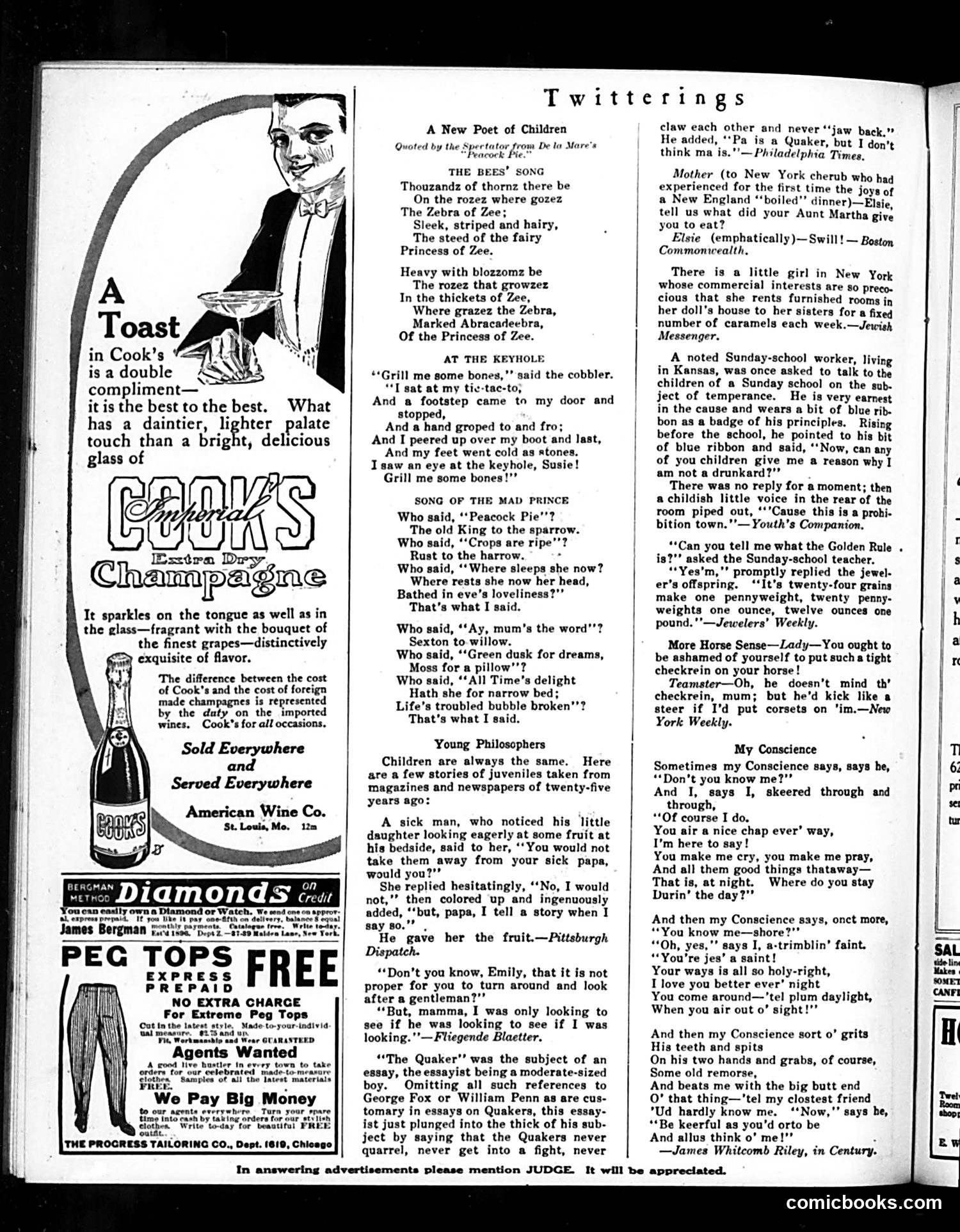
This page is primarily **literary content, not political satire**. The main feature, "Twitterings: A New Poet of Children," presents whimsical children's poetry attributed to or quoted from De la Mare's work—pieces like "The Bees' Song" and "Song of the Mad Prince" with their playful, deliberately affected spellings ("rozez," "gozez," "blozzomz"). Below this are anecdotes labeled "Young Philosophers"—humorous stories about children's innocent logic and honesty, drawn from magazines and newspapers. These illustrate how children observe the world literally and unselfconsciously. The surrounding advertisements (Cook's Champagne, "Peg Tops" tailoring, Progress Tailoring Co.) are standard period commercial content. **The satirical element is subtle**: the page gently mocks both affected literary pretension in children's verse and adults' sentimental fascination with children's "wisdom"—a common theme in early 20th-century magazines.
📄 Transcribed text from this page (OCR, searchable)
Machine-transcribed from the original scan — historical spelling and the odd misread are preserved.
isadouble A compliment— itis the best tothe best. What has a daintier, lighter palate touch than a bright, delicious glass of Ces Champagne It sparkles on the tongue as well as in the glass—fragrant with the bouquet of the finest grapes—distinctively Sy exquisite of flavor. ‘The difference between the cost of Cook's and the cost of foreign made champagnes is represented by the duty on the imported wines. Cook's for all occasions. Sold Everywhere and Served Everywhere American Wine Co. St. Louis, Mo. 12m ee t PEG TOPS FREE EXPRESS PREPAID NO EXTRA CHARCE For Extreme Peg Tops Cut in the latest style, Made-to-your-individ al measure. 6273 and un Vit, Workmanship and Wear GUARANTEED Agents Wanted A cood live hustler in every town to take onters for our celebrated. tade-to-measare ples of all the latest materials to our agents everywhere Tura your spare time {nto cash by taking orders for our st Clothes Write to-day for beautiful F! ’ outst. THE PROGRESS TAILORING CO., Dept. 1619, Chicago Twitterings A New Poet of Children Quoted by the Spectator from De la Mare'e THE BEES’ SONG Thouzandz of thornz there be On the rozez where gozez The Zebra of Zee; Sleek, striped and hairy, The steed of the fairy Princess of Zee. Heavy with blozzomz be The rozez that growzez In the thickets of Zee, Where grazez the Zebra, Marked Abracadeebra, Of the Princess of Zee. AT THE KEYHOLE ‘Grill me some bones,’’ said the cobbler. “T sat at my tic-tac-to; And a footstep came to my door and stopped, And a hand groped to and fro; And I peered up over my boot and last, And my feet went cold as stones. I saw an eye at the keyhole, Susie! Grill me some bones!"" SONG OF THE MAD PRINCE Who said, ‘Peacock Pie’'? The old King to the sparrow. Who said, ‘‘Crops are ripe’’? Rust to the harrow. ° Who said, ‘‘Where sleeps she now? Where rests she now her head, Bathed in eve’s loveliness?"’ That's what I said. Who said, ‘‘Ay, mum’s the word''? Sexton to-willow. Who said, ‘‘Green dusk for dreams, Moss for a pillow’’? Who said, ‘‘All Time's delight Hath she for narrow bed; Life’s troubled bubble broken’’? That's what I said. Young Philosophers Children are always the same. Here are a few stories of juveniles taken from magazines and newspapers of twenty-five years ago: A sick man, who noticed his little daughter looking eagerly at some fruit at his bedside, said to her, ‘‘You would not take them away from your sick papa, would you?” She replied hesitatingly, ‘‘No, I would not,’? then colored up and ingenuously added, ‘‘but, papa, I tell a story when I say 80."" , He gave her the fruit.—Pittsburgh Dispatch. “Don’t you know, Emily, that it is not proper for you to turn around and look after a gentleman?” “But, mamma, I was only looking to see if he was looking to see if I was looking."’"—Fliegende Blaetter. “The Quaker’’ was the subject of an essay, the essayist being a moderate-sized boy. Omitting all such references to George Fox or William Penn as are cus- tomary in essays on Quakers, this essay- ist just plunged into the thick of his sub- ject by saying that the Quakers never quarrel, never get into a fight, never claw each other and never “jaw ” He added, “Pa is a Quaker, but rane think ma is.""—Philadelphia Times, Mother (to New York cherub who had experienced for the first time the joys of a New England “‘boiled’’ dinner)—Elsie, tell us what did your Aunt Martha give you to eat? Elsie (emphatically )—Swill! — Boston Commonwealth, There is a little girl in New York whose commercial interests are so Preco- cious that she rents furnished rooms in her doll’s house to her sisters for a fixed number of caramels each week.—Jewish Messenger. A noted Sunday-school worker, living in Kansas, was once asked to talk to the children of a Sunday school on the sub- ject of temperance. He is very earnest in the cause and wears a bit of blue rib. bon as a badge of his principles. Rising before the school, he pointed to his bit of blue ribbon and said, ‘*Now, can any of you children give me a reason why I am not a drunkard?” There was no reply for a moment; then achildish little voice in the rear of the room piped out, ‘‘’Cause this is a prohi- bition town.’’— Youth's Companion, **Can you tell me what the Golden Rule . is?"’ asked the Sunday-school teacher. “*Yes’m,"’ promptly replied the jewel- er’s offspring. ‘‘It’s twenty-four grains make one pennyweight, twenty penny- weights one ounce, twelve ounces one pound. ’’—Jewelers’ Weekly. More Horse Sense—Lady—You ought to be ashamed of yourself to put sucha tight checkrein on your horse! Teamster—Oh, he doesn't mind th’ checkrein, mum; but he’d kick like a steer if I'd put corsets on 'im.—New York Weekly. My Conscience Sometimes my Conscience says, says he, “Don’t you know me?” And I, says I, skeered through and through, “Of course I do. You air a nice chap ever’ way, I'm here to say! You make me cry, you make me pray, And all them good things thataway— That is, at night. Where do you stay Durin’ the day?”’ And then my Conscience says, onct more, “*You know me—shore?”’ “Oh, yes,” says I, a-trimblin’ faint. “You're jes’ a saint! Your ways is all so holy-right, I love you better ever’ night You come around—’tel plum daylight, When you air out 0’ sight!"" And then my Conscience sort o’ grits His teeth and spits On his two hands and grabs, of course, Some old remorse, And beats me with the big butt end O’ that thing—'tel my clostest friend 'Ud hardly know me. ‘*Now,'’ says he, **Be keerful as you'd orto be And allus think o’ me!"’ : —James Whitcomb Riley, in Century. In answering advertisements please mention JUDGE. It will be appreciated. comicbooks.com