
Judge, 1913-09-27 · page 12 of 24
Judge — September 27, 1913 — page 12: what you’re looking at
What you’re looking at
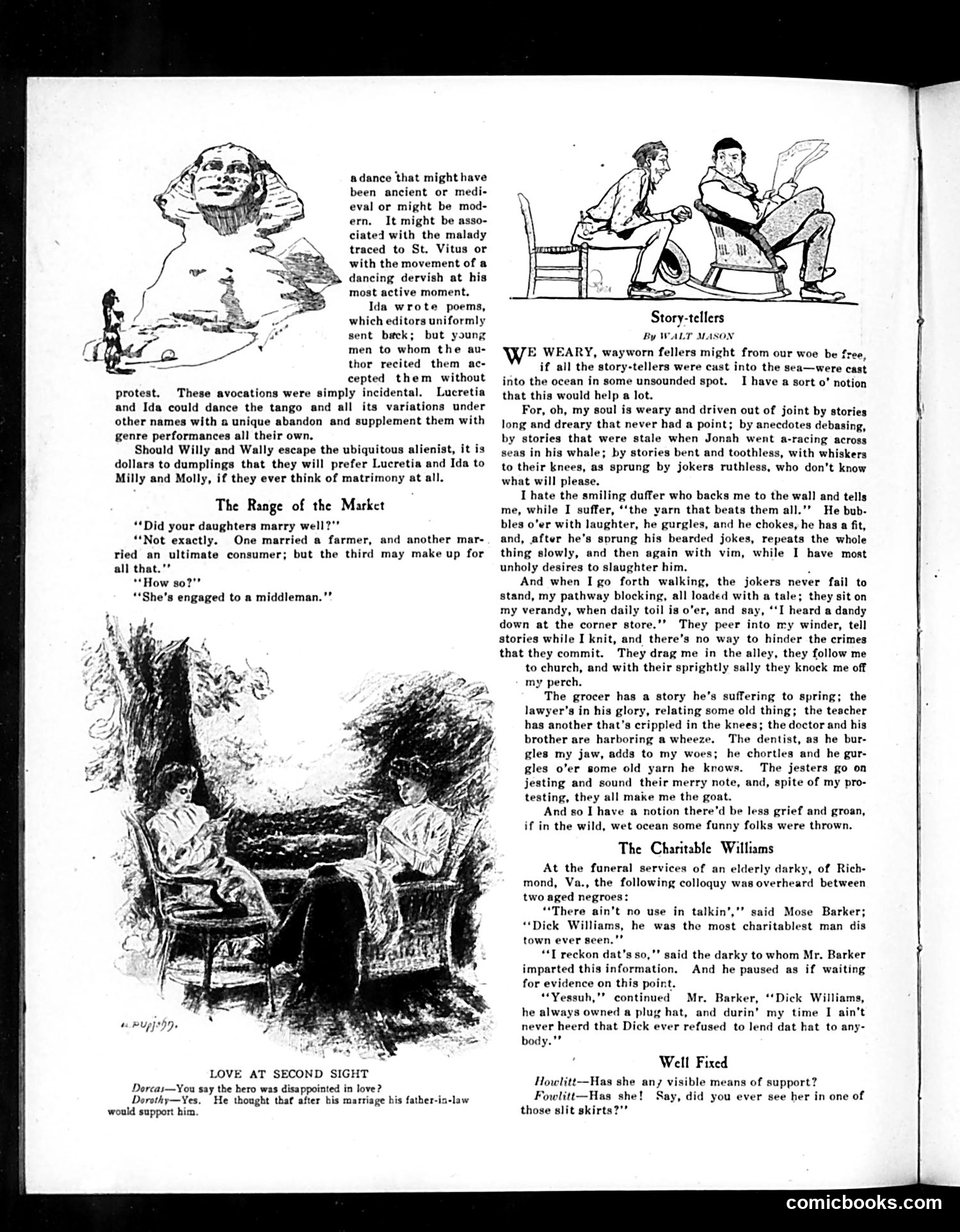
This page contains three distinct satirical pieces: **"The Range of the Market"** mocks class aspiration through a dialogue about daughters' marriages. The joke hinges on a middleman (a commercial intermediary) being positioned as a desirable match—satirizing how mercenary concerns and economic status determine marriage eligibility among the socially ambitious. **"Story-tellers"** by Walt Mason is a humorous poem lamenting chronic storytellers who inflict tedious, pointless anecdotes on captive audiences everywhere—at work, church, and home. It's social satire about the universal annoyance of people who won't stop talking. **"The Charitable Williams"** presents a racial dialogue (using period dialect) where two Black men discuss a deceased man's charity. The humor appears to rest on the contradiction between claims of generosity and the modest evidence (owning a plug hat)—though the incomplete text makes the punchline unclear. The illustrations complement these pieces with genre scenes of domestic life and social interaction typical of Judge's satirical style.
📄 Transcribed text from this page (OCR, searchable)
Machine-transcribed from the original scan — historical spelling and the odd misread are preserved.
adance that might have been ancient or medi- eval or might be mod- ern. It might be asso- ciated with the malady traced to St. Vitus or with the movement of a dancing dervish at his most active moment. Ida wrote poems, which editors uniformly sent back; but young men to whom the au- thor recited them ac- cepted them without protest. These avocations were simply incidental. Lucretia and Ida could dance the tango and all its variations under other names with a unique abandon and supplement them with genre performances all their own. Should Willy and Wally escape the ubiquitous alienist, it is dollars to dumplings that they will prefer Lucretia and Ida to Milly and Molly, if they ever think of matrimony at all. The Range of the Market “Did your daughters marry well?" “Not exactly. One married a farmer, and another mar- ried an ultimate consumer; but the third may make up for all that.’” **How so?” “‘She’s engaged to a middleman.’ LOVE AT SECOND SIGHT Dorcas—You say the hero was disappointed in love? Dorothy—Yes, He thought that after bis marriage his father-i would support him Story-tellers By WALT MASON W = WEARY, wayworn fellers might from our woe be free, if all the story-tellers were cust into the sea—were cast into the ocean in some unsounded spot. I have a sort o’ notion that this would help a lot. For, oh, my soul is weary and driven out of joint by stories long and dreary that never had a point; by anecdotes debasing, by stories that were stale when Jonah went a-racing across seas in his whale; by stories bent and toothless, with whiskers to their knees, as sprung by jokers ruthless, who don’t know what will please, I hate the smiling duffer who backs me to the wall and tells me, while I suffer, ‘‘the yarn that beats them all.’’ He bub- bles o’er with laughter, he gurgles, and he chokes, he has a fit, and, after he’s sprung his bearded jokes, repeats the whole thing slowly, and then again with vim, while I have most unholy desires to slaughter him. . And when I go forth walking, the jokers never fail to stand, my pathway blocking, all loaded with a tale; they sit on my verandy, when daily toil is o’er, and say, ‘‘I heard a dandy down at the corner store.’’ They peer into my winder, tell stories while I knit, and there’s no way to hinder the crimes that they commit. They drag me in the alley, they follow me to church, and with their sprightly sally they knock me off my perch. The grocer has a story he’s suffering to spring; the lawyer's in his glory, relating some old thing; the teacher has another that’s crippled in the knees; the doctor and his brother are harboring a wheeze. The dentist, as he bur- gles my jaw, adds to my woes; he chortles and he gur- gles o’er some old yarn he knows. The jesters go on jesting and sound their merry note, and, spite of my pro- testing, they all make me the goat. And so I have a notion there'd be less grief and groan, if in the wild, wet ocean some funny folks were thrown. The Charitable Williams At the funeral services of an elderly darky, of Rich- mond, Va., the following colloquy was overheard between two aged negroes: “There ain't no use in talkin’,"? said Mose Barker; “Dick Williams, he was the most charitablest man dis town ever seen, “LT reckon dat's so," said the darky to whom Mr. Barker imparted this information. And he paused as if waiting for evidence on this point. “Yessuh,"” continued Mr. Barker, ‘Dick Williams, he always owned a plug hat, and durin’ my time I ain’t never heerd that Dick ever refused to lend dat hat to any- body."” Well Fixed Howlitt—Has she any visible means of support? Fowlitt—Has she! Say, did you ever see ber in one of those slit skirts?"’ comicbooks.com