
Judge, 1913-09-27 · page 15 of 24
Judge — September 27, 1913 — page 15: what you’re looking at
What you’re looking at
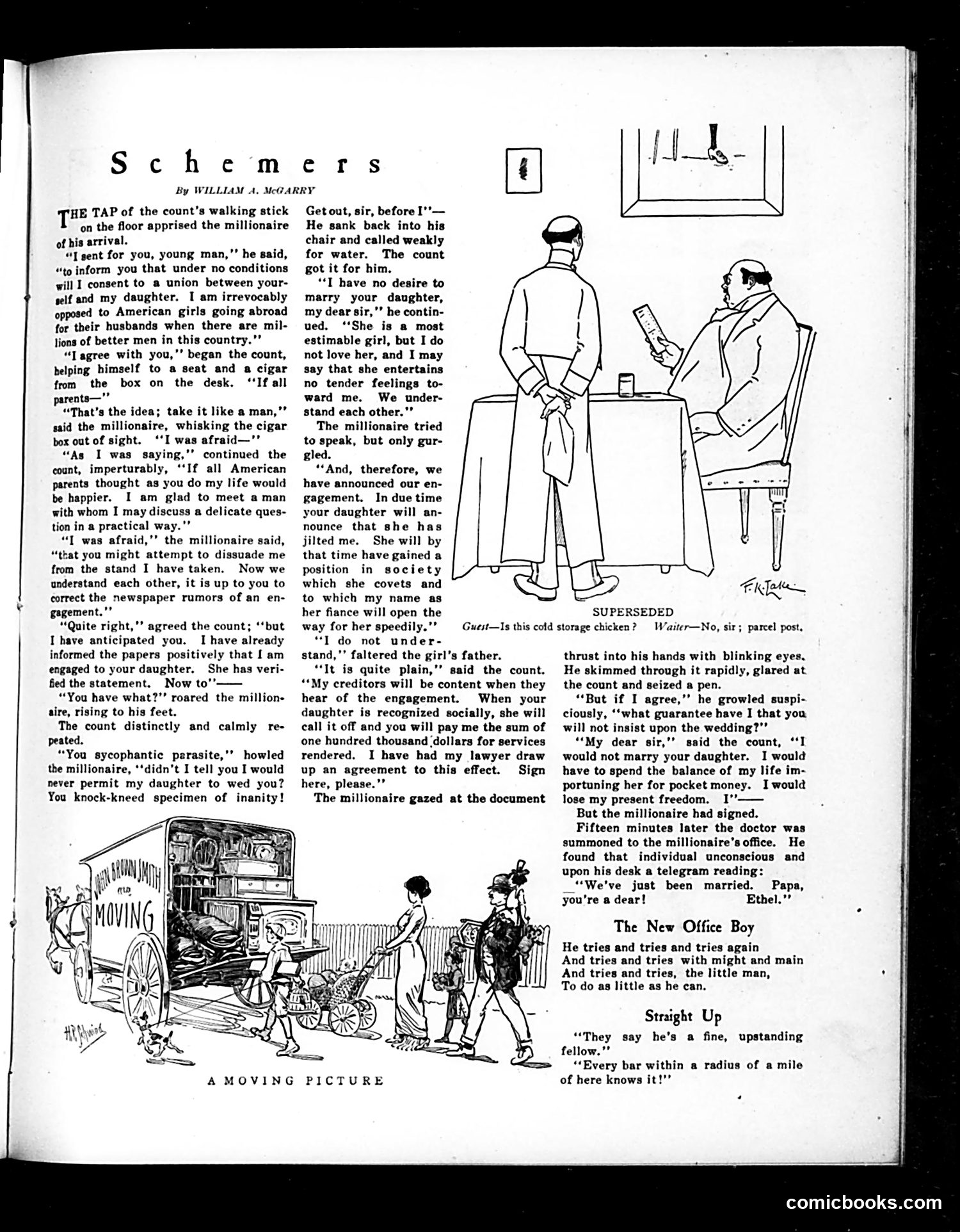
This story satirizes the transactional nature of turn-of-the-century courtship among the wealthy. A European count schemes to marry an American millionaire's daughter not for love, but to gain social credibility with his creditors. He proposes a cynical arrangement: announce the engagement (impressing creditors), allow the daughter to gain social position, then have her jilt him—for which the father pays $100,000. The satire targets both the opportunistic European fortune-hunter (a stock figure of the era) and the American millionaire's materialistic worldview, where even romance becomes a financial transaction. The joke's twist: the daughter elopes anyway, leaving the father apoplectic. The cartoon mocks how wealth-obsessed elites treat marriage as business rather than love—and how their schemes backfire when genuine human emotion intervenes.
📄 Transcribed text from this page (OCR, searchable)
Machine-transcribed from the original scan — historical spelling and the odd misread are preserved.
Schem By WILLIAM A, Mc@ARRY TH TAP of the count’s walking stick on the floor apprised the millionaire of his arrival. “J sent for you, young man,”’ he said, “to inform you that under no conditions will I consent to a union between your- self and my daughter. I am irrevocably opposed to American girls going abroad for their husbands when there are mil- lions of better men in this country."’ “L agree with you,’’ began the count, helping himself to a seat and a cigar from the box on the desk. ‘‘If all “That's the idea; take it like a man,”” said the millionaire, whisking the cigar box out of sight. ‘‘I was afraid—’’ “As I was saying,’’ continued the count, imperturably, ‘‘If all American parents thought as you do my life would be happier. I am glad to meet aman with whom I may discuss a delicate ques- tion in a practical way.’’ “I was afraid,’’ the millionaire said, “that you might attempt to dissuade me from the stand I have taken. Now we understand each other, it is up to you to correct the newspaper rumors of an en- gagement.’” “Quite right,” agreed the count; ‘‘but I have anticipated you. I have already informed the papers positively that [ am engaged to your daughter. She has veri- fied the statement. Now to’’. “You have what?’’ roared the million- aire, rising to his feet. The count distinctly and calmly re- peated. “You sycophantic parasite,’’ howled the millionaire, ‘‘didn't I tell you I would never permit my daughter to wed you? You knock-kneed specimen of inanity! A MOVING PICTURE ers Get out, sir, before I'’"— He sank back into his chair and called weakly for water. The count got it for him. “I have no desire to marry your daughter, my dear sir,’’ he contin- ued. ‘‘She is a most estimable girl, but I do not love her, and I may say that she entertains no tender feelings to- ward me. We under- stand each other."” The millionaire tried to speak, but only gur- gled. “And, therefore, we have announced our en- gagement. In due time your daughter will an- nounce that she has jilted me. She will by that time have gained a position in society which she covets and to which my name as her fiance will open the way for her speedily.”* “I do not under- stand,’’ faltered the girl’s father. “It is quite plain,’’ said the count. “*My creditors will be content when they hear of the engagement. When your daughter is recognized socially, she will call it off and you will pay me the sum of one hundred thousand ‘dollars for services rendered. I have had my lawyer draw up an agreement to this effect. Sign here, please.”” The millionaire gazed at the document SUPERSEDED Guest—Is this cold storage chicken? Waiter—No, sir; parcel post, thrust into his hands with blinking eyes. He skimmed through it rapidly, glared at the count and seized a pen. “But if I agree,’’ he growled suspi- ciously, ‘‘what guarantee have I that you will not insist upon the wedding?”’ “(My dear sir,’’ said the count, ‘‘I would not marry your daughter. I would have to spend the balance of my life im- portuning her for pocket money. I would lose my present freedom. I’’. But the millionaire had signed. Fifteen minutes later the doctor was summoned to the millionaire’s office. He found that individual unconscious and upon his desk a telegram reading: _‘*We've just been married. Papa, you’re a dear! Ethel.’” The New Office Boy He tries and tries and tries again And tries and tries with might and main And tries and tries, the little man, ’ To do as little as he can. Straight Up “They say he’s a fine, fellow.”’ “Every bar within a radius of a mile of here knows it!’’ upstanding comicbooks.com