
Judge, 1913-09-27 · page 10 of 24
Judge — September 27, 1913 — page 10: what you’re looking at
What you’re looking at
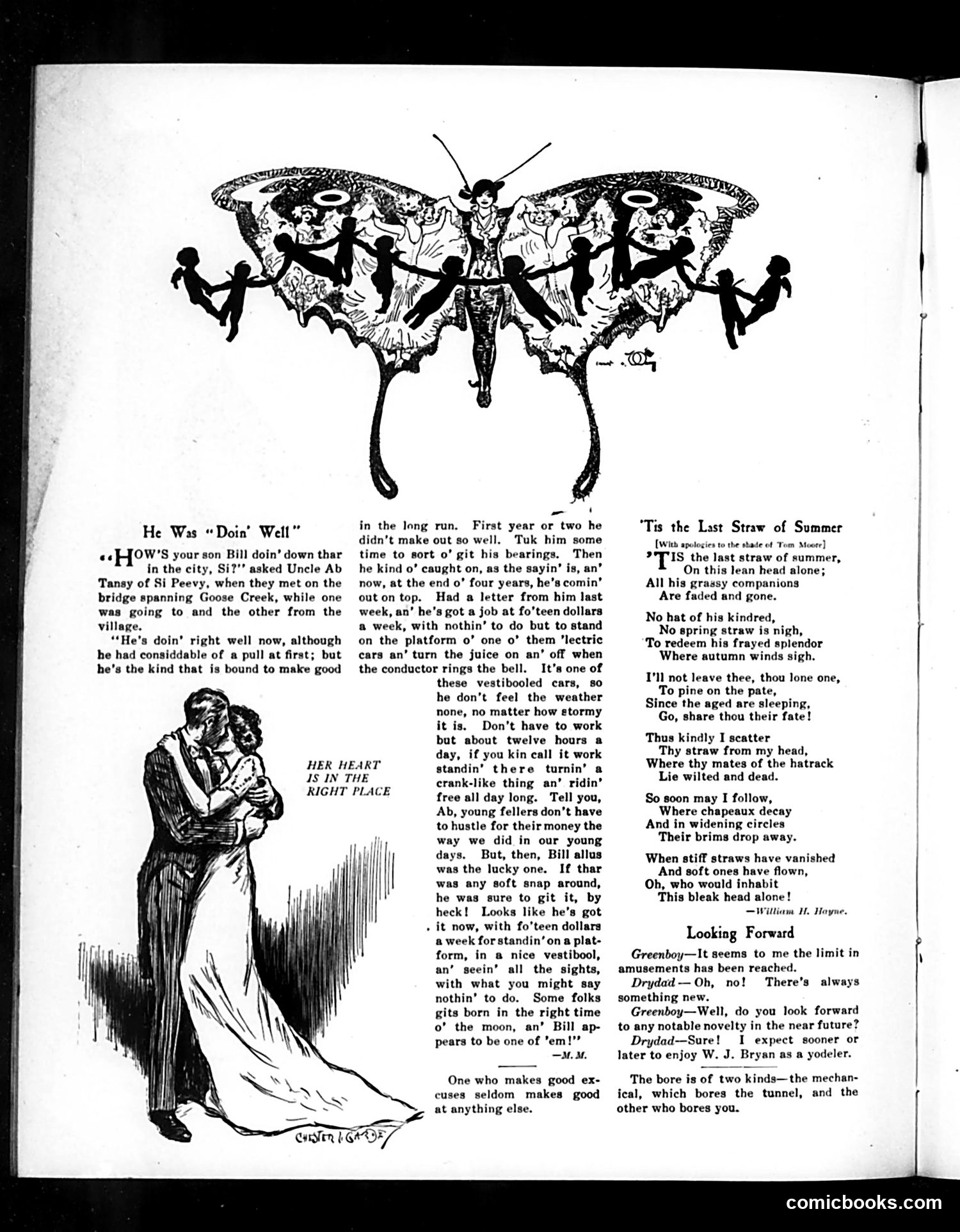
This page contains three satirical pieces from *Judge* magazine: **"He Was 'Doin' Well'"** (left): A rural dialect story mocking class aspirations. Si Peevy brags that his son Bill, working as a streetcar operator in the city, is "doing well" earning $14/week for minimal labor in a heated car. The satire targets both working-class delusion about "easy money" jobs and the sentimentality about rural virtue versus city work. The illustration shows a working-class couple, suggesting the humor lies in their pride over what was actually low-wage, unskilled labor. **"'Tis the Last Straw of Summer"** (right): A sentimental parody of romantic poetry, treating a worn straw hat as a dying companion. It mocks overwrought Romantic-era verse (referencing Tom Moore, an Irish Romantic poet). **"Looking Forward"** (bottom): A brief dialogue joke where Drydad predicts future entertainment will include "W. J. Bryan as a yodeler"—likely satirizing William Jennings Bryan, the three-time presidential candidate, as an unlikely performer, suggesting he was considered ridiculous or exhausting.
📄 Transcribed text from this page (OCR, searchable)
Machine-transcribed from the original scan — historical spelling and the odd misread are preserved.
He Was “Doin’ Well” ‘ «How's your son Bill doin’ down thar in the city, Si?’’ asked Uncle Ab Tansy of Si Peevy, when they met on the bridge spanning Goose Creek, while one was going to and the other from the village. “He's doin’ right well now, although he had considdable of a pull at first; but he’s the kind that is bound to make good HER HEART IS IN THE RIGHT PLACE in the long run. First year or two he didn’t make out so well. Tuk him some time to sort o’ git his bearings. Then he kind 0’ caught on, as the sayin’ is, an’ now, at the end o’ four years, he’s comin’ outon top. Had a letter from him last week, an’ he’s got a job at fo’teen dollars a week, with nothin’ to do but to stand on the platform o’ one o’ them ‘lectric cars an’ turn the juice on an’ off when the conductor rings the bell. It’s one of these vestibooled cars, 80 he don’t feel the weather none, no matter how etormy it is. Don’t have to work but about twelve hours a day, if you kin call it work din’ there turnin’ a erank-like thing an’ ridin’ free all day long. Tell you, Ab, young fellers don’t have to hustle for their money the way we did in our young days. But, then, Bill allus was the lucky one. If thar was any soft snap around, he was sure to git it, by heck! Looks like he’s got it now, with fo’teen dollars a week forstandin’on a plat- form, in a nice vestibool, an’ seein’ all the sights, with what you might say nothin’ to do. Some folks gits born in the right time o’ the moon, an’ Bill ap- pears to be one of 'em!"” —M. M. One who makes good ex- cuses seldom makes good at anything else. = 'y I “Tis the Last Straw of Summer [Wht apolocies to the shade of Tom Moore) ?TIs the last straw of summer, On this lean head alone; All his grassy companions Are faded and gone. No hat of his kindred, No spring straw is nigh, To redeem his frayed splendor Where autumn winds sigh. I'll not leave thee, thou lone one, To pine on the pate, Since the aged are sleeping, Go, share thou their fate! Thus kindly I scatter Thy straw from my head, Where thy mates of the hatrack Lie wilted and dead. So soon may I follow, Where chapeaux decay And in widening circles Their brims drop away. When stiff straws have vanished And soft ones have flown, Oh, who would inhabit This bleak head alone! William H, Hayne. Looking Forward Greenboy—It seems to me the limit in amusements has been reached. Drydad— Oh, no! There’s always something new. Greenboy—Well, do you look forward to any notable novelty in the near future? Drydad—Sure! I expect sooner or later to enjoy W. J. Bryan as a yodeler. The bore is of two kinds—the mechan- ical, which bores the tunnel, and the other who bores you. comicbooks.com