
A complete issue · 24 pages · 1913
Judge — May 17, 1913
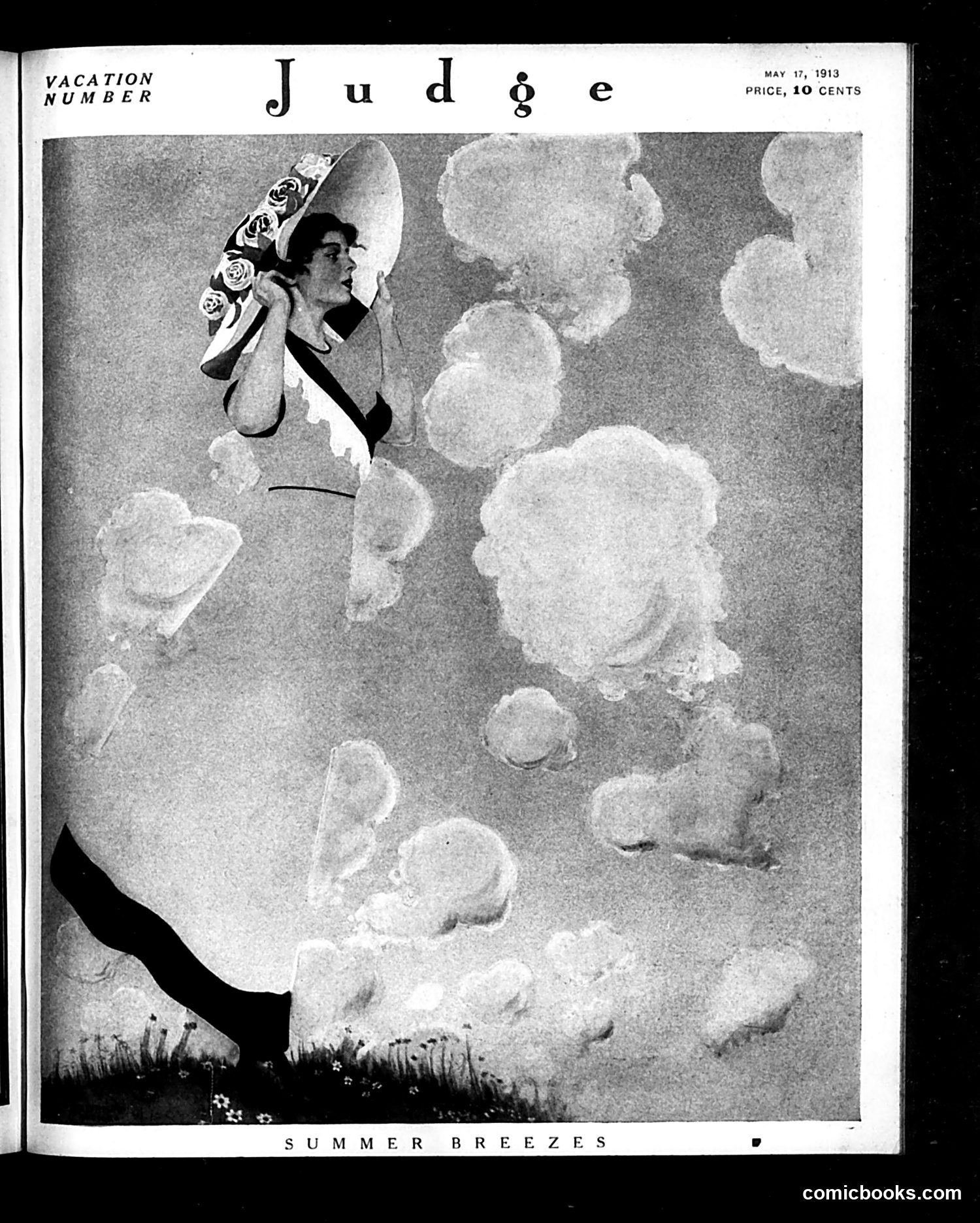
This illustration depicts a whimsical fantasy where a woman in an enormous, billowing white dress and decorative hat floats upward, carried aloft by giant clouds. The caption "Summer Breezes" plays on the literal effect of wind lifting her voluminous skirts—a visual gag about the impracticality of women's fashion of the era. The satire likely mocks both the absurdly exaggerated silhouettes of 1913 women's clothing and the vulnerability such fashions created in public settings. The image suggests that the fashionable woman, weighed down by elaborate hats and massive skirts, becomes almost comically uncontrollable when exposed to natural forces—poking fun at the tension between genteel femininity and physical reality.
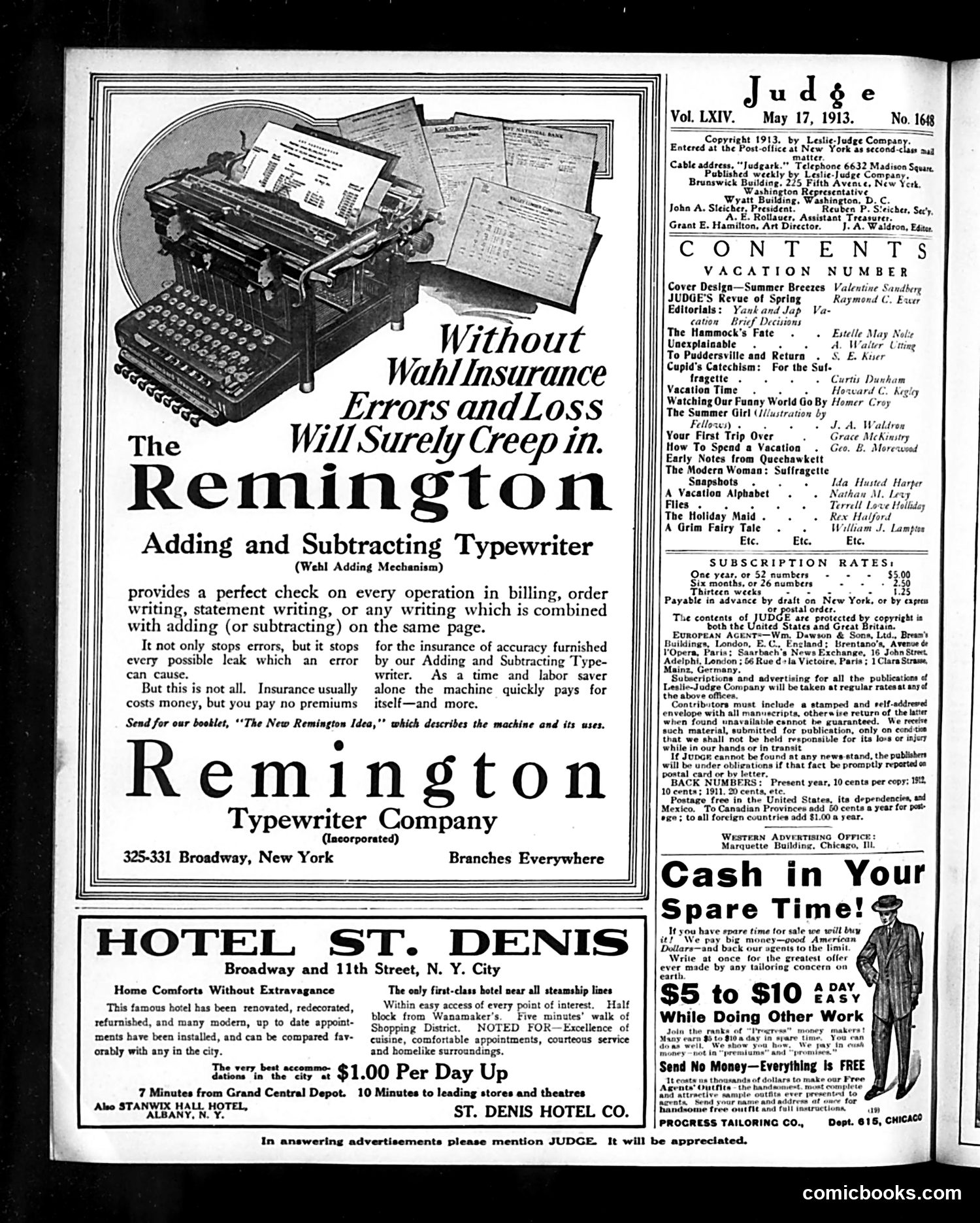
This page is primarily **advertising**, not political satire. The dominant advertisement features a Remington Adding and Subtracting Typewriter with the Wiehl Adding Mechanism. The pitch emphasizes accident prevention in business: "Without Wahl Insurance Errors and Loss Will Surely Creep in." It's a straightforward commercial appeal to office managers worried about clerical mistakes—positioning the machine as insurance against costly errors. Below are standard hotel and employment ads typical of the era. No political cartoons or satirical commentary appear on this page. The content reflects early 20th-century business anxieties about accuracy and efficiency in modern office work.
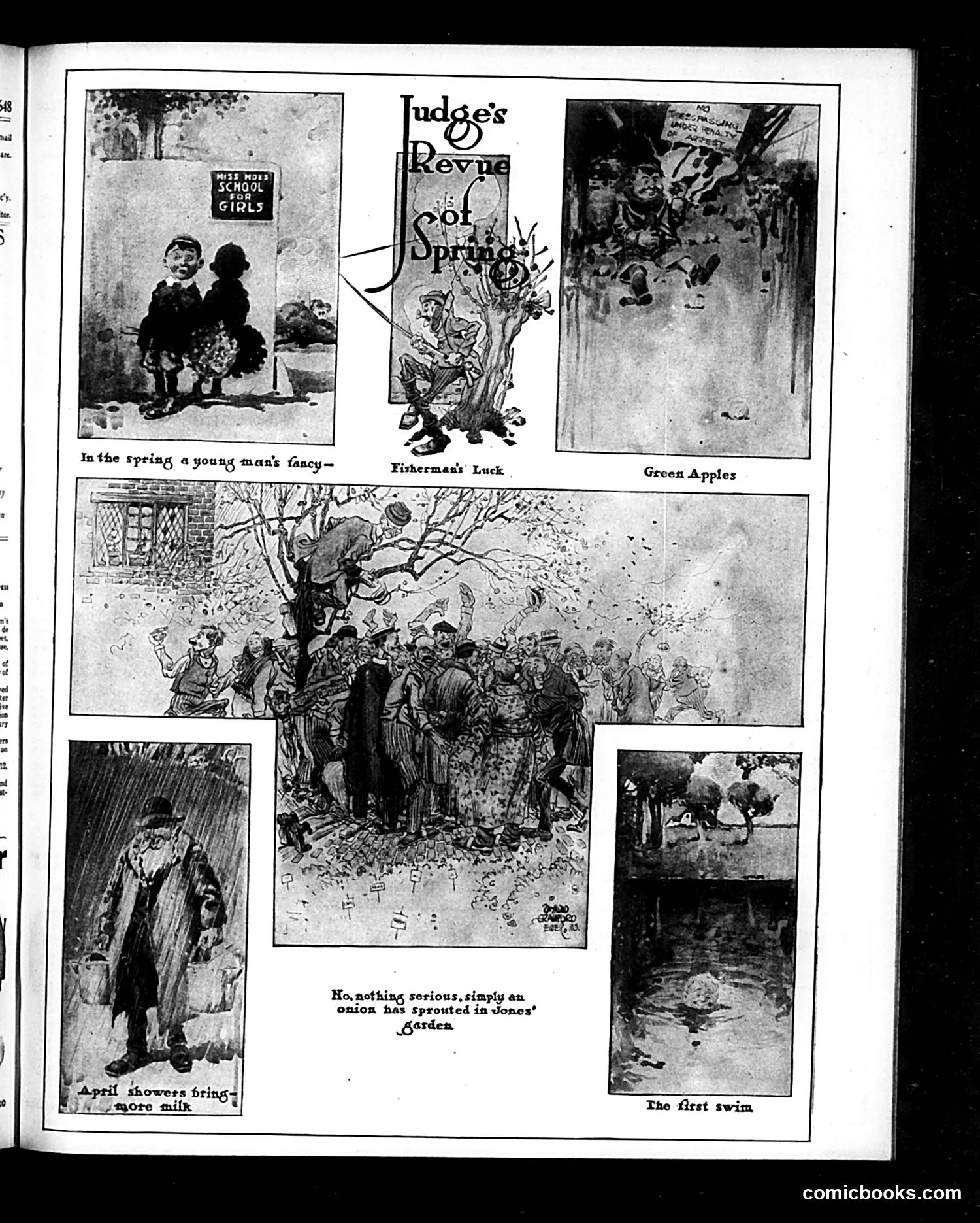
This page presents seasonal humor using spring as a framework for social commentary: **"In the spring, a young man's fancy"** — depicts children, likely referencing the famous Tennyson poem about spring romance. **"Fisherman's Luck"** — shows a figure by a tree with the magazine's masthead, a visual pun on spring activities. **"Green Apples"** — photograph showing what appears to be children near fruit, playing on spring's arrival and youth's recklessness. **"April showers bring more milk"** — man in rain, satirizing how April weather affects dairy production or milk delivery. **"The first swim"** — rural swimming scene marking seasonal recreation. The centerpiece shows a crowd around a tree, captioning "No, nothing serious, simply an onion has sprouted in Jones' garden" — absurdist humor about unexpected spring growth. Overall, spring themes mixing romance, nature, and domestic life.
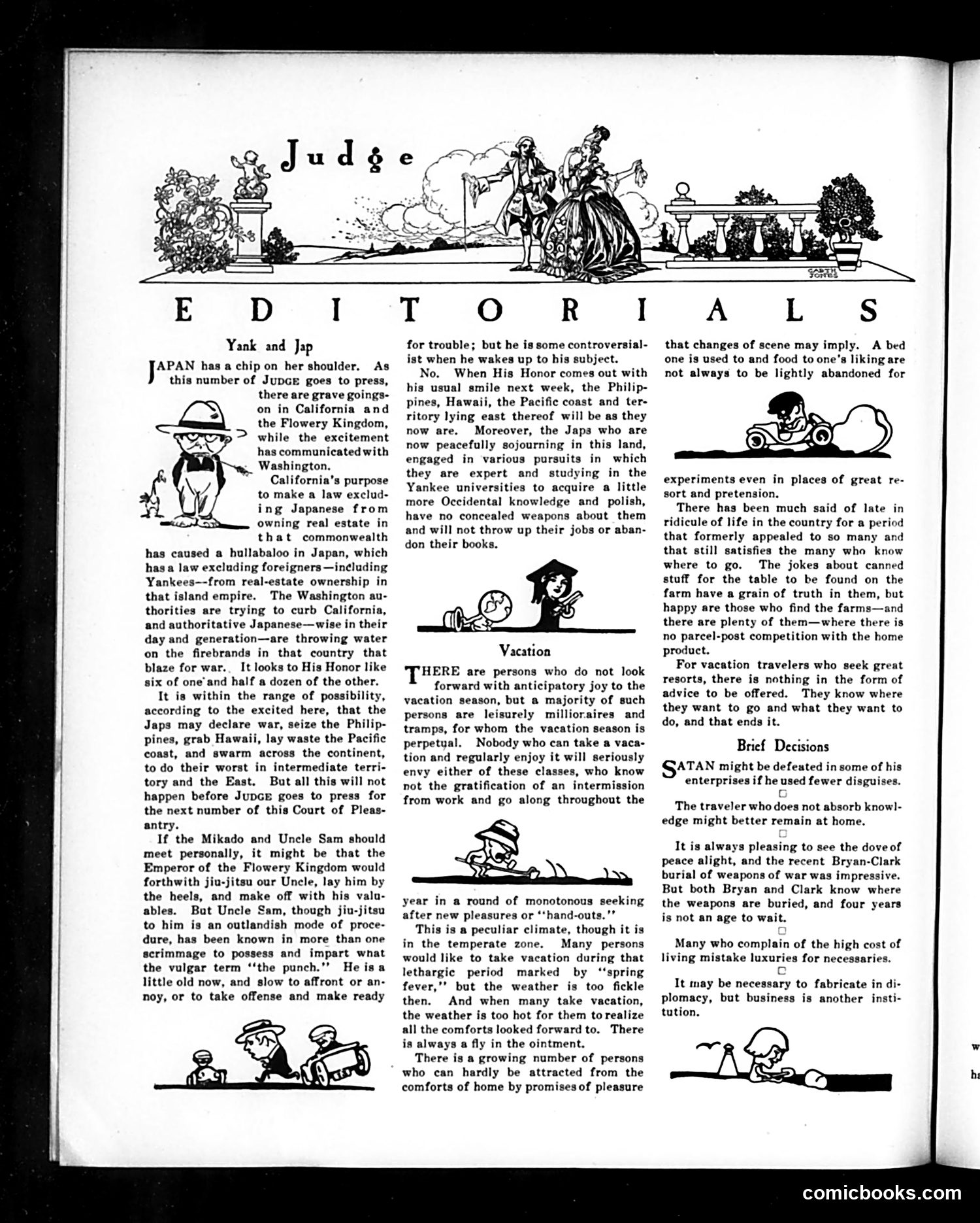
This editorial page contains two main sections with accompanying illustrations: **"Yank and Jap"** (left column): Critiques Japanese immigration policy and exclusionary laws targeting foreigners, particularly regarding California. The text references Japan's prohibition on foreign land ownership while the U.S. attempts similar exclusions. The small cartoon figure appears to represent Japan's contradictory stance—demanding access while denying it to others. **"Vacation"** (right column): A humorous piece mocking vacation season, suggesting many people travel out of obligation rather than genuine desire. Multiple small cartoon vignettes illustrate various vacation mishaps and discomforts. **"Brief Decisions"** (far right): Brief editorial comments on unrelated topics including war, peace, and economics. The illustrations throughout use simple, period-appropriate cartoon style to underscore each section's satirical point.
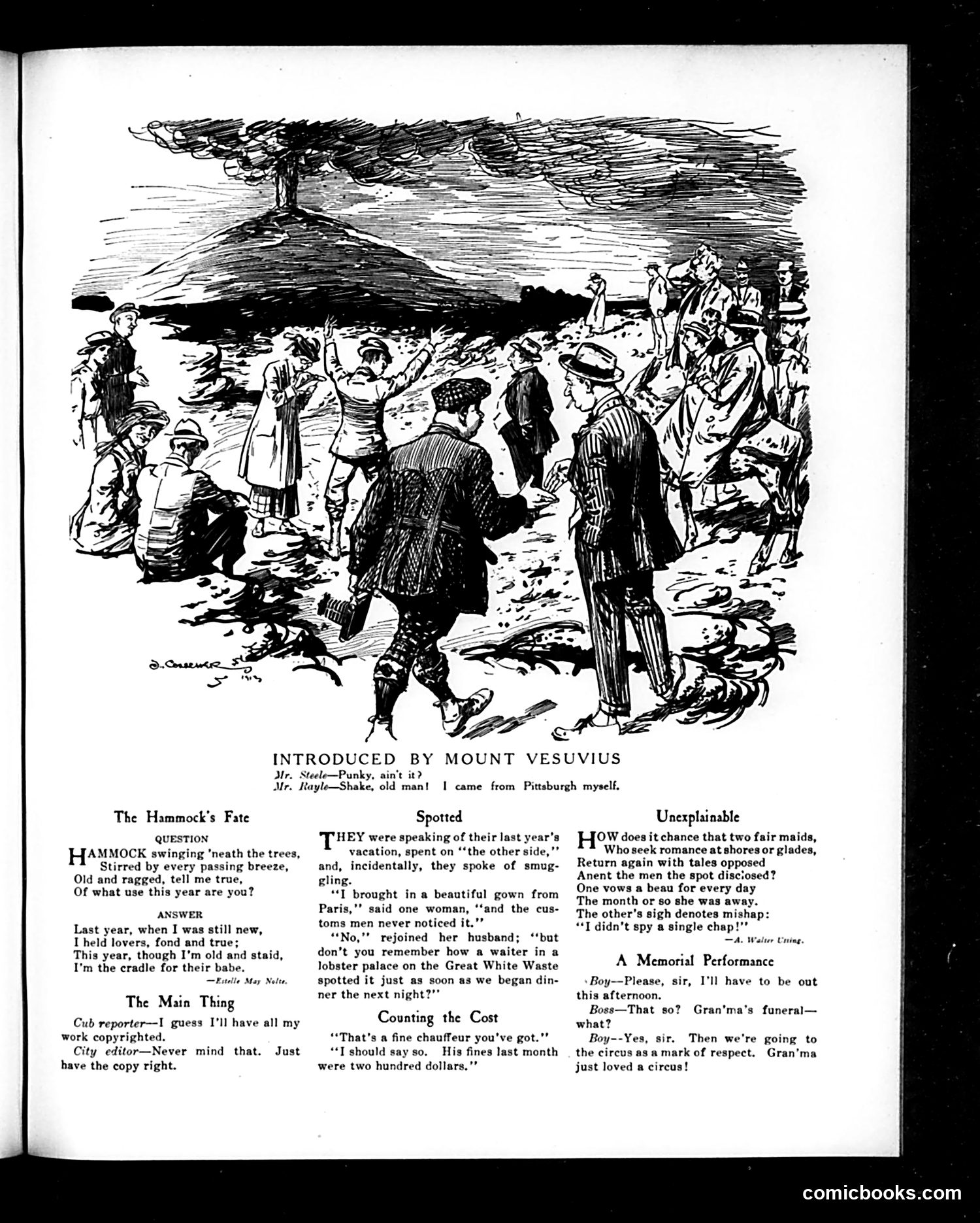
The main illustration depicts a crowded beach scene titled "Introduced by Mount Vesuvius," referencing the famous volcano. The cartoon appears to satirize social pretension and networking at fashionable resorts. Two men exchange dialogue about meeting someone, with one claiming he "came from Pittsburgh myself"—suggesting the humor derives from unexpected social connections among the supposedly elite vacationing crowd. The surrounding text contains several brief humorous pieces, including "The Hammock's Fate" and "Spotted," which mock romantic and social situations typical of leisure settings. "Counting the Cost" jokes about expensive automobile fines. These appear to be light satirical commentary on upper-class vacation behavior, social climbing, and conspicuous consumption—standard Judge magazine fare mocking genteel society.
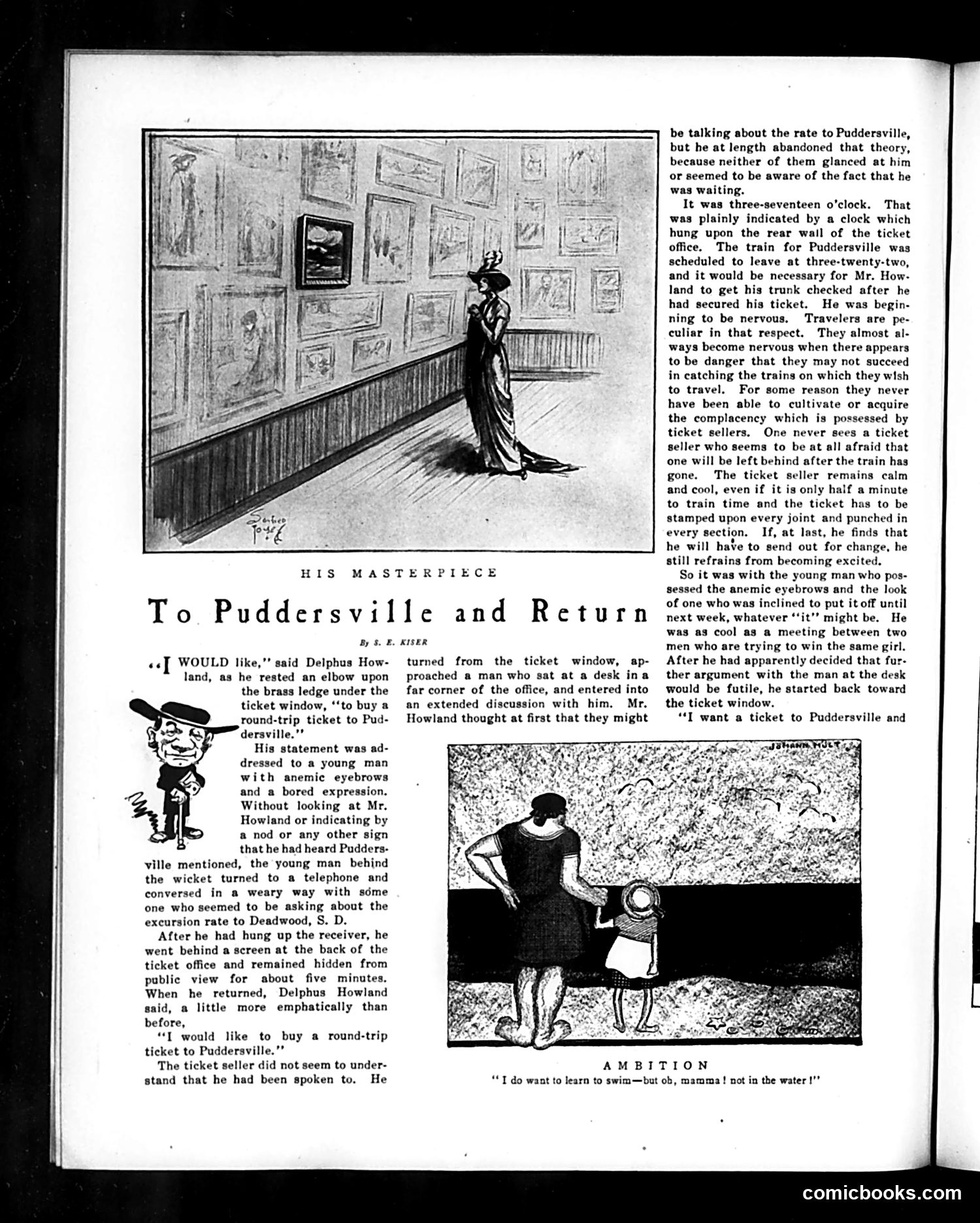
This is a humorous short story illustrated with two separate cartoons satirizing different social types. The main narrative mocks **railway ticket sellers**—specifically their legendary indifference and incompetence. A customer repeatedly requests a ticket to the fictional town "Puddersville" while his train departs in five minutes. The ticket seller ignores him, takes phone calls about other destinations, disappears behind screens, and converses with colleagues—all while remaining perfectly calm. The satire targets how ticket sellers possessed "complacency" that travelers could never match, treating urgent customer requests with infuriating passivity. The second cartoon, titled "Ambition," depicts a child reluctant to enter water despite wanting to learn swimming—a visual joke about hesitant ambition or the gap between aspirations and willingness to face discomfort. Both pieces reflect early 20th-century frustrations with bureaucratic indifference and human nature's contradictions.
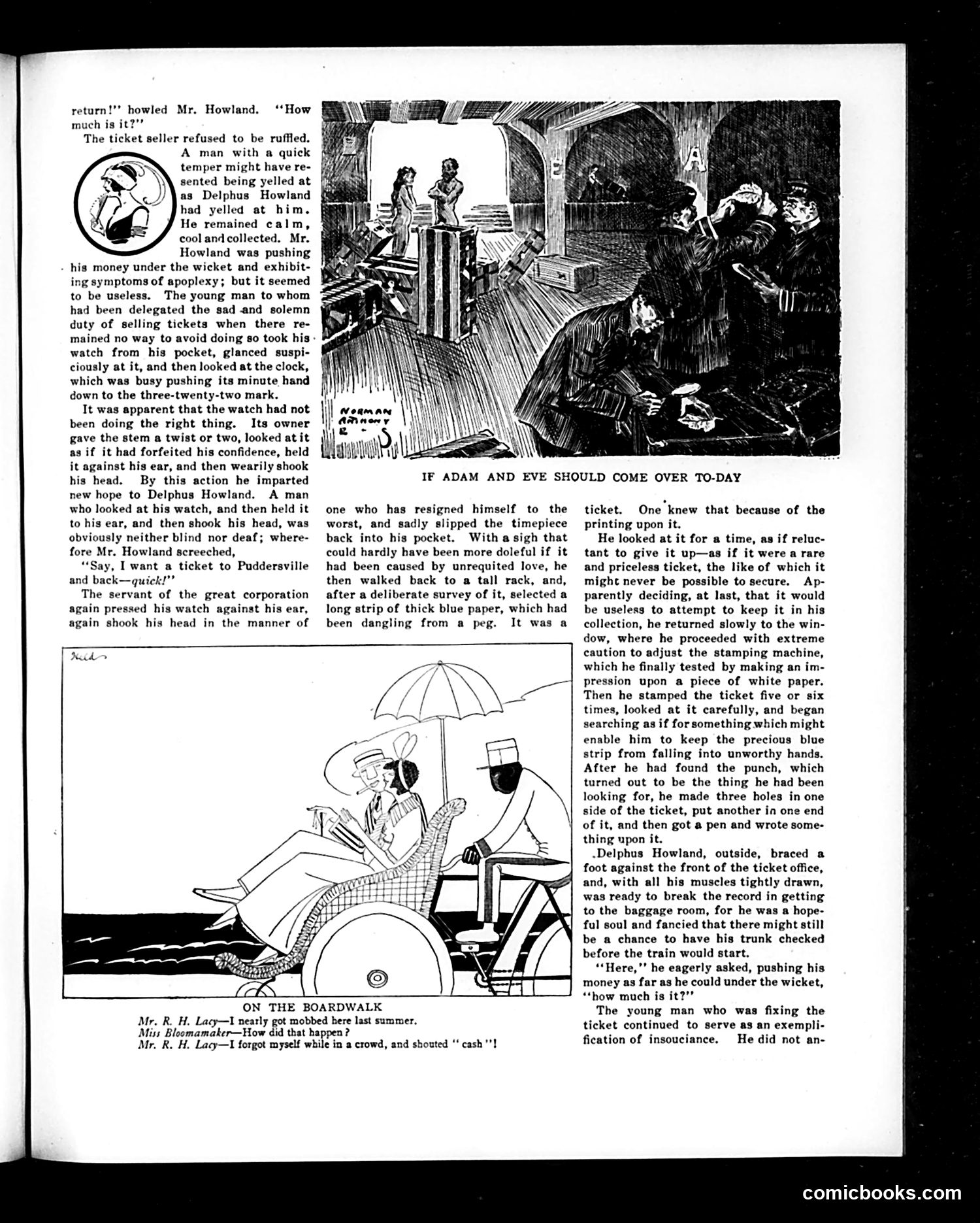
This page satirizes **railroad ticket office inefficiency and bureaucratic indifference**—a common complaint in early 20th-century America. The main narrative mocks a ticket seller's deliberate slowness. When impatient customer Delphus Howland demands a ticket to "Puddersville," the clerk responds with exaggerated lethargy: checking his broken watch, sighing mournfully, selecting the ticket reluctantly as if parting with treasure, testing the stamping machine repeatedly, punching holes obsessively, and writing mysterious notes. The clerk's "insouciance" (cool indifference) infuriates the desperate Howland, who fears missing his train. The sidebar cartoon "On the Boardwalk" offers unrelated social satire: a man caused a mob scene by shouting "cash!"—suggesting wealthy boardwalk crowds were scandalized by crude commercial language, a jab at upper-class pretension. Both items mock American institutional incompetence and class absurdities typical of Judge's satirical approach.
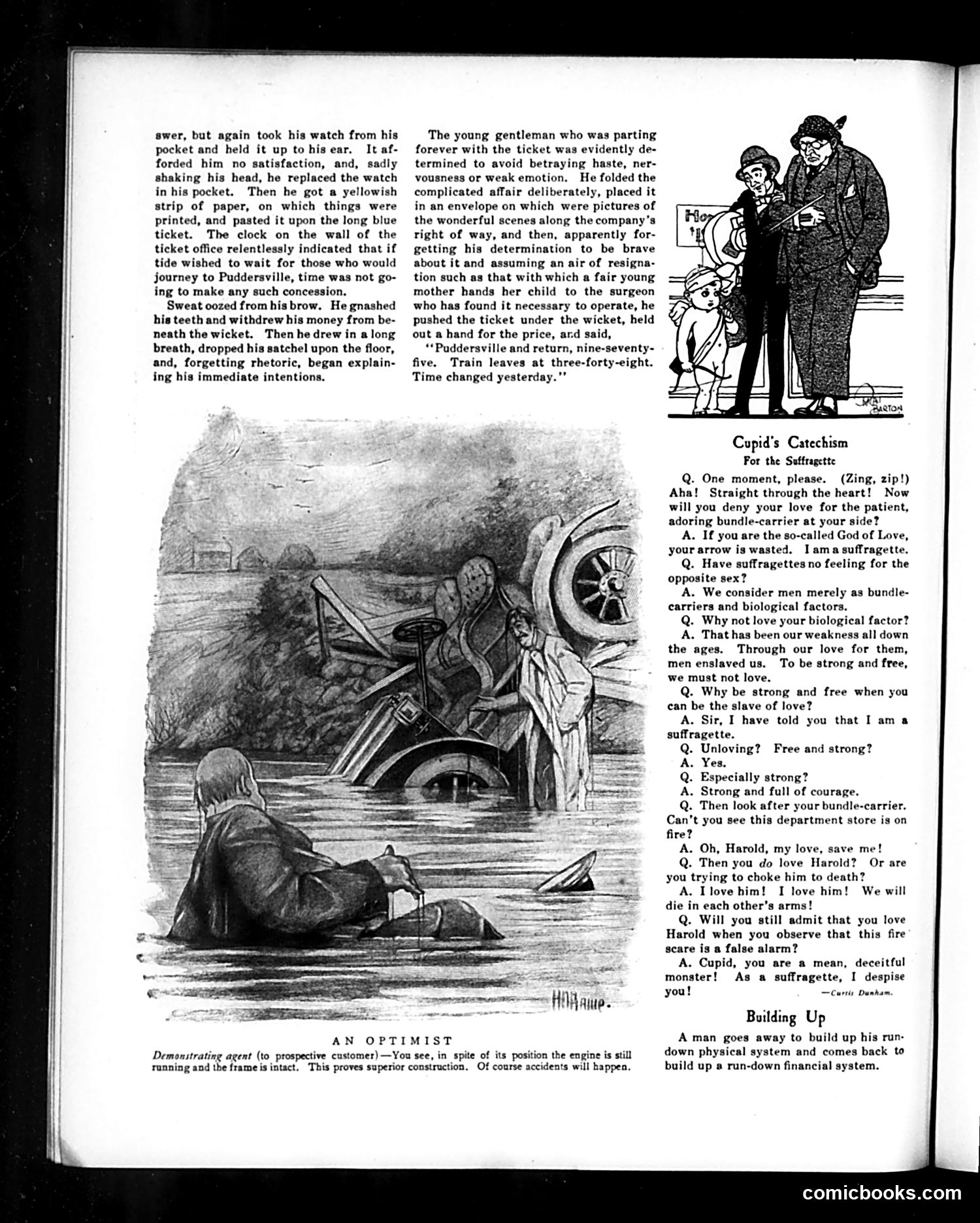
This satirical piece mocks the early suffragette movement through a faux-interview between Cupid and a female suffragist. The humor relies on attacking women's suffrage advocates by portraying them as: **The Satire's Points:** - Hypocritical: The suffragette claims to reject romantic love and view men as mere "bundle-carriers," but immediately abandons these principles when danger (a fire) threatens, crying "Oh, Harold, my love, save me!" - Emasculating: Men are reduced to "biological factors" and domestic servants - Irrational: She's exposed as emotionally unstable, despising Cupid for revealing her true feelings **The Message:** Judge magazine argues that suffragettes' ideology is fundamentally incompatible with women's "natural" romantic instincts—that feminist principles collapse under real-world pressure, revealing women as inherently emotional and dependent on men. This represents typical anti-suffrage propaganda from the early 1900s, using humor to delegitimize women's political rights by questioning their intellectual consistency and emotional stability.
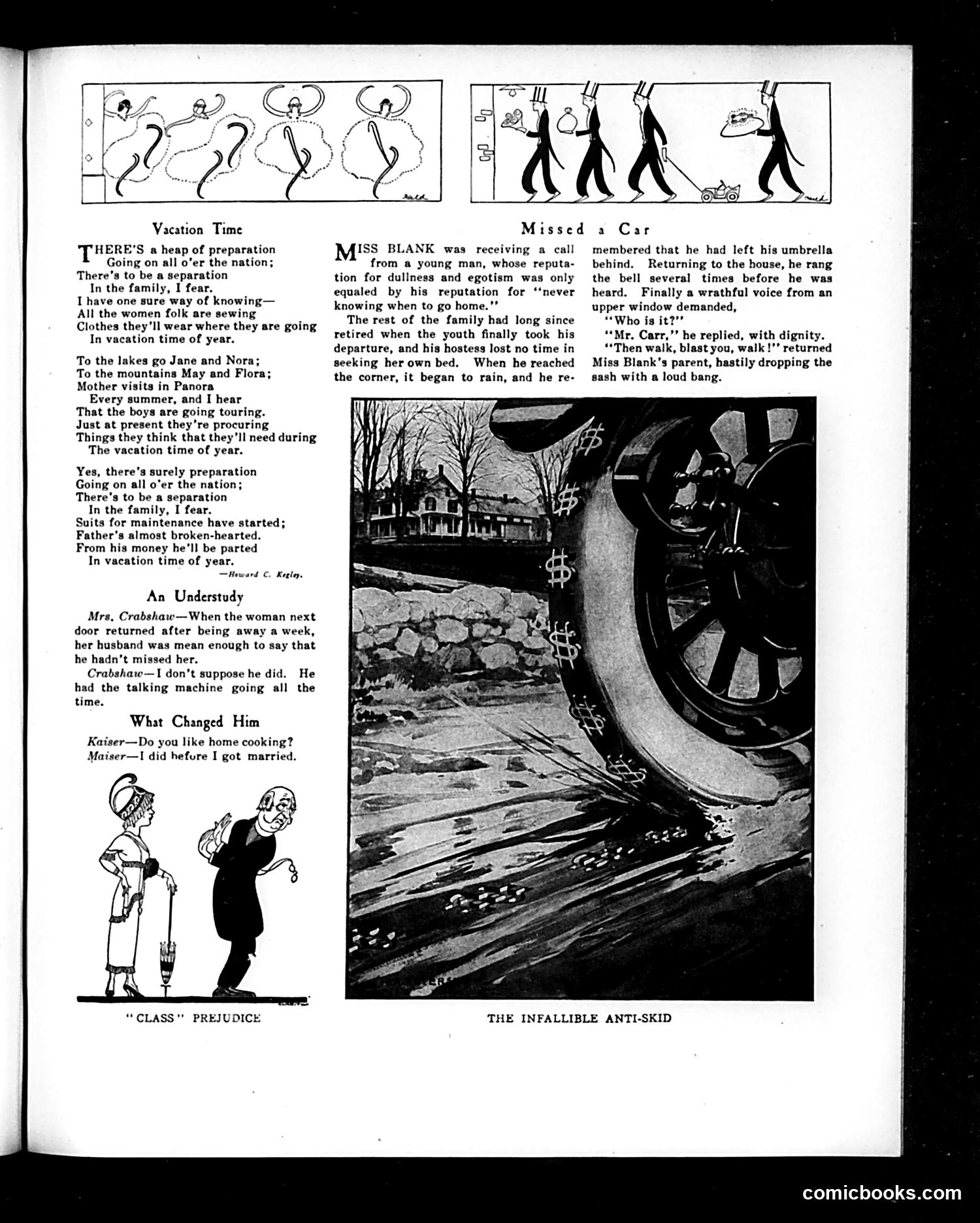
This page contains several period satirical pieces targeting early 20th-century domestic life: **"Vacation Time"** mocks the financial burden of family vacations on fathers. The poem humorously depicts wives and children preparing separate trips while the father faces financial ruin ("From his money he'll be parted"). **"Missed a Car"** ridicules a socially awkward young caller who overstays his welcome. Miss Blank's father, exhausted by the visitor's dullness and inability to recognize when to leave, refuses to let him back in when he returns for a forgotten umbrella—telling him to "walk" in the rain instead. **"An Understudy"** uses a talking machine (phonograph) as a joke about marital disconnection. **"What Changed Him"** plays on the stereotype that marriage ruins men's appreciation of home cooking. **"Class Prejudice"** contrasts a woman and man's different footwear (she in heels, he in worn shoes), suggesting class judgment. **"The Infallible Anti-Skid"** appears to be an automotive advertisement or demonstration, unrelated to the satire above.
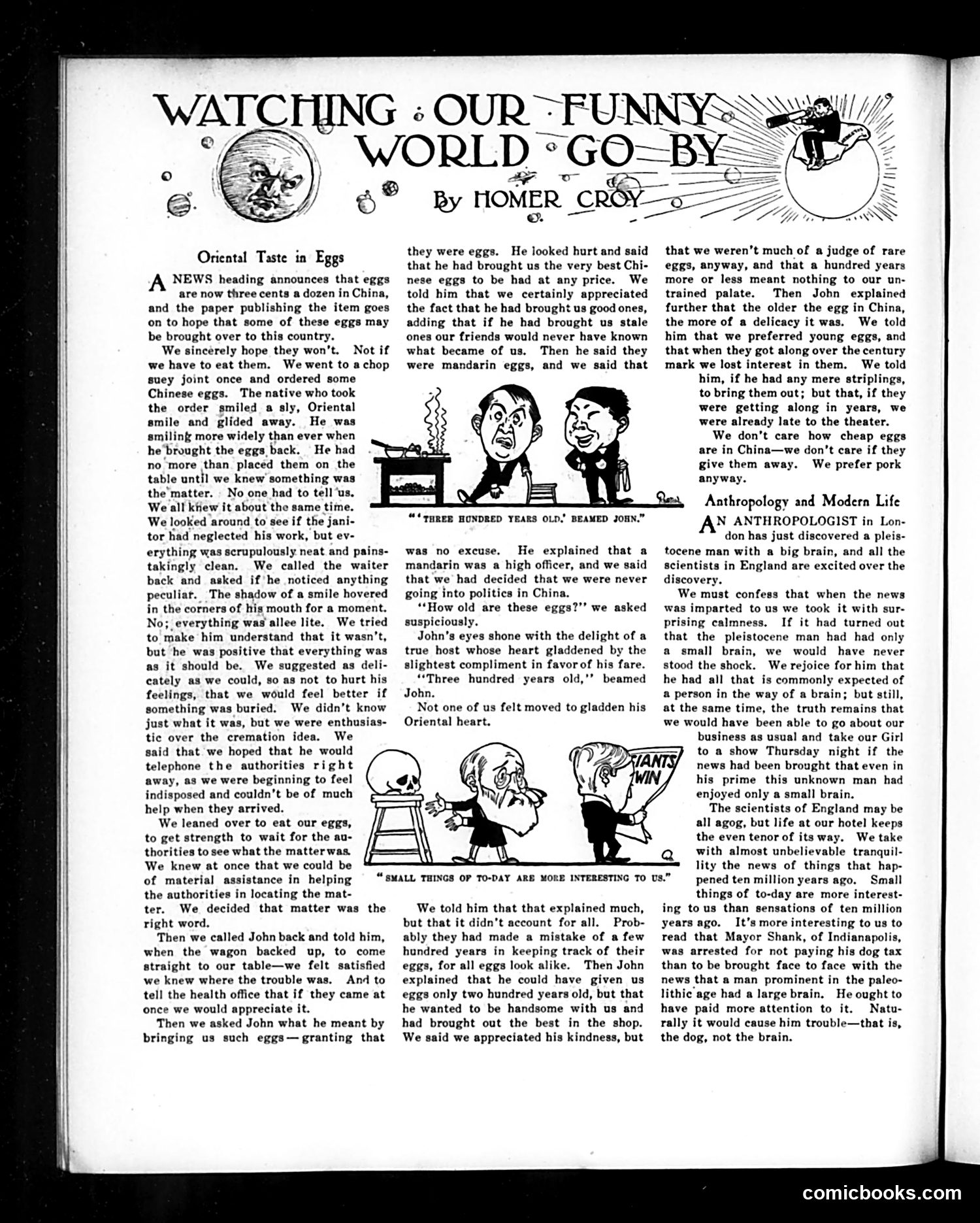
This satirical piece by Homer Croy mocks both Chinese cuisine and American attitudes toward it. The main joke: the author orders eggs at a Chinese restaurant and finds them inedible—so foul-smelling that he suggests calling authorities and having them cremated. When confronted, the waiter proudly reveals they are "mandarin eggs"—allegedly 300 years old, presented as a delicacy. The satire works on multiple levels: it ridicules Chinese culinary practices (particularly preserved/aged eggs, likely century eggs), stereotypes Chinese waiters as inscrutable and defensive, and mocks American diners' squeamishness about unfamiliar food. The secondary "Anthropology and Modern Life" piece continues this theme of dismissing non-Western cultures as intellectually backward. The humor relies on ethnic caricature and food-based xenophobia typical of 1920s Judge magazine.
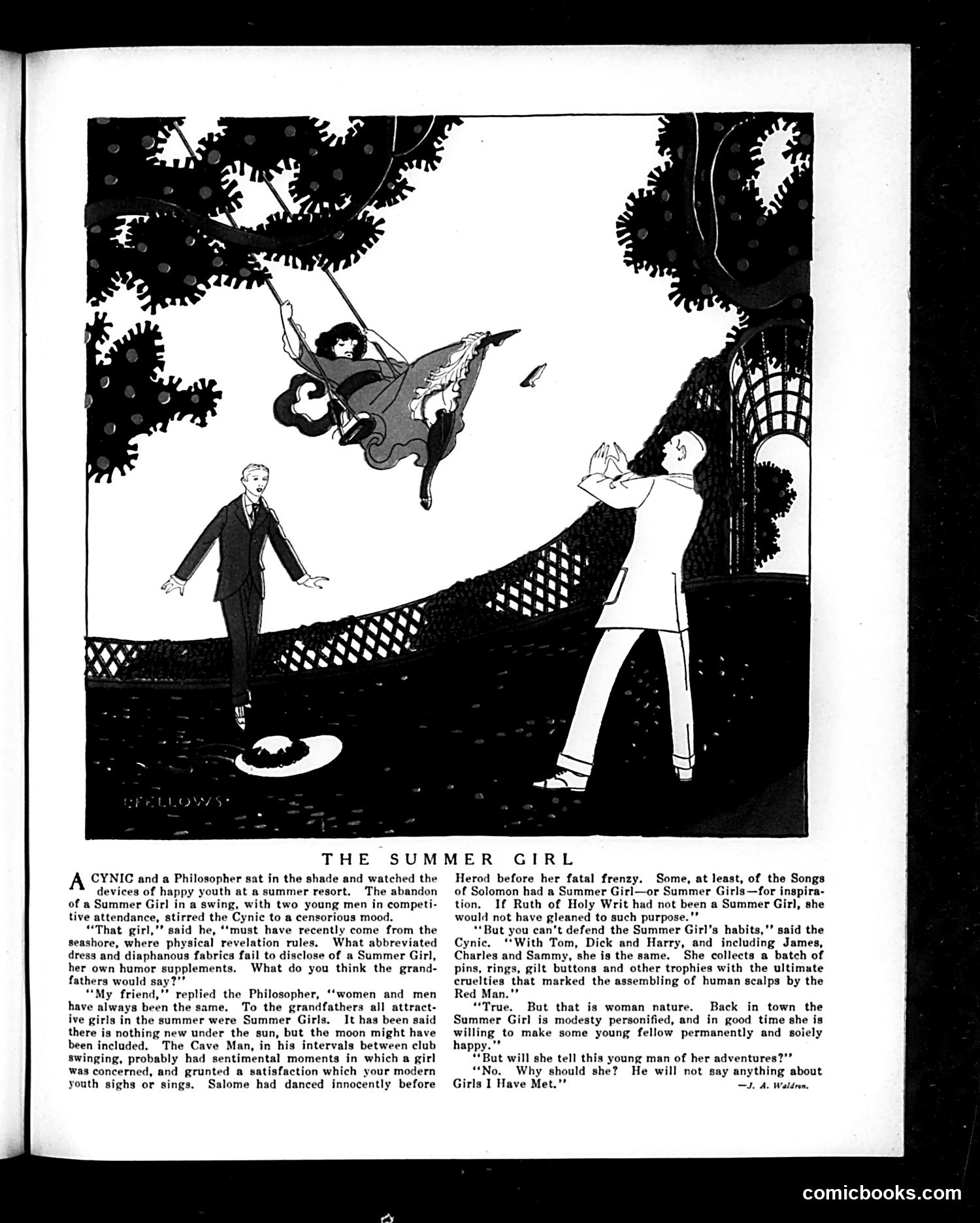
This satirical dialogue between a Cynic and Philosopher discusses the behavior of young women at summer resorts. The Cynic criticizes the "Summer Girl"—a stock character of the era—for her revealing clothing, flirtatiousness with multiple men, and collection of romantic "trophies" (pins, rings, buttons). He compares her behavior unfavorably to what previous generations would have tolerated. The Philosopher defends her by arguing human nature is timeless, invoking biblical and historical precedents (Salome, Ruth, Solomon's Songs). He suggests such behavior is temporary—the Summer Girl becomes modest and marriageable when returning to town, keeping her adventures secret just as men keep theirs. The cartoon satirizes both rigid moralism and the double standard regarding gender and sexuality. The "Summer Girl" represents newfound female freedom and independence that scandalized conservative observers in this pre-WWI era.
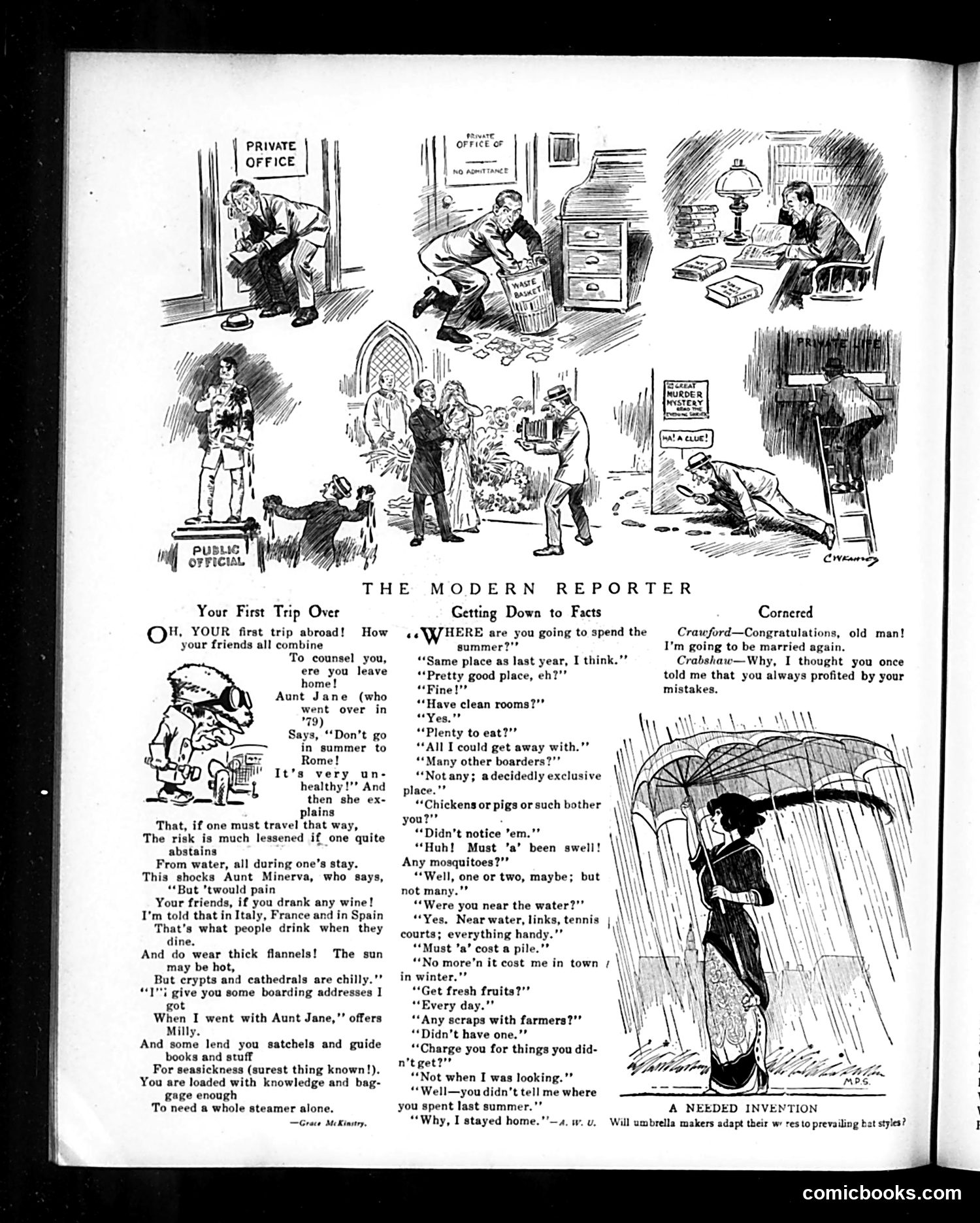
This page contains three satirical pieces mocking early 20th-century social conventions: **"Your First Trip Over"** satirizes well-meaning relatives overwhelming travelers with contradictory, outdated advice. Aunt Jane warns against Rome's summer heat; Aunt Minerva insists on thick flannels and warns against wine (despite it being standard in Mediterranean countries). The joke: travelers are "loaded with knowledge and baggage enough to need a whole steamer alone." **"Getting Down to Facts"** depicts a reporter interviewing someone about their summer vacation. The reporter asks increasingly pointed questions about the boarding house's condition, amenities, and costs, trying to determine if the person is lying about getting quality accommodations cheaply. The punchline reveals the person simply stayed home—undermining the entire interview. **"Cornered"** is a brief joke: when a man announces his remarriage, his friend sarcastically notes he claimed to always profit from mistakes—implying his first marriage was one. **"A Needed Invention"** notes that umbrella wire frames don't accommodate current hat styles, suggesting practical design lag behind fashion trends.
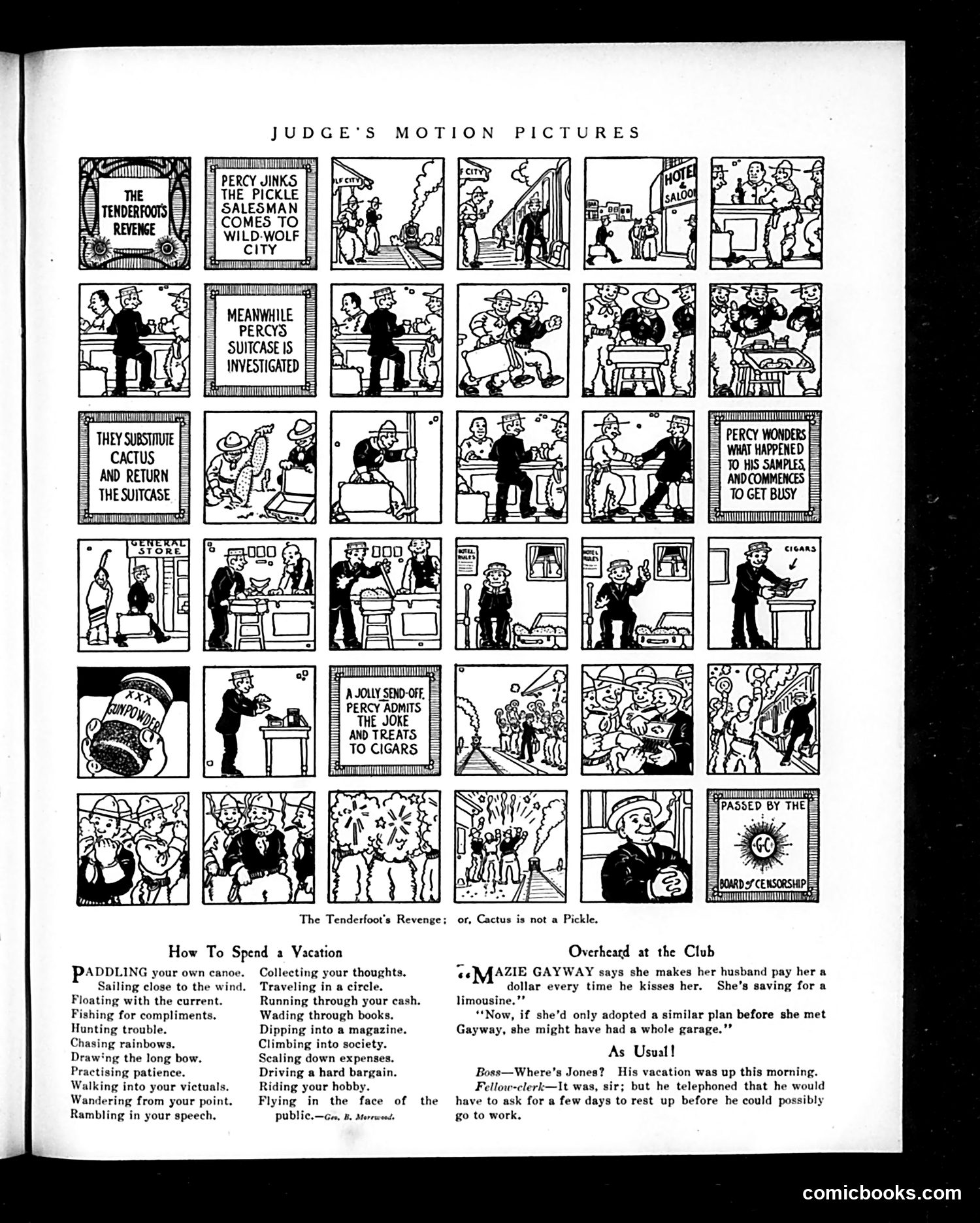
This page presents a silent-film-style comic strip about "Percy," apparently a city slicker or salesman who travels to "Wild Wolf City." The sequential panels show Percy's suitcase being investigated, suggest a substitution of cactus for its contents, and depict Percy's subsequent "revenge" or comeuppance. The humor relies on slapstick Western tropes—the naive tenderfoot deceived by frontier folk, leading to physical comedy. The title "Cactus is not a Pickle" suggests the practical joke: someone replaced Percy's belongings with a cactus. Below are three prose humor sections typical of Judge magazine: vacation tips using oxymoronic advice ("Sailing close to the wind," "Hunting trouble"), an office anecdote about a wife extracting payment for kisses to save for a limousine, and a joke about an employee extending his vacation by claiming exhaustion. The satire targets leisure-class pretension and marital dynamics of the era.
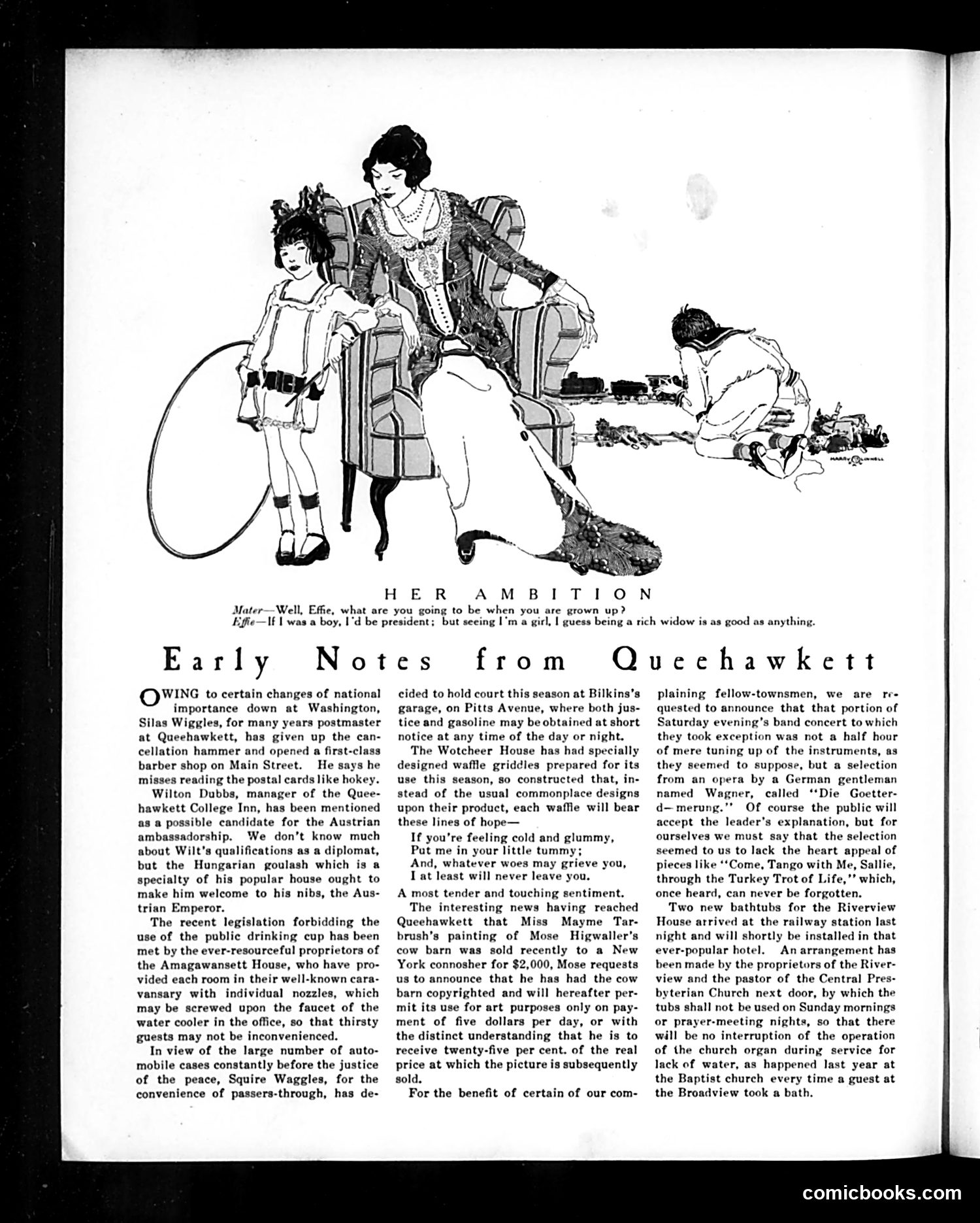
The cartoon depicts a mother and daughter with a young boy. The daughter, "Effie," expresses her life ambition: if she were male, she'd become president, but since she's a girl, being a rich widow is "as good as anything." This satirizes **gender limitations and women's restricted opportunities** in early 20th-century America. The joke's bitter edge lies in the contrast—a girl cannot aspire to political leadership, so her best realistic option is marrying wealth and outliving her husband. The casual tone makes the satire sharper: the "solution" to female powerlessness isn't equality but financial security through marriage. The accompanying "Early Notes from Queehawkett" section is small-town gossip humor—local figures getting minor positions or selling their property for unexpected prices. This framing contextualizes Effie's resignation: in a society where women's agency is limited to marriage, her pragmatic acceptance reflects actual social conditions Judge's readers would recognize.
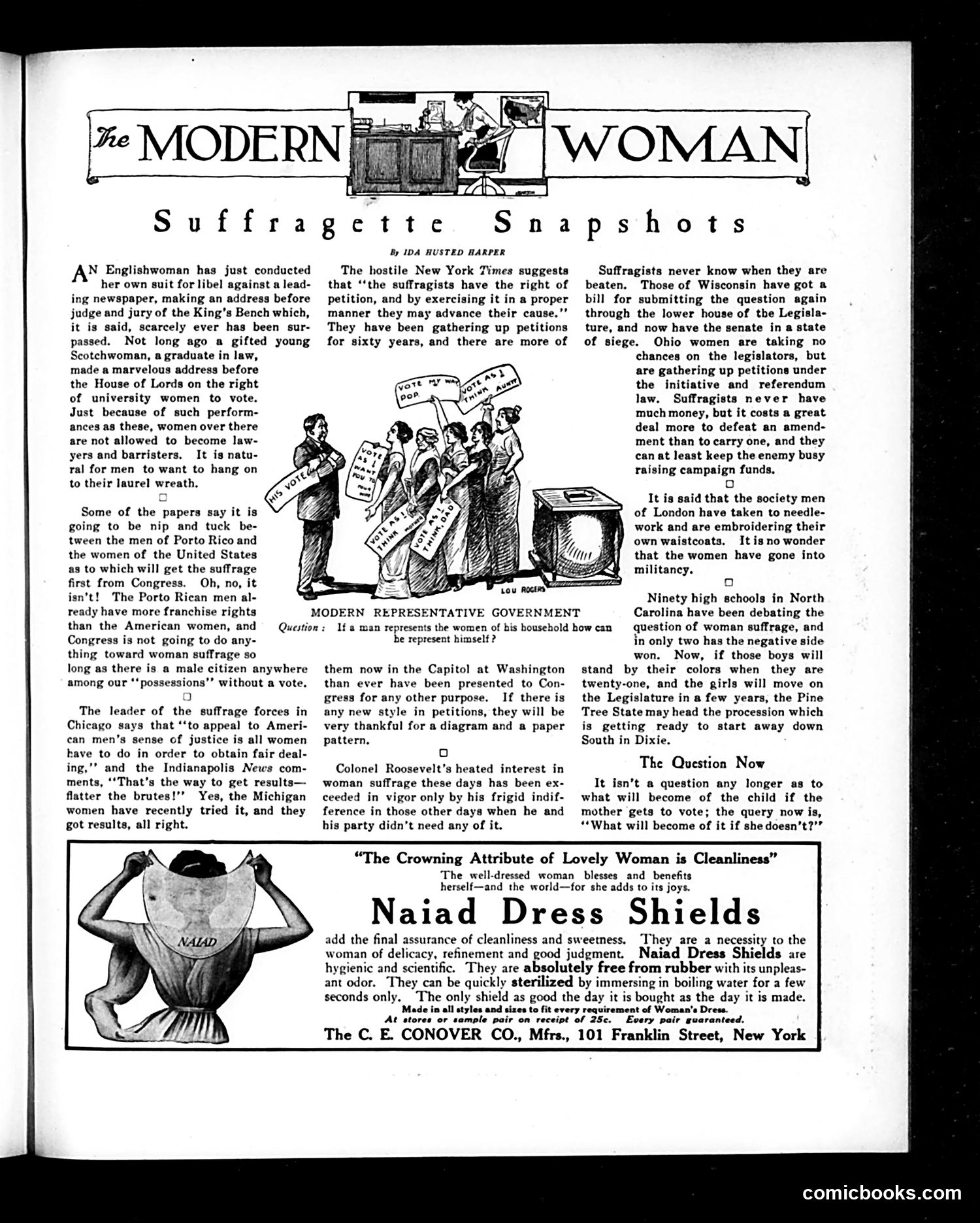
This Judge magazine page satirizes the women's suffrage movement through commentary by Ida Husted Harper, a pro-suffrage writer. The central cartoon depicts a man surrounded by women holding suffrage petitions, captioned "Modern Representative Government" with the ironic question: "If a man represents the women of his household how can he represent himself?" The satire cuts multiple ways: Harper uses sarcasm to mock anti-suffrage arguments (petitions are "proper" but futile; appeals to male justice are "flattering brutes"). She criticizes the inconsistency of denying American women voting rights while granting them to men in Puerto Rico. She also jabs at Theodore Roosevelt's sudden support for suffrage only when politically expedient. The surrounding text attacks newspapers dismissing suffragists and celebrates women's legal and academic achievements in Britain, implicitly shaming American men for resisting similar progress. The piece is ultimately *pro*-suffrage satire targeting suffrage opponents.
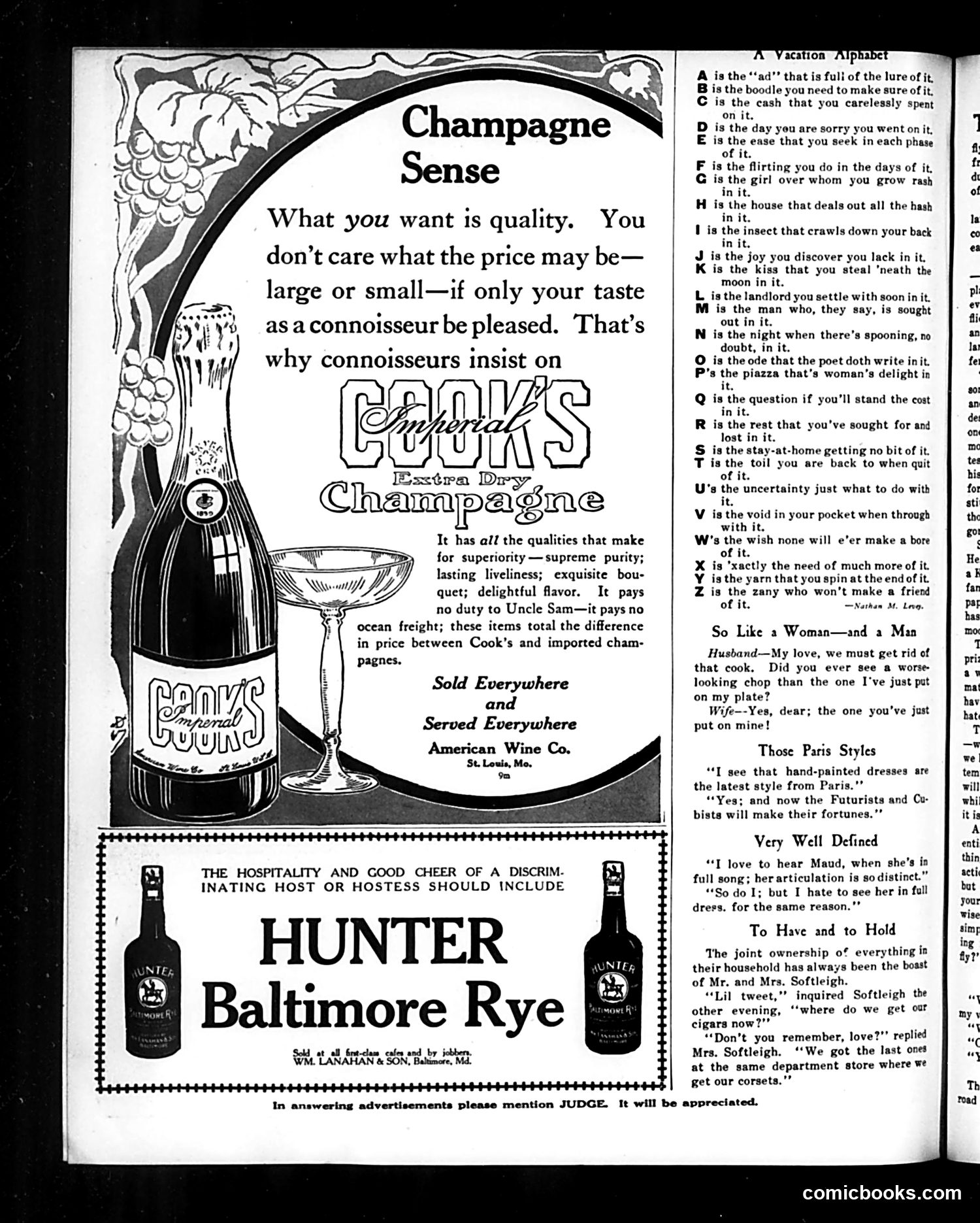
This page contains **two liquor advertisements** (Cook's Champagne and Hunter Baltimore Rye) and several **humorous prose pieces** typical of Judge magazine's satirical content. The main visual joke is a "Vacation Alphabet"—a cynical A-to-Z definition of vacation experiences. It satirizes middle-class leisure by cataloging the reality behind romantic getaways: initial expense (B-C), regret (D), flirtation and romance (F-K), but ultimately ending in financial ruin (V: "the void in your pocket"). The piece mocks both the aspirational marketing of vacations and the predictable disappointments that follow. The three brief prose pieces below mock domestic life and modern fashion through exaggerated wordplay and gender stereotypes—typical Judge humor targeting married couples, fashion fads, and social pretension. The advertisements position luxury goods (imported champagne, fine whiskey) as markers of sophistication and good hospitality, reflecting Prohibition-era advertising strategies.
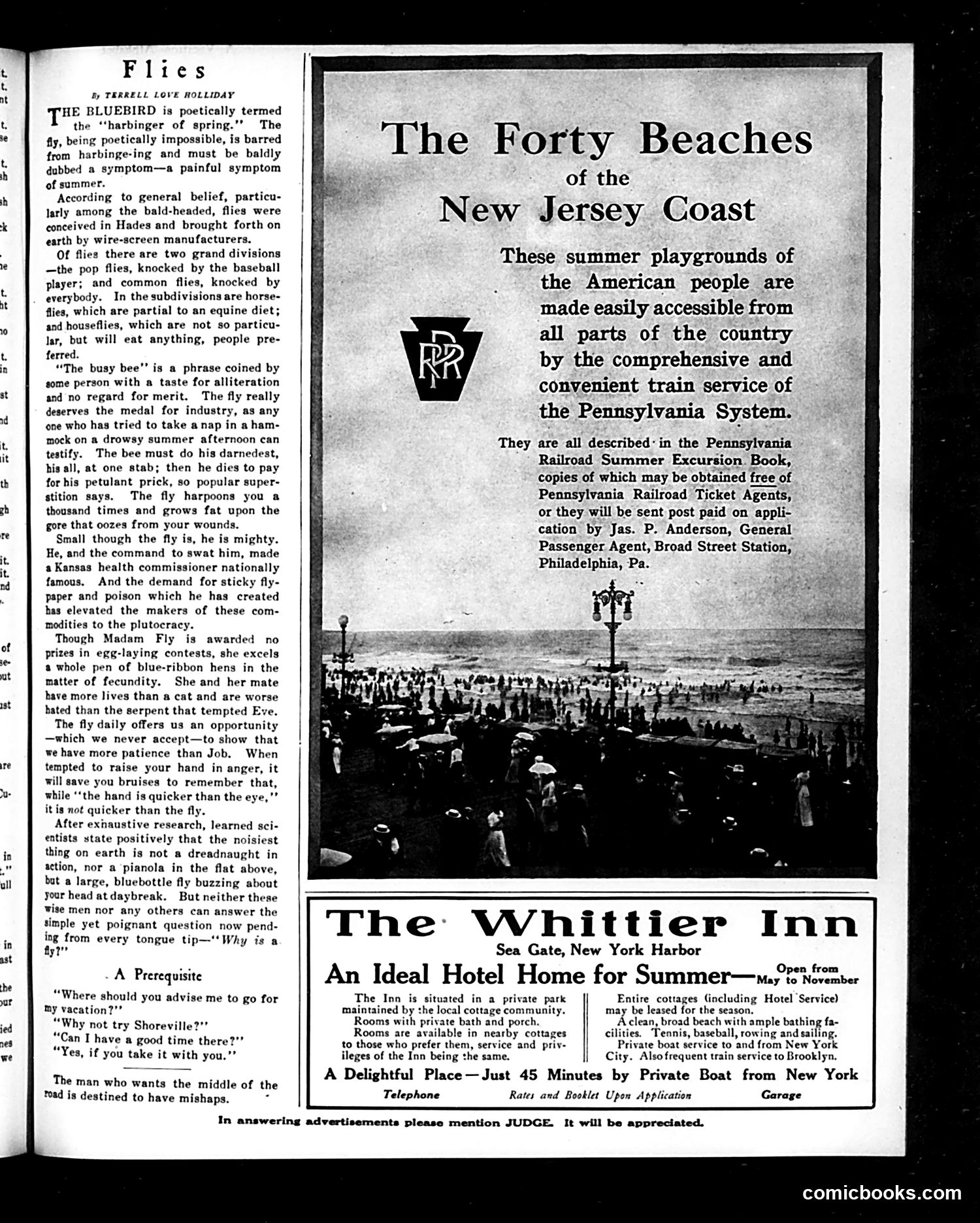
This page is primarily **advertising and light humor** rather than political satire. The left column contains "Flies" by Terrell Love Holliday—a humorous essay comparing flies unfavorably to bees. The author uses exaggeration to mock the fly's reputation: while bees are celebrated as industrious, flies are parasitic pests that deserve mockery. The piece includes gentle jabs at common wisdom ("The busy bee") and pokes fun at humanity's futile attempts to swat them. The concluding riddle "Why is a fly?" is simply wordplay. Below is a brief joke about vacation advice suggesting one can have fun anywhere if you bring the right attitude. The **right side is entirely commercial**—advertising Pennsylvania Railroad's access to New Jersey beaches and The Whittier Inn hotel at Sea Gate, New York Harbor. These were typical period advertisements promoting summer leisure destinations to affluent readers. No political commentary or caricature is present on this page.
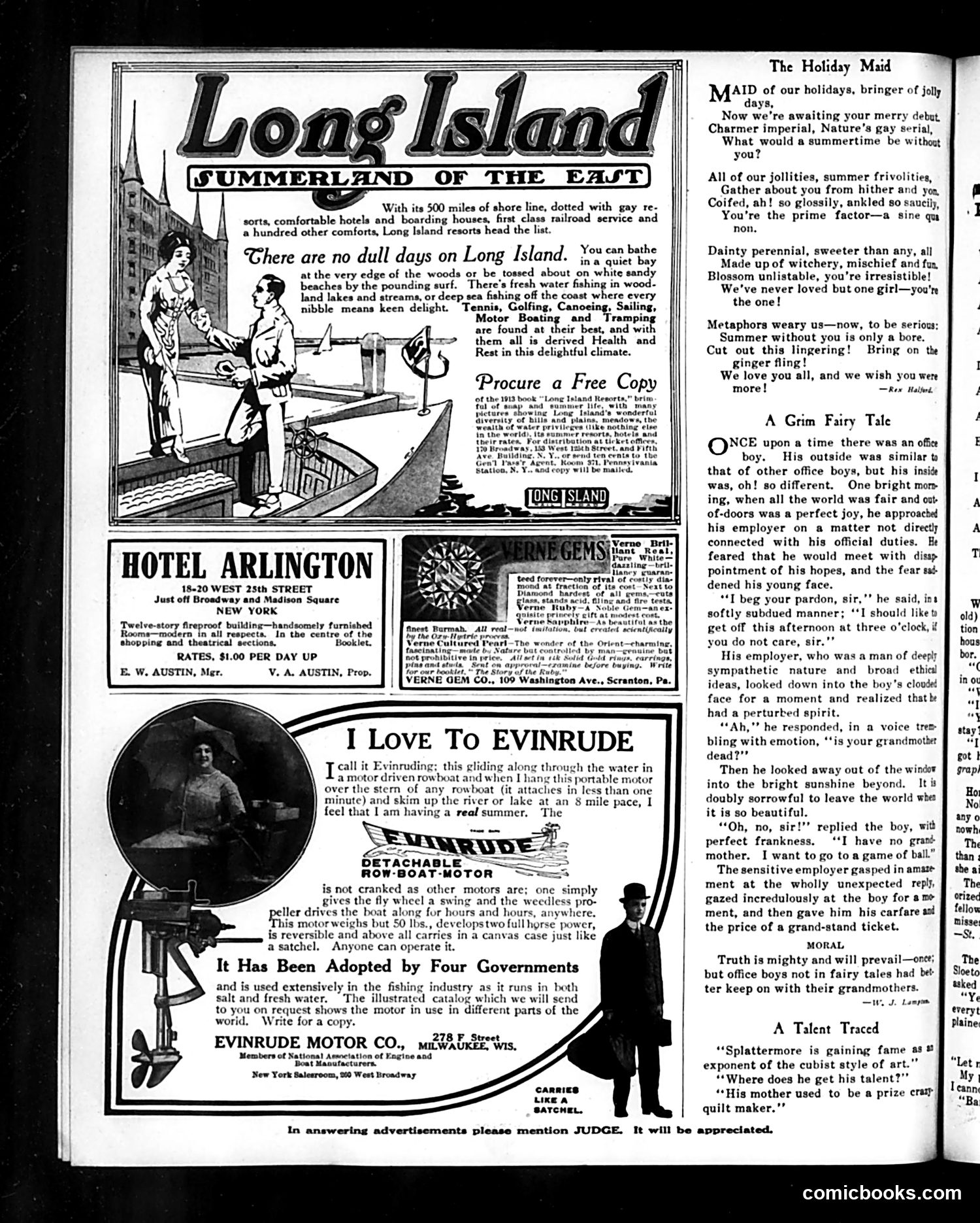
This page from *Judge* magazine is primarily **advertising and promotional content** rather than political satire. The dominant features are: 1. **Long Island Tourism Advertisement**: Promotes Long Island as a vacation destination with beaches, fishing, and resort hotels—typical early-20th-century leisure advertising. 2. **Hotel Arlington Ad**: Standard hotel promotion in New York City. 3. **Evinrude Motor Advertisement**: The main visual focus showcases a detachable rowboat motor. The ad emphasizes its portability, ease of operation, and governmental/industrial adoption—marketing a new consumer technology. 4. **"The Holiday Maid" Poem**: A lighthearted tribute to summer, celebrating warm-weather leisure activities. 5. **"A Grim Fairy Tale"**: A brief moral story about an office boy requesting an afternoon off, seemingly illustrating workplace dynamics of the era. **No clear political satire or caricature** is evident on this page. It represents typical *Judge* content: advertisements mixed with light humor and lifestyle pieces targeting an affluent readership interested in leisure, technology, and entertainment.
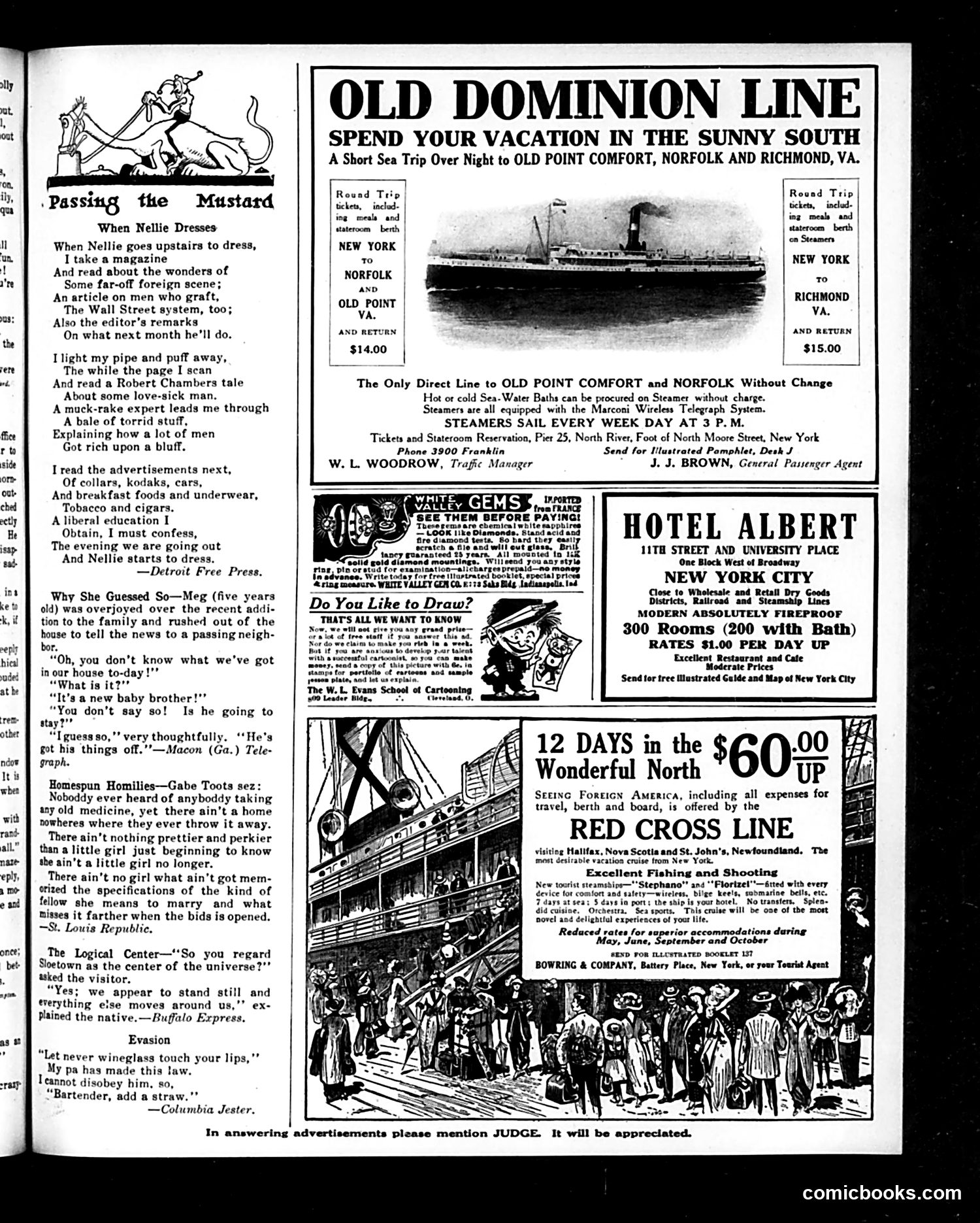
This page is primarily **advertising** with supporting humor content. The main feature is "Passing the Mustard," a humorous poem about a husband reading magazines while his wife dresses—satirizing both marital domestic life and the magazine industry itself by cataloging the random content he consumes (foreign affairs, Wall Street corruption, love stories, muckraking exposés, and product ads). The remaining content consists of **short humorous anecdotes** ("Homespun Homilies," "Why She Guessed So," etc.) typical of Judge's satirical style, poking gentle fun at everyday situations. The page is dominated by **paid advertisements** for travel (Old Dominion Line steamships), jewelry (White Valley Gem Co.), hotel accommodations (Hotel Albert), and drawing schools—standard early 20th-century advertising. One ad promises a "12 Days in the Wonderful North" tour for $60. There is **no obvious political satire** on this particular page; it reflects Judge's role as both humor magazine and advertising vehicle for the era.
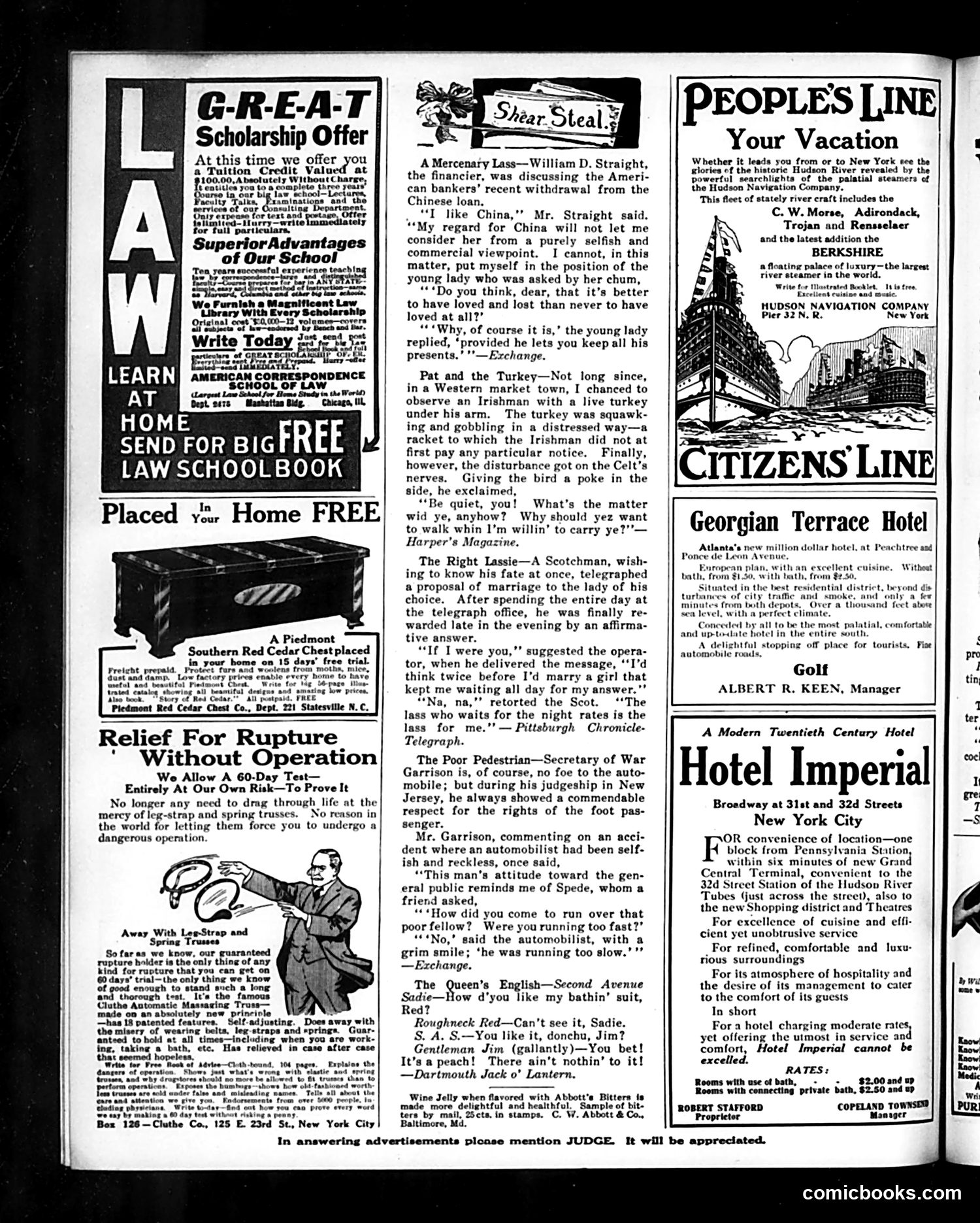
This is primarily an **advertising and humor page** from Judge magazine, featuring several short satirical anecdotes rather than political cartoons. The humor pieces mock social pretenses and gender dynamics: - **"A Mercenary Lass"** satirizes a woman who values gifts over love, using a financier's (William D. Straight's) disapproval of American bankers withdrawing from Chinese loans as a framing device for the joke. - **"Pat and the Turkey"** stereotypes Irish dialect and naïveté through slapstick humor. - **"The Right Lassie"** plays on Scottish thriftiness—a Scotsman approves of his fiancée's delay in accepting his proposal because she "waits for night rates" (cheaper telegraph costs). - **"The Poor Pedestrian"** references Secretary of War Garrison with a dark joke about automobiles hitting pedestrians, suggesting wealthy drivers care little for ordinary people's safety. The page is dominated by product advertisements (law school scholarships, medical devices, hotels). The satire reflects early 20th-century class anxieties and ethnic stereotyping typical of the era.
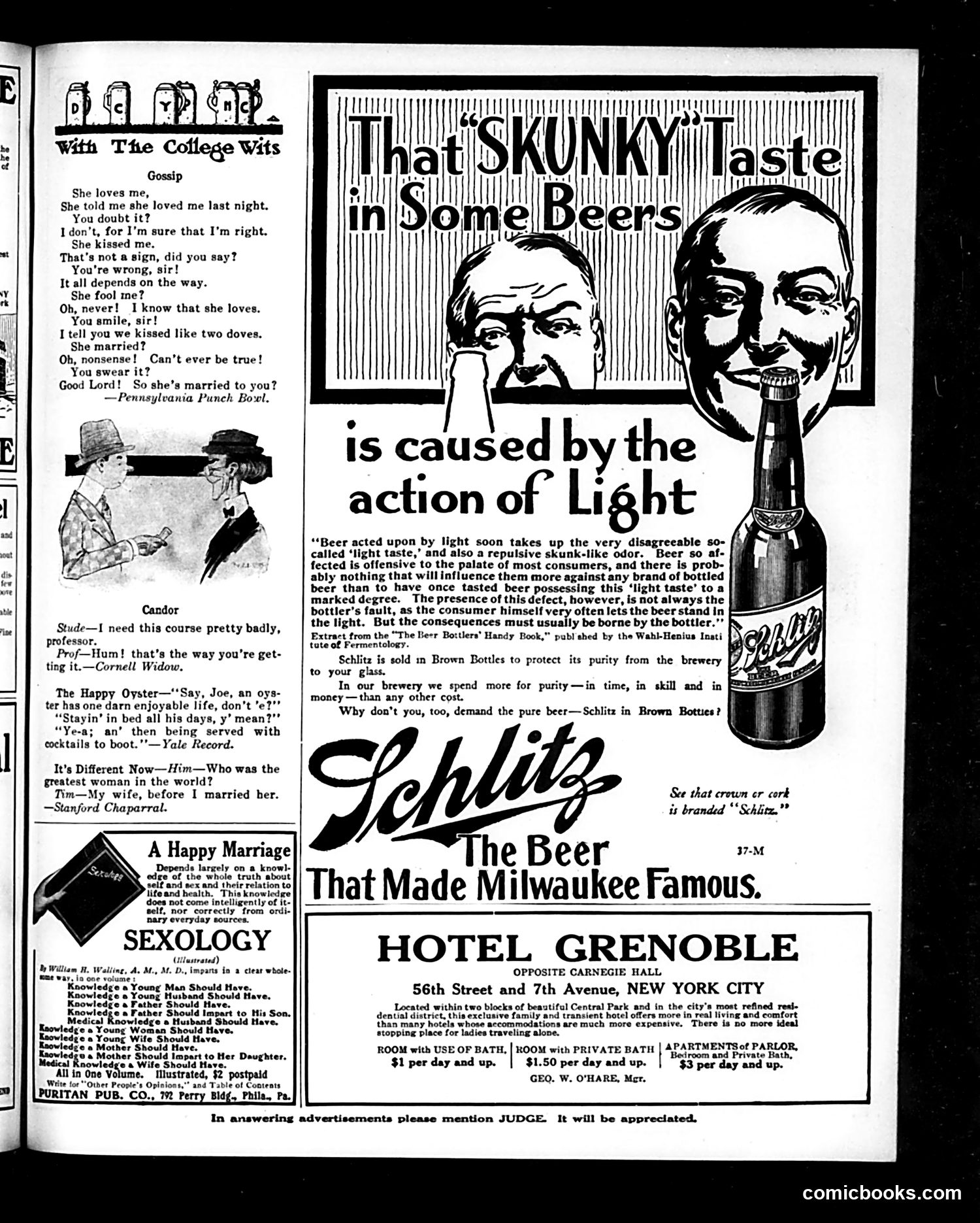
This page combines college humor with period advertising. The left side features "With The College Wits"—brief jokes from university publications (Pennsylvania Punch Bowl, Cornell Widow, Yale Record, Stanford Chaparral). These typically involve romantic misunderstandings: a man confidently believes a woman loves him, only to learn she's married to someone else; a student flatters a professor; an oyster enjoys being served with cocktails. The humor reflects early 20th-century college culture's preoccupation with courtship confusion and casual witticisms. The dominant content is a **Schlitz beer advertisement** exploiting legitimate chemistry: beer exposed to light develops an unpleasant "skunky" taste. Schlitz markets brown bottles as superior protection for purity. The ad quotes brewery authority and emphasizes manufacturing investment in quality. Below appears a **Hotel Grenoble advertisement** targeting affluent NYC travelers, particularly "ladies traveling alone," emphasizing proximity to Central Park and refined neighborhood credentials. The page reflects pre-Prohibition commercial culture where beer advertising appeared alongside mainstream editorial content.
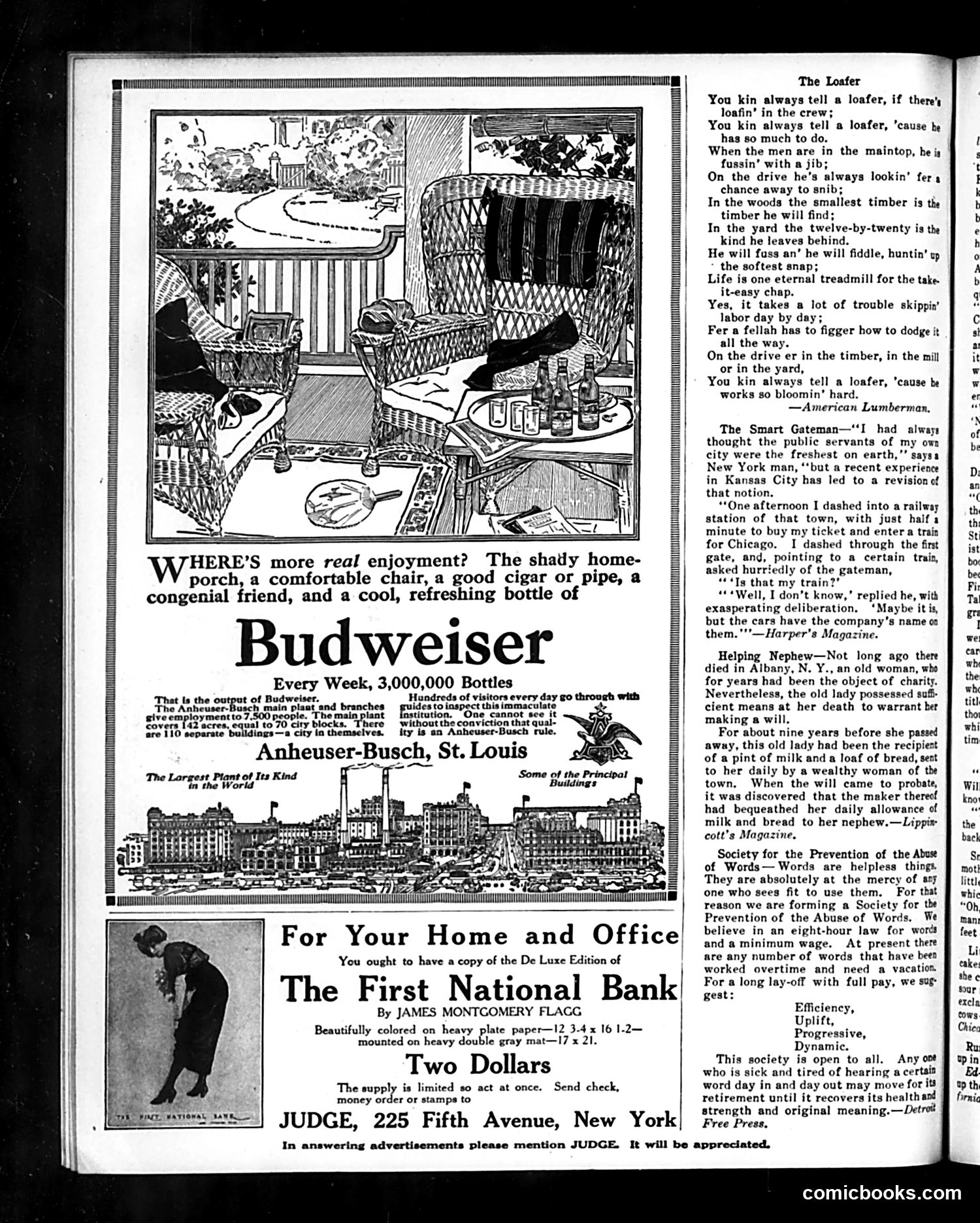
This is primarily a **Budweiser beer advertisement** occupying most of the page, depicting a man relaxing on a home porch—the idealized leisure scenario the brewery marketed to sell beer as essential to domestic comfort. The page also contains several **humorous short pieces**: - **"The Loafer"**: A folk-style poem (credited to American Lumberman) that paradoxically celebrates a worker who avoids labor yet "works so bloomin' hard" at dodging work—satire on workplace laziness. - **"The Smart Gateman"**: A anecdote mocking a Kansas City railroad employee's unhelpful attitude toward a rushed passenger. - **"Helping Nephew"**: A brief story about an elderly charity recipient who leaves her daily milk and bread allowance to a nephew in her will—gentle satire on unexpected inheritances. - **"Society for the Prevention of the Abuse of Words"**: Satirizes overworked language by proposing an "eight-hour law" for words needing vacation. These pieces typify Judge's mix of social satire and light humor targeting American manners and speech.
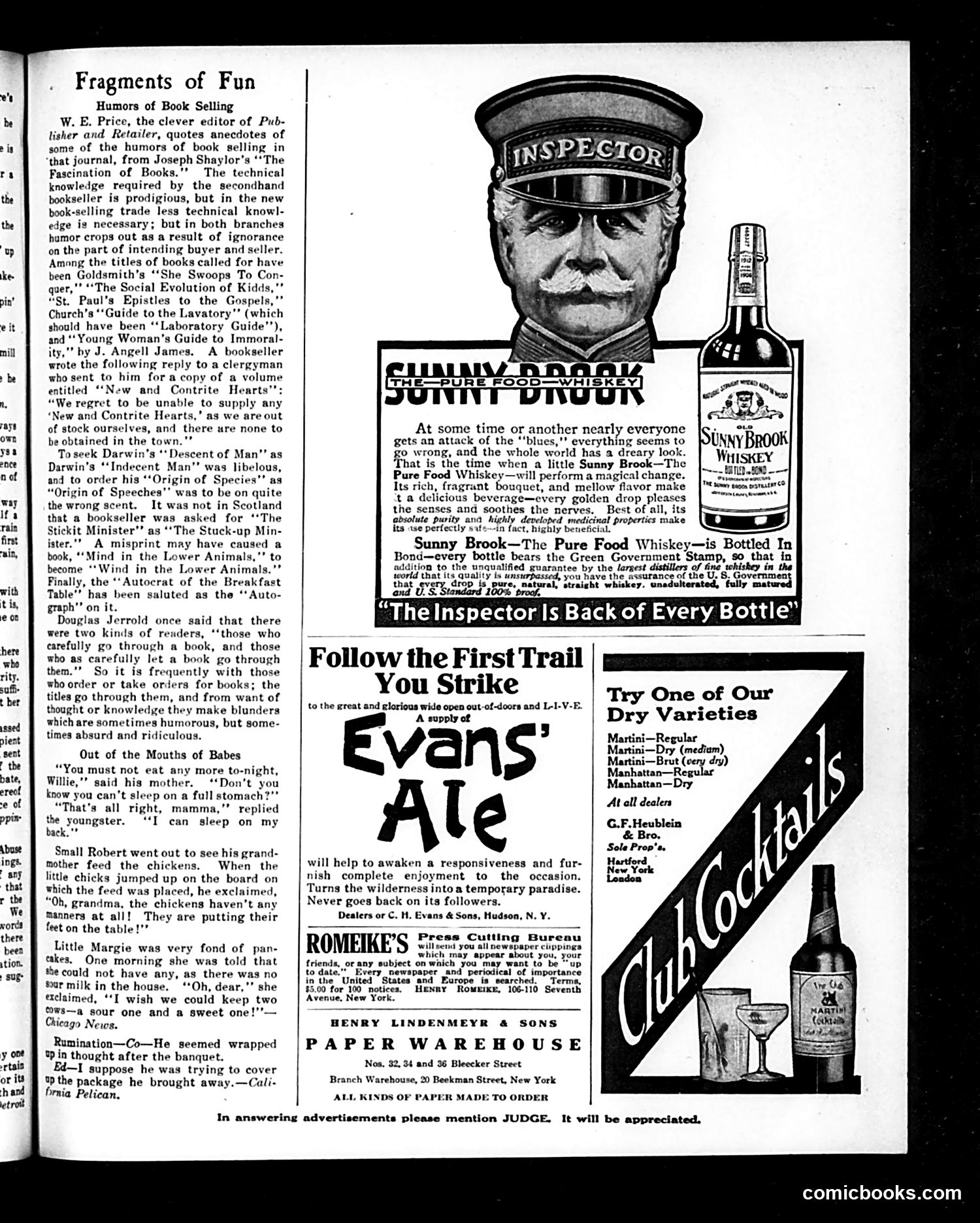
This page combines humorous anecdotes about book selling with period advertisements. The left column recounts comic mishearings and misorderings of book titles—customers asking for "She Swoops to Conquer" instead of Goldsmith's "She Stoops to Conquer," or "Origin of Speeches" for Darwin's "Origin of Species." These reflect genuine literacy gaps and the absurdities that emerged when semi-educated customers ordered books by ear or memory, without careful reading. The humor assumes readers would catch these errors and enjoy the mockery of working-class and rustic ignorance. Short jokes follow about children's innocent malapropisms. The right side features period whiskey and ale advertisements, typical of Judge magazine's revenue model. The Sunny Brook whiskey ad notably markets itself as "Pure Food Whiskey"—a legal sales pitch following 1906 Pure Food and Drug Act regulations—and claims medicinal benefits, common advertising claims before stricter regulations. The Evans' Ale and Cockhill's ads are standard period drink promotions.
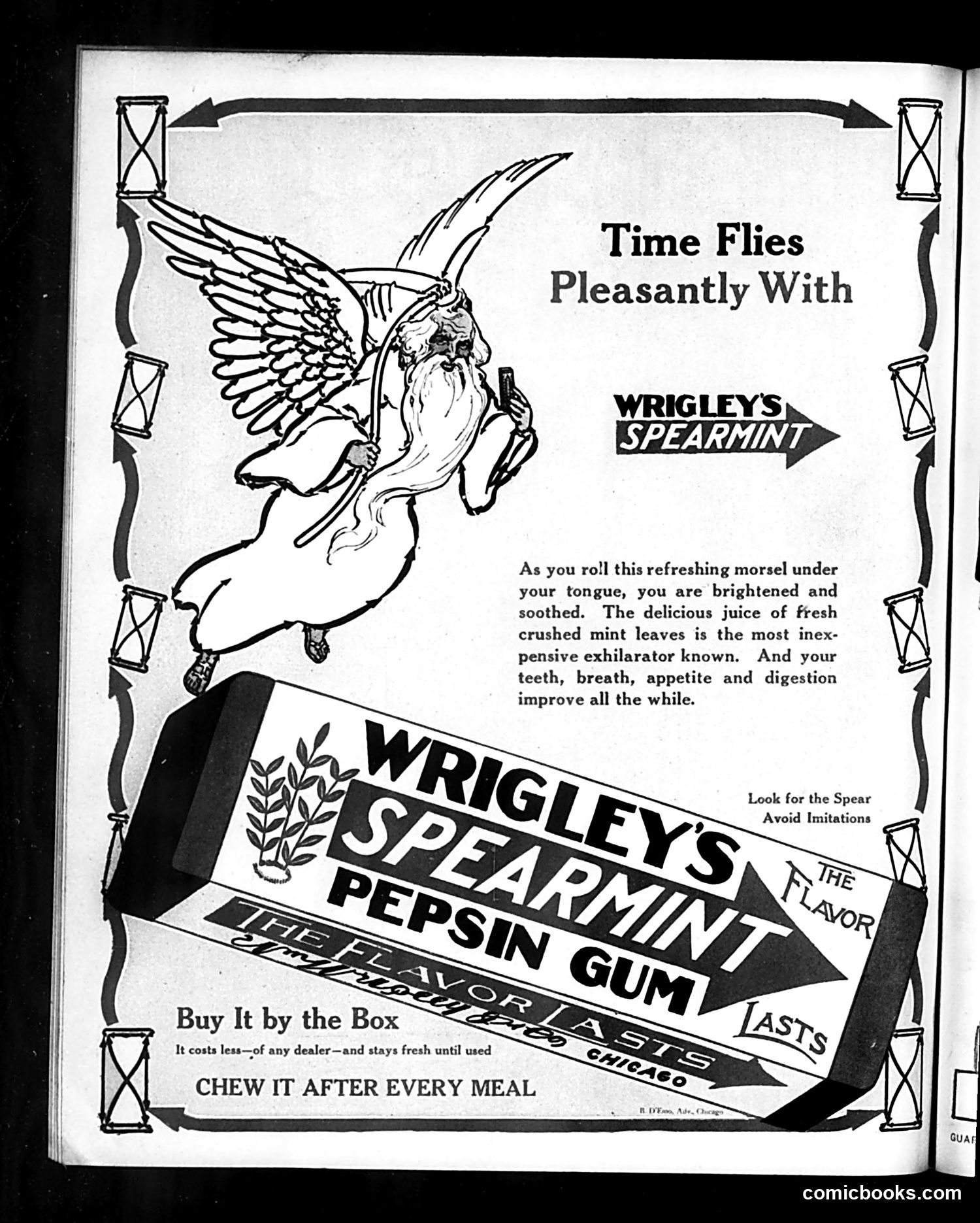
This page is primarily a **product advertisement**, not a political cartoon. It promotes Wrigley's Spearmint Gum, featuring an illustration of Chronos (Father Time) with wings, hourglass, and scythe—a classical personification of time itself. The ad's central message plays on the phrase "time flies": chewing this gum makes time pass pleasantly. The text claims the mint provides an "inexpensive exhilarator" and improves teeth, breath, appetite, and digestion. The satirical or humorous element is minimal—it's primarily a straightforward product pitch using classical imagery to suggest that a simple stick of gum transforms the experience of passing time. The page demonstrates Judge magazine's common function: mixing editorial content with paid advertising to sustain publication costs.