
Judge, 1913-05-17 · page 10 of 24
Judge — May 17, 1913 — page 10: what you’re looking at
What you’re looking at
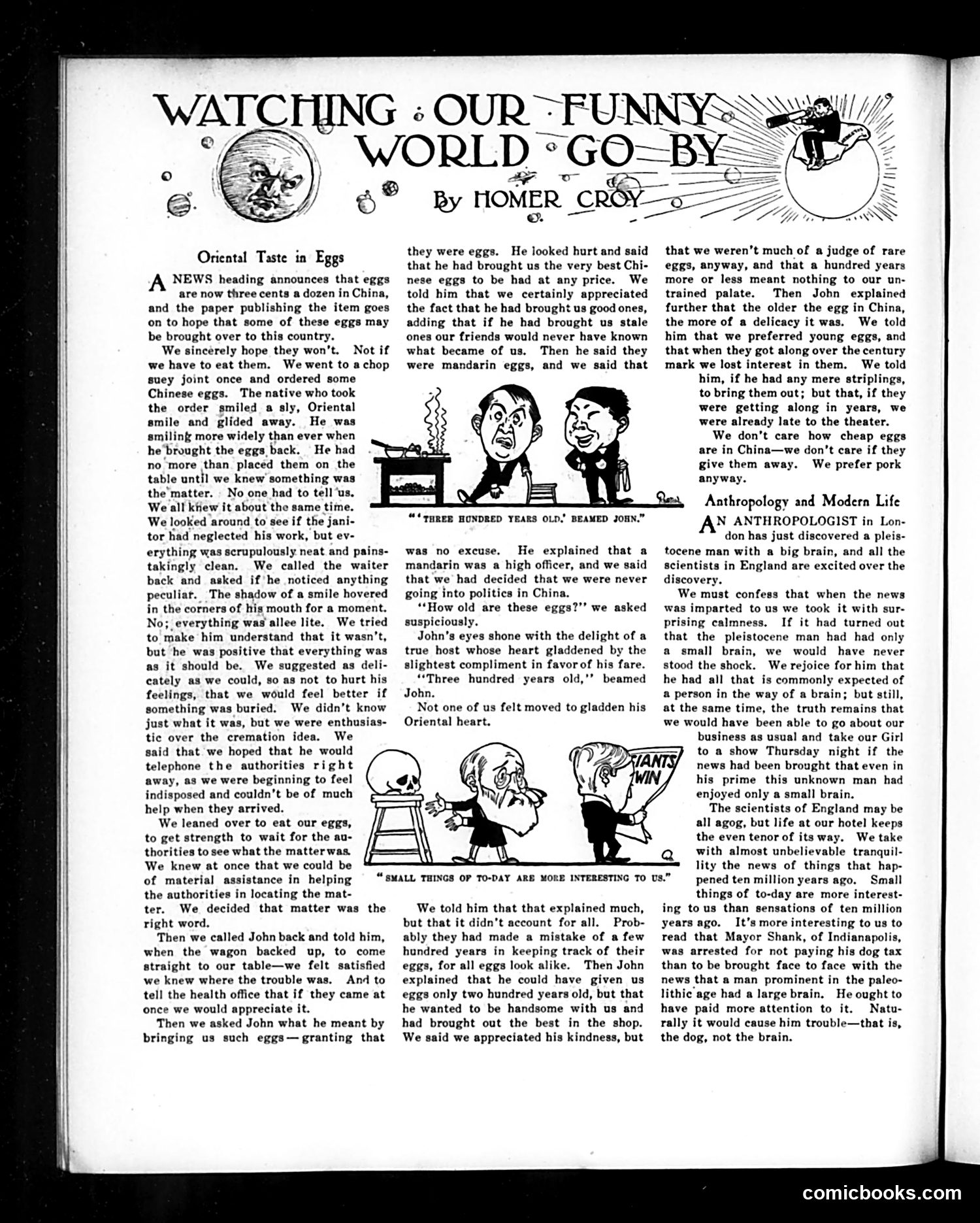
This satirical piece by Homer Croy mocks both Chinese cuisine and American attitudes toward it. The main joke: the author orders eggs at a Chinese restaurant and finds them inedible—so foul-smelling that he suggests calling authorities and having them cremated. When confronted, the waiter proudly reveals they are "mandarin eggs"—allegedly 300 years old, presented as a delicacy. The satire works on multiple levels: it ridicules Chinese culinary practices (particularly preserved/aged eggs, likely century eggs), stereotypes Chinese waiters as inscrutable and defensive, and mocks American diners' squeamishness about unfamiliar food. The secondary "Anthropology and Modern Life" piece continues this theme of dismissing non-Western cultures as intellectually backward. The humor relies on ethnic caricature and food-based xenophobia typical of 1920s Judge magazine.
📄 Transcribed text from this page (OCR, searchable)
Machine-transcribed from the original scan — historical spelling and the odd misread are preserved.
OEE WIC OUR -FUNNYSS 3S WORLD ° SS =BY_ Oriental Taste in Eggs A NEWS heading announces that eggs are now three cents a dozen in China, and the paper publishing the item goes on to hope that some of these eggs may be brought over to this country. We sincerely hope they won't. Not if we have to eat them. We went to achop suey joint once and ordered some Chinese eggs. The native who took the order smiled a sly, Oriental smile and glided away. He was smiling more widely than ever when he brought the eggs back. He had no more than placed them on the table until we knew something was the’matter. No one had to tell ‘us. We all kiiew it about the same time. We looked around to see if the jani- tor had neglected his work, but ev- erything was scrupulously neat and pains- takingly clean. We called the waiter back and asked if'he noticed anything peculiar. The shadow of a smile hovered in the corners of his mouth for a moment. No;_everything was allee lite. We tried to make him understand that it wasn’t, but he was positive that everything was as it should be. We suggested as deli- cately as we could, so as not to hurt his feelings, that we would feel better if something was buried. We didn’t know just what it was, but we were enthusias- tic over the cremation idea. We said that we hoped that he would telephone the authorities right away, as we were beginning to feel indisposed and couldn't be of much help when they arrived. We leaned over to eat our eggs, to get strength to wait for the au- thorities to see what the matterwas. We knew at once that we could be of material assistance in helping the authorities in locating the mat- ter. We decided that matter was the right word. Then we called John back and told him, when the wagon backed up, to come straight to our table—we felt satisfied we knew where the trouble was. And to tell the health office that if they came at once we would appreciate it. Then we asked John what he meant by bringing us such eggs—granting that By HOMER CRO they were eggs. He looked hurt and said that he had brought us the very best Chi- nese eggs to be had at any price. We told him that we certainly appreciated the fact that he had brought us good ones, adding that if he had brought us stale ones our friends would never have known what became of us. Then he said they were mandarin eggs, and we said that “*THREE HUNDRED YEARS OLD,’ BEAMED JOHN.” was no excuse. He explained that a mandarin was a high officer, and we said t we had decided that we were never going into politics in China. ‘*How old are these eggs?”’ we asked suspiciously. John's eyes shone with the delight of a true host whose heart gladdened by the slightest compliment in favor of his fare. “Three hundred years old,’’ beamed John. Not one of us felt moved to gladden his Oriental heart. “SMALL THINGS OP TO-DAY ARE MORE INTERESTING TO US.” We told him that that explained much, but that it didn’t account for all. Prob- ably they had made a mistake of a few hundred years in keeping track of their eggs, for all eggs look alike. Then John explained that he could have given us eggs only two hundred years old, but that he wanted to be handsome with us and had brought out the best in the shop. We said we appreciated his kindness, but SSS aes SA 2; Yu > that we weren't much of a judge of rare eggs, anyway, and that a hundred years more or less meant nothing to our un- trained palate. Then John explained further that the older the egg in China, the more of a delicacy it was. We told him that we preferred young eggs, and that when they got along over the century mark we lost interest in them. We told him, if he had any mere striplings, to bring them out; but that, if they were getting along in years, we were already late to the theater. We don’t care how cheap eggs are in China—we don’t care if they give them away. We prefer pork anyway. Anthropology and Modern Life AN ANTHROPOLOGIST in Lon- don has just discovered a pleis- tocene man with a big brain, and all the scientists in England are excited over the discovery. We must confess that when the news was imparted to us we took it with sur- prising calmness. If it had turned out that the pleistocene man had had only a small brain, we would have never stood the shock. We rejoice for him that he had all that is common a person in the way of a brai at the same time, the truth remains that we would have been able to go about our business as usual and take our Girl to a show Thursday night if the news had been brought that even in his prime this unknown man had enjoyed only a small brain. The scientists of England may be all agog, but life at our hotel keeps the even tenor of its way. We take with almost unbelievable tranquil- lity the news of things that hap- pened ten million years ago. Small things of to-day are more interest- ing tous than sensations of ten million years ago. It's more interesting to us to read that Mayor Shank, of Indianapolis, was arrested for not paying his dog tax than to be brought face to face with the news that a man prominent in the paleo- lithic 'age had a large brain. He ought to have paid more attention to it. Natu- rally it would cause him trouble—that is, the dog, not the brain. comicbooks.com