
Judge, 1913-05-17 · page 7 of 24
Judge — May 17, 1913 — page 7: what you’re looking at
What you’re looking at
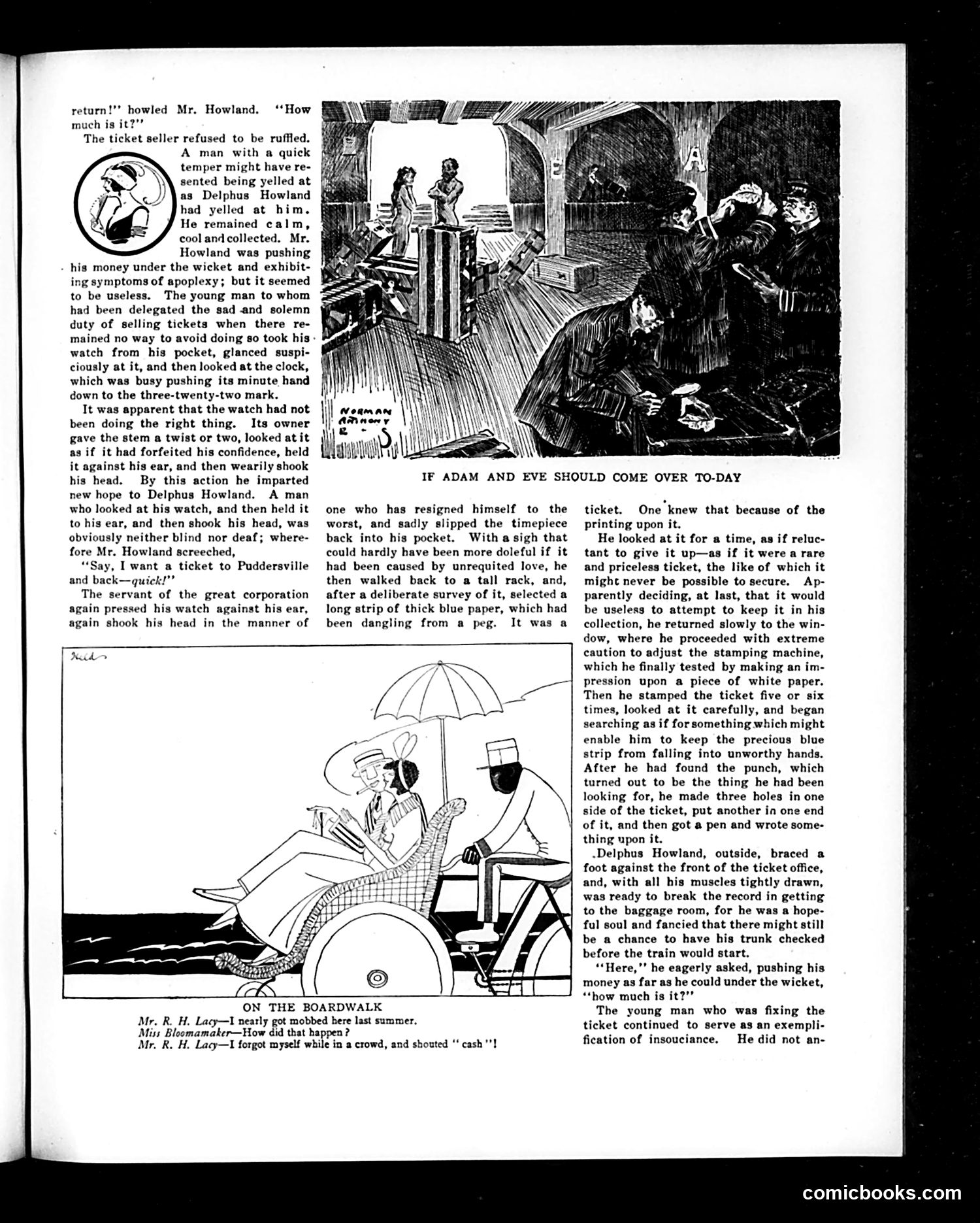
This page satirizes **railroad ticket office inefficiency and bureaucratic indifference**—a common complaint in early 20th-century America. The main narrative mocks a ticket seller's deliberate slowness. When impatient customer Delphus Howland demands a ticket to "Puddersville," the clerk responds with exaggerated lethargy: checking his broken watch, sighing mournfully, selecting the ticket reluctantly as if parting with treasure, testing the stamping machine repeatedly, punching holes obsessively, and writing mysterious notes. The clerk's "insouciance" (cool indifference) infuriates the desperate Howland, who fears missing his train. The sidebar cartoon "On the Boardwalk" offers unrelated social satire: a man caused a mob scene by shouting "cash!"—suggesting wealthy boardwalk crowds were scandalized by crude commercial language, a jab at upper-class pretension. Both items mock American institutional incompetence and class absurdities typical of Judge's satirical approach.
📄 Transcribed text from this page (OCR, searchable)
Machine-transcribed from the original scan — historical spelling and the odd misread are preserved.
return !’” much i The ticket seller refused to be ruffled. A man with a quick temper might have re- sented being yelled at as Delphus Howland had yelled at him. He remained calm, cool andcollected. Mr. Howland was pushing . his money under the wicket and exhibit- ing symptoms of apoplexy; but it seemed to be useless. The young man to whom had been delegated the sad and solemn duty of selling tickets when there re- howled Mr. Howland. ‘How mained no way to avoid doing 80 took his - watch from his pocket, glanced suspi- ciously at it, and then looked at the clock, which was busy pushing its minute hand down to the three-twenty-two mark. It was apparent that the watch had not been doing the right thing. Its owner gave the stem a twist or two, looked at it as if it had forfeited his confidence, held it against his ear, and then wearily shook his head. By this action he imparted new hope to Delphus Howland. A man who looked at his watch, and then held it to his ear, and then shook his head, was obviously neither blind nor deaf; where- fore Mr. Howland screeched, “Say, I want a ticket to Puddersville and back—quick!”” The servant of the great corporation again pressed his watch against his ear, again shook his head in the manner of IF ADAM AND EVE SHOULD COME OVER TO-DAY one who has resigned himself to the worst, and sadly slipped the timepiece back into his pocket. With a sigh that could hardly have been more doleful if it had been caused by unrequited love, he then walked back to a tall rack, and, after a deliberate survey of it, selected a long strip of thick blue paper, which had been dangling from a peg. It was a [ xus- sm ga ON THE BOARDWALK Mr. R. H. Lacy—I nearly got mobbed here last summer. Miss Bloomamaker—How did that happen ? Mr. R. H. Lacy—1 forgot myself while in a crowd, and shouted “‘ cash ""! ticket. One knew that because of the printing upon it. He looked at it for a time, as if reluc- tant to give it up—as if it were a rare and priceless ticket, the like of which it might never be possible to secure. Ap- parently deciding, at last, that it would be useless to attempt to keep it in his collection, he returned slowly to the win- dow, where he proceeded with extreme caution to adjust the stamping machine, which he finally tested by making an im- pression upon a piece of white paper. Then he stamped the ticket five or six times, looked at it carefully, and began searching as if for something which might enable him to keep the precious blue strip from falling into unworthy hands. After he had found the punch, which turned out to be the thing he had been looking for, he made three holes in one side of the ticket, put another in one end of it, and then got a pen and wrote some- thing upon it. -Delphus Howland, outside, braced a foot against the front of the ticket office, and, with all his muscles tightly drawn, was ready to break the record in getting to the baggage room, for he was a hope- ful soul and fancied that there might still be a chance to have his trunk checked before the train would start. “‘Here,’’ he eagerly asked, pushing his money as far as he could under the wicket, “how much is it?” The young man who was fixing the ticket continued to serve as an exempli- fication of insouciance. He did not an- comicbooks.com