
A complete issue · 24 pages · 1913
Judge — May 10, 1913
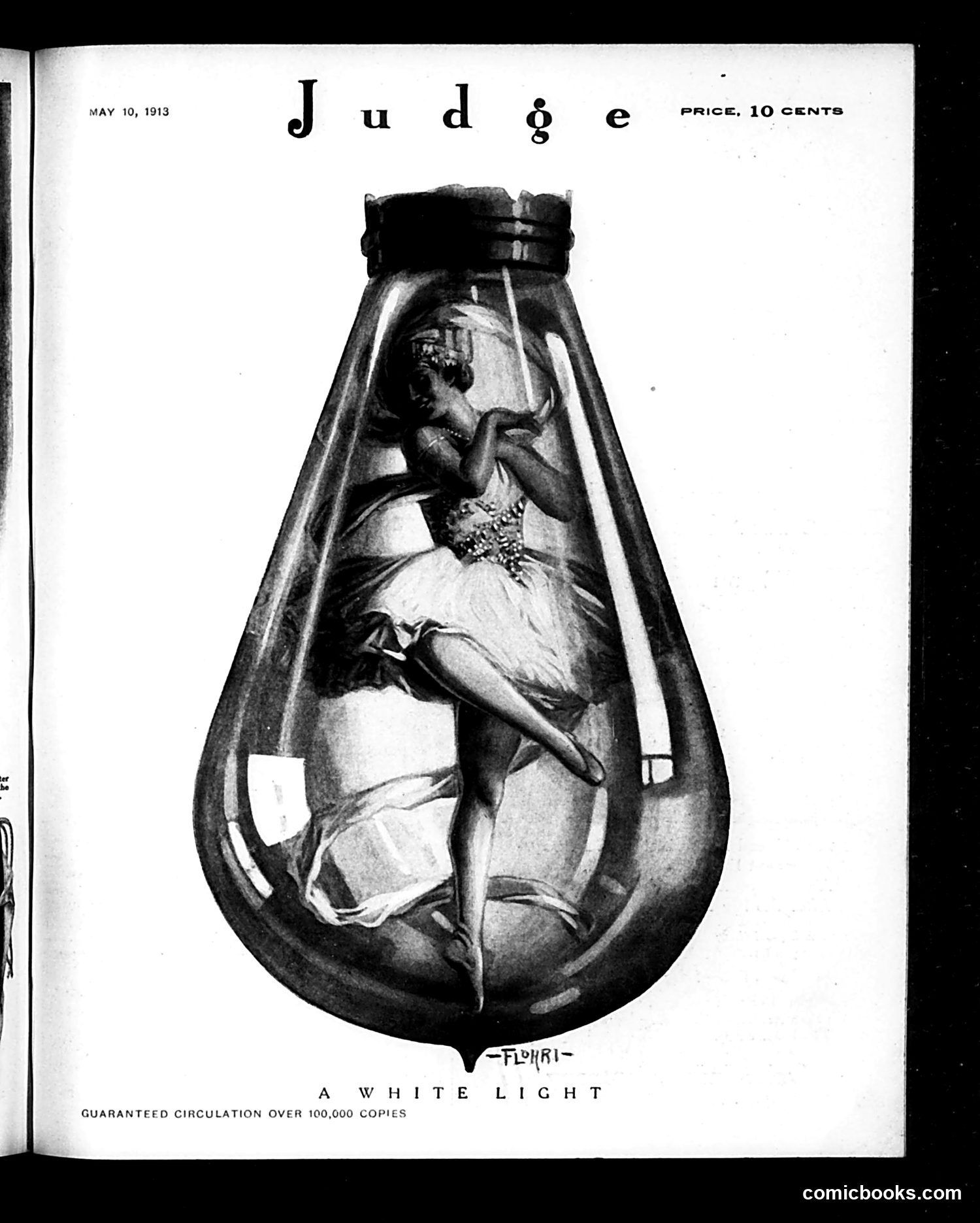
This cover depicts a figure of Lady Justice or Justitia enclosed within a light bulb, titled "A White Light." The image appears to be political satire commenting on judicial clarity or enlightenment, likely referencing a specific legal case or reform movement of 1913. The figure trapped within the bulb suggests justice is being contained or restricted by industrial/modern constraints. The "white light" reference may allude to either progressive reform ideals ("shedding light" on corruption) or, conversely, the false promise of such reform. Without additional context about specific 1913 events, the precise satirical target remains unclear, though it likely comments on either judicial reform, corporate power limiting justice, or public illumination of legal proceedings.
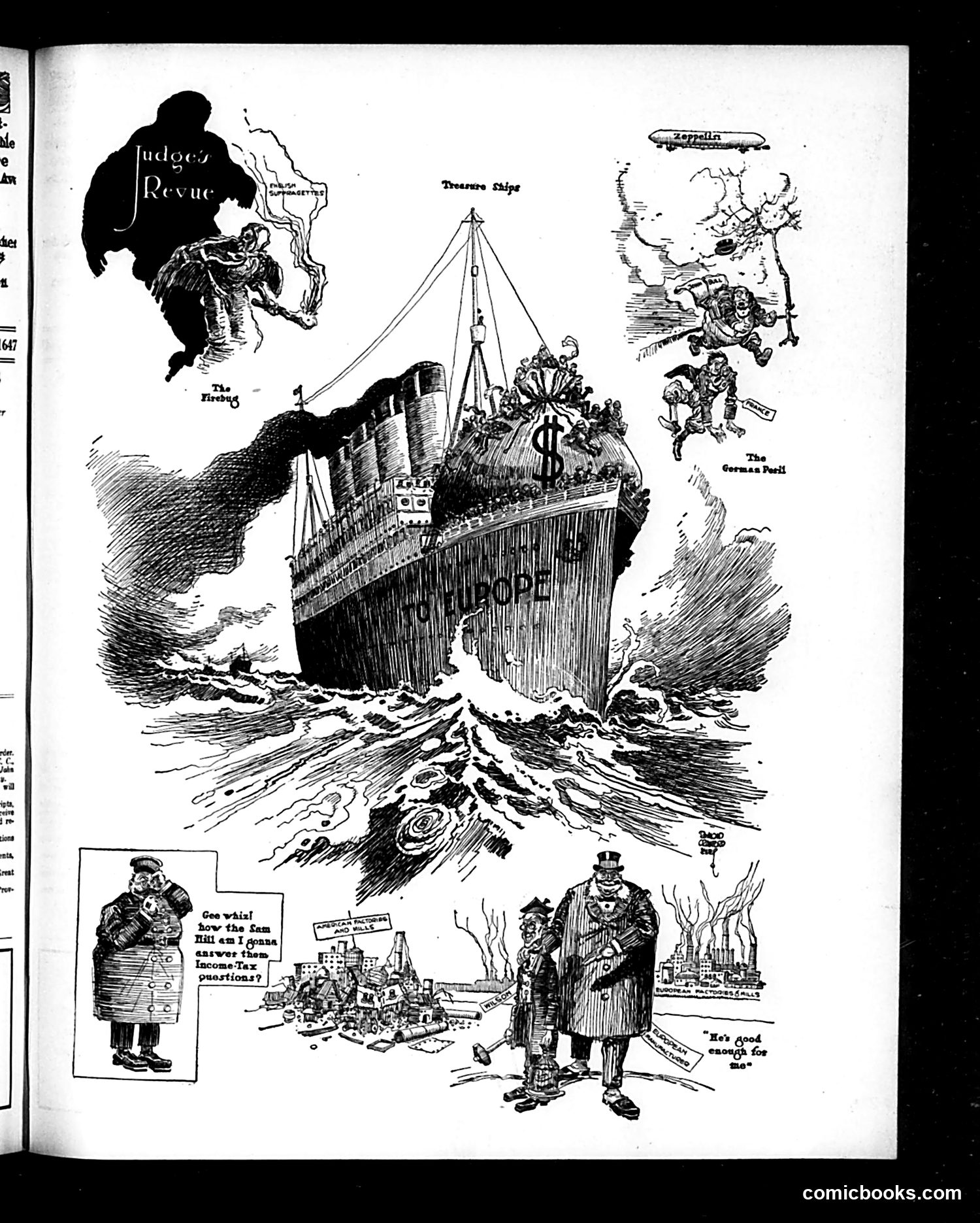
This appears to be early 20th-century satirical commentary on ocean liner economics and wealth. The central image depicts a massive ship laden with cargo and wealthy passengers, with its hull grounded on what appears to be a hazardous reef or rocky foundation labeled with a dollar sign—suggesting financial instability underpins the enterprise. The surrounding vignettes criticize those profiting from this system: "Judge's Revue" features caricatured figures, "Treasure Ships" references the vessel's cargo, and "The German Peril" likely references contemporary anxieties about German competition or naval power. The bottom panels appear to satirize wealthy industrialists' hypocrisy, with one figure asking about "carving them income-tax provisions" while another remarks such profits are "good enough for me"—critiquing wealth accumulation during an era of increasing progressive taxation debates.
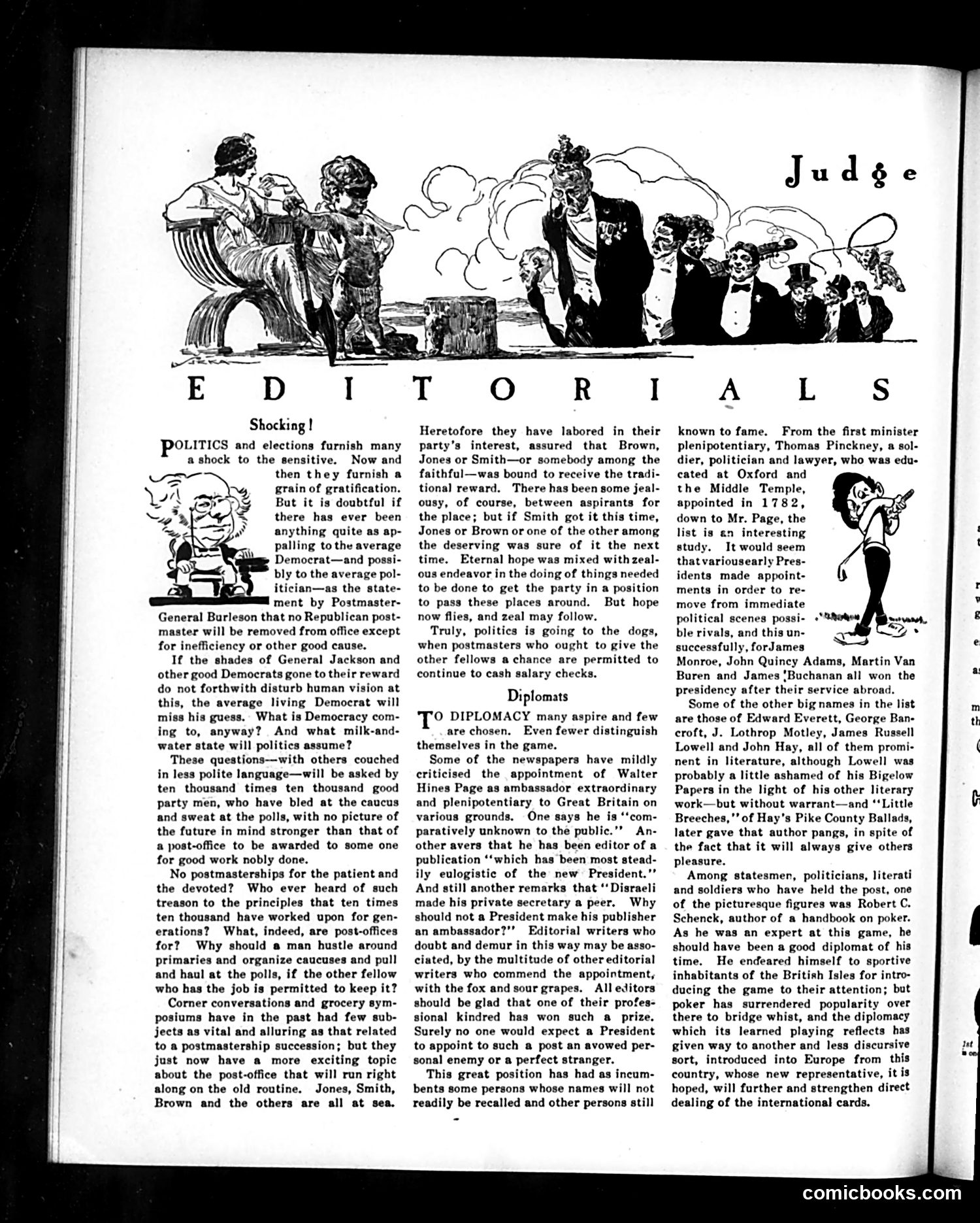
This "Editorials" page from Judge satirizes American political patronage and appointment systems. The masthead cartoon depicts a bloated judge figure surrounded by well-dressed men in formal attire—likely representing politicians and office-seekers competing for government positions. The accompanying text criticizes how political parties use postmaster and diplomatic appointments as rewards for party loyalty rather than merit. It mocks the expectation that winning an election entitles party members to "cash salary checks" and government sinecures. The satire targets both the corruption of the spoils system and the absurdity of unqualified individuals receiving diplomatic posts. References to specific appointees (Walter Hines Page as ambassador) suggest this addresses actual 1910s-era patronage controversies under a particular administration.
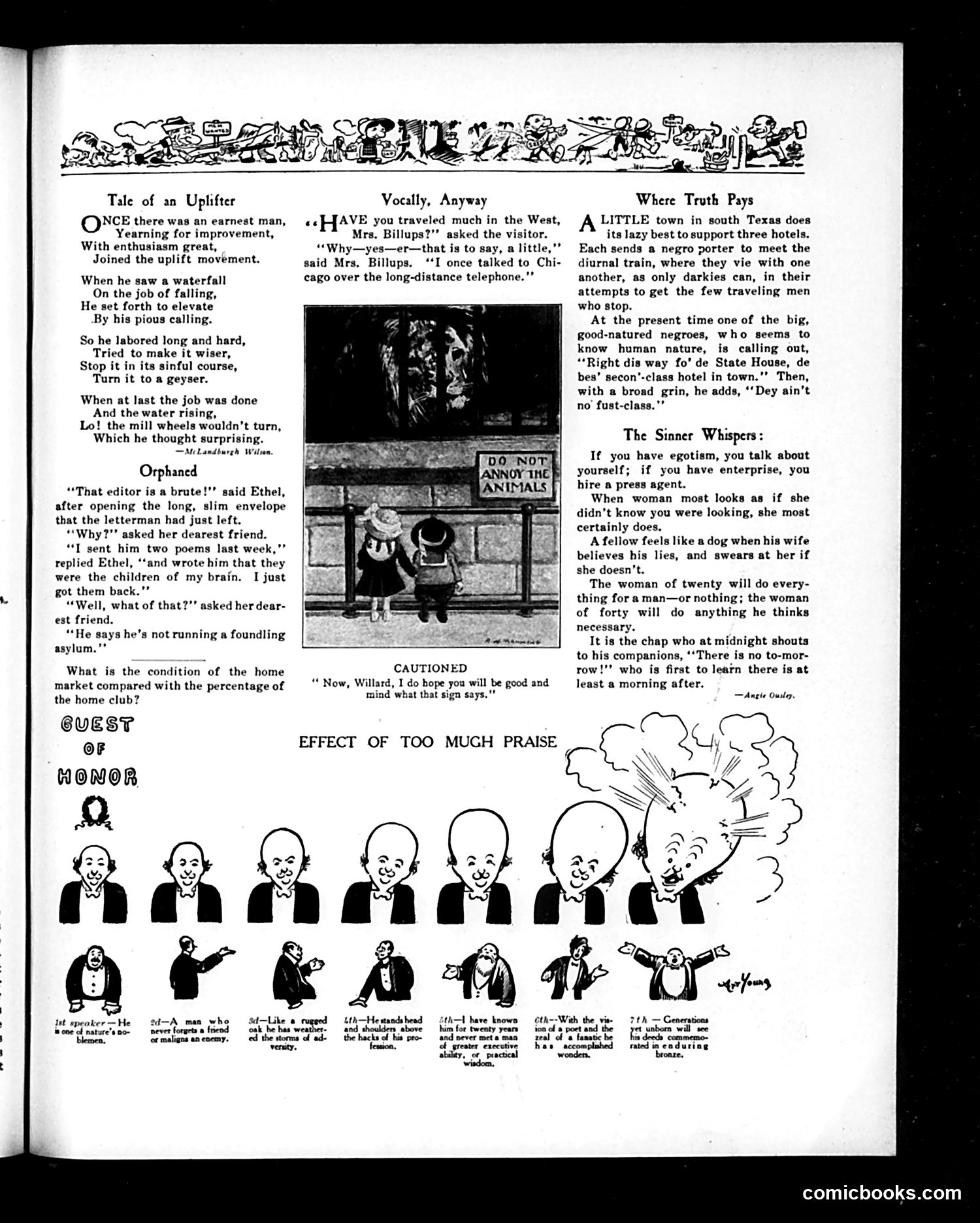
This page contains three distinct pieces of satirical content: 1. **"Tale of an Uplift"**: A poem mocking social reform movements, suggesting an idealistic reformer's efforts to improve a mill are frustrated when the machinery won't turn—satirizing the practical failures of well-intentioned reform. 2. **"Where Truth Pays"**: Commentary on American hotels, noting that Black porters work the diurnal train routes while meeting white travelers, with one porter calling out segregated accommodations as "fuss-class" rather than first-class—a critique of Jim Crow era discrimination. 3. **"Effect of Too Much Praise"**: A cartoon sequence showing a man's head progressively inflating from excessive flattery until it explodes—a visual joke about the dangers of vanity and ego inflation from unwarranted compliments. The page satirizes social hypocrisy, racial discrimination, and human weakness simultaneously.
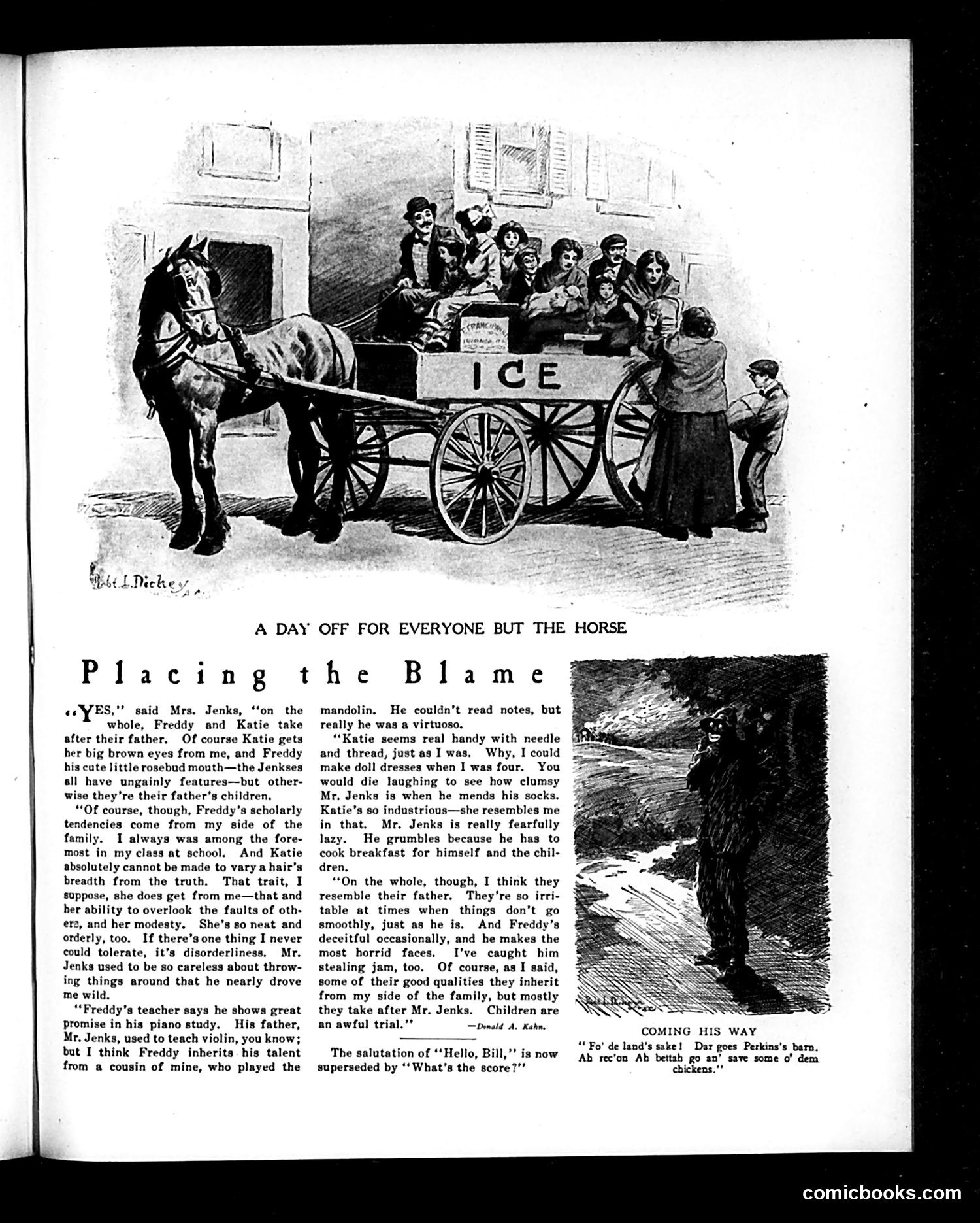
The main cartoon depicts a horse-drawn ice wagon surrounded by people enjoying a day off—everyone relaxes except the horse, who must still work. The title's irony is the satire's point: leisure is universal except for the beast of burden. The accompanying story, "Placing the Blame," satirizes a common social type: Mrs. Jenks, who constantly credits her children's good traits to herself while blaming her husband for their faults. She claims their honesty, industriousness, and musical talent come from her side of the family, while their irritability, deceitfulness, and laziness derive from Mr. Jenks. The humor lies in her obliviousness—she simultaneously insists they "resemble their father" while attributing nearly all positive qualities to herself. This mocks self-deluded parents who rationalize family dynamics through selective attribution, never acknowledging their own role in their children's shortcomings.
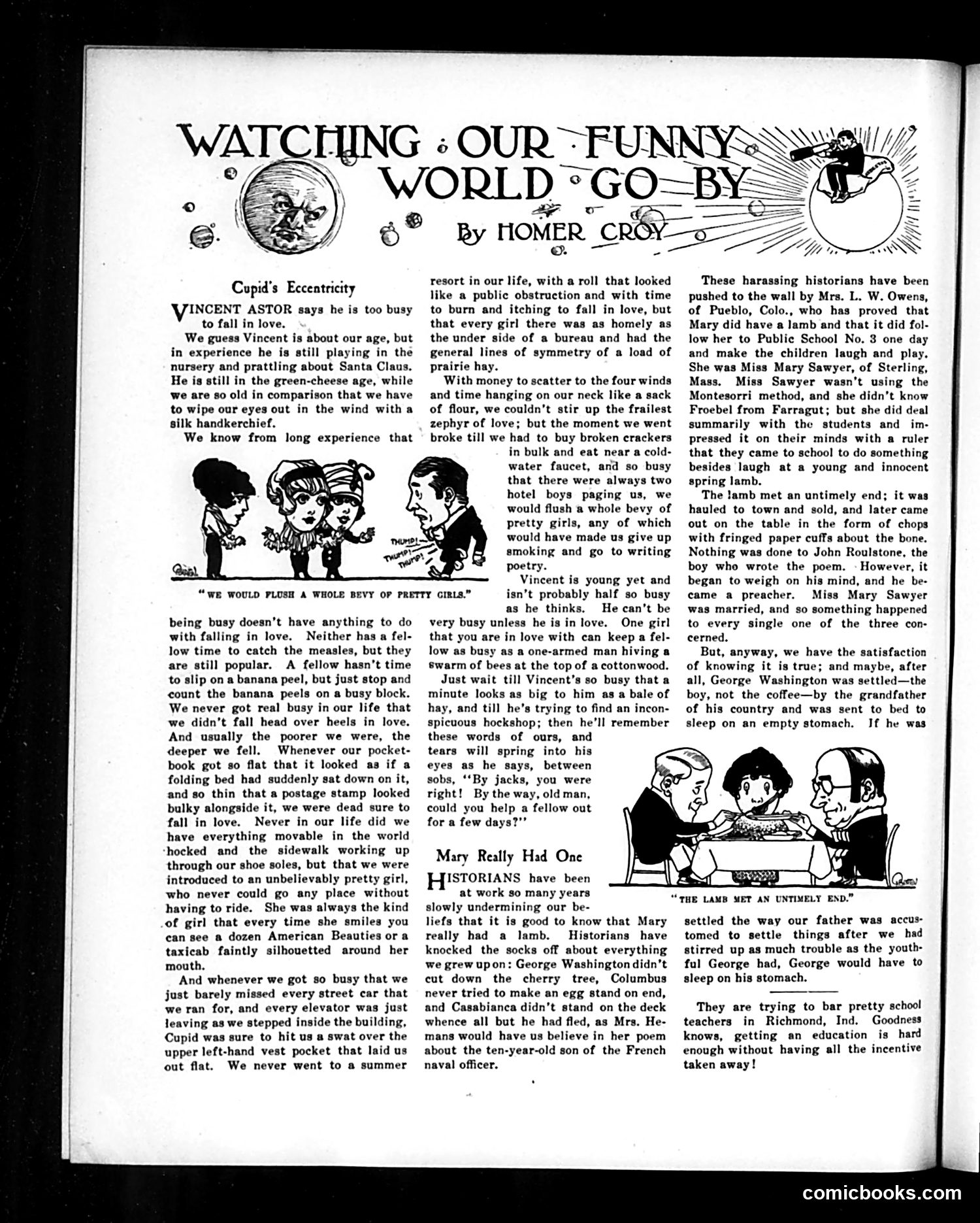
This satirical essay by Homer Croy mocks **Vincent Astor's claim of being too busy to fall in love**. Astor was a wealthy heir and socialite of the era. The joke is that busyness has nothing to do with romance—the author argues from personal experience that poverty and exhaustion paradoxically *attract* women. The poorer and busier he was, the more "pretty girls" appeared; when wealthy with free time, he found only homely women. He predicts young Vincent, currently claiming business prevents romance, will eventually discover love when he's truly desperate (broke, frantically seeking a pawnshop). The secondary piece debunks historical myth-busting, celebrating that **Mary's lamb was actually real**—one small victory against scholars who've demolished beloved legends like Washington's cherry tree and Columbus's egg trick. The cartoons illustrate these romantic and historical themes humorously.
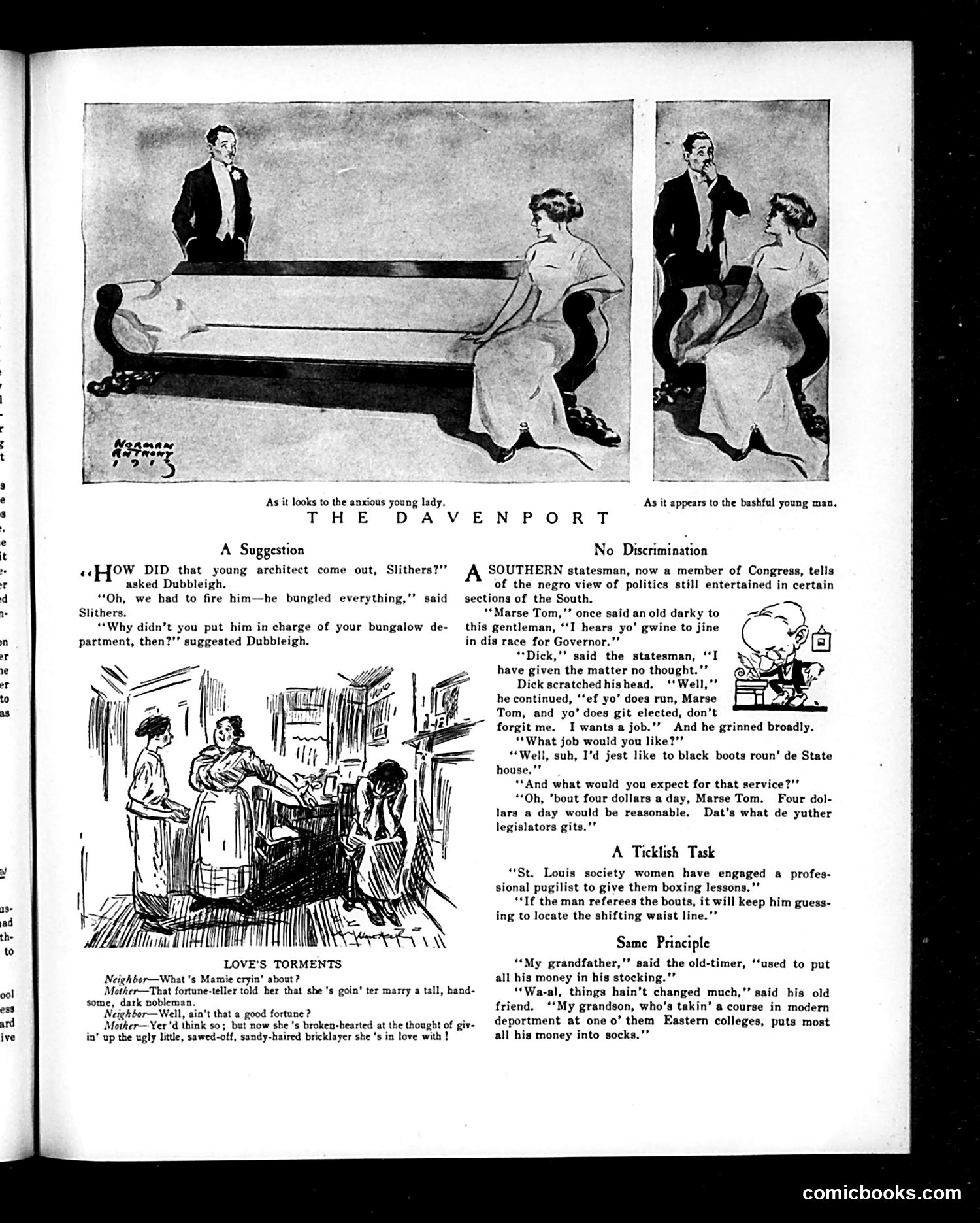
This page contains several satirical pieces reflecting early 20th-century American attitudes: **"The Davenport"** (top): A visual gag about perspective—the furniture piece appears dramatically elongated to an anxious woman but normal-sized to a bashful man, likely joking about how emotional states distort perception. **"No Discrimination"** (right): Satire on post-Reconstruction Southern politics. A Black man asks a newly elected congressman for a job "blackin' boots" at the statehouse, requesting the same pay as legislators. The joke targets Southern corruption—suggesting state legislators were themselves getting meager, questionable compensation. **"A Ticklish Task"** and **"Same Principle"** (bottom right): Brief quips about changing fashions (women's boxing) and generational consistency (money management). **"Love's Torments"** (bottom left): A woman is heartbroken that a fortune-teller predicted she'd marry a tall, handsome nobleman—not the short, homely bricklayer she actually loves. The overall page uses humor to comment on social hierarchies, political corruption, and romantic absurdity typical of Judge's satirical approach.
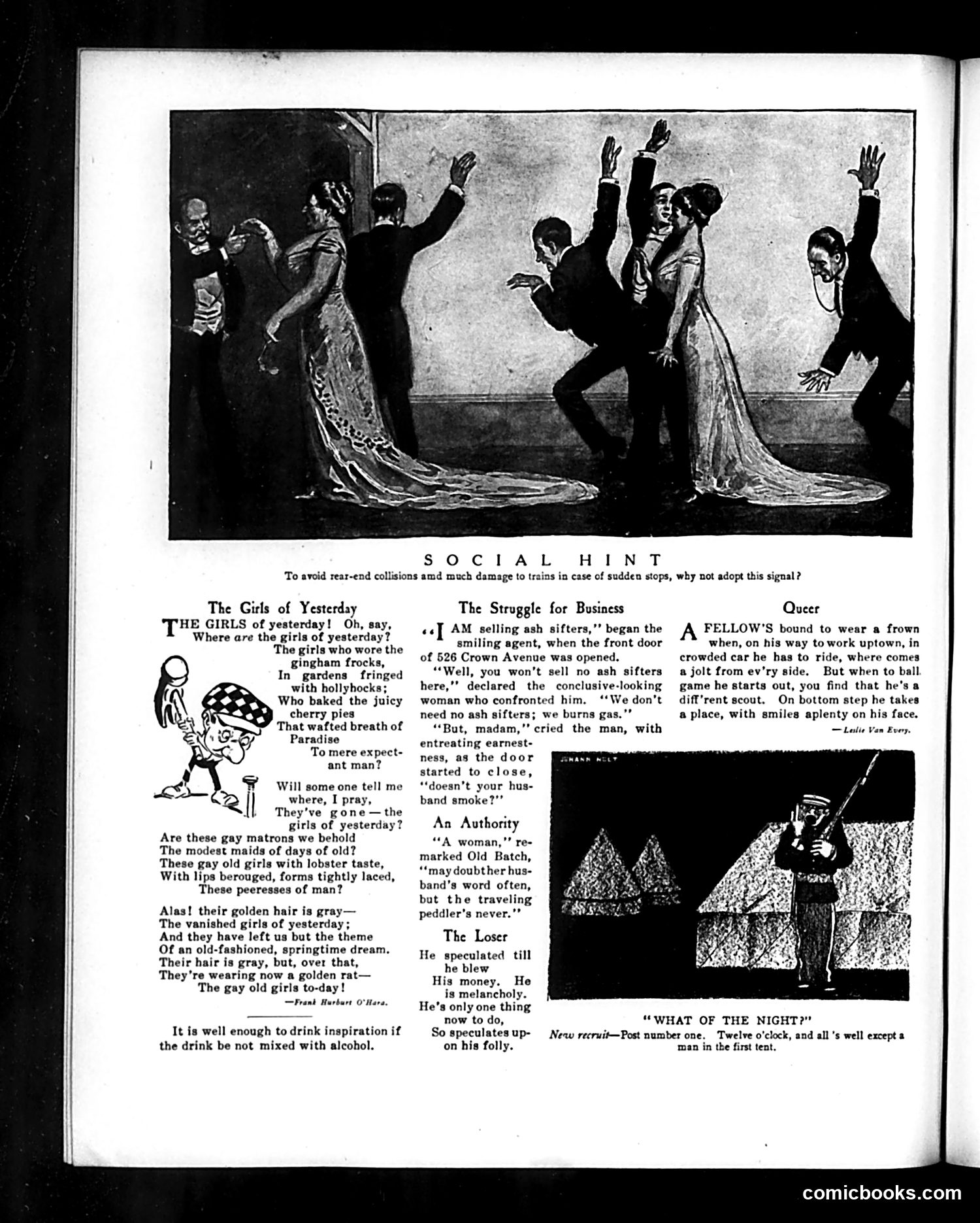
This page contains multiple short humorous pieces typical of early 20th-century satirical journalism: **"The Girls of Yesterday"** is nostalgic social commentary lamenting how modern women have changed. The poem mourns the loss of modest, domestic "girls of yesterday" who baked pies, contrasting them with current "gay old girls" who wear rouge, tight corsets, and artificial hair pieces ("golden rat"). It's conservative social satire about changing gender roles and female independence. **"The Struggle for Business"** presents a traveling salesman's futile pitch—he tries selling ash sifters to a woman who uses gas heating, then asks about her husband smoking. The joke reflects early advertising and consumer culture shifts. **The other brief pieces** ("An Authority," "The Loser," "Queer," and "What of the Night?") are scattered humor items typical of the magazine's format. **The top illustration** shows figures in formal dress with exaggerated gestures, likely satirizing social behavior, though the specific reference remains unclear without additional context.
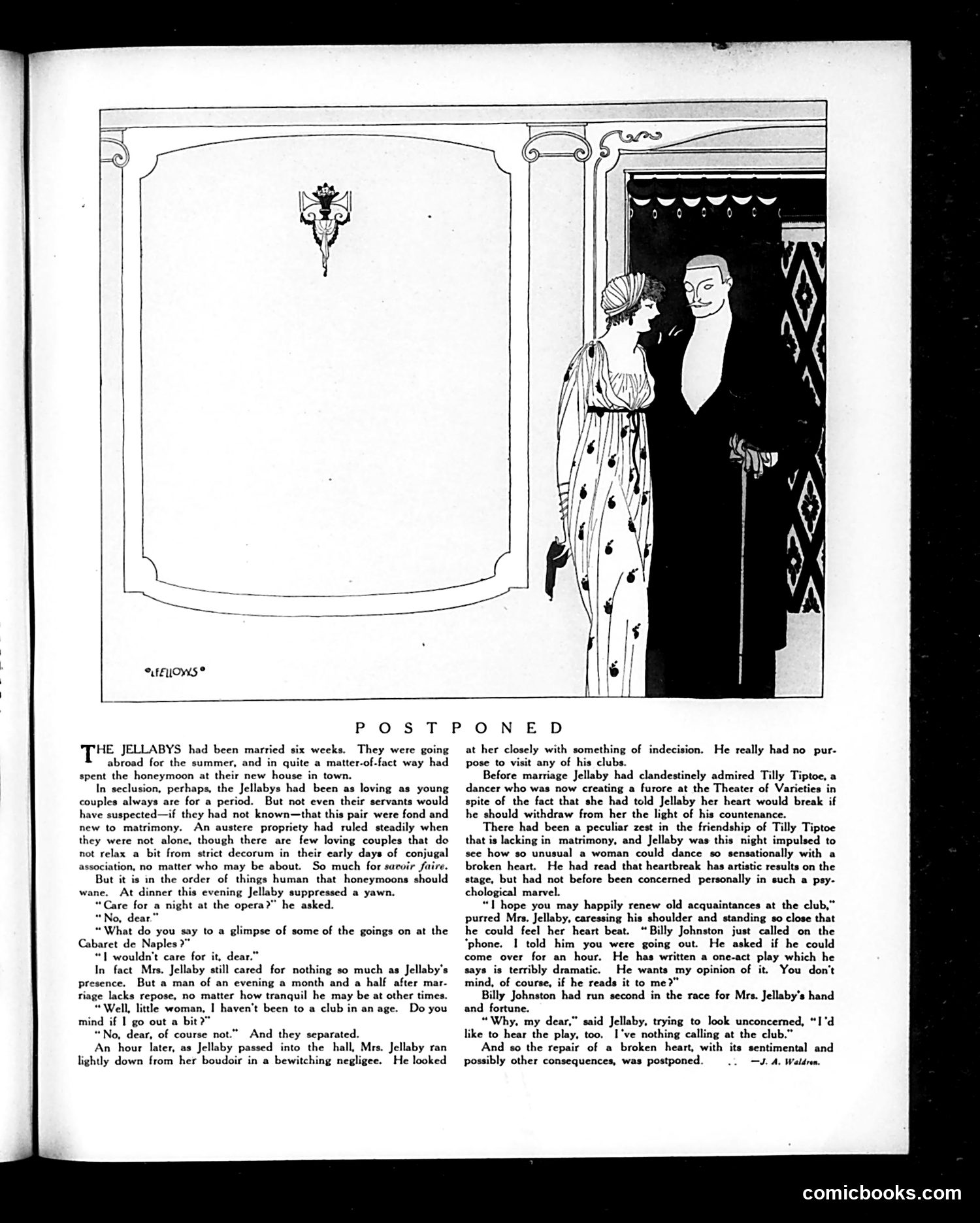
This story-cartoon illustrates the early friction in a six-week-old marriage. Jellaby, a man of leisure, grows restless during the honeymoon phase and invents an excuse to visit his club—really to see Tilly Tiptoe, a dancer he admired before marriage who claims her heart would break without his attention. Mrs. Jellaby, sensing his departure, emerges in a negligee and casually mentions that Billy Johnston—a rival suitor who "ran second" for her hand and fortune—is coming to read her his new play. This immediately cancels Jellaby's plans; jealousy trumps his desire to see the dancer. The satire targets both masculine restlessness in early marriage and the social games couples play. The "postponed" affair occurs because each spouse weaponizes a potential rival to keep the other's attention, suggesting that matrimonial tedium and wandering eyes are inevitable—only redirected, not eliminated—by jealousy.
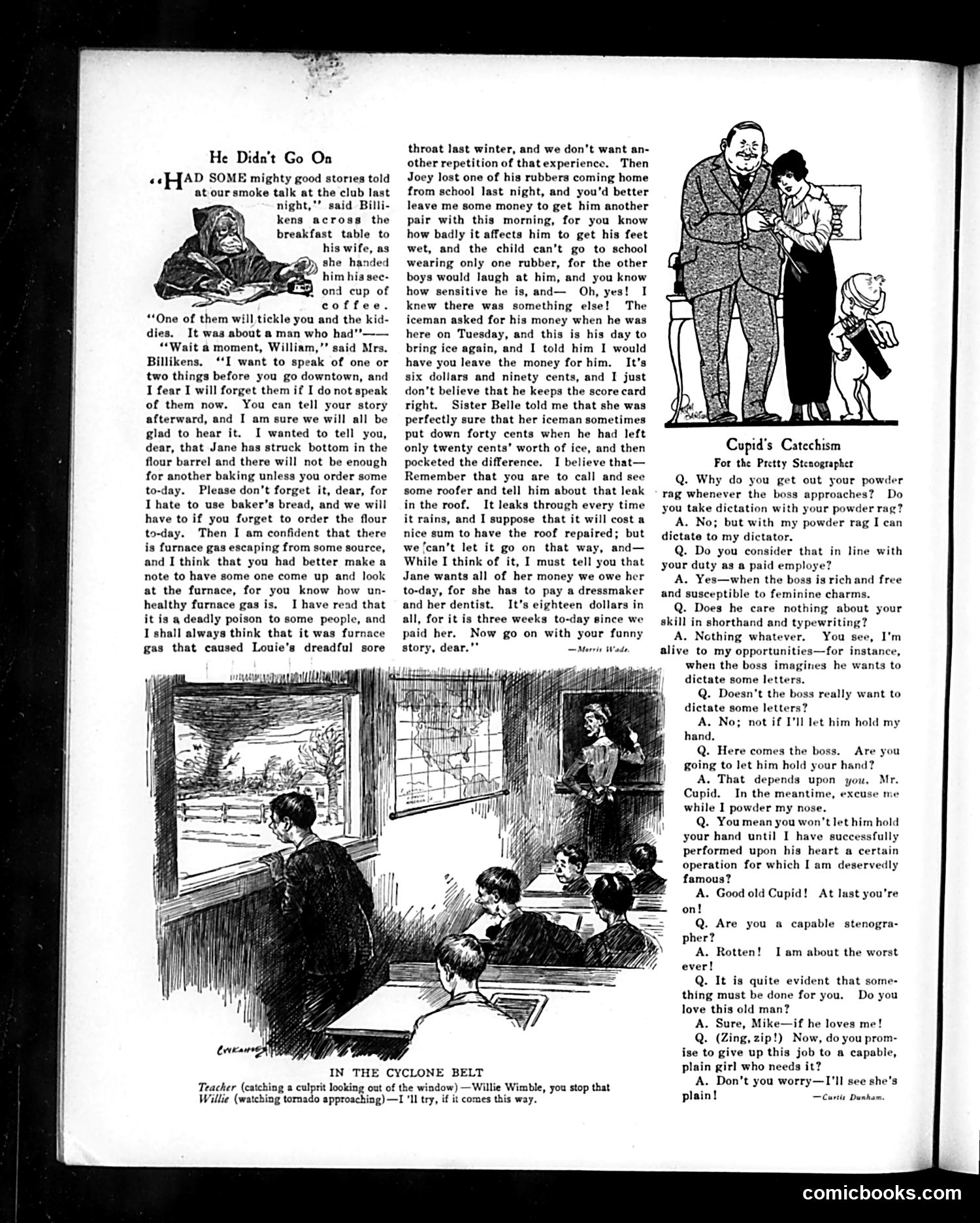
This page contains three distinct pieces of satire from Judge magazine: **"He Didn't Go On"** mocks the nagging wife stereotype. Mr. Billikens attempts to tell an amusing anecdote at breakfast, but his wife Mrs. Billikens interrupts with an exhausting list of domestic complaints—flour shortages, furnace gas danger, lost rubbers, unpaid servants, roof leaks—before finally inviting him to continue his story. The satire targets both the "long-suffering husband" trope and, implicitly, wives' domestic burdens and anxieties. **"In the Cyclone Belt"** is a brief joke about a schoolboy (Willie Wimble) watching a tornado approach outside the classroom window, unable to obey his teacher's order to stop looking because the natural disaster won't cooperate. **"Cupid's Catechism"** satirizes workplace sexual dynamics and female ambition. It presents a stenographer who uses cosmetics and flirtation strategically with her boss—prioritizing romantic manipulation over professional skill as a path to advantage. All three pieces reflect early-20th-century gender anxieties and working-class tensions.
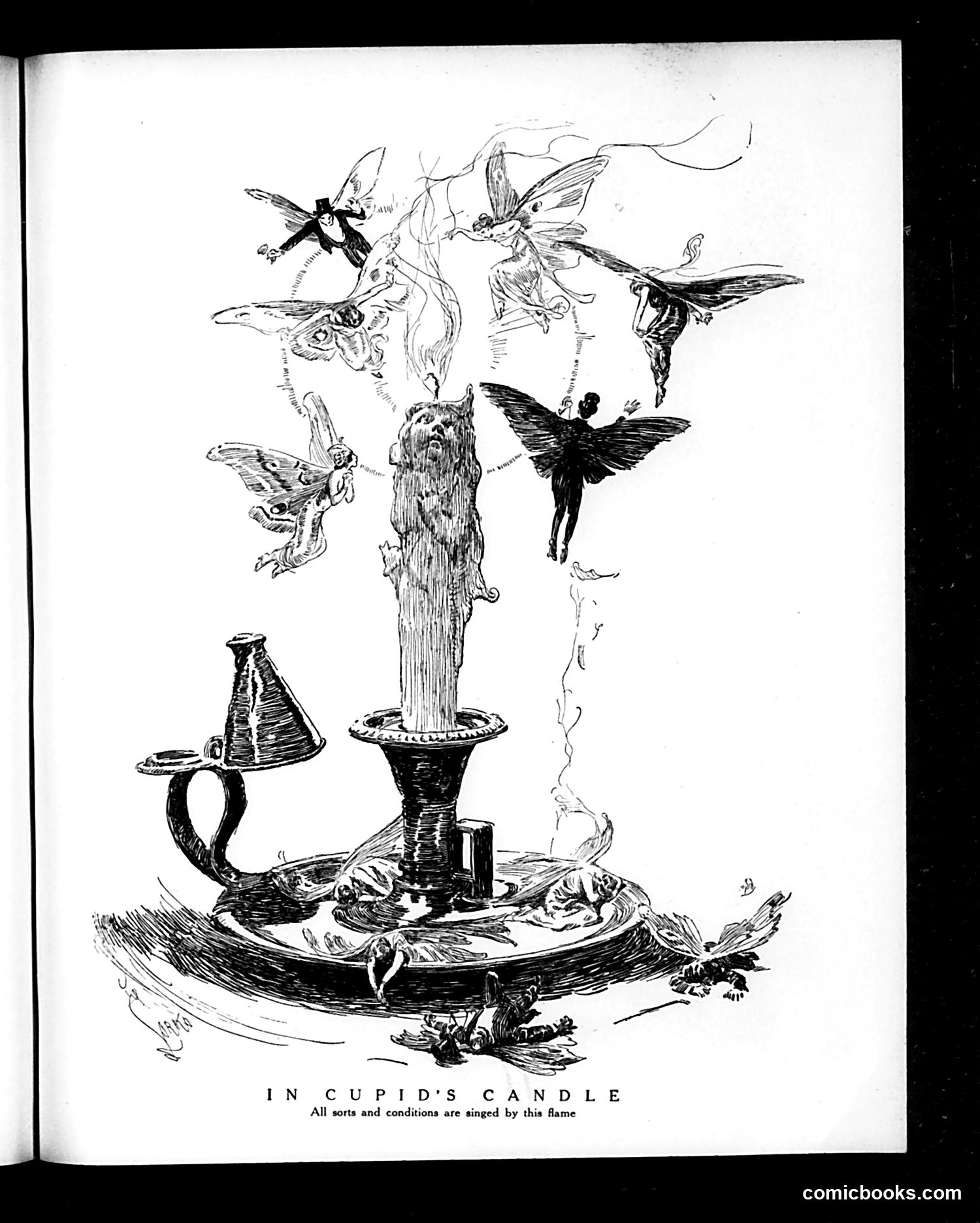
This is a satirical illustration depicting Cupid's candle as a central flame around which various winged figures—representing different types of people or social conditions—circle like moths. The subtitle states "All sorts and conditions are singed by this flame," suggesting that love or desire affects everyone indiscriminately, regardless of social status or circumstance. The figures appear to include fairies, cherubs, and human forms with wings, all drawn toward the flame. The satire seems to comment on how romantic attraction or passion is universal and indiscriminate—it "sings" (affects/wounds) all types of people equally. The base of the candle includes decorative elements and scattered objects, emphasizing the domestic or intimate nature of the subject. Without additional context about the specific issue date, the exact social commentary remains somewhat general.
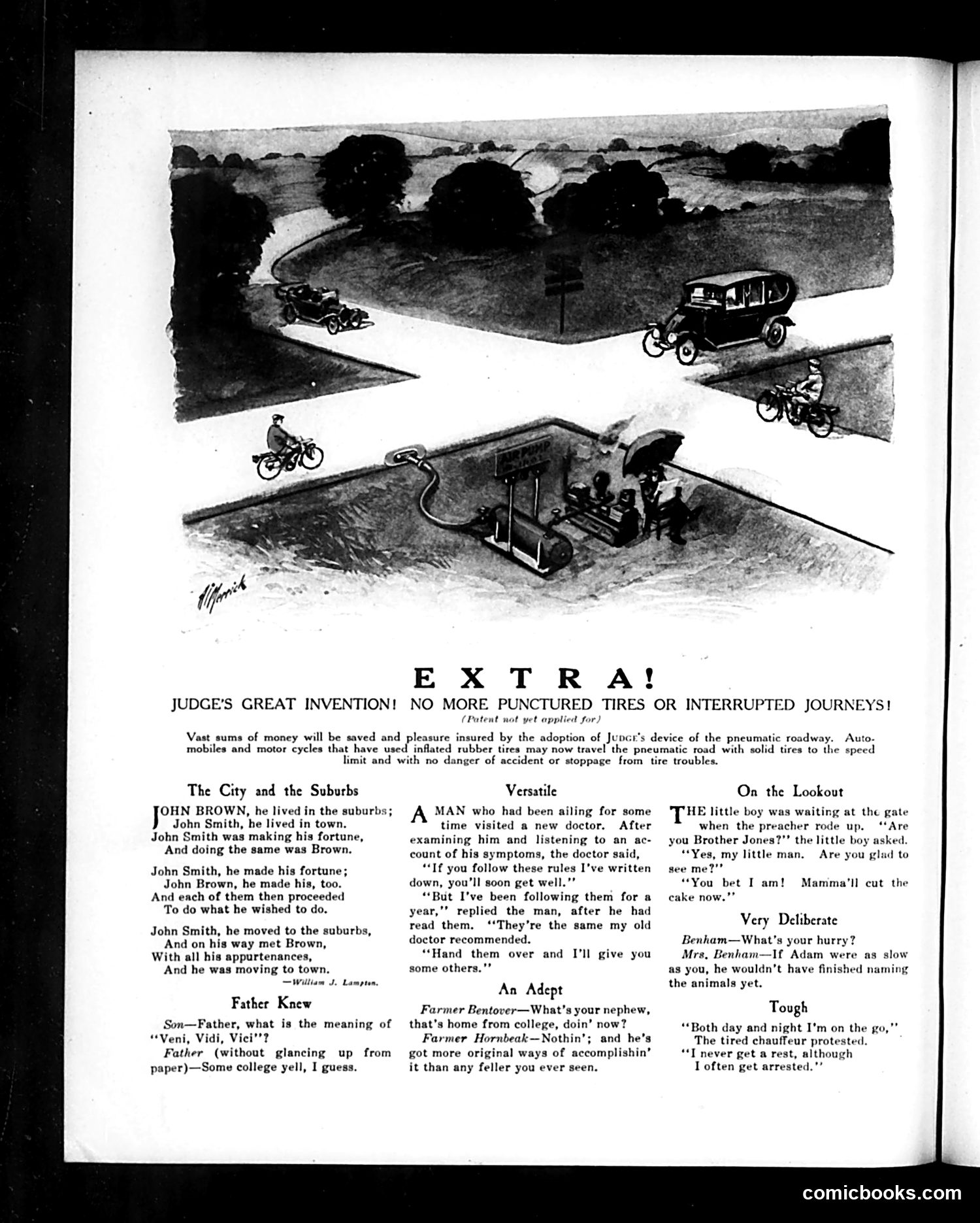
This page contains a mock invention advertisement and several brief comic anecdotes typical of early-20th-century American humor magazines. **Main Feature:** The "pneumatic roadway" is satirical—Judge proposes building special roads with cushioned surfaces so cars needn't worry about tire punctures. The humor lies in the absurdity: rather than improving tires (the obvious solution), Judge suggests reconstructing America's entire road infrastructure. This mocks both automotive industry growing pains and perhaps government inefficiency. **Comic Vignettes:** The remaining short jokes are mild domestic/rural humor standard to the era: a man and woman swap residences (social mobility satire), a college student accomplishes nothing, a boy's transparent bribe attempt with a preacher, marital speed-of-life commentary, and a chauffeur's arrest joke. The overall tone is genteel satire targeting urban/suburban American life, automobile culture, and family dynamics—nothing politically pointed, mostly observational humor for middle-class readers.
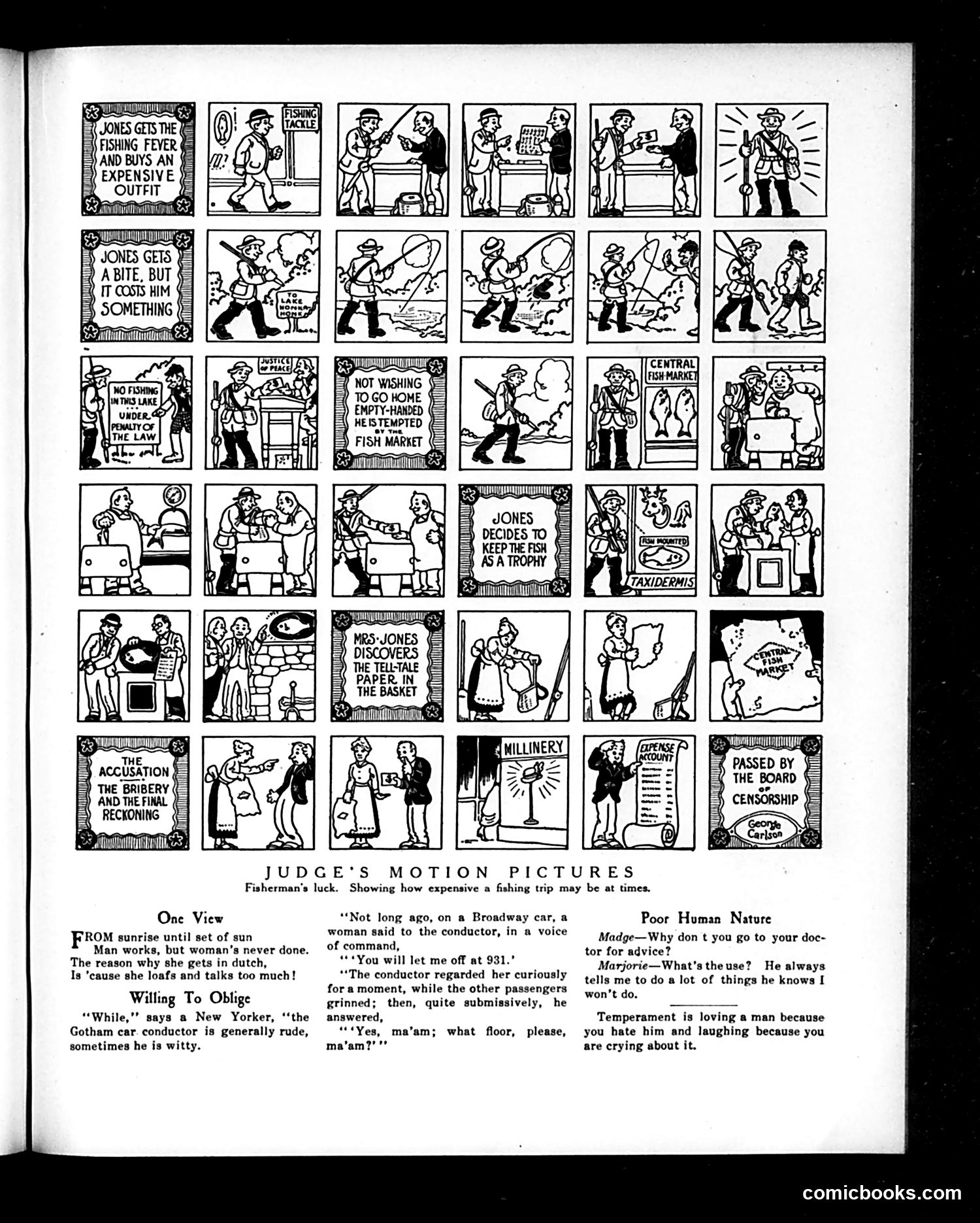
This multi-panel comic strip satirizes the hidden costs of recreational fishing. A man enthusiastically pursues fishing as a hobby, but each panel reveals escalating expenses: buying equipment, visiting fish markets to purchase catches to impress his wife, and ultimately confronting his spouse about the financial burden. The final panels show the wife discovering evidence of his spending and the "reckoning" with the bill. The satire targets early 20th-century consumer culture—specifically how leisure activities marketed as affordable recreation became financial traps through impulse purchases and social pressure (needing to show results to one's spouse). The accompanying anecdotes about women's behavior and relationship dynamics reflect period attitudes: women are depicted as talkative, demanding, and focused on domestic finances, while men bear the burden of providing.
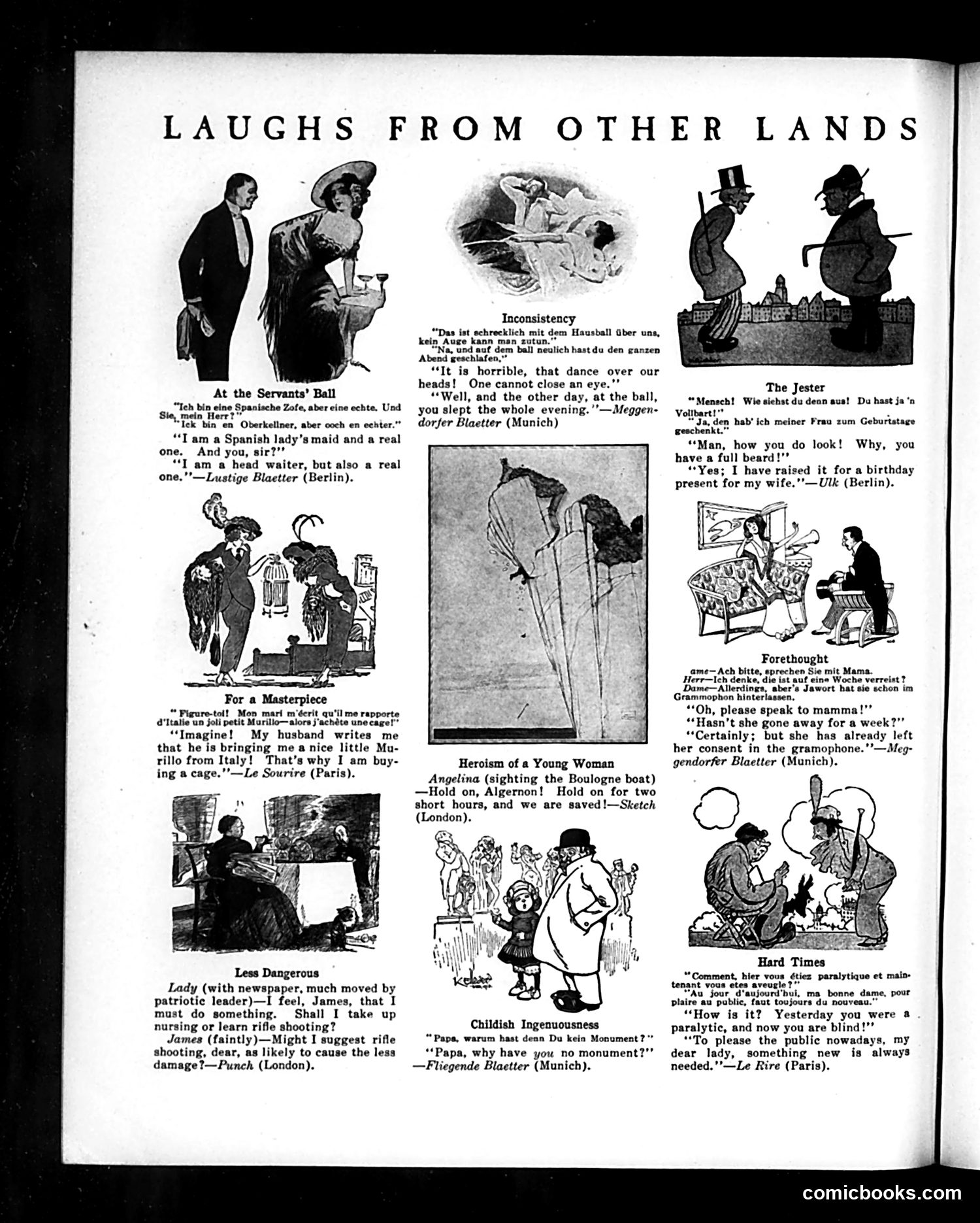
This *Judge* page collects humor from European satirical magazines, translated for American readers. The jokes target universal social absurdities rather than specific politics. **Key themes:** - **Class pretension**: Servants at a ball claim to be "real" versions of their roles—satire on working-class aspiration - **Wife management**: A husband buys a cage for a Murillo painting his wife expects (joke: she'll get a bird instead)—mocking spousal deception - **Female activism**: A patriotic woman's servant suggests rifle shooting over nursing as "less dangerous"—satirizing women's wartime involvement - **Hypocrisy**: Someone complains about noise from a ball while having slept through another—everyday inconsistency - **Professional desperation**: A street performer switches from paralysis to blindness "to please the public"—mocking exploitation of sympathy The page demonstrates how early 20th-century humor crossed borders through magazines like *Punch*, *Sketch*, and German *Blätter*, sharing comedic observations about gender, class, and human nature.
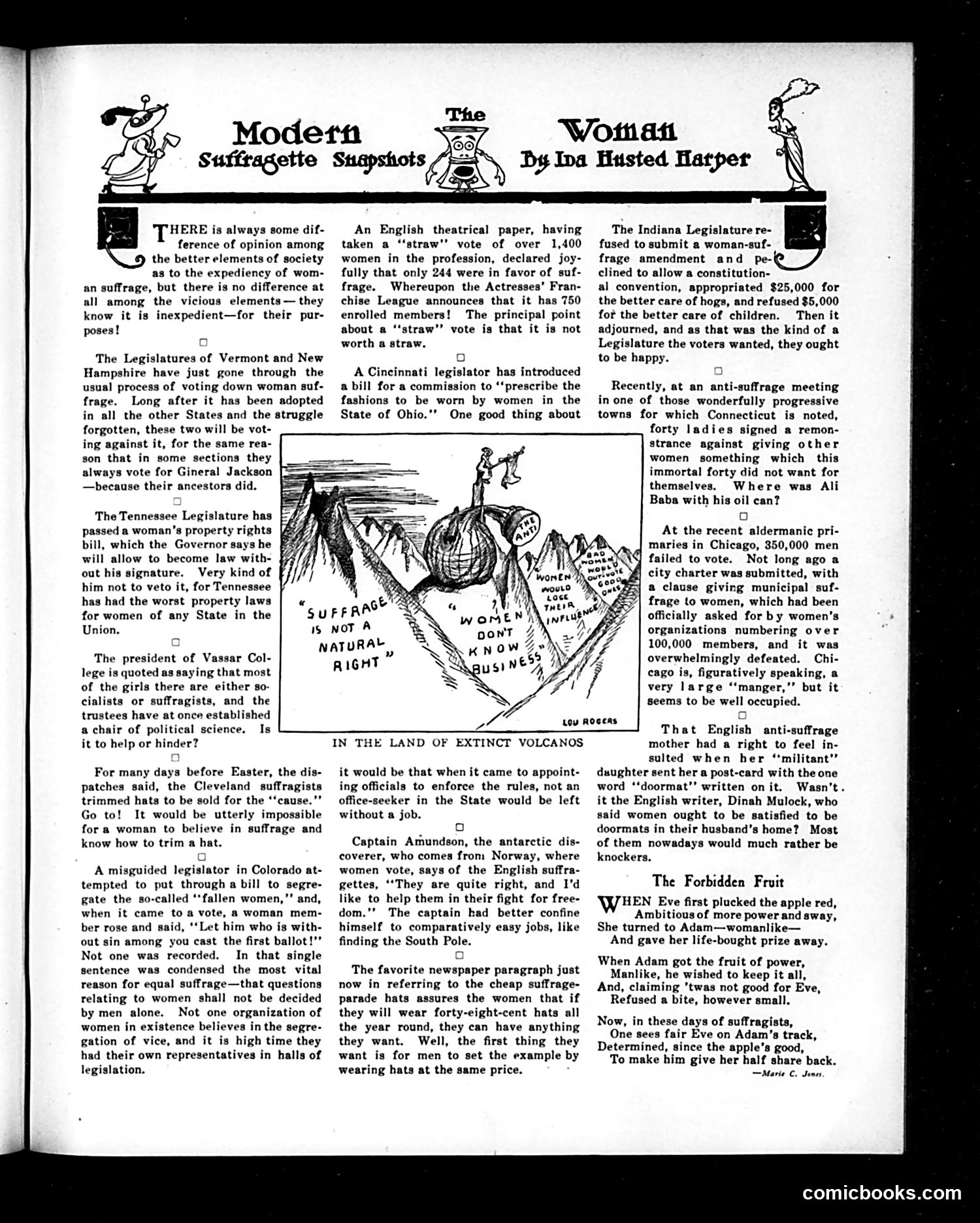
This Judge magazine page satirizes opponents of women's suffrage through sardonic commentary on contemporary legislative and social resistance to voting rights. The central cartoon, "In the Land of Extinct Volcanos," depicts women's suffrage arguments as dormant or dead issues, with caricatured figures representing anti-suffrage positions buried or fossilized—mocking those who cling to outdated opposition. The surrounding text uses biting irony: Vermont and New Hampshire are mocked for perpetually voting against suffrage "because their ancestors did"; a Tennessee governor is praised sarcastically for *not* vetoing women's property rights; the author ridicules the claim that women suffragists cannot trim hats; and he attacks a "straw vote" showing low suffrage support among actresses as inherently worthless. The piece also highlights hypocrisy: Indiana legislators funded hog care but denied children's care funding, then expected voters to approve their incompetence. Overall, Judge advocates for women's suffrage by exposing the logical absurdities and bad faith of its opponents.
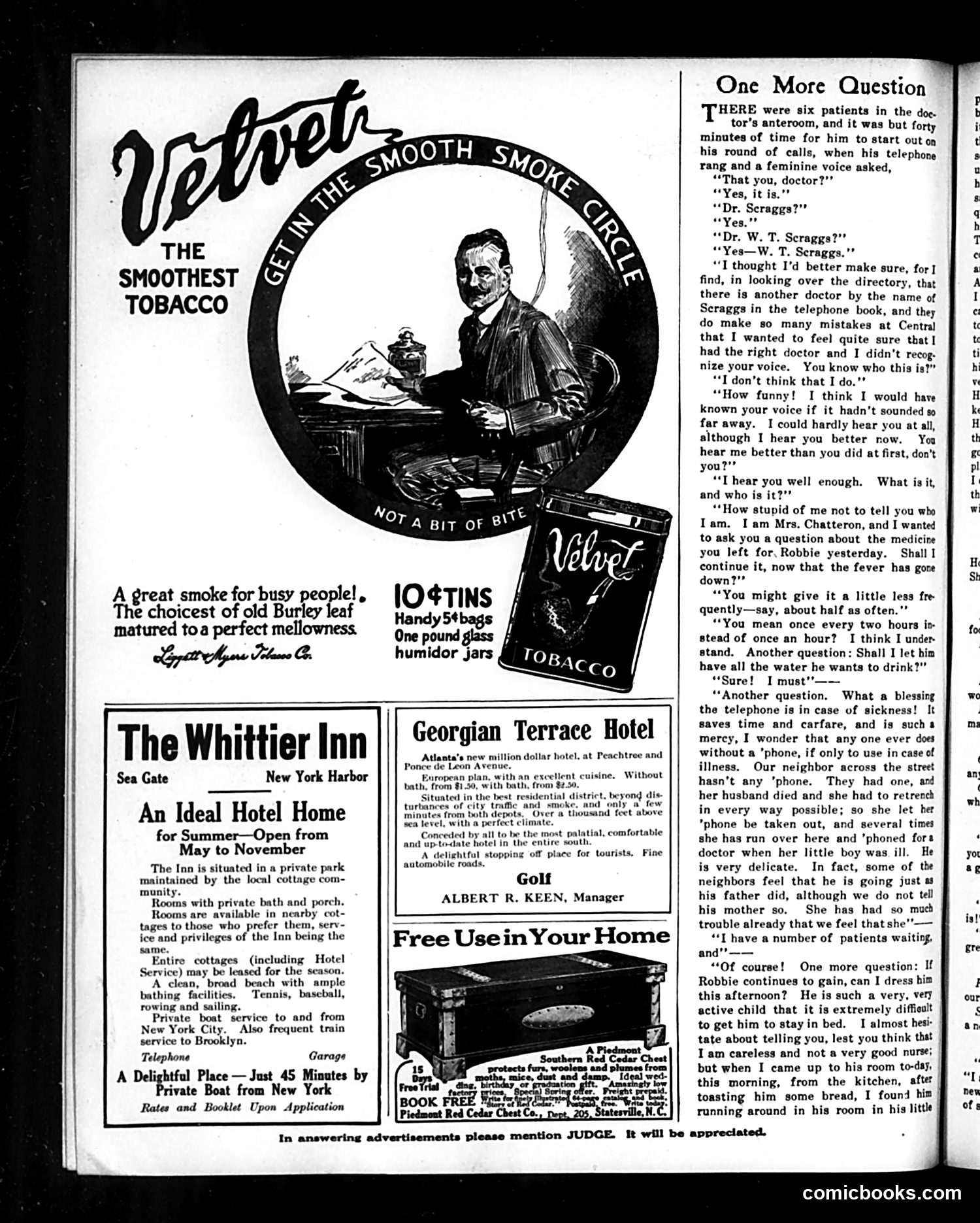
This page is primarily **advertising** for hotels, tobacco, and a luggage company, typical of Judge magazine's revenue model. The only narrative content is "One More Question," a **humorous short story** (not a political cartoon) about a doctor's telephone consultation. The joke satirizes **early 20th-century telephone etiquette and women's chattiness**: Mrs. Chatterton calls Dr. Scraggs with legitimate medical questions about her son Robbie's fever treatment, but persistently interrupts with tangential gossip—discussing a neighbor's financial troubles, her neighbor's sick child, the miracle of telephones—while the doctor grows increasingly impatient with multiple patients waiting. The satire targets both **women's perceived tendency to overshare on the telephone** and the **disruptive nature of this new communication technology** in professional settings. The humor derives from the doctor's mounting frustration as Mrs. Chatterton adds "one more question" repeatedly, unable to stop talking despite obvious time constraints. The advertisements reflect leisure activities and travel destinations popular among Judge's affluent readership.
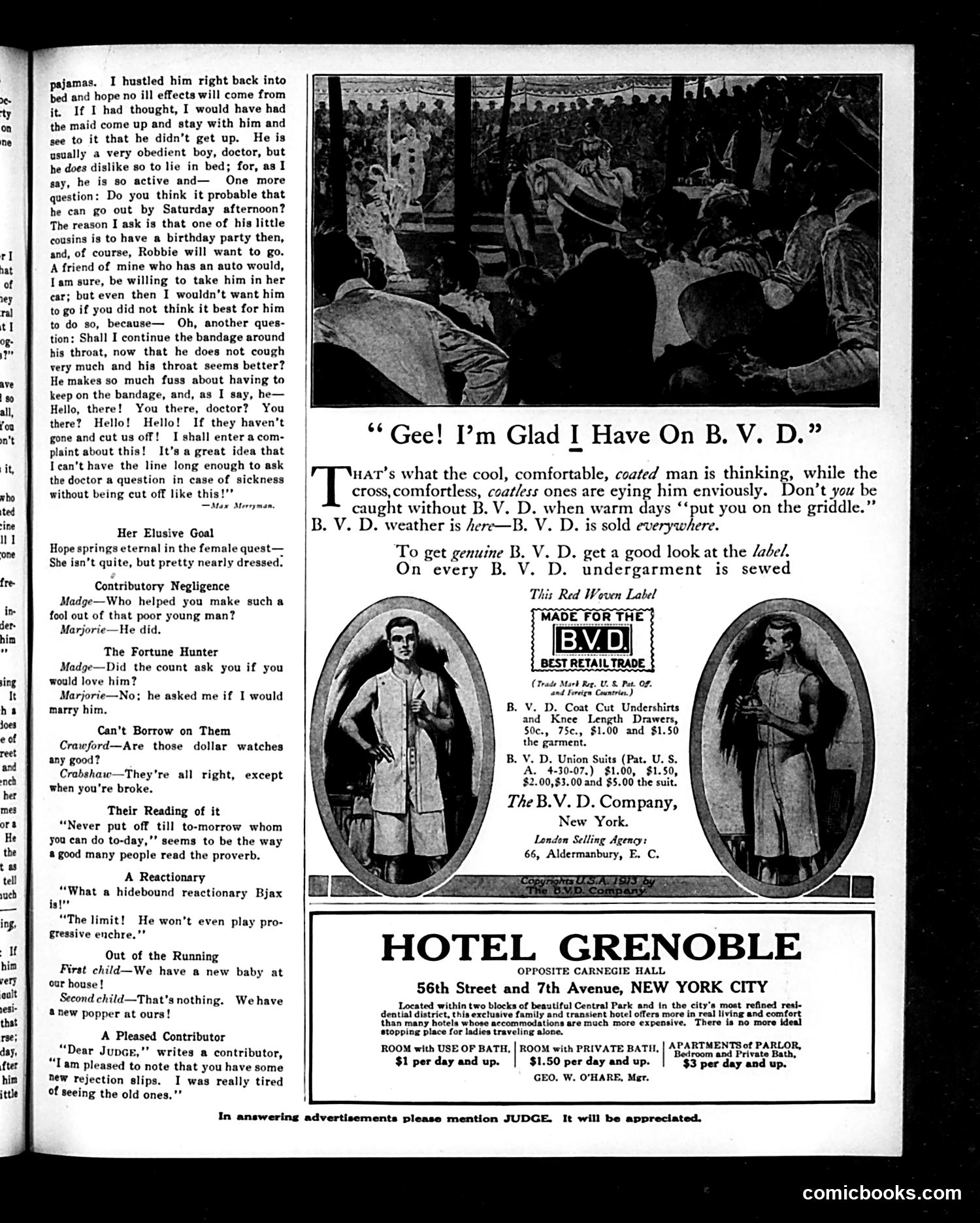
This page is primarily **advertising with marginal comic content**. The main feature is a large B.V.D. underwear advertisement (center-right) using a social observation as its hook: during hot weather, men wearing the "coated" (supportive) B.V.D. brand sit comfortably while poorly-dressed men envy them from across the room. The left column contains brief **one-liner jokes** about contemporary social situations—a woman unable to finish dressing, fortune hunters, and reactionary attitudes toward modern card games ("progressive euchre"). The largest text item is a humorous complaint letter about telephone service being cut off mid-conversation with a doctor. **The satire is mild**: it mocks domestic anxieties (overprotective motherhood), social climbing (fortune hunters), and resistance to modernity. The B.V.D. ad itself satirizes masculine discomfort and social embarrassment around undergarment choices. The page also advertises Hotel Grenoble in Manhattan, positioned as respectable lodging for traveling ladies. This reflects early 20th-century Judge magazine's blend of light satire, domestic humor, and commercial sponsorship.
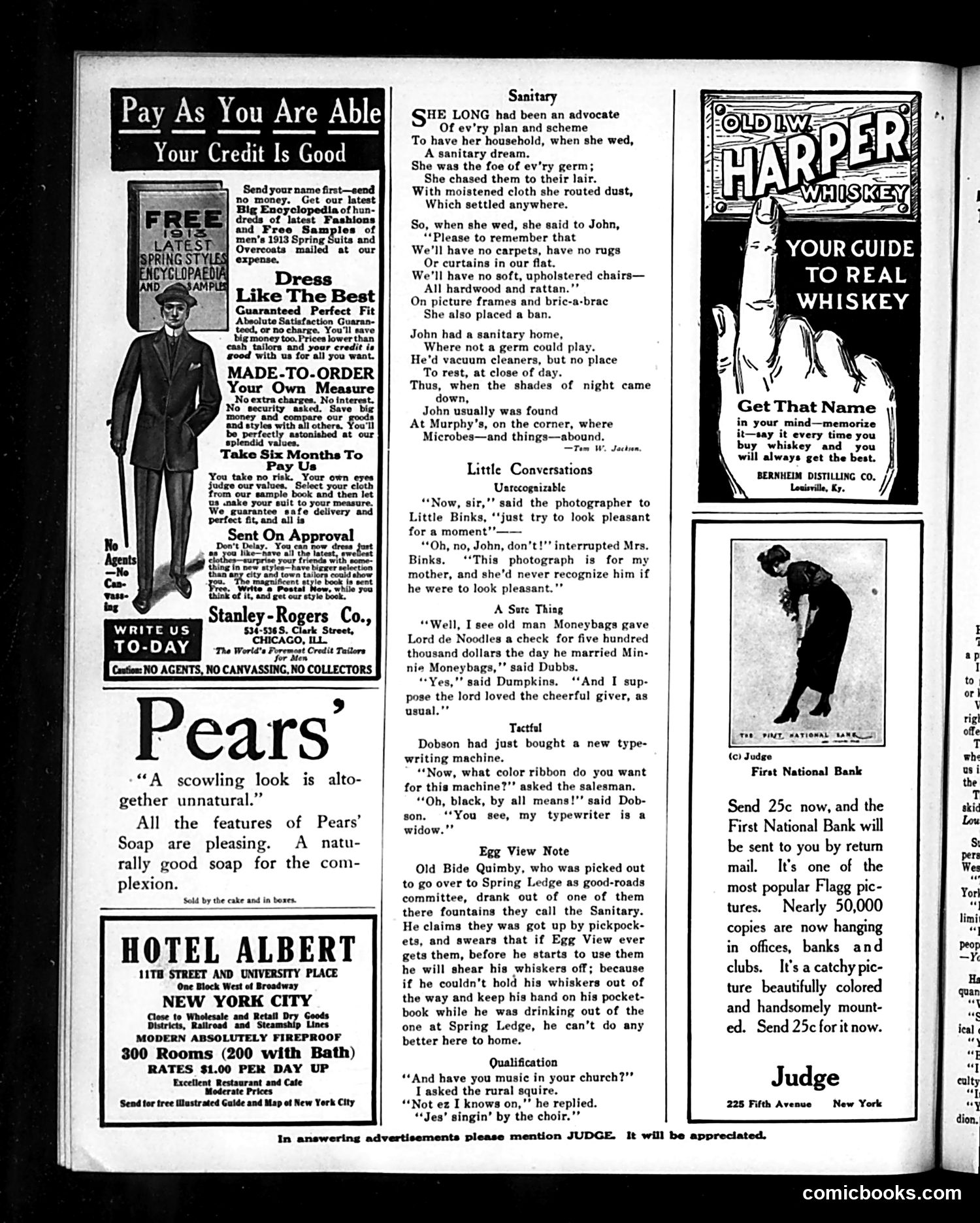
This page is primarily **advertising with humorous filler content**, typical of early 1900s magazines. The main satirical piece is "Sanitary," a poem mocking obsessive germ-consciousness. It depicts a newlywed woman so fixated on eliminating bacteria that she removes all household comforts—carpets, rugs, upholstered furniture—creating a sterile, joyless home. The joke: her husband John escapes to Murphy's bar, where "microbes—and things—abound," preferring actual living to her sanitized prison. This satirizes the emerging germ theory craze and overzealous domestic hygiene advocates of the era. The "Little Conversations" section offers brief joke vignettes typical of period humor—a photographer told not to make his subject look pleasant (wives didn't want husbands appearing happy to mothers-in-law); a man claiming his typewriter is a widow; a rural character suspicious of public drinking fountains. The heavy advertising—Stanley-Rogers credit tailoring, Pears' Soap, Hotel Albert—reflects Judge's revenue model. The page targets middle-class readers with disposable income and contemporary anxieties about health, appearance, and social propriety.
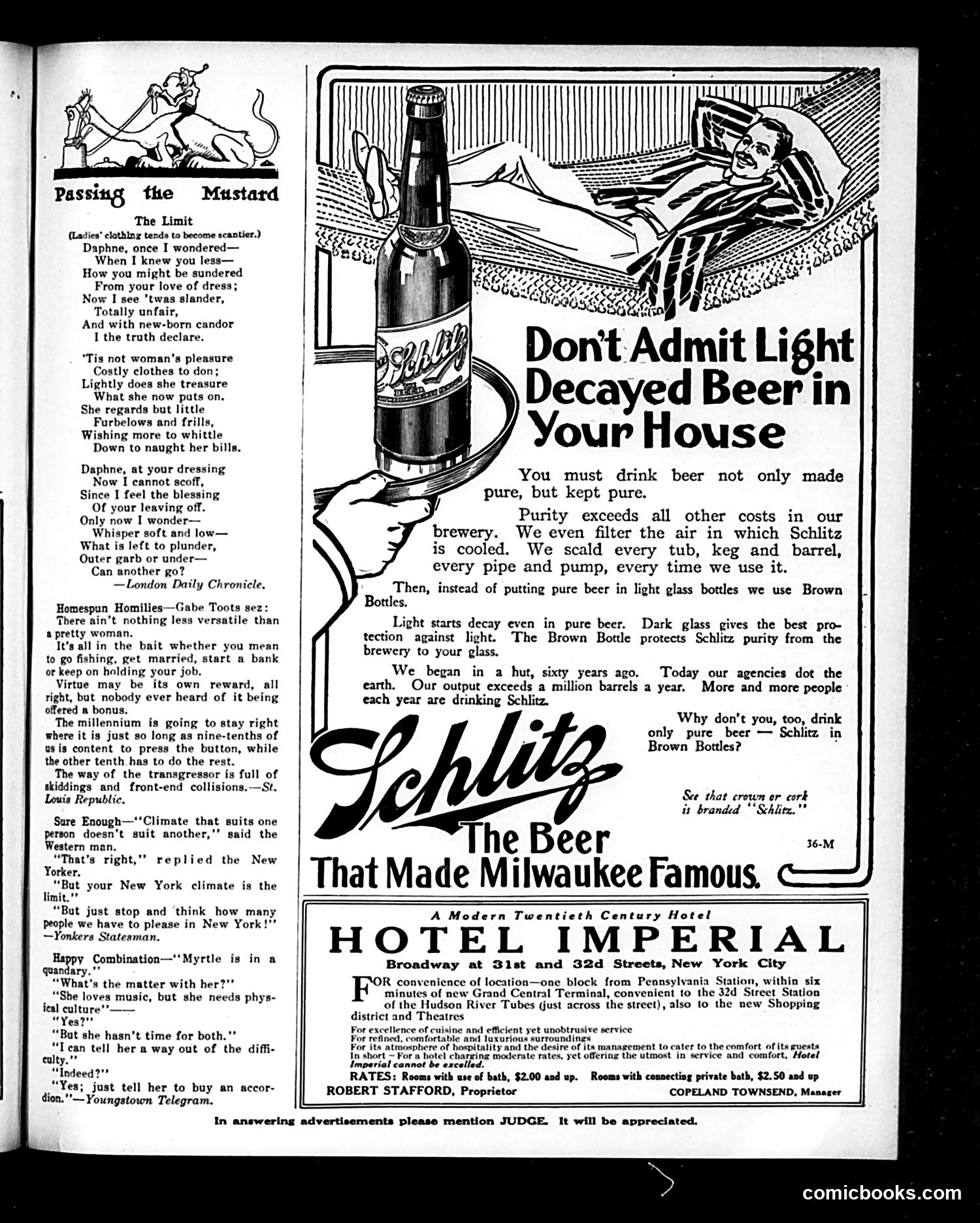
This page contains several distinct elements: **Left column** features short humorous poems and quips typical of Judge's satirical style, touching on domestic life and social observations—nothing politically charged. "Passing the Mustard" jokes about women shedding clothing; "Homespun Homilies" offers folksy observations about human nature. **Right side** is dominated by a **Schlitz beer advertisement** claiming superiority through brown bottles that protect beer from light decay. The ad emphasizes purity and manufacturing standards, appealing to early-20th-century consumer consciousness about product quality and hygiene. **Bottom** contains a hotel advertisement for the Hotel Imperial in New York. There are **no political cartoons** on this page. The content reflects Judge's mix of light social satire and advertising revenue. The Schlitz ad's emphasis on scientific purity and protection reflects Progressive Era marketing tactics—companies competed on claims of cleanliness and modern manufacturing standards, a significant selling point following food-safety scandals of the era.
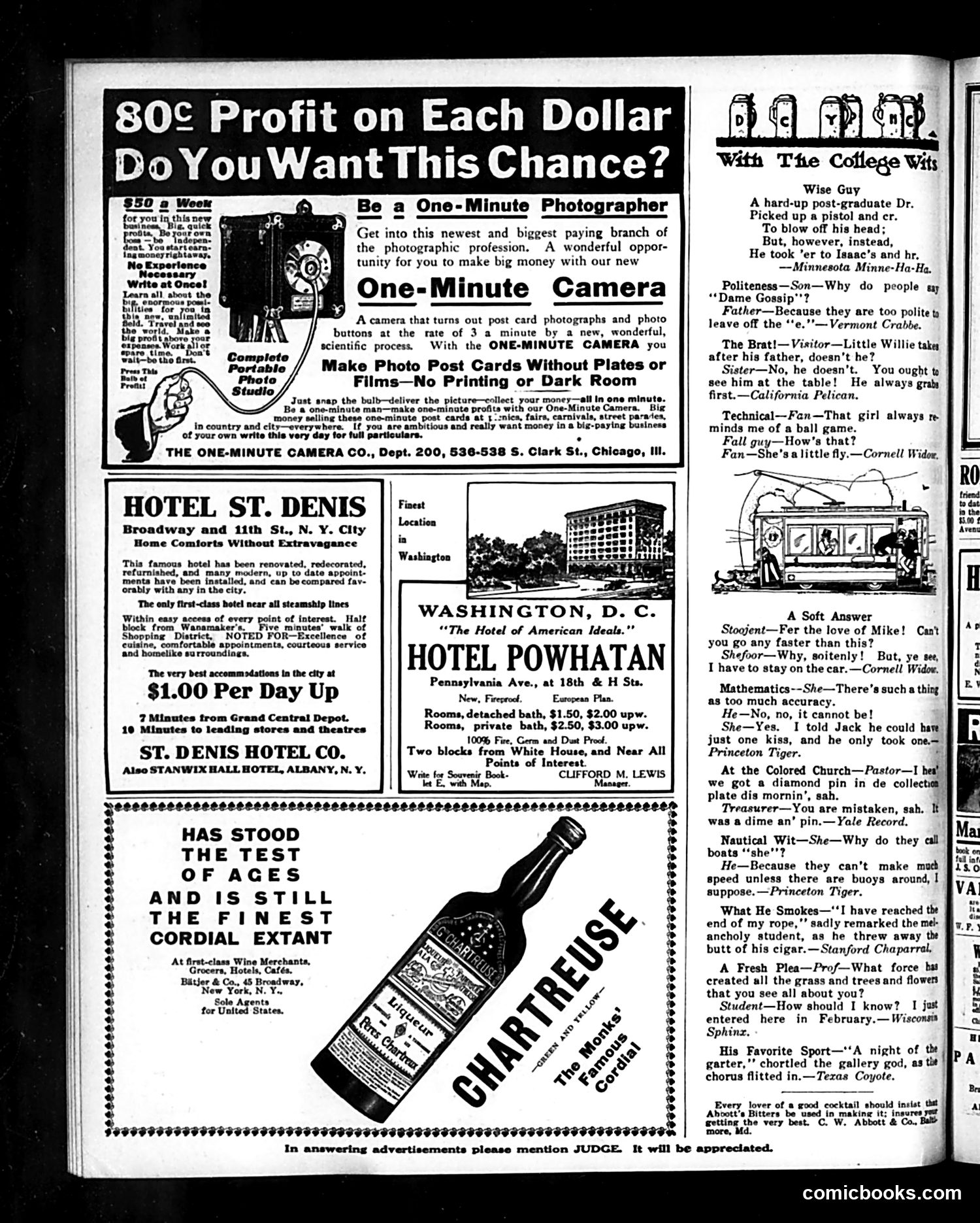
This page is primarily **advertising** with a humor section. The main content includes: **Major Advertisement:** "One-Minute Camera" (top) — a get-rich-quick scheme promising 80¢ profit per dollar by selling instant photograph post cards at fairs and carnivals. This appears to be a legitimate (if dubious) business opportunity typical of early 1900s entrepreneurship. **Other Ads:** Hotels, wine ("Chartreuse"), promoting leisure and consumption. **Humor Section:** "With The College Wit" (right side) contains brief jokes from college publications. These are mild, clean puns and observations—mostly wordplay about romance, college life, and dating. For example, one joke plays on "fall guy" (a dupe) with a baseball reference. The humor reflects early 20th-century college culture: young men chasing women, struggling financially, and making innocent wisecracks. **No political content or caricatures are evident.** This is a commercial publication page mixing business opportunities with genteel humor aimed at middle-class readers.
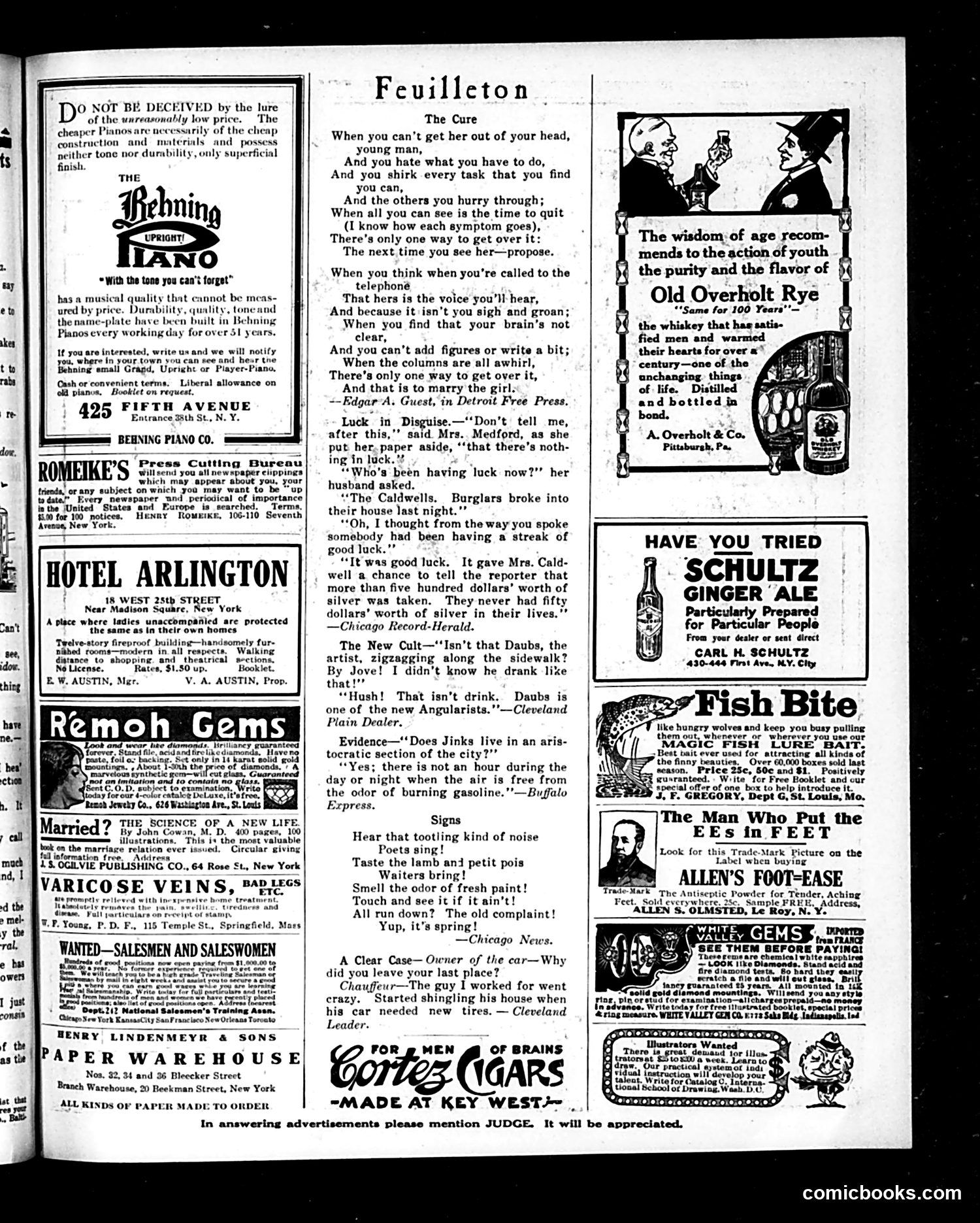
This page is primarily **advertising and humor content**, typical of Judge magazine's format. The main illustrated cartoon (top right) shows two men examining what appears to be a bottle, captioned about "the wisdom of age" recommending "Old Overholt Rye" whiskey—a straightforward liquor advertisement using the appeal of aged authority. The **"Feuilleton"** section (center) contains brief humorous anecdotes and poems, including Edgar A. Guest's satirical advice poem about lovesickness: a young man distracted by romantic thoughts should simply propose to solve his problem. Other short jokes mock luck, modern "Angularist" art movements, and class pretension (the Caldwells' fictional silver inventory). The remaining content consists of **various advertisements**: pianos, press clipping services, hotels, medical treatments, ginger ale, and patent medicines—typical early 20th-century magazine fare. There are **no significant political cartoons or social satire** on this particular page—it's a standard mixed-content issue page reflecting period consumer culture and light domestic humor.
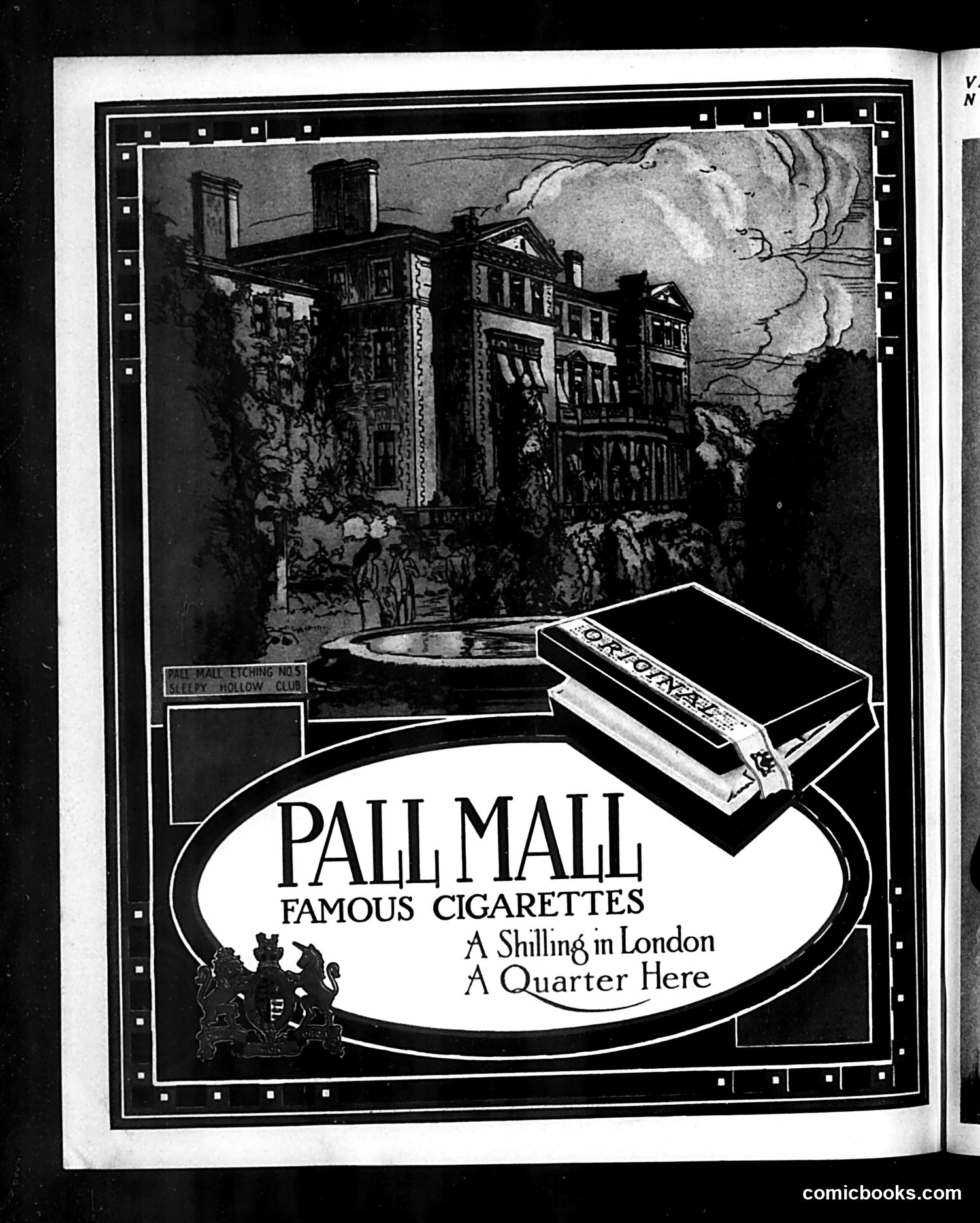
This is a **cigarette advertisement**, not a political cartoon. The page promotes Pall Mall brand cigarettes, showing a package and an etching-style illustration of what appears to be a historic London building (labeled "Pall Mall Etching No. 3 - Leery Hollow Club" in small text). The ad's tagline emphasizes pricing: "A Shilling in London / A Quarter Here," comparing British and American costs. The ornate building imagery and heraldic crest evoke prestige and tradition, suggesting these cigarettes carry British sophistication and respectability. This reflects early 20th-century advertising strategy—associating consumer products with established institutions and heritage to boost sales appeal.