
Judge, 1913-05-10 · page 4 of 24
Judge — May 10, 1913 — page 4: what you’re looking at
What you’re looking at
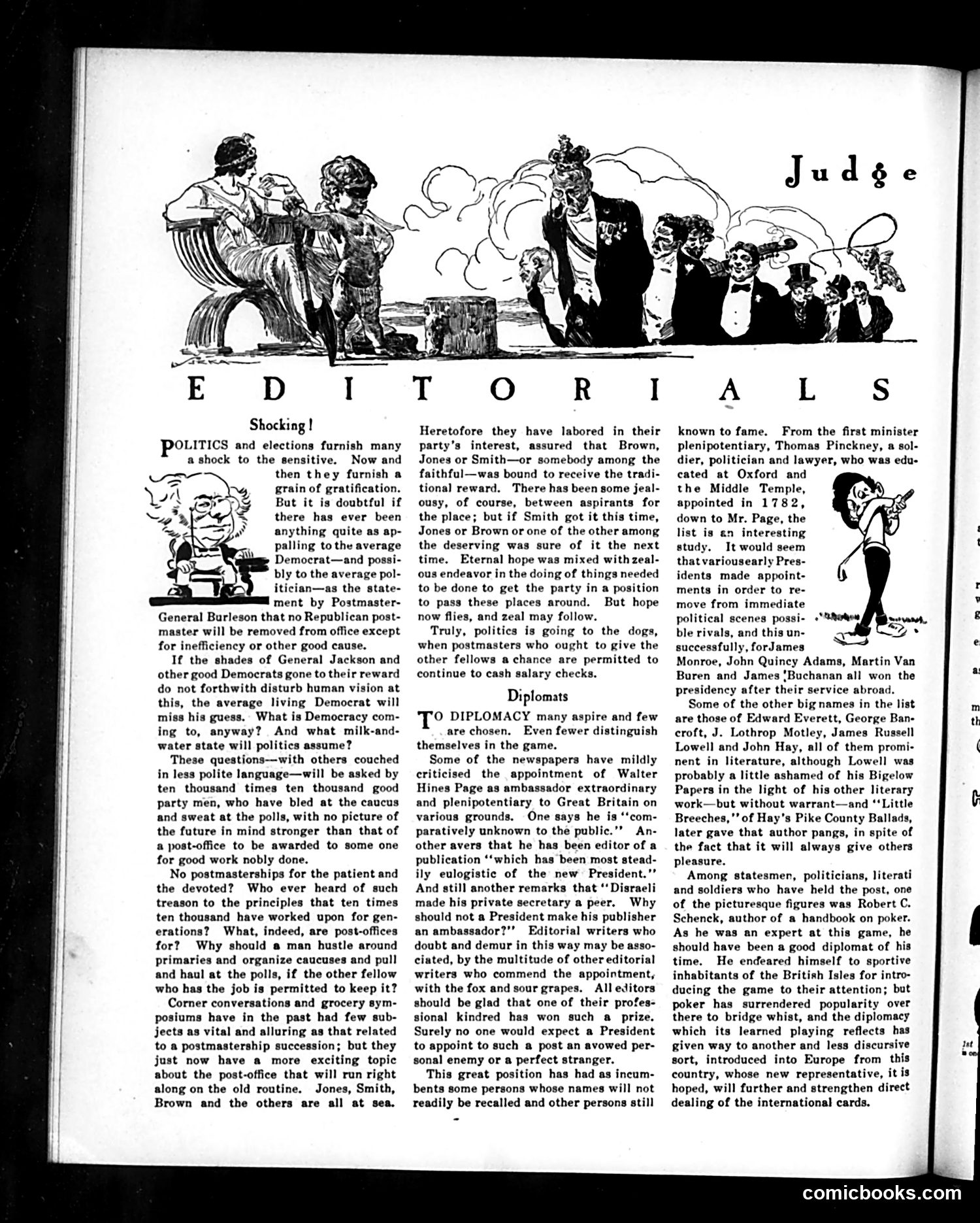
This "Editorials" page from Judge satirizes American political patronage and appointment systems. The masthead cartoon depicts a bloated judge figure surrounded by well-dressed men in formal attire—likely representing politicians and office-seekers competing for government positions. The accompanying text criticizes how political parties use postmaster and diplomatic appointments as rewards for party loyalty rather than merit. It mocks the expectation that winning an election entitles party members to "cash salary checks" and government sinecures. The satire targets both the corruption of the spoils system and the absurdity of unqualified individuals receiving diplomatic posts. References to specific appointees (Walter Hines Page as ambassador) suggest this addresses actual 1910s-era patronage controversies under a particular administration.
📄 Transcribed text from this page (OCR, searchable)
Machine-transcribed from the original scan — historical spelling and the odd misread are preserved.
Shocking ! PoLitics and elections furnish many a shock to the sensitive. Now and then they furnish a grain of gratification. But it is doubtful if there has ever been anything quite as ap- palling to the average Democrat—and possi- bly to the average pol- itician—as the state- ment by Postmaster- General Burleson that no Republican post- master will be removed from office except for inefficiency or other good cause. If the shades of General Jackson and other good Democrats gone to their reward do not forthwith disturb human vision at this, the average living Democrat will miss his guess. What is Democracy com- ing to, anyway? And what milk-and- water state will politics assume? These questions—with others couched in less polite language—will be asked by ten thousand times ten thousand good party men, who have bled at the caucus and sweat at the polls, with no picture of the future in mind stronger than that of a post-office to be awarded to some one for good work nobly done. No postmasterships for the patient and the devoted? Who ever heard of such treason to the principles that ten times ten thousand have worked upon for gen- erations? What, indeed, are post-offices for? Why should a man hustle around primaries and organize caucuses and pull and haul at the polls, if the other fellow who has the job is permitted to keep it? Corner conversations and grocery sym- posiums have in the past had few sub- jects as vital and alluring as that related to a postmastership succession; but they just now have a more exciting topic about the post-office that will run right along on the old routine. Jones, Smith, Brown and the others are all at sea. Heretofore they have labored in their party’s interest, assured that Brown, Jones or Smith—or somebody among the faithful—was bound to receive the tradi- tional reward. There has been some jeal- ousy, of course, between aspirants for the place; but if Smith got it this time, Jones or Brown or one of the other among the deserving was sure of it the next time. Eternal hope was mixed with zeal- ous endeavor in the doing of things needed to be done to get the party in a position to pass these places around. But hope now flies, and zeal may follow. Truly, politics is going to the dogs, when postmasters who ought to give the other fellows a chance are permitted to continue to cash salary checks. Diplomats T° DIPLOMACY many aspire and few are chosen. Even fewer distinguish themselves in the game. Some of the newspapers have mildly criticised the appointment of Walter Hines Page as ambassador extraordinary and plenipotentiary to Great Britain on various grounds. One says he is ‘‘com- paratively unknown to the public.” An- other avers that he has been editor of a publication ‘‘which has been most stea ily eulogistic of the new President. And still another remarks that “Disraeli made his private secretary a peer. Why should not a President make his publisher an ambassador?”’ Editorial writers who doubt and demur in this way may be asso- ciated, by the multitude of other editorial writers who commend the appointment, with the fox and sour grapes. All editors should be glad that one of their profes- sional kindred has won such a prize. Surely no one would expect a President to appoint to such a post an avowed per- sonal enemy or a perfect stranger. This great position has had as incum- bents some persons whose names will not readily be recalled and other persons still known to fame. From the first minister plenipotentiary, Thomas Pinckney, a sol- dier, politician and lawyer, who was edu- cated at Oxford and the Middle Temple, appointed in 1782, down to Mr. Page, the list is an interesting study. It would seem that variousearly Pres- idents made appoint- ments in order to re- move from immediate political scenes possi- «*Robew, ble rivals, and this un- successfully, forJames Monroe, John Quincy Adams, Martin Van Buren and James {Buchanan all won the presidency after their service abroad. Some of the other big names in the list are those of Edward Everett, George Ban- croft, J. Lothrop Motley, James Russell Lowell and John Hay, all of them promi- nent in literature, although Lowell was probably a little ashamed of his Bigelow Papers in the light of his other literary work—but without warrant—and ‘‘Little Breeches,’’ of Hay's Pike County Ballads, later gave that author pangs, in spite of the fact that it will always give others pleasure. Among statesmen, politicians, literati and soldiers who have held the post, one of the picturesque figures was Robert C. Schenck, author of a handbook on poker. As he was an expert at this game, he should have been a good diplomat of his time. He endeared himself to sportive inhabitants of the British Isles for intro- ducing the game to their attention; but poker has surrendered popularity over there to bridge whist, and the diplomacy which its learned playing reflects has given way to another and less discursive sort, introduced into Europe from this country, whose new representative, it is hoped, will further and strengthen direct dealing of the international cards. comicbooks.com