
Judge, 1913-05-10 · page 5 of 24
Judge — May 10, 1913 — page 5: what you’re looking at
What you’re looking at
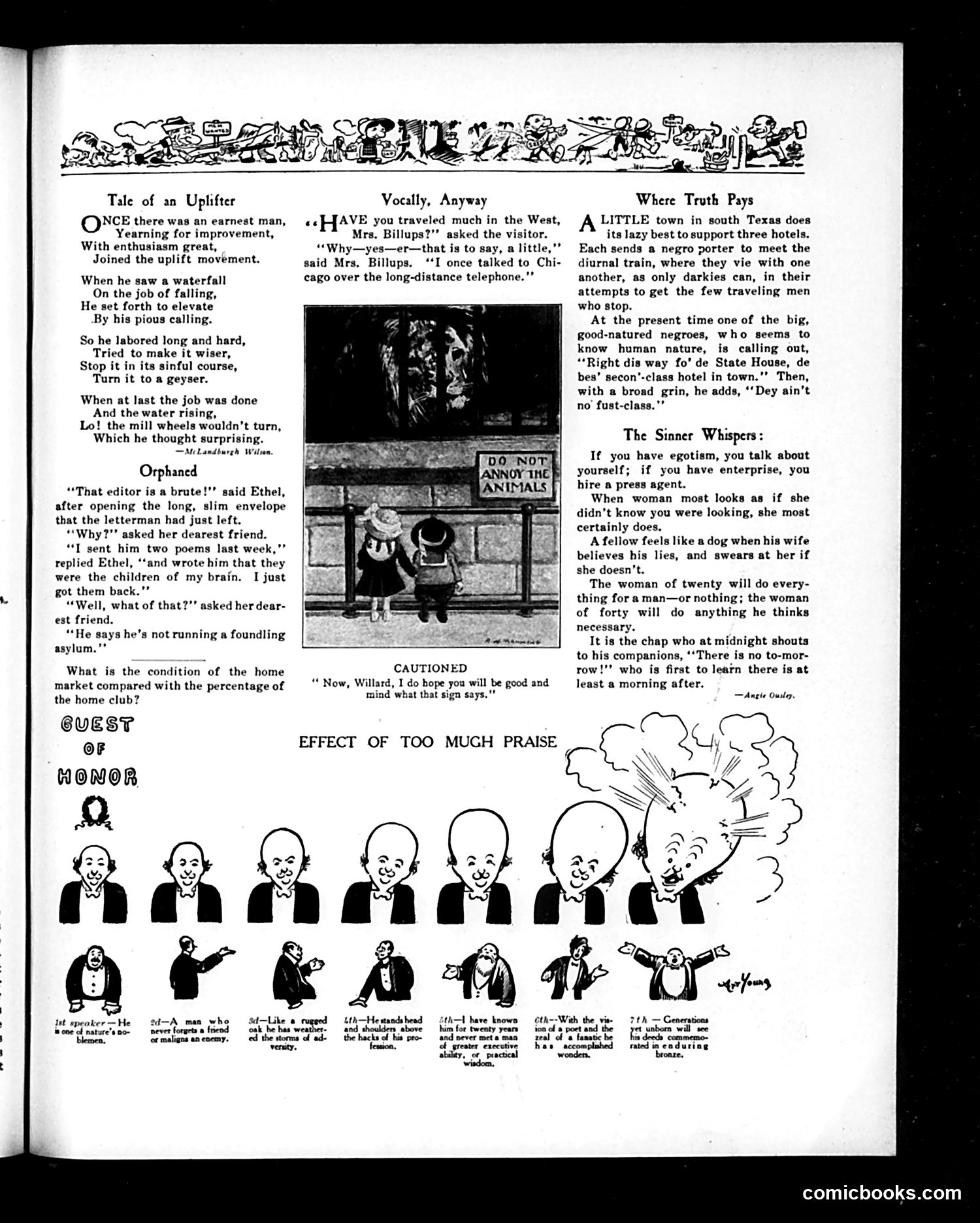
This page contains three distinct pieces of satirical content: 1. **"Tale of an Uplift"**: A poem mocking social reform movements, suggesting an idealistic reformer's efforts to improve a mill are frustrated when the machinery won't turn—satirizing the practical failures of well-intentioned reform. 2. **"Where Truth Pays"**: Commentary on American hotels, noting that Black porters work the diurnal train routes while meeting white travelers, with one porter calling out segregated accommodations as "fuss-class" rather than first-class—a critique of Jim Crow era discrimination. 3. **"Effect of Too Much Praise"**: A cartoon sequence showing a man's head progressively inflating from excessive flattery until it explodes—a visual joke about the dangers of vanity and ego inflation from unwarranted compliments. The page satirizes social hypocrisy, racial discrimination, and human weakness simultaneously.
📄 Transcribed text from this page (OCR, searchable)
Machine-transcribed from the original scan — historical spelling and the odd misread are preserved.
Tale of an Uplifter ONCE there was an earnest man, Yearning for improvement, With enthusiasm great, Joined the uplift movement. When he saw a waterfall On the job of falling, He set forth to elevate By his pious calling. So he labored long and hard, Tried to make it wiser, Stop it in its sinful course, Turn it to a geyser. When at last the job was done And the water rising, Lo! the mill wheels wouldn’t turn, Which he thought surprising. —McLandburgh Wilsen Orphaned “That editor is a brute!’’ said Ethel, after opening the long, slim envelope that the letterman had just left. “Why?” asked her dearest friend. “T sent him two poems last week,’” replied Ethel, ‘‘and wrote him that they were the children of my brain. I just got them back.’’ “Well, what of that?’’ asked her dear- est friend. “He says he’s not running a foundling asylum.’ What is the condition of the home market compared with the percentage of the home club? GUEST OF HONOR Q oe tt speaker—He Vocally, Anyway «e}HAVE you traveled much in the West, Mrs. Billups?’’ asked the visitor. ““Why—yes—er—that is to say, a little,’ “T once talked to Chi- said Mrs, Billups. cago over the long-distance telephone.”” CAUTIONED “ Now, Willard, I do hope you will be good and mind what that sign says.” EFFECT OF TOO MUGH ee Sth—1 have known him for twenty years ever met a man of greater executive + of practical wisdom. Lth—He sands head tand shoulders above the hacks of his pro- fession, Cth With the, vie ion of a poet at zeal of a famatche his has accom jooders, we Where Truth Pays LITTLE town in south Texas does its lazy best to support three hotels. Each sends a negro porter to meet the diurnal train, where they vie with one another, as only darkies can, in their attempts to get the few traveling men who stop. At the present time one of the big, good-natured negroes, who seems to know human nature, is calling out, “Right dis way fo’ de State House, de bes’ secon’-class hotel in town.’’ Then, with a broad grin, he adds, ‘‘Dey ain’t no’ fust-class."” The Sinner Whispers : If you have egotism, you talk about yourself; if you have enterprise, you hire a press agent. When woman most looks as if she didn’t know you were looking, she most certainly does. A fellow feels like a dog when his wife believes his lies, and swears at her if she doesn’t. The woman of twenty will do every- thing for a man—or nothing; the woman of forty will do anything he thinks necessary. It is the chap who at midnight shouts to his companions, ‘There is no to-mor- row!’’ who is first to learn there is at least a morning after. Artie Ousley. 7th — Generations ret unborn will se rated in enduring bronze. ind the comicbooks.com