
Judge, 1913-05-10 · page 8 of 24
Judge — May 10, 1913 — page 8: what you’re looking at
What you’re looking at
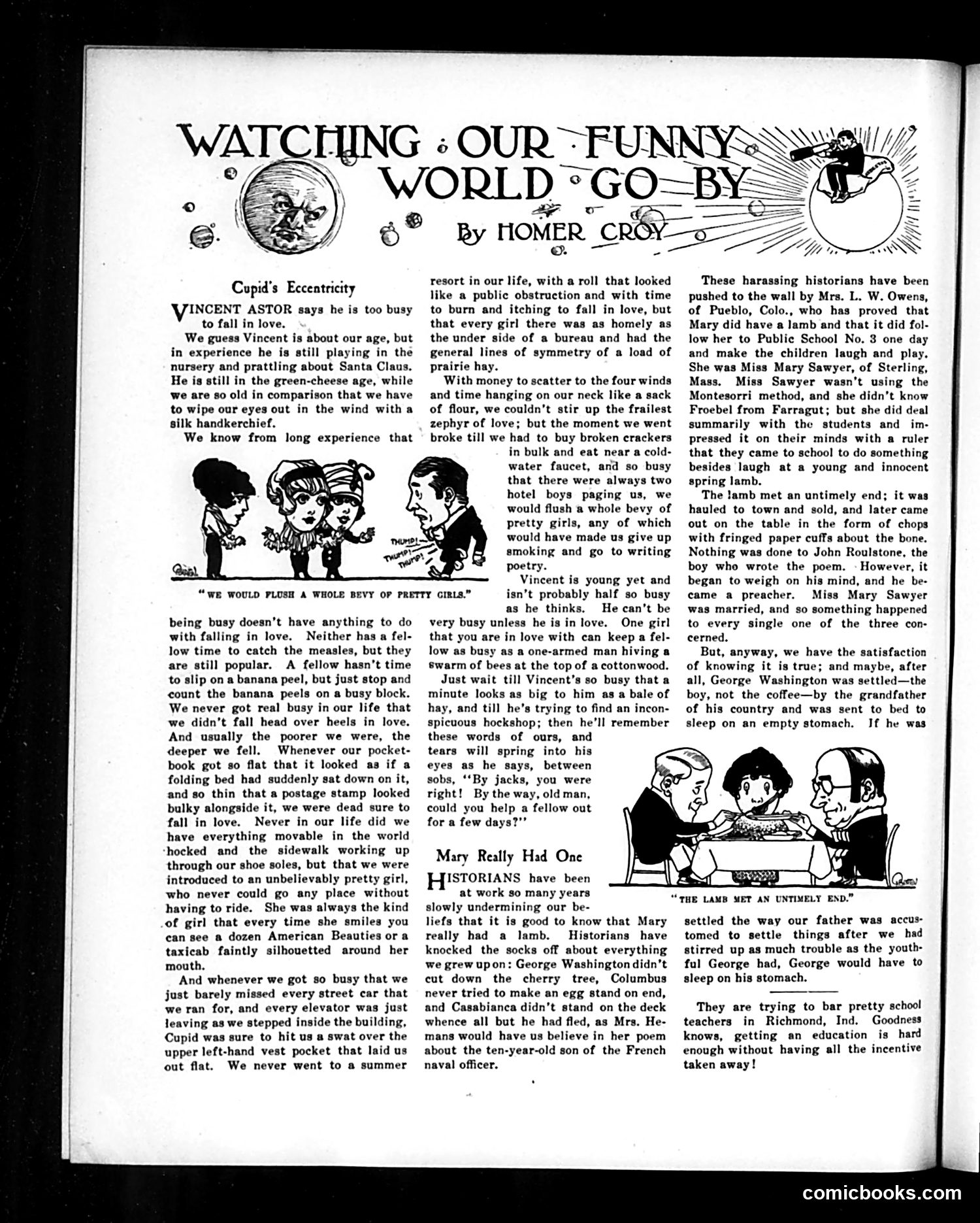
This satirical essay by Homer Croy mocks **Vincent Astor's claim of being too busy to fall in love**. Astor was a wealthy heir and socialite of the era. The joke is that busyness has nothing to do with romance—the author argues from personal experience that poverty and exhaustion paradoxically *attract* women. The poorer and busier he was, the more "pretty girls" appeared; when wealthy with free time, he found only homely women. He predicts young Vincent, currently claiming business prevents romance, will eventually discover love when he's truly desperate (broke, frantically seeking a pawnshop). The secondary piece debunks historical myth-busting, celebrating that **Mary's lamb was actually real**—one small victory against scholars who've demolished beloved legends like Washington's cherry tree and Columbus's egg trick. The cartoons illustrate these romantic and historical themes humorously.
📄 Transcribed text from this page (OCR, searchable)
Machine-transcribed from the original scan — historical spelling and the odd misread are preserved.
Cupid’s Eccentricity VINCENT ASTOR says he is too busy to fall in love. We guess Vincent is about our age, but in experience he is still playing in the nursery and prattling about Santa Claus. He is still in the green-cheese age, while we are so old in comparison that we have to wipe our eyes out in the wind witha silk handkerchief. We know from long experience that “WE WOULD PLUSH A WHOLE BEVY OP PRETTY GIRLS.” being busy doesn’t have anything to do with falling in love. Neither has a fel- low time to catch the measles, but they are still popular. A fellow hasn't time to slip on a banana peel, but just stop and count the banana peels on a busy block. We never got real busy in our life that we didn’t fall head over heels in love. And usually the poorer we were, the deeper we fell. Whenever our pocket- book got so flat that it looked as if a folding bed had suddenly sat down on it, and so thin that a postage stamp looked bulky alongside it, we were dead sure to fall in love. Never in our life did we have everything movable in the world shocked and the sidewalk working up through our shoe soles, but that we were introduced to an unbelievably pretty girl, who never could go any place without having to ride. She was always the kind of girl that every time she smiles you can see a dozen American Beauties or a taxicab faintly silhouetted around her mouth, And whenever we got so busy that we just barely missed every street car that we ran for, and every elevator was just leaving as we stepped inside the building, Cupid was sure to hit us a swat over the upper left-hand vest pocket that laid us out flat. We never went to a summer resort in our life, with a roll that looked like a public obstruction and with time to burn and itching to fall in love, but that every girl there was as homely as the under side of a bureau and had the general lines of symmetry of a load of prairie hay. With money to scatter to the four winds and time hanging on our neck like a sack of flour, we couldn’t stir up the frailest zephyr of love; but the moment we went broke till we had to buy broken crackers in bulk and eat near a cold- water faucet, and so busy that there were always two hotel boys paging us, we would flush a whole bevy of pretty girls, any of which would have made us give up smoking and go to writing poetry. Vincent is young yet and isn’t probably half so busy as he thinks. He can't be very busy unless he is in love. One girl that you are in love with can keep a fel- low as busy as a one-armed man hiving a swarm of bees at the top of a cottonwood. Just wait till Vincent’s so busy that a minute looks as big to him as a bale of hay, and till he’s trying to find an incon- spicuous hockshop; then he’ll remember these words of ours, and tears will spring into his eyes as he says, between sobs, ‘‘By jacks, you were right! By the way, old man, could you help a fellow out for a few days?"’ Mary Really Had One HISTORIANS have been at work so many years slowly undermining our be- liefs that it is good to know that Mary really had a lamb. Historians have knocked the socks off about everything we grew upon: George Washington didn’t cut down the cherry tree, Columbus never tried to make an egg stand on end, and Casabianca didn’t stand on the deck whence all but he had fled, as Mrs. He- mans would have us believe in her poem about the ten-year-old son of the French naval officer. These harassing historians have been pushed to the wall by Mrs. L. W. Owens, of Pueblo, Colo., who has proved that Mary did have a lamb and that it did fol- low her to Public School No. 3 one day and make the children laugh and play. She was Miss Mary Sawyer, of Sterling, Mass. Miss Sawyer wasn’t using the Montesorri method, and she didn’t know Froebel from Farragut; but she did deal summarily with the students and im- pressed it on their minds with a ruler that they came to school to do something besides laugh at a young and innocent spring lamb. The lamb met an untimely end; it was hauled to town and sold, and later came out on the table in the form of chops with fringed paper cuffs about the bone. Nothing was done to John Roulstone, the boy who wrote the poem. - However, it began to weigh on his mind, and he be- came a preacher. Miss Mary Sawyer was married, and so something happened to every single one of the three con- cerned. But, anyway, we have the satisfaction of knowing it is true; and maybe, after all, George Washington was settled—the boy, not the coffee—by the grandfather of his country and was sent to bed to sleep on an empty stomach. If he was “THE LAMB MET AN UNTIMELY END.” settled the way our father was accus- tomed to settle things after we had stirred up as much trouble as the youth- ful George had, George would have to sleep on his stomach. They are trying to bar pretty school teachers in Richmond, Ind. Goodness knows, getting an education is hard enough without having all the incentive taken away! comicbooks.com