
Judge, 1913-05-10 · page 17 of 24
Judge — May 10, 1913 — page 17: what you’re looking at
What you’re looking at
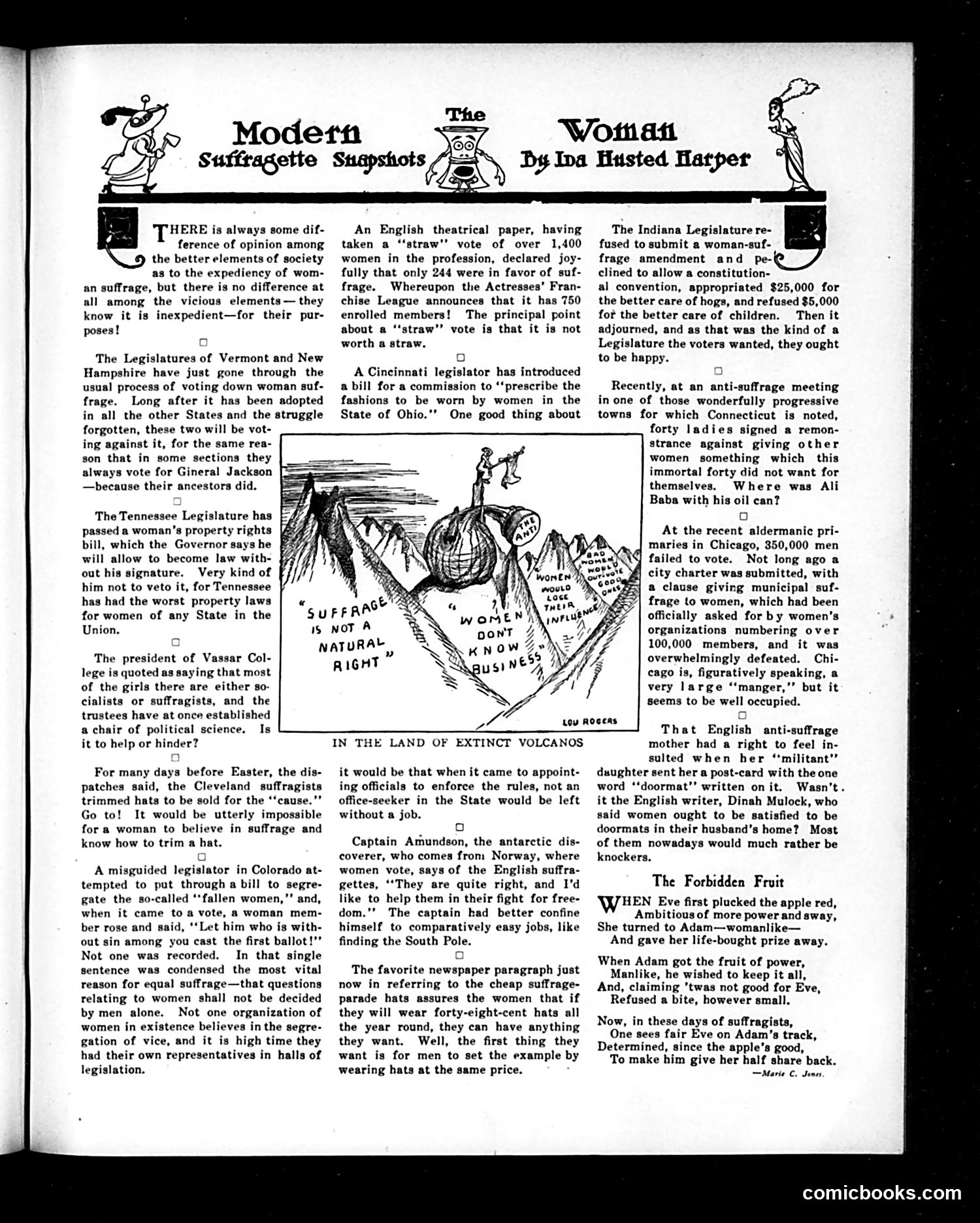
This Judge magazine page satirizes opponents of women's suffrage through sardonic commentary on contemporary legislative and social resistance to voting rights. The central cartoon, "In the Land of Extinct Volcanos," depicts women's suffrage arguments as dormant or dead issues, with caricatured figures representing anti-suffrage positions buried or fossilized—mocking those who cling to outdated opposition. The surrounding text uses biting irony: Vermont and New Hampshire are mocked for perpetually voting against suffrage "because their ancestors did"; a Tennessee governor is praised sarcastically for *not* vetoing women's property rights; the author ridicules the claim that women suffragists cannot trim hats; and he attacks a "straw vote" showing low suffrage support among actresses as inherently worthless. The piece also highlights hypocrisy: Indiana legislators funded hog care but denied children's care funding, then expected voters to approve their incompetence. Overall, Judge advocates for women's suffrage by exposing the logical absurdities and bad faith of its opponents.
📄 Transcribed text from this page (OCR, searchable)
Machine-transcribed from the original scan — historical spelling and the odd misread are preserved.
— THERE is always some dif- ference of opinion among the better elements of society as to the expediency of wom- an suffrage, but there is no difference at all among the vicious elements — they know it is inexpedient—for their pur- poses! The Legislatures of Vermont and New Hampshire have just gone through the usual process of voting down woman suf- frage. Long after it has been adopted in all the other States and the struggle forgotten, these two will be vot- ing against it, for the same rea- son that in some sections they always vote for Gineral Jackson —because their ancestors did. The Tennessee Legislature has passed a woman’s property rights bill, which the Governor says he will allow to become law with- out his signature. Very kind of him not to veto it, for Tennessee has had the worst property laws for women of any State in the Union. The president of Vassar Col- lege is quoted as saying that most of the girls there are either so- cialists or suffragists, and the trustees have at once established achair of political science. Is it to help or hinder? For many days before Easter, the dis- patches said, the Cleveland suffragists trimmed hats to be sold for the ‘‘cause.’’ Go to! It would be utterly impossible for a woman to believe in suffrage and know how to trim a hat. is} A misguided legislator in Colorado at- tempted to put through a bill to segre- gate the so-called ‘*fallen women,"’ and, when it came to a vote, a woman mem- ber rose and said, ‘‘Let him who is with- out sin among you cast the first ballot!’’ Not one was recorded. In that single sentence was condensed the most vital reason for equal suffrage—that questions relating to women shall not be decided by men alone. Not one organization of women in existence believes inthe segre- gation of vice, and it is high time they had their own representatives in halls of legislation. An English theatrical paper, having taken a ‘‘straw’’ vote of over 1,400 women in the profession, declared joy- fully that only 244 were in favor of suf- frage. Whereupon the Actresses’ Fran- chise League announces that it has 750 enrolled members! The principal point about a ‘‘straw’’ vote is that it is not worth a straw. o A Cincinnati legislator has introduced a bill for a commission to ‘prescribe the fashions to be worn by women in the State of Ohio.’’ One good thing about IN THE LAND OF EXTINCT VOLCANOS it would be that when it came to appoint- ing officials to enforce the rules, not an office-seeker in the State would be left without a job. Captain Amundson, the antarctic dis- coverer, who comes from Norway, where women vote, says of the English suffra- gettes, ‘‘They are quite right, and I'd like to help them in their fight for free- dom.’ The captain had better confine himself to comparatively easy jobs, like finding the South Pole. The favorite newspaper paragraph just now in referring to the cheap suffrage- parade hats assures the women that if they will wear forty-eight-cent hats all the year round, they can have anything they want. Well, the first thing they want is for men to set the example by wearing hats at the same price. The Indiana Legislature re- fused to submit a woman-suf- fe amendment and pe- clined to allow a constitution- al convention, appropriated $25,000 for the better care of hogs, and refused $5,000 fot the better care of children. Then it adjourned, and as that was the kind of a Legislature the voters wanted, they ought to be happy. Recently, at an anti-suffrage meeting in one of those wonderfully progressive towns for which Connecticut is noted, forty ladies signed a remon- strance against giving other women something which this immortal forty did not want for themselves. Where was Ali Baba with his oil can? o At the recent aldermanic pri- maries in Chicago, 350,000 men failed to vote. Not long ago a city charter was submitted, with Fi a clause giving municipal suf- frage to women, which had been officially asked for by women’s organizations numbering over 100,000 members, and it was overwhelmingly defeated. Chi- cago is, figuratively speaking, a very large ‘‘manger,’’ but it seems to be well occupied. That English anti-suffrage mother had a right to feel in- sulted when her ‘militant’ daughter sent her a post-card with the one word ‘‘doormat”’ written on it. Wasn't it the English writer, Dinah Mulock, who said women ought to be satisfied to be doormats in their husband’s home? Most of them nowadays would much rather be knockers, The Forbidden Fruit WHEN Eve first plucked the apple red, Ambitious of more power and sway, She turned to Adam—womanlike— And gave her life-bought prize away. When Adam got the fruit of power, Manlike, he wished to keep it all, And, claiming 'twas not good for Eve, Refused a bite, however small. Now, in these days of suffragists, One sees fair Eve on Adam’s track, Determined, since the apple’s good, To make him give her half share back. Marie C. Jones comicbooks.com