
Judge, 1913-05-10 · page 7 of 24
Judge — May 10, 1913 — page 7: what you’re looking at
What you’re looking at
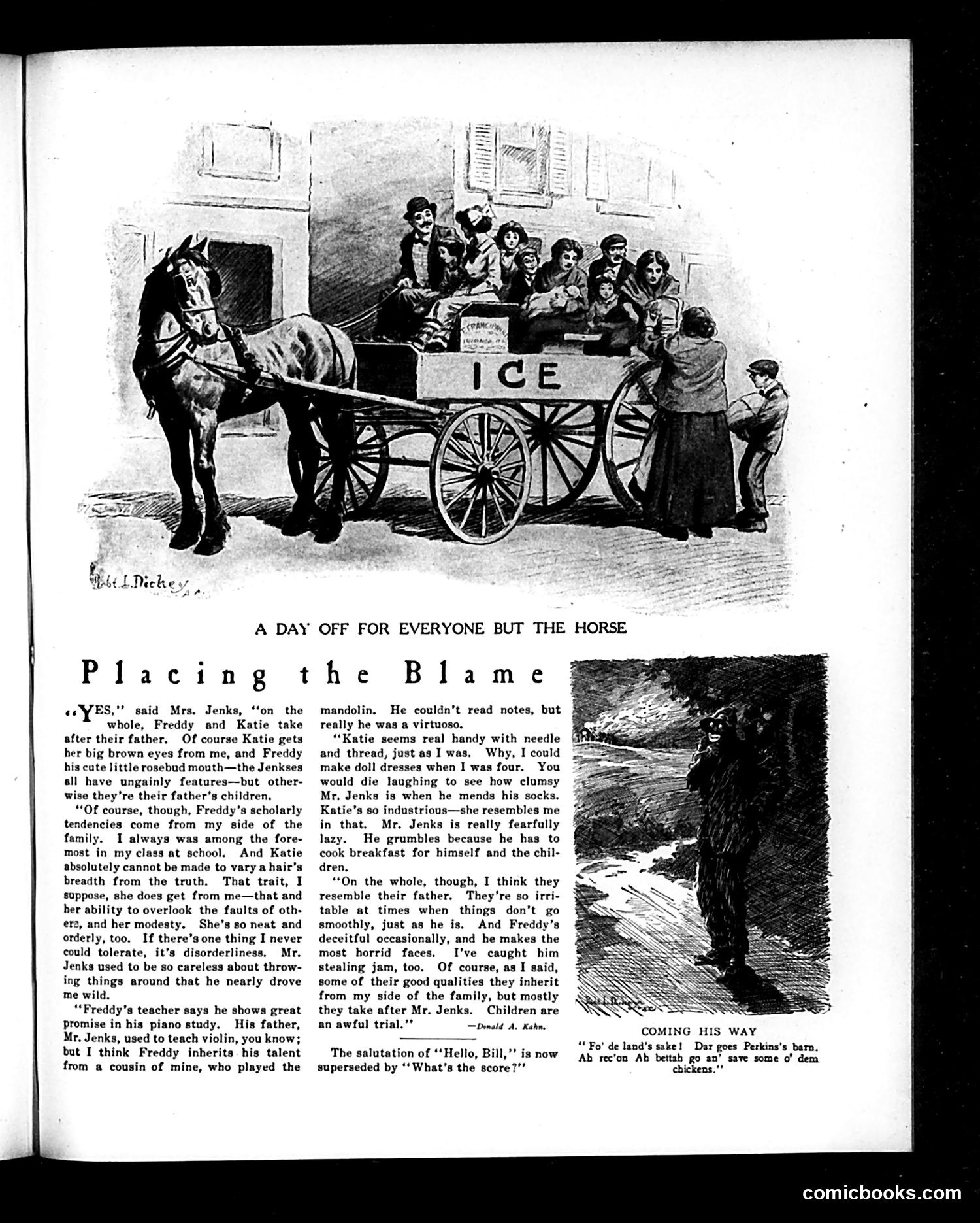
The main cartoon depicts a horse-drawn ice wagon surrounded by people enjoying a day off—everyone relaxes except the horse, who must still work. The title's irony is the satire's point: leisure is universal except for the beast of burden. The accompanying story, "Placing the Blame," satirizes a common social type: Mrs. Jenks, who constantly credits her children's good traits to herself while blaming her husband for their faults. She claims their honesty, industriousness, and musical talent come from her side of the family, while their irritability, deceitfulness, and laziness derive from Mr. Jenks. The humor lies in her obliviousness—she simultaneously insists they "resemble their father" while attributing nearly all positive qualities to herself. This mocks self-deluded parents who rationalize family dynamics through selective attribution, never acknowledging their own role in their children's shortcomings.
📄 Transcribed text from this page (OCR, searchable)
Machine-transcribed from the original scan — historical spelling and the odd misread are preserved.
A DAY OFF FOR EVERYONE BUT THE the Placing «ce YES,"’ said Mrs. Jenks, ‘ton the whole, Freddy and Katie take after their father. Of course Katie gets her big brown eyes from me, and Freddy his cute Jittle rosebud mouth—the Jenkses all have ungainly features—but other- wise they’re their father’s children, “Of course, though, Freddy's scholarly tendencies come from my side of the family. I always was among the fore- most in my class at school. And Katie absolutely cannot be made to vary a hair's breadth from the truth, That trait, I suppose, she does get from me—that and her ability to overlook the faults of oth- ere, and her modesty. She's so neat and orderly, too. If there’sone thing I never could tolerate, it’s disorderliness. Mr. Jenks used to be so careless about throw- ing things around that he nearly drove me wild. “Freddy’s teacher says he shows great Promise in his piano study. His father, Mr. Jenks, used to teach violin, you know; but I think Freddy inherits his talent from a cousin of mine, who played the Blame mandolin. He couldn’t read notes, but really he was a virtuoso. “Katie seems real handy with needle and thread, just as I was. Why, I could make doll dresses when I was four. You would die laughing to see how clumsy Mr. Jenks is when he mends his socks. Katie’s so industrious—she resembles me in that. Mr. Jenks is really fearfully lazy. He grumbles because he has to cook breakfast for himself and the chil- dren, “On the whole, though, I think they resemble their father. They’re so irri- table at times when things don't go smoothly, just as he is, And Freddy's deceitful occasionally, and he makes the most horrid faces. I've caught him stealing jam, too. Of course, as I said, some of their good qualities they inherit from my side of the family, but mostly they take after Mr. Jenks. Children are an awful trial.’” —Denald A, Kahn. The salutation of ‘Hello, Bill,”’ is now superseded by ‘‘What’s the score ?’’ COMING HIS WAY “* Fo! de land's sake! Ab rec'on Ab bettah go ai chickens. Dar goes Perkins's barn. save some o’ dem comicbooks.com