
Judge, 1913-05-10 · page 16 of 24
Judge — May 10, 1913 — page 16: what you’re looking at
What you’re looking at
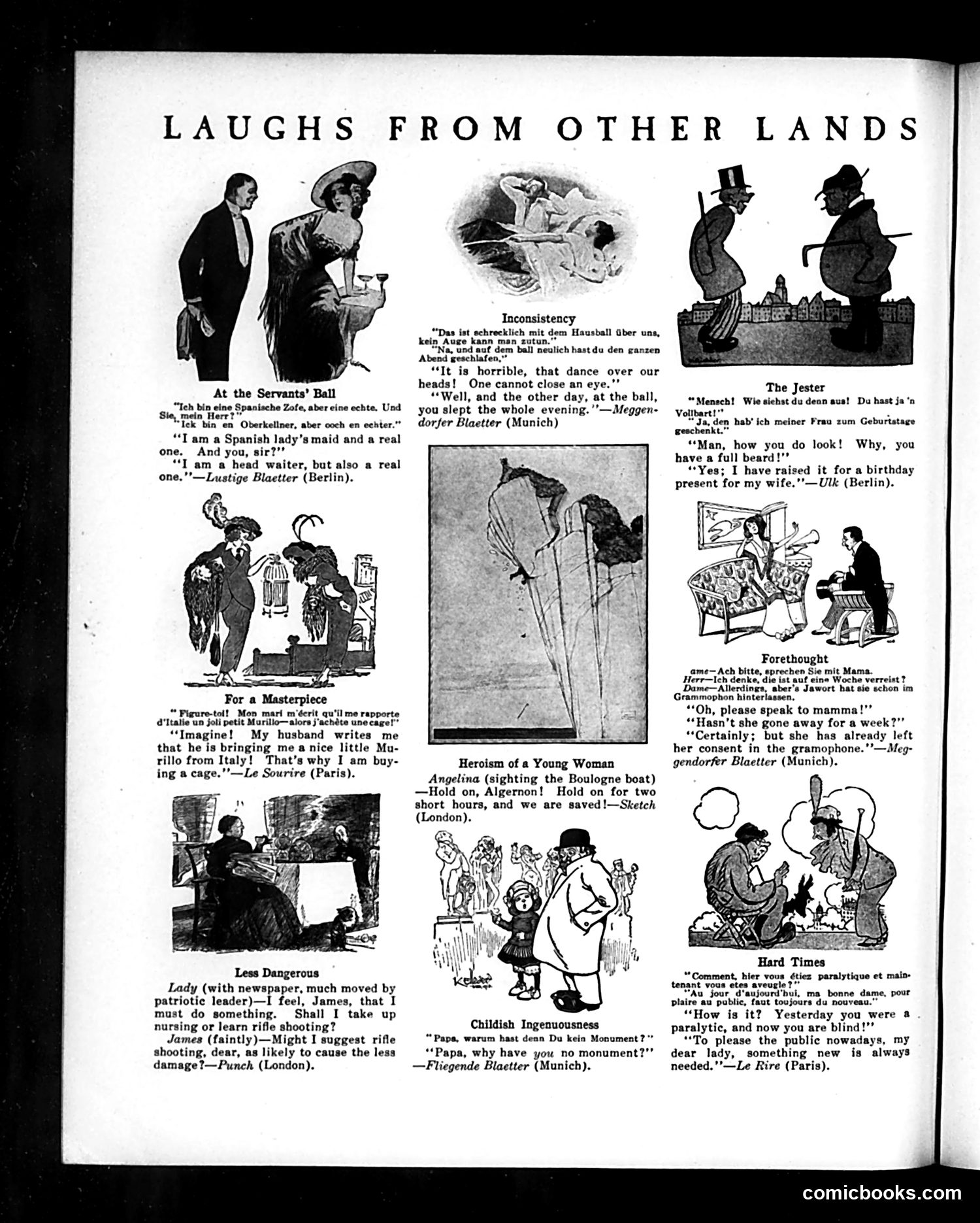
This *Judge* page collects humor from European satirical magazines, translated for American readers. The jokes target universal social absurdities rather than specific politics. **Key themes:** - **Class pretension**: Servants at a ball claim to be "real" versions of their roles—satire on working-class aspiration - **Wife management**: A husband buys a cage for a Murillo painting his wife expects (joke: she'll get a bird instead)—mocking spousal deception - **Female activism**: A patriotic woman's servant suggests rifle shooting over nursing as "less dangerous"—satirizing women's wartime involvement - **Hypocrisy**: Someone complains about noise from a ball while having slept through another—everyday inconsistency - **Professional desperation**: A street performer switches from paralysis to blindness "to please the public"—mocking exploitation of sympathy The page demonstrates how early 20th-century humor crossed borders through magazines like *Punch*, *Sketch*, and German *Blätter*, sharing comedic observations about gender, class, and human nature.
📄 Transcribed text from this page (OCR, searchable)
Machine-transcribed from the original scan — historical spelling and the odd misread are preserved.
LAUGHS FROM OTHER LANDS At the Servants’ Ball “Ich bin eine Spanische Zofe, aber eine echte. Und Sie, mein Herr? Ick bin en Oberkellner, aber ooch en echter.”” “Tam a Spanish lady’s maid and a real one. And you, sir?” “IT am a head waiter, but also a real one."’—Lustige Blaetter (Berlin). For a Masterpiece ‘ Figure-tol! Mon mari m’écrit qu'il me rapporte "Italie un joli petit Murillo—alors j'achéte unecage!” “Imagine! My husband writes me that he is bringing me a nice little Mu- rillo from Italy! That’s why I am buy- ing a cage.’’—Le Sourire (Paris). Less Dangerous Lady (with newspaper, much moved by patriotic leader)—I feel, James, that I must do something. Shall I take up nursing or learn rifle shooting? James (faintly)—Might I suggest rifle shooting, dear, as likely to cause the less damage ?—Punch (London). Inconsistency “Das ist schreeklich mit dem Hausball Gber uns, kein Auge kann mon zutun.” “Na, und auf dé neulich hastdu den ganzen Abend geschlafen,”” “It is horrible, that dance over our heads! One cannot close an eye."” “Well, and the other day, dorfer Blaetter (Munich) Heroism of a Young Woman Angelina (sighting the Boulogne boat) —Hold on, Algernon! Hold on for two short hours, and we are saved!—Sketch (London). Childish Ingenuousness “Papa, warum hast denn Du kein Monument ?”* **Papa, why have you no monument?"’ —Fliegende Blaetter (Munich). The Jester “Mensch! We sichst du dean aus! Du hast ja‘ Vollbart!"* “Ja, den hab! ich meiner Frau zum Geburtstage geschenkt.” “*Man, how you do look! have a full beard!" “Yes; I have raised it for a birthday present for my wife.’’—Ulk (Berlin). Why, you Forethought ame~Ach bitte, sprechen Sie mit Mama. Herr—Ich denke, die ist auf eine Woche verreist ? Dame—Allerdings, aber's Jawort hat sie echon im Grammophon hinteriassen. “Oh, please speak to mamma!” “Hasn't she gone away for a week?"" “Certainly; but she has already left her consent in the gramophone.""—Meg- gendorfer Blaetter (Munich). “Comment, hier vous étiez paralytique et main- tenant vous etes aveusie? Ai \jourd’bui, ma bonne dame, pour plaire au public, faut toujours du nouveau. “How is it? Yesterday you were @ paralytic, and now you are blind! “To please the public nowadays, my dear lady, something new is always needed.’’—Le Rire (Paris). comicbooks.com