
A complete issue · 24 pages · 1913
Judge — March 8, 1913
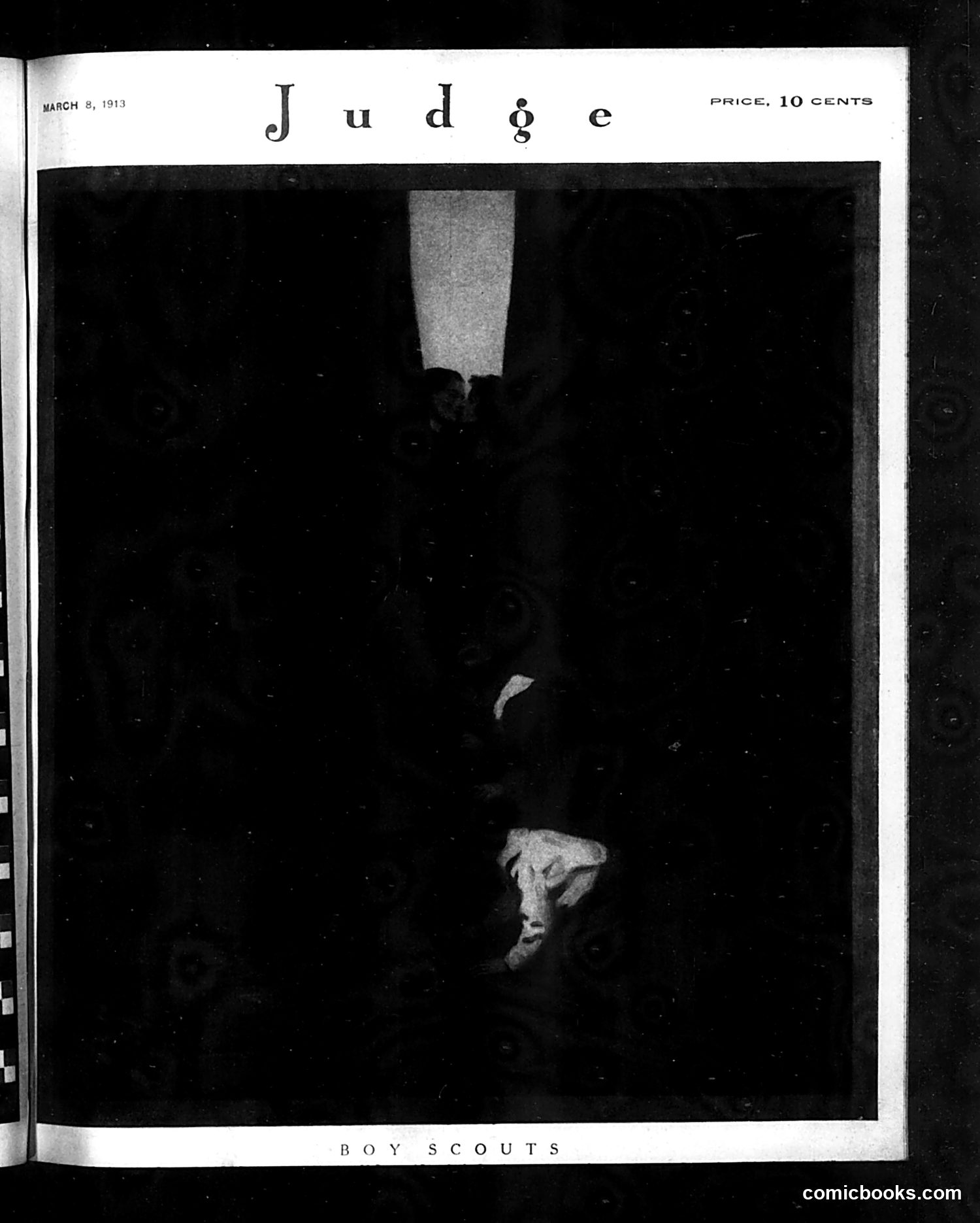
This page shows a darkened photograph labeled "Boy Scouts" at the bottom. The image is extremely dark and underexposed, making it difficult to discern clear details of what's being depicted. Given the date (1913) and title, this likely references the Boy Scouts of America, which had been founded just a few years earlier (1910). However, without clearer visibility of the actual content, I cannot definitively identify specific figures or determine what satirical point Judge is making about the organization. The darkness of the photograph itself may be intentional—possibly satirizing the Boy Scouts movement, their activities, or leadership—but the specific target and critique remain unclear from this reproduction.
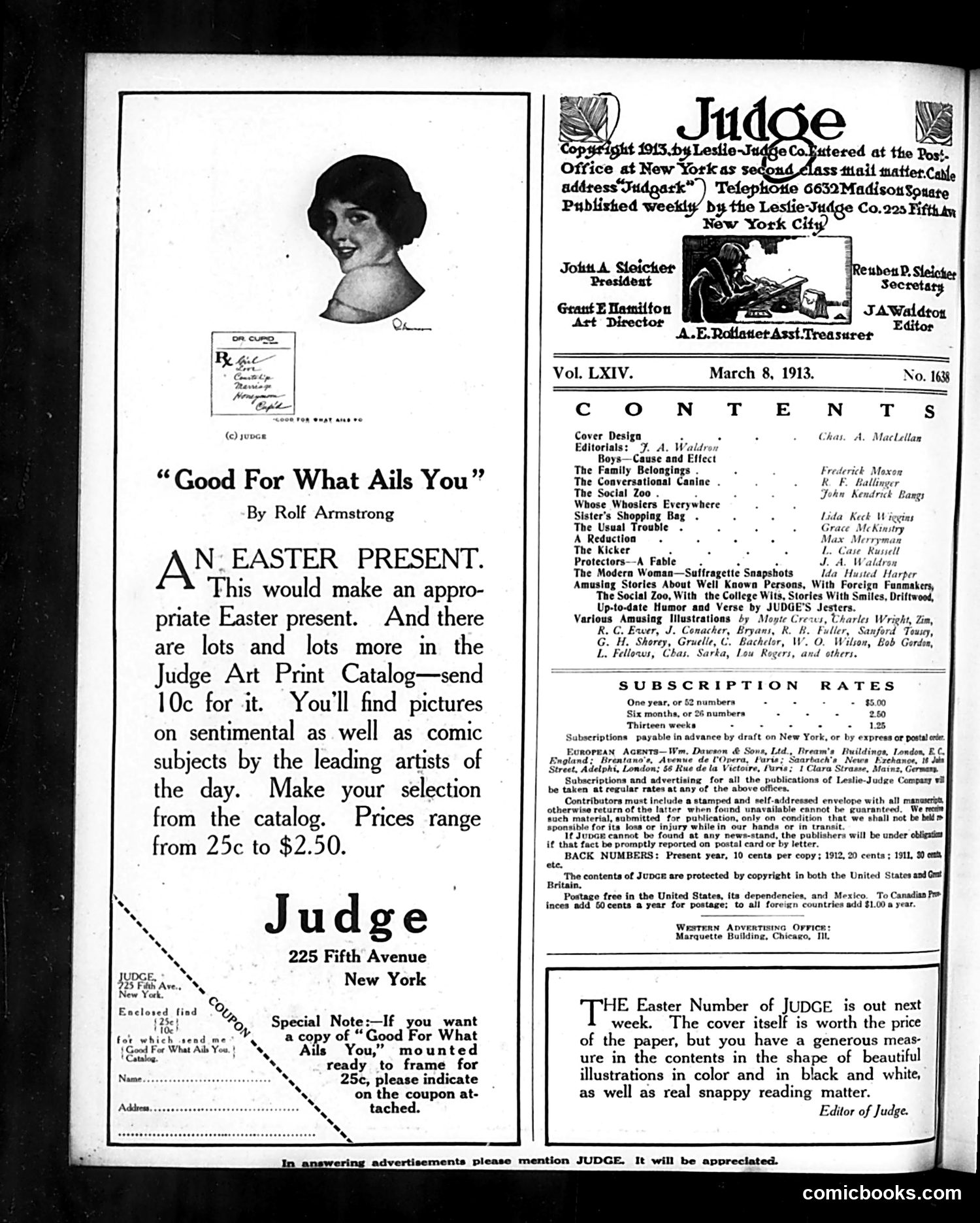
This page is primarily **advertising for Judge magazine itself**, not political satire. The left side promotes Judge's art print catalog and Easter gift offerings, featuring a portrait of an unnamed woman. The advertisement emphasizes affordable art prints (25¢ to $2.50) by "leading artists of the day." The right side shows the magazine's masthead, contents listing, and subscription rates ($5 annually). An editor's note announces the forthcoming Easter issue, highlighting color illustrations and "snappy reading matter." The only textual content is Rolf Armstrong's piece "Good For What Ails You"—a brief Easter gift recommendation. There is **no political cartoon or social satire visible** on this particular page; it functions as an editorial/advertising insert.
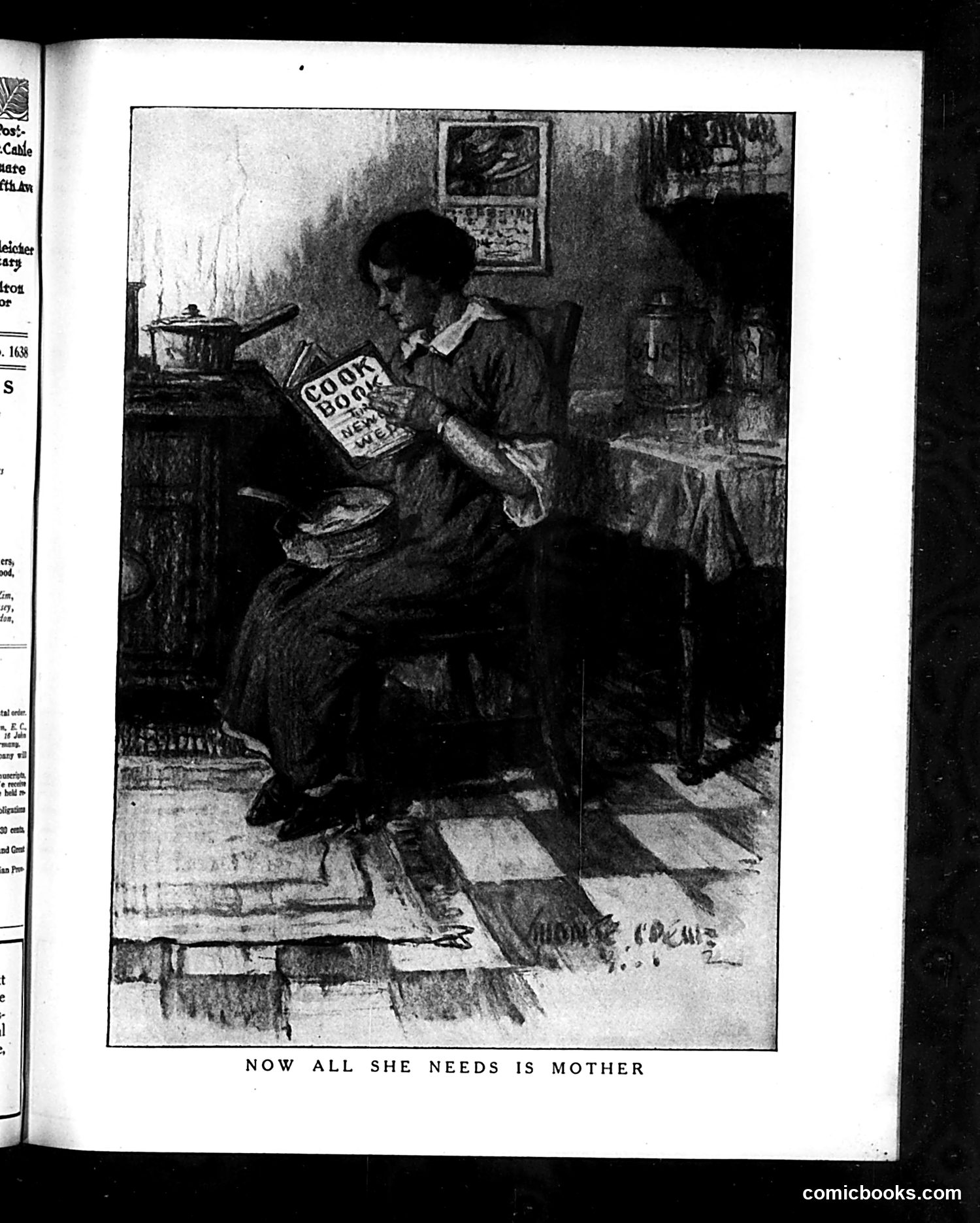
This illustration depicts a young woman in modest domestic circumstances reading a cookbook titled "Cook Book for the Newlywed." She sits in a sparse kitchen with basic furnishings and cookware visible. The caption's irony suggests the cartoon critiques the expectation that cookbook instruction alone suffices for new wives. The satire implies that cookbooks cannot replace maternal guidance, practical experience, or emotional support—a young bride needs her mother's direct instruction and wisdom, not just printed recipes. This reflects early-20th-century anxieties about changing domestic roles and the limitations of written instruction for traditionally female household tasks. The humor targets either the false promise of self-help literature or society's unrealistic expectations of newly married women.
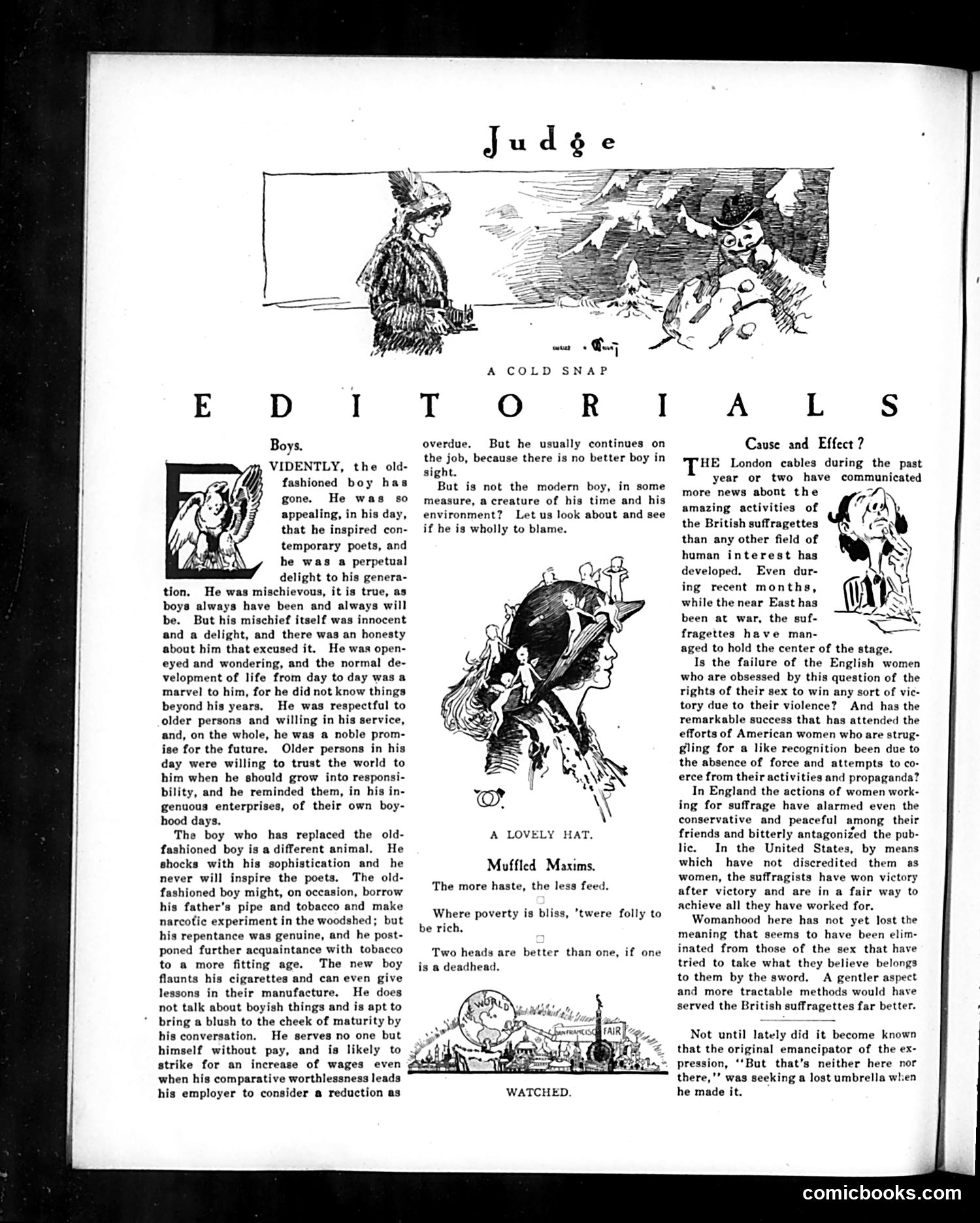
This page contrasts the "old-fashioned boy" with the modern boy, lamenting how contemporary youth have become cynical and self-interested. The text criticizes the modern boy as lacking inspiration, mischievous without innocence, and concerned only with wages and self-advancement—a sharp departure from boys who once inspired poets and served society faithfully. The cartoons illustrate this contrast: "A Cold Snap" and "A Lovely Hat" appear to satirize current fashions or social behaviors among the young. The right column shifts to British suffragettes, praising their peaceful methods compared to American suffragists' more confrontational tactics. The piece suggests American women's violence undermined their cause, while British women achieved better results through restraint. This reflects early 20th-century debates over suffrage strategy.
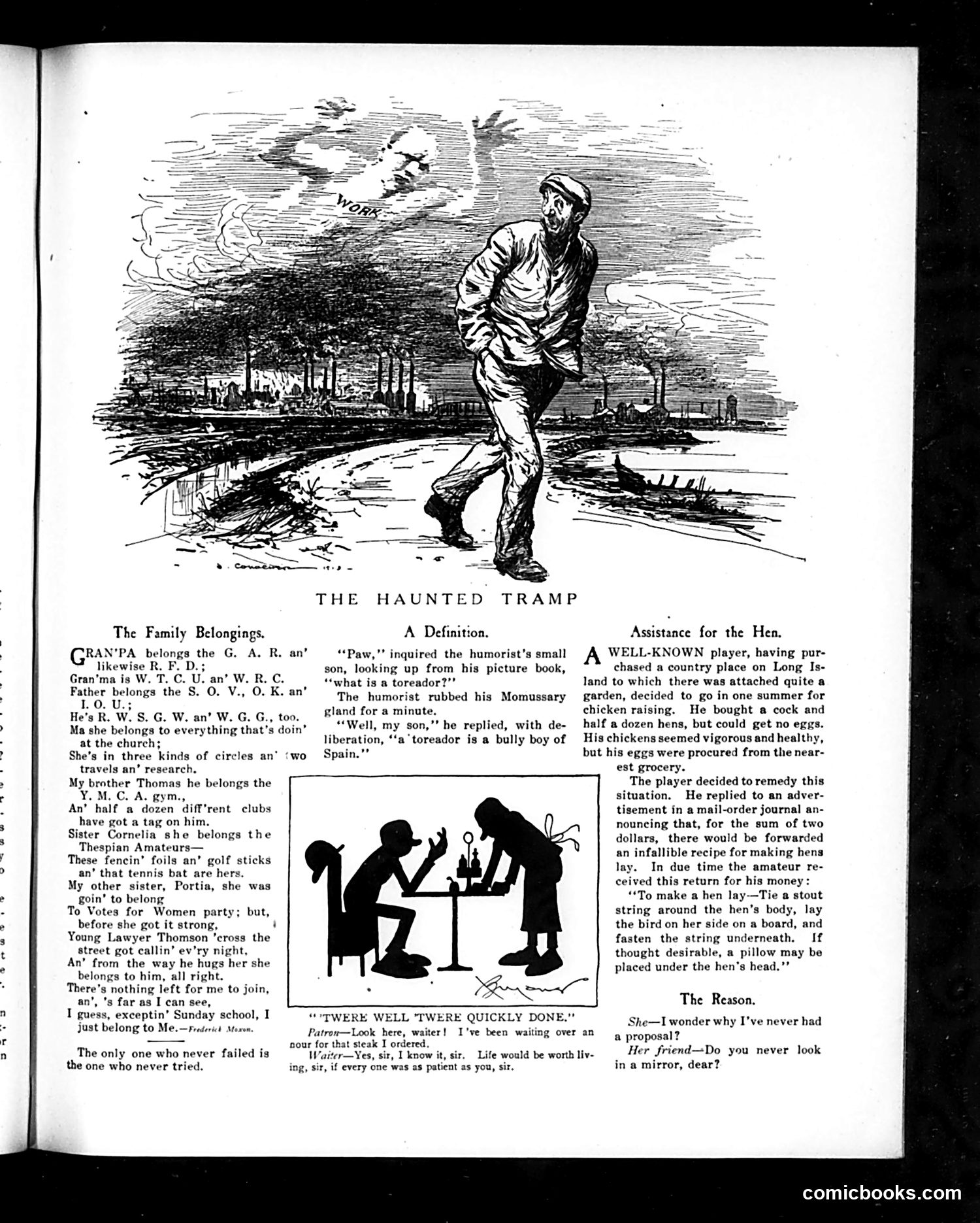
This Judge magazine page combines humor columns with satirical content. "The Haunted Tramp" illustration (top) depicts a disheveled vagrant near an industrial landscape—likely social commentary on homelessness and labor conditions during industrialization. The central cartoon shows three figures at a table with the caption "TWERE WELL 'TWERE QUICKLY DONE," referencing Shakespeare's *Macbeth*—a darkly comedic allusion to hasty, consequential decisions. The text sections are lighthearted social satire: "The Family Belongings" humorously catalogs organizational affiliations (golf clubs, tennis groups, political parties), mocking America's obsession with joining societies. "A Definition" plays on the word "torador," and "Assistance for the Hen" offers absurd advice about chicken-raising. The overall tone suggests turn-of-the-century American humor mixing class commentary with wordplay and domestic absurdity.
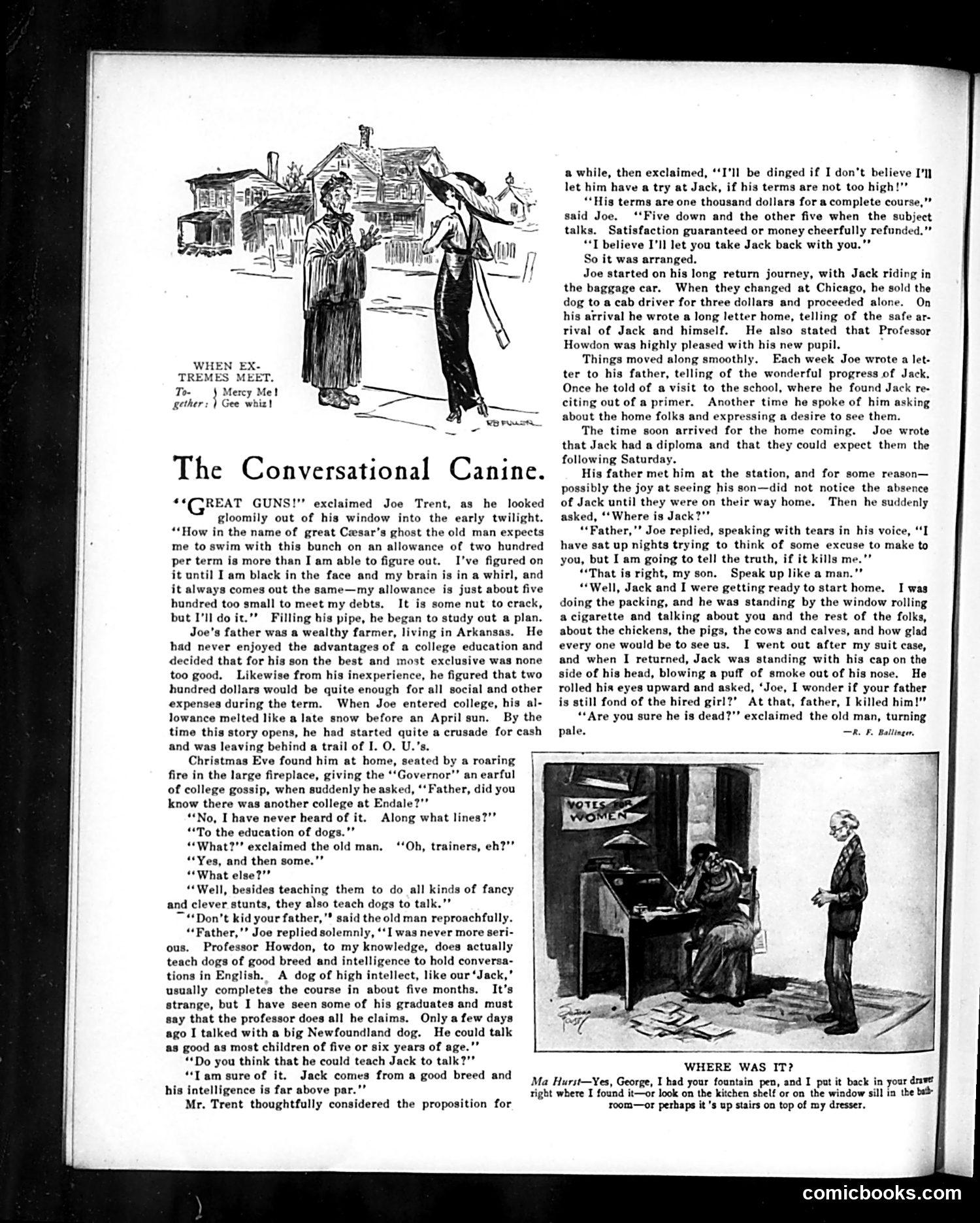
This story satirizes both a college student's financial irresponsibility and the era's fascination with animal intelligence claims. Joe Trent, a broke college student with a meager allowance, schemes to send his dog "Jack" home to his wealthy farmer father under the pretense that the dog has been trained to speak English by Professor Howdon—a dubious claim Joe monetizes at $1,000. The joke relies on period absurdity: the father actually believes dogs can be taught conversational English. Joe sells the dog mid-journey for three dollars and fabricates weekly letters about Jack's "progress." When confronted at homecoming, Joe claims he killed Jack because the dog asked about the hired girl—an insulting, familiar question no dog would ask. The satire mocks both paternal gullibility and student deception, alongside the era's credulous belief in animal education schemes.
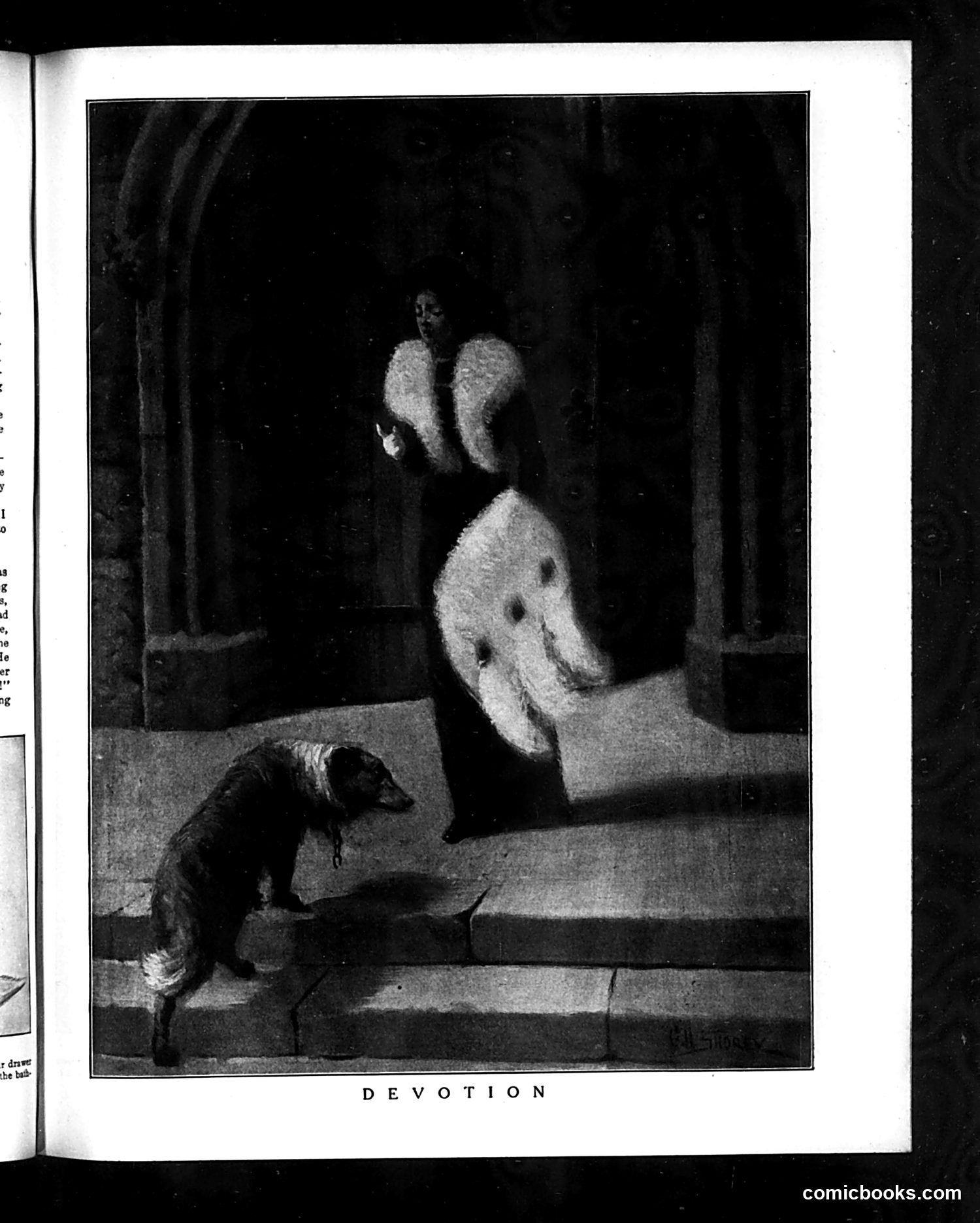
This artwork depicts a woman in an elegant white fur coat kneeling before what appears to be a religious or spiritual figure in dark robes within an arched, cathedral-like setting. A small dog sits in the foreground. The title "Devotion" suggests satirical commentary on religious faith or spiritual devotion, likely critiquing either sincere religious practice or its performative aspects. The woman's elaborate fur coat and the formal setting suggest she represents wealth or high society. Without additional context from the magazine's date or surrounding content, the specific target of satire remains unclear—it could reference religious hypocrisy, wealthy people's selective piety, or contemporary religious movements. The dog's presence may emphasize blind faith or loyalty. The artwork's style and publication in *Judge* magazine indicates this was intended as social or political commentary for an educated audience familiar with current events of its era.
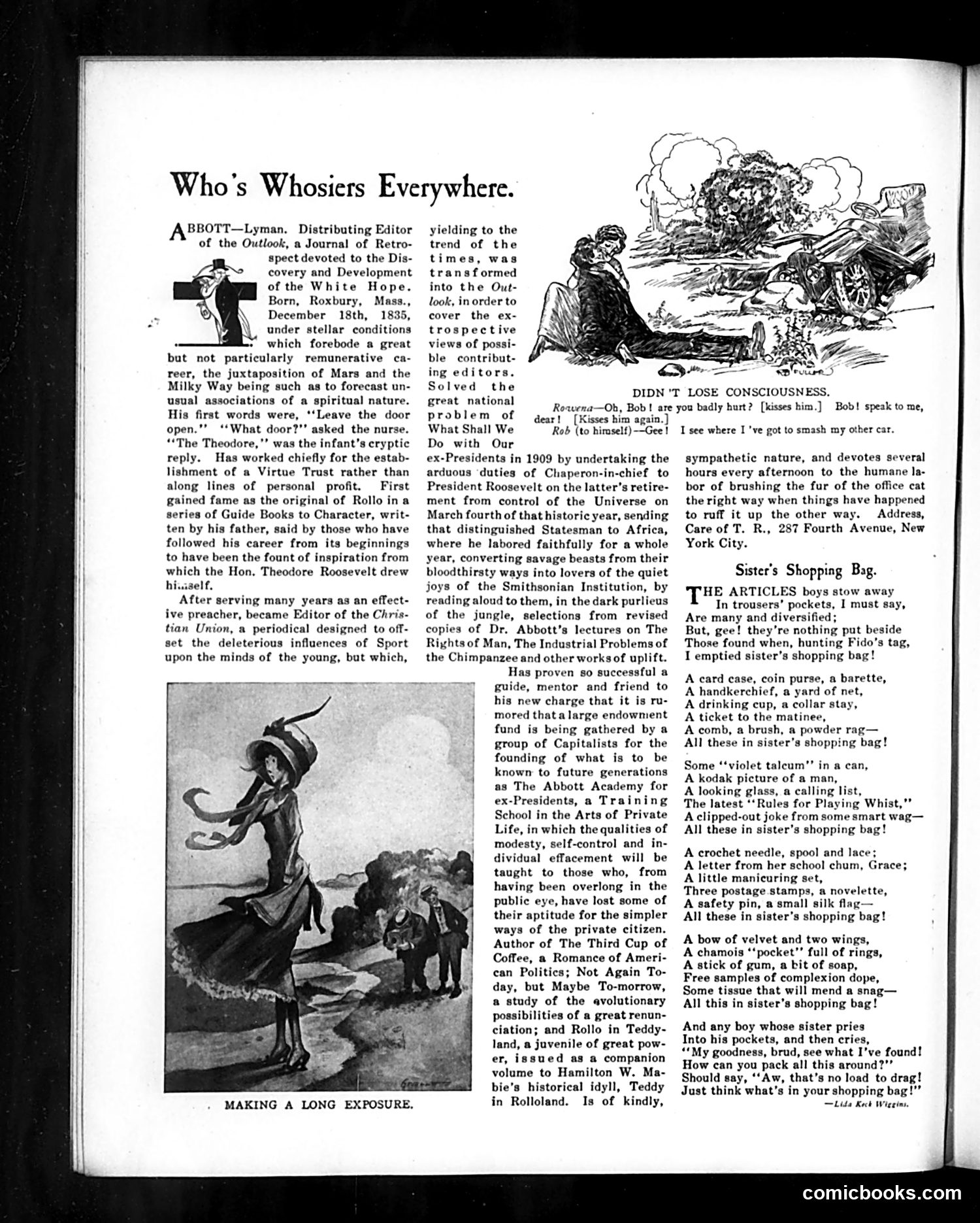
This page satirizes **Lyman Abbott**, editor of *The Outlook* magazine, through mock-biographical sketch and accompanying cartoon. The satire targets Abbott's role as Theodore Roosevelt's unofficial advisor and publicist. The text mocks Abbott for: 1. **Creating the "White Hope"** — Abbott promoted Roosevelt as a moral exemplar and spiritual guide 2. **The Africa solution** — Abbott arranged Roosevelt's post-presidency African safari (1909-1910), framed here as Abbott "chaperoning" an overgrown child-president, reading moral lectures to jungle animals to civilize them 3. **Proposed "Abbott Academy for ex-Presidents"** — sarcastically suggesting Abbott wants to establish a school teaching retired presidents how to live quietly as private citizens The cartoon labeled "Making a Long Exposure" (bottom left) appears to show photography or surveillance, likely mocking Abbott's obsessive documentation/promotion of Roosevelt. The humor lies in portraying Abbott as Roosevelt's spiritual minder—reducing the former president to a charge requiring moral instruction—and suggesting Abbott sees himself as indispensable to managing powerful men's public legacies.
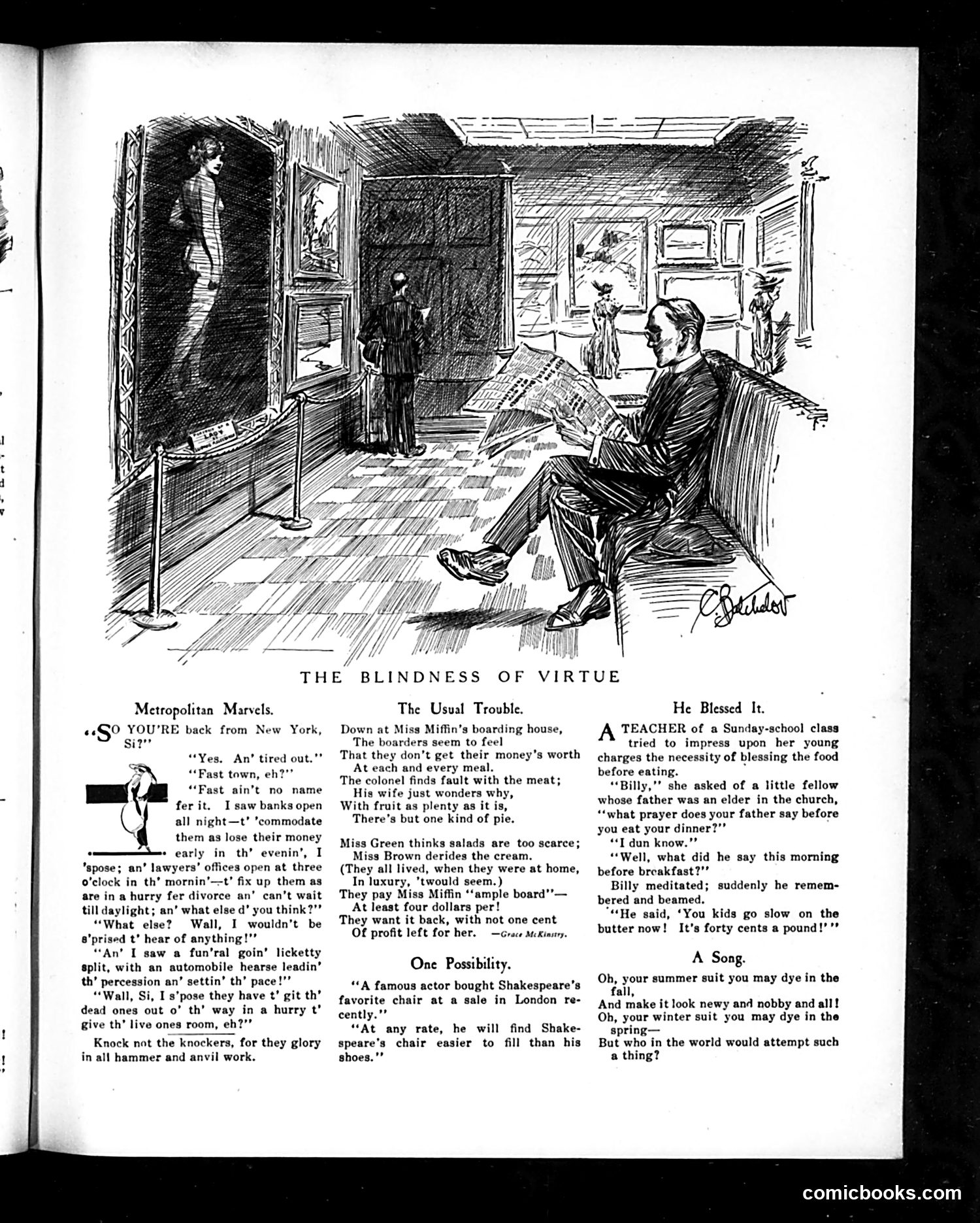
This page contains multiple satirical pieces mocking American urban life and social hypocrisy: **Main Cartoon**: Depicts a well-dressed man reading a newspaper in an art gallery while ignoring a nearly nude classical statue (or live model) behind him. The title suggests ironic commentary on selective moral blindness—he sees nothing inappropriate while surrounded by nudity, commenting on Victorian prudishness and cultural pretension. **Text Pieces**: Include: - "Metropolitan Marvels": Rural characters marveling at New York's fast pace (24-hour banks, divorce lawyers, speedy funerals) - "The Usual Trouble": Boarding house tenants complaining about meager meals despite paying four dollars—satirizing ungrateful guests - "He Blessed It": A child recounting his father's "blessing" as merely complaining about butter prices—mocking superficial religiosity The overall theme critiques American hypocrisy: false virtue, urban excess, ingratitude, and shallow piety. The humor relies on exposing gap between professed values and actual behavior.
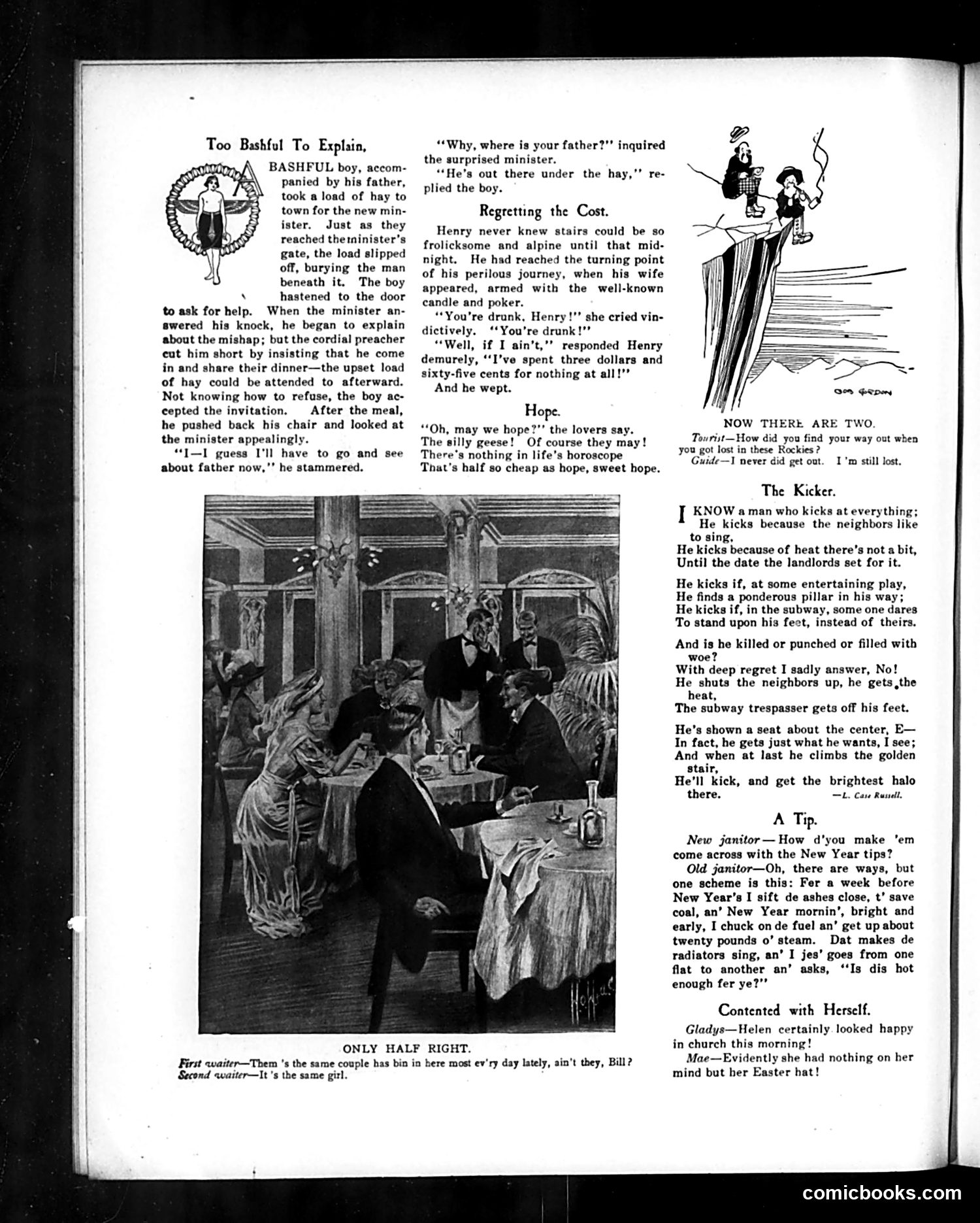
This page contains four brief humorous stories satirizing American social life, likely from the early 20th century: **"Too Bashful to Explain"** mocks social awkwardness—a boy is so flustered by the minister's hospitality that he forgets to mention his father is literally buried under hay outside. **"Regretting the Cost"** depicts a drunk husband defending himself to his angry wife by claiming his three-dollar drinking spree was at least a "bargain" if he's not actually drunk. **"The Kicker"** is verse satirizing chronic complainers who paradoxically always get what they want, suggesting their constant griping is actually effective. **"A Tip"** shows working-class humor—a janitor explains how to extract New Year's gratuities from tenants by deliberately withholding heat, then cranking radiators to create discomfort before soliciting tips. The cartoons target American middle and working-class domestic life, social pretension, and labor relations with gentle ridicule typical of Judge's satirical approach.
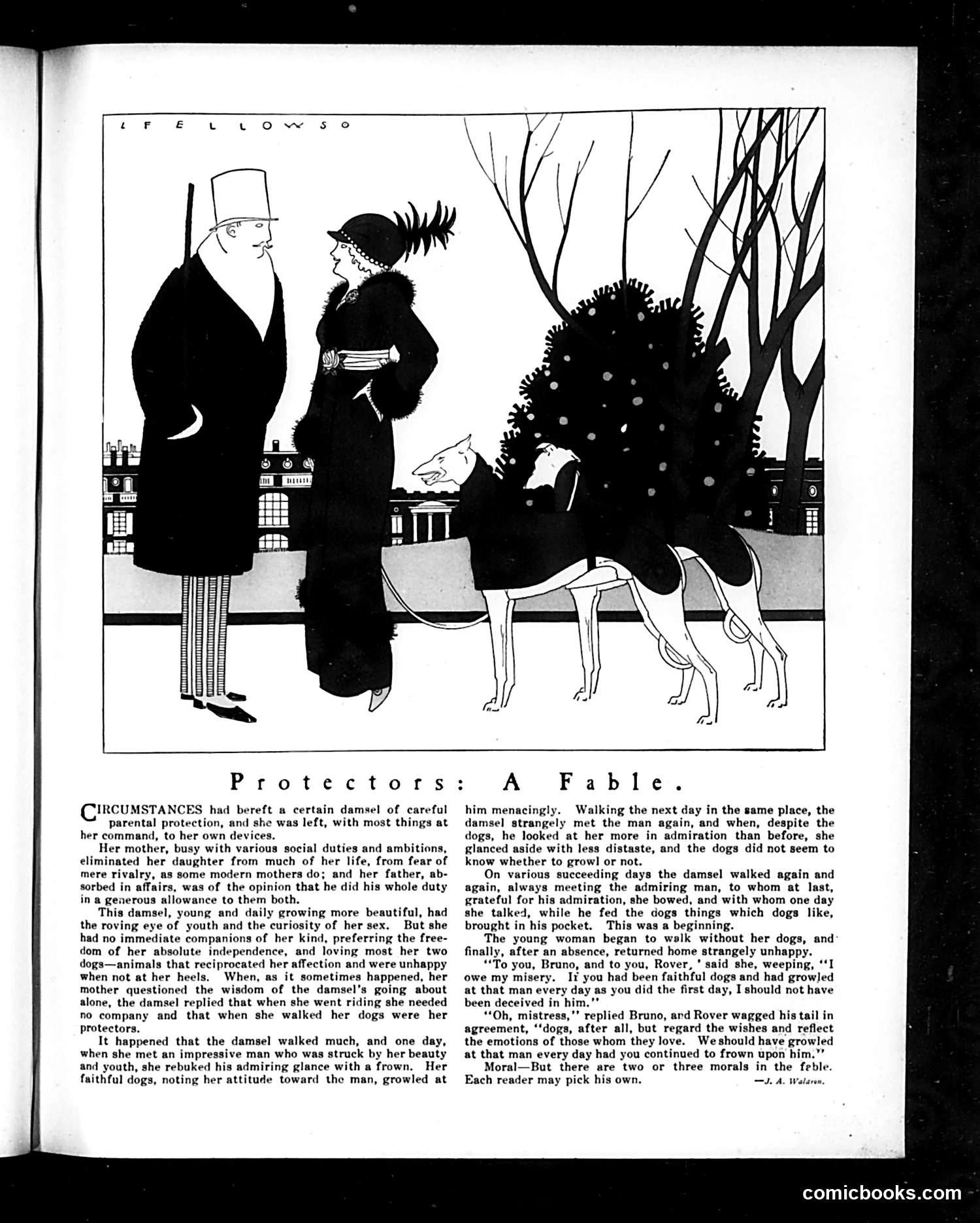
This moral fable satirizes a young woman's independence and naive romanticism. A neglected damsel relies on her two dogs as "protectors" while walking alone—a social transgression for an unaccompanied woman of the era. When she encounters an attractive man, her dogs initially growl at him. However, as she gradually softens toward the stranger (feeding him, walking without the dogs), the animals cease their warnings, sensing her changed attitude. She's ultimately "deceived" by the man and returns home unhappy. The dogs' moral reply: they merely reflect *her* emotions and wishes—they cannot protect her from her own poor judgment. The cartoon critiques both parental neglect (her busy mother and distant father) and the folly of relying on external "protectors" rather than personal virtue. For modern readers, it reflects Victorian anxieties about unsupervised women and the era's assumption that a woman's own moral weakness—not male predation—caused her downfall.
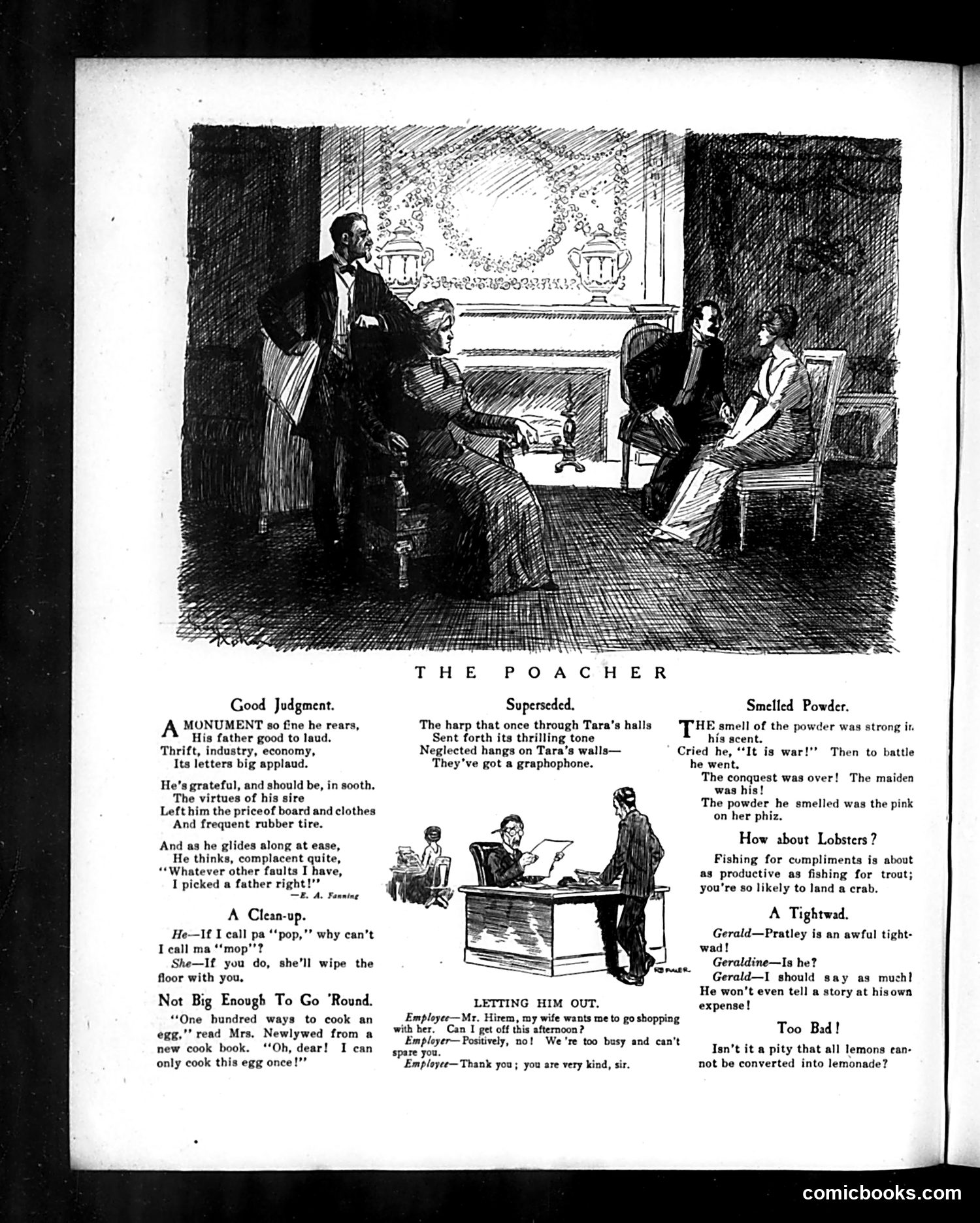
This page from *Judge* contains multiple short humorous pieces rather than a single unified cartoon. **"The Poacher"** (main illustration) shows a social-climbing young man bragging to visitors about his father's self-made success—not realizing he's merely inherited wealth and comfort ("the price of board and clothes / And frequent rubber tire"). The satire targets self-congratulation built on inherited privilege rather than personal merit. The remaining items are brief jokes addressing early 20th-century domestic life: wives' domestic authority ("Clean-up"), newlywed inexperience with cooking, nostalgia for traditional Irish culture being replaced by modern technology (the gramophone superseding the harp), workplace dynamics where an employee cleverly manipulates his boss into granting time off, and various quips about romance, compliments, and stinginess. The humor relies on wordplay and observations about social conventions rather than political commentary—typical *Judge* light satirical fare.
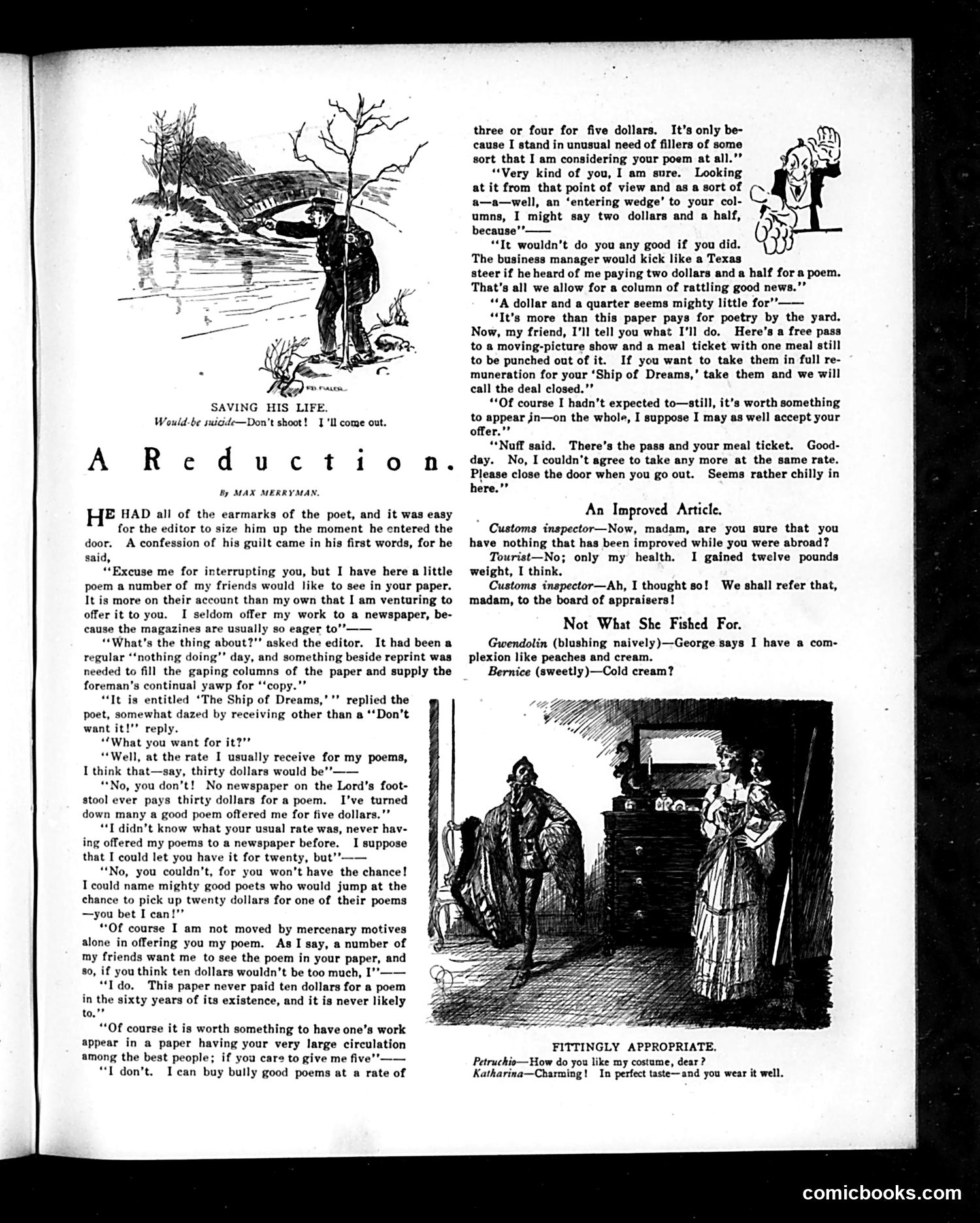
This satirical piece mocks the newspaper industry's notorious cheapness toward poets and writers. A hopeful poet enters a newspaper office offering his poem "The Ship of Dreams" for publication. The editor systematically negotiates him downward—from thirty dollars, to twenty, to ten, to five, finally offering only a movie pass and a meal ticket worth roughly one dollar. The satire targets two things: (1) newspaper editors' dismissive attitude toward literary work, viewing poetry as mere "filler" for empty columns rather than valuable content, and (2) struggling writers' desperation, forcing them to accept humiliating terms just for exposure in a widely-circulated publication. The cartoon's title, "A Reduction," refers both to the poet's repeatedly reduced asking price and the broader degradation of literary value in commercial publishing.
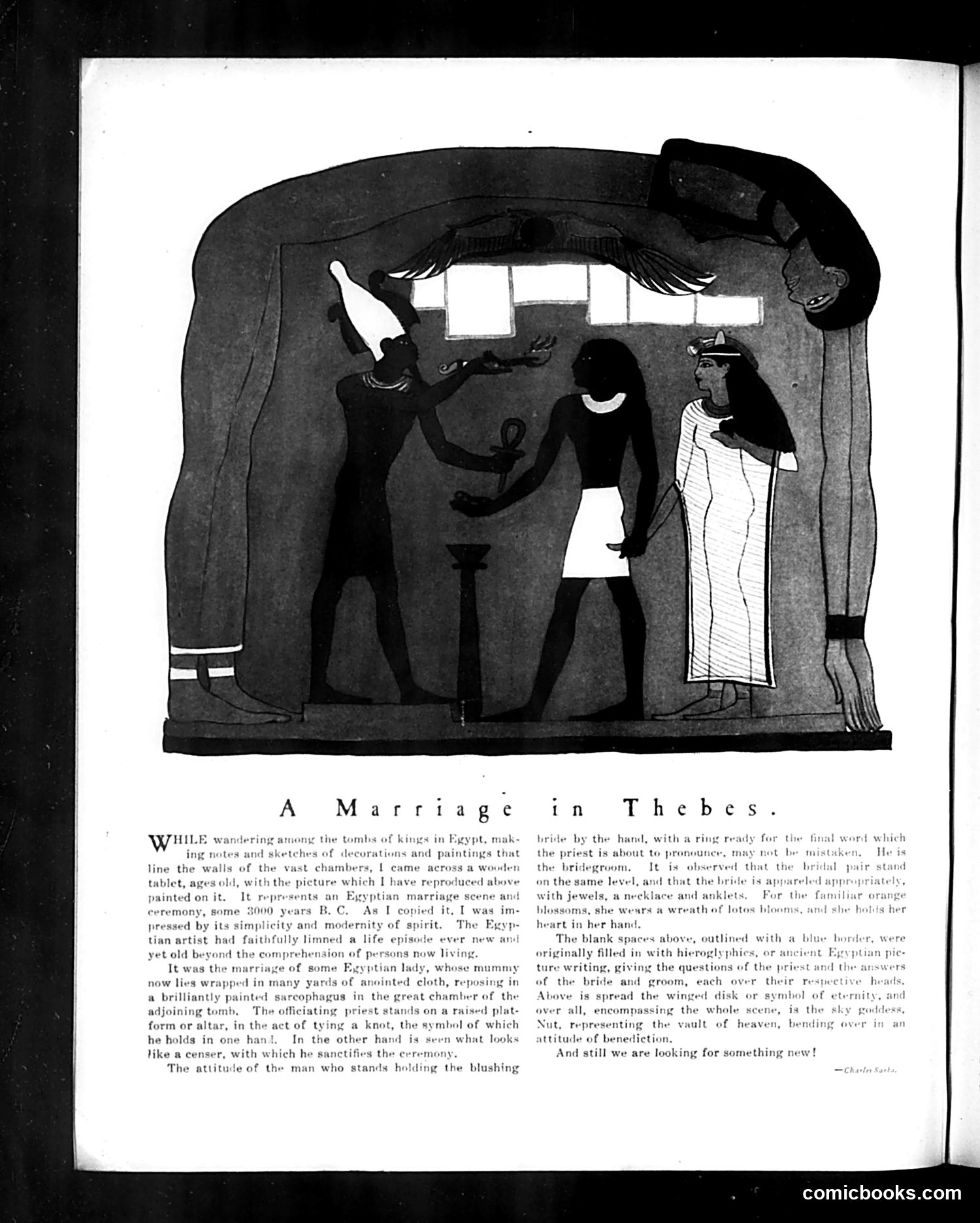
This page illustrates an ancient Egyptian wedding scene discovered in a tomb, presented as a historical curiosity. The accompanying text describes a wooden tablet depicting a marriage ceremony from around 3000 B.C., which the author claims to have found while exploring Egyptian tombs. The illustration shows silhouetted figures in Egyptian style: a priest tying a ceremonial knot, the bride and groom, and hieroglyphic elements. The satire's point—indicated by the final line "And still we are looking for something new!"—is that despite humanity's fascination with ancient civilizations and their supposed wisdom, we keep rediscovering the same basic human rituals (like marriage) across millennia. The joke suggests that even 5,000 years later, weddings remain fundamentally unchanged, undermining any notion of progress or novelty in human customs.
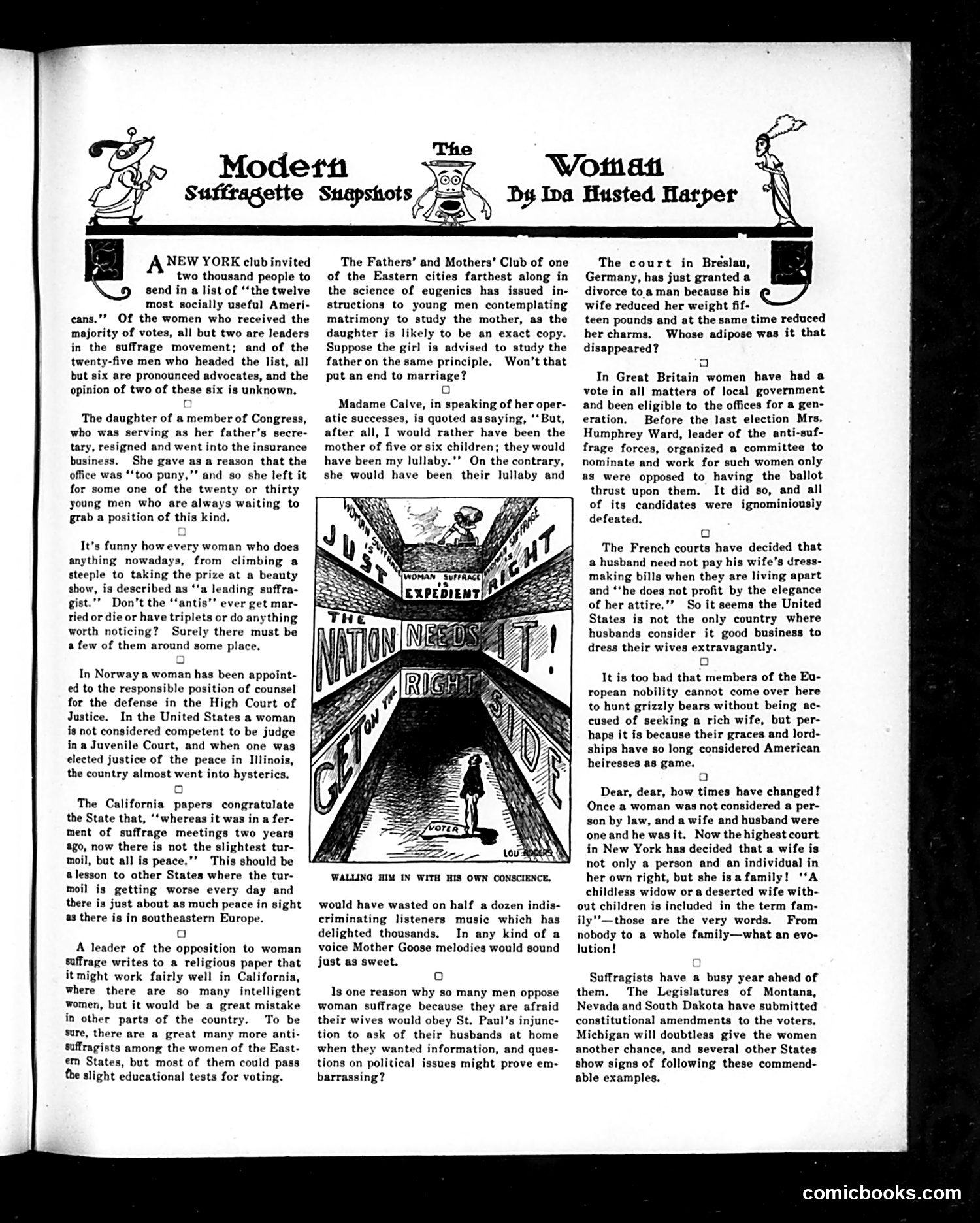
This page from *Judge* magazine presents satirical observations on the suffrage movement and women's changing social roles. The central cartoon depicts a woman walking through a corridor labeled with suffragist slogans and "The Nation Needs It," with the caption "Walling Him In With His Own Conscience"—suggesting suffragists are using moral arguments to pressure male opposition. The column mocks both suffragists and anti-suffragists through anecdotal commentary. It notes that women leaders are predominantly suffragists while questioning why anti-suffragists receive less publicity. The author sarcastically discusses male fears about educated wives questioning them on politics, and cites international examples (Norway, California, Great Britain) where women have gained political participation without societal collapse. The piece adopts a tone of bemused superiority, treating the suffrage debate as absurd while actually presenting evidence supporting women's competence and the movement's reasonableness.
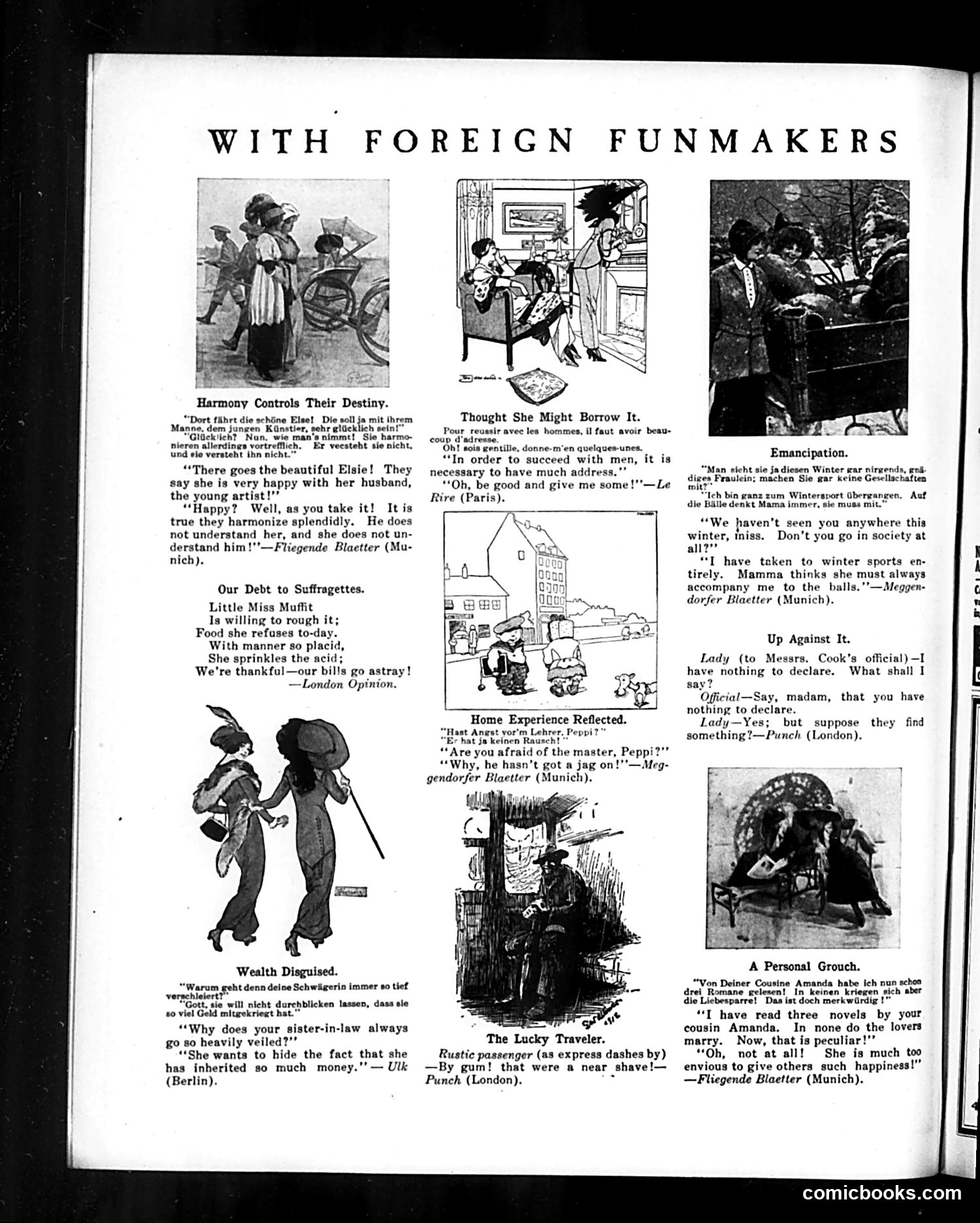
This page collects humorous observations from European satirical publications, translated for American readers. The cartoons and jokes mock social conventions of the early 20th century: **Key targets include:** - **Marriage dynamics**: A German piece jokes that harmony between spouses means mutual incomprehension. - **Women's emancipation**: A London piece sarcastically thanks suffragettes for committing mail-bombing (sprinking acid), which destroys bills. - **Wealth and social pretense**: A Berlin cartoon depicts a woman heavily veiled to hide her inheritance. - **Class and intellect**: A Munich piece suggests a schoolboy isn't afraid of his teacher because the teacher is drunk ("hasn't got a jag on"). - **Women's jealousy**: The final joke implies a female novelist sabotages her own romance plots out of spite. The page demonstrates Judge's practice of republishing European humor to entertain American audiences with foreign perspectives on shared social anxieties about marriage, women's rights, class, and propriety.
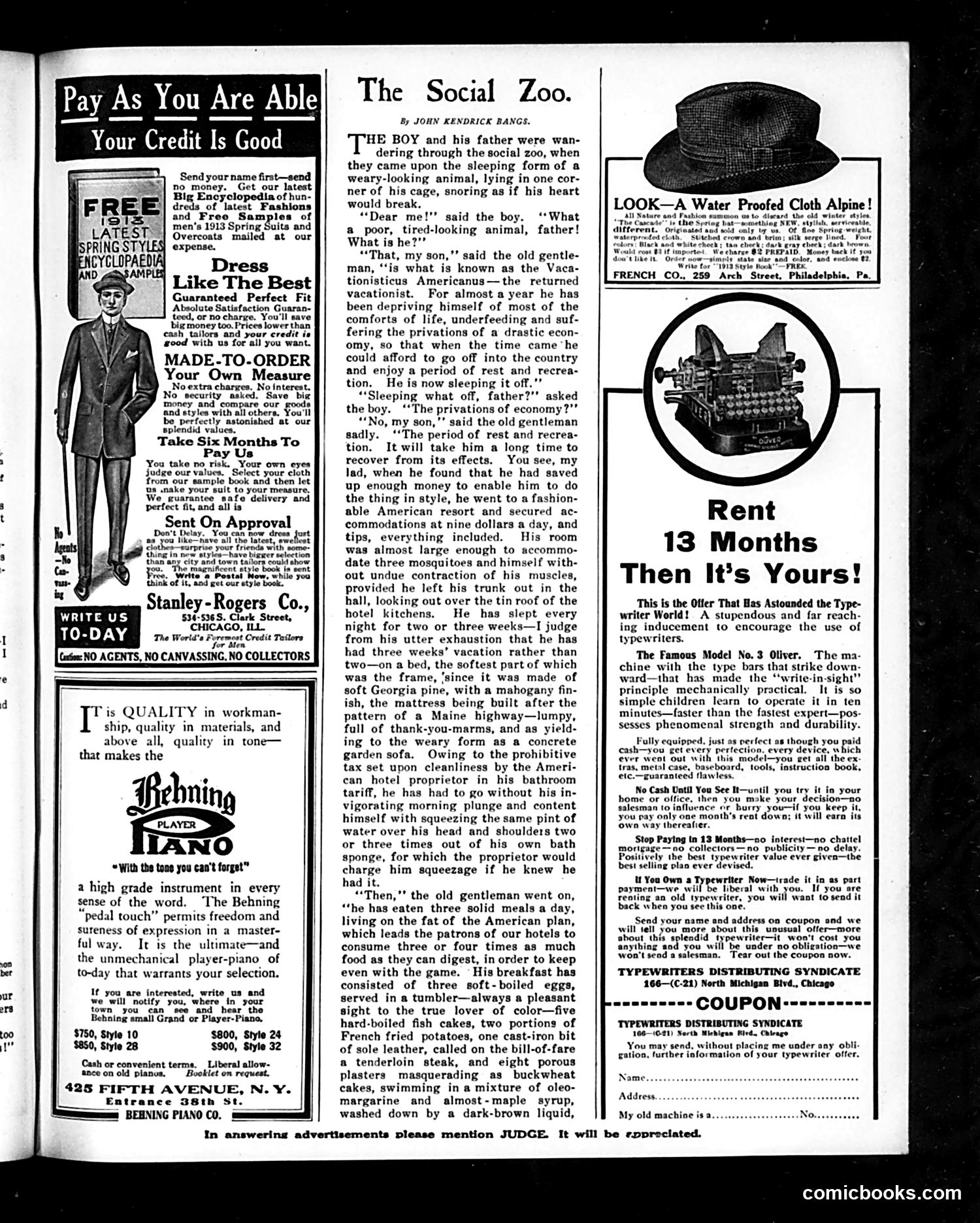
This satirical piece mocks the American vacation industry and middle-class aspirations circa 1913. A father and son observe a sleeping "Vacationisticus Americanus"—a exhausted man who saved money all year through strict economy, then spent lavishly at a fashionable resort, only to return utterly depleted. The satire targets multiple absurdities: the working-class person's self-denial to afford "nine dollars a day" accommodations (expensive then), the resort's exploitation (tiny rooms, rickety beds, expensive gratuities), and the cruel irony that the vacation meant to restore him has instead destroyed him. The "social zoo" framing presents American leisure culture as a specimen worthy of naturalistic study—ridiculous animal behavior observed by civilization. The joke assumes readers recognize this pattern: exhausting yourself to afford a vacation that exhausts you further.
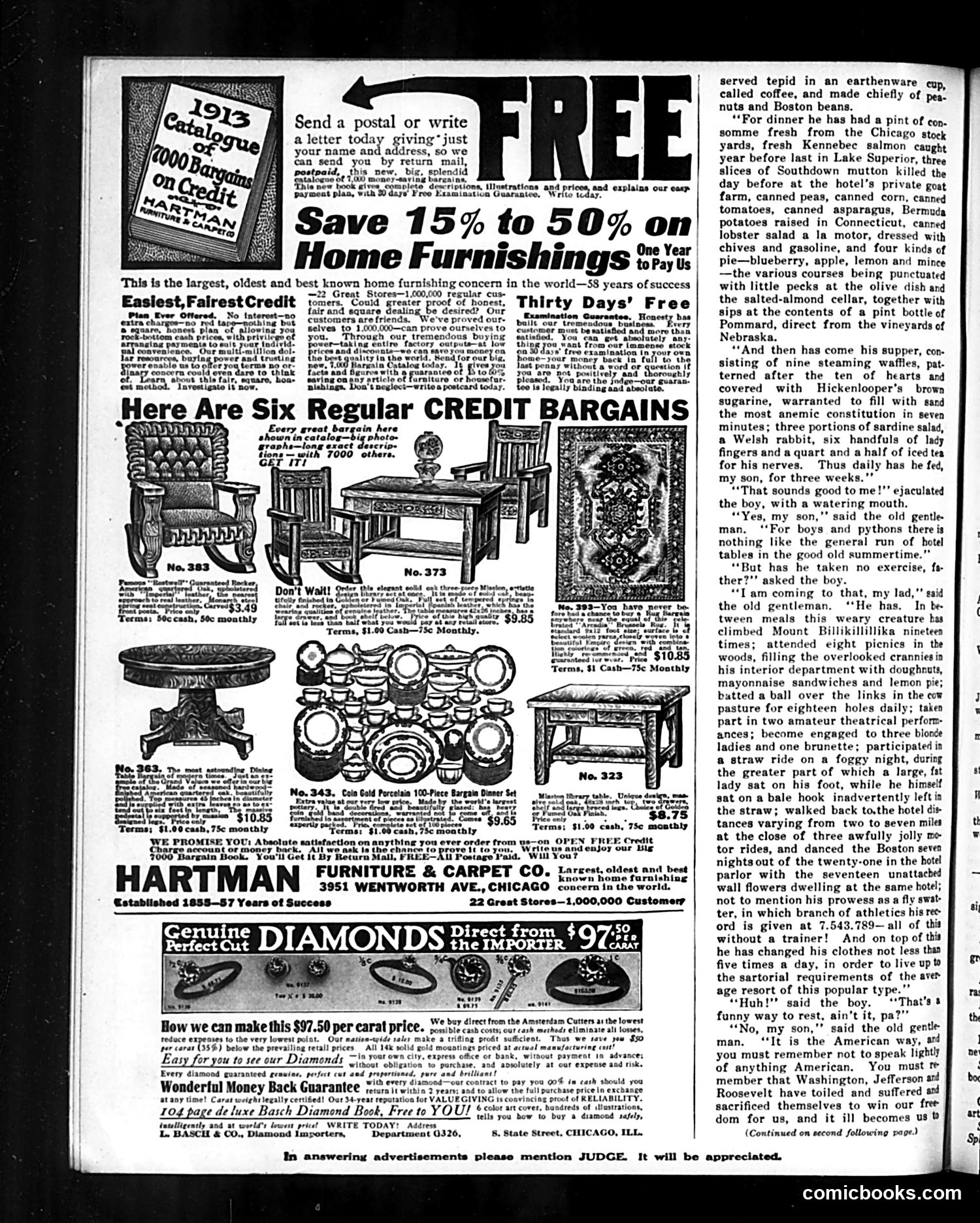
This page is predominantly **advertising**, not satirical editorial content. It features Hartman Furniture & Carpet Co.'s mail-order credit catalog and a diamond import business advertisement. The small text visible on the right appears to be a **satirical story or column** mocking luxury hotel dining. It describes an absurdly lavish meal presented as haute cuisine, but the descriptions reveal it as pretentious fraud: "fresh" salmon caught "year before last," mutton from "the hotel's private goat farm," vegetables that are all canned, and dressing made with "gasoline." The satire targets wealthy travelers who believe they're eating premium food at upscale establishments while actually consuming cheap, preserved ingredients disguised by fancy presentation. The humor lies in exposing the gap between hotels' claims and reality—a timely critique of Gilded Age consumer deception.
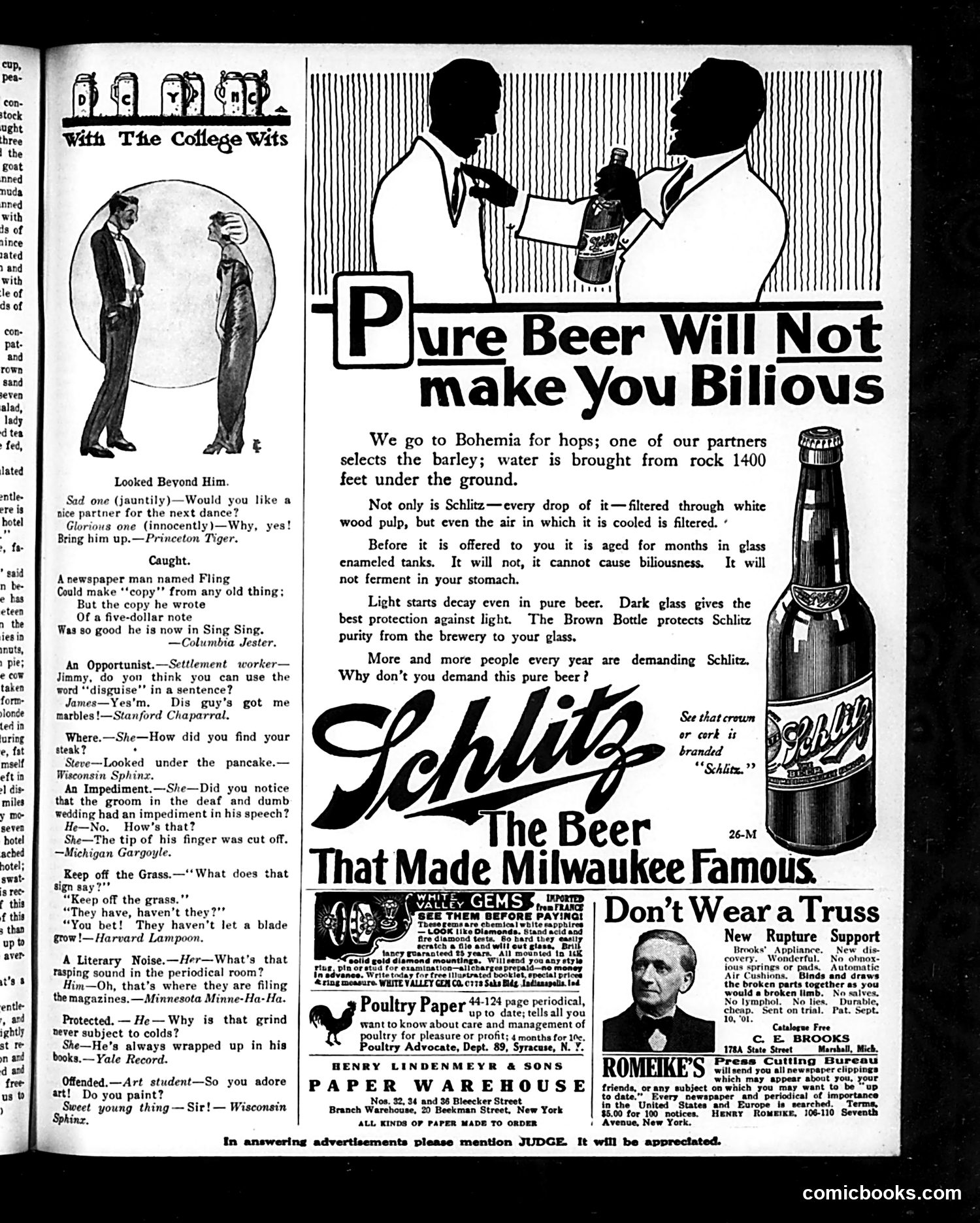
This page mixes humor with advertising. The left side contains college humor reprints—jokes from student publications about dating mishaps, wordplay, and campus life. These are lighthearted, innocent satire targeting young men's social awkwardness. The dominant content is a **Schlitz beer advertisement** claiming pure beer "will not make you bilious" (cause indigestion). This reflects early 20th-century health anxieties about fermented beverages and digestive problems. The ad emphasizes Schlitz's manufacturing process—filtered water, aged in tanks, protected by brown bottles from light decay—positioning the product as scientifically pure and safe. Surrounding this are period advertisements for miscellaneous products: gem jewelry, poultry guides, rupture supports, and newspaper clipping services—typical of magazines targeting middle-class readers. The satire here is gentle collegiate humor, not political. The page primarily serves as a vehicle for commercial advertising dressed in editorial content.
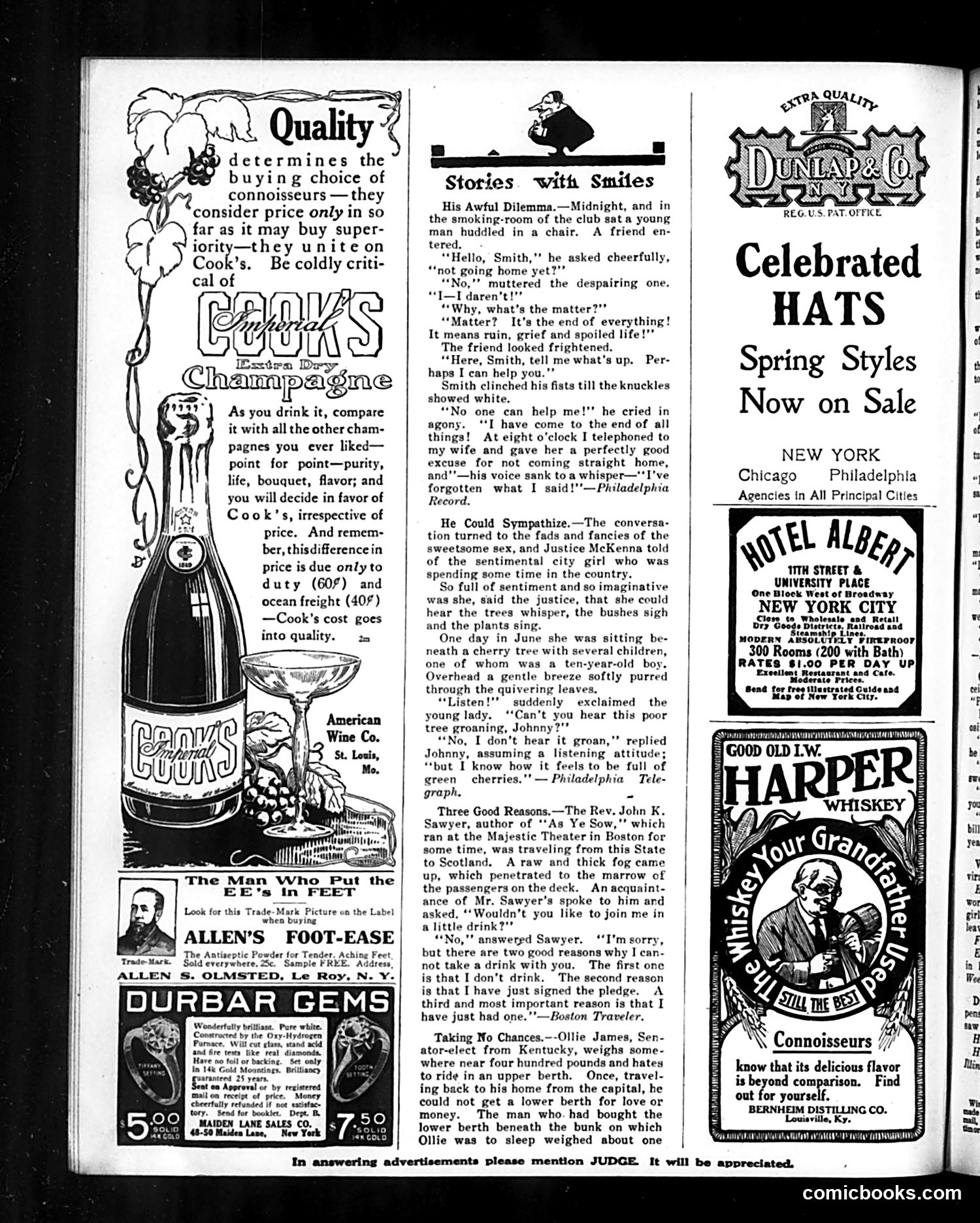
This page is primarily **advertising with humorous sidebar content**, typical of Judge magazine's format. The main advertisements promote luxury consumer goods—Cook's champagne (emphasizing quality over price), Allen's Foot-Ease powder, and Durbar Gems (synthetic diamonds). These ads target affluent readers. The "Stories with Smiles" section contains three brief, genteel humor pieces playing on wordplay and social embarrassment: 1. A man fears his wife because he forgot what excuse he gave for staying out 2. A sentimental city girl hears trees "groaning" with cherries; a boy responds he knows how it feels to be "full of green cherries" 3. A reverend gives three reasons for refusing a drink—the punchline being he's already had one These jokes reflect early 20th-century middle-class anxieties (marital discord, rural/urban pretension, temperance politics) and rely on gentle irony rather than sharp satire. The overall page demonstrates Judge's dual role: satirical commentary vehicle and advertiser to wealthy readers.
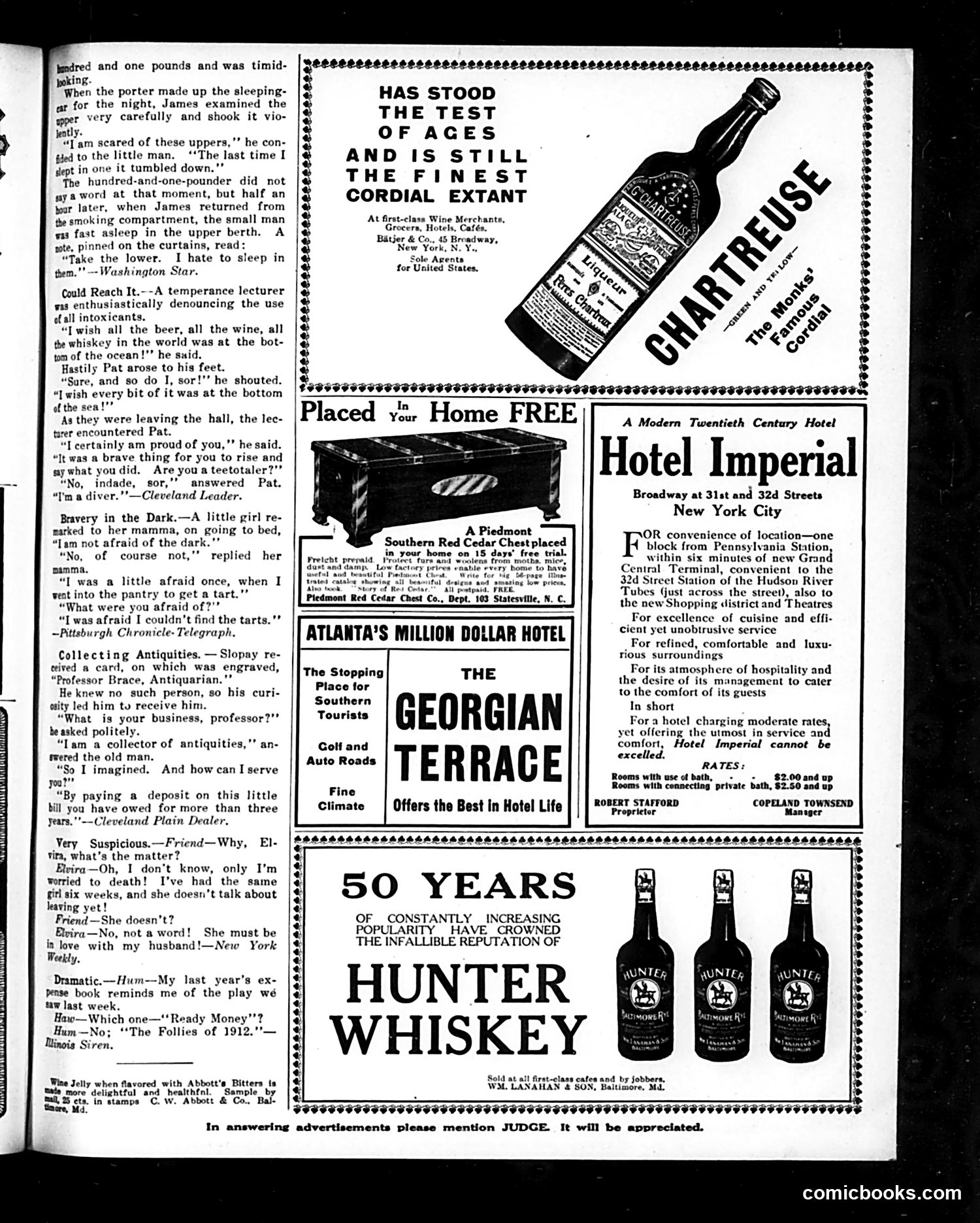
This page is primarily **advertisements and humor pieces**, not political cartoons. The content includes: **Humor Pieces**: Short anecdotes about everyday situations—a nervous train passenger checking berths, a temperance lecturer inadvertently praising a diver, a girl afraid she couldn't find pastries in the dark. These reflect early 20th-century domestic comedy. **Notable Joke**: A man reveals he's a "diver" to explain why he wants alcohol at the ocean bottom—physical comedy relying on the listener's assumption of moral agreement. **Advertisements**: Hotels (Hotel Imperial in NYC, Georgian Terrace in Atlanta), liquor products (Chartreuse cordial, Hunter Whiskey), and furniture (Piedmont cedar chests). The ads emphasize luxury and modern amenities. The whiskey ad claims "50 Years of Constantly Increasing Popularity," a common marketing approach of the era. **Context**: This represents Judge's mix of light social satire and commercial content typical of American magazines in the early 1900s.
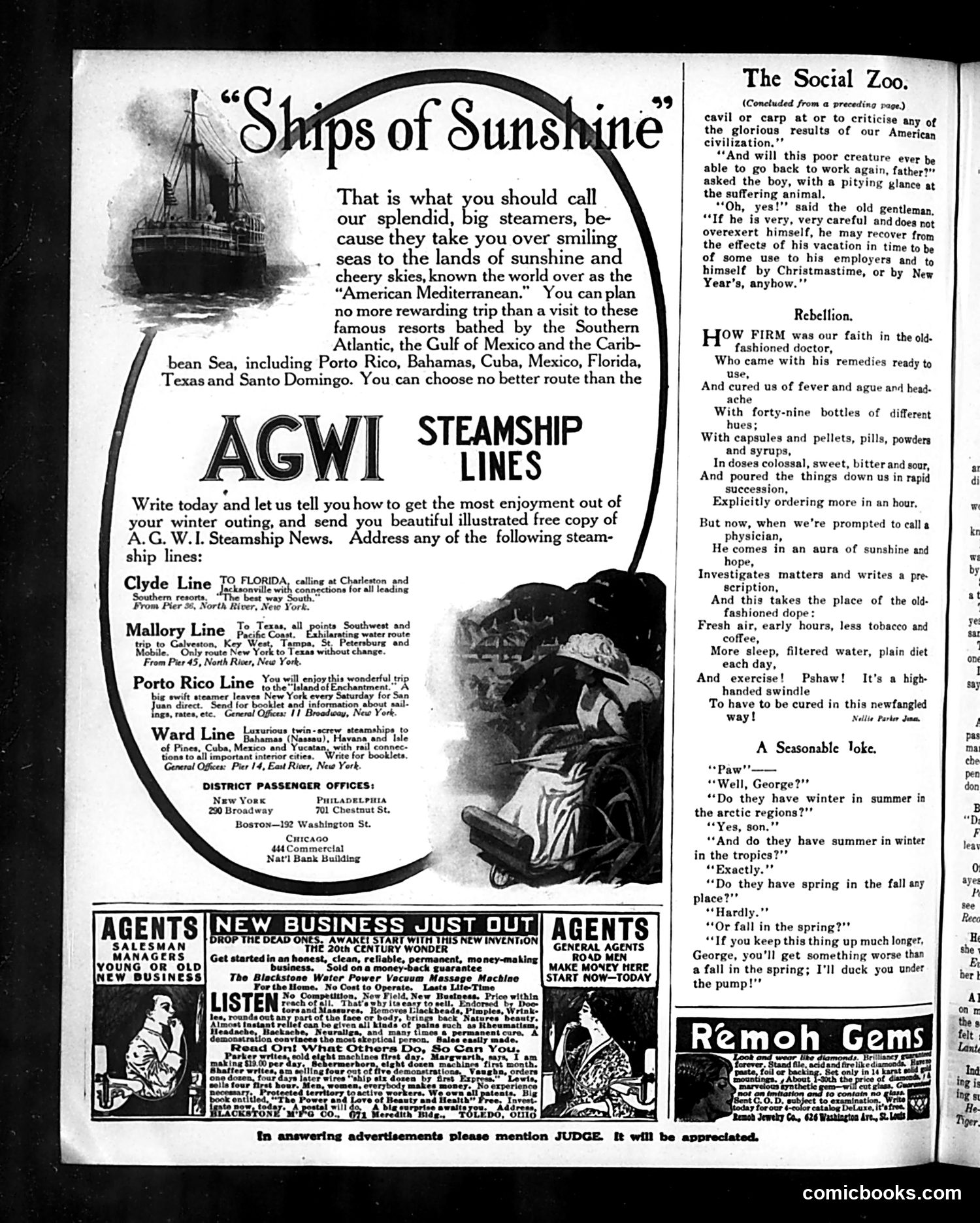
This page primarily consists of **advertising** for steamship lines offering Caribbean and Gulf Coast vacations. The AGWI Steamship Lines ad promotes winter cruises to tropical destinations (Cuba, Puerto Rico, Florida, etc.) as luxurious escapes, using the tagline "Ships of Sunshine." The right column contains **satirical short pieces**: 1. **"The Social Zoo"** - A class commentary where a gentleman observes a sick laborer and dismissively suggests he'll recover "in time to be of some use to his employers...by New Year's, anyhow." The satire mocks the callous upper-class attitude toward working-class suffering. 2. **"Rebellion"** - Nostalgic verse lamenting modern medicine's replacement of the old-fashioned doctor's aggressive pharmacology ("forty-nine bottles") with contemporary prescriptions of fresh air, exercise, and diet—which the speaker views as a "newfangled" swindle. The page reflects early 20th-century anxieties about modernization, class relations, and changing medical practice, all wrapped in satirical humor typical of Judge magazine's social commentary.
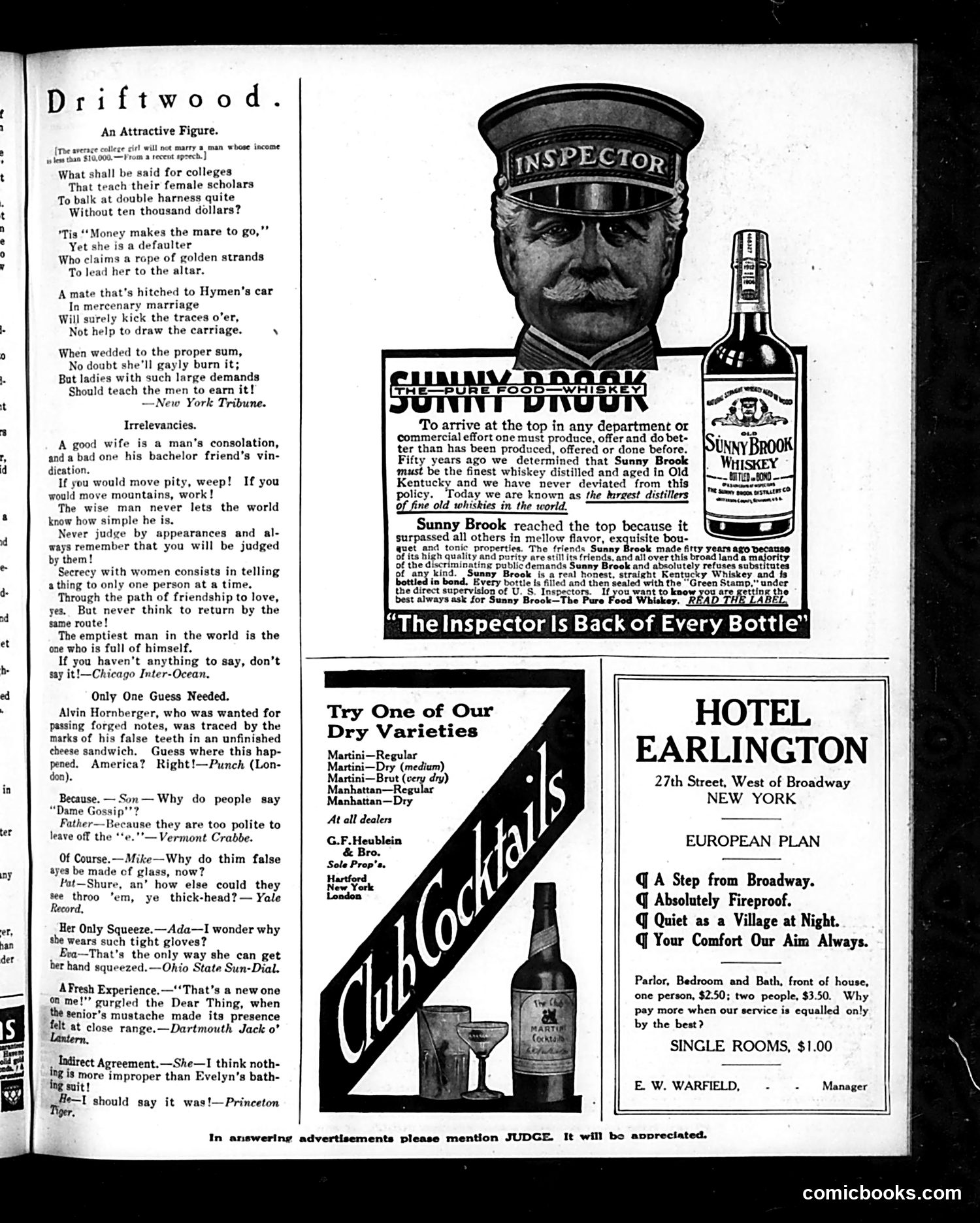
This page from Judge combines satirical commentary with advertisements typical of early 20th-century publications. **"Driftwood" Section:** A collection of short humorous observations and jokes about marriage, social behavior, and relationships—standard filler content. Notable is the opening poem critiquing female college graduates who demand wealthy husbands ($10,000+ income), sarcastically suggesting they should instead teach men to earn such sums. **Main Advertisements:** - **Sunny Brook Whiskey** dominates with an "Inspector" figure guaranteeing quality through federal oversight ("Green Stamp")—appealing to Progressive Era consumer confidence in regulation - **Hotel Earlington** advertises budget lodging near Broadway **Social Context:** The marriage-focused humor reflects anxieties about changing women's education and economic expectations during the 1910s-20s. The whiskey ad's emphasis on government inspection reflects post-Prohibition concerns about authenticity and safety. The page is primarily **advertising-driven with light satirical commentary**—typical Judge content mixing gentle social criticism with commercial promotion.
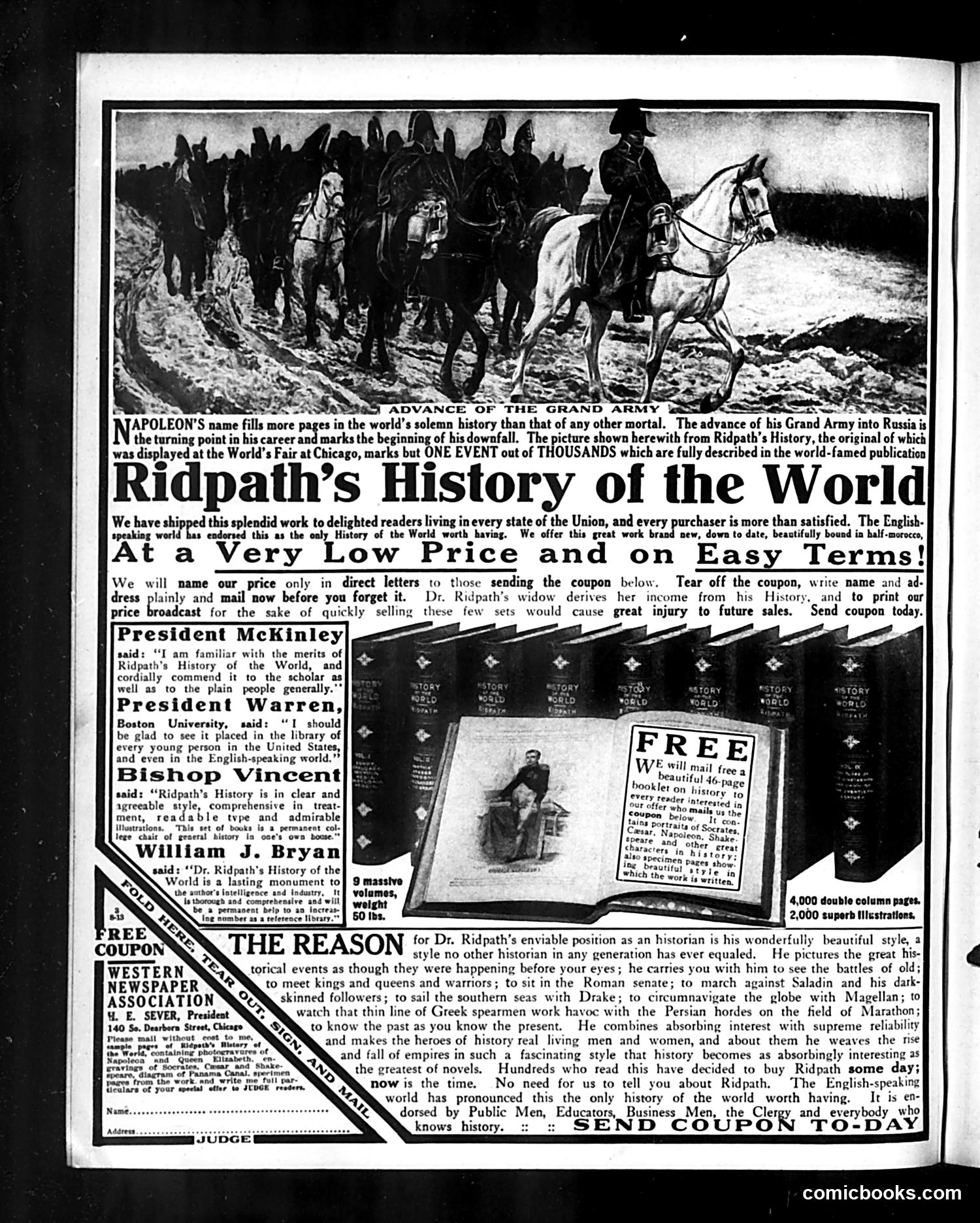
This page is primarily a **product advertisement** for Ridpath's History of the World, not political satire. The top features an illustration of Napoleon's Grand Army advancing into Russia—a dramatic historical moment—used to showcase the book's content. The advertisement leverages **celebrity endorsements** from prominent figures: President McKinley, President Warren of Boston University, Bishop Vincent, and William J. Bryan all praise the work's scholarly merit and accessibility. This was a common early 20th-century marketing tactic. The pitch emphasizes the book's "beautiful style" and vivid narrative that makes history "real" and engaging. A coupon system withholds the price, claiming Dr. Ridpath's widow depends on sales revenue. The ad highlights the massive scope: 4,000 pages and 2,000 illustrations. This appears to be a standard Judge magazine advertisement exploiting period nostalgia for comprehensive historical knowledge and patriotic authority figures to sell educational materials.