
Judge, 1913-03-08 · page 9 of 24
Judge — March 8, 1913 — page 9: what you’re looking at
What you’re looking at
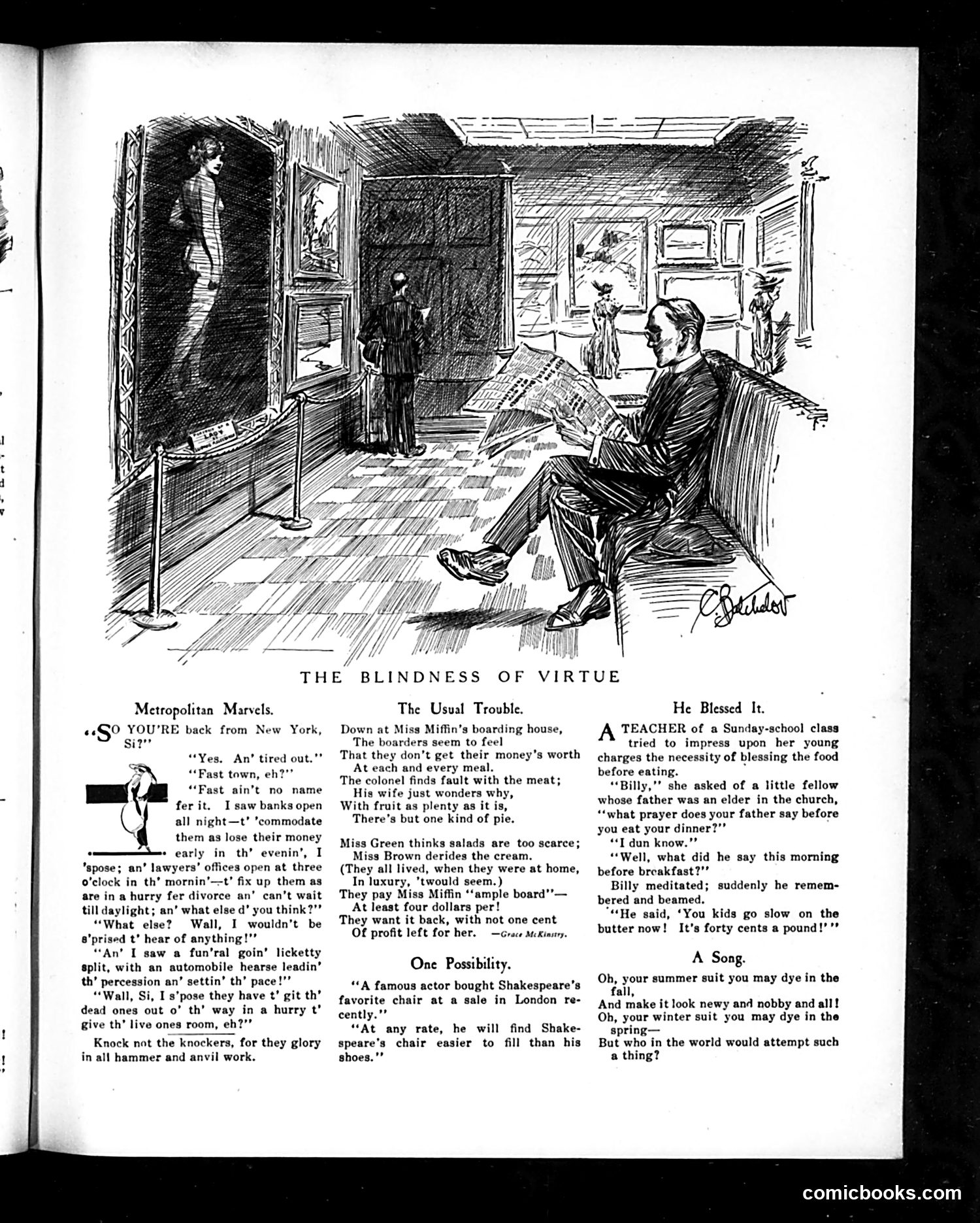
This page contains multiple satirical pieces mocking American urban life and social hypocrisy: **Main Cartoon**: Depicts a well-dressed man reading a newspaper in an art gallery while ignoring a nearly nude classical statue (or live model) behind him. The title suggests ironic commentary on selective moral blindness—he sees nothing inappropriate while surrounded by nudity, commenting on Victorian prudishness and cultural pretension. **Text Pieces**: Include: - "Metropolitan Marvels": Rural characters marveling at New York's fast pace (24-hour banks, divorce lawyers, speedy funerals) - "The Usual Trouble": Boarding house tenants complaining about meager meals despite paying four dollars—satirizing ungrateful guests - "He Blessed It": A child recounting his father's "blessing" as merely complaining about butter prices—mocking superficial religiosity The overall theme critiques American hypocrisy: false virtue, urban excess, ingratitude, and shallow piety. The humor relies on exposing gap between professed values and actual behavior.
📄 Transcribed text from this page (OCR, searchable)
Machine-transcribed from the original scan — historical spelling and the odd misread are preserved.
GAGE Soe | pl! THE BLINDNESS OF VIRTUE Metropolitan Marvels. «S° YOU'RE back from New York, siz”’ “Yes. An’ tired out.”” “Fast town, eh?” “Fast ain’t no name fer it. I saw banks open U all night—t’ '’commodate them as lose their money . * early in th’ evenin’, I "spose; an’ lawyers’ offices open at three o'clock in th’ mornin’—t’ fix up them as are in a hurry fer divorce an’ can’t wait till daylight; an’ what else d’ you think?”" “What else? Wall, I wouldn't be s'prised t’ hear of anything!"’ “An’ I saw a fun’ral goin’ licketty split, with an automobile hearse leadin’ th’ percession an’ settin’ th’ pace!’’ “Wall, Si, I s’pose they have t’ git th’ dead ones out o’ th’ way in a hurry t’ give th’ live ones room, eh?”’ Knock not the knockers, for they glory in all hammer and anvil work. The Usual Trouble. Down at Miss Miffin’s boarding house, The boarders seem to feel That they don’t get their money's worth At each and every meal. The colonel finds fault with the meat; His wife just wonders why, With fruit as plenty as it is, There's but one kind of pie. Miss Green thinks salads are too scarce; Miss Brown derides the cream. (They all lived, when they were at home, In luxury, 'twould seem.) They pay Miss Miffin ‘ample board’ — At least four dollars per! They want it back, with not one cent Of profit left for her. —Grace MeXinvtry One Possibility. “(A famous actor bought Shakespeare’s favorite chair at a sale in London re- cently.”” “At any rate, he will find Shake- speare’s chair easier to fill than his shoes."” He Blessed It. A TEACHER of a Sunday-school class tried to impress upon her young charges the necessity of blessing the food before eating. “*Billy,’’ she asked of a little fellow whose father was an elder in the church, “what prayer does your father say before you eat your dinner?” “IT dun know.’” “Well, what did he say this morning before breakfast?"’ Billy meditated; suddenly he remem- bered and beamed. ““He said, ‘You kids go slow on the butter now! It’s forty cents a pound!’’’ A Song. Oh, your summer suit you may dye in the fall, And make it look newy and nobby and all! Oh, your winter suit you may dye in the spring— But who in the world would attempt such a thing? comicbooks.com