
Judge, 1913-03-08 · page 11 of 24
Judge — March 8, 1913 — page 11: what you’re looking at
What you’re looking at
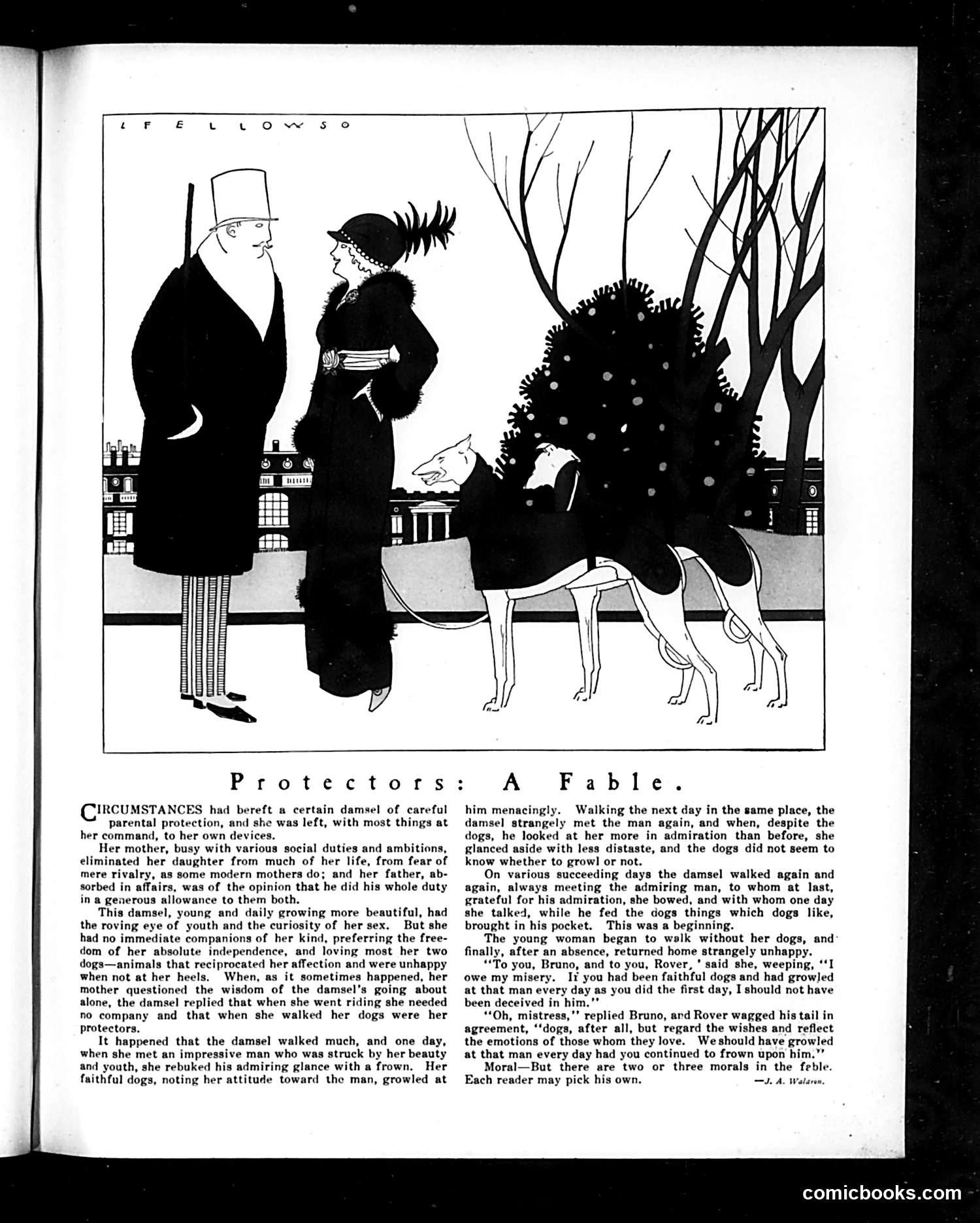
This moral fable satirizes a young woman's independence and naive romanticism. A neglected damsel relies on her two dogs as "protectors" while walking alone—a social transgression for an unaccompanied woman of the era. When she encounters an attractive man, her dogs initially growl at him. However, as she gradually softens toward the stranger (feeding him, walking without the dogs), the animals cease their warnings, sensing her changed attitude. She's ultimately "deceived" by the man and returns home unhappy. The dogs' moral reply: they merely reflect *her* emotions and wishes—they cannot protect her from her own poor judgment. The cartoon critiques both parental neglect (her busy mother and distant father) and the folly of relying on external "protectors" rather than personal virtue. For modern readers, it reflects Victorian anxieties about unsupervised women and the era's assumption that a woman's own moral weakness—not male predation—caused her downfall.
📄 Transcribed text from this page (OCR, searchable)
Machine-transcribed from the original scan — historical spelling and the odd misread are preserved.
Ww Protectors IRCUMSTANCES had bereft a certain damsel of careful parental protection, and she was left, with most things at her command, to her own devices. Her mother, busy with various social duties and ambitions, eliminated her daughter from much of her life, from fear of mere rivalry, as some modern mothers do; and her father, ab- sorbed in affairs, was of the opinion that he did his whole duty in a generous allowance to them both. This damsel, young and daily growing more beautiful, had the roving eye of youth and the curiosity of her sex. But she had no immediate companions of her kind, preferring the free- dom of her absolute independence, and loving most her two dogs—animals that reciprocated her affection and were unhappy when not at her heels. When, as it sometimes happened, her mother questioned the wisdom of the damsel’s going about alone, the damsel replied that when she went riding she needed no company and that when she walked her dogs were her protectors. It happened that the damsel walked much, and one day, when she met an impressive man who was struck by her beauty and youth, she rebuked his admiring glance with a frown. Her faithful dogs, noting her attitude toward the man, growled at A Fable. him menacingly. Walking the next day in the same place, the damsel strangely met the man again, and when, despite the dogs, he looked at her more in admiration than before, she glanced aside with less distaste, and the dogs did not seem to know whether to growl or not. On various succeeding days the damsel walked again and again, always meeting the admiring man, to whom at last, grateful for his admiration, she bowed, and with whom one day she talked, while he fed the dogs things which dogs like, brought in his pocket. This was a beginning. The young woman began to welk without her dogs, and finally, after an absence, returned home strangely unhappy. “To you, Bruno, and to you, Rover, ’ said she, weeping, ‘I owe my misery. It you had been faithful dogs and had growled at that man every day as you did the first day, I should not have been deceived in him,”” “Oh, mistress,’’ replied Bruno, ard Rover wagged his tail in agreement, ‘‘dogs, after all, but regard the wishes and reflect the emotions of those whom they love. We should have growled at that man every day had you continued to frown upon him.”’ Moral—But there are two or three morals in the feble. Each reader may pick his own. J. A. Waleven, comicbooks.com