
Judge, 1913-03-08 · page 4 of 24
Judge — March 8, 1913 — page 4: what you’re looking at
What you’re looking at
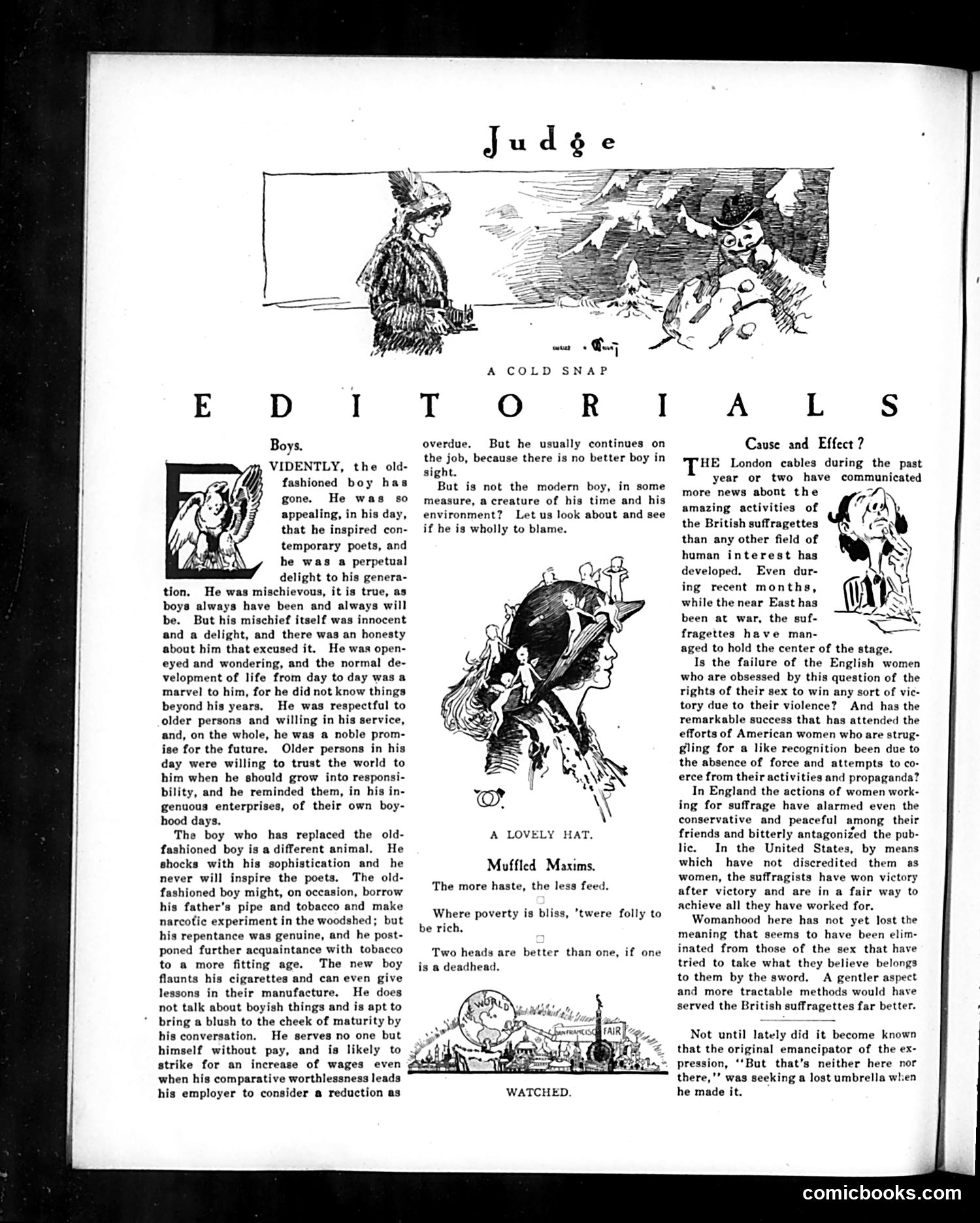
This page contrasts the "old-fashioned boy" with the modern boy, lamenting how contemporary youth have become cynical and self-interested. The text criticizes the modern boy as lacking inspiration, mischievous without innocence, and concerned only with wages and self-advancement—a sharp departure from boys who once inspired poets and served society faithfully. The cartoons illustrate this contrast: "A Cold Snap" and "A Lovely Hat" appear to satirize current fashions or social behaviors among the young. The right column shifts to British suffragettes, praising their peaceful methods compared to American suffragists' more confrontational tactics. The piece suggests American women's violence undermined their cause, while British women achieved better results through restraint. This reflects early 20th-century debates over suffrage strategy.
📄 Transcribed text from this page (OCR, searchable)
Machine-transcribed from the original scan — historical spelling and the odd misread are preserved.
Boys. VIDENTLY, the old- fashioned boy has gone. He was so appealing, in his day, that he inspired con- temporary poets, and he was a perpetual delight to his genera- tion. He was mischievous, it is true, as boys always have been and always will be. But his mischief itself was innocent and a delight, and there was an honesty about him that excused it. He was open- eyed and wondering, and the normal de- velopment of life from day to day was a marvel to him, for he did not know things beyond his years. He was respectful to older persons and willing in his service, and, on the whole, he was a noble prom- ise for the future. Older persons in his day were willing to trust the world to him when he should grow into responsi- bility, and he reminded them, in his in- genuous enterprises, of their own boy- hood days. The boy who has replaced the old- fashioned boy is a different animal. He shocks with his sophistication and he never will inspire the poets. The old- fashioned boy might, on occasion, borrow his father’s pipe and tobacco and make narcotic experiment in the woodshed; but his repentance was genuine, and he post- poned further acquaintance with tobacco to a more fitting age. The new boy flaunts his cigarettes and can even give lessons in their manufacture. He does not talk about boyish things and is apt to bring a blush to the cheek of maturity by his conversation. He serves no one but himself without pay, and is likely to - strike for an increase of wages even when his comparative worthlessness leads his employer to consider a reduction as A COLD SNAP T O R J overdue. But he usually continues on the job, because there is no better boy in sight. But is not the modern boy, in some measure, a creature of his time and his environment? Let us look about and see if he is wholly to blame. A LOVELY HAT. Moffled Maxims. The more haste, the less feed. Where poverty is bliss, ’twere folly to be rich, Two heads are better than one, if one is a deadhead. WATCHED. S Cause and Effect ? THE London cables during the past year or two have communicated more news abont the amazing activities of the British suffragettes than any other field of human interest has developed. Even dur- ing recent months, while the near East has been at war, the suf- fragettes have man- aged to hold the center of the stage. Is the failure of the English women who are obsessed by this question of the rights of their sex to win any sort of vic- tory due to their violence? And has the remarkable success that has attended the efforts of American women who are strug- gling for a like recognition been due to the absence of force and attempts to co- erce from their activities and propaganda? In England the actions of women work- ing for suffrage have alarmed even the conservative and peaceful among their friends and bitterly antagonized the pub- lic. In the United States, by means which have not discredited them as women, the suffragists have won victory after victory and are in a fair way to achieve all they have worked for. Womanhood here has not yet lost the meaning that seems to have been elim- inated from those of the sex that have tried to take what they believe belongs to them by the sword. A gentler aspect and more tractable methods would have served the British suffragettes far better. Not until lately did it become known that the original emancipator of the ex- pression, ‘‘But that’s neither here nor there,’ was seeking a lost umbrella when he made it. comicbooks.com