
Judge, 1913-03-08 · page 6 of 24
Judge — March 8, 1913 — page 6: what you’re looking at
What you’re looking at
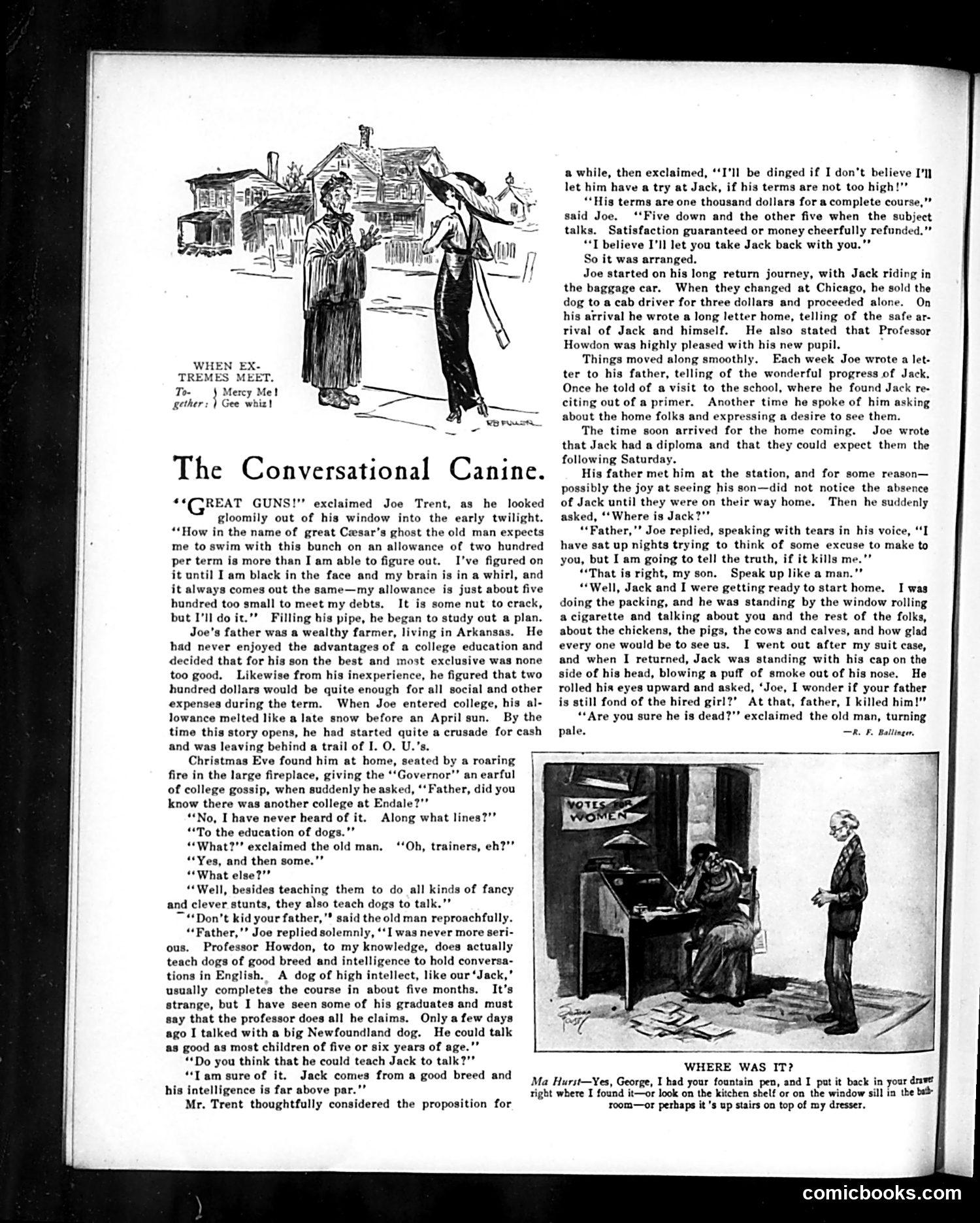
This story satirizes both a college student's financial irresponsibility and the era's fascination with animal intelligence claims. Joe Trent, a broke college student with a meager allowance, schemes to send his dog "Jack" home to his wealthy farmer father under the pretense that the dog has been trained to speak English by Professor Howdon—a dubious claim Joe monetizes at $1,000. The joke relies on period absurdity: the father actually believes dogs can be taught conversational English. Joe sells the dog mid-journey for three dollars and fabricates weekly letters about Jack's "progress." When confronted at homecoming, Joe claims he killed Jack because the dog asked about the hired girl—an insulting, familiar question no dog would ask. The satire mocks both paternal gullibility and student deception, alongside the era's credulous belief in animal education schemes.
📄 Transcribed text from this page (OCR, searchable)
Machine-transcribed from the original scan — historical spelling and the odd misread are preserved.
WHEN EX- TREMES MEET. To, | Mercy Me! gether: ) Gee whiz! The Conversational Canine. “*GREAT GUNS!” exclaimed Joe Trent, as he looked gloomily out of his window into the early twilight. “*‘How in the name of great Cwesar’s ghost the old man expects me to swim with this bunch on an allowance of two hundred per term is more than I am able to figure out. I’ve figured on it until Iam black in the face and my brain is in a whirl, and it always comes out the same—my allowance is just about five hundred too small to meet my debts. It is some nut to crack, but I'll do it.”” Filling his pipe, he began to study out a plan. Joe's father was a wealthy farmer, living in Arkansas. He had never enjoyed the advantages of a college education and decided that for his son the best and most exclusive was none too good. Likewise from his inexperience, he figured that two hundred dollars would be quite enough for all social and other expenses during the term. When Joe entered college, his al- lowance melted like a late snow before an April sun. By the time this story opens, he had started quite a crusade for cash a while, then exclaimed, ‘‘I'll be dinged if I don’t believe I'l let him have a try at Jack, if his terms are not too high!”* His terms are one thousand dollars for a complete course,’”” said Joe. ‘Five down and the other five when the subject talks. Satisfaction guaranteed or money cheerfully refunded."" “T believe I'll let you take Jack back with you."” So it was arranged. Joe started on his long return journey, with Jack riding in the baggage car. When they changed at Chicago, he sold the dog to a cab driver for three dollars and proceeded alone. On his arrival he wrote a long letter home, telling of the safe ar- rival of Jack and himself. He also stated that Professor Howdon was highly pleased with his new pupil. Things moved along smoothly. Each week Joe wrote a let- ter to his father, telling of the wonderful progress of Jack, Once he told of a visit to the school, where he found Jack re- citing out of a primer. Another time he spoke of him asking about the home folks and expressing a desire to see them. The time soon arrived for the home coming. Joe wrote that Jack had a diploma and that they could expect them the following Saturday. His father met him at the station, and for some reason— possibly the joy at seeing his son—did not notice the absence of Jack until they were on their way home. Then he suddenly asked, ‘Where is Jack?"" “Father,”’ Joe replied, speaking with tears in his voice, “I have sat up nights trying to think of some excuse to make to you, but I am going to tell the truth, if it kills me.” “That is right, my son. Speak up like a man."” “Well, Jack and I were getting ready to start home. I was doing the packing, and he was standing by the window rolling acigarette and talking about you and the rest of the folks, about the chickens, the pigs, the cows and calves, and how glad every one would be to see us. I went out after my suit case, and when I returned, Jack was standing with his cap on the side of his head, blowing a puff of smoke out of his nose. He rolled his eyes upward and asked, ‘Joe, I wonder if your father is still fond of the hired girl?’ At that, father, I killed him!" “Are you sure he is dead?’ exclaimed the old man, turning RF. Ballinger, pale. and was leaving behind a trail of I. O. U.'s. Christmas Eve found him at home, seated by a roaring fire in the large fireplace, giving the ‘‘Governor”’ an earful of college gossip, when suddenly he asked, ‘‘Father, did you know there was another college at Endale?”” “No, I have never heard of it. Along what lines?’’ “To the education of dogs.” “‘What?’’ exclaimed the old man, “Yes, and then some."” “What else?” } “Well, besides teaching them to do all kinds of fancy | and clever stunts, they also teach dogs to talk.”” ~**Don’t kid your father, "* said the old man reproachfully. “Father,’’ Joe replied solemnly, ‘‘I was never more seri- ous. Professor Howdon, to my knowledge, does actually teach dogs of good breed and intelligence to hold conversa- | tions in English. A dog of high intellect, like our ‘Jack,’ usually completes the course in about five months. It’s strange, but I have seen some of his graduates and must say that the professor does all he claims. Only a few days ago I talked with a big Newfoundland dog. He could talk “Oh, trainers, eh?’’ as good as most children of five or six years of age."” “Do you think that he could teach Jack to talk?"’ “Tam sure of it. Jack comes from a good breed and his intelligence is far above par.'’ Mr. Trent thoughtfully considered the proposition for WHERE WAS IT? Ma Hurst—Yes, George, I had your fountain pen, and I pat it back in your draw right where I found it—or look on the kitchen shelf or on the window sill in the ba room—or perhaps it 's up stairs on top of my dresser. comicbooks.com