
A complete issue · 44 pages · 1912
Judge — December 7, 1912
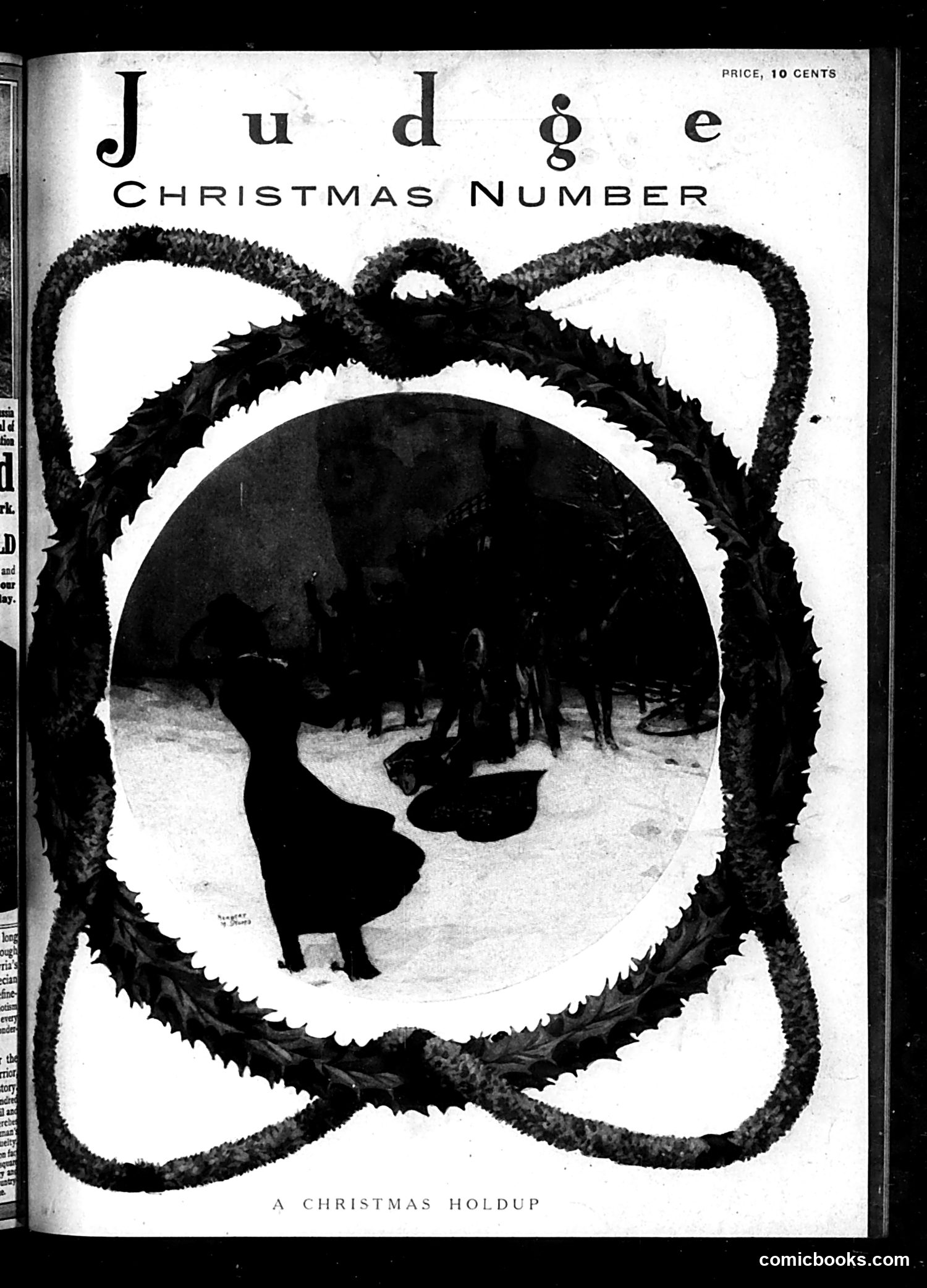
This is the cover of Judge magazine's Christmas issue, priced at 10 cents. The image shows a festive wreath frame made of evergreen garland and large bows, framing a snowy winter scene. Inside the wreath, silhouetted figures appear to be gathered outdoors in snow, with what looks like a child or small figure in the foreground. The caption reads "A Christmas Holdup," suggesting a humorous seasonal theme. Without clearer OCR text or additional context from the magazine's interior, the specific satirical target is unclear—it could reference holiday commercialism, family obligations, or a topical event from the publication date. The wreath frame itself was a common decorative device for Judge's holiday covers during this era.
This page is primarily a **commercial advertisement**, not political satire. It features a painting titled "Bubbles" by Sir John Everett Millais (a famous 19th-century Pre-Raphaelite artwork) repurposed to advertise **Pears' Soap**. The image shows a young child in period dress blowing soap bubbles, gazing upward with wonder. The advertisement claims the product "Beautifies the complexion, keeps the hands white and imparts a constant bloom of freshness to the skin." This represents a common advertising strategy of the era: using respected fine art to lend cultural legitimacy and prestige to commercial products. The "bubbles" in the painting cleverly reinforce the soap product name, creating a visual pun. The copy emphasizes beauty and cleanliness—typical beauty-product messaging for the period.
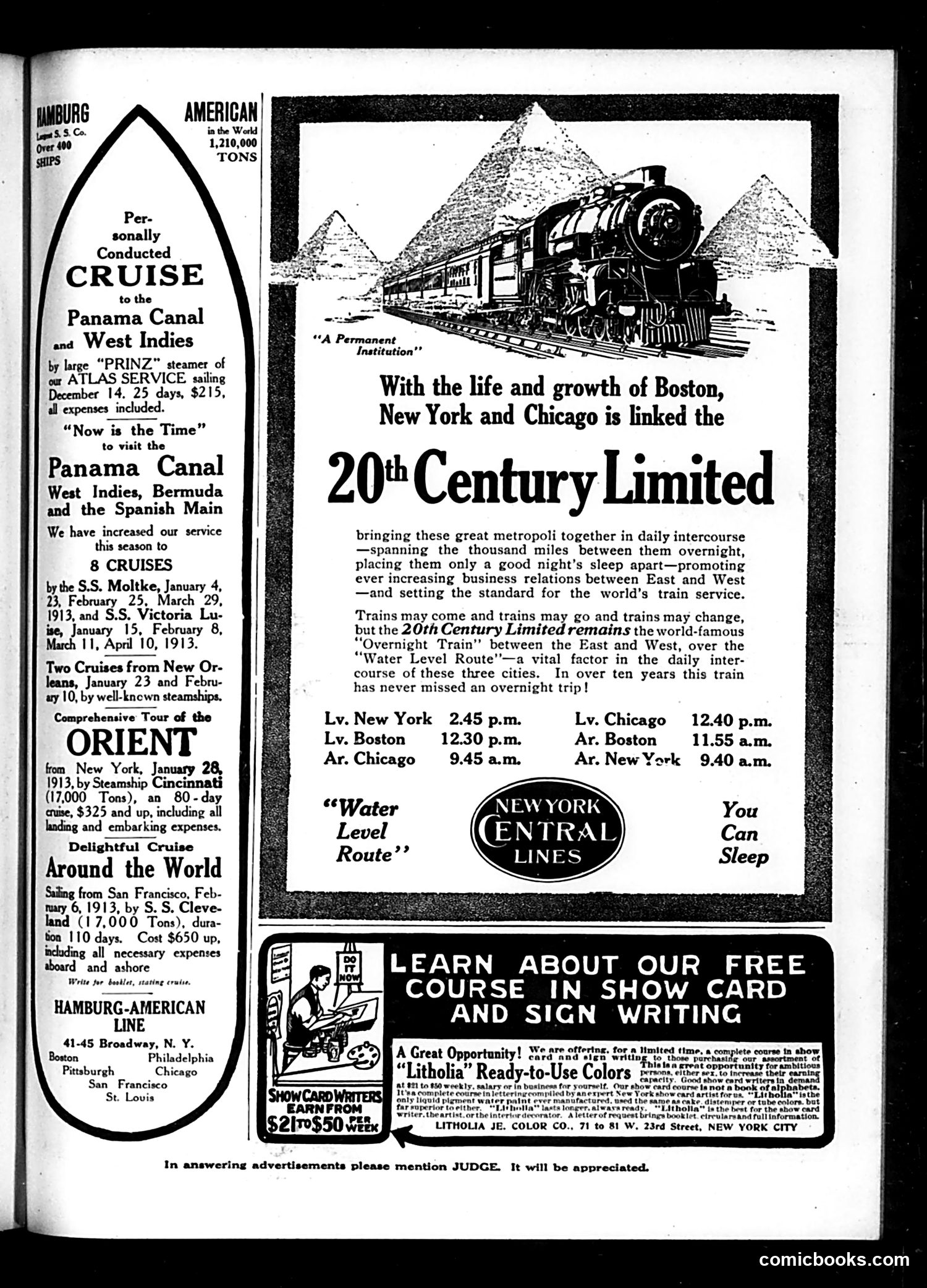
This page is **primarily advertising**, not satirical content. It contains three distinct ads: 1. **Hamburg-American Line** (left): Promotes luxury cruises to the Panama Canal and West Indies, plus an around-the-world voyage—emphasizing the recently-opened Panama Canal (1913) as a major tourist draw. 2. **New York Central Lines** (center): Features the "20th Century Limited" train, advertising overnight service connecting Boston, New York, and Chicago. The locomotive illustration emphasizes speed and modernity as selling points for business travel. 3. **Litholia Color Company** (bottom): Promotes a free course in show-card writing and color illustration—a vocational opportunity. The page reflects early-1910s prosperity and expansion: transcontinental rail service, canal commerce, and consumer education advertising.
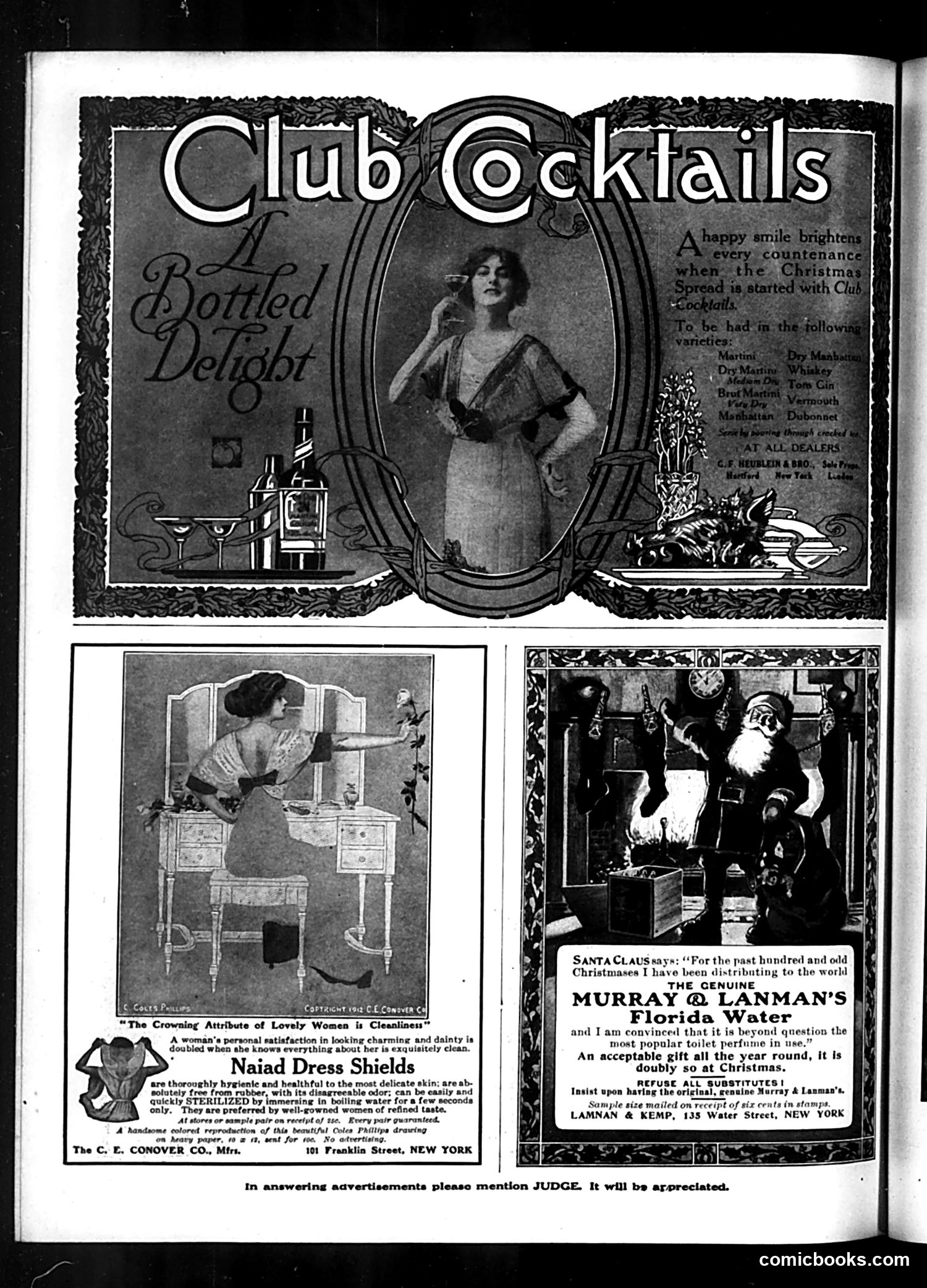
This page is primarily **advertising rather than editorial content**. The top features a "Club Cocktails" advertisement for "Bottled Delight" liquor, listing varieties like Martini, Whiskey, and Vermouth—notable given Prohibition was enacted in 1920, suggesting this predates that era or represents pre-Prohibition advertising. Below are two product advertisements: one for "Naiad Dress Shields" (undergarment protection) and another for "Murray & Lanman's Florida Water" (toilet perfume), with a humorous Christmas message attributed to Santa Claus endorsing the product. The page contains **no political cartoons or satirical commentary**—it's a commercial layout typical of Judge's revenue model, mixing advertisements with editorial content. The humor is purely commercial/lighthearted rather than socially or politically pointed.
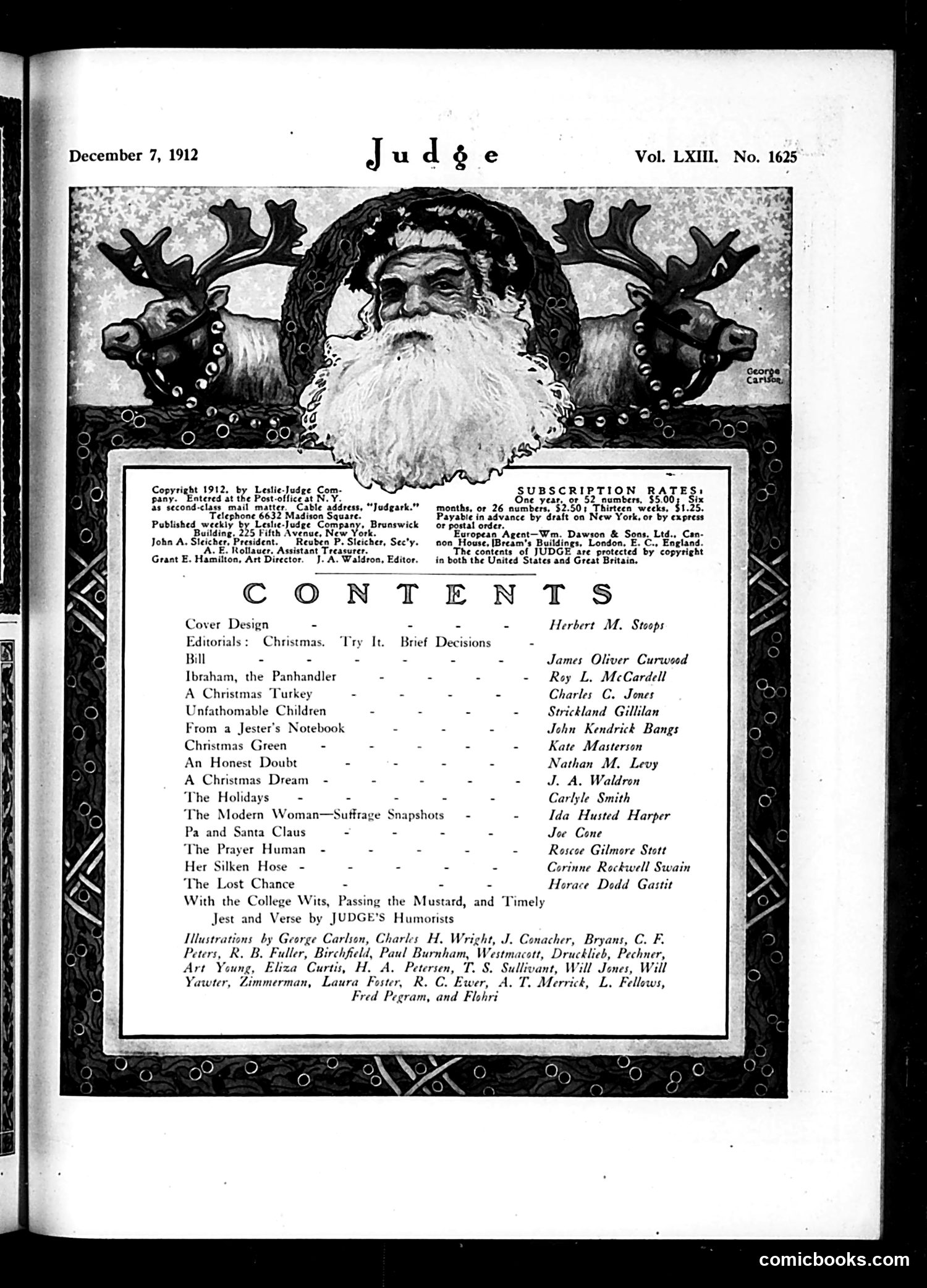
This December 7, 1912 *Judge* magazine cover features a jolly Santa Claus with reindeer, designed by Herbert M. Staepi. The illustration is purely seasonal and decorative—a Christmas-themed cover for a holiday issue. The page itself is primarily a contents listing for that issue, showing various articles and their authors (including pieces titled "Christmas," "Ibrahim the Panhandler," and "A Christmas Turkey"). Multiple illustrators are credited at the bottom. There is no political satire or social commentary visible on this particular page. It's a straightforward holiday cover and table of contents for *Judge*'s December holiday edition.
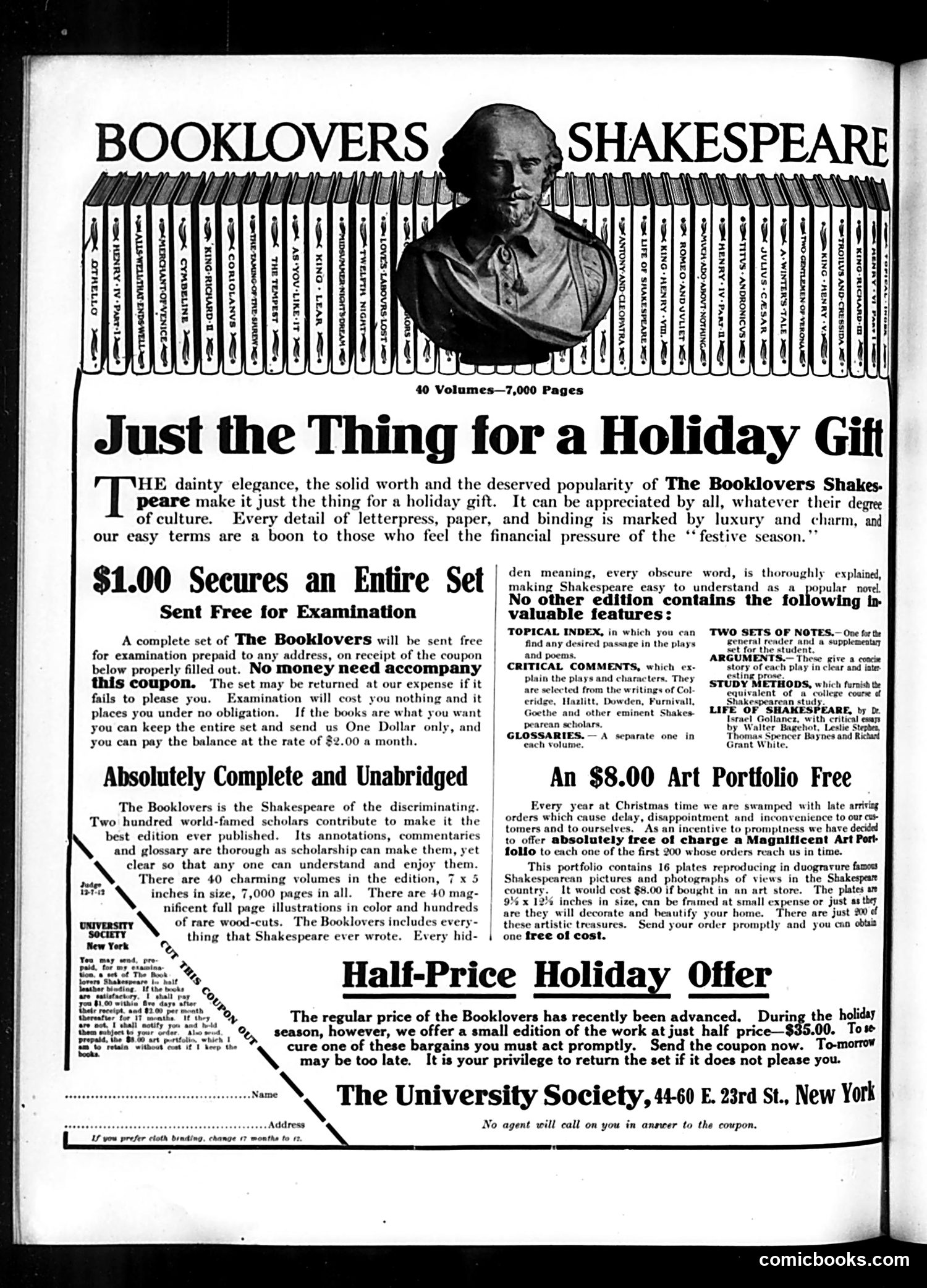
This page is **primarily advertising**, not satirical content. It's a full-page advertisement for "The Booklovers Shakespeare," a 40-volume complete Shakespeare edition sold by The University Society. The bust of Shakespeare at the top is a standard decorative element, not a caricature or political figure. **What's being sold:** A luxury Shakespeare collection marketed as an ideal holiday gift during the "festive season"—addressing readers facing "financial pressure" with payment plans ($1 down, $2/month). **The appeal:** The ad emphasizes scholarship (200 scholars contributed), accessibility (glossaries, topical indexes, study methods), and prestige. The "Half-Price Holiday Offer" and promise of a free $8 art portfolio are sales incentives. **Historical context:** This appears to be early 20th century, when such multi-volume "complete works" were common aspirational purchases for middle-class households seeking cultural refinement. There is no political satire or social commentary visible on this page.
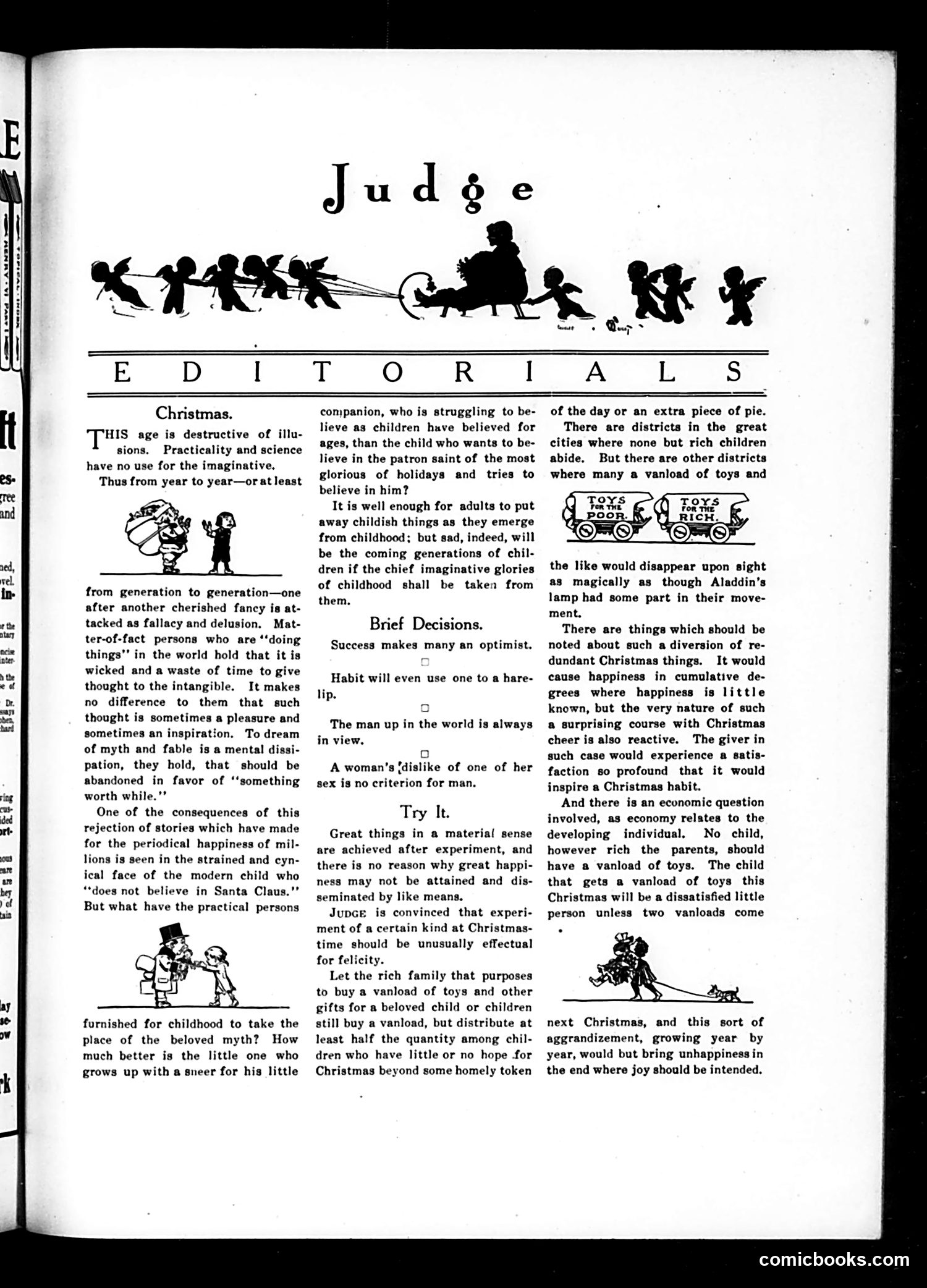
This page critiques modernism's rejection of childhood imagination. The editorial laments that practical, science-minded adults mock Santa Claus and fairy tales as wasteful delusion, leaving children cynical rather than wonder-filled. The satire targets two problems: First, the loss of imaginative joy in childhood. Second, wealthy families' excessive toy-buying creates unsustainable expectations and materialism rather than genuine happiness. Judge proposes an experiment: rich families should distribute half their toy vanloads to poor children in city districts where Christmas means only "a homely token" or pie. This benefits poor children materially while giving wealthy givers profound satisfaction—creating a sustainable "Christmas habit" of generosity. The editorial criticizes both soulless practicality *and* conspicuous consumption, advocating instead for imagination preserved *and* wealth redistributed.
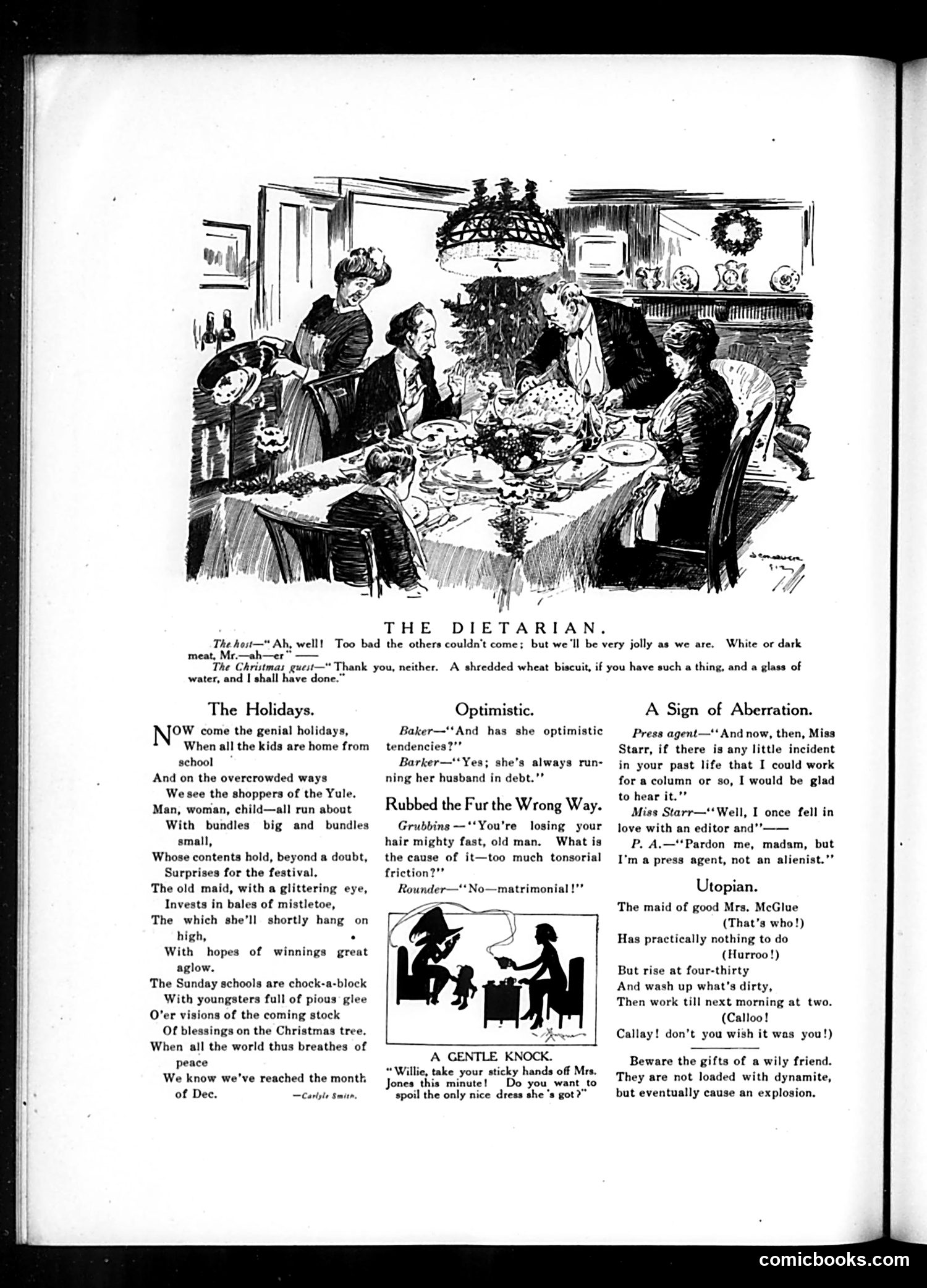
This page contains multiple satirical sketches typical of turn-of-the-century American humor. **"The Dietarian"**: Mocks the then-fashionable "dietarian" movement—guests obsessed with health fads. The Christmas dinner guest refuses normal food, demanding only shredded wheat biscuit and water, embodying the era's emerging dietary reform movement that some viewed as pretentious affectation. **"Optimistic"**: A brief marital joke: the wife's "optimistic tendencies" are revealed as her habit of running her husband into debt—presenting debt accumulation as optimism about spending. **"Rubbed the Fur the Wrong Way"**: A pun linking hair loss to marital friction, suggesting marriage causes baldness. **"A Gentle Knock"**: Depicts a child being scolded for touching a guest's dress, satirizing overly precious household manners. **Other sketches** include light commentary on the Christmas season, press agents exploiting actresses, and domestic servants' endless labor presented as "utopian." The overall tone is genteel, middle-class satire typical of Judge's target audience—poking fun at affectations, marriage troubles, and modern fads rather than political issues.
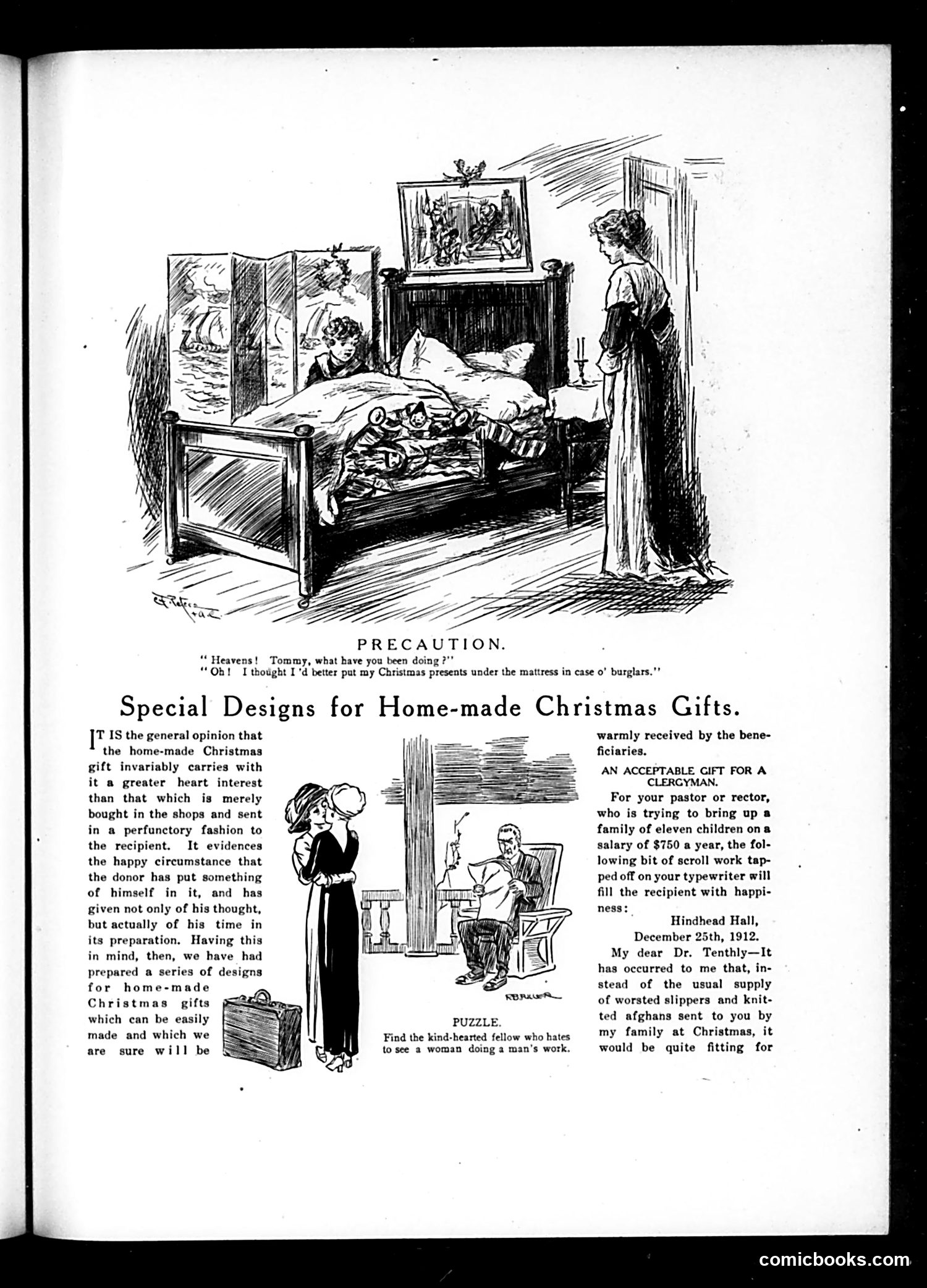
**Main Cartoon ("Precaution"):** A humorous domestic scene where a boy has hidden Christmas presents under a mattress for safekeeping against burglars. The joke plays on childish logic—the boy conflates protecting valuables with protecting gifts, missing the point that burglars target *existing* valuables, not newly-arrived presents. **Content Section:** The page discusses home-made versus store-bought Christmas gifts, arguing hand-made gifts carry greater sentimental value because they represent the giver's time and thought. **Gift Suggestions:** Two examples are illustrated: one for clergy (a clergyman on a modest $750 annual salary supporting eleven children) and a puzzle challenging readers to identify "the kind-hearted fellow who hates to see a woman doing a man's work." **Historical Context:** This 1912 publication reflects early 20th-century values regarding domestic economy, gender roles, and clerical poverty. The puzzle likely satirizes hypocrisy—men who oppose women's work equality while benefiting from their labor.
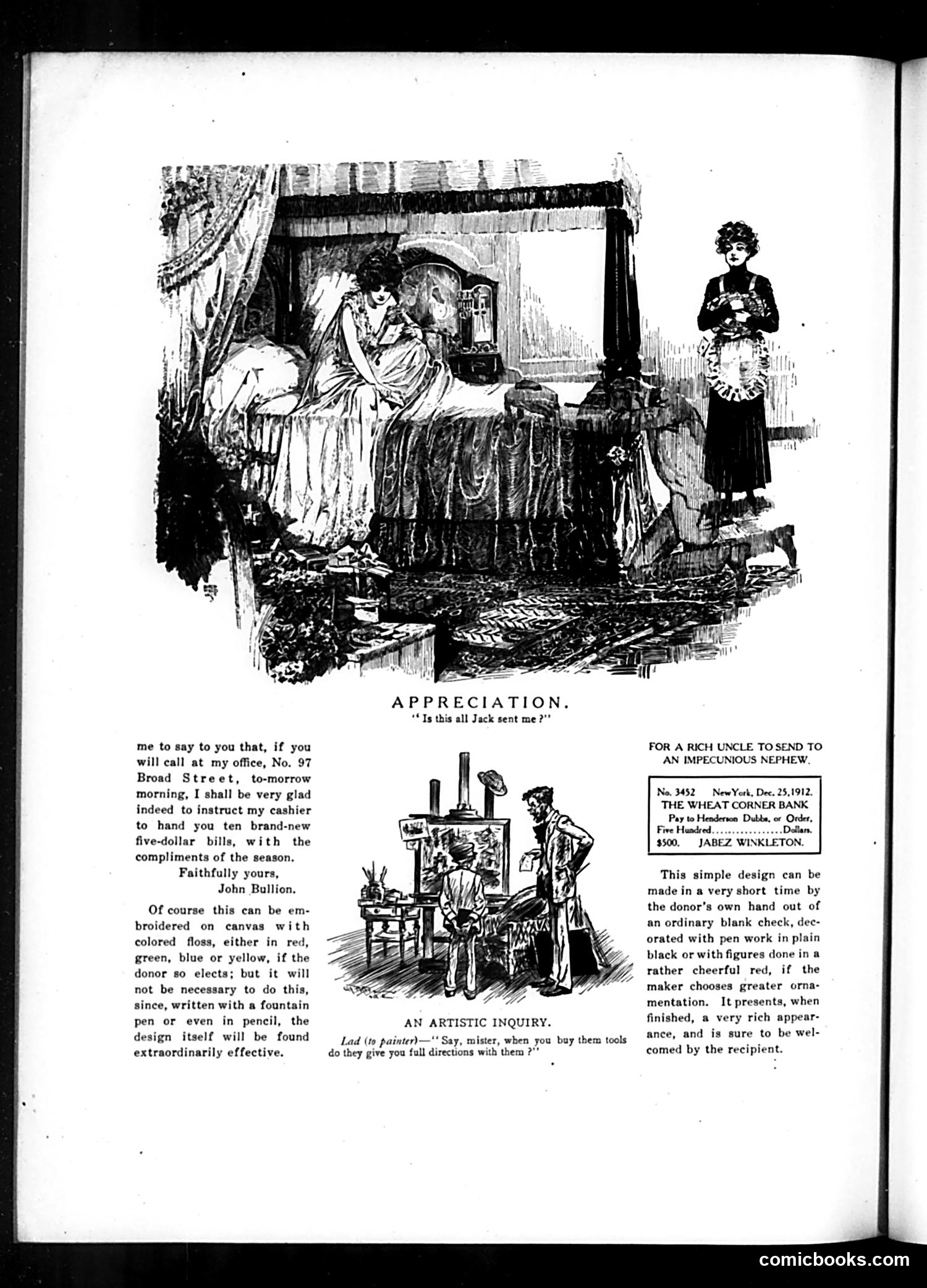
This page contains three separate satirical items mocking gift-giving customs: **"Appreciation"** (top): A wealthy man's letter offering ten five-dollar bills as a Christmas gift, presented as if it were a precious artistic creation worthy of embroidery on canvas—mocking the pretentiousness of the wealthy and the absurdity of treating money as fine art. **"For a Rich Uncle to Send to an Impecunious Nephew"** (right): Shows a blank check for $500 styled as a decorative "design" made from a bank check. The satire suggests that wealthy relatives give money instead of thoughtful gifts, and that these financial gifts are presented as clever, artistic solutions to gift-giving. **"An Artistic Inquiry"** (bottom): A young boy asks a painter whether tool sets come with instructions—a simple joke about incompetence or naiveté, possibly mocking amateur artists or the assumption that expensive materials guarantee quality work. Overall, the page satirizes wealthy people's gift-giving habits and the pretense of treating monetary gifts as meaningful presents.
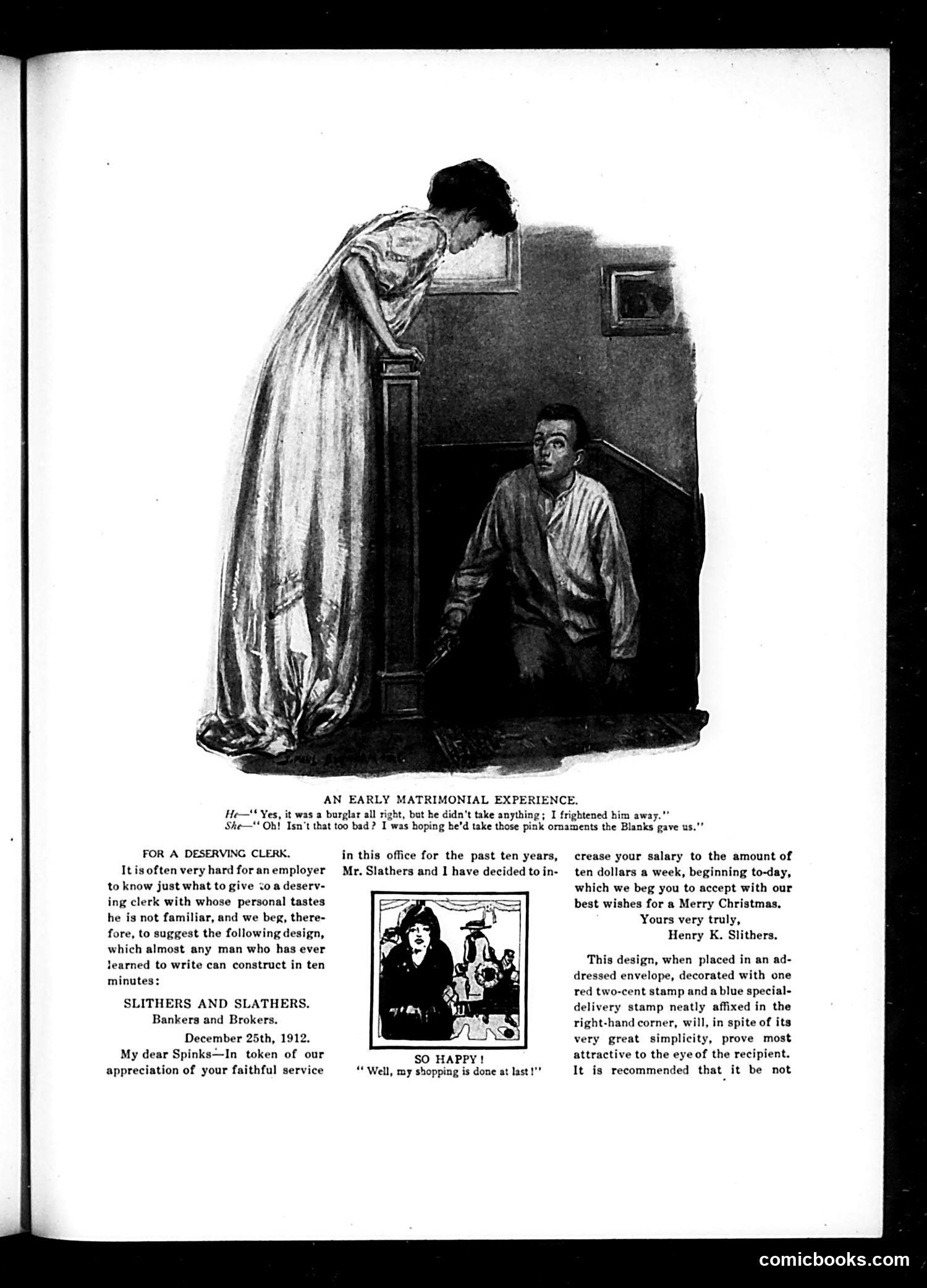
This page contains two satirical pieces reflecting early 20th-century social attitudes: **"An Early Matrimonial Experience"**: A couple discusses a burglar who fled without stealing anything. The wife expresses disappointment, hoping he'd take "pink ornaments the Blanks gave us"—satirizing newlyweds' dislike of unwanted wedding gifts. The joke mocks the social awkwardness of receiving and displaying gifts from people whose taste you don't share. **"For a Deserving Clerk"**: This section ridicules employers' difficulty giving meaningful Christmas bonuses. The accompanying letter from "Henry K. Slithers" of "Slithers and Slathers" (a mocking banking firm name) offers a deserving ten-year employee a pittance—$10 weekly raise—delivered via formal letter on expensive stationery and special delivery. The satire targets cheap employers who dress up minimal compensation with ceremonial presentation, treating a modest raise as generous holiday charity. Both pieces critique class attitudes and social pretense in early 1900s America.
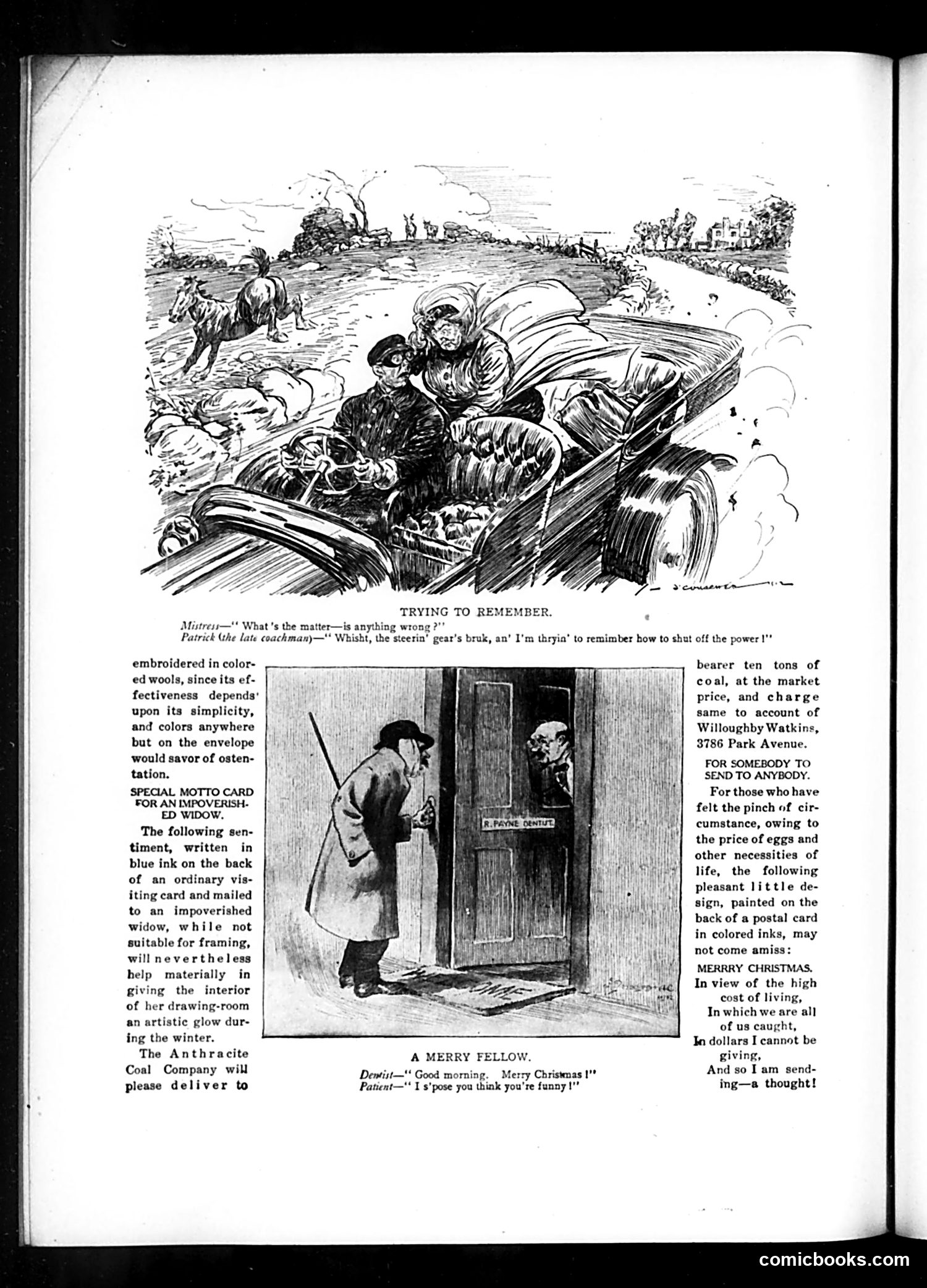
This page contains three satirical cartoons and related commentary reflecting early 20th-century social concerns. **"Trying to Remember"** depicts an Irish coachman (Patrick) who has broken a car's steering gear and struggles to recall how to shut off the power—satirizing anxieties about new automobile technology replacing traditional horse-drawn transport. The working class is portrayed as struggling to adapt. **"A Merry Fellow"** shows a dentist greeting a patient cheerfully on Christmas; the patient's sarcastic response suggests dark humor about the costs of dental care. The text sections offer mock "motto cards" for poor widows and those facing financial hardship during economically difficult times. One sardonically proposes sending free coal as a Christmas gift; another suggests sending only "a thought" instead of money due to the high cost of living—commentary on economic inequality and hardship affecting the working and middle classes. The overall theme reflects Judge magazine's satirical critique of social inequality and the tension between modernity and tradition during an economically strained period.
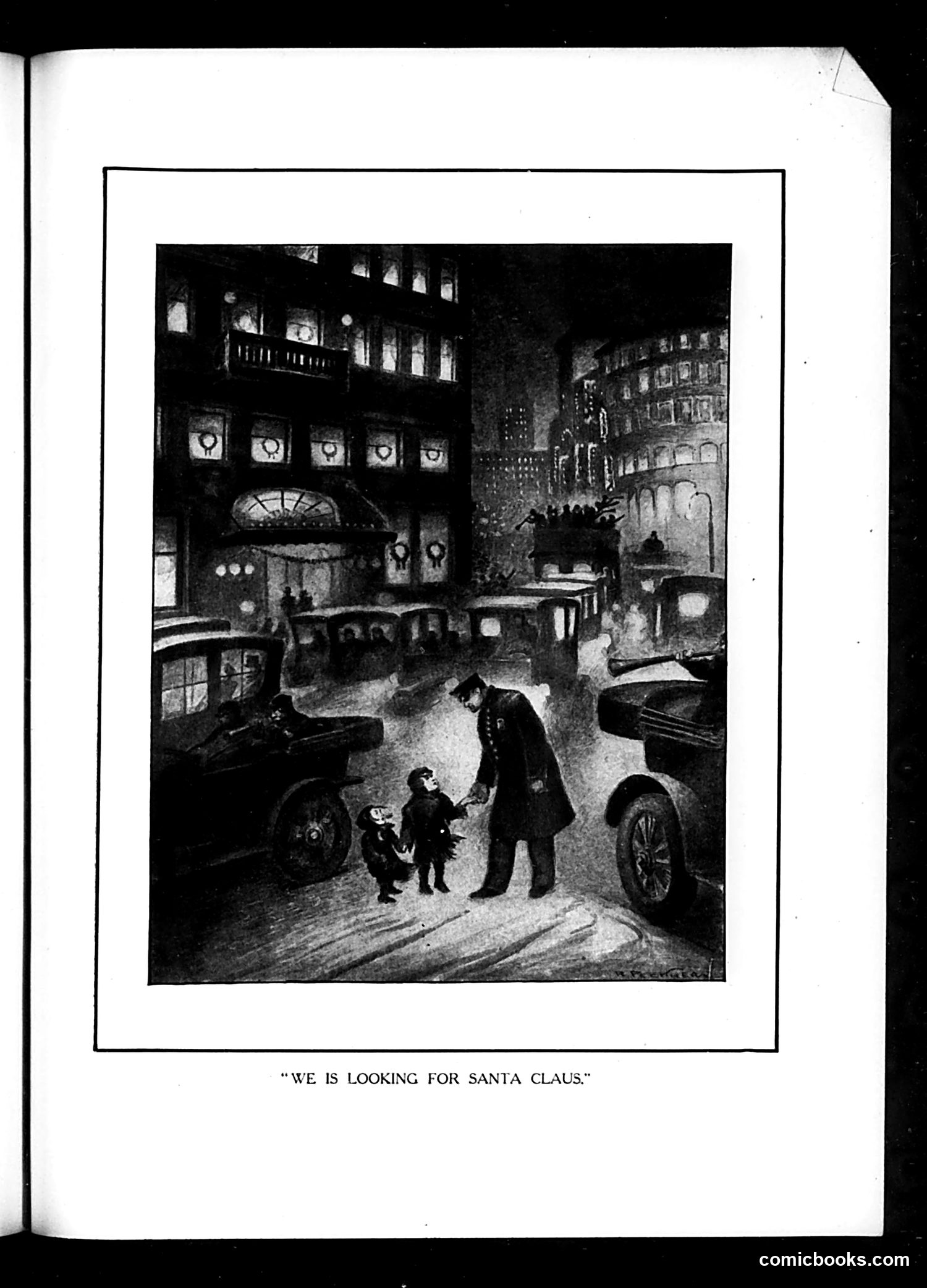
This cartoon depicts two children on a nighttime city street, searching for Santa Claus among parked automobiles and urban buildings. The caption uses dialect speech ("We is looking"), which was a common satirical device in early 20th-century Judge magazine for comic effect. The joke appears to be situational humor: children expecting to find Santa in a modern urban setting with cars and city infrastructure, rather than the traditional snowy, rural landscape associated with Christmas imagery. The contrast between the industrial cityscape and the whimsical, innocent quest for Santa creates the satire—likely mocking either the artificiality of city Christmas celebrations or children's naive expectations in a commercialized, mechanized world.
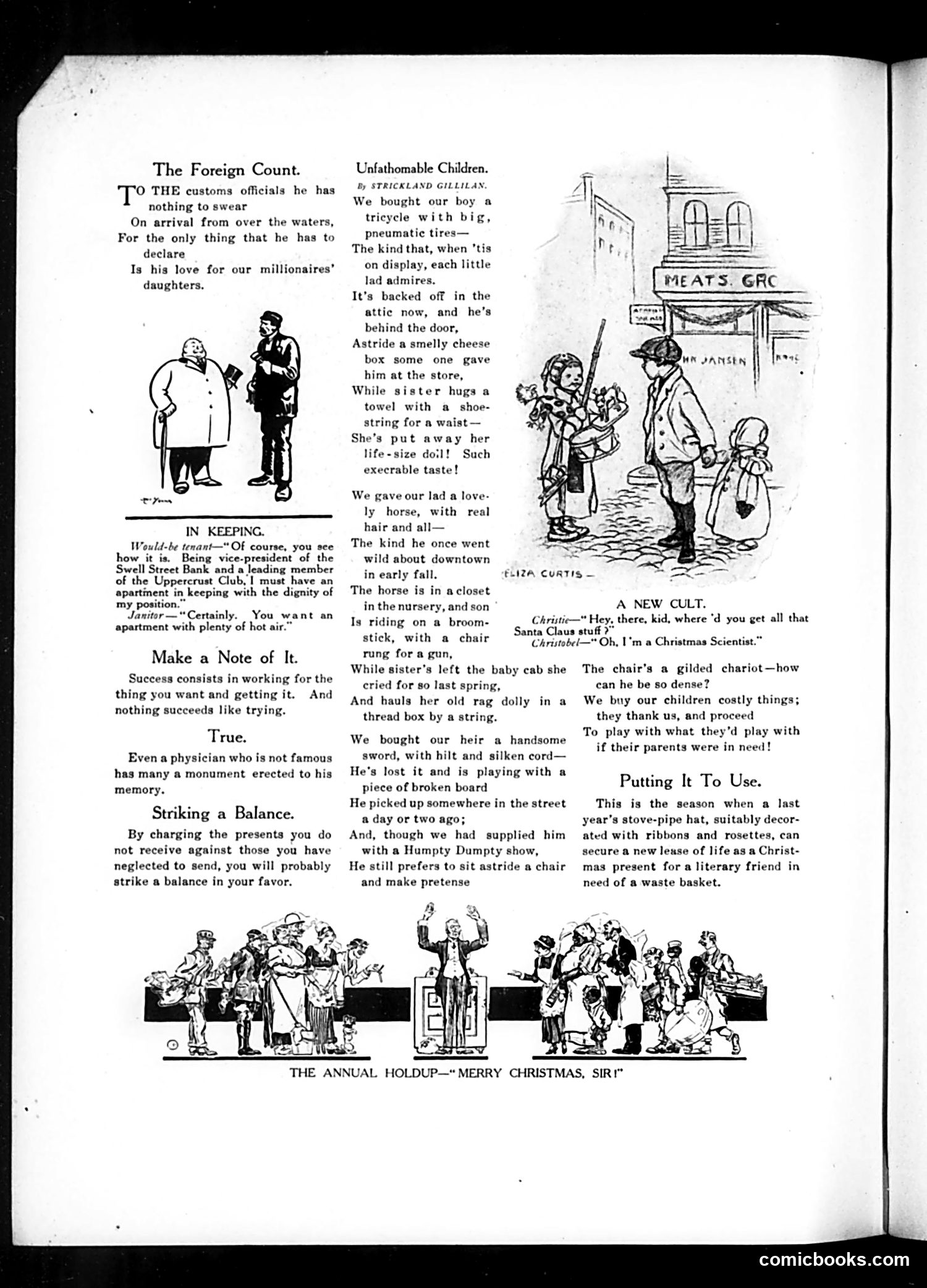
**"The Foreign Count"** satirizes gold-digger marriages: a European aristocrat arriving in America has no taxable possessions to declare except his desire to marry wealthy American heiresses—mocking both the fortune-hunting foreigner and the wealthy families' social-climbing desperation. **"In Keeping"** ridicules class pretension: a bank vice president insists his apartment must match his social status, while the janitor sarcastically suggests "plenty of hot air" suffices—commentary on wealthy people's hollow status-consciousness. **"Unfathomable Children"** (the longest piece) humorously laments that expensive toys bore children, who prefer imaginary play with household items—a timeless observation about childhood that parents still recognize. **"A New Cult"** makes a gentle joke about "Christmas Scientists" (likely referencing Christian Science), showing a child conflating Santa Claus with religious faith. **"Putting It To Use"** suggests repurposing old hats as waste baskets for gift-giving to broke literary friends—Depression-era thriftiness disguised as generosity. The page emphasizes class anxiety, consumerism, and generational values typical of early 20th-century American satire.
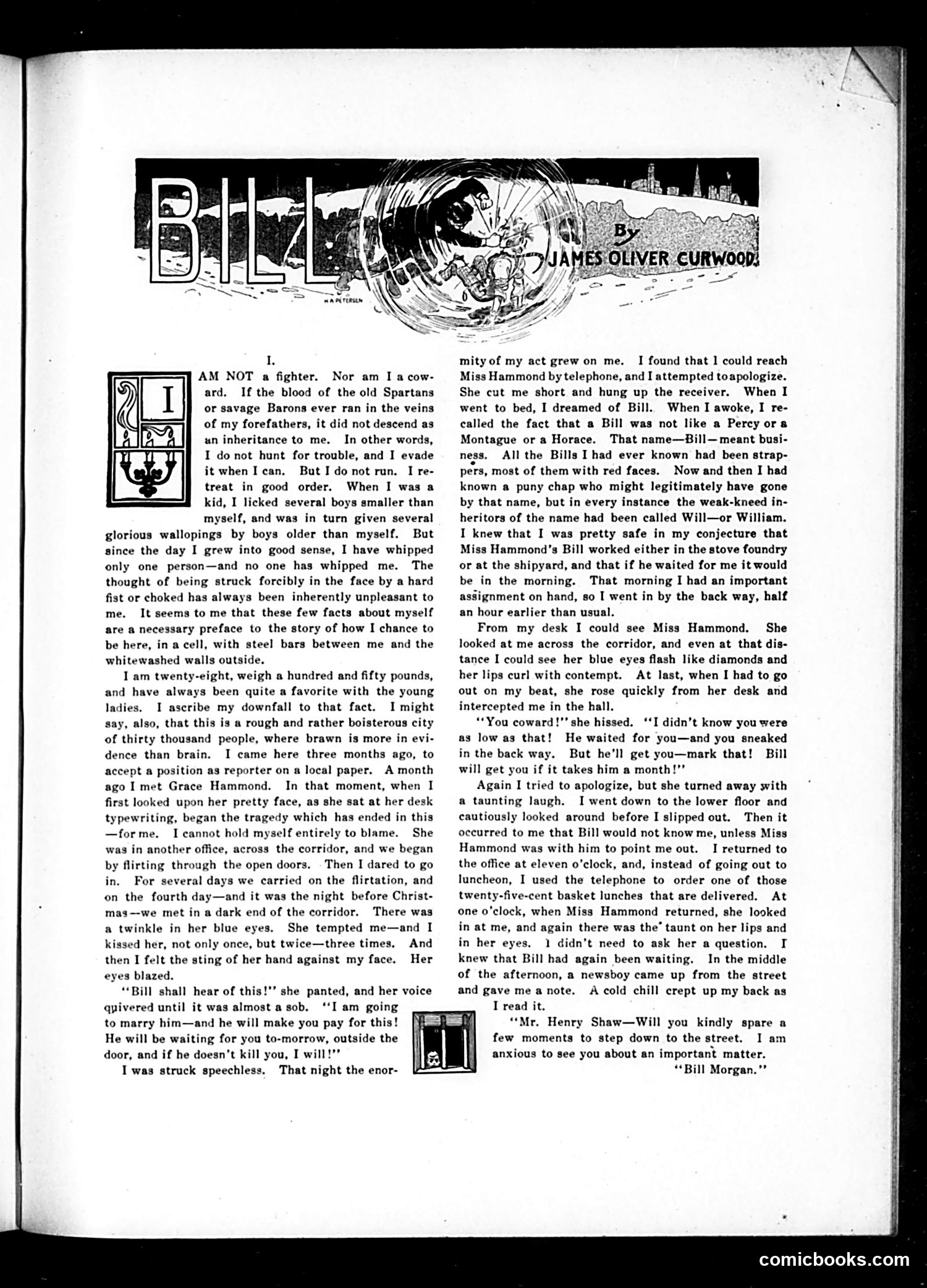
This page opens a serialized short story titled "Blitz," not a political cartoon. The narrative is a romantic comedy about a newspaper reporter who kisses Grace Hammond—a coworker—and then learns she's engaged to a man named "Bill," whom the narrator stereotypes as a rough, working-class type (likely a foundry or shipyard worker, given the era). The joke is class-based: the narrator, an educated journalist, assumes "Bill" is a dangerous brute because of his working-class name and occupation, contrasting with fancier names like "Percy" or "Montague." The narrator's cowardice—sneaking in the back way to avoid Bill the next morning—sets up comedic conflict. The story reflects early 20th-century anxieties about class differences and masculine competition over women, treated here with satirical humor rather than genuine menace.
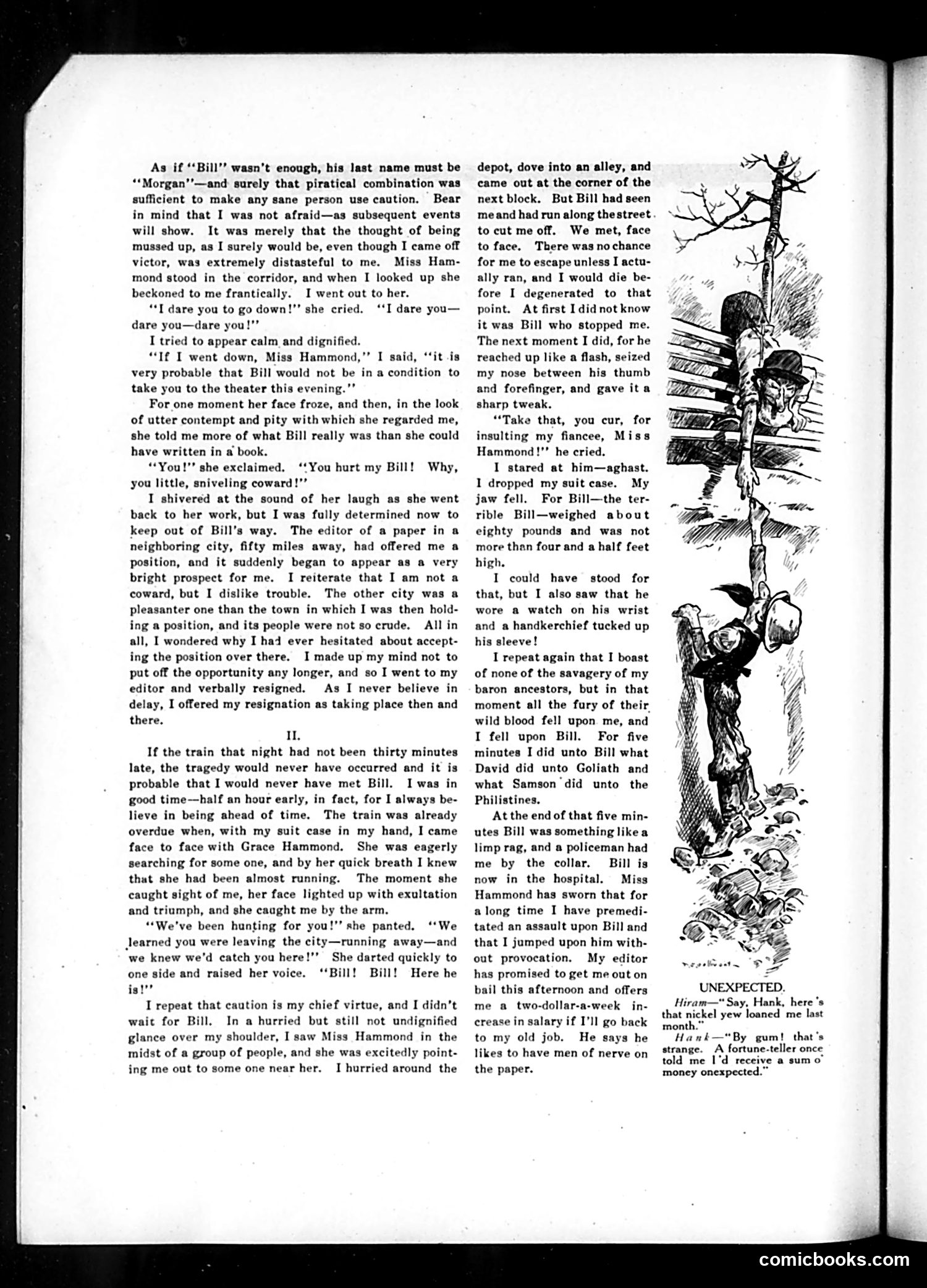
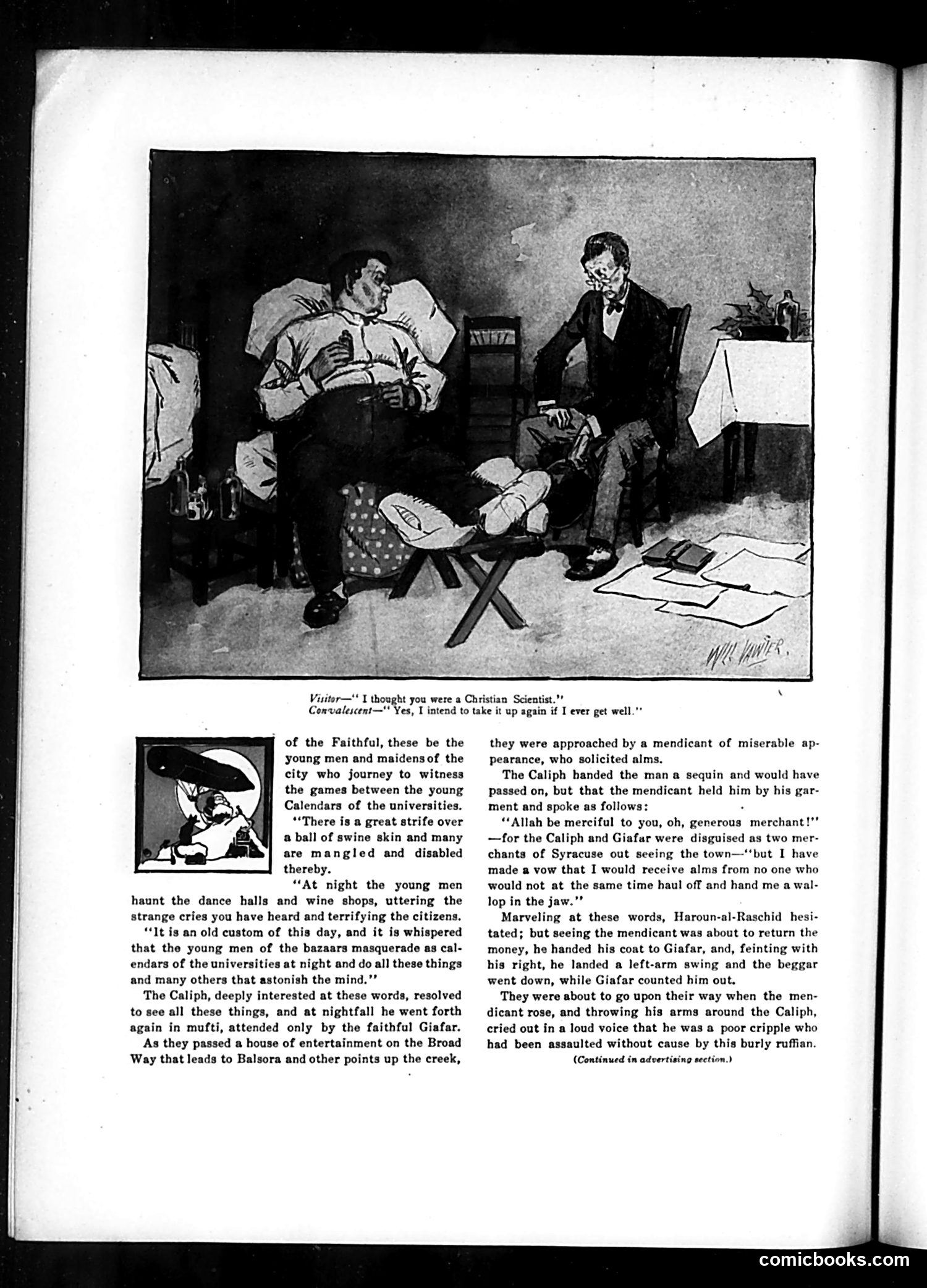
This page presents a serialized humorous story about a cowardly narrator who fears confrontation with "Bill Morgan," portrayed as a dangerous character. The joke's payoff comes at the climax: after the narrator spends considerable time anxiously avoiding this fearsome "Bill," he's finally confronted—only to discover Bill is a tiny man, weighing eighty pounds and standing four-and-a-half feet tall. The satire mocks masculine anxiety and social cowardice. The narrator's elaborate justifications for fleeing (concern about being "mussed up," accepting a job offer to avoid trouble) are undercut by the revelation that his nemesis is physically insignificant. Grace Hammond's contempt for the narrator's avoidance—calling him a "sniveling coward"—is validated when even her diminutive fiancé must resort to the childish nose-tweak. The accompanying illustration on the right depicts a dead tree with birds, likely symbolizing barrenness or consequence, thematically reinforcing the narrator's moral emptiness.
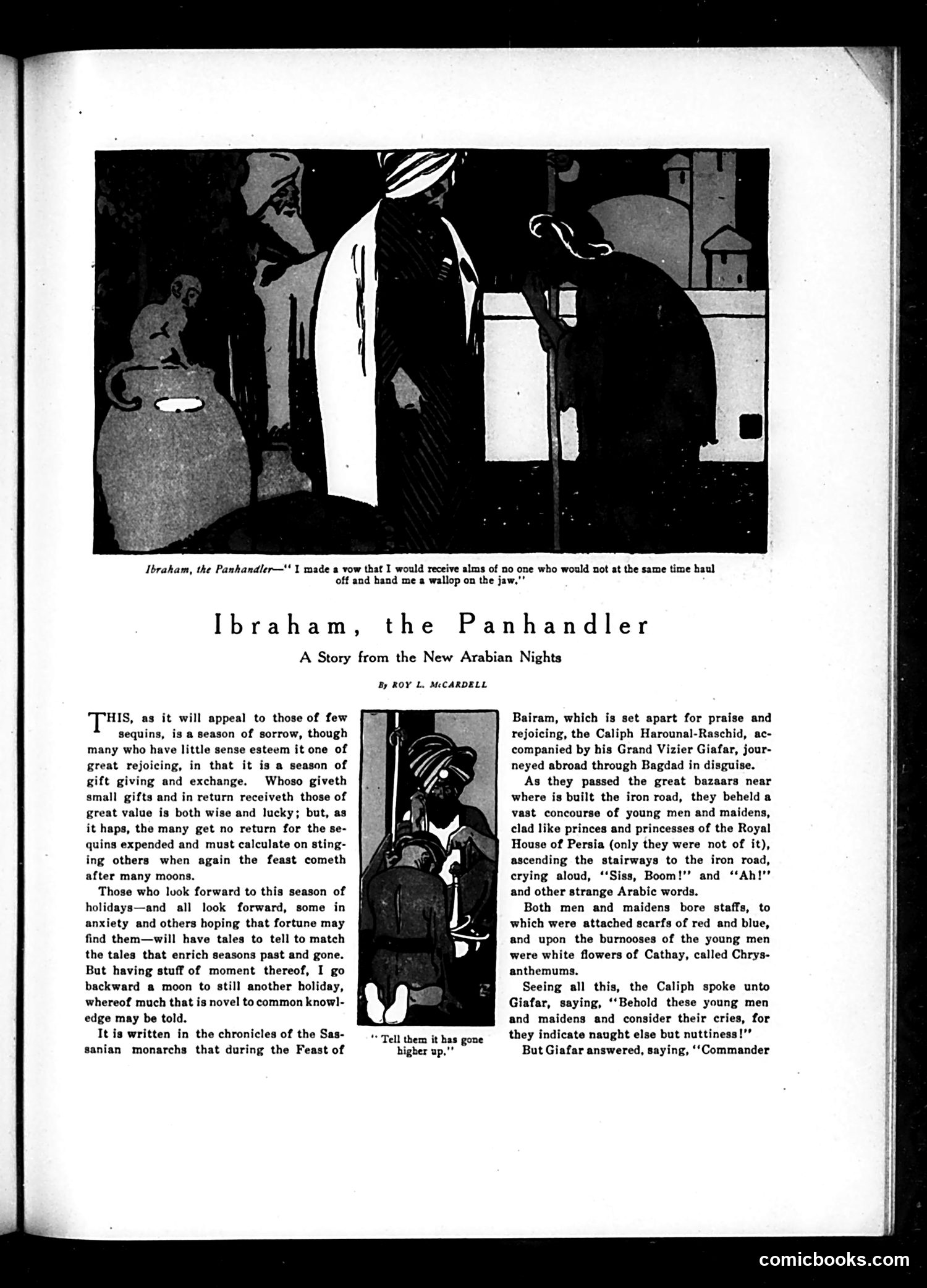
This is the opening of a fictional story (not a political cartoon) titled "Ibrahim, the Panhandler," attributed to Roy L. McCardell, framed as a tale from the Arabian Nights tradition. The text uses orientalist language to describe what appears to be a satirical observation of modern American life. References to a "Caliph" and "Grand Vizier" journeying through "Bagdad" are the story's framing device. The actual subject seems to be young Americans at a railway station—the text mentions "the iron road" (train), people wearing college colors ("scarfs of red and blue"), and chrysanthemums, while shouting "Siss, Boom!" (recognizable as college cheer language). The satire appears to mock youthful enthusiasm and what the narrator (and presumably Judge's readers) considered excessive emotional display, calling it "nuttiness." The opening vow about receiving alms only from those willing to punch the panhandler suggests dark humor about social obligation and reciprocity.
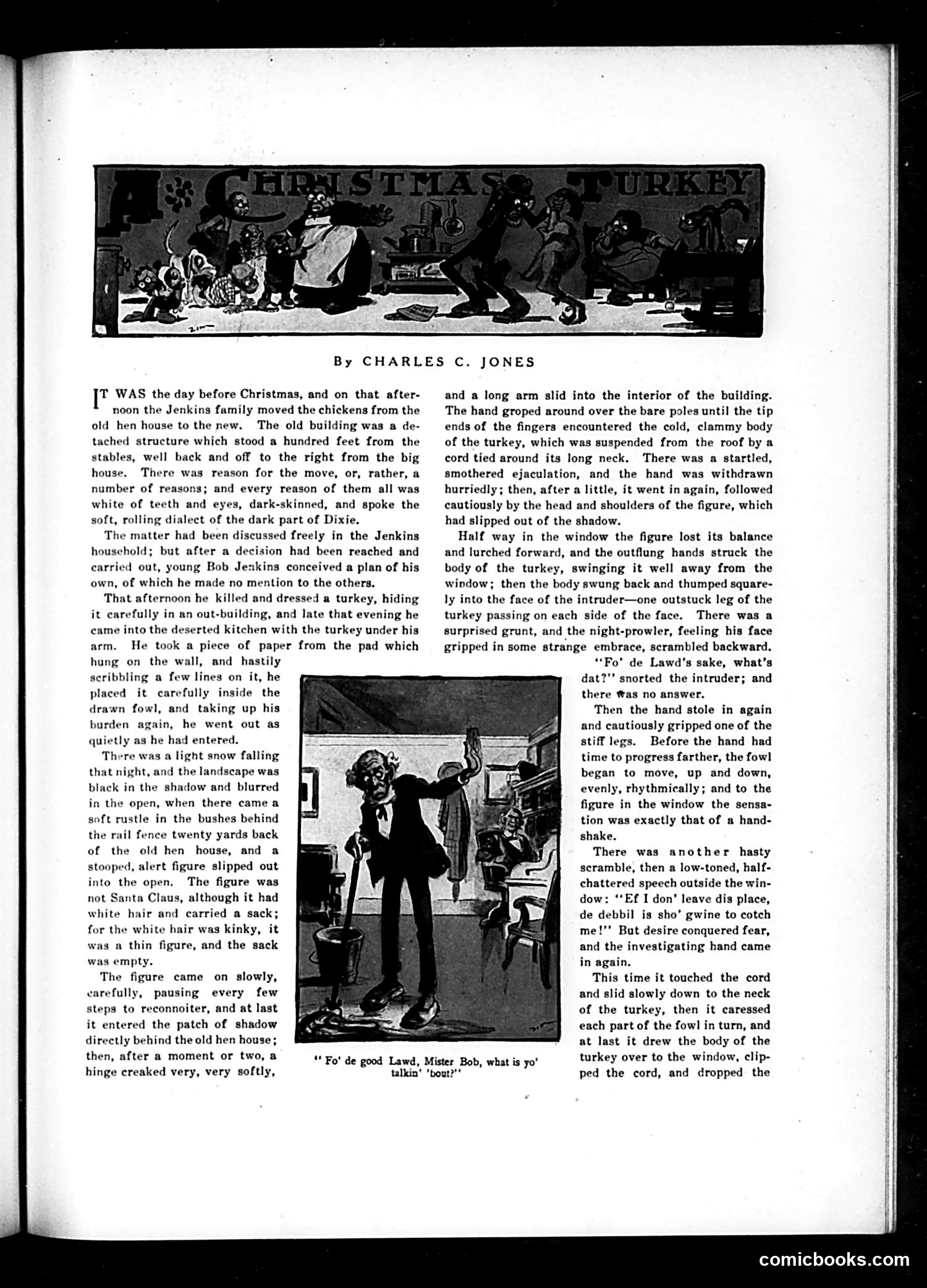
This is a humorous short story (not a political cartoon) about a prank on Christmas Eve. Young Bob Jenkins hides a dressed turkey in an old hen house and leaves a note inside it. That night, an elderly Black man—apparently planning to steal from the Jenkins family—discovers the turkey by reaching through a window. The cold bird startles him repeatedly: it swings into his face, appears to "shake hands" when the fowl moves rhythmically, and generally confuses and frightens the would-be thief into thinking he's encountered something supernatural ("de debbil"). The story trades on racial stereotypes common to early 20th-century American humor: depicting a Black character speaking in exaggerated dialect, superstitious, and engaged in petty theft. The "joke" relies on the reader finding humor in his terror and confusion—typical of the era's offensive entertainment conventions.
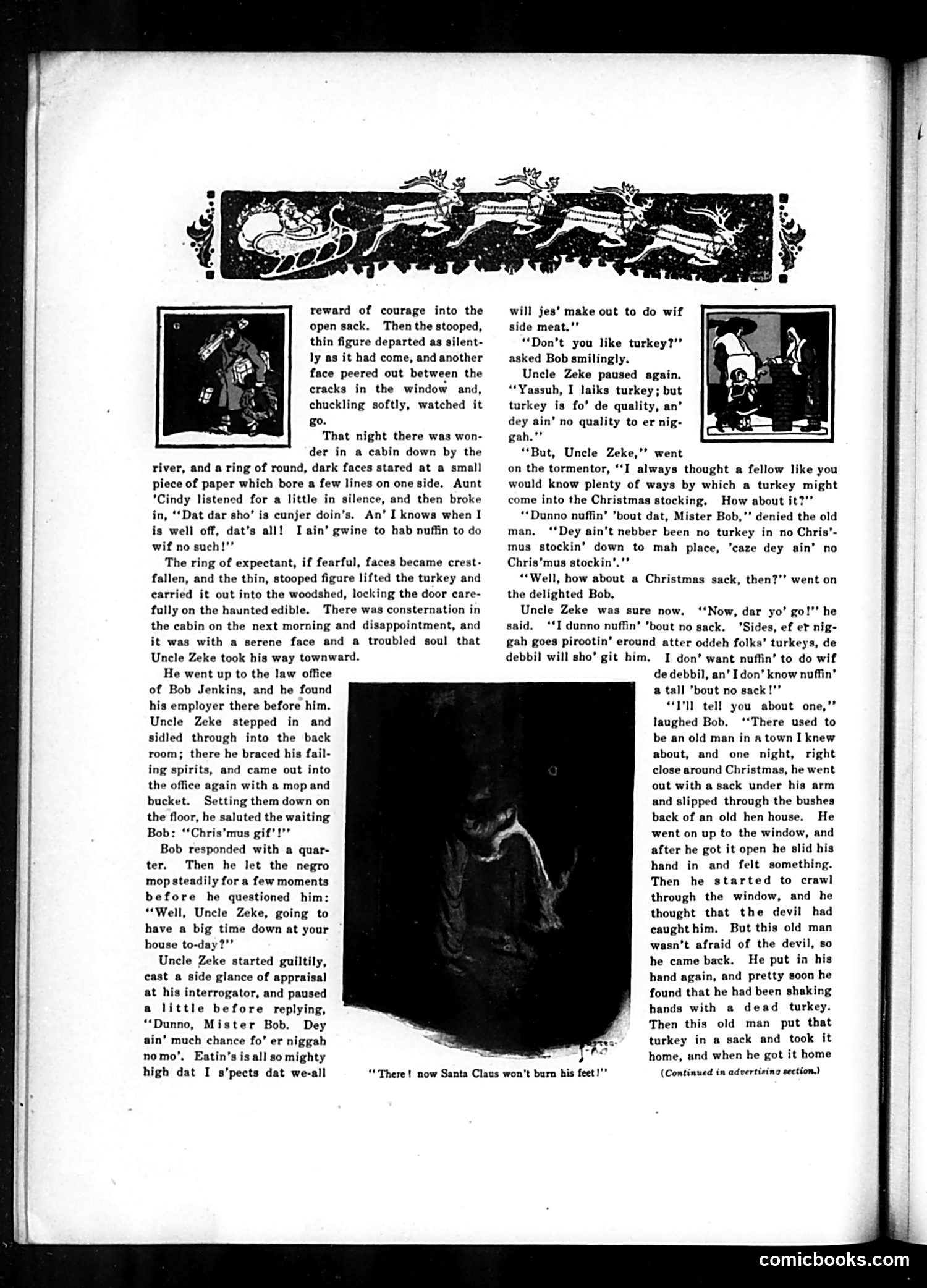
This is a narrative story with racial caricature, not a political cartoon. It depicts "Uncle Zeke," a Black man presented in exaggerated dialect, interacting with his white employer Bob Jenkins around Christmas. The plot involves Bob tempting Uncle Zeke to steal a turkey by suggesting it could arrive magically in a Christmas sack—a tale about an old man who retrieved a dead turkey from a henhouse window. Uncle Zeke resists, citing superstitious fear of the devil and claiming Black people don't deserve quality food like turkey. The story relies on era-typical racist stereotypes: enslaved/poor Black laborers speaking in heavy dialect, accepting social inferiority ("dey ain' no quality to er niggah"), and being depicted as superstitious and fearful. The white employer's amusement at manipulating him compounds the degradation. This reflects early-20th-century American attitudes normalizing racial hierarchy and minstrelsy-style humor.
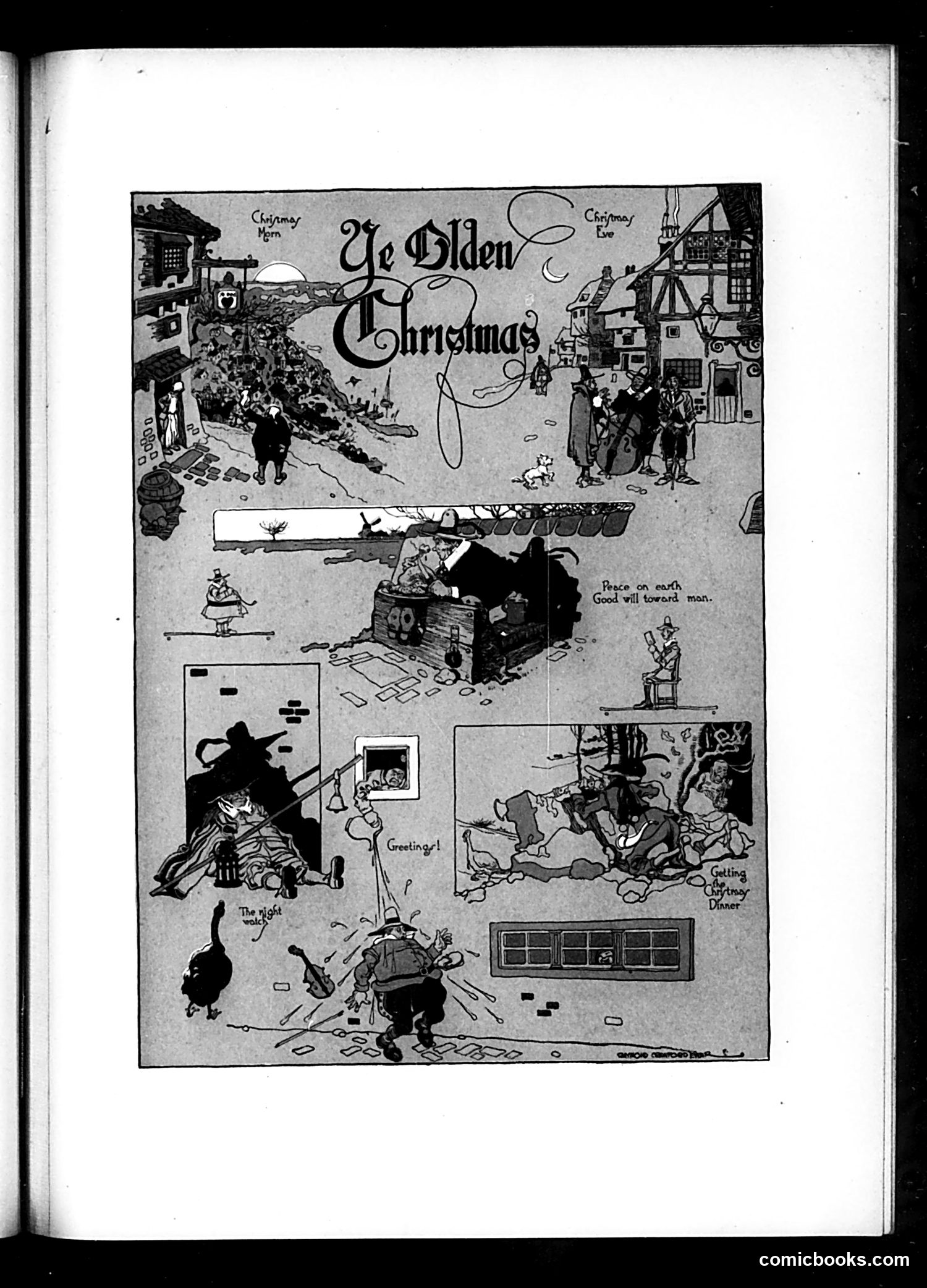
This is a nostalgic comic strip celebrating traditional Christmas celebrations. The title page shows a medieval or old-fashioned village scene with "Christmas Morn" and "Christmas Eve" labeled at top corners. The multiple panels below depict various vintage Christmas activities: caroling, gift-giving, feasting, and general merriment. Text snippets include "Peace on earth, Good will toward man," "Greeting!," and "Getting ready for Dinner." The satire appears gentle—celebrating an idealized "olden" Christmas as superior to (presumably) more commercialized modern practices of the Judge magazine era. The contrast between quaint, communal historical celebrations and contemporary consumer culture is the implicit joke, nostalgia being used as mild social commentary on how Christmas had changed by the time this was published.
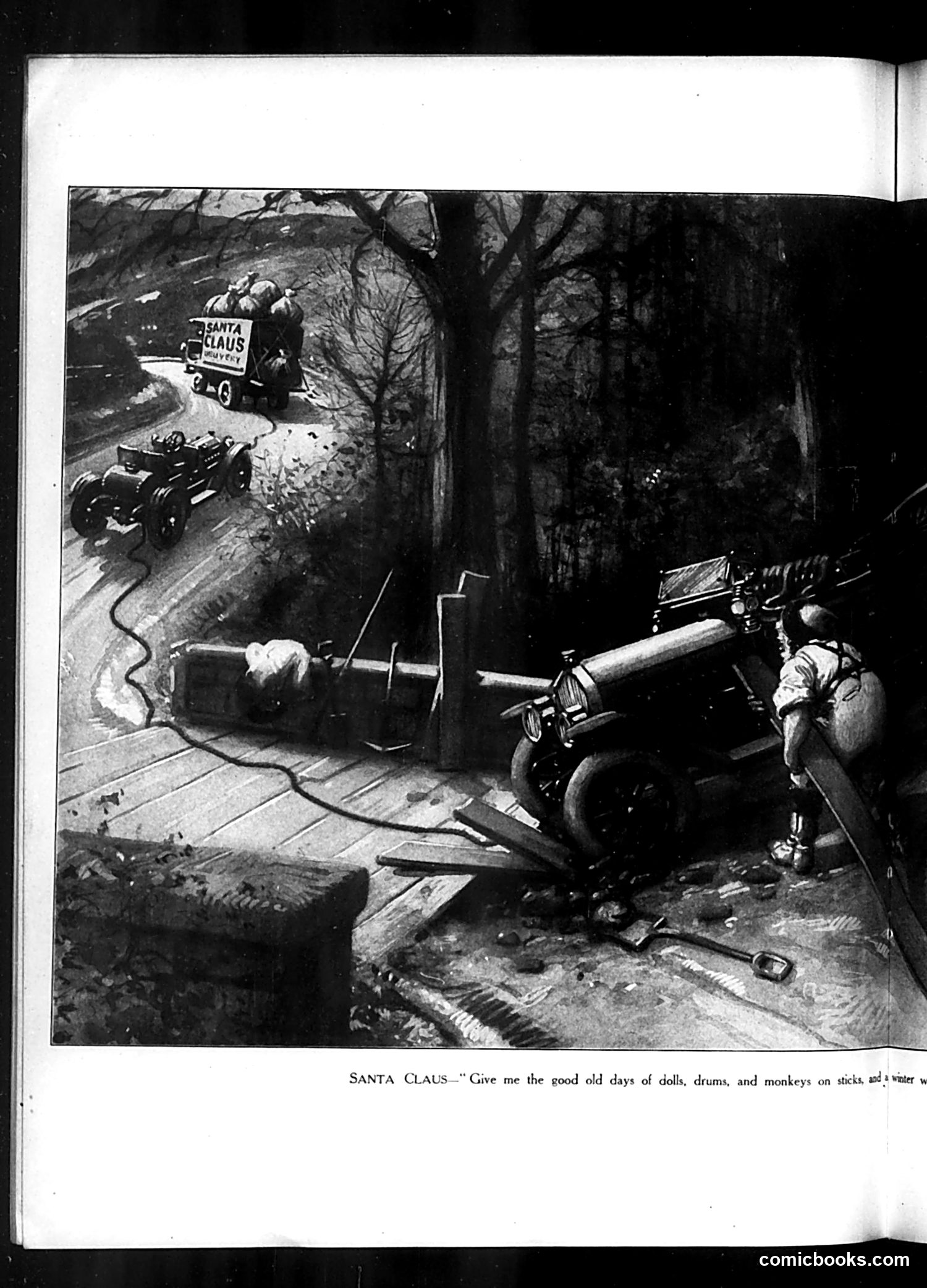
This satirical image shows Santa Claus in a workshop scene, likely commenting on modern versus traditional Christmas gifts. Santa appears surrounded by industrial/mechanical equipment and toy-making machinery, contrasting with his nostalgic plea for "the good old days of dolls, drums, and monkeys on sticks." The satire likely critiques the commercialization and mechanization of Christmas gift-giving in early 20th-century America. Santa's complaint suggests Judge magazine was poking fun at how modern manufacturing had transformed toy production into an industrial enterprise, moving away from simpler, handmade playthings. The complex machinery visible in the workshop emphasizes this shift toward mass production and consumerism, even as Santa romanticizes an idealized, simpler past. This reflects broader Progressive Era anxieties about industrialization's social impacts.
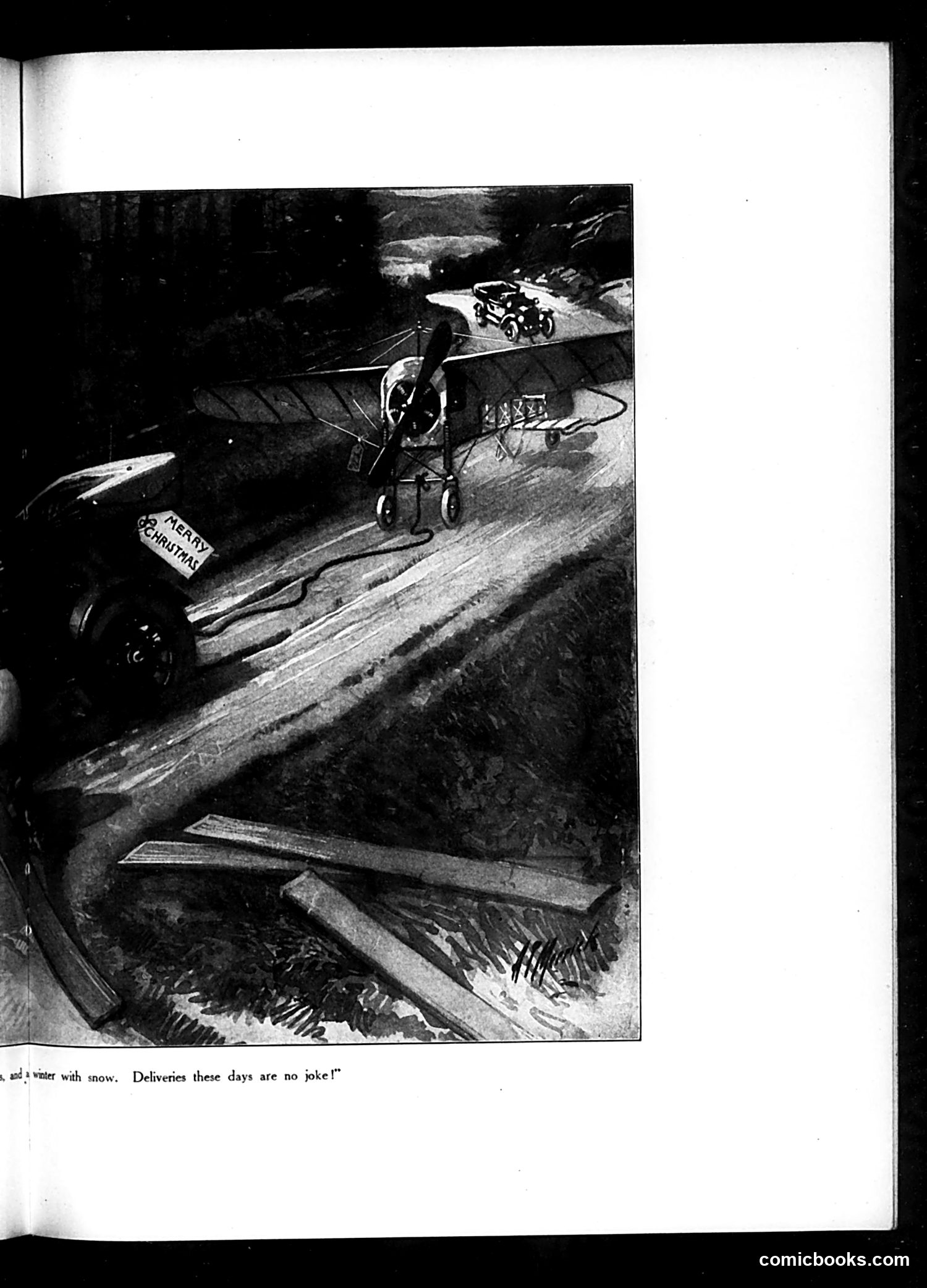
This photograph shows aircraft and delivery vehicles in snowy conditions, illustrating the caption's point about winter delivery challenges. The image appears to be documenting practical wartime or early aviation-era logistics rather than satirical political commentary. One vehicle is marked "MERRY CHRISTMAS," suggesting this may be a holiday-themed piece about the difficulties of delivering goods during winter weather, particularly relevant if this dates to a period when air transport was becoming important for commerce or military operations. The caption "Deliveries these days are no joke!" emphasizes how harsh weather conditions complicated transportation. Without additional context about Judge magazine's publication date or surrounding content, the specific satirical target remains unclear, though the piece appears to mock contemporary delivery complications.
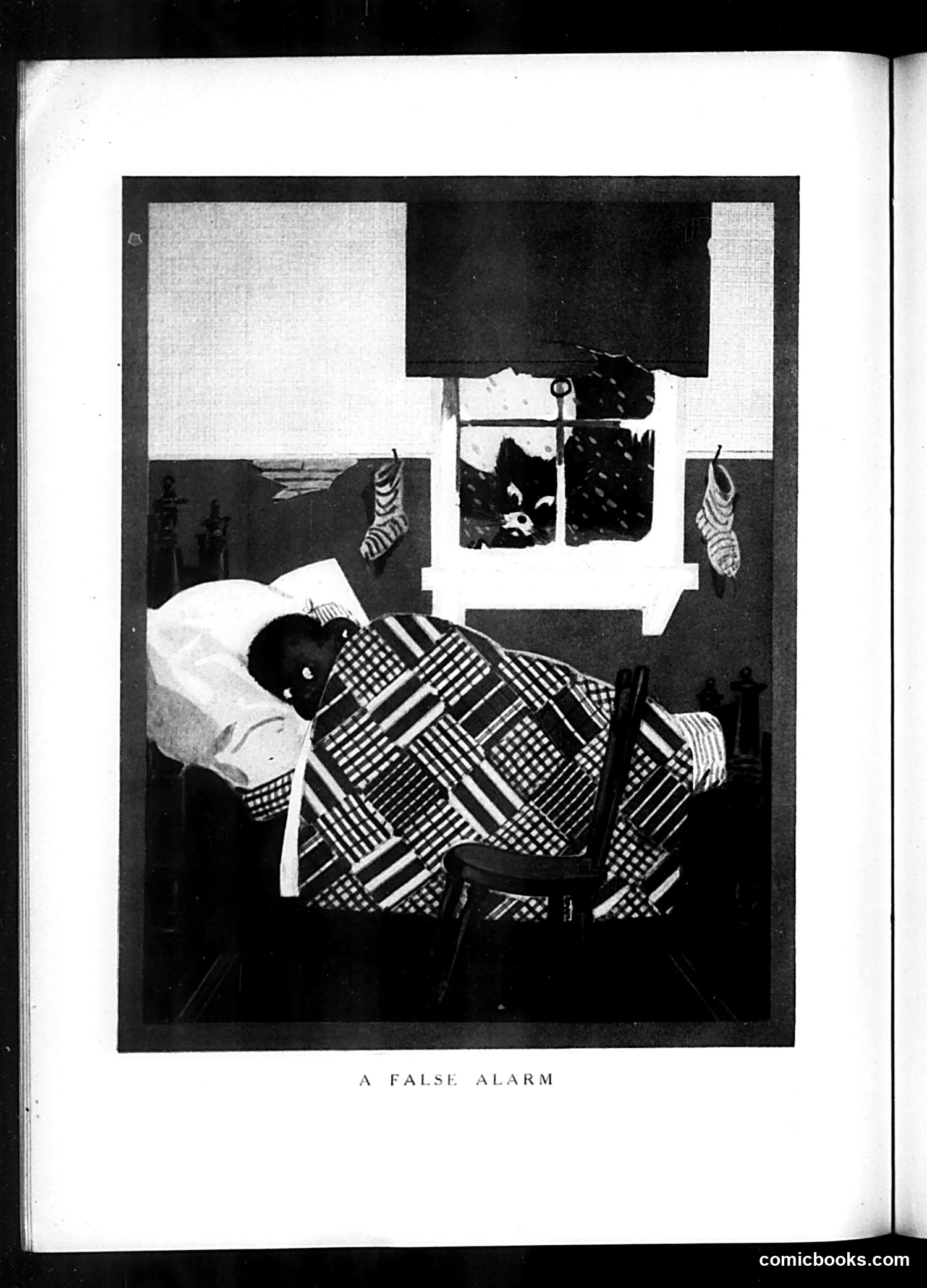
This illustration from *Judge* magazine depicts a bedroom scene viewed from above. A person lies in bed wearing patterned pajamas, apparently startled awake. The room contains windows, hanging garments, and bedroom furniture rendered in stark black and white contrasts. The title "A False Alarm" suggests the humor derives from a misunderstanding or unnecessary panic—likely the sleeper being awakened by something trivial or imaginary. Without additional context about the magazine's publication date or accompanying text, the specific social or political satire remains unclear. The artistic style and composition suggest early-to-mid 20th-century humor, possibly addressing domestic life anxieties or marital situations common to that era's satirical commentary.
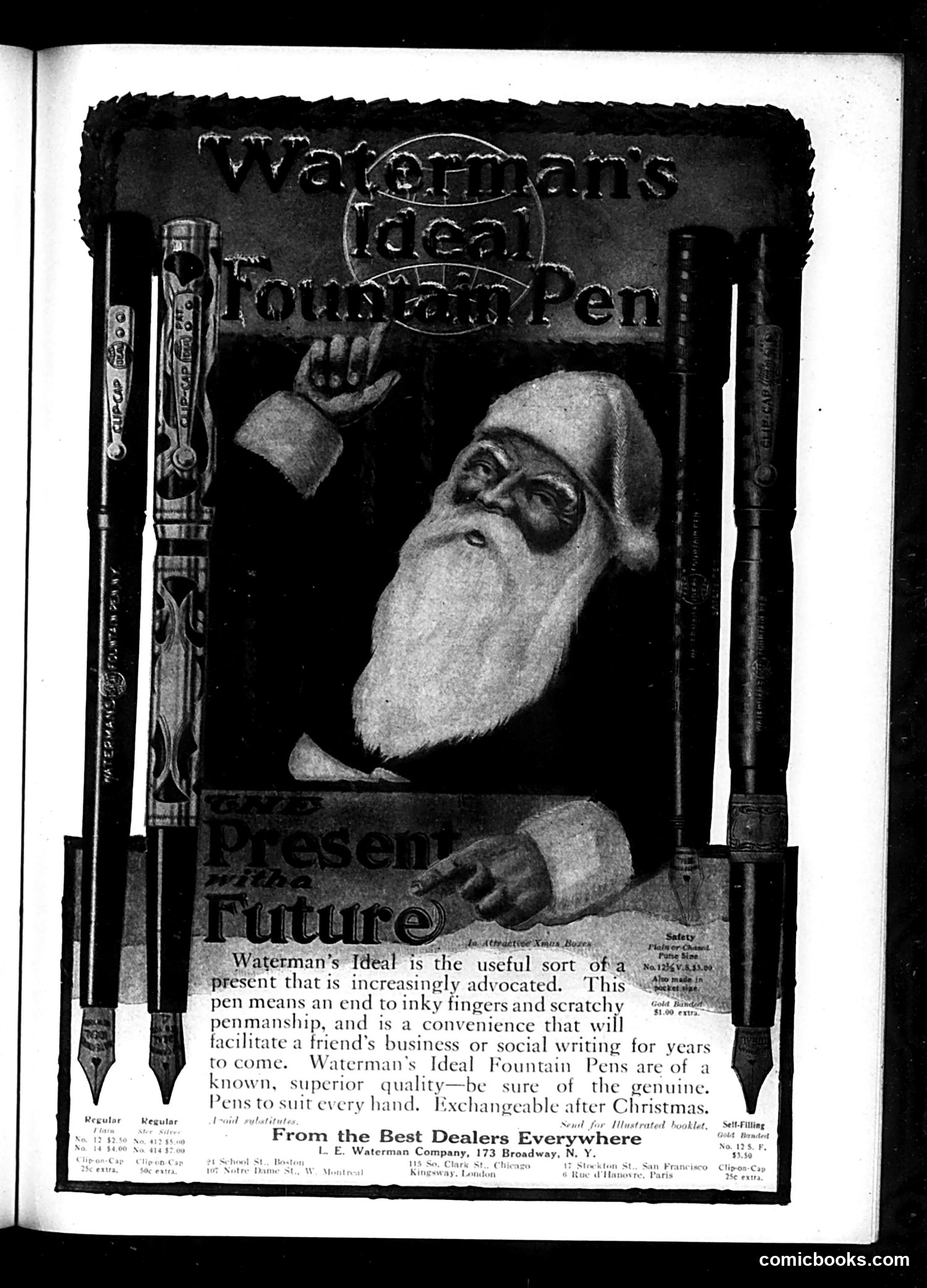
This is primarily a **product advertisement**, not political satire. It promotes Waterman's Ideal Fountain Pens, featuring an illustrated figure (likely Santa Claus or a bearded gift-giver) holding a pen as an ideal Christmas present. The ad's pitch emphasizes practical utility: fountain pens as gifts that prevent "inky fingers and scratchy penmanship" and provide "a convenience that will facilitate a friend's business or social writing for years to come." The text stresses quality and availability across different models. The decorative border displays actual sample pens flanking the central illustration, functioning as product display. Text at bottom lists the L.E. Waterman Company's locations (New York, Chicago, Montreal, London, Paris) and indicates this is from an era when fountain pens were luxury items marketed as thoughtful, long-lasting gifts—a stark contrast to today's disposable writing instruments.
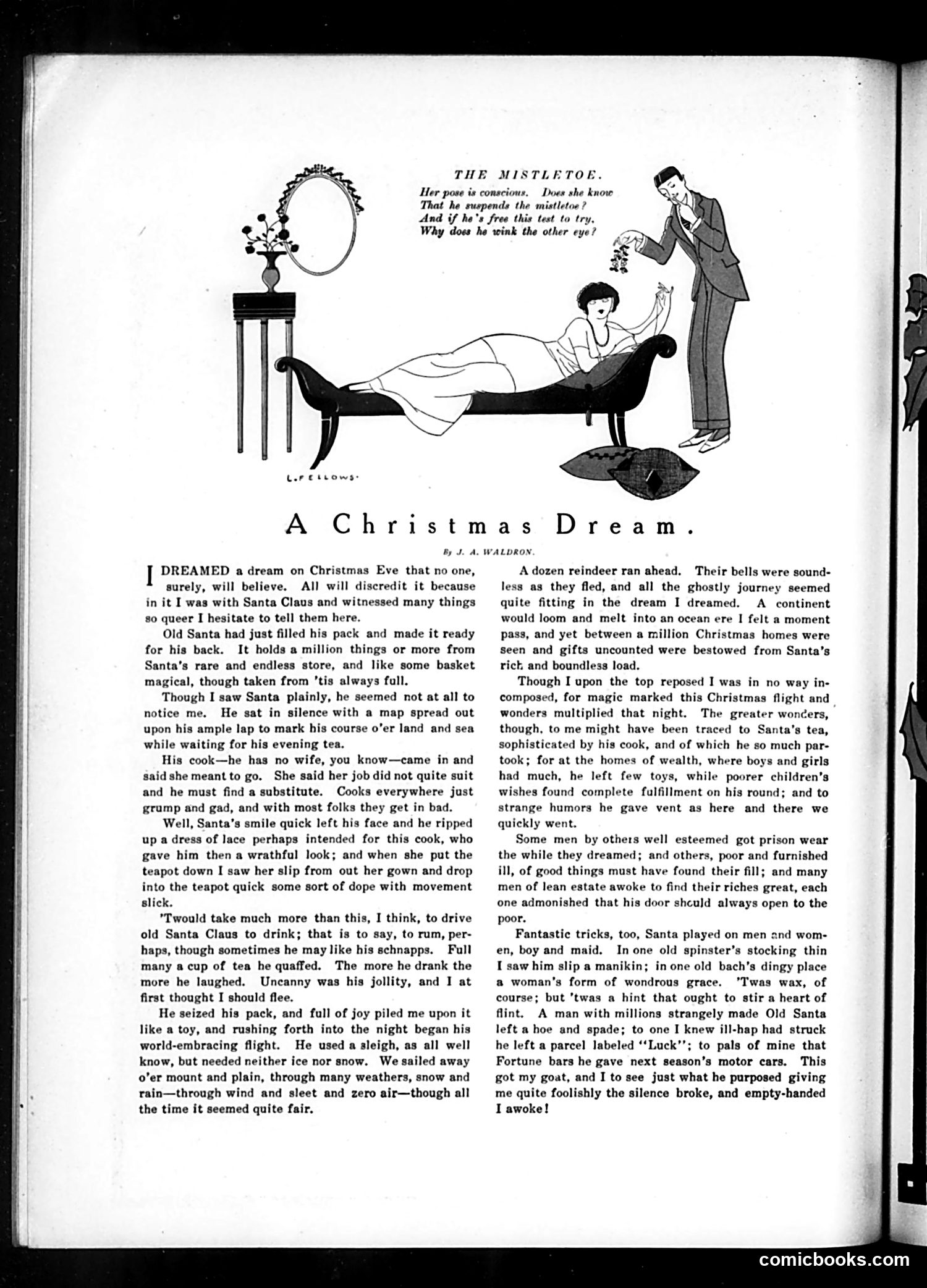
This page contains two pieces of Christmas-themed satirical content from *Judge* magazine. **"The Mistletoe" (top cartoon):** A quick visual gag about the tradition of kissing under mistletoe. The cartoon mocks male deception—a man holds up mistletoe while winking, suggesting he's using the holiday custom as a pretext to kiss a woman who may not fully consent ("Does she know / That he suspends the mistletoe?"). The humor hinges on male cunning and female naiveté. **"A Christmas Dream" (main story):** A longer satirical tale where the narrator dreams Santa's cook has spiked his tea, causing him to behave chaotically. The story uses this device to critique wealth inequality: under the drug's influence, Santa gives toys to poor children while denying them to rich ones, and grants unexpected windfalls to the poor. The satire suggests Santa's "real" agenda should be redistributing wealth to those in need—a progressive critique wrapped in fantastical humor. Both pieces reflect early 20th-century attitudes about class, consent, and holiday traditions.
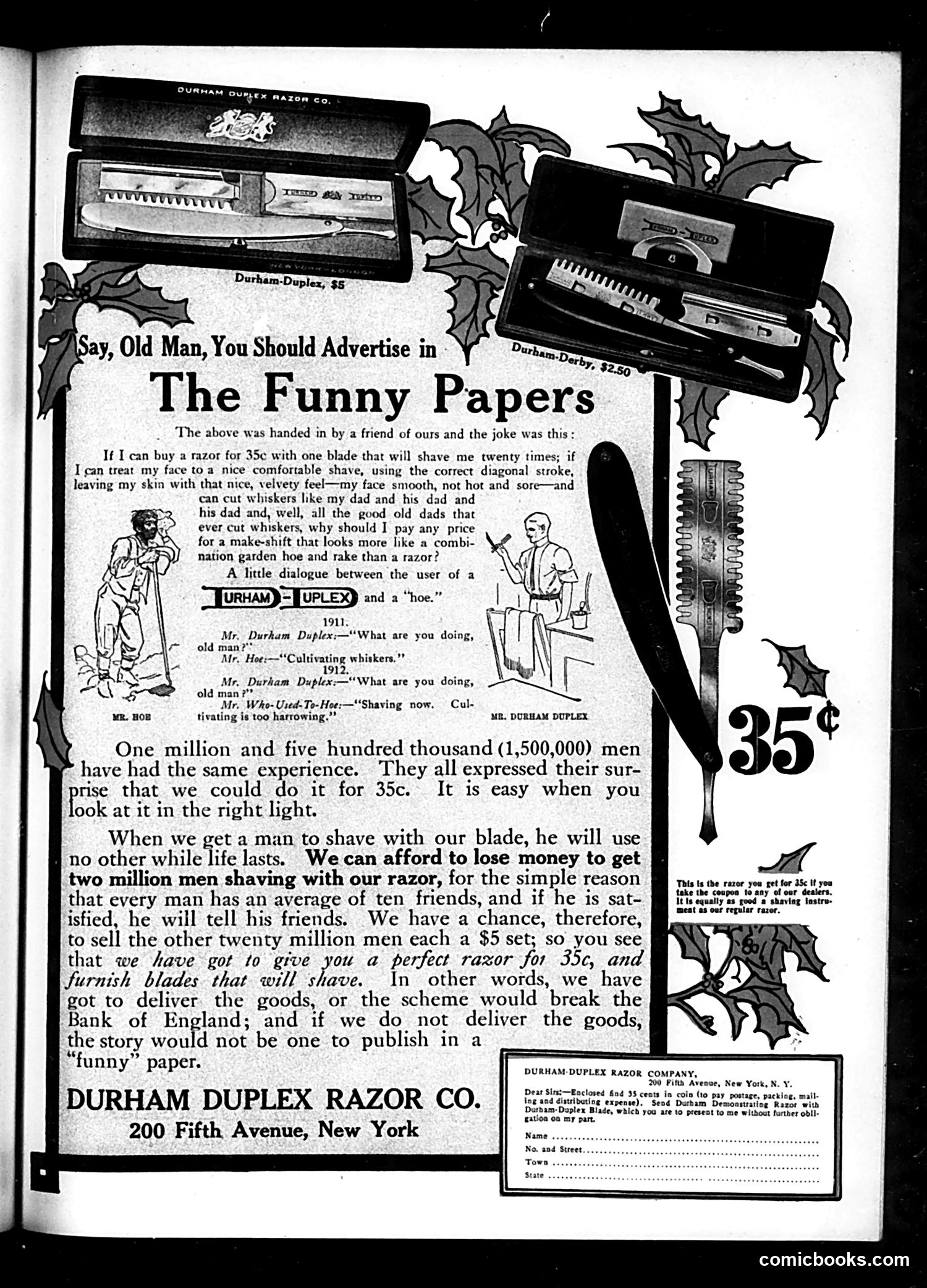
This is primarily a **product advertisement** rather than political satire, though it uses humor to make its sales pitch. The "joke" referenced satirizes competing razors by contrasting them with Durham-Duplex's affordable offering. The dialogue depicts a character nicknamed "Hoe" (suggesting his old razor resembles a garden tool) who initially "cultivates whiskers" with an inferior razor. By 1912, he's switched to Durham-Duplex and can actually shave properly—the pun being that cultivation is "harrowing" (tedious). The advertisement's core argument: sell razors cheaply (35¢) to capture market share through word-of-mouth, then profit from repeat blade sales. The company claims 1.5 million satisfied customers support this strategy. The satirical edge mocks inferior competing razors as clumsy garden implements, while positioning Durham-Duplex as the rational choice for modern men seeking comfort and efficiency—a common early-1910s advertising tactic appealing to masculine self-interest.
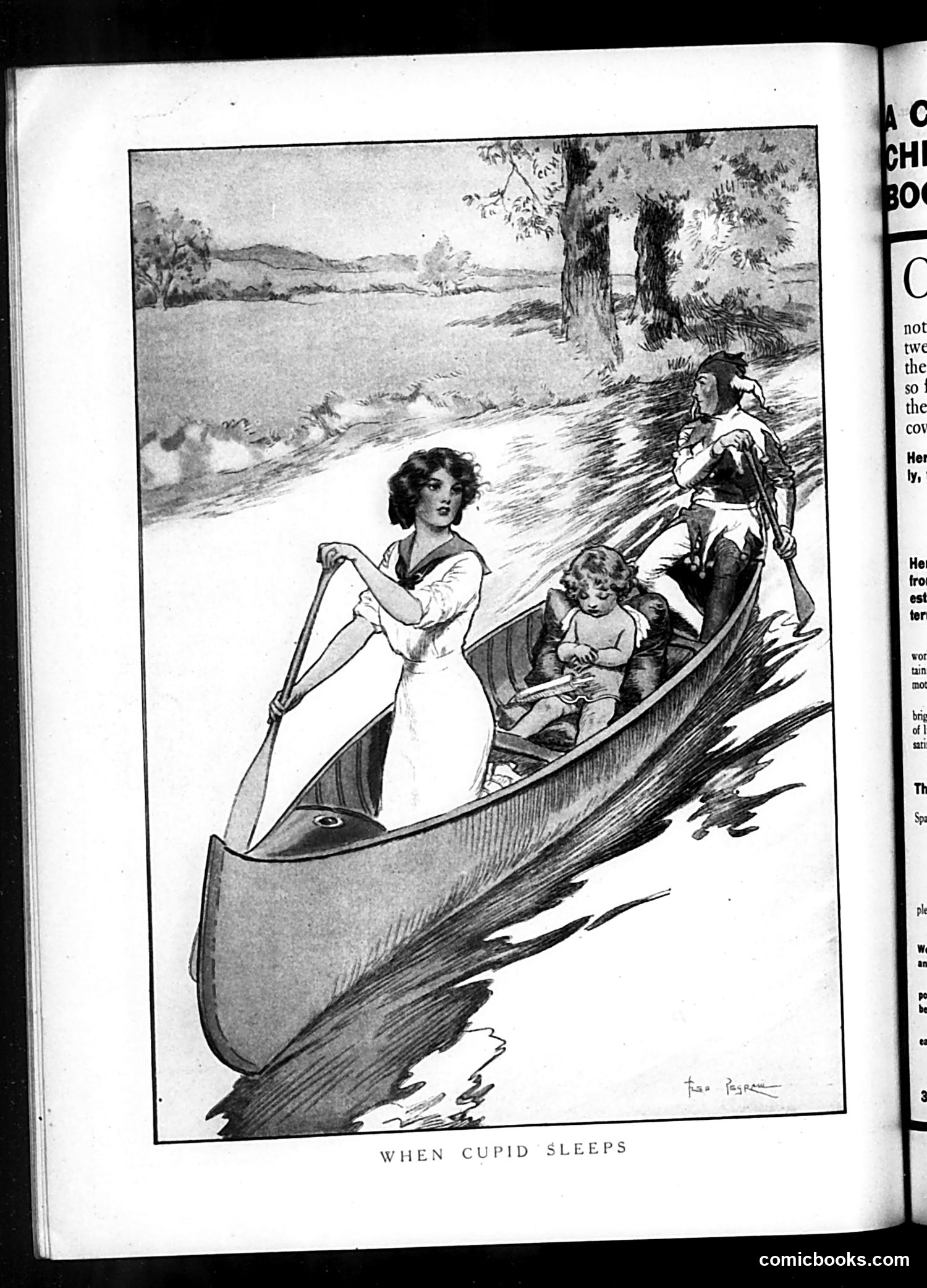
This illustration depicts a woman paddling a canoe containing a cherub (Cupid, the Roman god of love) who appears to be asleep or inactive. A man in period dress stands nearby on the riverbank, seemingly unnoticed or ignored. The cartoon's satire likely comments on romantic indifference or the absence of love/attraction in a relationship or courtship scenario. The sleeping Cupid—traditionally responsible for inspiring love and desire—suggests that romantic feelings are dormant or absent. The woman's focus on paddling (action, control, effort) rather than on the man implies she is proceeding independently, perhaps suggesting themes about female agency or the futility of romantic pursuit when passion is absent. The joke hinges on the contrast between Cupid's expected role and his current inactivity.
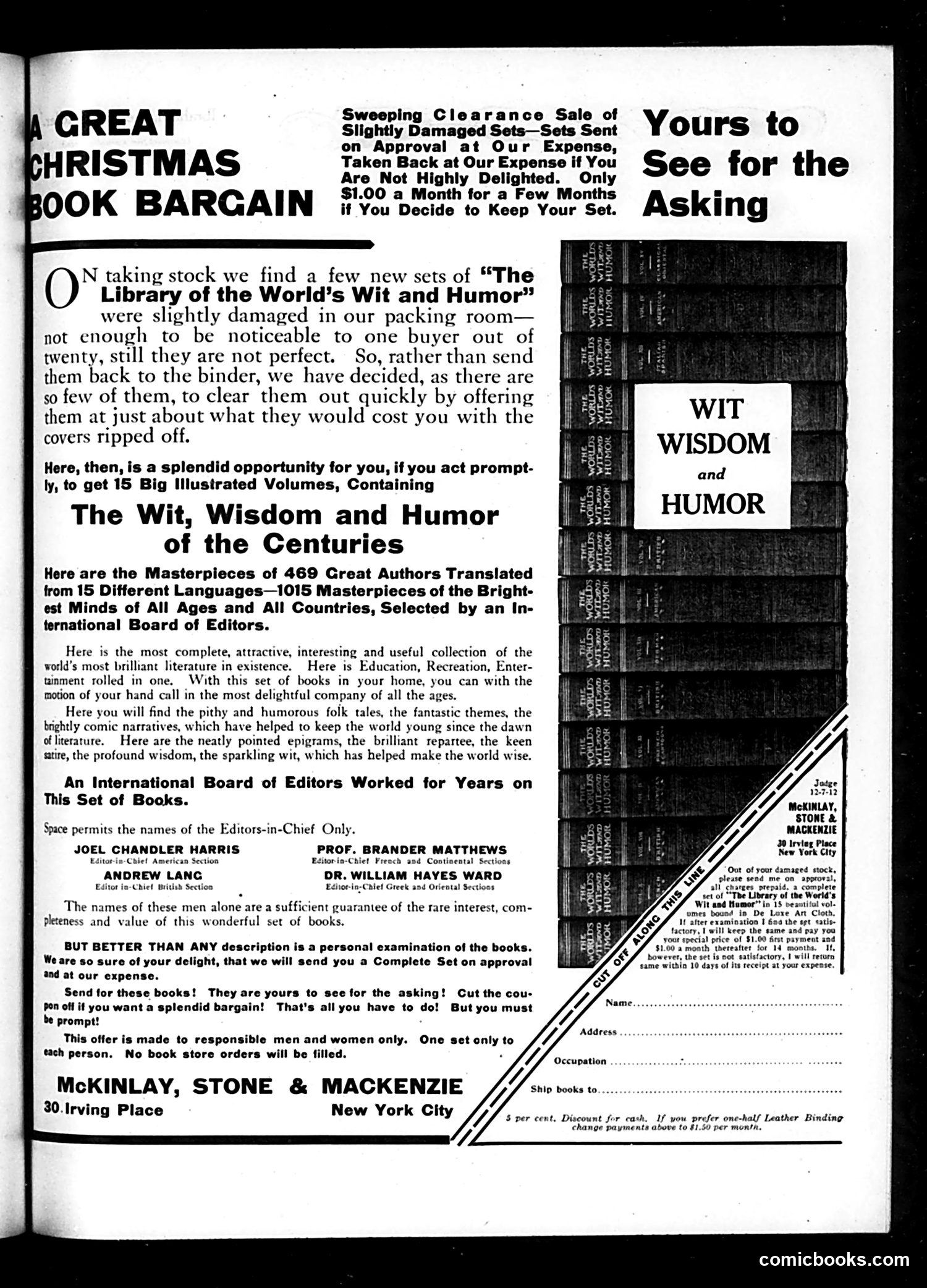
This page is **entirely advertising**, not editorial content or satire. It's a mail-order catalog advertisement for "The Library of the World's Wit and Humor"—a 15-volume book set published by McKinlay, Stone & Mackenzie. The ad uses a sales strategy common to the era: offering "damaged" stock at discount prices (allegedly slightly damaged during packing). The copy emphasizes the prestigious editorial board (Joel Chandler Harris, Andrew Lang, Brander Matthews, and William Hayes Ward—all legitimate literary figures of the period), suggesting cultural legitimacy for the purchase. The appeal targets middle-class readers seeking self-improvement and family entertainment through classic literature and humor. The payment plan ($1 monthly) made it accessible to ordinary households. The "yours to see for the asking" and approval basis ("send it back if unsatisfied") were standard direct-mail tactics. There is no political cartoon or satire on this page—it's a straightforward period advertisement.
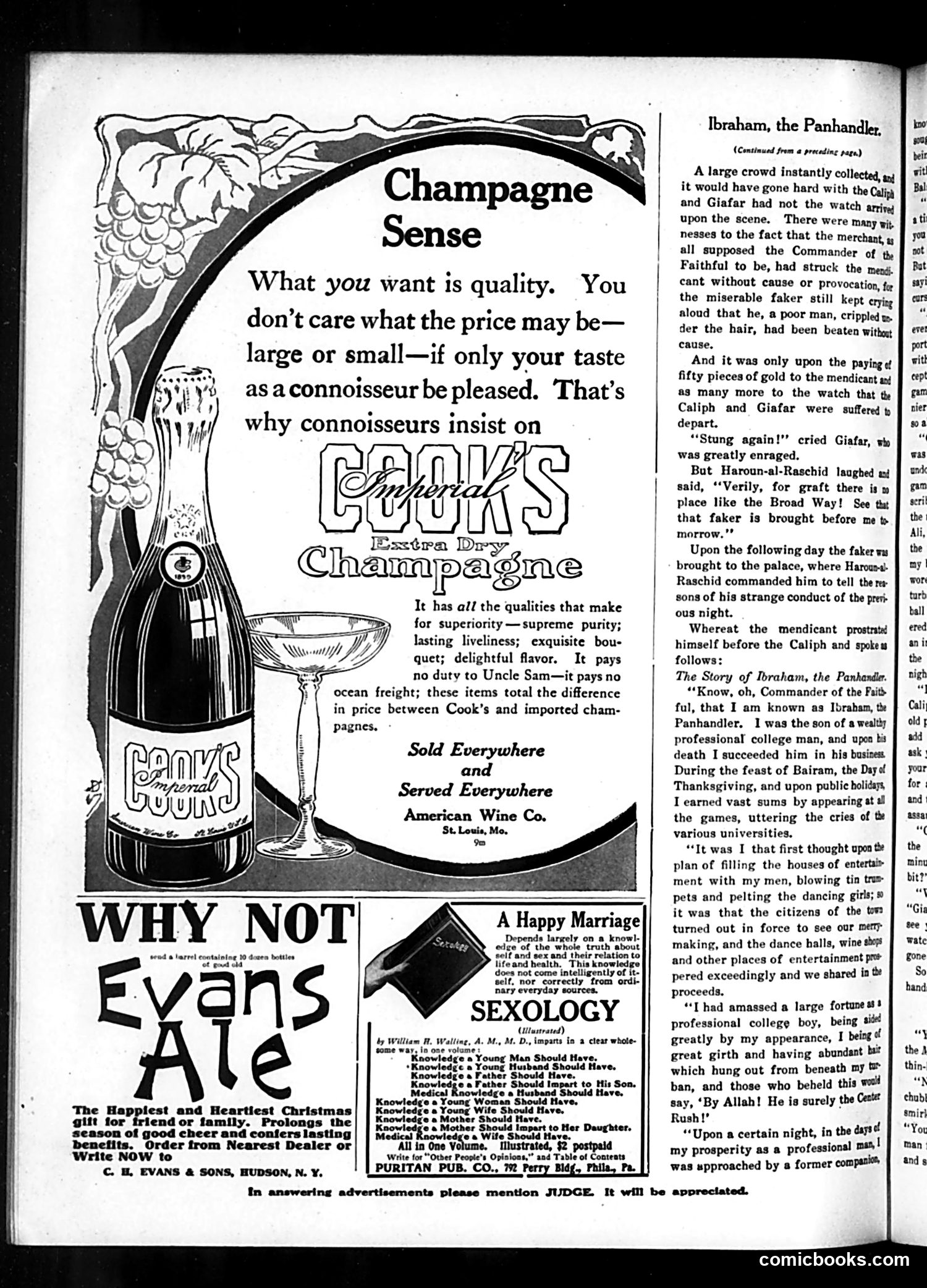
This page contains two distinct elements: **Left side:** A full-page advertisement for Cook's Extra Dry Champagne, emphasizing quality over price. It appeals to connoisseurs and claims American-made champagne equals imported versions without import duties or shipping costs. **Right side:** A serialized story titled "Ibraham, the Panhandler" (continuing from a previous issue). The narrative is a satirical frame story set in Baghdad under Caliph Haroun-al-Raschid, following a panhandler's encounters. The satire appears to reference contemporary American graft and urban schemes—the character mentions "the Broad Way" (Broadway) and running schemes at entertainment venues. The story uses this Middle Eastern setting to satirize modern American con-artists and corruption, a common Judge magazine technique for social commentary. The page also includes small advertisements for marital advice books and other products typical of early 20th-century magazine content.
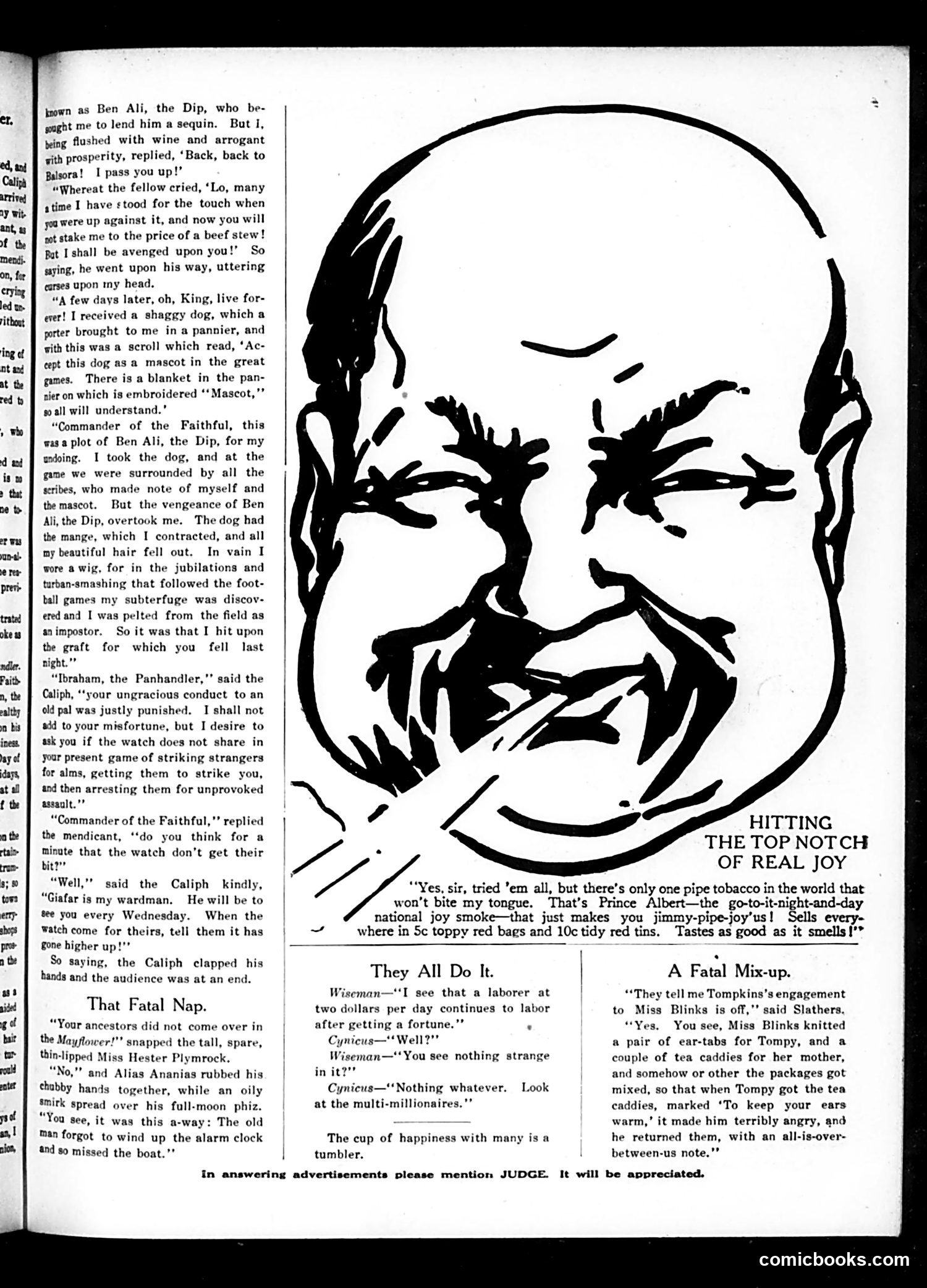
This page contains multiple satirical pieces typical of the publication: **Main Narrative ("That Fatal Nap"):** A comedic tale mocking pretentious genealogy. Miss Hester Plymrock snobbishly boasts her ancestors came on the Mayflower, only to learn her interlocutor's ancestors missed the boat because someone forgot to wind an alarm clock. The joke deflates American snobbery about colonial ancestry by suggesting pure chance, not virtue, determined who arrived. **Supporting Jokes:** Brief satirical vignettes on labor exploitation ("They All Do It"—wealthy and poor alike pursue money obsessively) and romantic mishaps ("A Fatal Mix-up"—a packaging error ruins an engagement). **Advertisement:** A substantial tobacco advertisement for Prince Albert pipe tobacco dominates the right column, typical of Judge's revenue model. The overall tone is genteel humor targeting American social pretensions and class consciousness during the early 20th century.
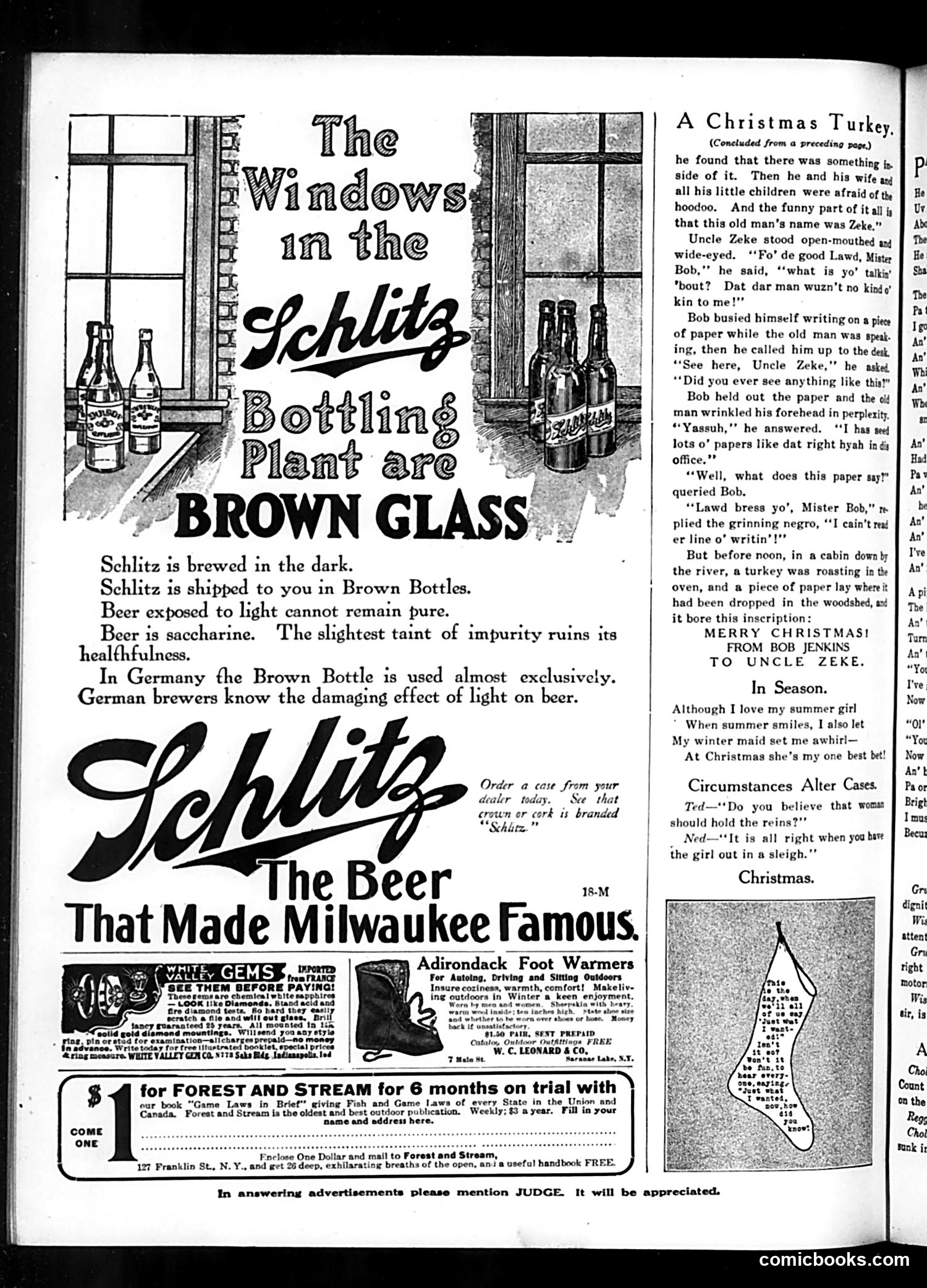
This is primarily a **beer advertisement**, not political satire. The Schlitz brewery uses pseudo-scientific claims to market brown bottles: beer exposed to light becomes impure, so brown glass protects the product's "healthfulness." The ad invokes German brewing authority ("In Germany the Brown Bottle is used almost exclusively") to establish credibility. The page also contains a sentimental short story titled "A Christmas Turkey" about a white man (Bob Jenkins) who leaves a handwritten note for an elderly Black man (Uncle Zeke) as a Christmas gift. The story's appeal lies in depicting interracial kindness during the holiday season—a theme common in turn-of-the-century popular magazines. The remaining content consists of unrelated product advertisements (foot warmers, gems, a hunting/fishing magazine subscription).
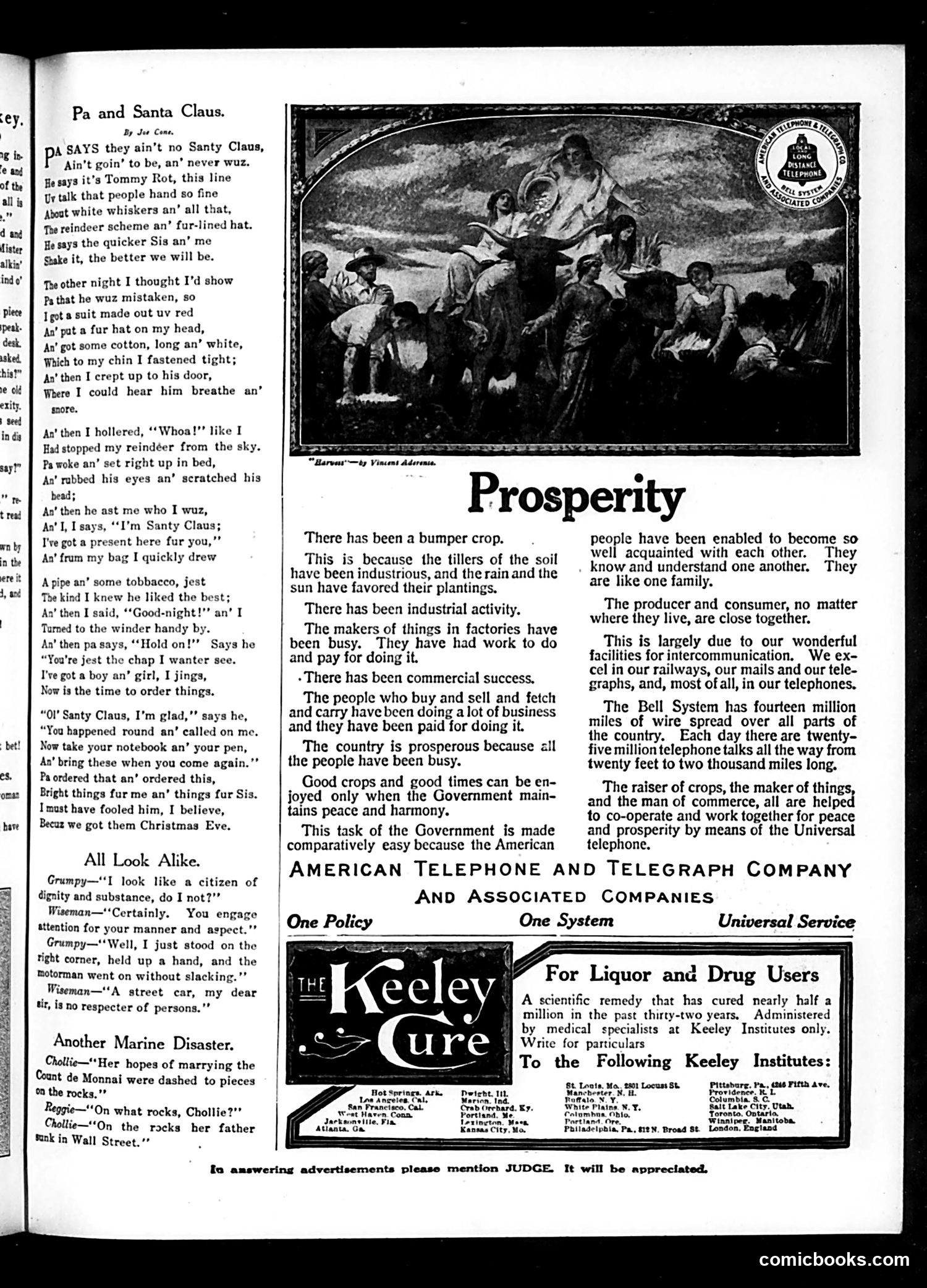
This Judge magazine page contains three distinct elements: **"Pa and Santa Claus"** (left column): A humorous poem by Joe Cone about a skeptical father who disbelieves in Santa Claus. A child tricks him by dressing as Santa and delivering a pipe and tobacco. The joke's payoff: the father is so fooled he immediately orders Christmas presents, inadvertently proving Santa's magic works. **"Prosperity"** (center): An AT&T advertisement masquerading as editorial content. It credits American prosperity to industrial activity, commerce, and good times—attributable to the telephone system enabling nationwide communication and cooperation. This is corporate propaganda presenting telephonic infrastructure as essential to national harmony and economic success. **"All Look Alike"** and **"Another Marine Disaster"**: Brief humorous exchanges about appearance and social class distinctions. **"The Keeley Cure"** (bottom): An advertisement for addiction treatment services. The page exemplifies Judge's mix of satire, humor, and advertising—typical of early 20th-century American magazines blending editorial and commercial content.
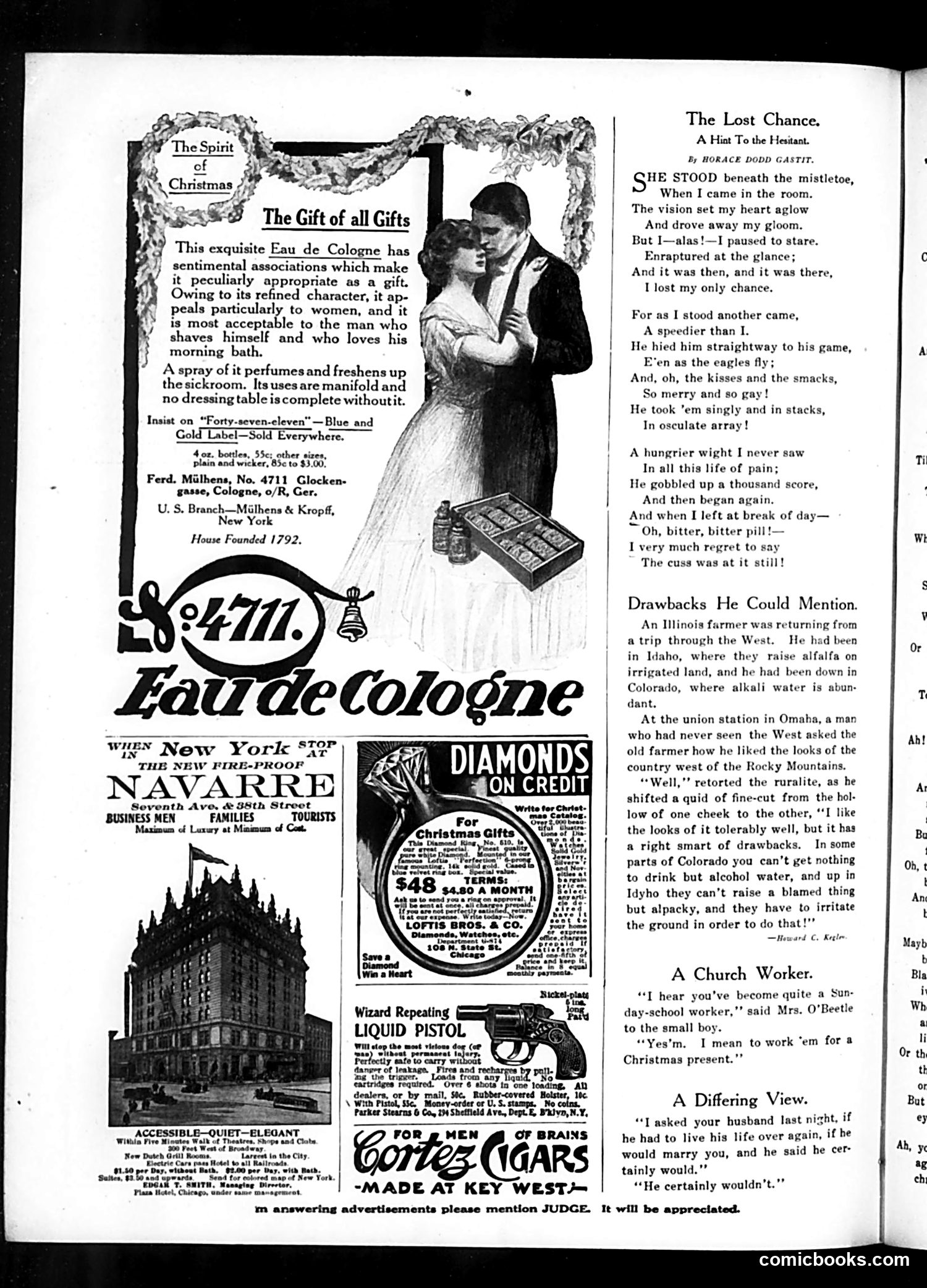
This page is primarily **advertisements and light humor pieces** rather than political satire. The main content includes: **Advertisements:** Eau de Cologne (4711 brand), the Navarre Hotel in New York, a "Wizard Repeating Liquid Pistol" toy, diamonds on credit, and Cortez cigars. **Humor pieces:** - "The Lost Chance" (poem): A man hesitates under mistletoe while a bolder rival kisses a woman—a common romantic trope playing on regret and missed opportunity - "Drawbacks He Could Mention": A farmer's comedic complaints about the American West (alkali water in Colorado, alfalfa/irrigation needs in Idaho)—gentle regional humor - "A Church Worker" and "A Differing View": Brief jokes about a boy working Sunday school for Christmas gifts and a marriage disagreement **Context:** This reflects early 20th-century American magazine humor—largely situational comedy about courtship, regional stereotypes, and domestic life, with no apparent political content. The ads target middle-class readers with consumer goods and travel.
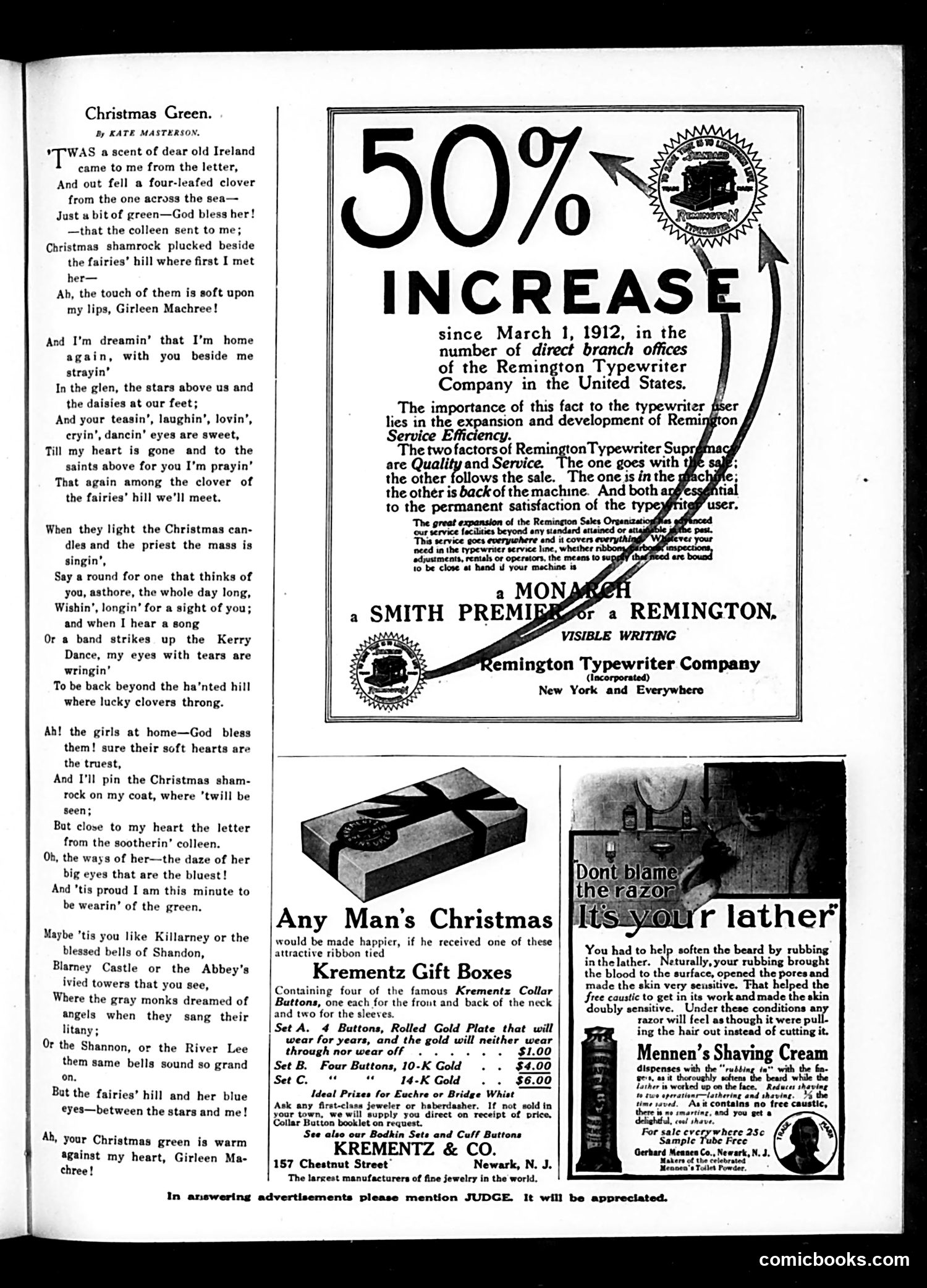
This page mixes nostalgic Irish-American sentiment with early 1900s advertising. **"Christmas Green" Poem**: A sentimental verse by Kate Masterson about an Irish immigrant longing for home. The speaker receives a shamrock and letter from Ireland, dreaming of return while wearing "the green" (Irish identity symbol). References to Irish geography (Killarney, Shandon, River Lee) and Catholic imagery anchor the immigrant experience. The tone celebrates Irish-American identity and romantic attachment to the homeland—typical of Judge's era appeals to Irish readers. **Remington Typewriter Advertisement**: Claims a 50% increase in branch offices since 1912, emphasizing "Quality and Service." This reflects early-20th-century business expansion and the typewriter's importance in modern office work. **Krementz Gift Boxes & Mennen's Shaving Cream**: Standard period advertising for luxury goods and grooming products. The page illustrates Judge's dual audience: nostalgic Irish-American immigrants and urban professionals—both targeted through sentiment and consumerism.
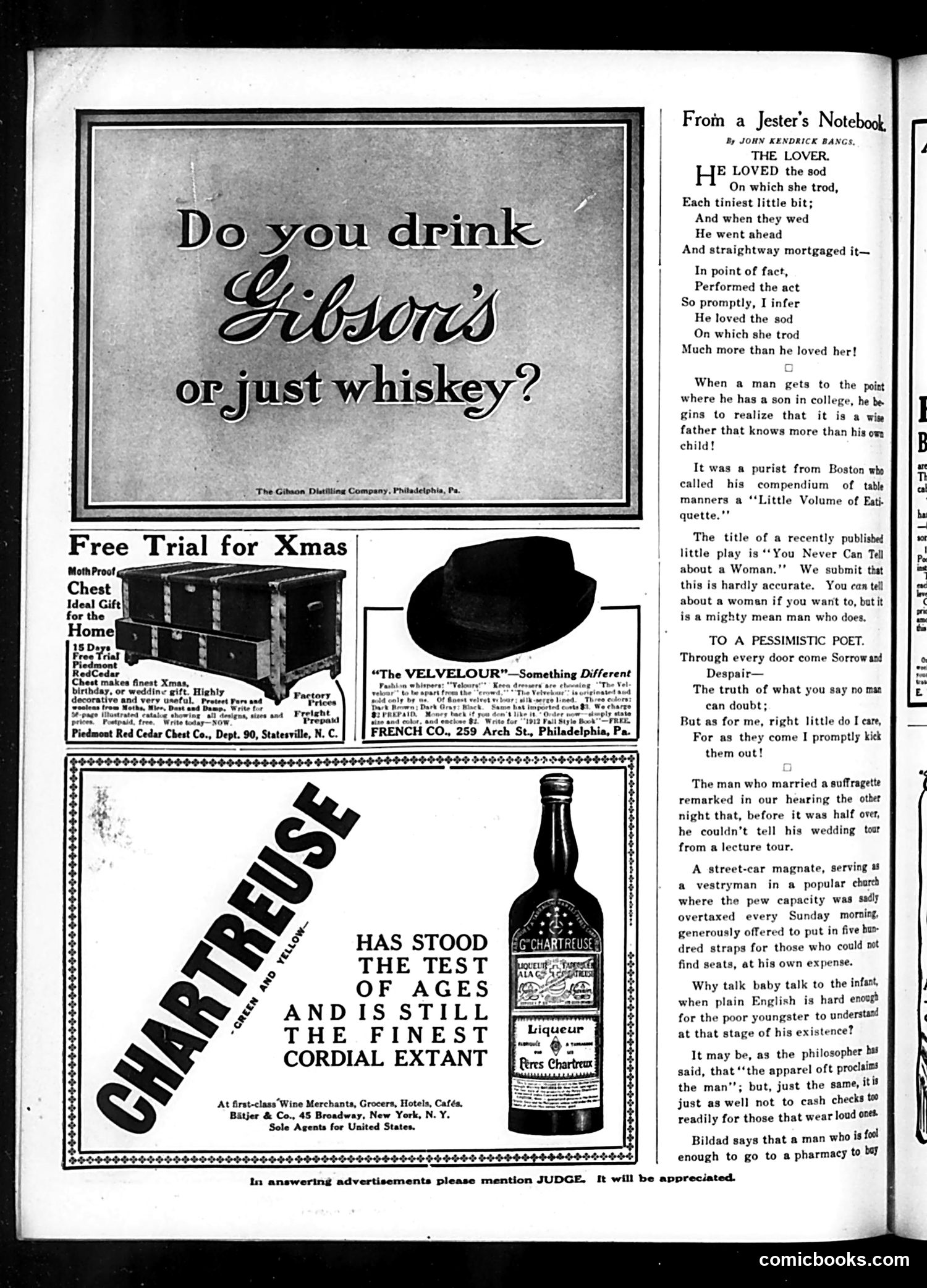
This page combines humorous poetry and social commentary with period advertisements. The main content is John Kendrick Bangs' "From a Jester's Notebook," featuring satirical observations about contemporary society. **Key satirical pieces:** - "The Lover" mocks newlyweds who immediately mortgage property—suggesting the husband loves the land more than his bride - "To a Pessimistic Poet" advises embracing optimism by literally kicking out sorrow and despair - Various quips target: college-educated sons outthinking parents, Boston pretension, women's unpredictability, and suffragettes (husbands comparing wedding tours to lecture circuits) **Social context:** These jokes reflect early 20th-century attitudes—skepticism toward women's rights activism, anxiety about generational knowledge gaps, and class consciousness. **Advertisements** occupy significant space: Gibson's whiskey, a steamer trunk, Chartreuse cordial, and a cedar chest—typical luxury goods for affluent Judge readers. The page is primarily entertainment and advertising rather than political cartooning; the satire targets manners and social pretension rather than specific political figures or events.
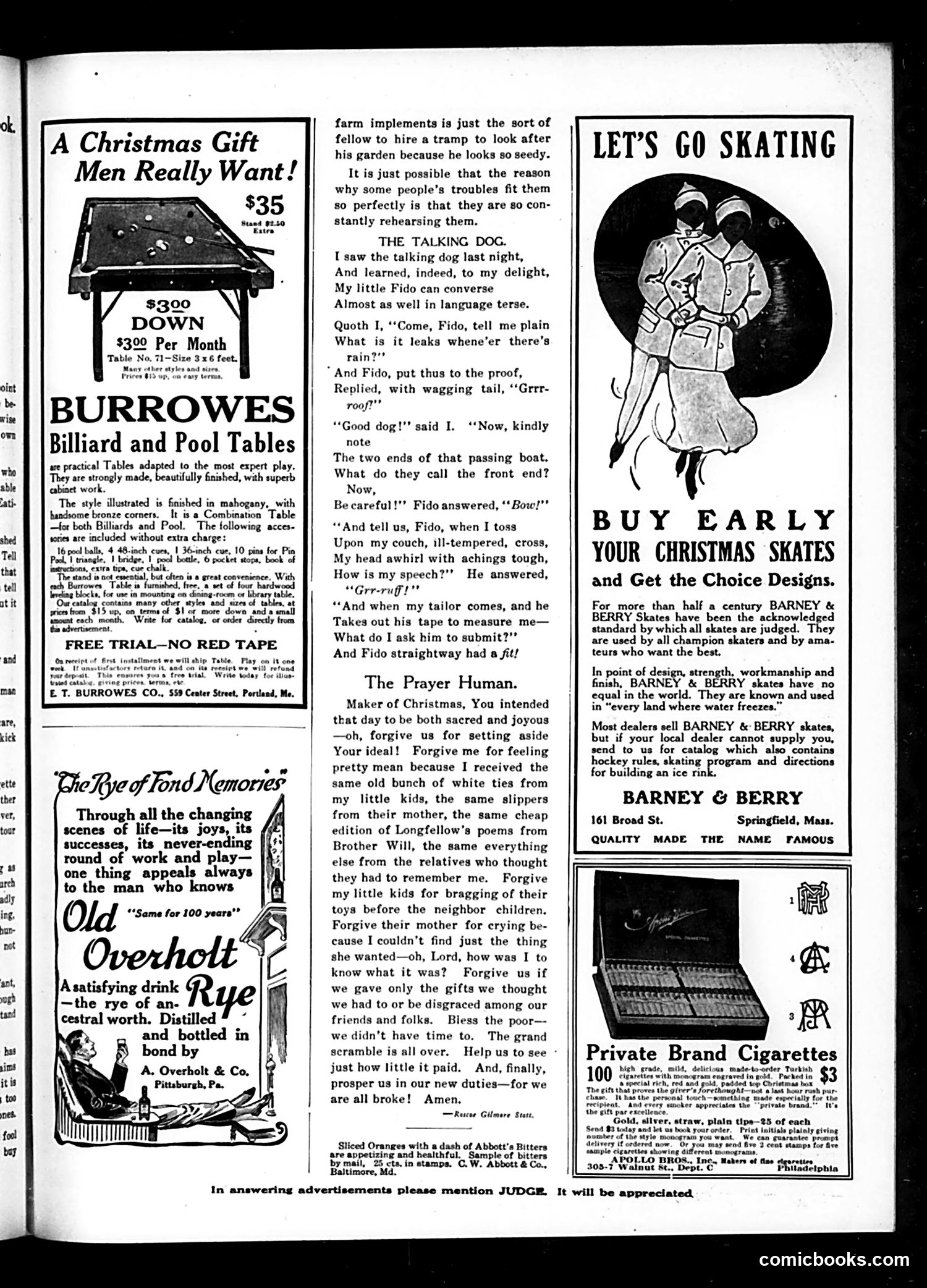
This is primarily an **advertising page** from Judge magazine, featuring Christmas gift promotions rather than political satire. The main content includes: 1. **Billiard/Pool Table Ad** - promoting a Burrowes combination table as an ideal Christmas gift for men, with financing options ($300 down, $300/month) 2. **"The Talking Dog"** - a humorous poem about a dog that answers questions through puns (e.g., "roof" for leaks, "bow" for boat front, etc.). This is lighthearted wordplay rather than satire. 3. **"The Prayer Human"** - a satirical religious piece criticizing materialist Christmas excess, complaining about receiving cheap gifts (ties, slippers, Longfellow editions) and the commercialization overshadowing the holiday's sacred meaning. The speaker confesses to feeling "pretty mean" and laments that Christmas has become a financial scramble leaving people "all broke." 4. **Ice Skates Advertisement** - Barney & Berry brand promotion The page reflects early 20th-century consumer culture and holiday commercialization concerns—themes still relevant today.
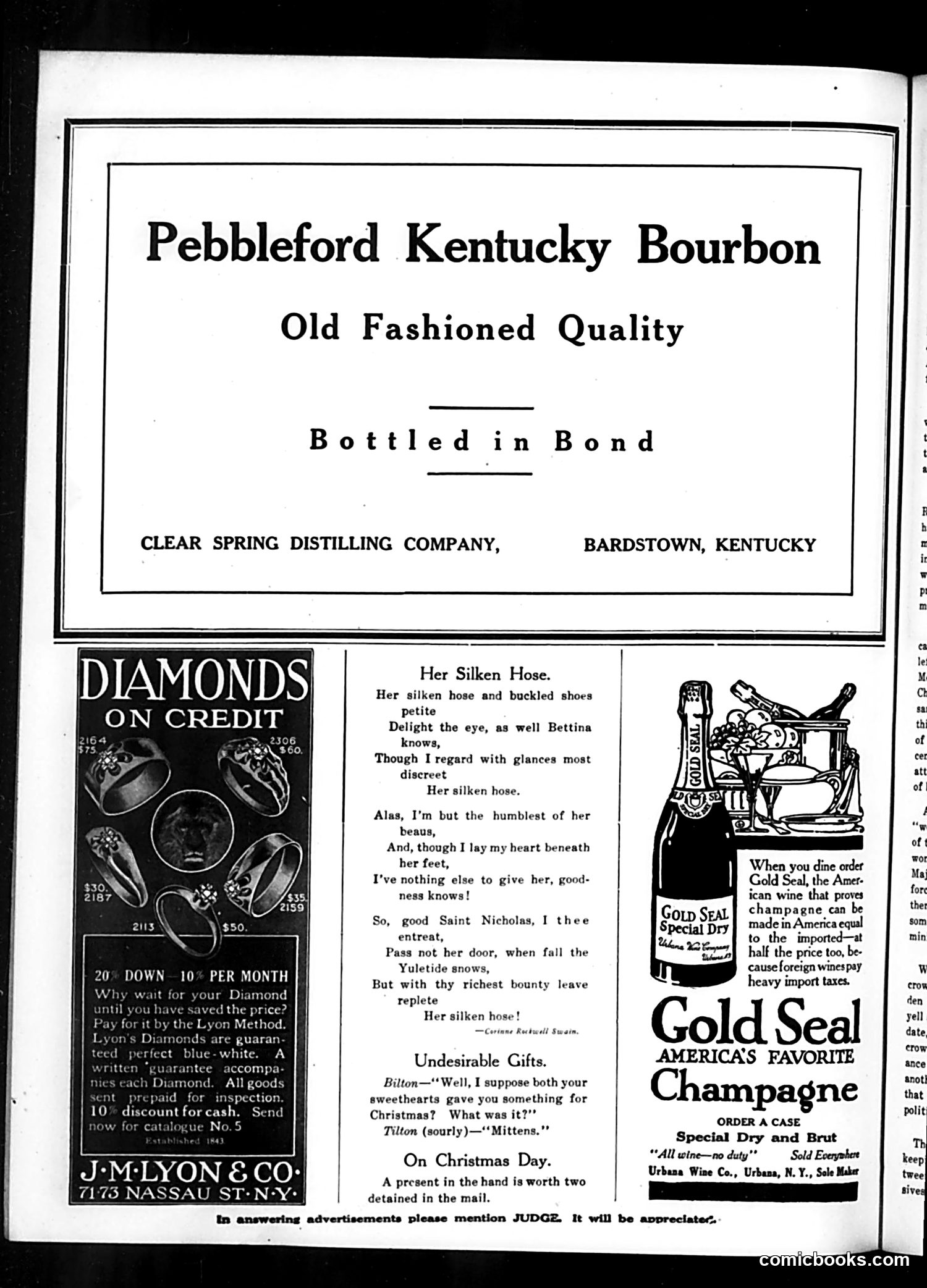
This is primarily an **advertising page** rather than satirical editorial content. The page features: 1. **Pebbleford Kentucky Bourbon advertisement** (top) — promoting whiskey "bottled in bond," a federal guarantee of authenticity and proof. 2. **Three commercial ads** for luxury goods and wine: - J.M. Lyon & Co. diamonds (installment plan: "20° down, 10% per month") - Gold Seal American champagne (emphasizing domestic quality and tax advantages over imports) 3. **Two brief humorous pieces** that are **light social satire**: - "Her Silken Hose" — a romantic poem about a suitor admiring a woman's stockings, appealing to Saint Nicholas (Christmas) for gift-giving inspiration - "Undesirable Gifts" — a joke where one character complains his sweetheart gave him mittens (practical, unromantic) The page targets **affluent readers** with luxury purchasing options while the humor gently mocks Christmas gift-giving conventions and romantic aspirations. The satire is gentle and commercial rather than political.
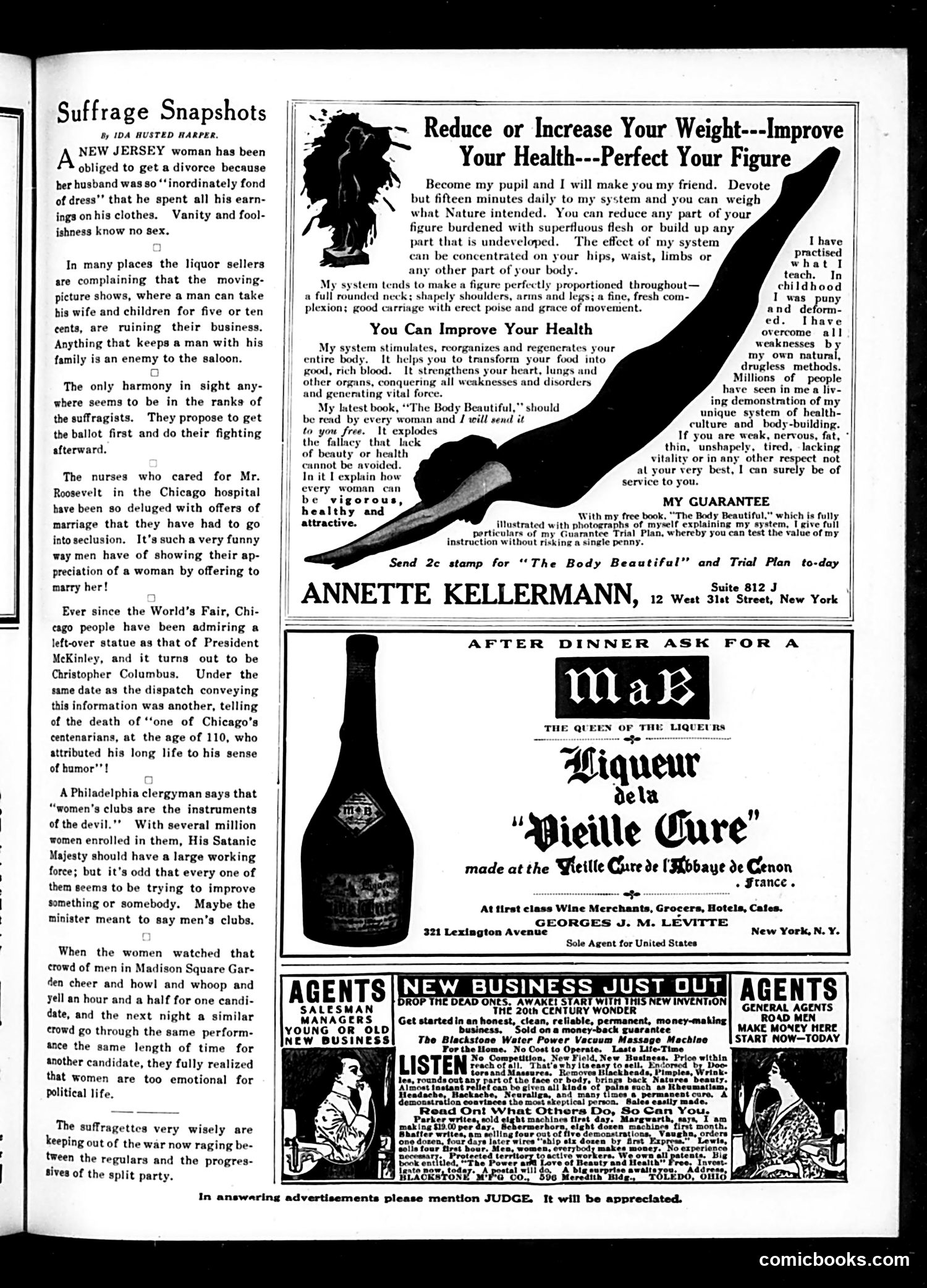
This page mixes satirical commentary on women's suffrage with period advertisements. The "Suffrage Snapshots" column by Ida Husted Harper presents brief anecdotes defending women's rights and intelligence through humor. Key satire points: - **The divorce story** mocks male vanity, suggesting foolishness "knows no sex" - **Moving pictures vs. saloons**: sarcastically notes that keeping families together threatens liquor sellers - **Nurses and marriage proposals**: ridicules men's crude way of "appreciating" women - **Chicago's Columbus statue confusion and centenarian's longevity**: mocks male incompetence and illogic - **Women's clubs as "instruments of the devil"**: inverts the clergyman's claim by noting women actually improve things - **The Madison Square Garden crowd**: sarcastically suggests women observing emotional male political behavior proves women too emotional for politics—reversing the actual observation The column uses irony to argue women are rational, improvement-oriented, and deserve political participation. The adjacent advertisements (weight reduction, liqueur) are typical period commerce, unrelated to the satire.
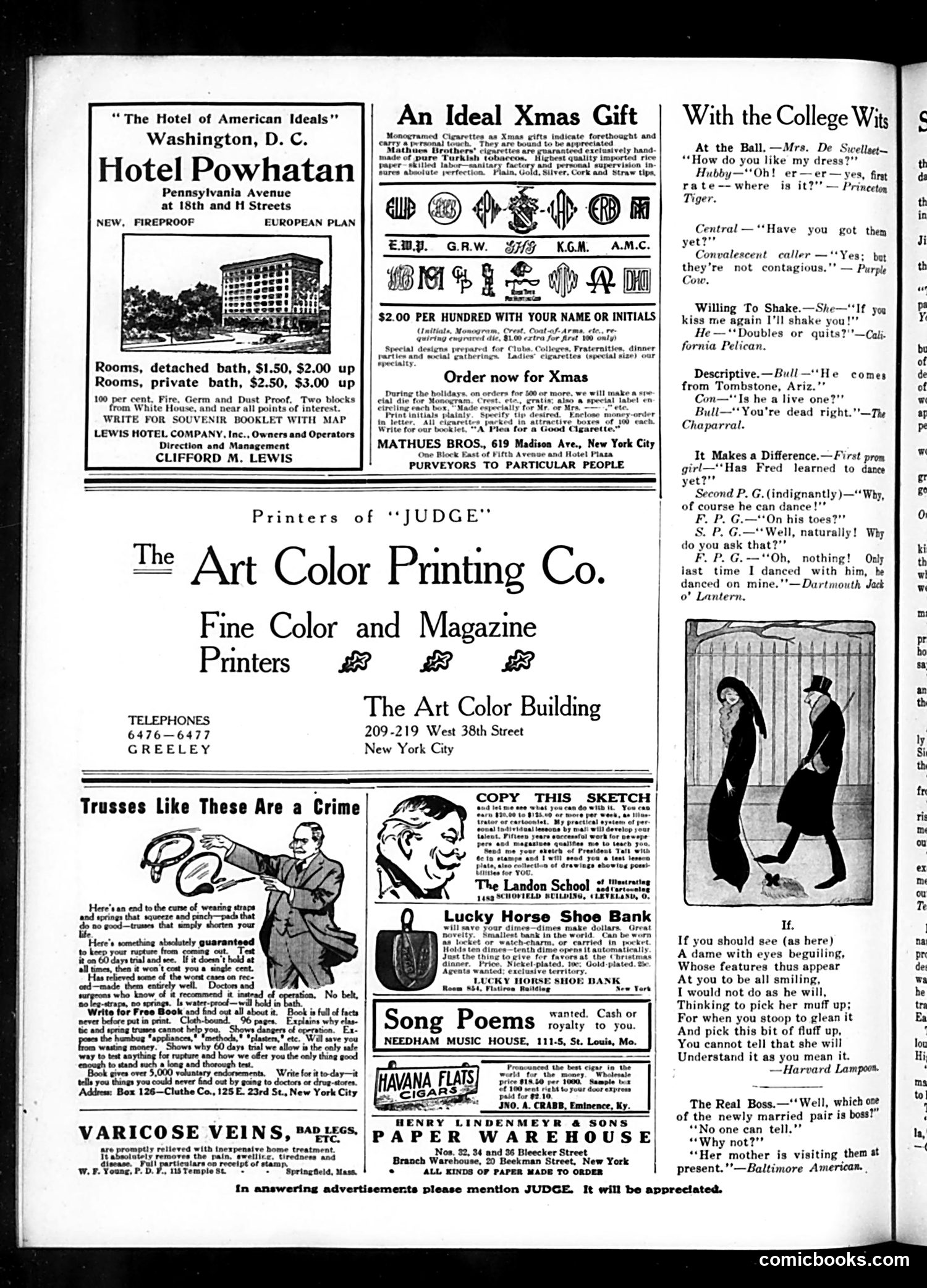
This page is primarily **advertisements with comic snippets** rather than a sustained political cartoon. The main content consists of: 1. **Hotel and commercial ads** (Powhatan Hotel, Art Color Printing, cigarettes, trusses, music lessons) 2. **"With the College Wits"** — a collection of brief jokes about courtship and marriage, drawn from college humor magazines (Princeton Tiger, California Pelican, Dartmouth Jack o'Lantern, Harvard Lampoon). These mock-naive exchanges satirize young romance — husbands who don't compliment wives' dresses, awkward dancing, and the punchline about a new bride's mother visiting being the "real boss." The humor is gentle, domestic satire typical of early 20th-century Judge magazine — poking fun at newlyweds and dating rather than political figures. No specific identifiable public figures appear. The page reflects period attitudes about gender dynamics and courtship conventions without pushing serious political commentary.
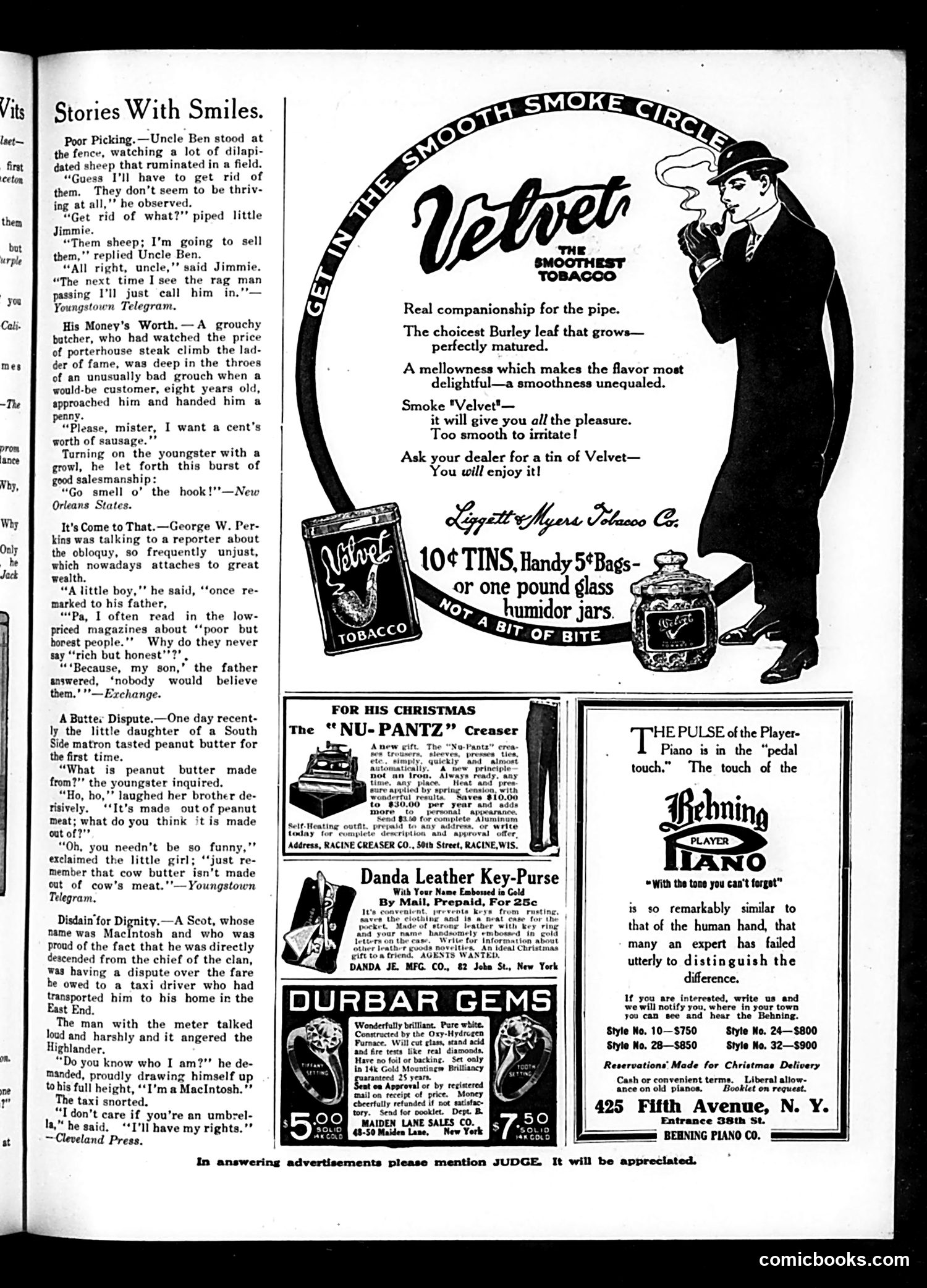
This page is primarily **advertising**, with humor stories as secondary content. The "Stories With Smiles" section presents brief, genteel anecdotes with predictable punchlines—a child confuses sheep with rags, a cynic notes nobody believes the phrase "rich but honest," a girl logically questions peanut butter's origins. These are wholesome, family-friendly jokes typical of early 20th-century publications. The advertisements dominate: **Velvet tobacco** (emphasizing smoothness), a "Nu-Pantz" creaser for Christmas gifts, a Danda leather key-purse, Durbar gems, and a Behning player piano. The piano ad notes its "pedal touch" mimics human hands—appealing to early 20th-century piano enthusiasts. **No political satire is present.** The page represents Judge's shift toward mainstream advertising revenue, with mild humor serving as filler content rather than the sharp social commentary the magazine once offered.
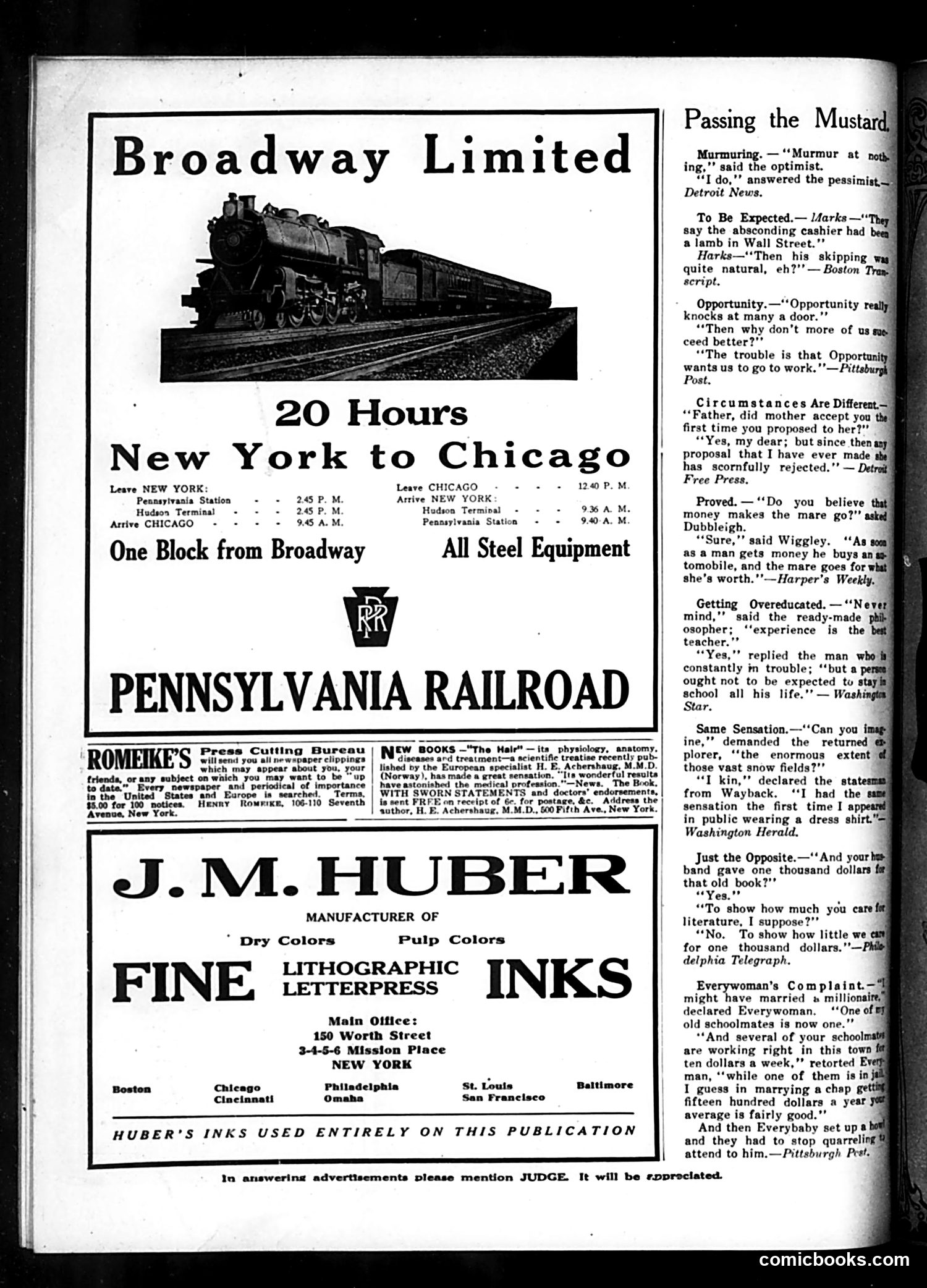
This page is primarily **advertising**, featuring a prominent Pennsylvania Railroad advertisement for the "Broadway Limited" train service (New York to Chicago in 20 hours). The ad emphasizes modern "All Steel Equipment" and convenient departure points "One Block from Broadway." The right column contains **humorous short jokes** typical of Judge magazine's satirical content—brief exchanges on topics like optimism, Wall Street scandals, opportunity, wealth and materialism, education, and marriage. These are mild social commentary rather than political cartoons, poking gentle fun at human nature and contemporary attitudes (the absconding cashier joke references Wall Street fraud concerns of the era). The remaining space is filled with **service advertisements** for Romeike's Press Cutting Bureau (newspaper clipping service), J.M. Huber's lithographic inks, and notices of new books. **No significant political cartoons or caricatures appear on this page**—it's essentially a commercial publication page with light comedy filler.
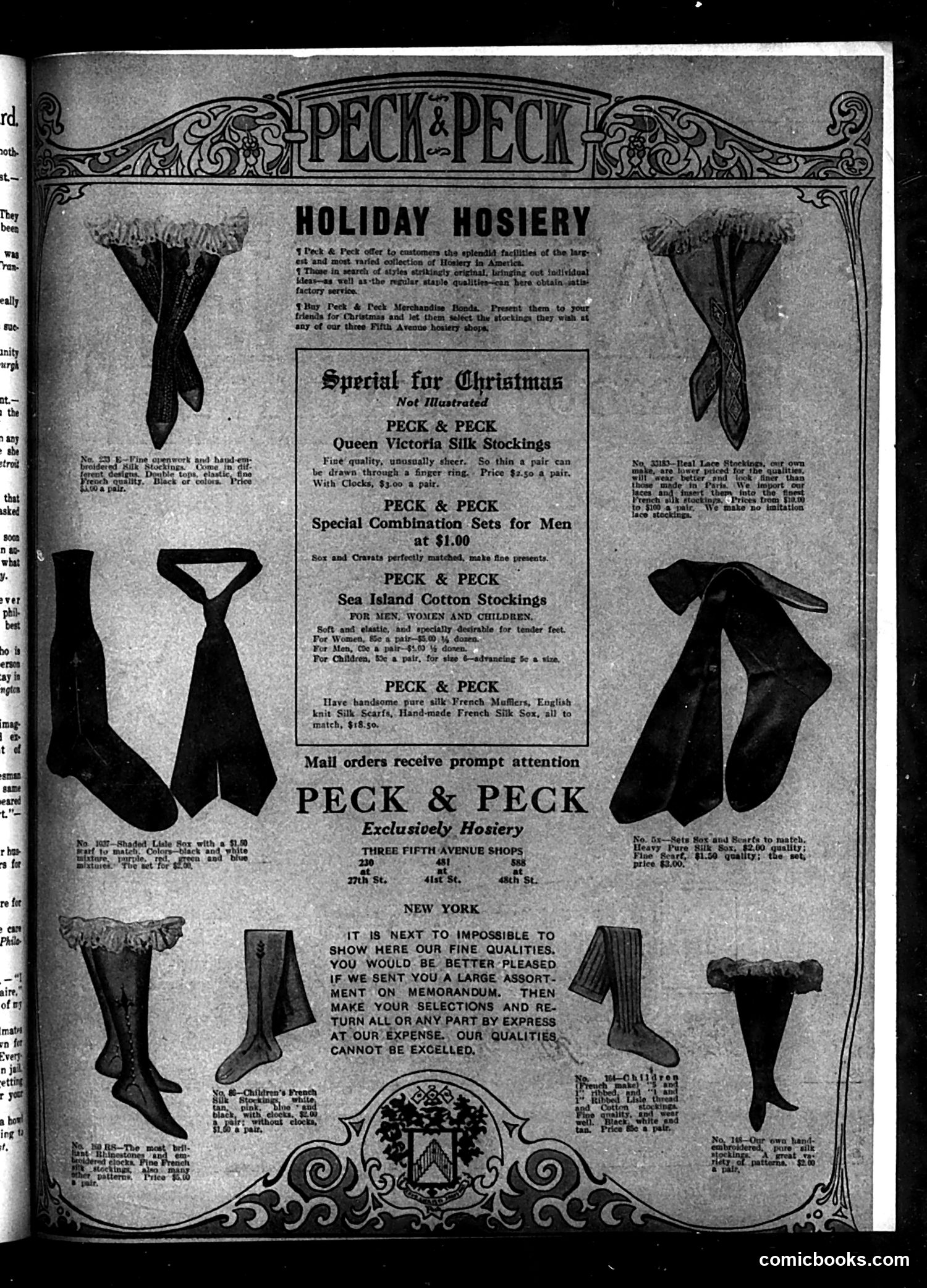
This page is **not a cartoon or satirical content** — it's a straightforward advertisement for Peck & Peck, a hosiery retailer with shops on Fifth Avenue in New York. The page showcases various stockings and socks for men, women, and children, with illustrations of different hosiery styles displayed on legs. Products include "Queen Victoria Silk Stockings," "Sea Island Cotton Stockings," and combination gift sets marketed for Christmas shopping. The decorative header and footer with ornamental designs are typical of period advertising aesthetics. The text emphasizes quality, variety, and customer service (including mail-order options and a liberal return policy). This appears in *Judge* magazine likely as a paid advertisement rather than editorial content. No political satire or social commentary is present — it's purely commercial.
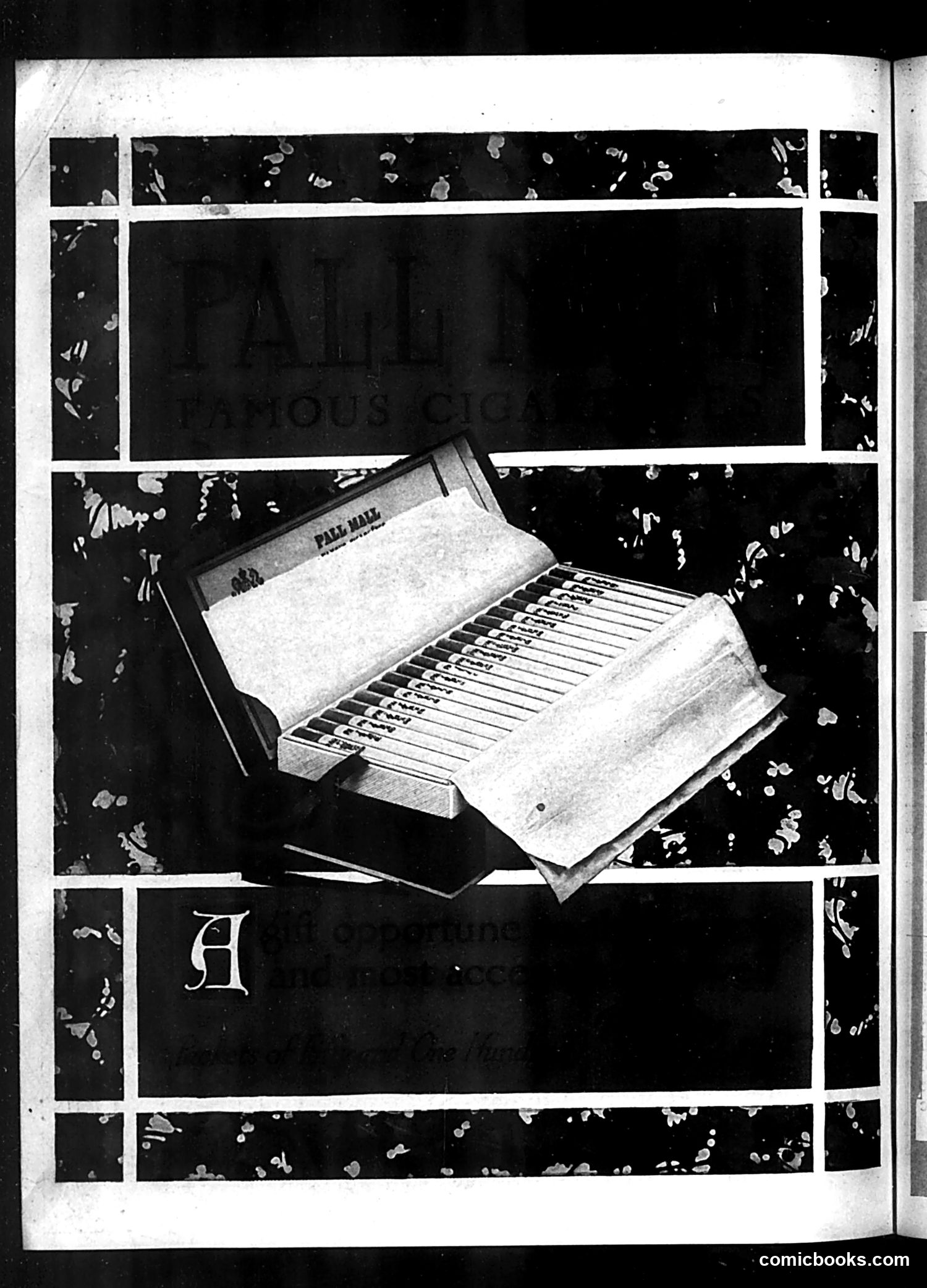
This appears to be a **product advertisement page** from Judge magazine rather than a political cartoon or satirical content. The page features a photograph of what looks like a **Palmtall accordion or similar musical instrument**, displayed open to show its keyboard and internal mechanism. The instrument is positioned at an angle against a decorative floral background. The layout includes blank or heavily darkened sections typical of vintage magazine pages, with ornamental borders framing the product. While the text mentions "comicbooks.com" at the bottom, this appears to be a modern archival notation rather than original magazine content. **No political figures, satire, or social commentary is evident** on this particular page. It's a straightforward product showcase.