
Judge, 1912-12-07 · page 7 of 44
Judge — December 7, 1912 — page 7: what you’re looking at
What you’re looking at
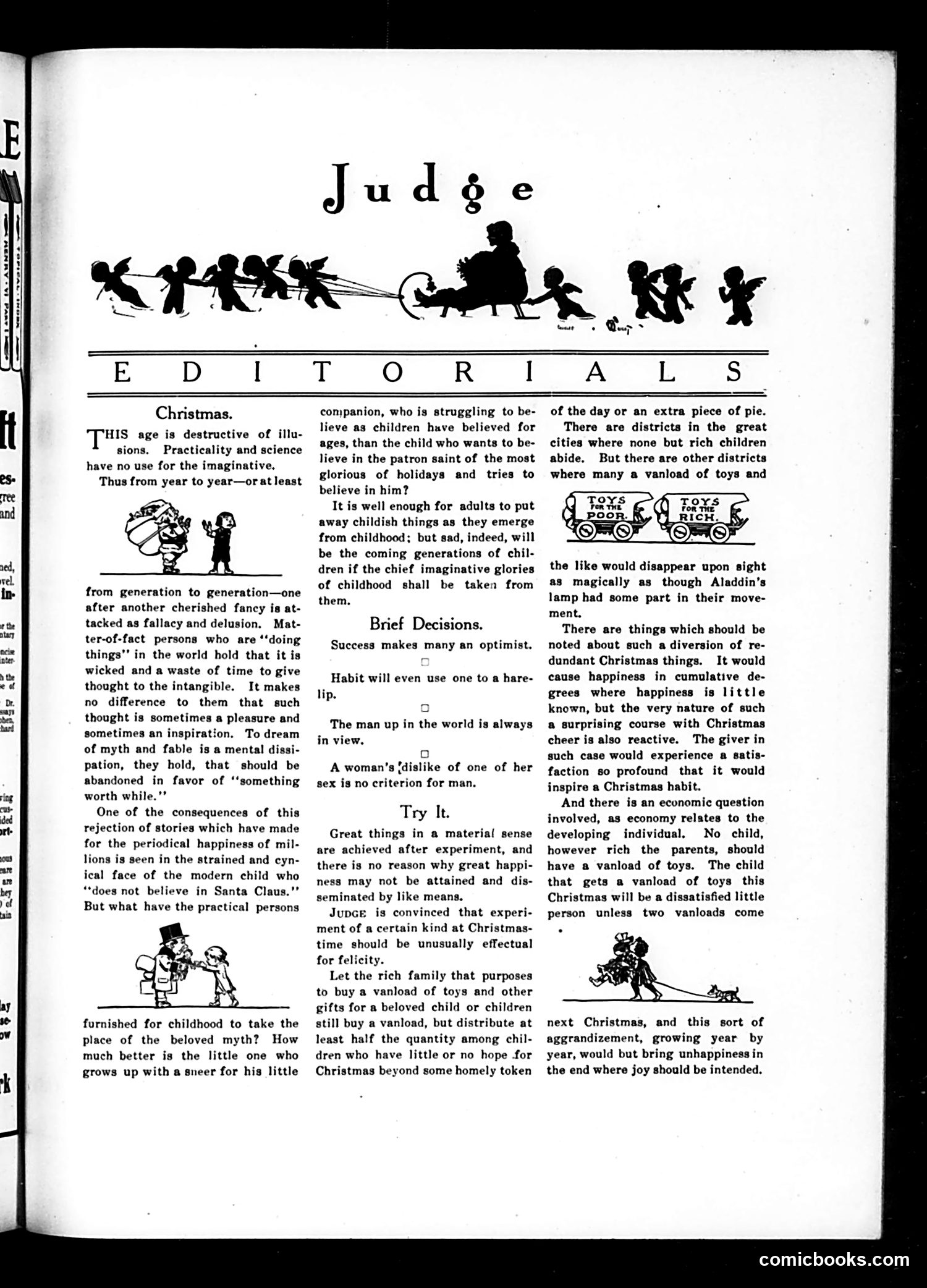
This page critiques modernism's rejection of childhood imagination. The editorial laments that practical, science-minded adults mock Santa Claus and fairy tales as wasteful delusion, leaving children cynical rather than wonder-filled. The satire targets two problems: First, the loss of imaginative joy in childhood. Second, wealthy families' excessive toy-buying creates unsustainable expectations and materialism rather than genuine happiness. Judge proposes an experiment: rich families should distribute half their toy vanloads to poor children in city districts where Christmas means only "a homely token" or pie. This benefits poor children materially while giving wealthy givers profound satisfaction—creating a sustainable "Christmas habit" of generosity. The editorial criticizes both soulless practicality *and* conspicuous consumption, advocating instead for imagination preserved *and* wealth redistributed.
📄 Transcribed text from this page (OCR, searchable)
Machine-transcribed from the original scan — historical spelling and the odd misread are preserved.
JSad PER Ba. Christmas. HIS age is destructive of illu- sions. Practicality and science have no use for the imaginative. Thus from year to year—or at least from generation to generation—one after another cherished fancy is at- tacked as fallacy and delusion. Mat- ter-of-fact persons who are ‘‘doing things’’ in the world hold that it is wicked and a waste of time to give thought to the intangible. It makes no difference to them that such thought is sometimes a pleasure and sometimes an inspiration. To dream of myth and fable is a mental dissi- pation, they hold, that should be abandoned in favor of ‘‘something worth while.’” One of the consequences of this rejection of stories which have made for the periodical happiness of mil- lions is seen in the strained and cyn- ical face of the modern child who “does not believe in Santa Claus.’’ But what have the practical persons furnished for childhood to take the place of the beloved myth? How much better is the little one who grows up with a sneer for his little O R companion, who is struggling to be- lieve as children huve believed for ages, than the child who wants to be- lieve in the patron saint of the most glorious of holidays and tries to believe in him? It is well enough for adults to put away childish things as they emerge from childhood; but sad, indeed, will be the coming generations of chil- dren if the chief imaginative glories of childhood shall be taken from them. Brief Decisions. Success makes many an optimist. Habit will even use one to a hare- lip. The man up in the world is always in view. Oo A woman's (dislike of one of her sex is no criterion for man. Try It. Great things in a material sense are achieved after experiment, and there is no reason why great happi- ness may not be attained and dis- seminated by like means, Jupce is convinced that experi- ment of a certain kind at Christmas- time should be unusually effectual for felicity. Let the rich family that purposes to buy a vanload of toys and other gifts for a beloved child or children still buy a vanload, but distribute at least half the quantity among chil- dren who have little or no hope for Christmas beyond some homely token TOS) of the day or an extra piece of pie. There are districts in the great cities where none but rich children abide. But there are other districts where many a vanload of toys and the like would disappear upon sight as magically as though Aladdin's lamp had some part in their move- ment, There are things which should be noted about such a diversion of re- dundant Christmas things. It would cause happiness in cumulative de- grees where happiness is little known, but the very nature of such a surprising course with Christmas cheer is also reactive. The giver in such case would experience a satis- faction so profound that it would inspire a Christmas habit. And there is an economic question involved, as economy relates to the developing individual, No child, however rich the parents, should have a vanload of toys. The child that gets a vanload of toys this Christmas will be a dissatisfied little person unless two vanloads come next Christmas, and this sort of aggrandizement, growing year by year, would but bring unhappiness in the end where joy should be intended. comicbooks.com