
Judge, 1912-12-07 · page 15 of 44
Judge — December 7, 1912 — page 15: what you’re looking at
What you’re looking at
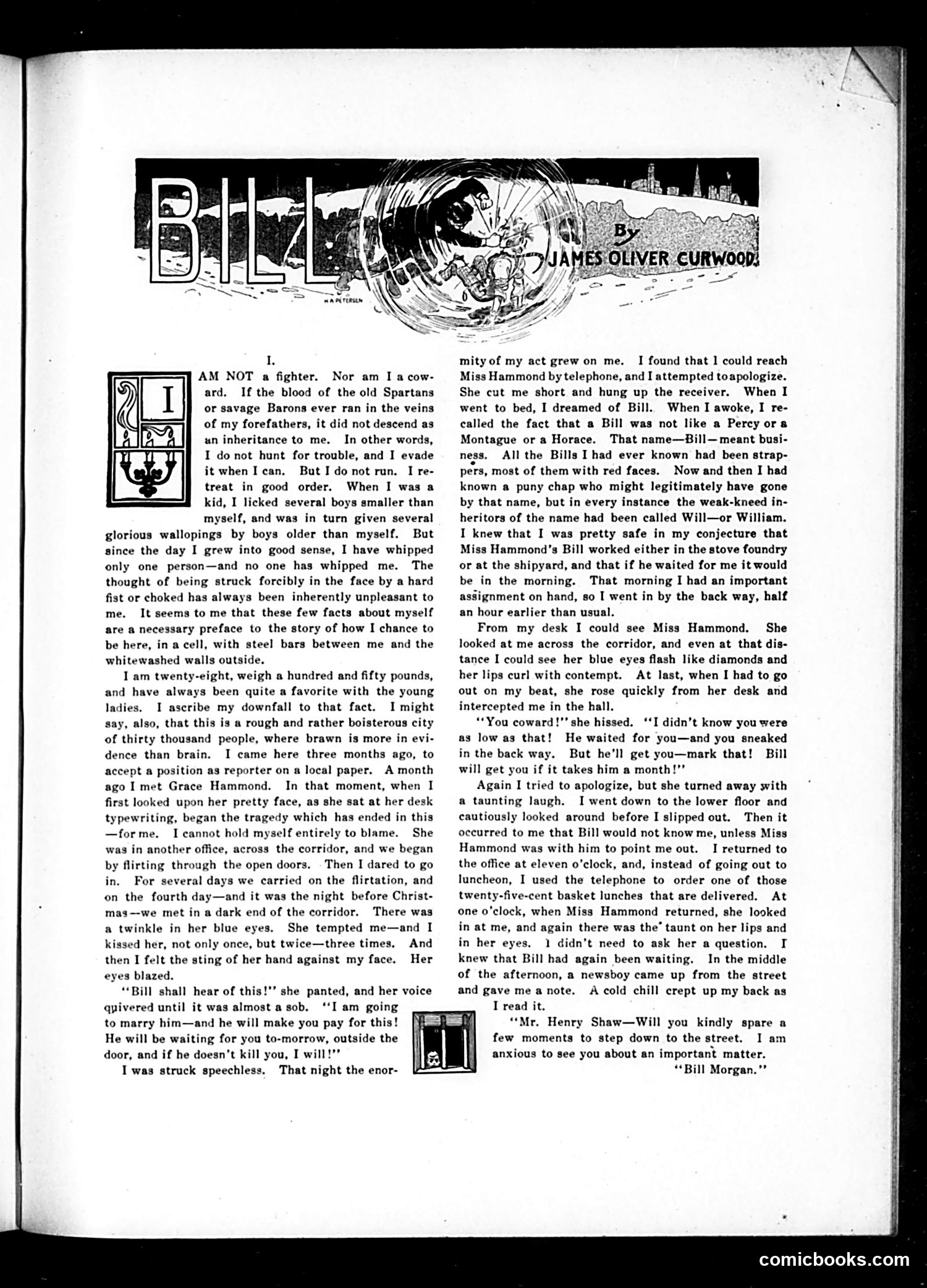
This page opens a serialized short story titled "Blitz," not a political cartoon. The narrative is a romantic comedy about a newspaper reporter who kisses Grace Hammond—a coworker—and then learns she's engaged to a man named "Bill," whom the narrator stereotypes as a rough, working-class type (likely a foundry or shipyard worker, given the era). The joke is class-based: the narrator, an educated journalist, assumes "Bill" is a dangerous brute because of his working-class name and occupation, contrasting with fancier names like "Percy" or "Montague." The narrator's cowardice—sneaking in the back way to avoid Bill the next morning—sets up comedic conflict. The story reflects early 20th-century anxieties about class differences and masculine competition over women, treated here with satirical humor rather than genuine menace.
📄 Transcribed text from this page (OCR, searchable)
Machine-transcribed from the original scan — historical spelling and the odd misread are preserved.
I, AM NOT a fighter. Nor am I acow- ard. If the blood of the old Spartans or savage Barons ever ran in the veins of my forefathers, it did not descend as un inheritance to me. In other words, I do not hunt for trouble, and I evade it when Ican. But I do not run. I re- treat in good order. When I was a kid, I licked several boys smaller than myself, and was in turn given several glorious wallopings by boys older than myself. But since the day I grew into good sense, I have whipped only one person—and no one has whipped me. The thought of being struck forcibly in the face by a hard fist or choked has always been inherently unpleasant to me. It seems to me that these few facts about myself are a necessary preface to the story of how I chance to be here, in a cell, with steel bars between me and the whitewashed walls outside. I am twenty-eight, weigh a hundred and fifty pounds, and have always been quite a favorite with the young ladies. I ascribe my downfall to that fact. I might say, also, that this is a rough and rather boisterous city of thirty thousand people, where brawn is more in evi- dence than brain. I came here three months ago, to accept a position as reporter on a local paper. A month ago I met Grace Hammond. In that moment, when I first looked upon her pretty face, as she sat at her desk typewriting, began the tragedy which has ended in this —forme. I cannot hold myself entirely to blame. She was in another office, across the corridor, and we began by flirting through the open doors. Then I dared to go in. For several days we carried on the flirtation, and on the fourth day—and it was the night before Christ- mas—we met in a dark end of the corridor. There was a twinkle in her blue eyes. She tempted me—and I kissed her, not only once, but twice—three times. And then I felt the sting of her hand against my face. Her eyes blazed. ‘*Bill shall hear of this!'’ she panted, and her voice quivered until it was almost a sob. ‘‘I am going to marry him—and he will make you pay for this! He will be waiting for you to-morrow, outside the door, and if he doesn’t kill you, I will!’’ I was struck speechless. That night the enor- mity of my act grew on me. I found that 1 could reach Miss Hammond by telephone, and I attempted to apologize. She cut me short and hung up the receiver. When I went to bed, I dreamed of Bill. When I awoke, I re- called the fact that a Bill was not like a Percy ora Montague or a Horace. That name—Bill—meant busi- ness. All the Bills I had ever known had been strap- pers, most of them with red faces. Now and then I had known a puny chap who might legitimately have gone by that name, but in every instance the weak-kneed in- heritors of the name had been called Will—or William. I knew that I was pretty safe in my conjecture that Miss Hammond's Bill worked either in the stove foundry or at the shipyard, and that if he waited for me it would be in the morning. That morning I had an important assignment on hand, so I went in by the back way, half an hour earlier than usual. From my desk I could see Miss Hammond. She looked at me across the corridor, and even at that dis- tance I could see her blue eyes flash like diamonds and her lips curl with contempt. At last, when I had to go out on my beat, she rose quickly from her desk and intercepted me in the hall. “You coward!"’ she hissed. ‘‘I didn’t know you were as low as that! He waited for you—and you sneaked in the back way. But he'll get you—mark that! Bill will get you if it takes him a month!"” Again I tried to apologize, but she turned away with a taunting laugh. I went down to the lower floor and cautiously looked around before I slipped out. Then it occurred to me that Bill would not know me, unless Miss Hammond was with him to point me out. I returned to the office at eleven o'clock, and, instead of going out to luncheon, I used the telephone to order one of those twenty-five-cent basket lunches that are delivered. At one o'clock, when Miss Hammond returned, she looked in at me, and again there was the’ taunt on her lips and in her eyes. 1 didn’t need to ask her a question. I knew that Bill had again been waiting. In the middle of the afternoon, a newsboy came up from the street and gave me a note. A cold chill crept up my back as I read it. “Mr. Henry Shaw—Will you kindly spare a few moments to step down to the street. I am anxious to see you about an important matter. **Bill Morgan.’" comicbooks.com