
Judge, 1912-12-07 · page 16 of 44
Judge — December 7, 1912 — page 16: what you’re looking at
What you’re looking at
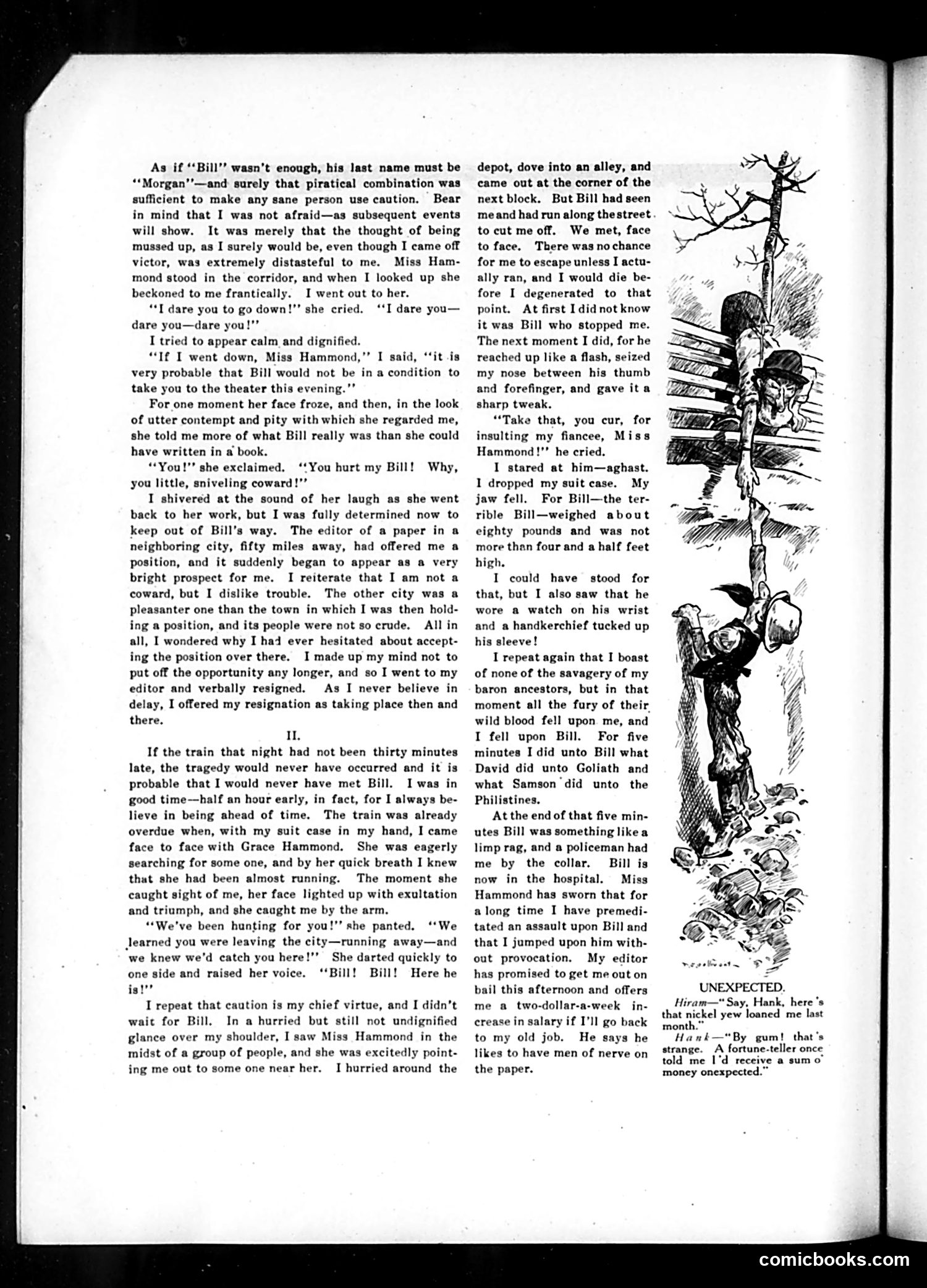
This page presents a serialized humorous story about a cowardly narrator who fears confrontation with "Bill Morgan," portrayed as a dangerous character. The joke's payoff comes at the climax: after the narrator spends considerable time anxiously avoiding this fearsome "Bill," he's finally confronted—only to discover Bill is a tiny man, weighing eighty pounds and standing four-and-a-half feet tall. The satire mocks masculine anxiety and social cowardice. The narrator's elaborate justifications for fleeing (concern about being "mussed up," accepting a job offer to avoid trouble) are undercut by the revelation that his nemesis is physically insignificant. Grace Hammond's contempt for the narrator's avoidance—calling him a "sniveling coward"—is validated when even her diminutive fiancé must resort to the childish nose-tweak. The accompanying illustration on the right depicts a dead tree with birds, likely symbolizing barrenness or consequence, thematically reinforcing the narrator's moral emptiness.
📄 Transcribed text from this page (OCR, searchable)
Machine-transcribed from the original scan — historical spelling and the odd misread are preserved.
As if ‘‘Bill’’ wasn't enough, his last name must be ‘*Morgan’’—and surely that piratical combination was sufficient to make any sane person use caution. Bear in mind that I was not afraid—as subsequent events will show. It was merely that the thought of being mussed up, as I surely would be, even though I came off victor, was extremely distasteful to me. Miss Ham- mond stood in the corridor, and when I looked up she beckoned to me frantically. I went out to her. “I dare you to go down!” she cried. ‘‘I dare you— dare you—dare you!"’ I tried to appear calm and dignified. “If I went down, Miss Hammond,’’ I said, ‘‘it is very probable that Bill would not be in a condition to take you to the theater this evening.’’ For one moment her face froze, and then, in the look of utter contempt and pity with which she regarded me, she told me more of what Bill really was than she could have written in a book. “You!"’ she exclaimed. ‘‘You hurt my Bill! you little, sniveling coward !”’ I shivered at the sound of her laugh as she went back to her work, but I was fully determined now to keep out of Bill's way. The editor of a paper in a neighboring city, fifty miles away, had offered me a position, and it suddenly began to appear as a very bright prospect for me. I reiterate that I am not a coward, but I dislike trouble. The other city was a Why, pleasanter one than the town in which I was then hold- ing a position, and its people were not so crude. All in all, I wondered why I had ever hesitated about accept- ing the position over there. I made up my mind not to put off the opportunity any longer, and so I went to my editor and verbally resigned. As I never believe in delay, I offered my resignation as taking place then and there. II. If the train that night had not been thirty minutes late, the tragedy would never have occurred and it is probable that I would never have met Bill. I was in good time—half an hour early, in fact, for I always be- lieve in being ahead of time. The train was already overdue when, with my suit case in my hand, I came face to face with Grace Hammond. She was eagerly searching for some one, and by her quick breath I knew that she had been almost running. The moment she caught sight of me, her face lighted up with exultation and triumph, and she caught me by the arm. “We've been hunting for you!’’ she panted. ‘*We learned you were leaving the city—running away—and “we knew we'd catch you here!’’ She darted quickly to one side and raised her voice. ‘Bill! Bill! Here he is!” I repeat that caution is my chief virtue, and I didn’t wait for Bill. In a hurried but still not undignified glance over my shoulder, I saw Miss Hammond in the midst of a group of people, and she was excitedly point- ing me out to some one near her. I hurried around the depot, dove into an alley, and came out at the corner of the next block. But Bill had seen meand had run along thestreet to cut me off. We met, face to face. There was nochance for me to escape unless I actu- ally ran, and I would die be- fore I degenerated to that point. At first I didnot know it was Bill who stopped me. The next moment I did, for he reached up like a flash, seized my nose between his thumb and forefinger, and gave ita sharp tweak. “Take that, you cur, for insulting my fiancee, Miss Hammond!"’ he cried. I stared at him—aghast. 1 dropped my suitcase. My jaw fell. For Bill—the ter- rible Bill—weighed about eighty pounds and was not more than four and a half feet high. I could have stood for that, but I also saw that he wore a watch on his wrist and a handkerchief tucked up his sleeve! I repeat again that I boast of none of the savagery of my baron ancestors, but in that moment all the fury of their. wild blood fell upon me, and I fell upon Bill. For five minutes I did unto Bill what David did unto Goliath and what Samson did unto the Philistines. At the end of that five min- utes Bill was something likea limp rag, and a policeman had me by the collar. Bill is now in the hospital. Miss Hammond has sworn that for along time I have premedi- tated an assault upon Bill and that I jumped upon him with- out provocation. My editor has promised to get me out on bail this afternoon and offers me a two-dollar-a-week in- crease in salary if I'll go back to my old job. He says he likes to have men of nerve on the paper. *Say, Hank, here ‘s 1 yew loaned me last month.” Hank—*"By gum! that's strange. A fortune-teller once told me I'd receive a sum 0° moncy onexpected.” comicbooks.com