
Judge, 1912-12-07 · page 17 of 44
Judge — December 7, 1912 — page 17: what you’re looking at
What you’re looking at
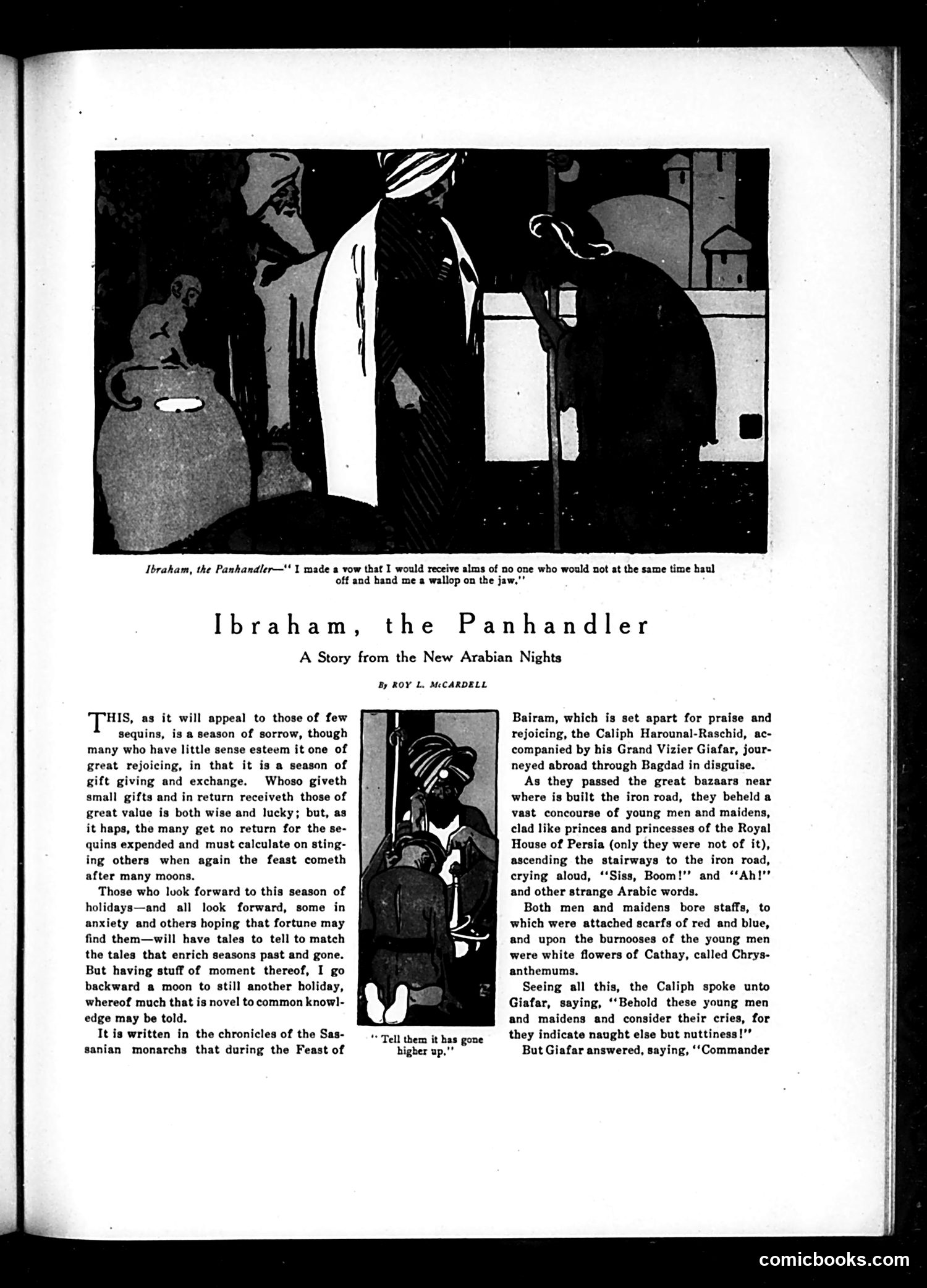
This is the opening of a fictional story (not a political cartoon) titled "Ibrahim, the Panhandler," attributed to Roy L. McCardell, framed as a tale from the Arabian Nights tradition. The text uses orientalist language to describe what appears to be a satirical observation of modern American life. References to a "Caliph" and "Grand Vizier" journeying through "Bagdad" are the story's framing device. The actual subject seems to be young Americans at a railway station—the text mentions "the iron road" (train), people wearing college colors ("scarfs of red and blue"), and chrysanthemums, while shouting "Siss, Boom!" (recognizable as college cheer language). The satire appears to mock youthful enthusiasm and what the narrator (and presumably Judge's readers) considered excessive emotional display, calling it "nuttiness." The opening vow about receiving alms only from those willing to punch the panhandler suggests dark humor about social obligation and reciprocity.
📄 Transcribed text from this page (OCR, searchable)
Machine-transcribed from the original scan — historical spelling and the odd misread are preserved.
Ibraham, the Panhandler—" 1 made a vow that I would receive alms of no one who would not at the same time haul off and hand me a wallop on the jaw,"’ the Panhandler A Story from the New Arabian Nights Ibraham, 'HIS, as it will appeal to those of few sequins, is a season of sorrow, though many who have little sense esteem it one of great rejoicing, in that it is a season of gift giving and exchange. Whoso giveth small gifts and in return receiveth those of great value is both wise and lucky; but, as it haps, the many get no return for the se- quins expended and must calculate on sting- ing others when again the feast cometh after many moons. Those who lvok forward to this season of holidays—and all look forward, some in anxiety and others hoping that fortune may find them—will have tales to tell to match the tales that enrich seasons past and gone. But having stuff of moment thereof, I go backward a moon to still another holiday, whereof much that is novel to common knowl- edge may be told. It is written in the chronicles of the Sas- sanian monarchs that during the Feast of By ROY L. McCARDELL “Tell them it has gone higher up," Bairam, which is set apart for praise and rejoicing, the Caliph Harounal-Raschid, ac- companied by his Grand Vizier Giafar, jour- neyed abroad through Bagdad in disguise. As they passed the great bazaars near where is built the iron road, they beheld a vast concourse of young men and maidens, clad like princes and princesses of the Royal House of Persia (only they were not of it), ascending the stairways to the iron road, crying aloud, ‘‘Siss, Boom!’’ and ‘‘Ah!'’ and other strange Arabic words. Both men and maidens bore staffs, to which were attached scarfs of red and blue, and upon the burnooses of the young men were white flowers of Cathay, called Chrys- anthemums. Seeing all this, the Caliph spoke unto Giafar, saying, ‘‘Behold these young men and maidens and consider their cries, for they indicate naught else but nuttiness!’’ But Giafar answered, saying, ‘‘Commander comicbooks.com