
A complete issue · 28 pages · 1912
Judge — October 12, 1912
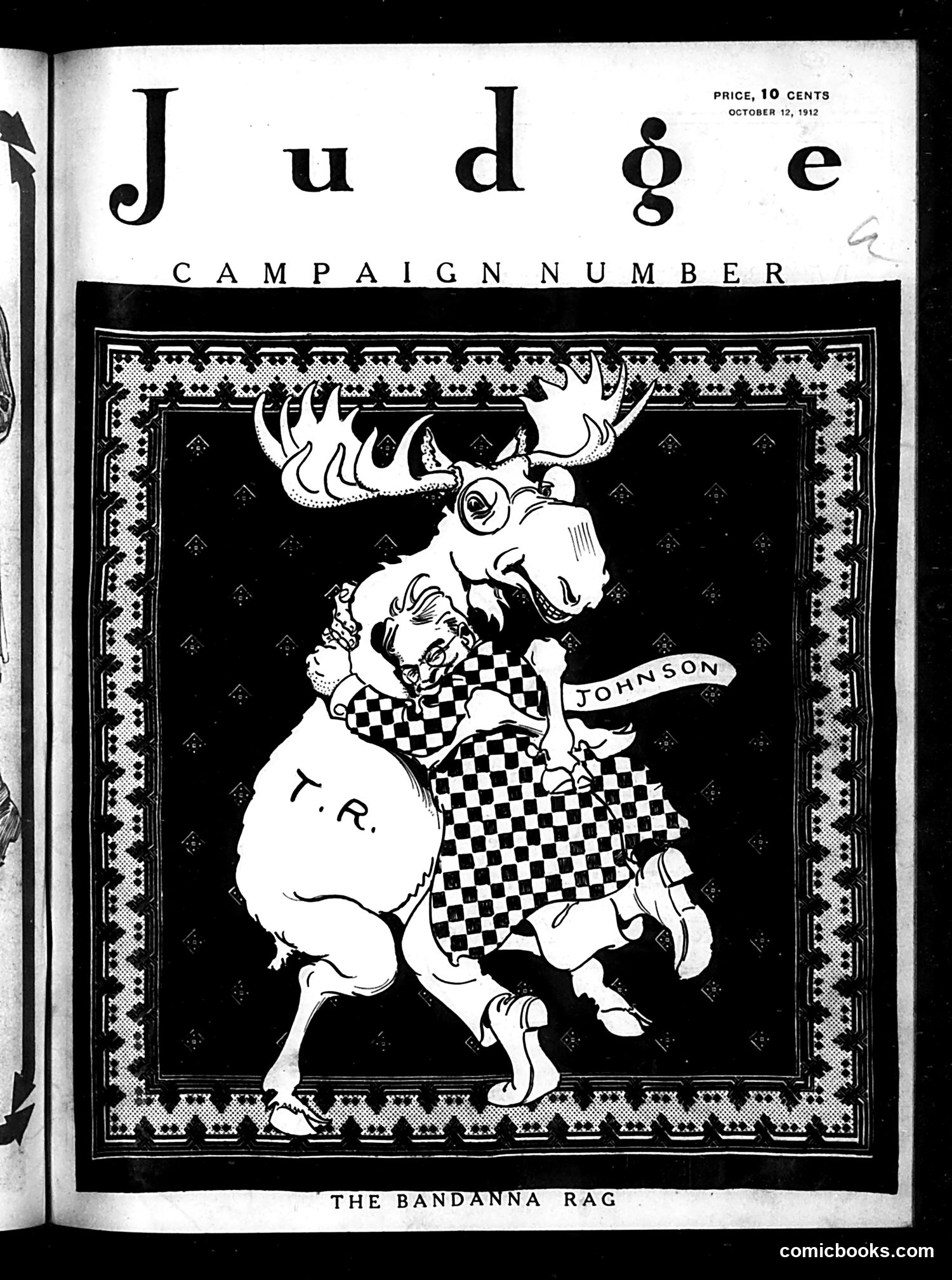
This is a campaign satire titled "The Bandanna Rag," featuring a moose (labeled "T.R." for Theodore Roosevelt) dancing with a figure labeled "Johnson." The moose wears a checkered bandanna pattern. This likely references the 1912 presidential election, when Roosevelt's Progressive "Bull Moose" Party split the Republican vote. The dancing partnership appears to satirize Roosevelt's complicated relationship with candidate selection—possibly mocking his choice or alliance. The bandanna reference suggests either working-class association or a racial element common to early 1900s political cartoons. The crude caricature and "rag" (musical style) title employ period satirical conventions to mock Roosevelt's political maneuvering during this fractious election year.
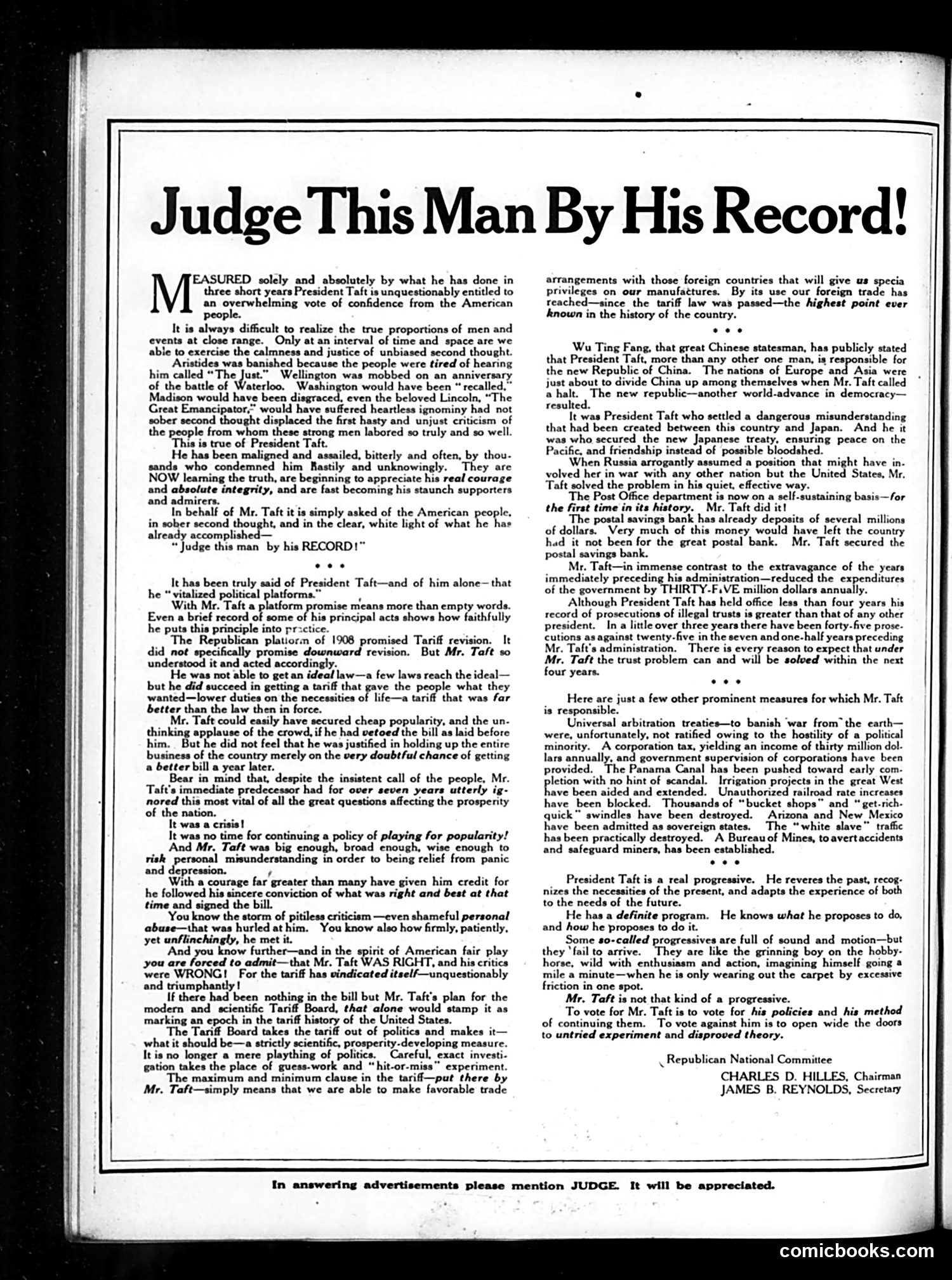
This is a **political advertisement**, not a cartoon. The page is a pro-Taft endorsement published by the Republican National Committee (signed by Charles D. Hilles, Chairman, and James B. Reynolds, Secretary). The text defends President **William Howard Taft** against criticism, arguing readers should "judge this man by his record." It praises his accomplishments in three years, including postal savings banks, conservation efforts, and trust-busting, while defending his tariff policies. The piece addresses **Wu Ting Fang** (Chinese statesman) and contrasts Taft favorably with predecessors, suggesting Taft prevented war and advanced democracy. It attacks critics as practicing "playing for popularity" and argues for voting based on Taft's "policies and his method" rather than "untried experiment and disapproved theory." This reflects **1912 election** Republican messaging.
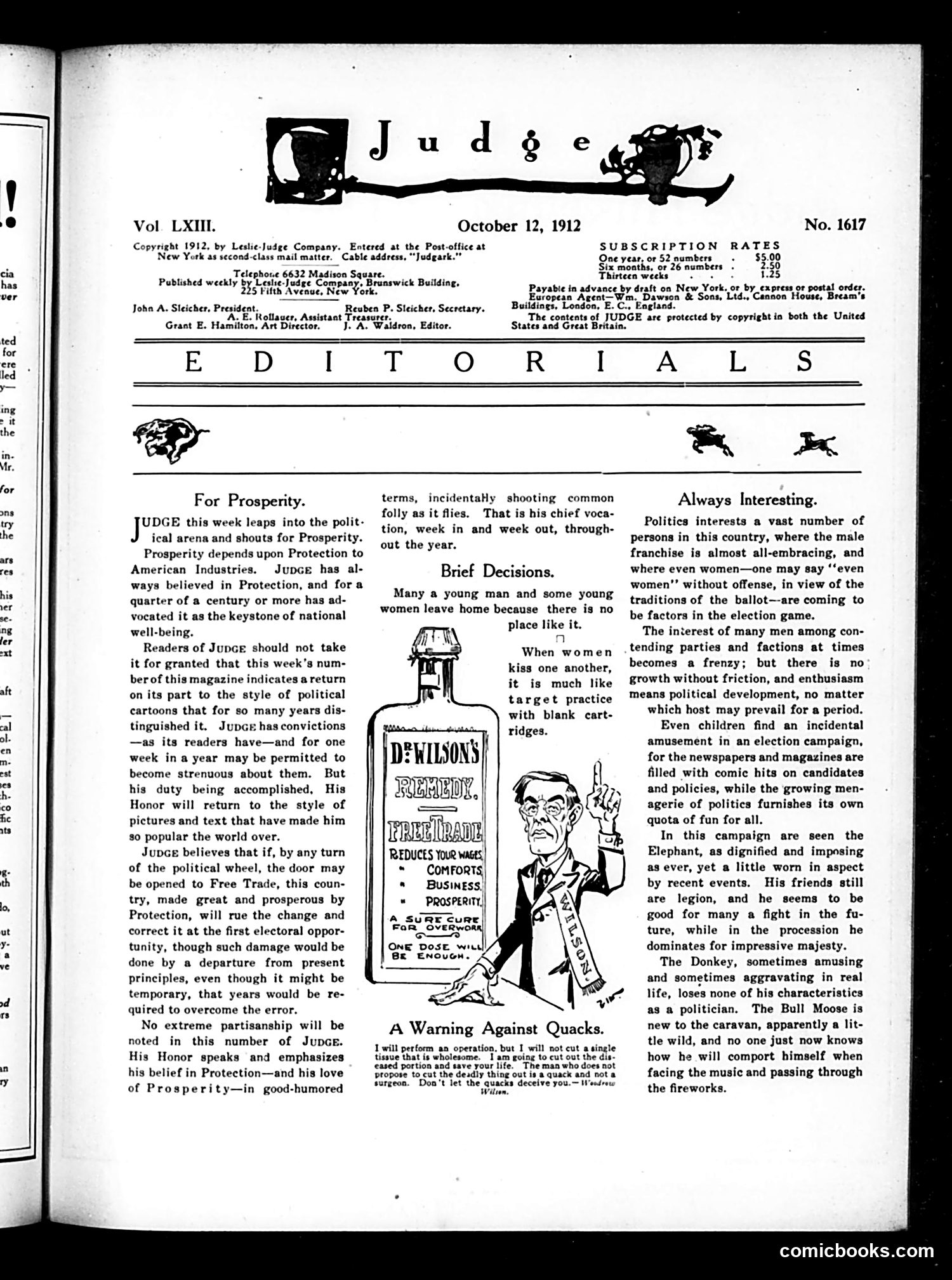
The main cartoon depicts a man labeled "DeWilson's Remedy" holding a bottle, with text promising to reduce "your wages," "comforts," "business," and "prosperity." This appears to satirize Woodrow Wilson's economic policies during the 1912 presidential campaign, likely criticizing his support for tariff reduction and antitrust action as harmful to American business and workers' prosperity. The editorial "For Prosperity" defends protective tariffs and criticizes Wilson's approach, reflecting Judge's Republican/protectionist stance. The page also includes smaller political cartoons and an article "A Warning Against Quacks," suggesting broader attacks on reform candidates as fraudulent. This represents the magazine's explicit partisan advocacy during the contentious 1912 election.
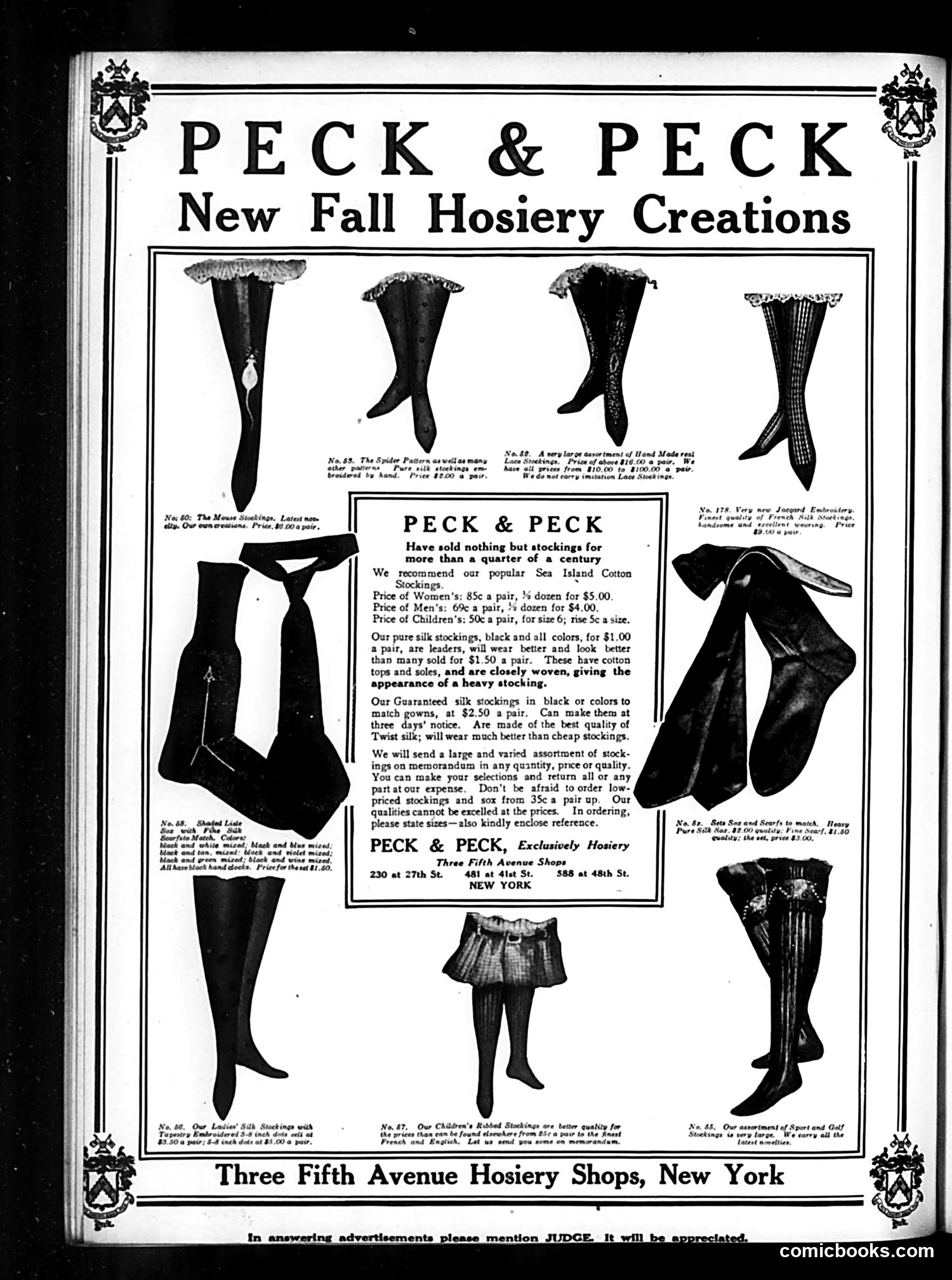
This page is **not a cartoon or satire** — it's a straightforward **advertisement** for Peck & Peck, a hosiery retailer with multiple Fifth Avenue locations in New York. The page showcases their "New Fall Hosiery Creations," displaying various women's and children's stockings in different styles: lace-trimmed, plain black, patterned, and ribbed designs. The central text block emphasizes their quality Sea Island Cotton stockings and pricing (85¢ to $2.50 per pair). There is no political commentary, satire, or hidden meaning — this is a period fashion advertisement, likely from the 1920s-1930s based on style and typography. It simply demonstrates how department stores marketed seasonal hosiery to consumers through Judge magazine.
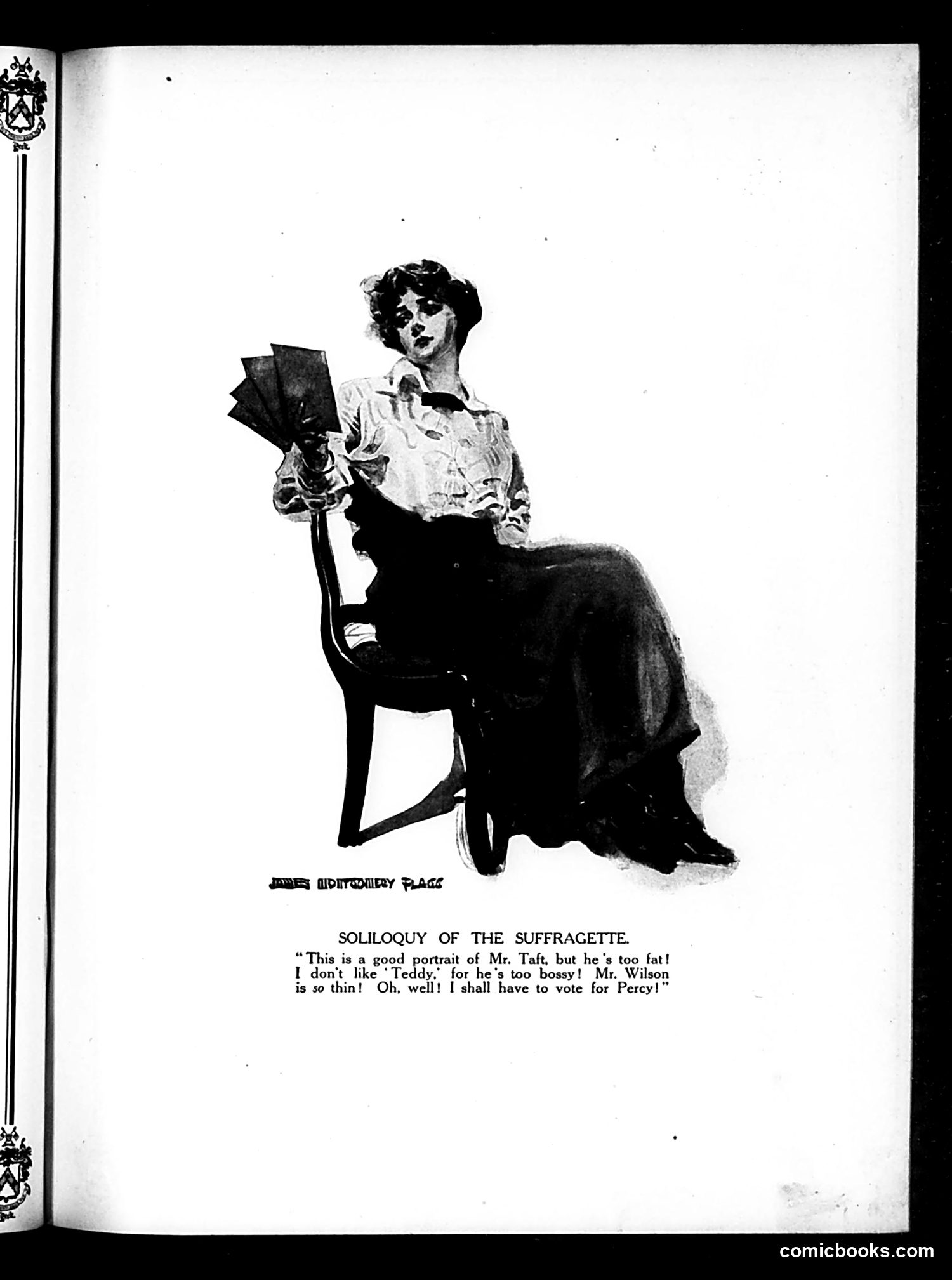
This 1910s-era Judge cartoon satirizes the women's suffrage movement. The illustrated woman, labeled a "suffragette," holds a decorative fan while seated, speaking a monologue that critiques political candidates. She expresses dissatisfaction with "Mr. Taft" (President William Howard Taft) and "Mr. Wilson," finding both flawed—Taft is "too fat" and "too bossy," Wilson is "too thin." Her conclusion to "vote for Percy" appears to mock suffragettes as frivolous, suggesting they'll base voting decisions on trivial personal preferences rather than substantive policy. The satire mocks both the suffragettes' judgment and the candidates themselves, reflecting anti-suffrage sentiment that portrayed women voters as shallow and unsuited for political participation.
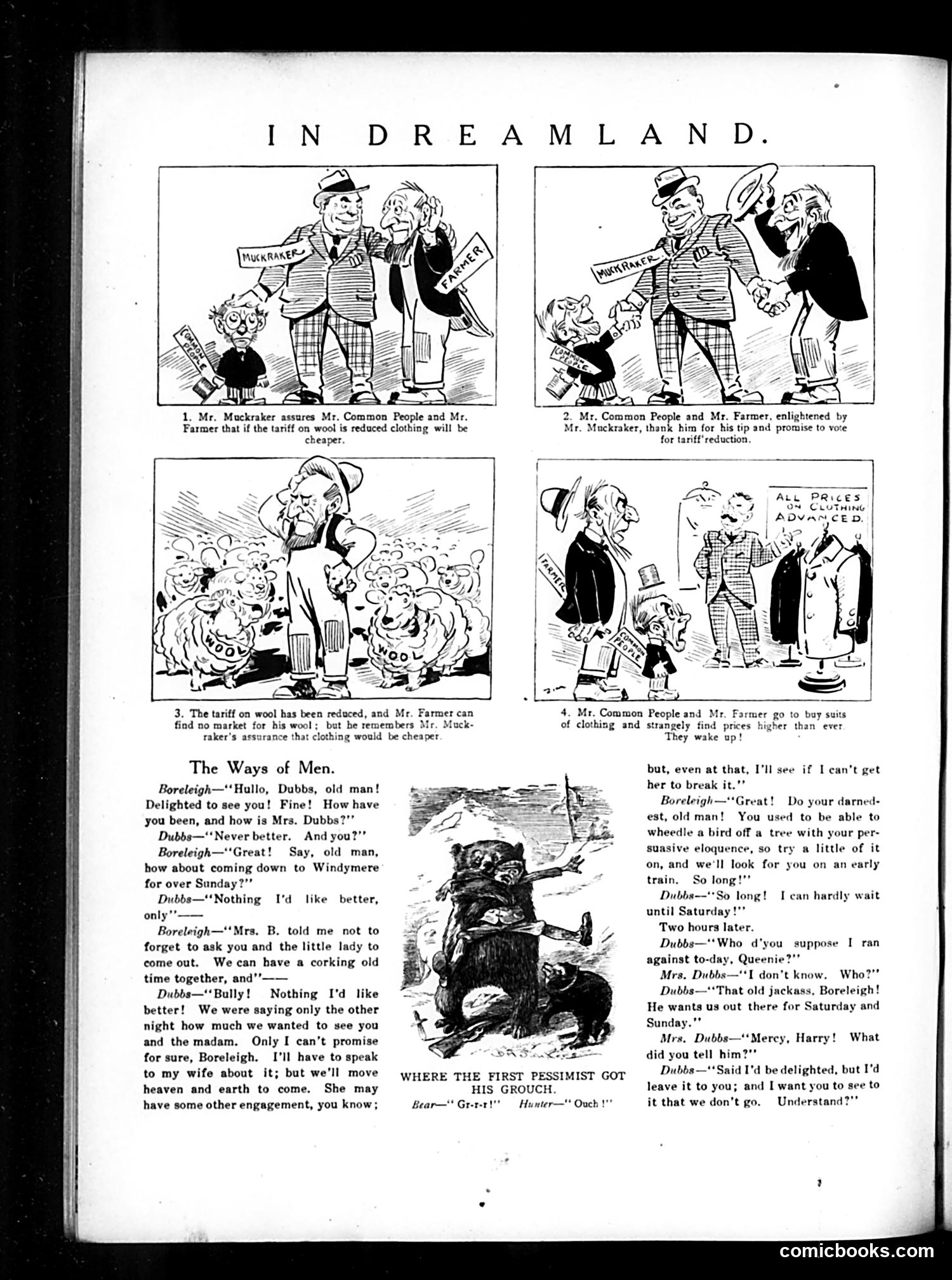
This four-panel satirical sequence mocks the disconnect between political promises and economic reality, specifically targeting tariff debate rhetoric. **The Satire:** A figure labeled "Muckraker" (likely representing progressive journalists or politicians) promises "Mr. Common People" and "Mr. Farmer" that reducing wool tariffs will lower clothing prices. After the tariff reduction passes (panel 3), farmers find no market for wool and prices actually *rise*—the opposite of promised. Panel 4 shows buyers shocked by higher prices, having been duped. **The Point:** The cartoon exposes how political rhetoric about tariff reduction—presented as benefiting ordinary citizens—actually harms farmers and consumers while enriching manufacturers. The "Muckraker" figure represents those making false populist claims. The lower section, "The Ways of Men," appears unrelated—a humorous vignette about social hypocrisy in accepting invitations. **Context:** This reflects early-20th-century American debates over protectionist vs. free-trade tariff policies.
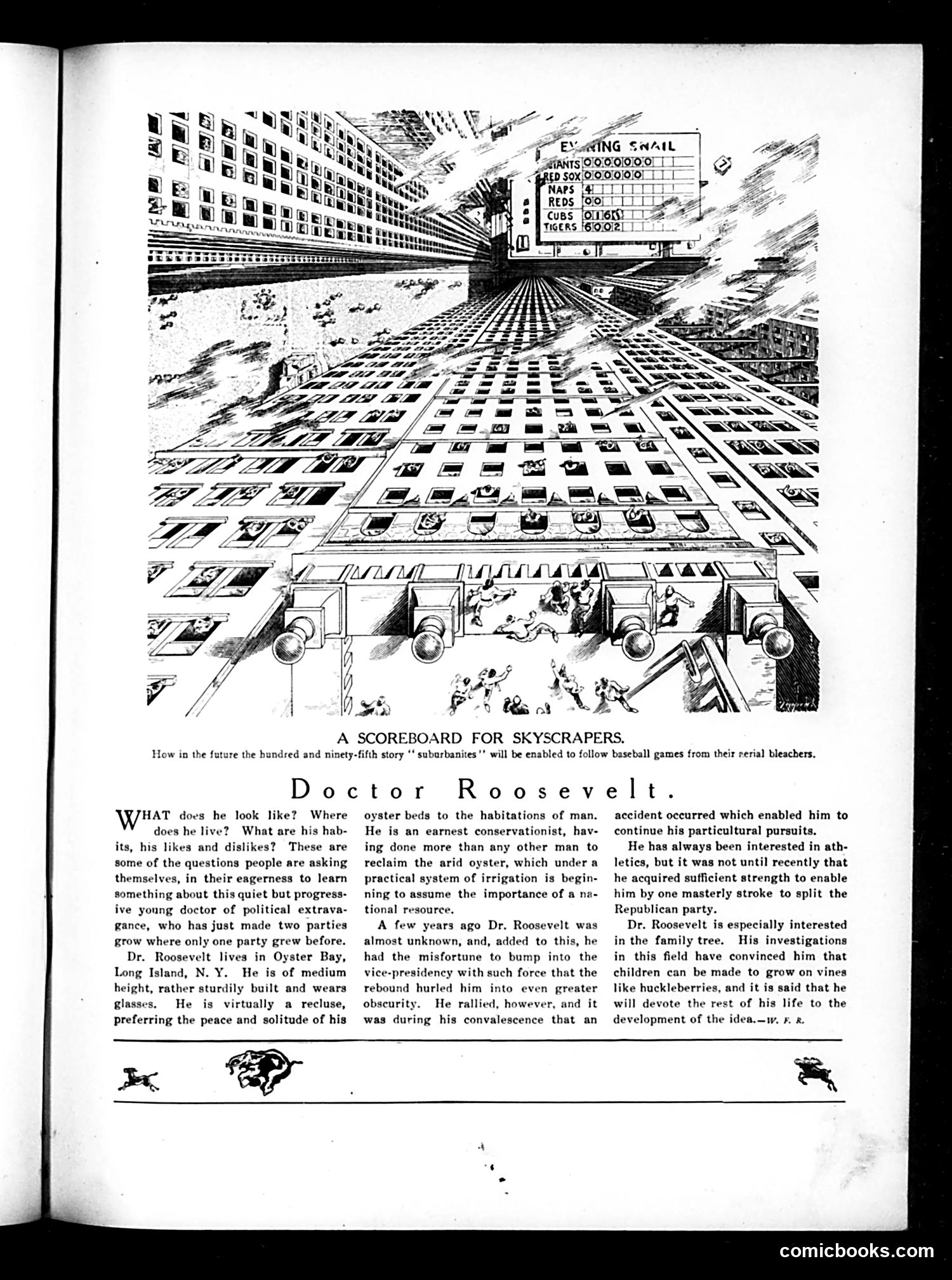
This page from *Judge* satirizes Theodore Roosevelt through absurdist humor. The top cartoon shows a futuristic baseball scoreboard on a skyscraper's rooftop—a joke about how tall buildings will eventually dominate urban life. The main article mocks Roosevelt as "Doctor Roosevelt," a fictional eccentric scientist living in Oyster Bay who has devoted himself to growing oysters through irrigation and breeding children on vines like fruit. The satire targets his recent political actions: his "split" of the Republican Party (likely the 1912 Progressive/Bull Moose Party split) is presented as a singular "masterly stroke," while his vice-presidency is described as an embarrassing "bump" from which he "rallied." The piece uses pretend-serious biographical language to ridicule Roosevelt's conservation efforts and political ambitions, treating his real accomplishments as absurd pseudoscientific pursuits. This was typical *Judge* mockery of prominent public figures of the era.
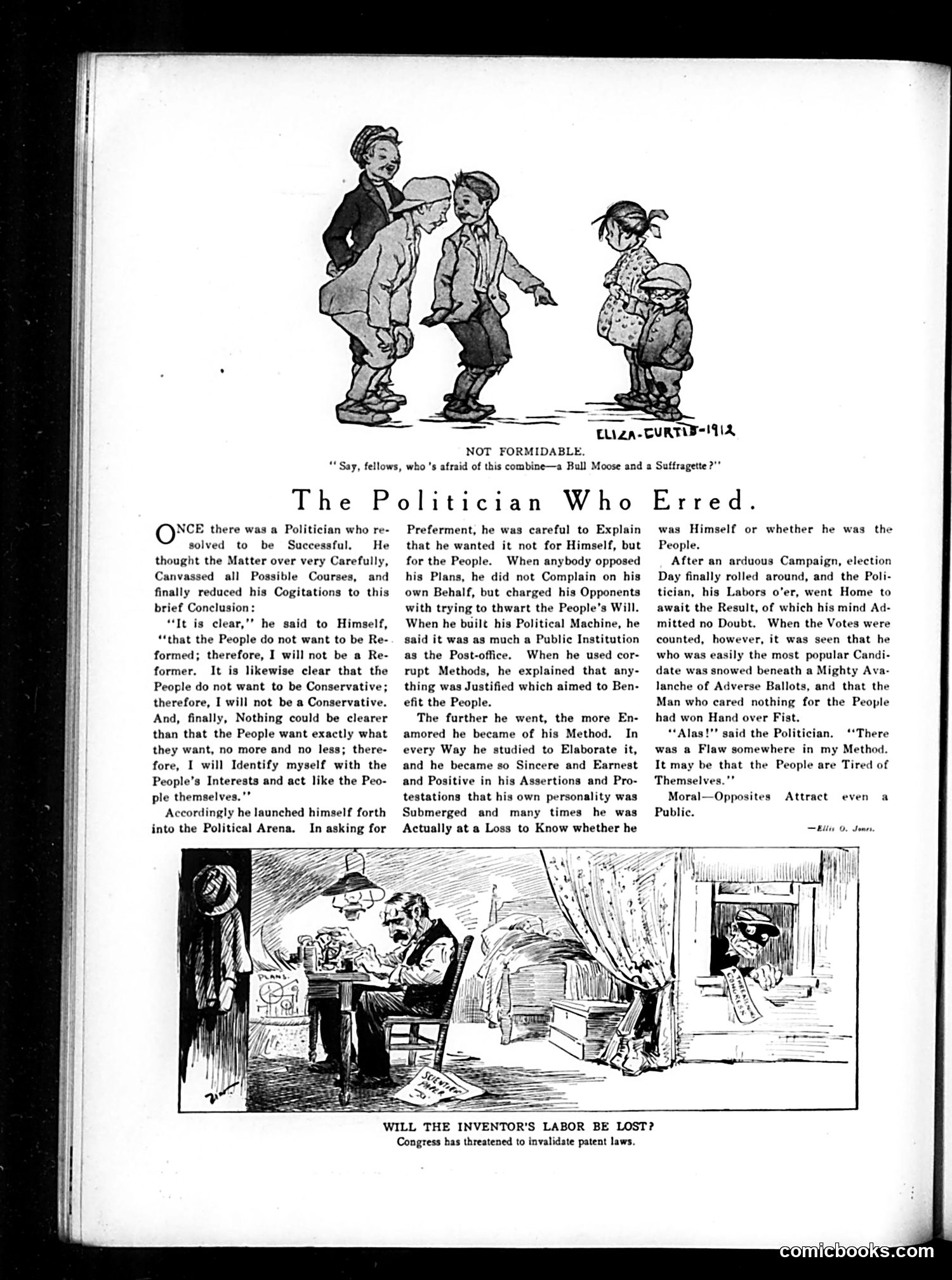
This 1912 *Judge* page satirizes a politician who cynically claims to represent "the People" while abandoning all principles. The story mocks his calculation: he adopts no reform or conservative position, instead claiming total identification with popular will—using "the People" as cover for corrupt methods and self-interest. The irony: despite his elaborate manipulation, he loses decisively while his opponent (who ignores the People) wins easily. The politician's conclusion—that the People are "tired of themselves"—is the joke's punchline: his strategy backfired because voters saw through the phoniness. **Top cartoon**: References the "Bull Moose" (Theodore Roosevelt's 1912 Progressive Party) and women's suffrage as non-threatening political forces, mocking politicians who fear them. **Bottom cartoon**: Separate editorial item warning that Congress threatens patent law invalidation, potentially harming inventors' interests. The page critiques hollow populist rhetoric and suggests authenticity matters in politics.
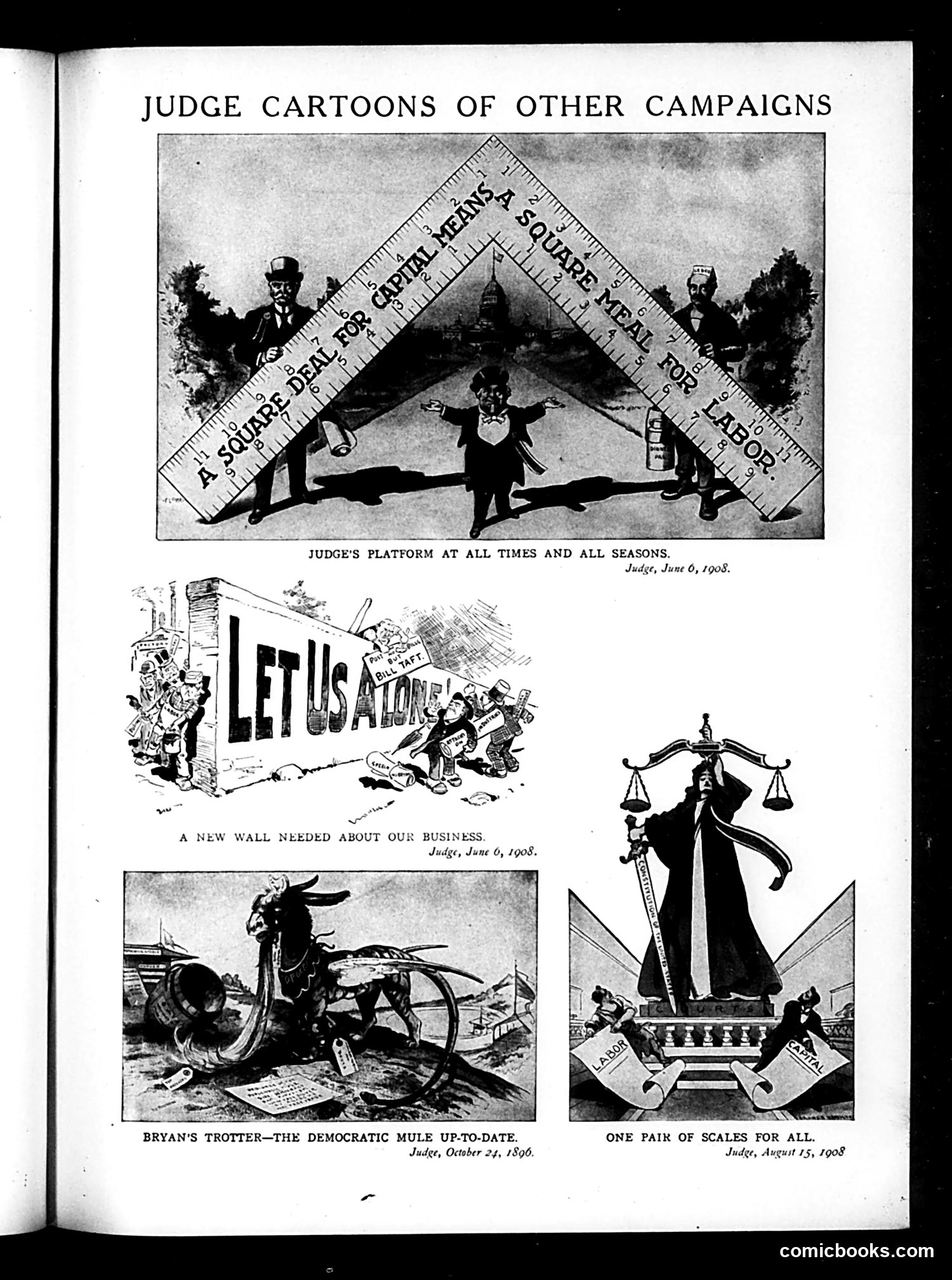
This page collects cartoons from multiple election campaigns mocking Democratic candidates and policies. The top cartoon (1908) depicts Judge's editorial stance as an impartial platform held by two figures, symbolizing consistent fairness. "A New Wall Needed About Our Business" (1908) shows figures being attacked by chaos, suggesting Democrats threatened business stability. "Bryan's Trotter—The Democratic Mule" (1896) ridicules William Jennings Bryan, the Democratic presidential candidate, depicting him as an unreliable mule—a common insult suggesting incompetence or stubbornness. "One Pair of Scales for All" (1908) shows Lady Justice on a balanced scale, likely advocating for fair treatment of business interests against what Judge viewed as unfair Democratic regulation or populist demands. These cartoons reflect Judge's pro-business, Republican-leaning editorial perspective during the Gilded Age and Progressive Era.
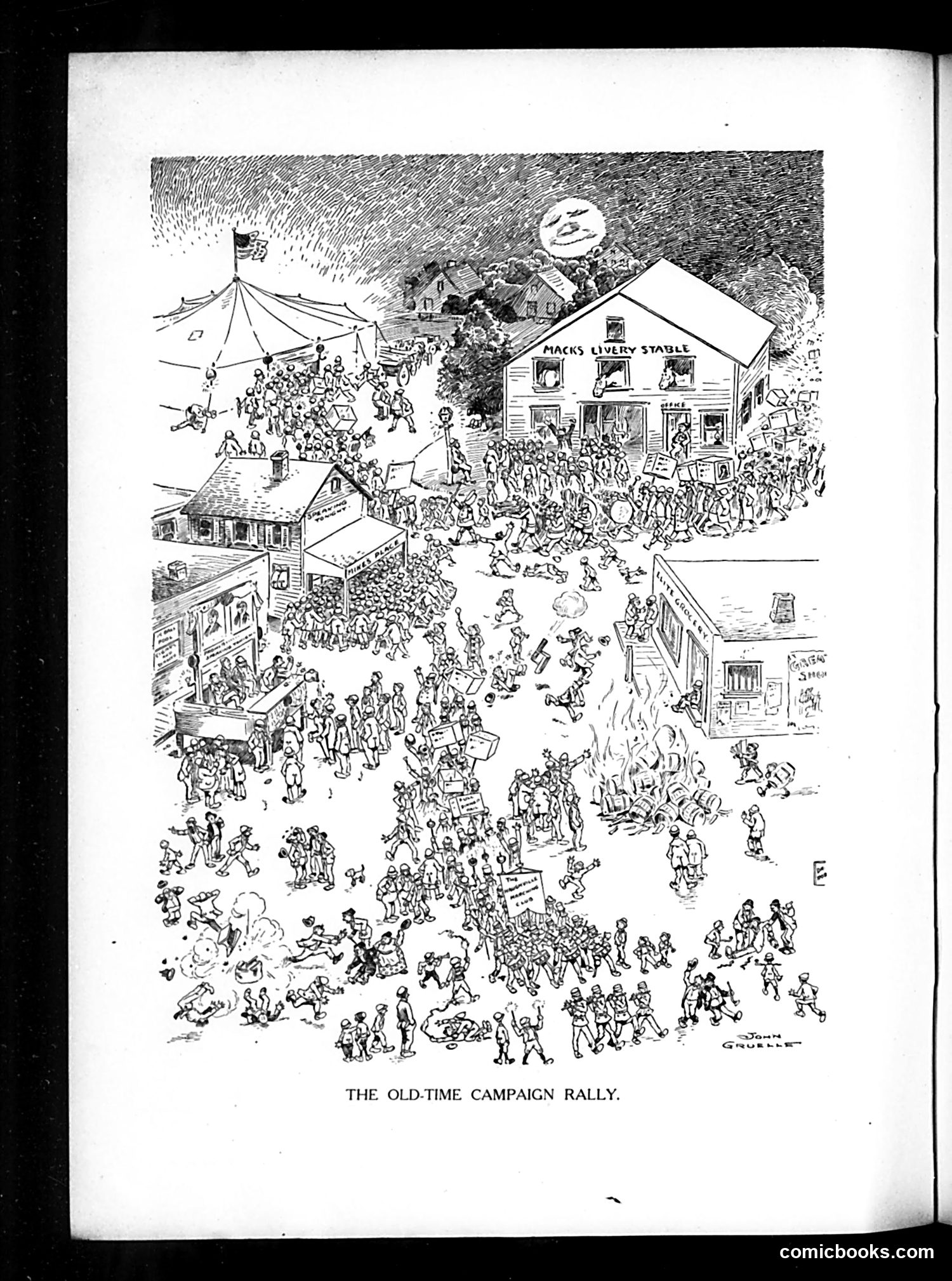
This satirical illustration depicts a chaotic 19th-century political campaign gathering. The crowded scene shows hundreds of people swarming around various structures—a carousel, Mack's Livery Stable, and vendor booths—suggesting the carnival-like atmosphere of historical political rallies. The cartoon satirizes campaign events as disorganized, rowdy public spectacles rather than serious political discourse. The teeming masses, diverse activities, and general bedlam mock the informal, entertainment-focused nature of old political campaigning. The inclusion of amusement features (carousel) and commercial establishments implies campaigns were social events blending politics with entertainment and commerce. The title's nostalgic tone suggests Judge magazine is critiquing either the persistence of outdated campaign methods or contrasting "old-time" disorder with contemporary (presumably more refined) political processes. The exact date is unclear from the image alone.
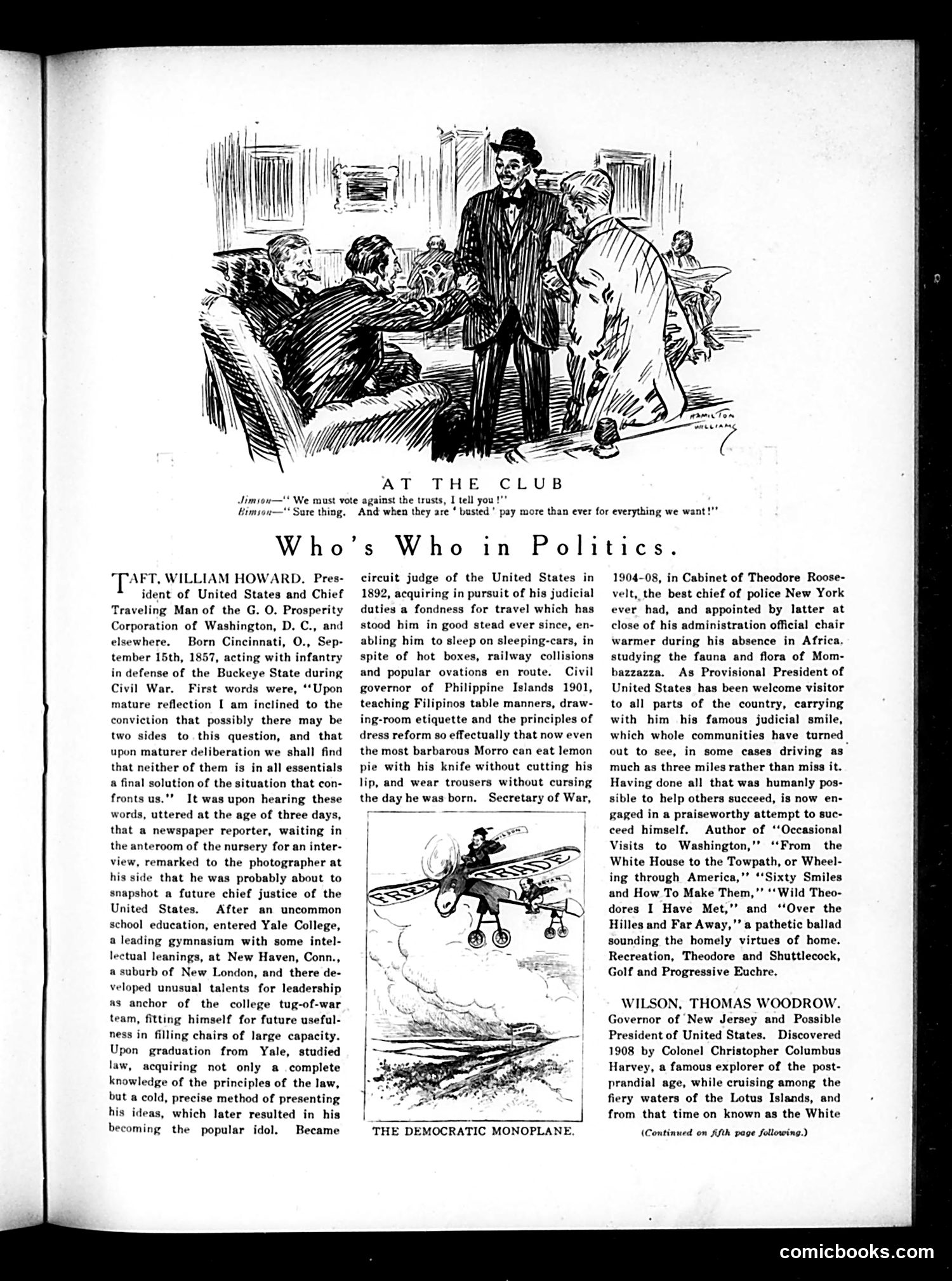
The top cartoon satirizes wealthy club members discussing anti-trust reform while remaining hypocritical—they claim to oppose monopolies ("trusts") but clearly benefit from them. Below is a mock-biographical entry for President William Howard Taft, dripping with sarcasm. Judge ridicules him as indecisive (born spouting "both sides" arguments), overly cautious, and primarily known for traveling and golf rather than decisive leadership. The exaggerated resume—Philippine governor teaching "table manners," Secretary of War, etc.—portrays him as unqualified and lightweight. The small illustration labeled "The Democratic Monoplane" appears to be a satirical jab at Democratic technological/political aspirations, though its specific meaning is unclear. The entry on Woodrow Wilson at bottom treats him mockingly as a recent "discovery" for possible presidency, implying he's an unknown quantity being tested for higher office. Overall, this page mocks Taft's presidency and positioning while introducing Wilson as an alternative candidate, likely from the 1908-1912 political period.
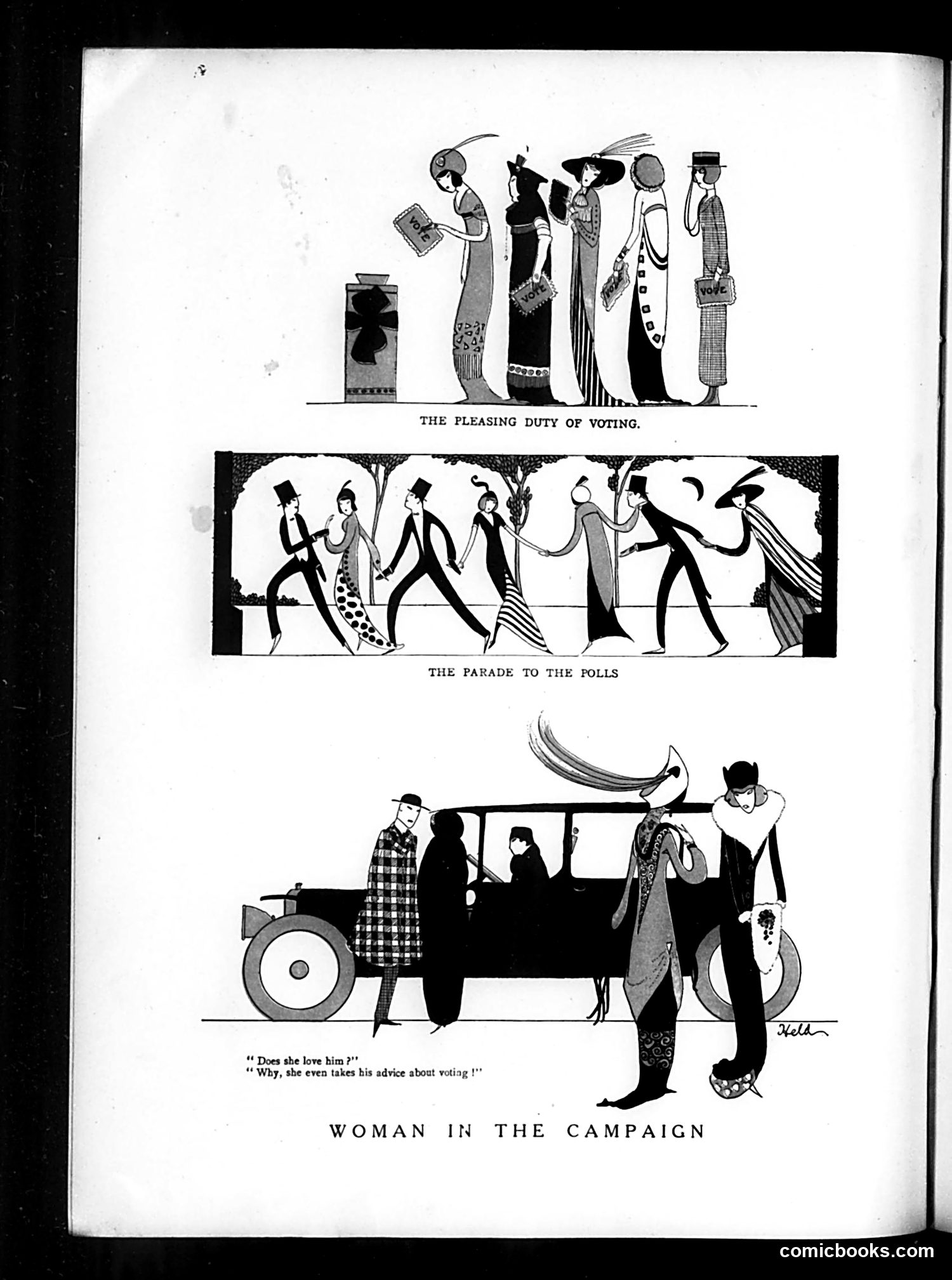
This page presents three satirical cartoons about women's political participation, likely from the early 20th century when women's suffrage was debated. The top cartoon, "The Pleasing Duty of Voting," depicts women in fashionable dress approaching a ballot box—celebrating women's voting rights as desirable and empowering. The middle panel, "The Parade to the Polls," shows elegantly dressed figures marching together in a procession, suggesting organized women's suffrage movements. The bottom cartoon, "Woman in the Campaign," contains the key joke: a man asks another if a woman loves a certain man, to which the response is "she even takes his advice about voting!" The satire mocks the idea that a woman taking a man's political advice demonstrates devotion—treating women's political autonomy as absurdly subservient. The cartoon ridicules both women's dependence on male guidance and the notion that this constitutes romantic devotion.
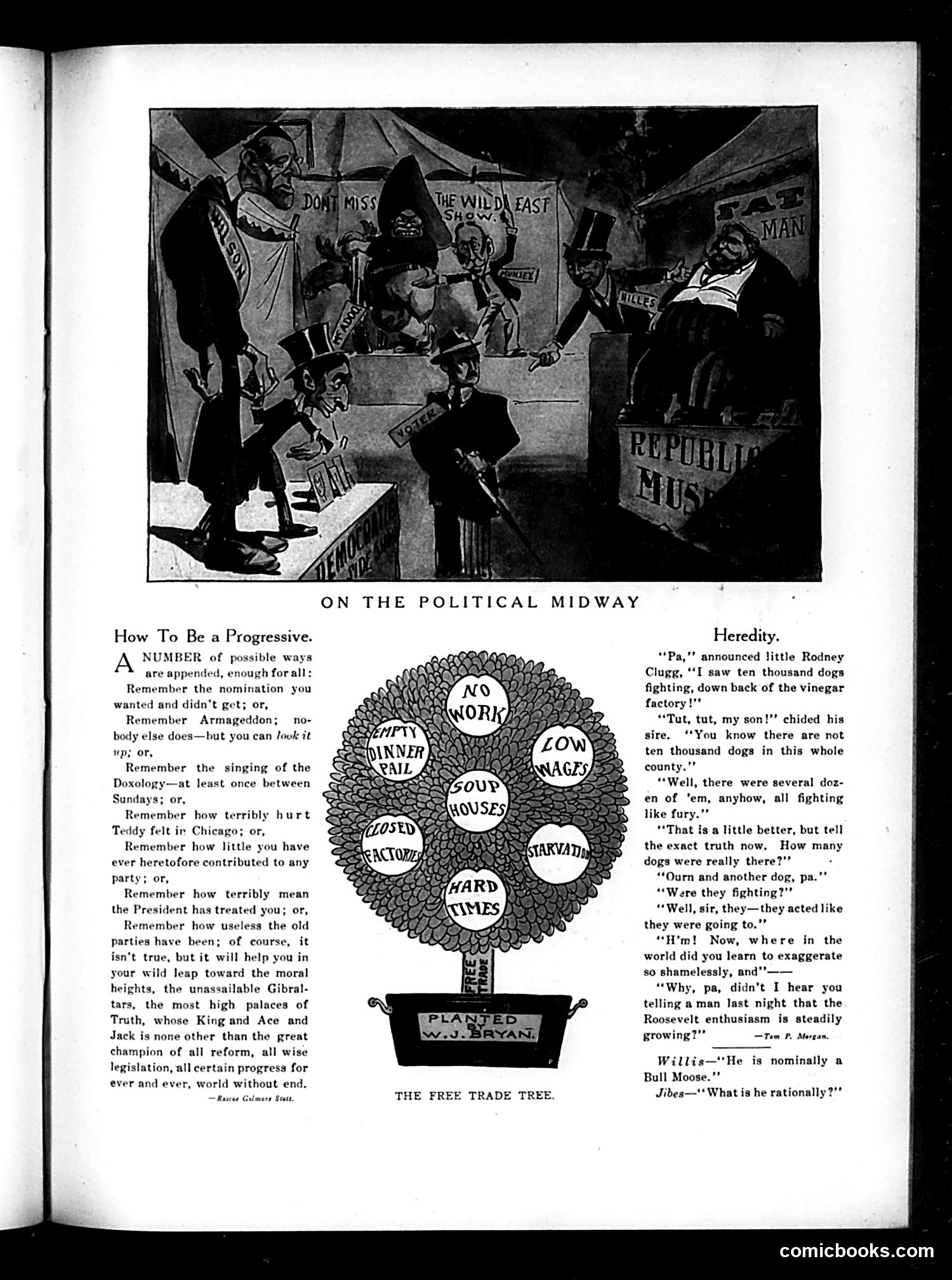
**"On the Political Midway"** presents three pieces mocking progressive politics, likely from the 1912 election era when Theodore Roosevelt's "Bull Moose" Progressive Party split the Republican vote. The top photograph shows a carnival-like "midway" scene, satirizing progressive politics as cheap spectacle. **"How To Be a Progressive"** sarcastically lists reasons to join the movement: nursing grudges (lost nominations, how "Teddy felt in Chicago"), exaggerating one's moral superiority, and ignoring actual party contributions. It mocks progressives as self-righteous while dishonest. **"The Free Trade Tree"** diagram (planted by W.J. Bryan) shows interconnected progressive complaints: no work, low wages, soup houses, starvation, hard times, closed factories—blaming capitalism while offering free trade as solution. **"Heredity"** jokes that young Rodney learned exaggeration from his father, who inflates Roosevelt's popularity—implying progressives are fundamentally dishonest propagandists, not genuine reformers. The page attacks progressivism as moralistic posturing masking self-interest and factual dishonesty.
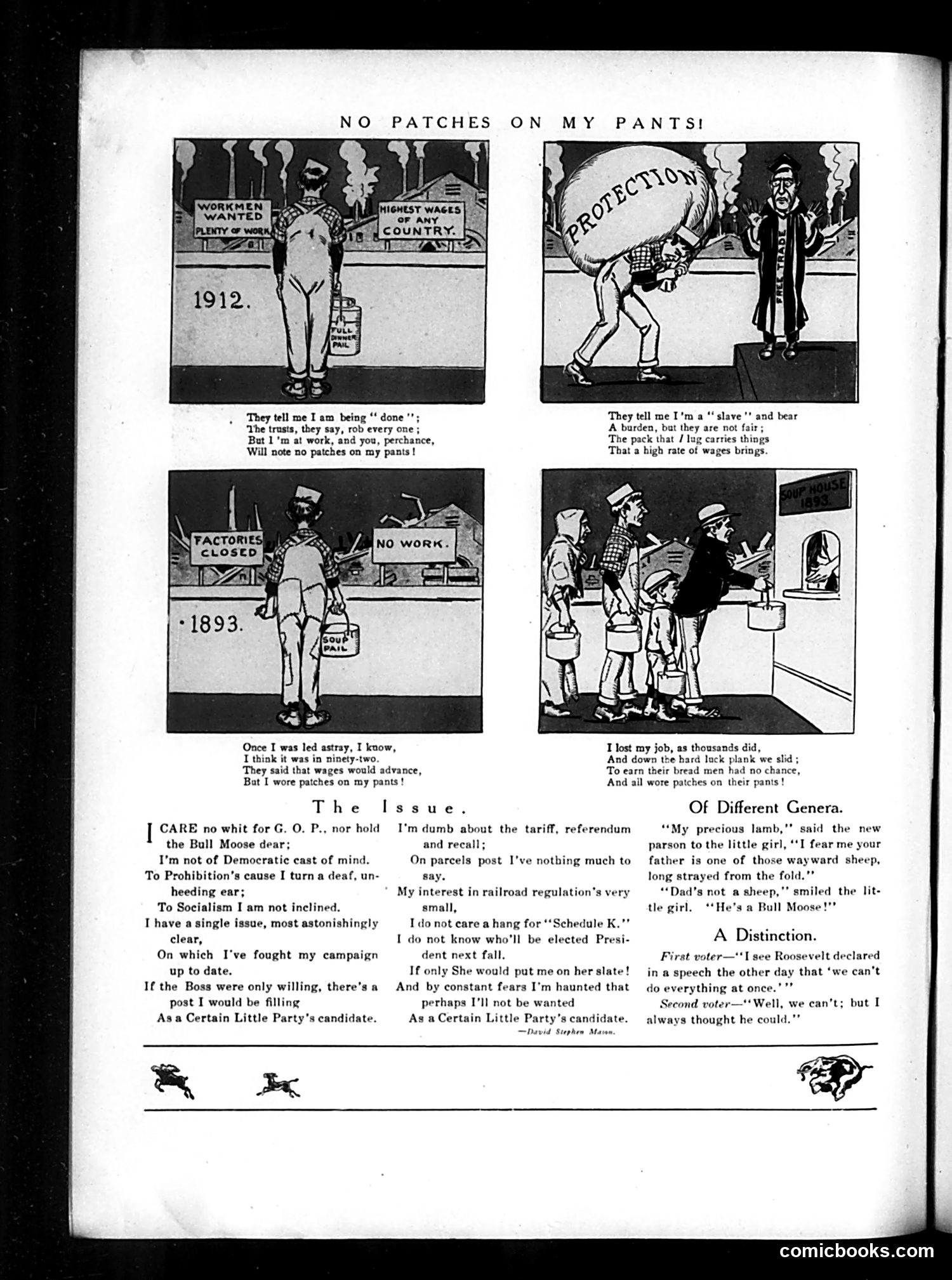
This Judge magazine page satirizes the 1912 U.S. presidential election, featuring four comic panels showing a worker's economic hardship across different political eras. **The narrative**: A laborer contrasts his current employment (1912) with past unemployment (1893), claiming he now avoids "patches" because he has work—yet he ironically cares nothing about actual political issues (tariffs, regulation, Prohibition, Socialism, or the G.O.P.). His sole concern is securing a government job if "the Boss" or a mysterious "She" puts him on the slate. **Key references**: The "Bull Moose" alludes to Theodore Roosevelt's Progressive Party candidacy in 1912, splitting Republican votes. The worker's indifference to substantive policy—combined with his naked job-seeking—mocks voters motivated purely by patronage rather than principle. **The satire's point**: Working-class political engagement amounts to self-interest masked as patriotism. The final anecdote about Roosevelt underscores the irony: a man famous for action claims he can't "do everything at once," yet voters still believe in him.
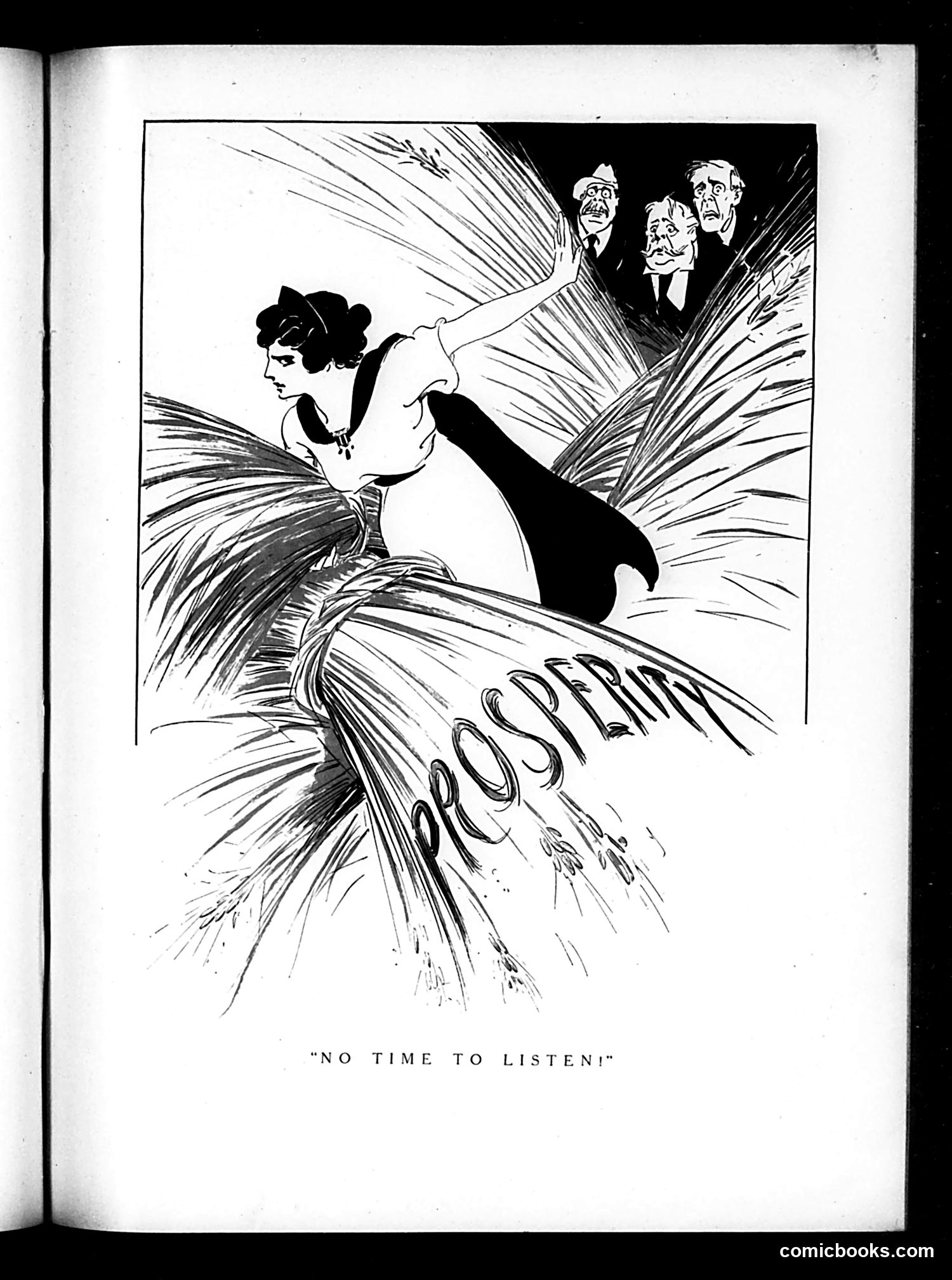
This Judge magazine cartoon depicts a woman in an elegant black and white dress with large, dramatic feathered wings labeled "PROSPERITY," bursting energetically forward. Three men in dark suits behind her appear startled or concerned, watching her rapid movement. The caption "No Time to Listen" suggests the woman represents prosperity or economic boom, moving so swiftly that observers cannot catch up or voice concerns. The cartoon likely satirizes the rapid economic growth of a particular era (possibly the 1920s, given Judge's era and the Art Deco styling) where momentum seemed unstoppable and warnings went unheeded. The contrast between the dynamic woman and the static, worried men emphasizes how quickly conditions were changing, potentially beyond anyone's ability to control or moderate it.
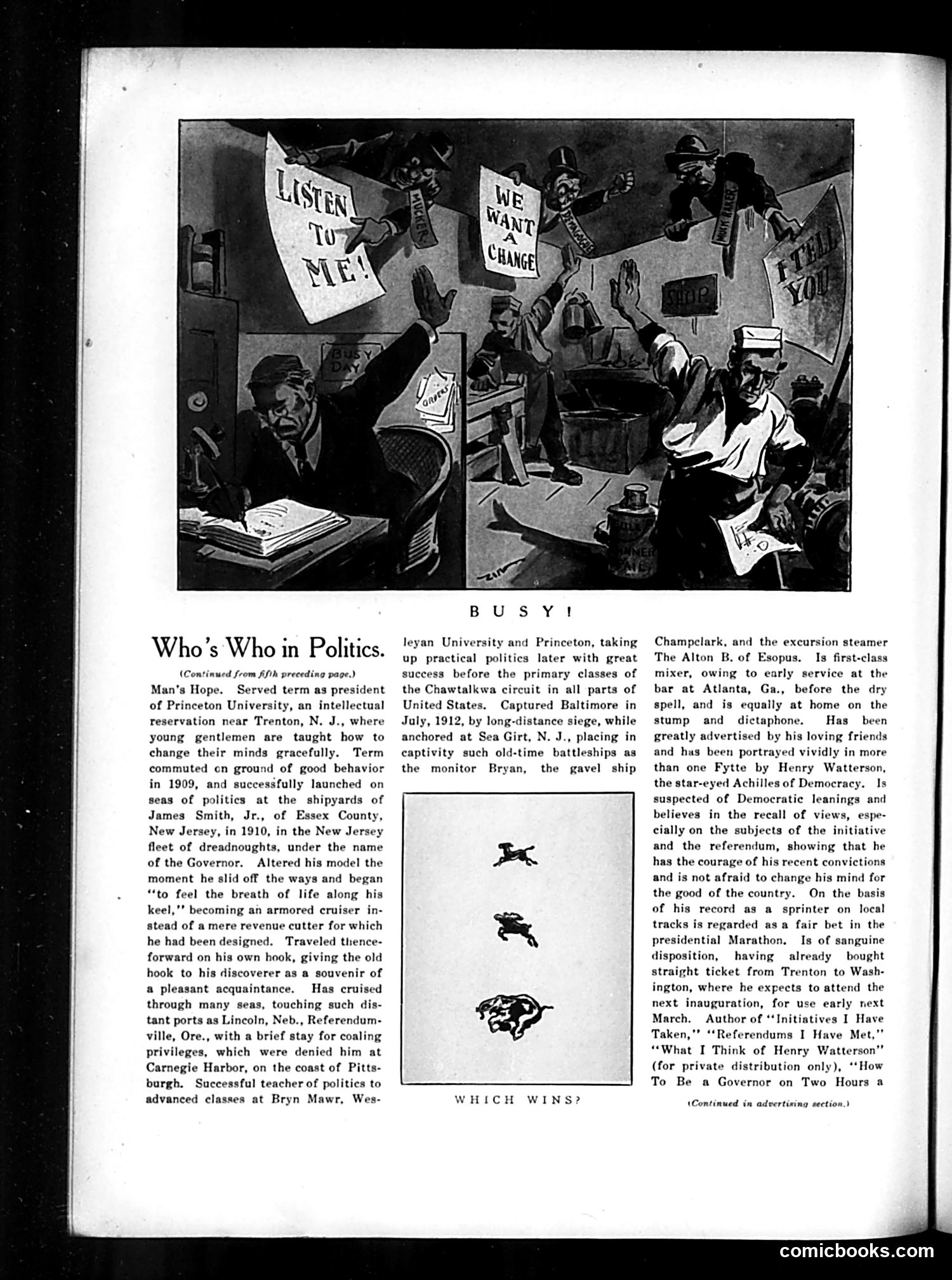
This Judge magazine page satirizes Woodrow Wilson, then a presidential candidate. The text mockingly describes Wilson's career trajectory using naval metaphors—he's a "ship" that altered course once launched into politics, abandoning his Princeton presidency and his political patron James Smith Jr. The satire targets Wilson's political inconsistency: he's accused of changing his positions on progressive issues (initiative, referendum) based on convenience rather than conviction. The reference to Henry Watterson (a prominent Democratic editor) and "star-eyed Achilles of Democracy" is ironic praise masking criticism. The cartoon's "WHICH WINS?" panel appears to show competing political forces—likely depicting the Democratic primary battle of 1912. The text mentions Wilson "captured Baltimore in July, 1912," referencing the Democratic Convention where he secured the nomination. Overall, Judge presents Wilson as an ambitious opportunist who shifts positions like a naval vessel changing course, having no fixed principles beyond personal advancement.
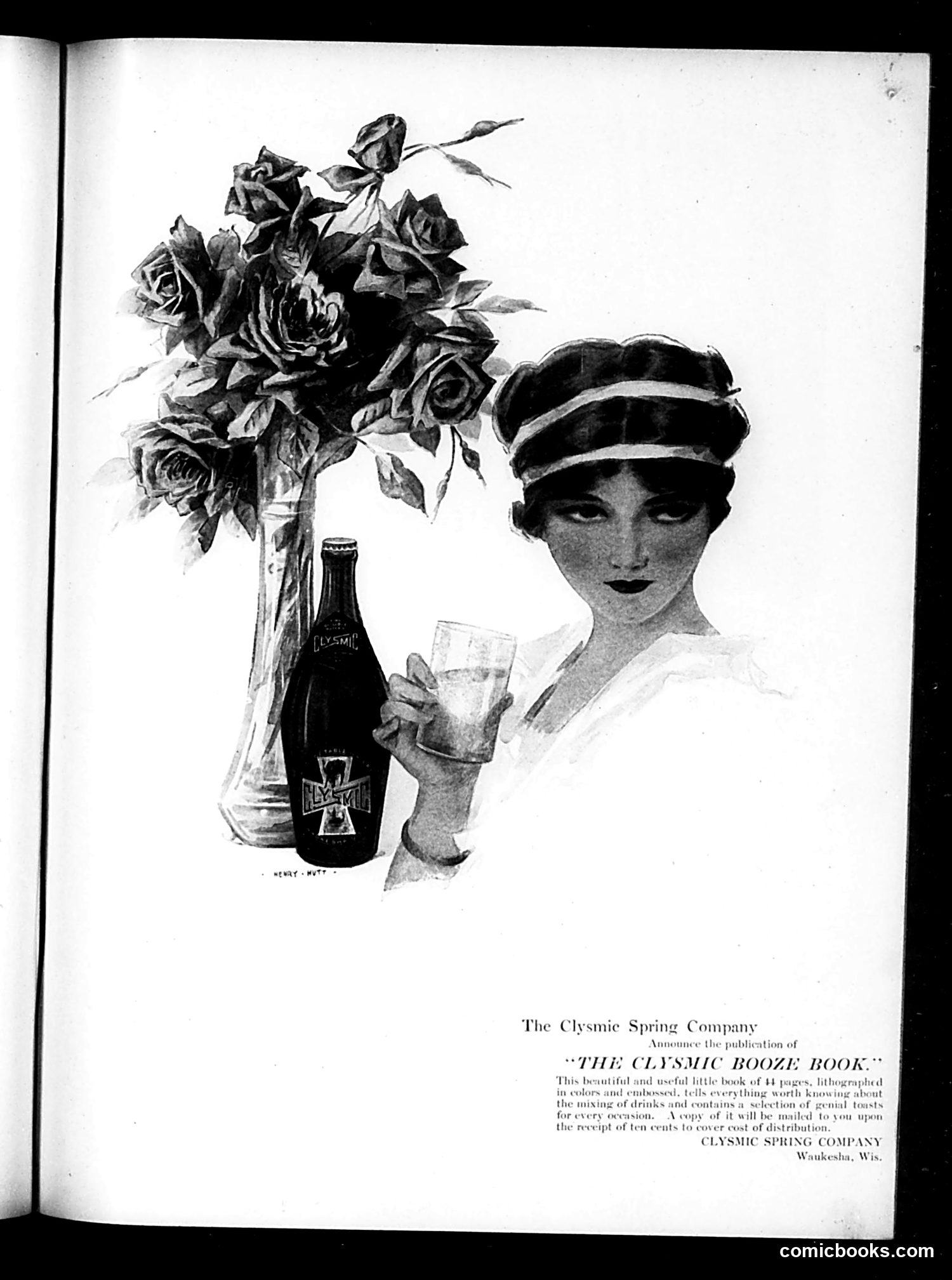
This is primarily a **product advertisement** rather than political satire. The Clysmic Spring Company of Waukesha, Wisconsin announces publication of "The Clysmic Booze Book"—a 44-page illustrated guide about mixing drinks and cocktail recipes, available for ten cents. The illustration features an elegant woman in 1920s fashion (cloche hat with bands, fashionable styling) holding a glass, positioned next to a bottle of Clysmic brand beverage and a vase of roses. The imagery appeals to sophistication and leisure, targeting affluent consumers. The timing and product name suggest this likely predates or relates to Prohibition-era debates about alcohol consumption, though the ad itself doesn't make explicit political commentary. It's essentially a luxury beverage company marketing cocktail culture to a prosperous audience.
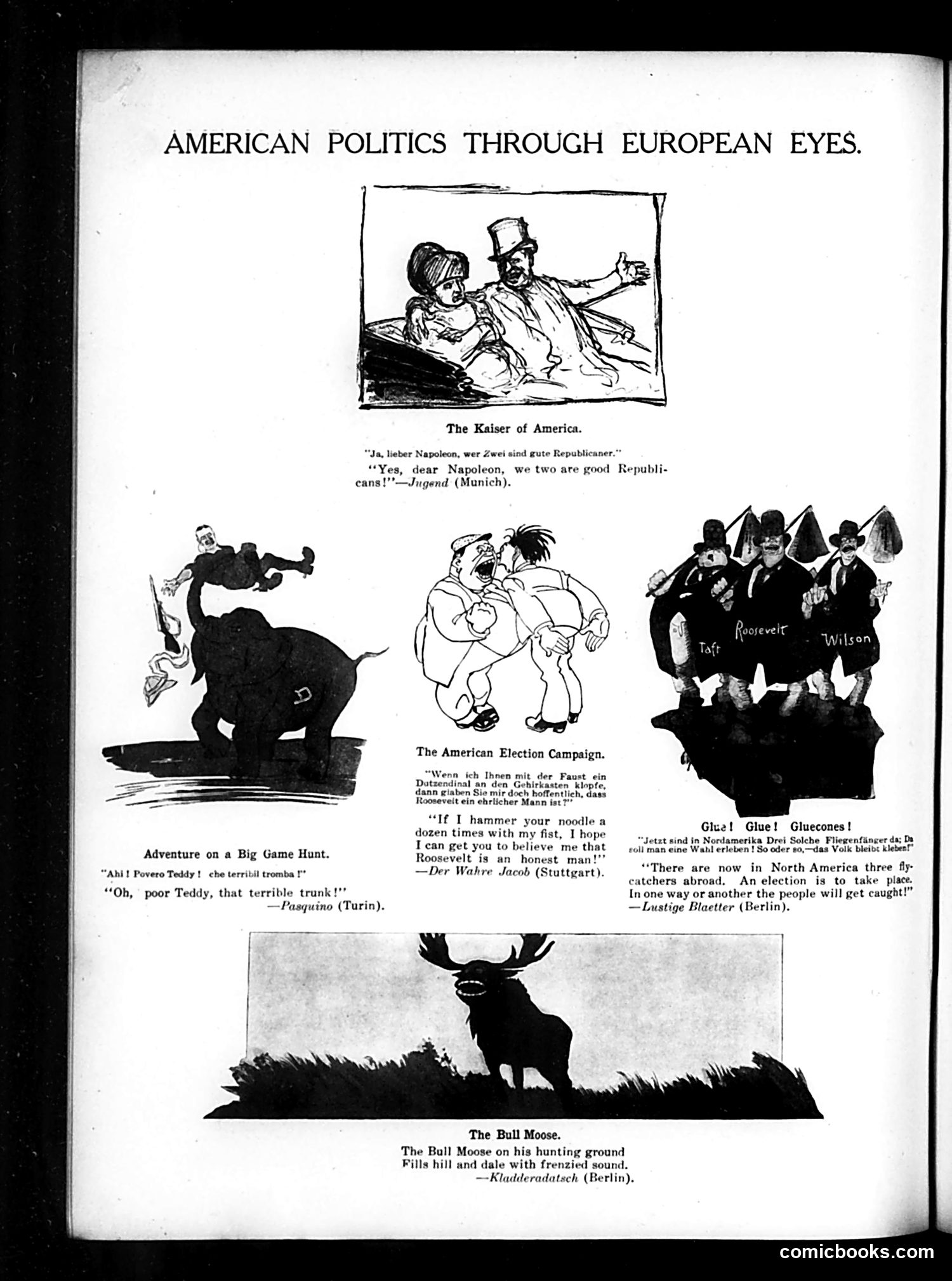
This page satirizes American politics from German and European perspectives, likely from the 1912 election period. "The Kaiser of America" compares an American leader to Napoleon, suggesting autocratic tendencies despite Republican claims. "Adventure on a Big Game Hunt" mocks "Teddy" (Theodore Roosevelt) and his "trunk"—likely referring to his moose-hunting expedition or political ambitions as a third-party candidate. "The American Election Campaign" depicts three political figures (labeled Taft, Roosevelt, Wilson) as competing "fly-catchers" manipulating voters. "The Bull Moose" references Roosevelt's Progressive "Bull Moose" Party, portraying him as wild and chaotic. The caricatures express European skepticism about American democratic pretensions, suggesting that despite rhetoric about republicanism, American politics involved strongmen, manipulation, and chaos comparable to European authoritarianism.
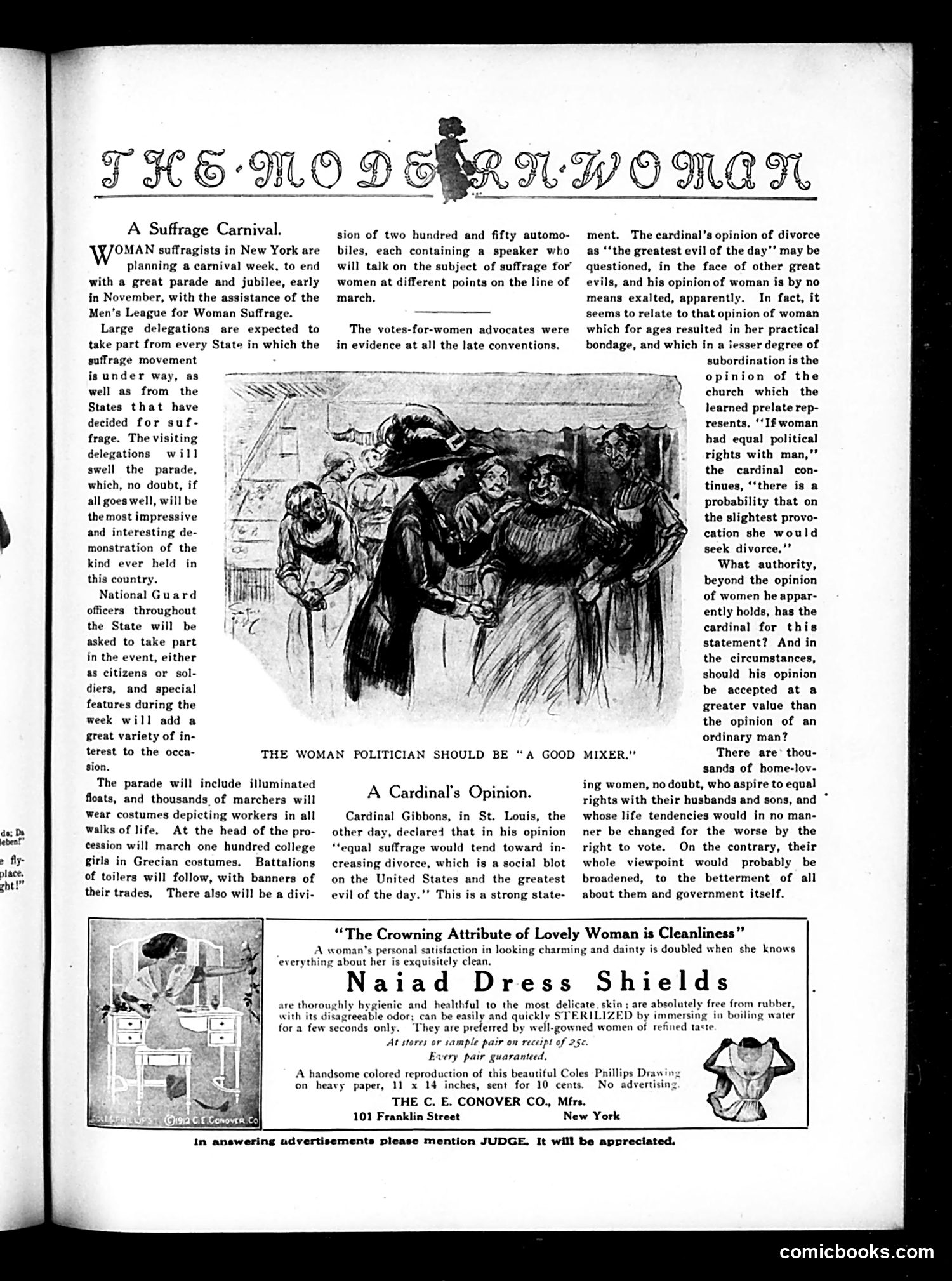
This page presents **opposing views on women's suffrage** through editorial content and advertising. The main article describes a planned **suffrage carnival parade in New York** (early November, date unclear from text), featuring delegations from multiple states, college girls in Grecian costumes, trade workers, and 250 automobiles with speakers—a massive demonstration of organized political activism. The cartoon caption "**THE WOMAN POLITICIAN SHOULD BE 'A GOOD MIXER'**" (accompanying an illustration of women socializing) appears satirical, suggesting female politicians must focus on social charm rather than serious politics. The **"Cardinal's Opinion"** section mocks **Cardinal Gibbons of St. Louis**, who opposed suffrage, claiming equal voting rights would increase divorce. The writer sarcastically questions the cardinal's authority on this matter and argues that voting would actually broaden women's perspectives beneficially. The page concludes with an advertisement for **Naiad Dress Shields**, which ironically emphasizes women's cleanliness and appearance—undermining the serious political arguments above by reducing women to concerns about hygiene and daintiness.
This page from *Judge* magazine contains a biographical satire of Theodore Roosevelt. The text mockingly describes Roosevelt as "a popular idol" while simultaneously ridiculing him through exaggeration and irreverent humor. The satire suggests Roosevelt sees himself as a reincarnation of historical figures (Julius Caesar, Alexander the Great, Moses). It sarcastically chronicles his career: his Harvard education (called "Dr. Eliot's Academy of Athletics"), his time in the New York State Legislature, his ranching period, his police commissioner role, and his enforcement of excise laws. The tone is characteristic of *Judge*'s political commentary—admiring yet contemptuous, celebrating Roosevelt's popularity while implying he's pretentious, overly theatrical, and self-aggrandizing. The piece exemplifies how turn-of-the-century satirical magazines addressed public figures with irreverent wit that modern readers would find surprising for its directness.
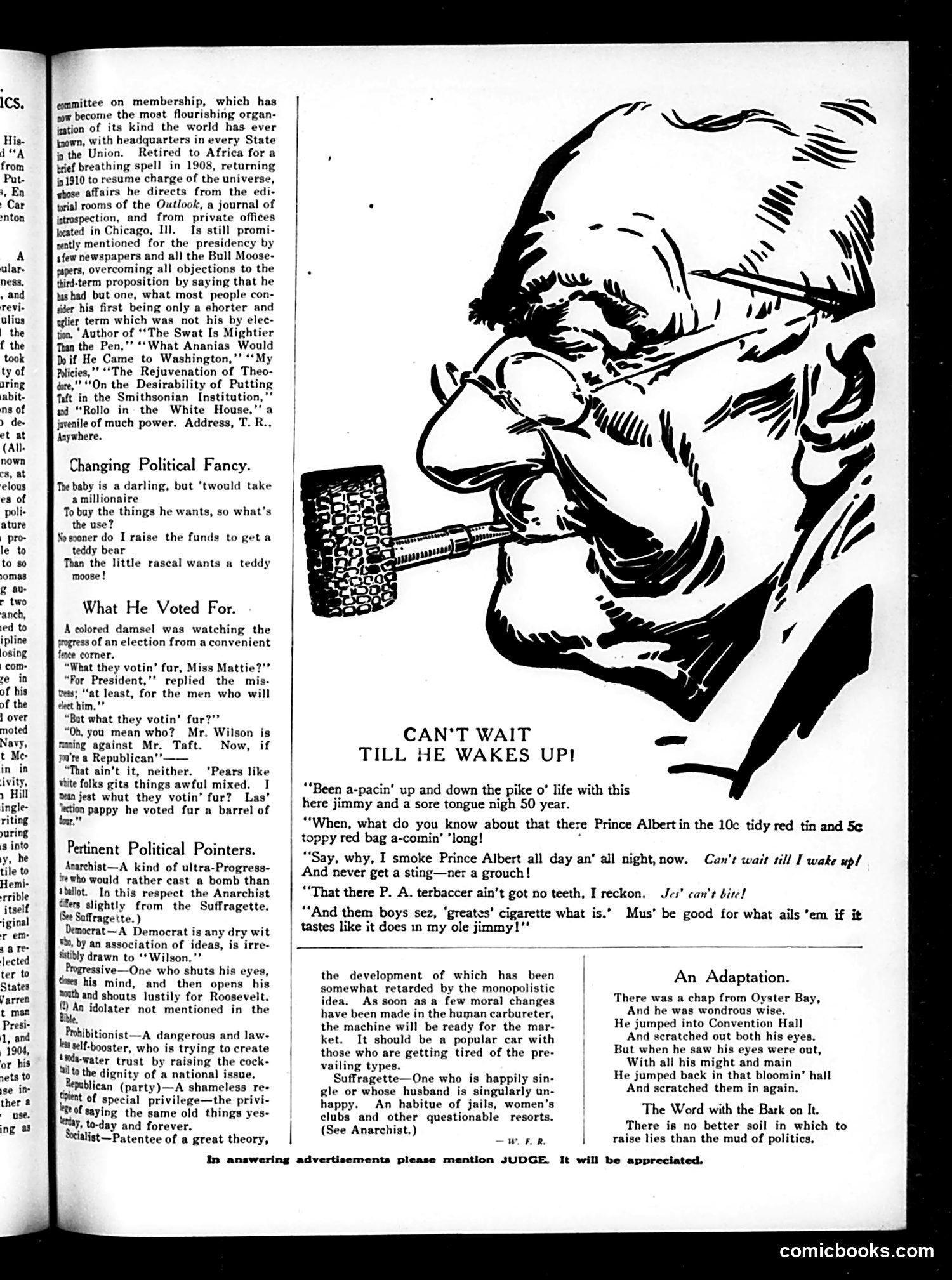
The main cartoon depicts a sleeping figure being struck with a mallet, captioned "CAN'T WAIT TILL HE WAKES UP!" This appears to reference **Theodore Roosevelt**, based on the surrounding text mentioning his presidency, Africa trip (1908), and the "Bull Moose" movement. The satire mocks Roosevelt's potential return to politics—someone eager to rouse him from retirement. The accompanying text includes pointed political definitions mocking various figures and movements of the era, including: - A jab at Wilson vs. Taft's 1912 presidential contest - References to suffragettes and anarchists - Criticism of Republican "special privilege" The smaller pieces include vernacular dialect humor about voting preferences and a Prince Albert tobacco advertisement parody. The overall theme satirizes Roosevelt's lingering political ambitions and the chaos of contemporary political factions—progressives, conservatives, and various reform movements competing for power during this turbulent early-20th-century period.
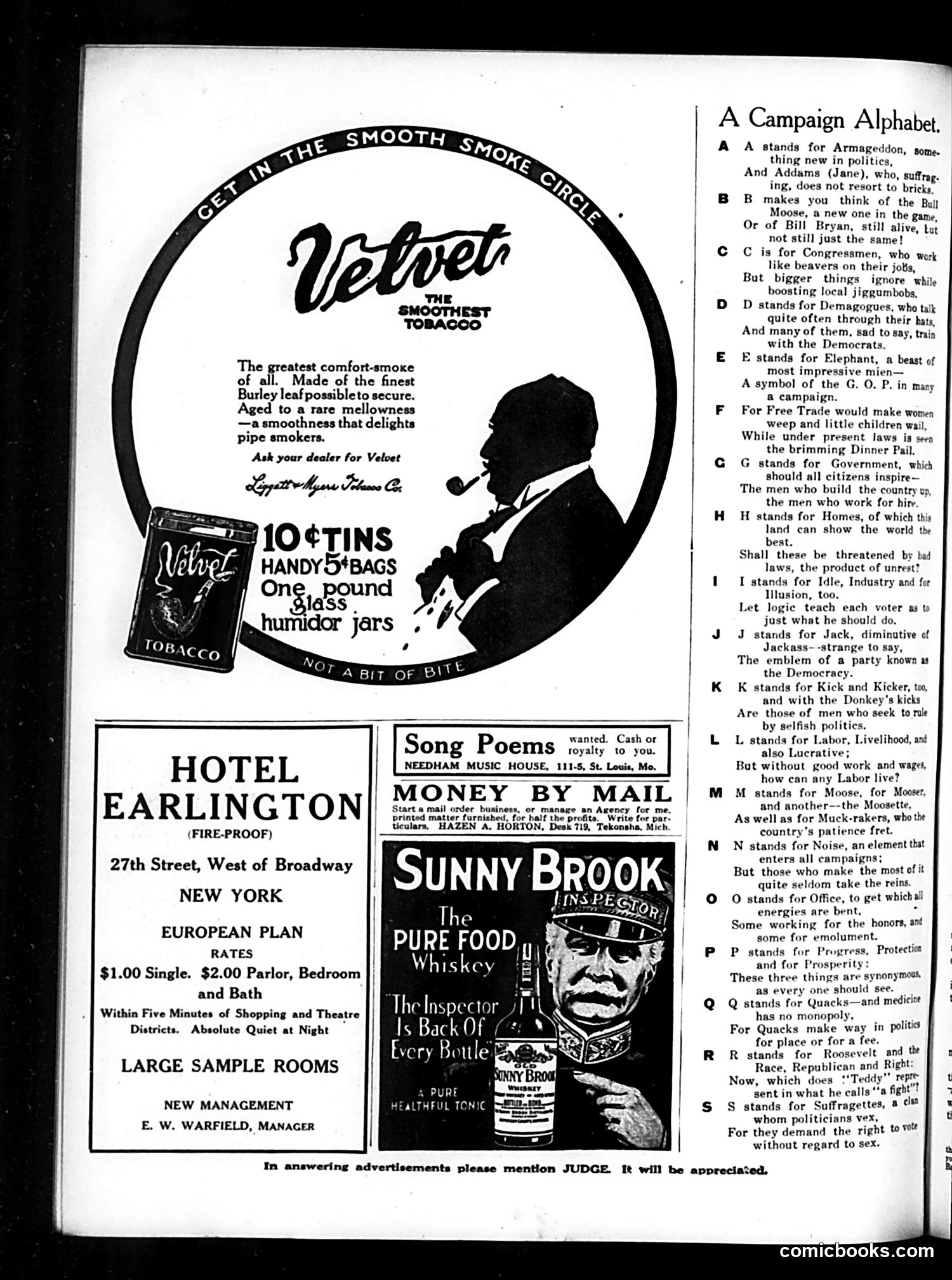
This page presents a political alphabet that mocks 1912 election figures and issues through coded letters. "A" references Jane Addams and Armageddon politics; "B" attacks the Bull Moose Party (Theodore Roosevelt's Progressive split) and William Jennings Bryan; "C" criticizes congressmen; "D" mocks demagogues aligned with Democrats; "E" represents the Republican elephant; "J" uses a donkey to ridicule Democrats as jackasses. The alphabet continues satirizing contemporary political concerns: tariffs, government corruption, labor disputes, and the nascent suffragette movement ("S"). References to "Teddy" (Roosevelt) and his "Bull Moose" candidacy indicate this judges the chaotic 1912 three-way race between Taft (Republican), Wilson (Democrat), and Roosevelt (Progressive). The page also features vintage advertisements—typical for Judge—and employs humor through crude political stereotyping common to early 20th-century American satire.
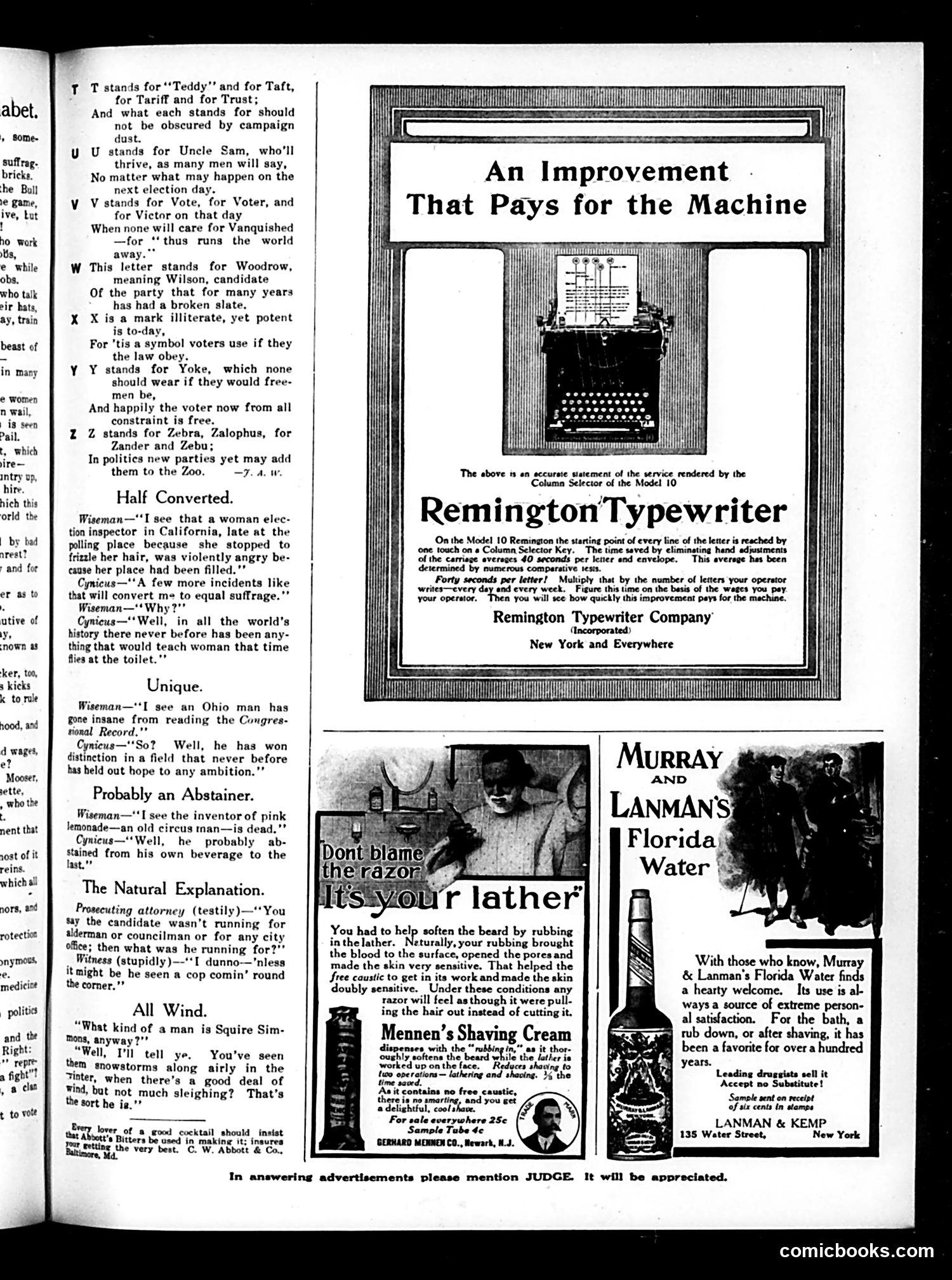
This page primarily contains **political satire** through an alphabetical commentary on the 1912 election. The acrostic poem (T through Z) mocks the major candidates and campaign issues: "Teddy" Roosevelt and Taft (Republicans), their tariff policies, and Wilson (the Democratic candidate with a "broken slate"). The verses jest that whichever wins, "Uncle Sam" will survive, and voters are now "free" from constraints—likely a sarcastic reference to ongoing suffrage debates. The humor pieces below ("Half Converted," "Unique," "Probably an Abstainer") employ the common Judge format of two characters (Wiseman and Cynicus) debating social issues. These mock women's voting rights, Congressional tedium, and Prohibition sentiment—all hot-button 1912 topics. The page is largely **advertising** (Remington typewriter, shaving cream, Florida water), typical of Judge's revenue model.
This page is primarily **advertisements** with one featured short story, "No Politician," by Robert C. McBirney. The story concerns **Colonel George Lawton**, a Western politician reluctant to run for Governor. Party leaders convince him to host a banquet to launch his candidacy. Lawton invites **Jack Young**, a local "cowboy orator" from Montrose County, to give a nominating speech—but Young fails to arrive, causing embarrassment. The satire targets **machine politics**: how parties draft reluctant candidates as compromise figures, stage-manage their campaigns, and rely on colorful local figures to generate enthusiasm. The humor lies in Lawton's folksy narrative voice and the comedic timing of Young's absence disrupting careful political theater. The accompanying advertisements (Cook's Champagne, Schultz Ginger Ale, etc.) are unrelated to the political content—typical of *Judge* magazine's mixed editorial-advertising format.
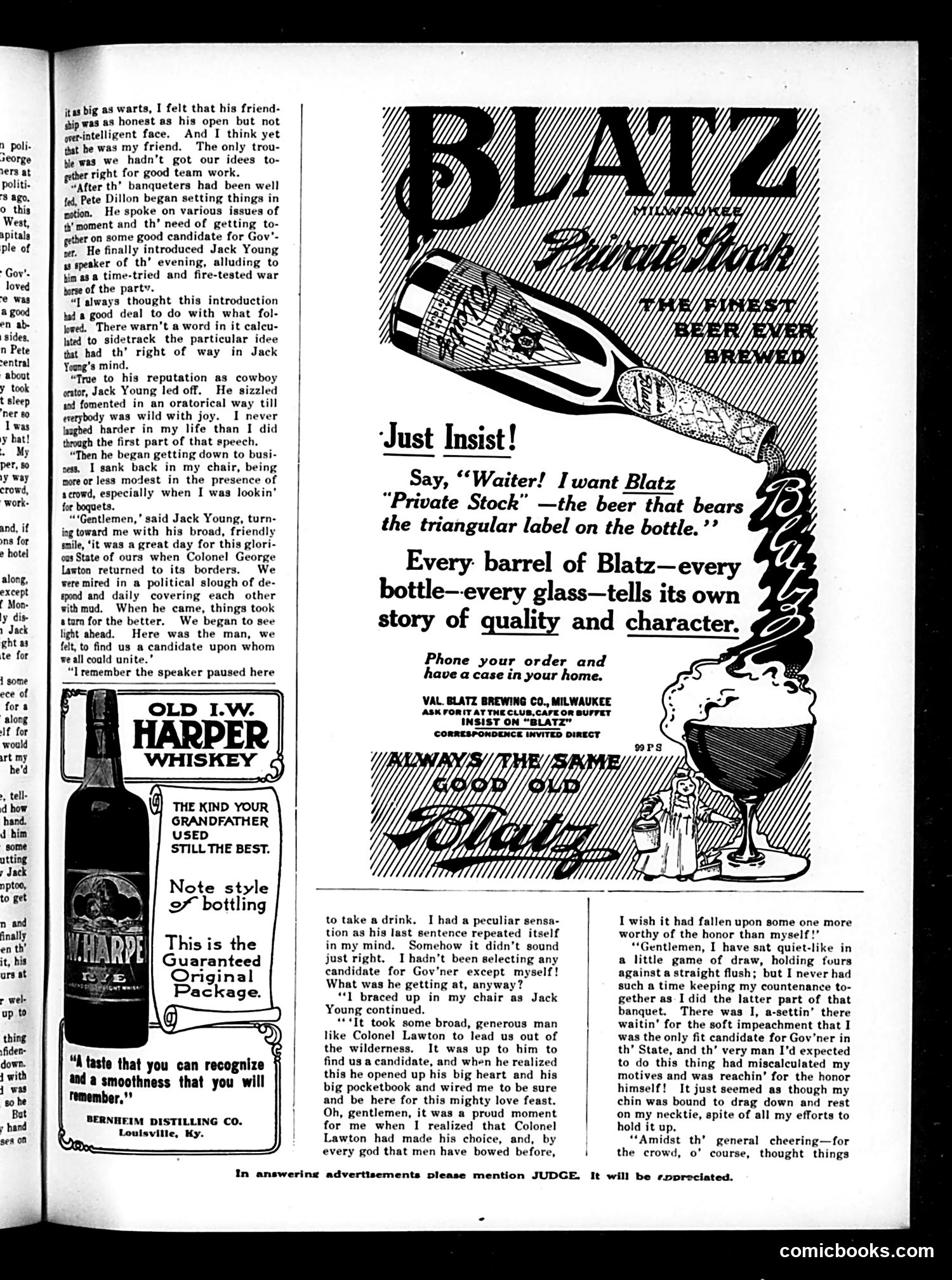
This page contains a narrative story (left column) about a political banquet, alongside period advertisements. The story satirizes political ambition and misplaced assumptions. The narrator, apparently a candidate for state governor, attends a banquet where speaker Jack Young is expected to endorse him. Young praises Colonel Lawton for leading the state out of "political slough" and mentions Lawton wired him to attend "this mighty love feast" to announce a candidate choice. The satire's joke: Young then reveals he is **himself** the chosen candidate—not the narrator. The narrator, who'd been confidently expecting nomination, experiences the humiliation of public disappointment, forced to maintain composure while his political hopes collapse. The advertisements (Old I.W. Harper Whiskey, Blatz Beer) are period-typical magazine filler, unrelated to the satire's political commentary about ambition, miscalculation, and the performative nature of political endorsements.
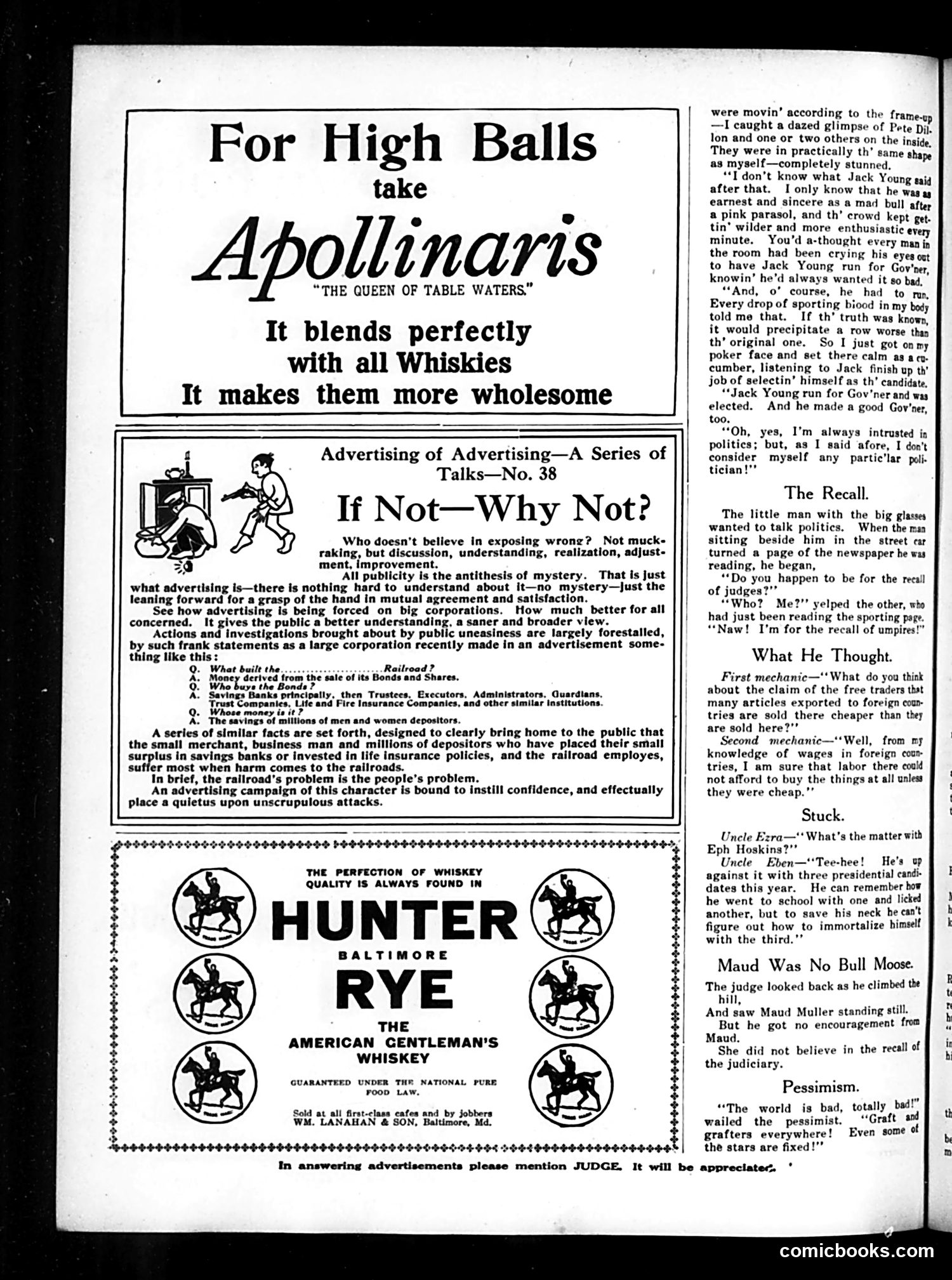
This page is primarily **advertising with some satirical editorial content**. **Main Features:** The top advertises Apollinaris mineral water, claiming it makes whiskey "more wholesome"—a humorous pitch exploiting contemporary health anxieties. The central article, "Advertising of Advertising—If Not—Why Not?", defends corporate advertising as transparency, arguing it builds public confidence. It uses railroads as an example, claiming frank advertising about who owns railroad bonds (depositors, insurance companies) demonstrates that "the railroad's problem is the people's problem." This appears to be **pro-business propaganda** responding to Progressive Era skepticism of large corporations. The Hunter Rye whiskey ad occupies the lower half with decorative horseman imagery. **Context:** Published during the muckraking era (early 1900s), this page ironically argues that advertising—often viewed as deceptive manipulation—actually serves the public interest through transparency. The juxtaposition with liquor ads undermines this earnest argument.
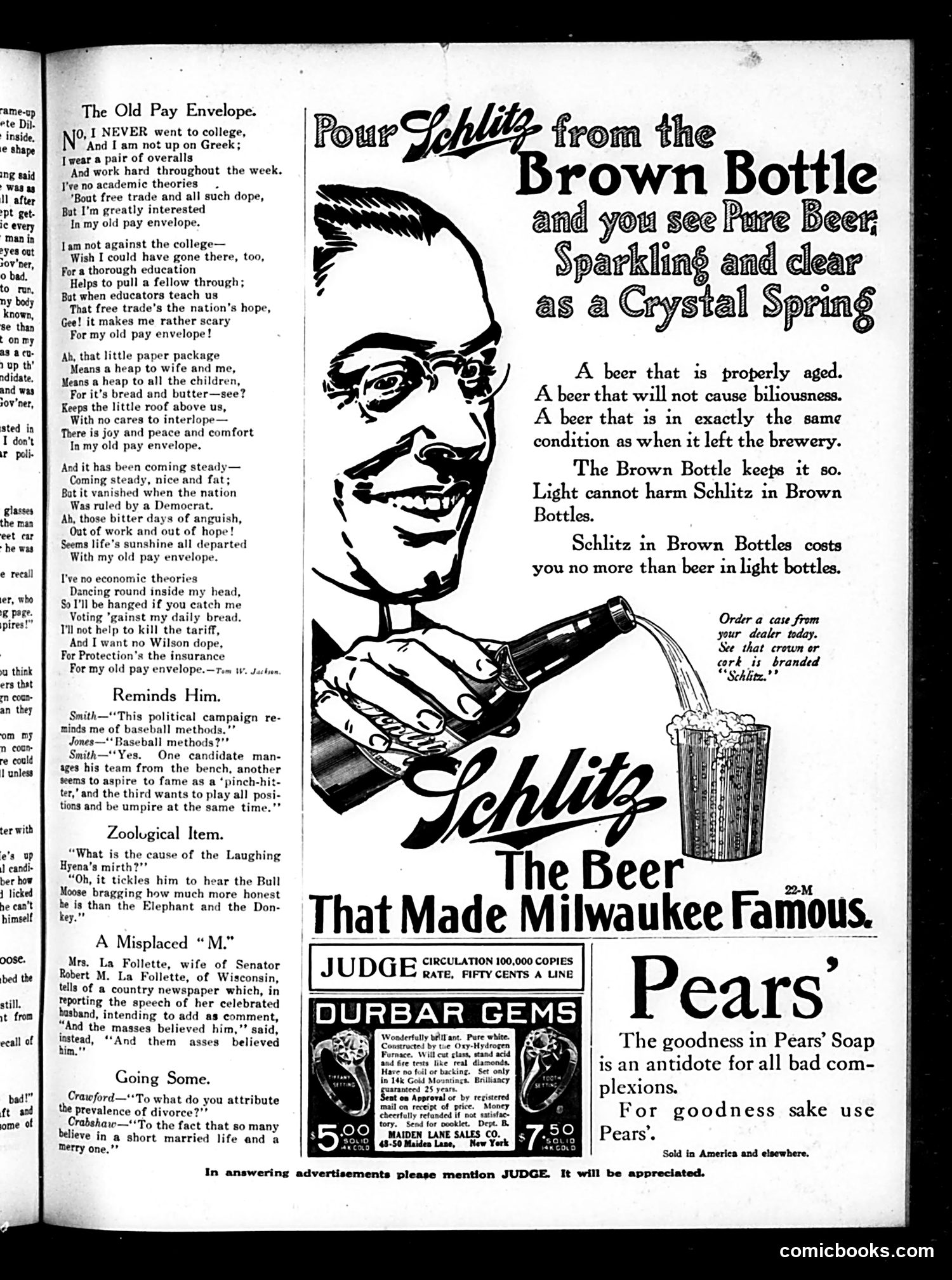
**"The Old Pay Envelope"** is a working-class defense of protectionist trade policy and Republican politics. The speaker—an uneducated laborer who doesn't follow economic theory—argues that his steady paycheck depends on protective tariffs, which he credits to Republican rule. He opposes free trade ("dope") and Wilson-era Democratic policies, viewing them as threats to his employment. The satire targets intellectuals who advocate free trade without understanding its impact on ordinary workers' livelihoods. **The other humor pieces** mock political campaigns (comparing them to baseball team management), a senator's wife's husband being misquoted in print, and divorce rates. The **advertisements**—Schlitz beer (brown bottles preserve quality), Pears' soap, and gemstones—are period commercial content typical of Judge magazine's revenue model. The page reflects early 1910s American anxieties about trade policy and its effects on working families.
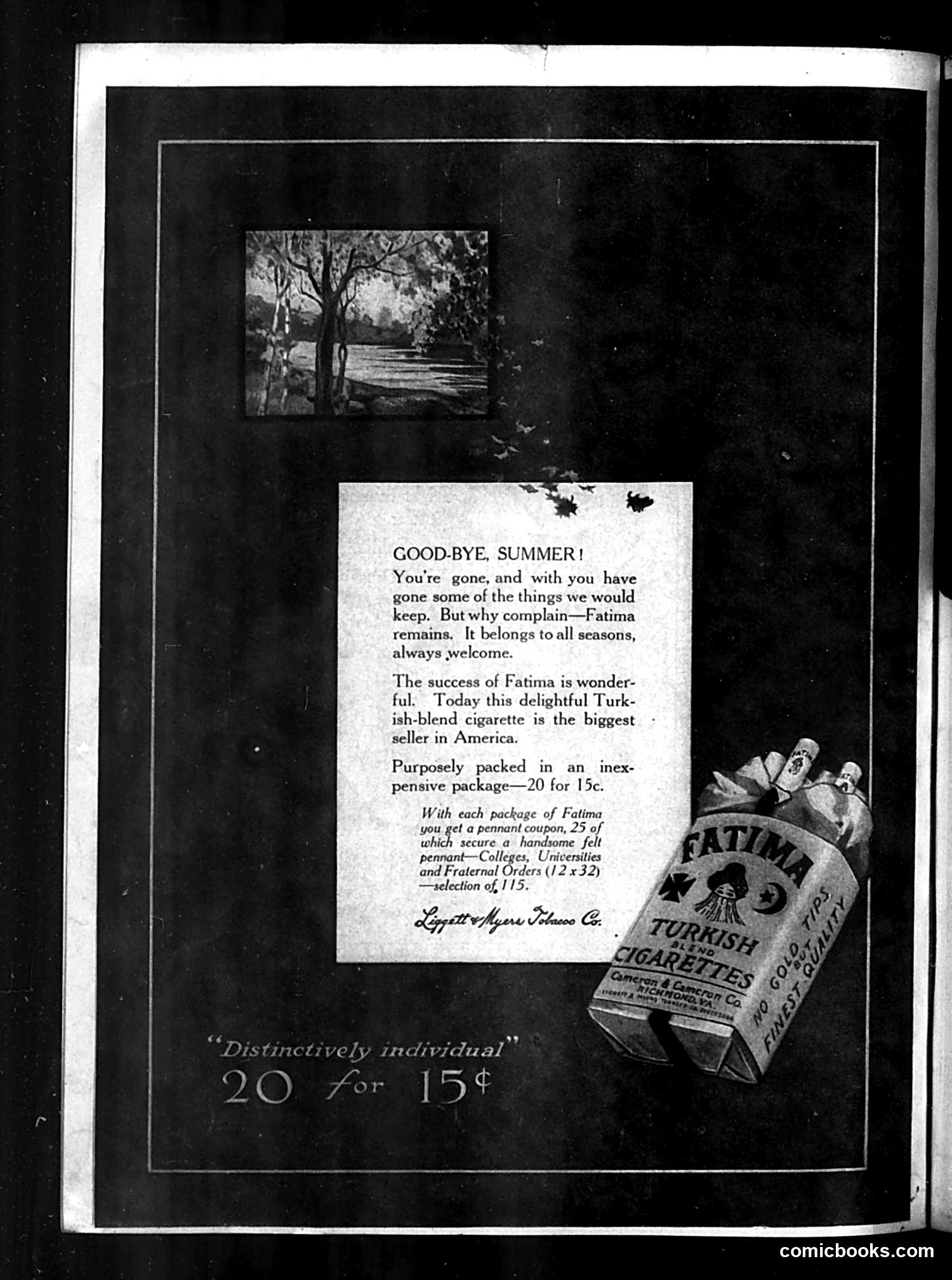
This is a **cigarette advertisement**, not political satire. The page promotes Fatima Turkish-blend cigarettes, marketed as "the biggest seller in America." The ad uses a seasonal hook—"Good-bye, Summer"—to suggest cigarettes as a constant companion year-round. The copy emphasizes affordability (20 cigarettes for 15 cents) and a premium incentive: collecting pennant coupons from packages to redeem felt pennants featuring colleges, universities, and fraternal orders. The image shows a cigarette package beside a pastoral riverside scene. The tagline "Distinctively individual" positions Fatima as a premium yet accessible product. This reflects early-20th-century tobacco marketing: aggressive advertising in mainstream publications, collector incentives targeting young men (college/fraternity audience), and emphasis on foreign "Turkish" blends as sophisticated.